Basic Clinical Skills
1
Outline
• History taking
• Physical examination
2
INTRODUCTION
• Complete medical evaluation includes
• Medical History → Symptom
• Physical examination → Sign
• Appropriate laboratory or imaging studies
• Analysis of data
• Diagnosis
• Treatment plan
3
History Taking
• Description: a report that includes information gained from a
patient's medically relevant recollections.
• Objectives
• Establish a good physician-patient relationship
• Precise documentation of symptoms
• Develop a differential diagnosis
4
History Taking
• Optimal setting
• Uninterrupted environment: a quiet room without other patients, if possible
• Only the patient should be present, unless:
• Patient’s Request
• Children
• Special conditions: E.g. language barrier (Interpreter need)
5
History Taking
• Key Elements: The “Classic” History Taking Sequence
1. Identification
2. Previous Admission
3. Chief Complaints
4. History of Present Illness
5. Past Illness
6. Family History
7. Social & Personal History
8. Functional Inquiry (System Review)
9. Additional targeted questions depending on the patient
6
History Taking
• Key Elements: The “Classic” History Taking Sequence
1. Identification
• Full Name
• Age
• Sex
• Address
• Date
• Hospital/Card number
• Occupation
• Religion
• Marital status
• Ethnicity/Race
7
History Taking
• Key Elements: The “Classic” History Taking Sequence
2. Previous Admission
• List of hospitalization in the order they occurred
• Include:
• Specify the date
• Name and location of the hospital
• Disease that led to admission
• Outcome as briefly as is possible
• E.g.: 1990 (EC). Menilik II Hospital, Addis Ababa. Bleeding duodenal ulcer. Discharged
symptom free after transfusion of 2 units of blood.
8
History Taking
• Key Elements: The “Classic” History Taking Sequence
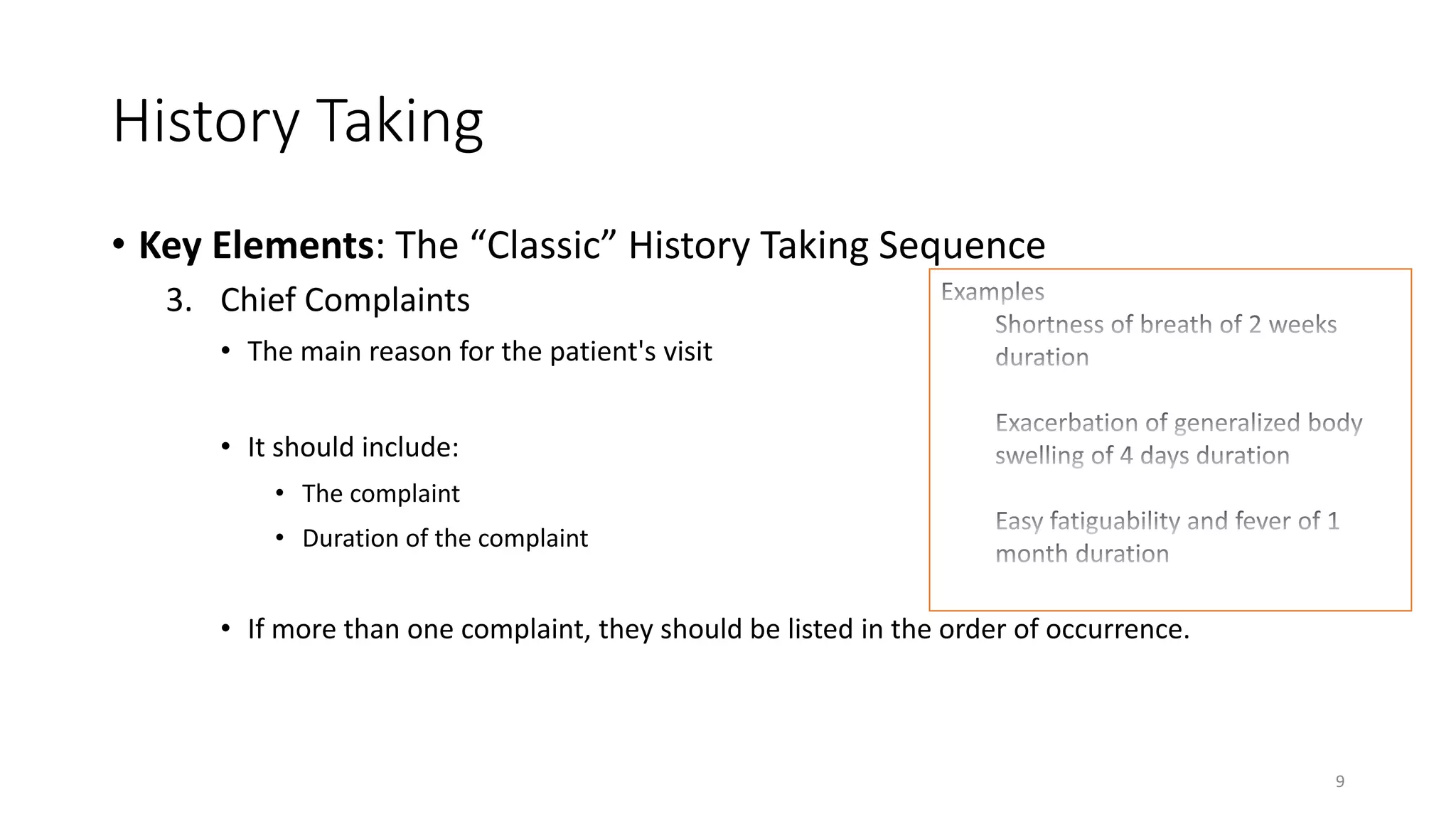
3. Chief Complaints
• The main reason for the patient's visit
• It should include:
• The complaint
• Duration of the complaint
• If more than one complaint, they should be listed in the order of occurrence.
9
History Taking
• Key Elements: The “Classic” History Taking Sequence
3. Chief Complaints
• While recording chief complaint,
• It should be clearly in the patient's own words, e.g., "knee hurts,” “upset stomach,” “runny
nose.”
• The first question should be as open as possible in order to enable the patient to freely
describe their concerns. Examples include:
• ”How may I help you?”
• ”What brings you here today?”
10
History Taking
• Key Elements: The “Classic” History Taking Sequence
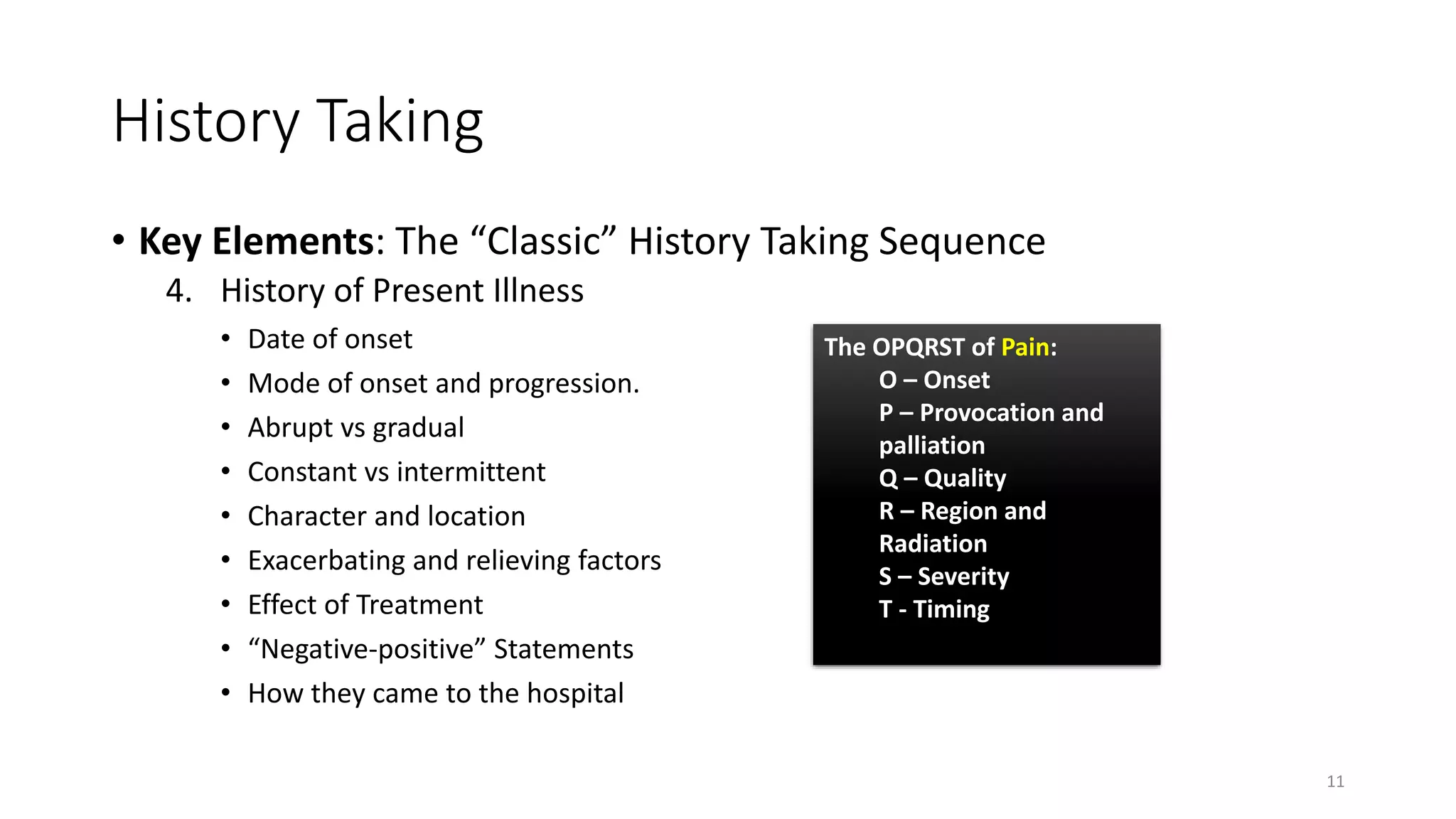
4. History of Present Illness
• Date of onset
• Mode of onset and progression.
• Abrupt vs gradual
• Constant vs intermittent
• Character and location
• Exacerbating and relieving factors
• Effect of Treatment
• “Negative-positive” Statements
• How they came to the hospital
The OPQRST of Pain:
O – Onset
P – Provocation and
palliation
Q – Quality
R – Region and
Radiation
S – Severity
T - Timing
11
History Taking
• Key Elements: The “Classic” History Taking Sequence
5. Past Medical History
• Listing of illnesses unrelated to the present illness, experienced in the past including:
• Childhood diseases
• Serious injuries and surgery not requiring hospitalization
• Medications and Allergies should also be sought.
• Mention of each disease with an approximate date, severity, duration, complications and
sequelae (consequences) is essential
12
History Taking
• Key Elements: The “Classic” History Taking Sequence
6. Family History
• Father and mother: Age, health, date and cause of death.
• Siblings: List with ages, health (if dead, mention cause of death)
• Family disease: Tuberculosis, diabetes mellitus, hypertensive disorders, migraine.
13
History Taking
• Key Elements: The “Classic” History Taking Sequence
7. Social & Personal History
• Early development: place of birth and early homes, childhood development, health and
activities, social and economic status.
• Education: School history, achievements and failures.
• Social activities: Recreation and other activities
• Work record: Age begun, type of work, number of jobs, industrial hazards and exposures,
present work.
• Environment: living conditions.
• Habits: Dietary, alcohol, tobacco, drugs, herbs.
• Marital status: Health of wife (or husband), adjustment, number of children and their health.
14
History Taking
• Key Elements: The “Classic” History Taking Sequence
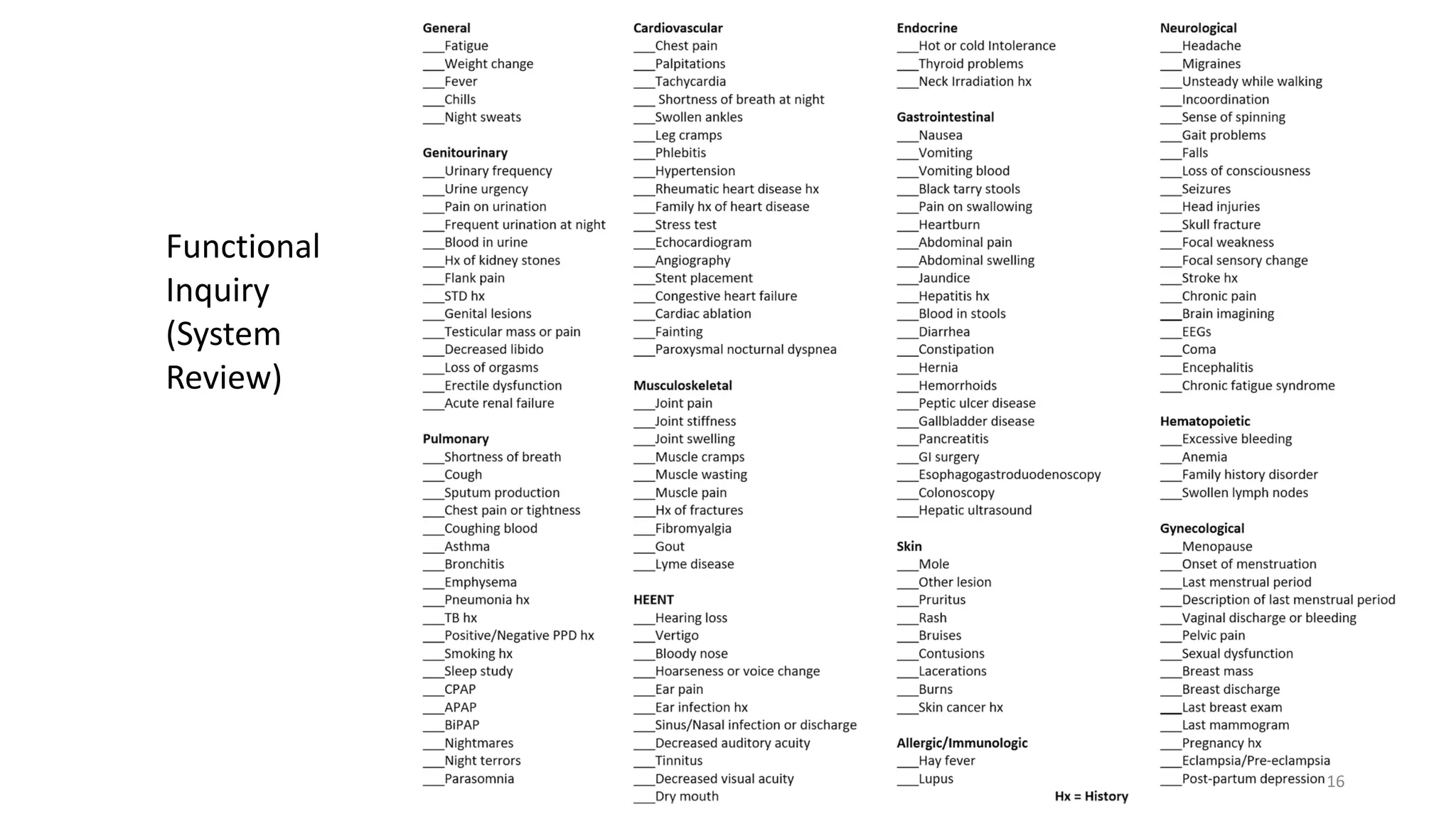
8. Functional Inquiry (System Review)
• A list of questions, arranged by organ systems, to help establish the causes of signs and
symptoms
• Goals:
• Systematic approach to establish the correlation of symptoms to organ systems
• Identifying potential or underlying concerns that the patient did not report while taking an
HPI or PMH
• Establishing positive and negative organ-specific findings
15
Functional
Inquiry
(System
Review)
16
History Taking
• Key Elements: The “Classic” History Taking Sequence
9. Additional targeted questions depending on the patient
• Obstetrics and Gynecological History
• Pediatrics
• Surgery
• Psychiatric History
17
History Taking
• Key Elements: The “Classic” History Taking Sequence
9. Additional targeted questions depending on the patient
• Obstetrics and Gynecological History:
• Menstrual/Menopausal History: Age at Menarche, Date of Last Menstrual Period, Duration,
History of postmenopausal vaginal bleeding
• Sexual History: Current/past sexual partners, Current/past sex practices, Current/past
contraceptive methods, History of Sexually transmitted infections
• Obstetrics History: Gravida (Number of birth), Mode of Delivery and details of the birth,
Pergnancy (Term, Preterm, Postterm; Trimester of Pregnancy), Abortions
18
History Taking
• Key Elements: The “Classic” History Taking Sequence
9. Additional targeted questions depending on the patient
• Obstetrics and Gynecological History:
• Patients may be hesitant to disclose certain aspects of their gynecologic history because of
the sensitive nature of the topic.
• In some cases, it may be due to cultural differences or even a history of abuse.
• If you feel that the patient is uncomfortable talking about their gynecologic history, start with
a social or family history in order to establish rapport with the patient
19
History Taking
• Key Elements: The “Classic” History Taking Sequence
9. Additional targeted questions depending on the patient
• Pediatrics
• In addition to the details of a general medical history, there are some notable differences to
be aware of when taking a pediatric medical history, including
• Certain patient details,
• The source of information, and
• Modes of communication.
20
History Taking
• Key Elements: The “Classic” History Taking Sequence
9. Additional targeted questions depending on the patient
• Pediatrics
• In addition to the details of a general medical history, there are some notable differences to
be aware of when taking a pediatric medical history, including
• Certain patient details,
• The source of information, and
• Modes of communication.
❑ Prenatal and birth history (History of related to
pregnancy and birth)
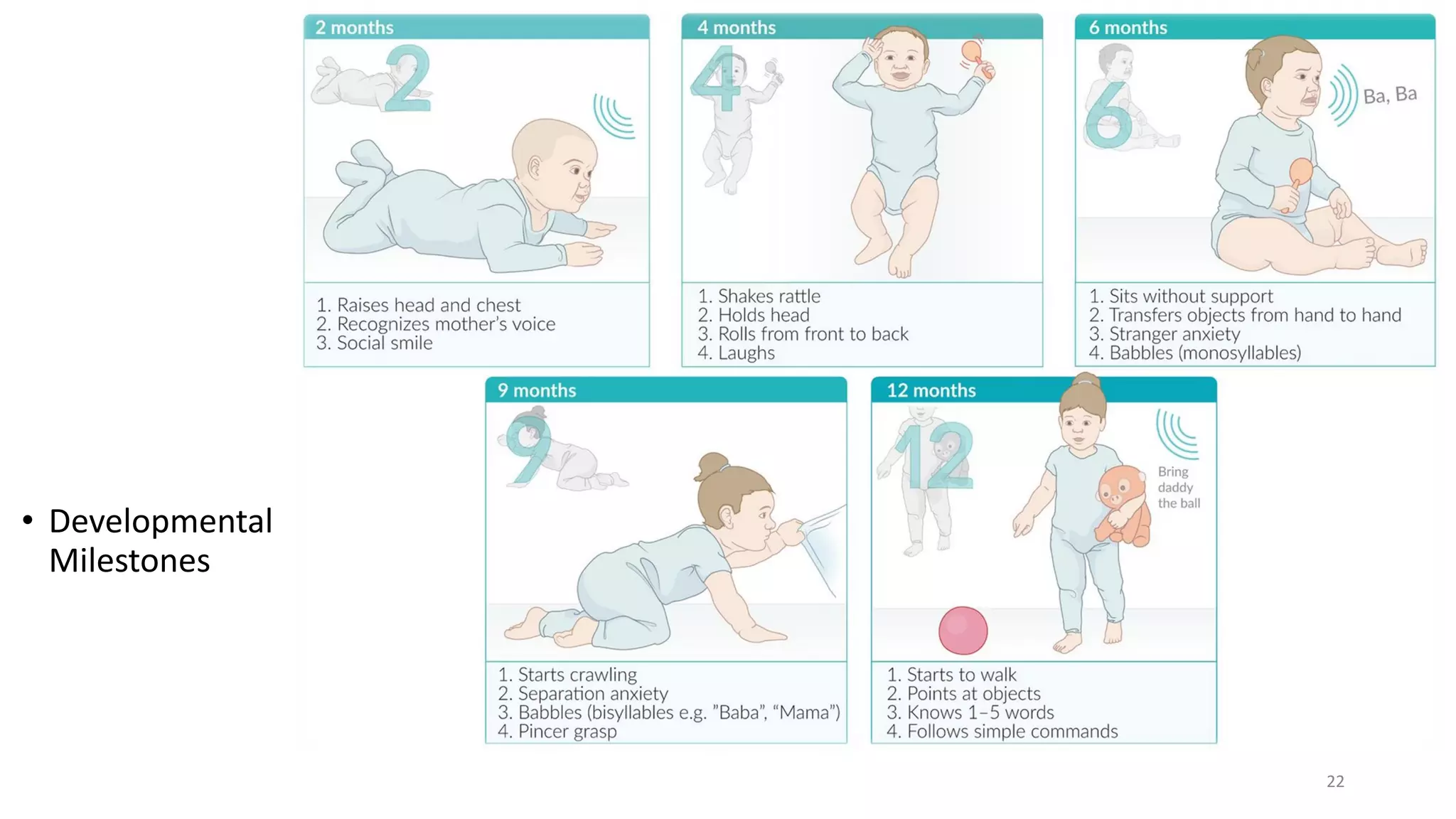
❑ Developmental history (in those aged <3 years
ask about age specific milestones)
❑ Further social history details (Nutritional
History)
❑ Immunization history
21
• Developmental
Milestones
22
History Taking
• Key Elements: The “Classic” History Taking Sequence
9. Additional targeted questions depending on the patient
• Pediatrics
• In addition to the details of a general medical history, there are some notable differences to
be aware of when taking a pediatric medical history, including
• Certain patient details,
• The source of information, and
• Modes of communication.
❑ Involvement of Parents/Guardian specially in
lower age groups
23
History Taking
• Key Elements: The “Classic” History Taking Sequence
9. Additional targeted questions depending on the patient
• Pediatrics
• In addition to the details of a general medical history, there are some notable differences to
be aware of when taking a pediatric medical history, including
• Certain patient details,
• The source of information, and
• Modes of communication.
❑ Always open the interview with casual conversation to
establish rapport between you and the child or
parents/guardian.
❑ Begin the medical portion of the interview by taking
the social history before addressing the current health
concern.
❑ Observe parent-child interaction, and always be
vigilant regarding signs of potential child neglect or
maltreatment.
24
History Taking
• Key Elements: The “Classic” History Taking Sequence
9. Additional targeted questions depending on the patient
• Surgery
• Previous Hospitalized Surgical History (with details)
• Allergies:
• Drug allergies and allergies to iodine (used for sterilization), latex (contained in gloves),
and other materials the patient might come in contact with during or after a procedure
(e.g., allergies to metals relevant for implants)
• Medication: Do not forget to ask about anticoagulants.
25
History Taking
• Key Elements: The “Classic” History Taking Sequence
9. Additional targeted questions depending on the patient
• Surgery
• Ask about anything that could lead to complications during anesthesia, e.g.:
• Cardiovascular and pulmonary diseases
• Smoking and alcohol
• If the patient needs emergency surgery: Ask when they had their last meal and which
medication(s) they took today.
• Ensure that the patient is authorized to give their consent for procedures (see also informed
consent).
26
History Taking
• Key Elements: The “Classic” History Taking Sequence
9. Additional targeted questions depending on the patient
• Psychiatric History
• History of psychiatric conditions (various mental disorders, which affect mood, cognition, perception, and behavior).
• Previous psychiatric hospitalization: when, where, and why
• Use of psychotropic medications: drugs, dosages, effectiveness, and side effects
• Suicide attempts or self-harm: why, when, how
• Past medical records available to consult
• History of substance use/abuse
27
References
• Amboss (https://www.amboss.com/)
• Harrison's principles of internal medicine. (2015). New York :McGraw
Hill Education
28

1. Basic Clinical Skills.pdf

  • 1.
  • 2.
    Outline • History taking •Physical examination 2
  • 3.
    INTRODUCTION • Complete medicalevaluation includes • Medical History → Symptom • Physical examination → Sign • Appropriate laboratory or imaging studies • Analysis of data • Diagnosis • Treatment plan 3
  • 4.
    History Taking • Description:a report that includes information gained from a patient's medically relevant recollections. • Objectives • Establish a good physician-patient relationship • Precise documentation of symptoms • Develop a differential diagnosis 4
  • 5.
    History Taking • Optimalsetting • Uninterrupted environment: a quiet room without other patients, if possible • Only the patient should be present, unless: • Patient’s Request • Children • Special conditions: E.g. language barrier (Interpreter need) 5
  • 6.
    History Taking • KeyElements: The “Classic” History Taking Sequence 1. Identification 2. Previous Admission 3. Chief Complaints 4. History of Present Illness 5. Past Illness 6. Family History 7. Social & Personal History 8. Functional Inquiry (System Review) 9. Additional targeted questions depending on the patient 6
  • 7.
    History Taking • KeyElements: The “Classic” History Taking Sequence 1. Identification • Full Name • Age • Sex • Address • Date • Hospital/Card number • Occupation • Religion • Marital status • Ethnicity/Race 7
  • 8.
    History Taking • KeyElements: The “Classic” History Taking Sequence 2. Previous Admission • List of hospitalization in the order they occurred • Include: • Specify the date • Name and location of the hospital • Disease that led to admission • Outcome as briefly as is possible • E.g.: 1990 (EC). Menilik II Hospital, Addis Ababa. Bleeding duodenal ulcer. Discharged symptom free after transfusion of 2 units of blood. 8
  • 9.
    History Taking • KeyElements: The “Classic” History Taking Sequence 3. Chief Complaints • The main reason for the patient's visit • It should include: • The complaint • Duration of the complaint • If more than one complaint, they should be listed in the order of occurrence. 9
  • 10.
    History Taking • KeyElements: The “Classic” History Taking Sequence 3. Chief Complaints • While recording chief complaint, • It should be clearly in the patient's own words, e.g., "knee hurts,” “upset stomach,” “runny nose.” • The first question should be as open as possible in order to enable the patient to freely describe their concerns. Examples include: • ”How may I help you?” • ”What brings you here today?” 10
  • 11.
    History Taking • KeyElements: The “Classic” History Taking Sequence 4. History of Present Illness • Date of onset • Mode of onset and progression. • Abrupt vs gradual • Constant vs intermittent • Character and location • Exacerbating and relieving factors • Effect of Treatment • “Negative-positive” Statements • How they came to the hospital The OPQRST of Pain: O – Onset P – Provocation and palliation Q – Quality R – Region and Radiation S – Severity T - Timing 11
  • 12.
    History Taking • KeyElements: The “Classic” History Taking Sequence 5. Past Medical History • Listing of illnesses unrelated to the present illness, experienced in the past including: • Childhood diseases • Serious injuries and surgery not requiring hospitalization • Medications and Allergies should also be sought. • Mention of each disease with an approximate date, severity, duration, complications and sequelae (consequences) is essential 12
  • 13.
    History Taking • KeyElements: The “Classic” History Taking Sequence 6. Family History • Father and mother: Age, health, date and cause of death. • Siblings: List with ages, health (if dead, mention cause of death) • Family disease: Tuberculosis, diabetes mellitus, hypertensive disorders, migraine. 13
  • 14.
    History Taking • KeyElements: The “Classic” History Taking Sequence 7. Social & Personal History • Early development: place of birth and early homes, childhood development, health and activities, social and economic status. • Education: School history, achievements and failures. • Social activities: Recreation and other activities • Work record: Age begun, type of work, number of jobs, industrial hazards and exposures, present work. • Environment: living conditions. • Habits: Dietary, alcohol, tobacco, drugs, herbs. • Marital status: Health of wife (or husband), adjustment, number of children and their health. 14
  • 15.
    History Taking • KeyElements: The “Classic” History Taking Sequence 8. Functional Inquiry (System Review) • A list of questions, arranged by organ systems, to help establish the causes of signs and symptoms • Goals: • Systematic approach to establish the correlation of symptoms to organ systems • Identifying potential or underlying concerns that the patient did not report while taking an HPI or PMH • Establishing positive and negative organ-specific findings 15
  • 16.
  • 17.
    History Taking • KeyElements: The “Classic” History Taking Sequence 9. Additional targeted questions depending on the patient • Obstetrics and Gynecological History • Pediatrics • Surgery • Psychiatric History 17
  • 18.
    History Taking • KeyElements: The “Classic” History Taking Sequence 9. Additional targeted questions depending on the patient • Obstetrics and Gynecological History: • Menstrual/Menopausal History: Age at Menarche, Date of Last Menstrual Period, Duration, History of postmenopausal vaginal bleeding • Sexual History: Current/past sexual partners, Current/past sex practices, Current/past contraceptive methods, History of Sexually transmitted infections • Obstetrics History: Gravida (Number of birth), Mode of Delivery and details of the birth, Pergnancy (Term, Preterm, Postterm; Trimester of Pregnancy), Abortions 18
  • 19.
    History Taking • KeyElements: The “Classic” History Taking Sequence 9. Additional targeted questions depending on the patient • Obstetrics and Gynecological History: • Patients may be hesitant to disclose certain aspects of their gynecologic history because of the sensitive nature of the topic. • In some cases, it may be due to cultural differences or even a history of abuse. • If you feel that the patient is uncomfortable talking about their gynecologic history, start with a social or family history in order to establish rapport with the patient 19
  • 20.
    History Taking • KeyElements: The “Classic” History Taking Sequence 9. Additional targeted questions depending on the patient • Pediatrics • In addition to the details of a general medical history, there are some notable differences to be aware of when taking a pediatric medical history, including • Certain patient details, • The source of information, and • Modes of communication. 20
  • 21.
    History Taking • KeyElements: The “Classic” History Taking Sequence 9. Additional targeted questions depending on the patient • Pediatrics • In addition to the details of a general medical history, there are some notable differences to be aware of when taking a pediatric medical history, including • Certain patient details, • The source of information, and • Modes of communication. ❑ Prenatal and birth history (History of related to pregnancy and birth) ❑ Developmental history (in those aged <3 years ask about age specific milestones) ❑ Further social history details (Nutritional History) ❑ Immunization history 21
  • 22.
  • 23.
    History Taking • KeyElements: The “Classic” History Taking Sequence 9. Additional targeted questions depending on the patient • Pediatrics • In addition to the details of a general medical history, there are some notable differences to be aware of when taking a pediatric medical history, including • Certain patient details, • The source of information, and • Modes of communication. ❑ Involvement of Parents/Guardian specially in lower age groups 23
  • 24.
    History Taking • KeyElements: The “Classic” History Taking Sequence 9. Additional targeted questions depending on the patient • Pediatrics • In addition to the details of a general medical history, there are some notable differences to be aware of when taking a pediatric medical history, including • Certain patient details, • The source of information, and • Modes of communication. ❑ Always open the interview with casual conversation to establish rapport between you and the child or parents/guardian. ❑ Begin the medical portion of the interview by taking the social history before addressing the current health concern. ❑ Observe parent-child interaction, and always be vigilant regarding signs of potential child neglect or maltreatment. 24
  • 25.
    History Taking • KeyElements: The “Classic” History Taking Sequence 9. Additional targeted questions depending on the patient • Surgery • Previous Hospitalized Surgical History (with details) • Allergies: • Drug allergies and allergies to iodine (used for sterilization), latex (contained in gloves), and other materials the patient might come in contact with during or after a procedure (e.g., allergies to metals relevant for implants) • Medication: Do not forget to ask about anticoagulants. 25
  • 26.
    History Taking • KeyElements: The “Classic” History Taking Sequence 9. Additional targeted questions depending on the patient • Surgery • Ask about anything that could lead to complications during anesthesia, e.g.: • Cardiovascular and pulmonary diseases • Smoking and alcohol • If the patient needs emergency surgery: Ask when they had their last meal and which medication(s) they took today. • Ensure that the patient is authorized to give their consent for procedures (see also informed consent). 26
  • 27.
    History Taking • KeyElements: The “Classic” History Taking Sequence 9. Additional targeted questions depending on the patient • Psychiatric History • History of psychiatric conditions (various mental disorders, which affect mood, cognition, perception, and behavior). • Previous psychiatric hospitalization: when, where, and why • Use of psychotropic medications: drugs, dosages, effectiveness, and side effects • Suicide attempts or self-harm: why, when, how • Past medical records available to consult • History of substance use/abuse 27
  • 28.
    References • Amboss (https://www.amboss.com/) •Harrison's principles of internal medicine. (2015). New York :McGraw Hill Education 28