The views expressed in this presentation are the views of the author/s and do not necessarily reflect the views or policies of the Asian
Development Bank, or its Board of Governors, or the governments they represent. ADB does not guarantee the accuracy of the data included
in this presentation and accepts no responsibility for any consequence of their use. The countries listed in this presentation do not imply any
view on ADB's part as to sovereignty or independent status or necessarily conform to ADB's terminology.
A Guide to Social Network
Analysis
Olivier Serrat
2014
The Social Network Groundswell
The information revolution has given birth to new
economies structured around flows of data, information,
and knowledge. In parallel, social networks have grown
stronger as forms of human activity.
Information and communication technologies—especially
social media—explain much but not all. Other catalysts of
social networks include globalization; the emergence of the
third sector, viz., civil and nongovernment organizations;
recognition of the importance of social capital; and interest
in knowledge management and organizational learning.
The Social Network Groundswell
Social networks are nodes of individuals,
groups, organizations, and related systems that
tie in interdependencies, viz., shared values,
visions, and ideas; social contacts; kinship;
financial exchanges; trade; membership in
organizations; participation in events, etc.
Communities of practice are a recurrent form.
Others are policy and advocacy networks;
public-private policy networks; knowledge
networks; etc. Functions differ too, with nodes
behaving as filters, amplifiers, investors and
providers, convenors, community builders,
and/or facilitators.
The Social Network Groundswell
When they succeed, social networks influence larger social
processes by accessing diverse forms of capital as well as the
information and knowledge content of these.
Networked organizations enjoy unifying purposes and clear
coordination structures; consensus (born of shared interests);
strength in numbers; representativeness; multiple, interactive
communications (spanning horizontal and vertical dimensions);
and dynamism and creativity (from rich communications).
Define:Social Network Analysis
Social network analysis focuses on the
structure of relationships among a set of
actors.
Social network analysis maps and measures
formal and informal relationships to identify
what facilitates or impedes the information
and knowledge flows that bind interacting
units, viz., who knows whom and who shares
what information and knowledge with
whom through what media.
Applications of Social Network
Analysis
The results of social network analysis can be used to:
• Identify individuals, teams, and units who play central roles.
• Discern information breakdowns, bottlenecks, structural holes, as
well as isolated individuals, teams, and units.
• Make out opportunities to accelerate knowledge flows across
functional and organizational boundaries.
• Strengthen the efficiency and effectiveness of existing, formal
communication channels.
• Raise awareness of and reflection on the importance of informal
networks and ways to enhance their organizational performance.
• Leverage peer support.
• Improve innovation and learning.
• Refine strategies.
The Process of Social Network
Analysis
Typically, social network
analysis relies on
questionnaires and
interviews to gather
information about the
relationships within a
defined set of actors. The
responses gathered are then
mapped.
The data gathering and
analysis process provides
baseline information against
which one can then prioritize
and plan interventions to
improve knowledge flows,
which may entail recasting
social connections.
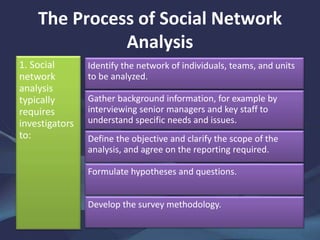
The Process of Social Network
Analysis
1. Social
network
analysis
typically
requires
investigators
to:
Identify the network of individuals, teams, and units
to be analyzed.
Gather background information, for example by
interviewing senior managers and key staff to
understand specific needs and issues.
Define the objective and clarify the scope of the
analysis, and agree on the reporting required.
Formulate hypotheses and questions.
Develop the survey methodology.
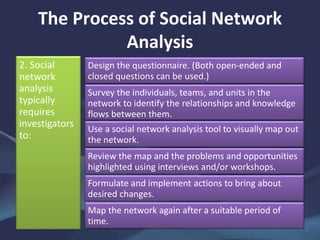
The Process of Social Network
Analysis
2. Social
network
analysis
typically
requires
investigators
to:
Design the questionnaire. (Both open-ended and
closed questions can be used.)
Survey the individuals, teams, and units in the
network to identify the relationships and knowledge
flows between them.
Use a social network analysis tool to visually map out
the network.
Review the map and the problems and opportunities
highlighted using interviews and/or workshops.
Formulate and implement actions to bring about
desired changes.
Map the network again after a suitable period of
time.
The Future of Social Network
Analysis
Social network analysis is somewhat akin to an "organizational
x-ray." Early uses were in investigations of leadership networks
to sustain and strengthen their relationships within and across
groups, organizations, and related systems. (Applications have
also been found in areas as diverse as psychology and health.)
The Future of Social Network
Analysis
With the rise of Facebook, Google
+, LinkedIn, Twitter, etc., interest
has grown in social network
analysis of electronic
communications. Most likely,
social network analysis is set to
emerge as a key technique in
modern sociology.
• ADB. 2008. Building Communities of Practice. Manila.
www.adb.org/publications/building-communities-practice
• ——. 2009. Social Network Analysis. Manila.
www.adb.org/publications/social-network-analysis
• ——. 2009. Building Networks of Practice. Manila.
www.adb.org/publications/building-networks-practice
• ——. 2010. Social Media and the Public Sector. Manila.
www.adb.org/publications/social-media-and-public-sector
• ——. 2010. Informal Authority in the Workplace. Manila.
www.adb.org/publications/informal-authority-workplace
• ——. 2013. On Networked Organizations. Manila.
digitalcommons.ilr.cornell.edu/intl/268/
Further Reading
Quick Response Codes
@ADB
@ADB Sustainable
Development Timeline
@Academia.edu
@LinkedIn
@ResearchGate
@Scholar
@SlideShare
@Twitter

A Guide to Social Network Analysis

  • 1.
    The views expressedin this presentation are the views of the author/s and do not necessarily reflect the views or policies of the Asian Development Bank, or its Board of Governors, or the governments they represent. ADB does not guarantee the accuracy of the data included in this presentation and accepts no responsibility for any consequence of their use. The countries listed in this presentation do not imply any view on ADB's part as to sovereignty or independent status or necessarily conform to ADB's terminology. A Guide to Social Network Analysis Olivier Serrat 2014
  • 2.
    The Social NetworkGroundswell The information revolution has given birth to new economies structured around flows of data, information, and knowledge. In parallel, social networks have grown stronger as forms of human activity. Information and communication technologies—especially social media—explain much but not all. Other catalysts of social networks include globalization; the emergence of the third sector, viz., civil and nongovernment organizations; recognition of the importance of social capital; and interest in knowledge management and organizational learning.
  • 3.
    The Social NetworkGroundswell Social networks are nodes of individuals, groups, organizations, and related systems that tie in interdependencies, viz., shared values, visions, and ideas; social contacts; kinship; financial exchanges; trade; membership in organizations; participation in events, etc. Communities of practice are a recurrent form. Others are policy and advocacy networks; public-private policy networks; knowledge networks; etc. Functions differ too, with nodes behaving as filters, amplifiers, investors and providers, convenors, community builders, and/or facilitators.
  • 4.
    The Social NetworkGroundswell When they succeed, social networks influence larger social processes by accessing diverse forms of capital as well as the information and knowledge content of these. Networked organizations enjoy unifying purposes and clear coordination structures; consensus (born of shared interests); strength in numbers; representativeness; multiple, interactive communications (spanning horizontal and vertical dimensions); and dynamism and creativity (from rich communications).
  • 5.
    Define:Social Network Analysis Socialnetwork analysis focuses on the structure of relationships among a set of actors. Social network analysis maps and measures formal and informal relationships to identify what facilitates or impedes the information and knowledge flows that bind interacting units, viz., who knows whom and who shares what information and knowledge with whom through what media.
  • 6.
    Applications of SocialNetwork Analysis The results of social network analysis can be used to: • Identify individuals, teams, and units who play central roles. • Discern information breakdowns, bottlenecks, structural holes, as well as isolated individuals, teams, and units. • Make out opportunities to accelerate knowledge flows across functional and organizational boundaries. • Strengthen the efficiency and effectiveness of existing, formal communication channels. • Raise awareness of and reflection on the importance of informal networks and ways to enhance their organizational performance. • Leverage peer support. • Improve innovation and learning. • Refine strategies.
  • 7.
    The Process ofSocial Network Analysis Typically, social network analysis relies on questionnaires and interviews to gather information about the relationships within a defined set of actors. The responses gathered are then mapped. The data gathering and analysis process provides baseline information against which one can then prioritize and plan interventions to improve knowledge flows, which may entail recasting social connections.
  • 8.
    The Process ofSocial Network Analysis 1. Social network analysis typically requires investigators to: Identify the network of individuals, teams, and units to be analyzed. Gather background information, for example by interviewing senior managers and key staff to understand specific needs and issues. Define the objective and clarify the scope of the analysis, and agree on the reporting required. Formulate hypotheses and questions. Develop the survey methodology.
  • 9.
    The Process ofSocial Network Analysis 2. Social network analysis typically requires investigators to: Design the questionnaire. (Both open-ended and closed questions can be used.) Survey the individuals, teams, and units in the network to identify the relationships and knowledge flows between them. Use a social network analysis tool to visually map out the network. Review the map and the problems and opportunities highlighted using interviews and/or workshops. Formulate and implement actions to bring about desired changes. Map the network again after a suitable period of time.
  • 10.
    The Future ofSocial Network Analysis Social network analysis is somewhat akin to an "organizational x-ray." Early uses were in investigations of leadership networks to sustain and strengthen their relationships within and across groups, organizations, and related systems. (Applications have also been found in areas as diverse as psychology and health.)
  • 11.
    The Future ofSocial Network Analysis With the rise of Facebook, Google +, LinkedIn, Twitter, etc., interest has grown in social network analysis of electronic communications. Most likely, social network analysis is set to emerge as a key technique in modern sociology.
  • 12.
    • ADB. 2008.Building Communities of Practice. Manila. www.adb.org/publications/building-communities-practice • ——. 2009. Social Network Analysis. Manila. www.adb.org/publications/social-network-analysis • ——. 2009. Building Networks of Practice. Manila. www.adb.org/publications/building-networks-practice • ——. 2010. Social Media and the Public Sector. Manila. www.adb.org/publications/social-media-and-public-sector • ——. 2010. Informal Authority in the Workplace. Manila. www.adb.org/publications/informal-authority-workplace • ——. 2013. On Networked Organizations. Manila. digitalcommons.ilr.cornell.edu/intl/268/ Further Reading
  • 13.
    Quick Response Codes @ADB @ADBSustainable Development Timeline @Academia.edu @LinkedIn @ResearchGate @Scholar @SlideShare @Twitter