


Coleman’s Classroom www.clmn.net
BLAST Study Skills Method
Steps for Effective Study
Coleman’s Classroom www.clmn.net
How can I ever learn all this?
Coleman’s Classroom www.clmn.net
I’ll apply the BLAST method!
Coleman’s Classroom www.clmn.net
Now the
knowledge is
accessible! I can
learn this!
Coleman’s Classroom www.clmn.net
I did it!
I mastered
my subject!!
Coleman’s Classroom www.clmn.net
Ask Yourself
• When do you read a textbook chapter
for the first time?
• How do you read a chapter for the first
time?
• How do you prepare for a class lecture?
• How do you take notes during a lecture?
Coleman’s Classroom www.clmn.net
Ask Yourself
• What do you do with the notes after a
lecture?
• How do you correlate the lecture with
the text?
• Do you use highlighting or underlining?
Does it help you?
• How many times do you read the text?
Coleman’s Classroom www.clmn.net
Ask Yourself
• What do you look for when deciding to
study?
• How do you prepare for a graded
activity such as a writing assignment or
content evaluation?
• Do you usually feel prepared going into a
test?
Coleman’s Classroom www.clmn.net
Who would like to have a
method that enables you
to achieve the best result
in the least amount of
time?
Coleman’s Classroom www.clmn.net
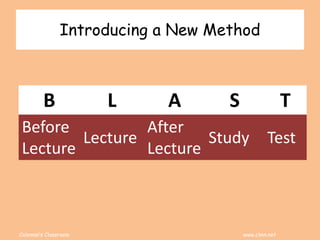
Introducing a New Method
B L A S T
Before
Lecture
Lecture
After
Lecture
Study Test
Coleman’s Classroom www.clmn.net
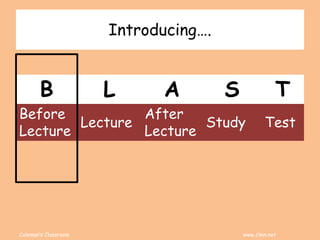
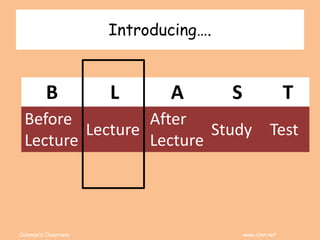
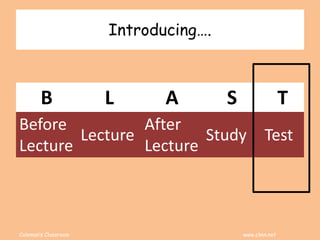
Introducing….
B L A S T
Before
Lecture
Lecture
After
Lecture
Study Test
Coleman’s Classroom www.clmn.net
• What are the steps you take before a
lecture?
• How do you look over your text book?
• Is your method effective?
• Could it be improved?
Let’s look at some specific strategies
for studying
Before the Lecture!
Coleman’s Classroom www.clmn.net
B Steps
1. Look over text structure
2. Skim the text
3. Ask yourself questions
4. Jot down questions for
instructor
5. Be prepared for lecture
Coleman’s Classroom www.clmn.net
1. Look over text structure
• Are there preview questions?
• Are there pictures or illustrations
in the chapter?
• Are the questions at the end of the
chapter?
• Is there vocabulary development in
the chapter?
Coleman’s Classroom www.clmn.net
Pay Attention To…
• Bold Text
• Boxes
• Titles
• Subheadings
• Italics
• Quotes
• Colored Text
• Graphics
• Bullet Lists
• Numbered
Lists
Coleman’s Classroom www.clmn.net
2. Skimming the Text
After identifying text
format, read over quickly,
looking at main ideas only.
Coleman’s Classroom www.clmn.net
3. Questioning the Text
Based on Main Ideas, write
some questions you expect to
be covered in lecture.
Coleman’s Classroom www.clmn.net
Turn Headers into Questions
Example Header
Pilgrim Settlement at Plymouth Harbor
ASK the WH Questions
Who? What? Where? When? Why? How?
Coleman’s Classroom www.clmn.net
Example WH Questions
Who were the pilgrims?
Where did they come from? Where did
they go?
Why did they go to Plymouth Harbor.
What happened to them there?
How did that happen?
When did this occur?
Coleman’s Classroom www.clmn.net
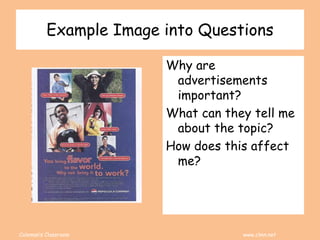
Turning Image into Questions
Examine Image
ASK the WH Questions
Who? What? Where? When? Why? How?
Coleman’s Classroom www.clmn.net
Example Image into Questions
Why are
advertisements
important?
What can they tell me
about the topic?
How does this affect
me?
Coleman’s Classroom www.clmn.net
Turning Lists into Questions
Examine the List
ASK yourself:
• Do I recognize all these topics?
• Is there something I don’t understand?
• What do these have in common?
Coleman’s Classroom www.clmn.net
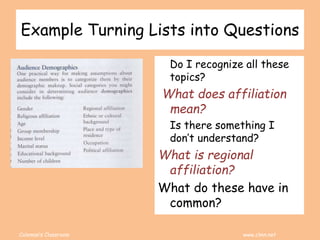
Example Turning Lists into Questions
Do I recognize all these
topics?
What does affiliation
mean?
Is there something I
don’t understand?
What is regional
affiliation?
What do these have in
common?
Coleman’s Classroom www.clmn.net
4. Questions for Instructor
Is there anything unclear?
Are there specific things you didn’t
understand?
Is there anything particularly
interesting that catches you
attention?
Coleman’s Classroom www.clmn.net
5. Prepare for Lecture
• Does your instructor provide
handouts?
• Does your instructor provide
lecture notes?
If so, BRING THEM to class!!
Coleman’s Classroom www.clmn.net
5. Prepare for Lecture
Make sure you have
• some valid questions
• your book
• appropriate writing implements
• paper
• recorder if allowed
Coleman’s Classroom www.clmn.net
Let’s Practice!!
Coleman’s Classroom www.clmn.net
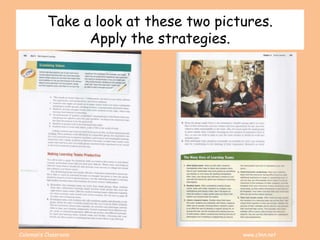
Take a look at these two pictures.
Apply the strategies.
Coleman’s Classroom www.clmn.net
• What do you notice about the box on
the first page?
• What do you notice about the bullet list
on the first?
• What do you notice about the numbered
list on both pages?
• What do you notice about the picture on
the second page?
Coleman’s Classroom www.clmn.net
Based on the given
example pages,
WRITE your own questions.
Coleman’s Classroom www.clmn.net
Possible Questions Could Be…
• What is a learning team?
• What are some types of teams?
• Why are they important?
• When could a team be beneficial?
• Where do I find team members?
• How might they work?
• How do I feel about team learning?
Coleman’s Classroom www.clmn.net
Now that you’ve prepared for the
lecture…
what comes next?
Coleman’s Classroom www.clmn.net
Introducing….
B L A S T
Before
Lecture
Lecture
After
Lecture
Study Test
Coleman’s Classroom www.clmn.net
• What are the steps you take during a
lecture?
• How do you write your lecture notes?
• Is your method effective?
• Could it be improved?
Let’s look at some specific strategies
for taking notes
During a Lecture!
Coleman’s Classroom www.clmn.net
Introducing the Cornel System
1. Divide page into 3 areas
2. Use the cue (recall column)
3. Use the summary column
4. Take Notes
Coleman’s Classroom www.clmn.net
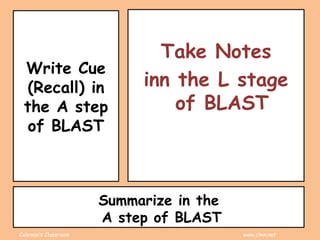
1. Divide Page into 3 parts
Cue (Recall) Column
Summary Column
Notes Column
Coleman’s Classroom www.clmn.net
Summarize in the
A step of BLAST
Take Notes
inn the L stage
of BLAST
Write Cue
(Recall) in
the A step
of BLAST
Coleman’s Classroom www.clmn.net
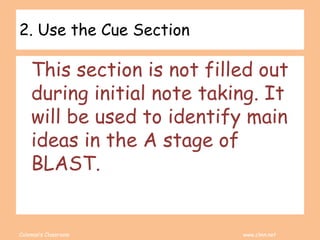
2. Use the Cue Section
This section is not filled out
during initial note taking. It
will be used to identify main
ideas in the A stage of
BLAST.
Coleman’s Classroom www.clmn.net
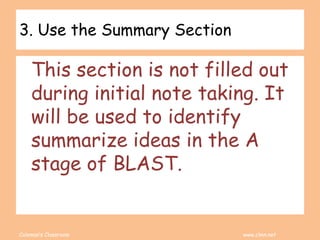
3. Use the Summary Section
This section is not filled out
during initial note taking. It
will be used to identify
summarize ideas in the A
stage of BLAST.
Coleman’s Classroom www.clmn.net
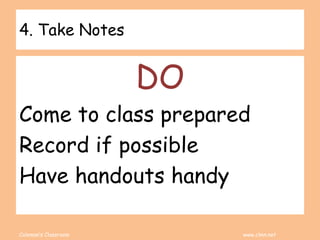
4. Take Notes
DO
Come to class prepared
Record if possible
Have handouts handy
Coleman’s Classroom www.clmn.net
4. Take Notes
DO
Write main ideas
Write information written on
board
Write information on PPT
slides
Coleman’s Classroom www.clmn.net
4. Take Notes
DO
Listen for concepts and words
from your B stage of BLAST
Identify most important ideas
with symbol
Coleman’s Classroom www.clmn.net
4. Take Notes
DO NOT
Try to write down every
word
Panic at disorganization
Coleman’s Classroom www.clmn.net
Let’s Practice!!!
Coleman’s Classroom www.clmn.net
Listen to the short video
lecture by Sean Stephenson
here
http://www.youtube.com/watch?v=YmxBBo-
sxUE
Take Notes
Coleman’s Classroom www.clmn.net
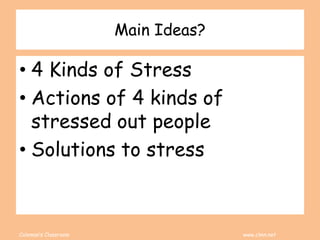
Main Ideas?
• 4 Kinds of Stress
• Actions of 4 kinds of
stressed out people
• Solutions to stress
Coleman’s Classroom www.clmn.net
Now that you’ve finished the
lecture…
what comes next?
Coleman’s Classroom www.clmn.net
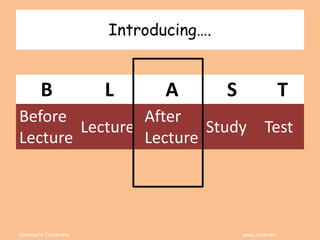
Introducing….
B L A S T
Before
Lecture
Lecture
After
Lecture
Study Test
Coleman’s Classroom www.clmn.net
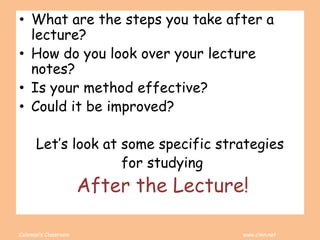
• What are the steps you take after a
lecture?
• How do you look over your lecture
notes?
• Is your method effective?
• Could it be improved?
Let’s look at some specific strategies
for studying
After the Lecture!
Coleman’s Classroom www.clmn.net
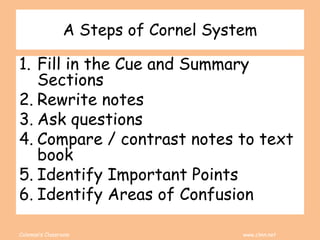
A Steps of Cornel System
1. Fill in the Cue and Summary
Sections
2. Rewrite notes
3. Ask questions
4. Compare / contrast notes to text
book
5. Identify Important Points
6. Identify Areas of Confusion
Coleman’s Classroom www.clmn.net
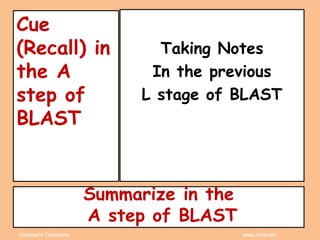
Summarize in the
A step of BLAST
Taking Notes
In the previous
L stage of BLAST
Cue
(Recall) in
the A
step of
BLAST
Coleman’s Classroom www.clmn.net
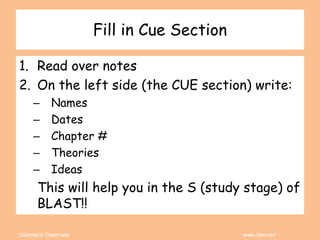
Fill in Cue Section
1. Read over notes
2. On the left side (the CUE section) write:
– Names
– Dates
– Chapter #
– Theories
– Ideas
This will help you in the S (study stage) of
BLAST!!
Coleman’s Classroom www.clmn.net
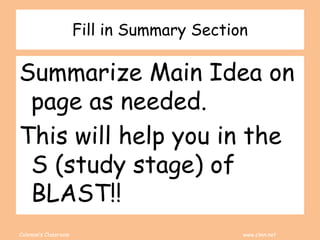
Fill in Summary Section
Summarize Main Idea on
page as needed.
This will help you in the
S (study stage) of
BLAST!!
Coleman’s Classroom www.clmn.net
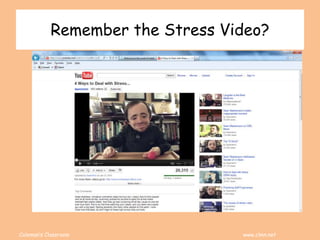
Remember the Stress Video?
Coleman’s Classroom www.clmn.net
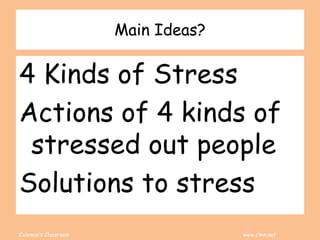
Main Ideas?
4 Kinds of Stress
Actions of 4 kinds of
stressed out people
Solutions to stress
Coleman’s Classroom www.clmn.net
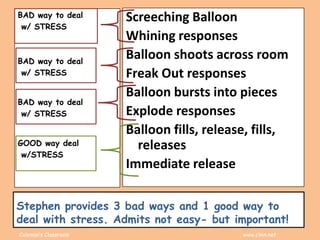
Stephen provides 3 bad ways and 1 good way to
deal with stress. Admits not easy- but important!
Screeching Balloon
Whining responses
Balloon shoots across room
Freak Out responses
Balloon bursts into pieces
Explode responses
Balloon fills, release, fills,
releases
Immediate release
BAD way to deal
w/ STRESS
BAD way to deal
w/ STRESS
BAD way to deal
w/ STRESS
GOOD way deal
w/STRESS
Coleman’s Classroom www.clmn.net
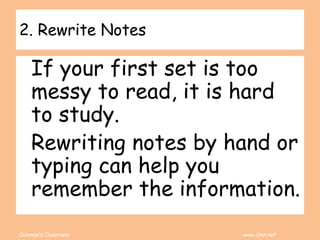
2. Rewrite Notes
If your first set is too
messy to read, it is hard
to study.
Rewriting notes by hand or
typing can help you
remember the information.
Coleman’s Classroom www.clmn.net
3. Ask Questions
Based on important points, write WH
questions such as:
• What was XX or What happened to
XX?
• Where did it happen?
• When did it happen?
• How did it occur?
• Why is it important?
Coleman’s Classroom www.clmn.net
Let’s Practice
Based on the Stress Video
and notes,
what kinds of WH questions
might we ask?
Coleman’s Classroom www.clmn.net
Possible Questions
• Which of these methods do I do to deal
with stress?
• What does “freaking out” look like when
I do it?
• What does “exploding” look like when I
do it?
• How might I pro-actively release stress
before it gets to the bad method?
Coleman’s Classroom www.clmn.net
4. Compare / Contrast Notes to Text
• Check your main ideas in Cue
section with the headers in the
book.
• Note when they align
• Note what is missing
Coleman’s Classroom www.clmn.net
5. Indentify Important Points
• What points did the instructor
indicate are important?
• Are there points in the notes not in
the book? Do you need more
information? Where can you get it?
• Are there points in the book not in
the notes? Do you need more
information? Where can you get it?
Coleman’s Classroom www.clmn.net
6. Indentify Areas of Confusion
• Is there anything unclear?
• Are there specific things you
didn’t understand?
• Is there anything particularly
interesting that catches you
attention?
Coleman’s Classroom www.clmn.net
Now that you’ve reviewed the
lecture…
what comes next?
Coleman’s Classroom www.clmn.net
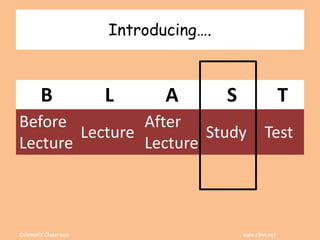
Introducing….
B L A S T
Before
Lecture
Lecture
After
Lecture
Study Test
Coleman’s Classroom www.clmn.net
• How do you read an assignment?
• How do you complete a writing
assignment?
• How do you study for a test?
• Is your method effective?
• Could it be improved?
Let’s look at some specific strategies
to employ
During Study!
Coleman’s Classroom www.clmn.net
S Steps
1. Identify the kind of study
required
2. As you read, refer to material
from B,L, & A.
3. Focus on key ideas
4. Ask and answer questions
Coleman’s Classroom www.clmn.net
S Steps continued
5. Annotate text
6. Note important vocabulary
7. Make lists, charts, time lines
8. Reread relevant material
Coleman’s Classroom www.clmn.net
1. Identify Kind of Study Required
Different genres require different
study.
Are you reading for a Literature
class? Science class? Business
class?
What are other classes you could
apply this stage too?
Coleman’s Classroom www.clmn.net
1. Identify Kind of Study Required
Keep in mind the ultimate evaluation.
• Will you have a multiple choice test?
• Will you have an essay test?
• Will you write a paper?
• Will you have give a presentation?
• What are other kinds of evaluations you
might have?
Coleman’s Classroom www.clmn.net
1. Identify Kind of Study Required
• How would an essay test differ from a
multiple choice?
• How would reading a science text differ
from a short story?
• How would a philosophy exam differ
from a math test?
Coleman’s Classroom www.clmn.net
2. Refer to Material from B, L, & A.
Your BEFORE Lecture notes,
LECTURE notes, and
AFTER Lecture notes have
revealed important information.
Coleman’s Classroom www.clmn.net
3. Focus on Key Ideas
As you read, focus on the key
ideas gathered in the BLA
stages.
Make sure that you read and
understand all the material
related to that information.
Coleman’s Classroom www.clmn.net
4. Answer Questions As You Go
• Is there anything unclear?
• Are there specific things you
didn’t understand?
• Is there anything particularly
interesting that catches you
attention?
Coleman’s Classroom www.clmn.net
5. Annotate Text
Highlight, Underline,
Star ideas that
correlate to your
important ideas.
Coleman’s Classroom www.clmn.net
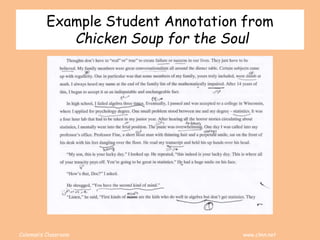
Example Student Annotation from
Chicken Soup for the Soul
Coleman’s Classroom www.clmn.net
Mrs. C’s
Annotation From
When I Was
Puerto Rican
Coleman’s Classroom www.clmn.net
6. Note Important Vocabulary
• Make a list of vocabulary you
need to look up, review, or
learn.
• Write in your notes or in
book
Coleman’s Classroom www.clmn.net
7. Make Lists, Charts, Time Lines
Pay attention to the facts
that can be listed, to charts
or graphs, to time lines and
dates.
Coleman’s Classroom www.clmn.net
8. Reread Relevant Material
• When you go to reread, don’t
reread every word.
• Focus on annotations and
identified main ideas.
Coleman’s Classroom www.clmn.net
Other Ideas??
• Can you think of other things
you might focus on when you
read?
• Is it a good idea to translate?
• Is it a good idea to paraphrase
and summarize?
Coleman’s Classroom www.clmn.net
Now that you’ve studied…
what comes next?
Coleman’s Classroom www.clmn.net
Introducing….
B L A S T
Before
Lecture
Lecture
After
Lecture
Study Test
Coleman’s Classroom www.clmn.net
• What are the steps you take before a
lecture?
• How do you look over your text book?
• Is your method effective?
• Could it be improved?
Let’s look at some specific strategies
for TESTING
Coleman’s Classroom www.clmn.net
T = TEST
What are the steps you take to
prepare for:
• a multiple choice test?
• an essay test?
• a summary assignment
• an essay assignment?
Coleman’s Classroom www.clmn.net
T Steps
1. Know test or assignment type
2. Have effective strategies
3. Take care of health
4. Have confidence in preparation
5. Test in a Bubble
Coleman’s Classroom www.clmn.net
1. Know Test Type
What are differences between:
• multiple choice test?
• short answer?
• fill in blank?
• essay test?
• essay assignment?
Coleman’s Classroom www.clmn.net
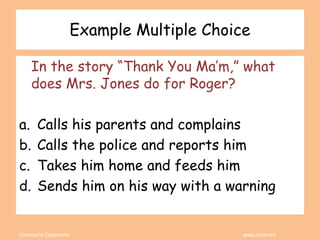
Example Multiple Choice
In the story “Thank You Ma’m,” what
does Mrs. Jones do for Roger?
a. Calls his parents and complains
b. Calls the police and reports him
c. Takes him home and feeds him
d. Sends him on his way with a warning
Coleman’s Classroom www.clmn.net
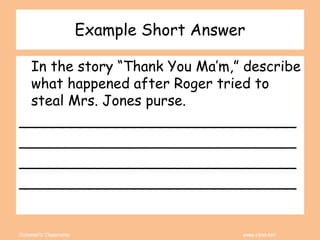
Example Short Answer
In the story “Thank You Ma’m,” describe
what happened after Roger tried to
steal Mrs. Jones purse.
_______________________________
_______________________________
_______________________________
_______________________________
Coleman’s Classroom www.clmn.net
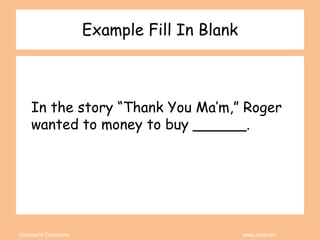
Example Fill In Blank
In the story “Thank You Ma’m,” Roger
wanted to money to buy ______.
Coleman’s Classroom www.clmn.net
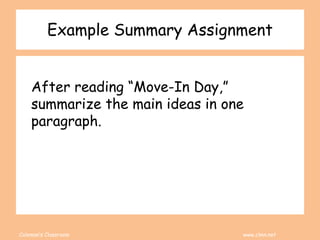
Example Summary Assignment
After reading “Move-In Day,”
summarize the main ideas in one
paragraph.
Coleman’s Classroom www.clmn.net
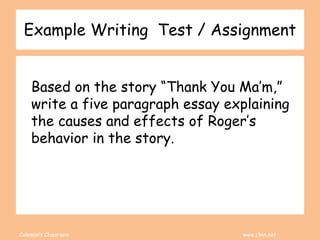
Example Writing Test / Assignment
Based on the story “Thank You Ma’m,”
write a five paragraph essay explaining
the causes and effects of Roger’s
behavior in the story.
Coleman’s Classroom www.clmn.net
2. Have Effective Testing Strategies
1. Tips for multiple choice test
2. Tips for short answer or fill in
blank
3. Tips for essay test
4. Tips for essay assignment
Coleman’s Classroom www.clmn.net
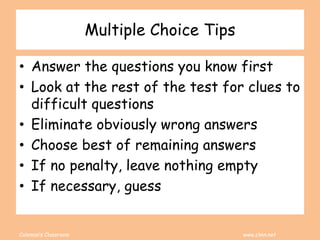
Multiple Choice Tips
• Answer the questions you know first
• Look at the rest of the test for clues to
difficult questions
• Eliminate obviously wrong answers
• Choose best of remaining answers
• If no penalty, leave nothing empty
• If necessary, guess
Coleman’s Classroom www.clmn.net
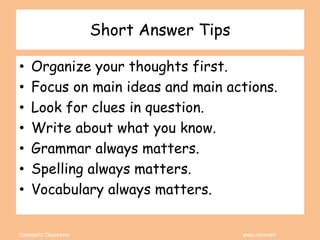
Short Answer Tips
• Organize your thoughts first.
• Focus on main ideas and main actions.
• Look for clues in question.
• Write about what you know.
• Grammar always matters.
• Spelling always matters.
• Vocabulary always matters.
Coleman’s Classroom www.clmn.net
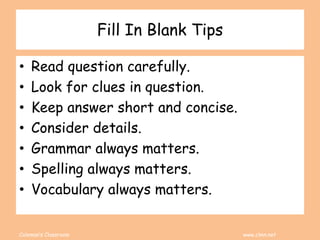
Fill In Blank Tips
• Read question carefully.
• Look for clues in question.
• Keep answer short and concise.
• Consider details.
• Grammar always matters.
• Spelling always matters.
• Vocabulary always matters.
Coleman’s Classroom www.clmn.net
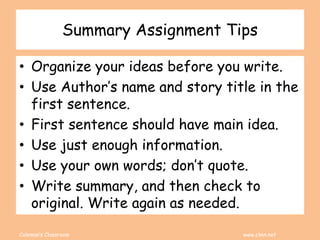
Summary Assignment Tips
• Organize your ideas before you write.
• Use Author’s name and story title in the
first sentence.
• First sentence should have main idea.
• Use just enough information.
• Use your own words; don’t quote.
• Write summary, and then check to
original. Write again as needed.
Coleman’s Classroom www.clmn.net
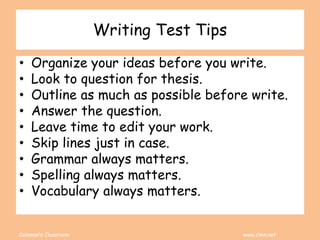
Writing Test Tips
• Organize your ideas before you write.
• Look to question for thesis.
• Outline as much as possible before write.
• Answer the question.
• Leave time to edit your work.
• Skip lines just in case.
• Grammar always matters.
• Spelling always matters.
• Vocabulary always matters.
Coleman’s Classroom www.clmn.net
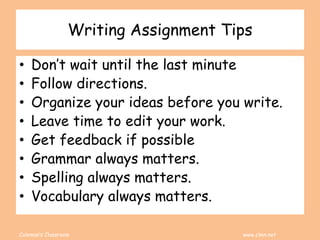
Writing Assignment Tips
• Don’t wait until the last minute
• Follow directions.
• Organize your ideas before you write.
• Leave time to edit your work.
• Get feedback if possible
• Grammar always matters.
• Spelling always matters.
• Vocabulary always matters.
Coleman’s Classroom www.clmn.net
3. Take Care of Health
The night before the test
1. DON’T cram
2. DO get enough sleep
3. DO eat
4. ???
Coleman’s Classroom www.clmn.net
3. Take Care of Health
The day of the test
1. DON’T be late
2. DON’T cram
3. DO eat
4. DO bring the right materials
5. DO relax as much as possible
Coleman’s Classroom www.clmn.net
4. Have Confidence in Preparation
• You have spent the time studying.
• You have learned the material.
• You have done the best you can.
• Now, simply demonstrate what you
know.
Coleman’s Classroom www.clmn.net
Test in a Bubble
1. DON’T worry about others
2. DO pace yourself
3. DO remember to breathe
4. DO the best you can
Coleman’s Classroom www.clmn.net
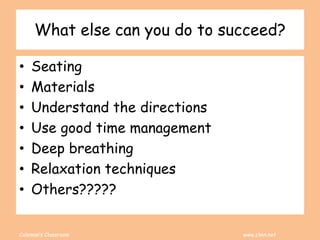
What else can you do to succeed?
• Seating
• Materials
• Understand the directions
• Use good time management
• Deep breathing
• Relaxation techniques
• Others?????
Coleman’s Classroom www.clmn.net
With Practice…
Education
can be a
BLAST!!!
Coleman’s Classroom www.clmn.net
For More Information
• Email Mrs. C
ccoleman@clmn.net
• Visit Coleman’s Classroom
• www.clmn.net

Blast Study Method