ADVANCED GRAMMAR, C LEVEL
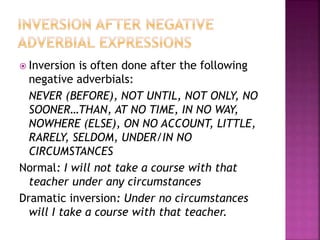
 Inversion is often done after the following
negative adverbials:
NEVER (BEFORE), NOT UNTIL, NOT ONLY, NO
SOONER…THAN, AT NO TIME, IN NO WAY,
NOWHERE (ELSE), ON NO ACCOUNT, LITTLE,
RARELY, SELDOM, UNDER/IN NO
CIRCUMSTANCES
Normal: I will not take a course with that
teacher under any circumstances
Dramatic inversion: Under no circumstances
will I take a course with that teacher.
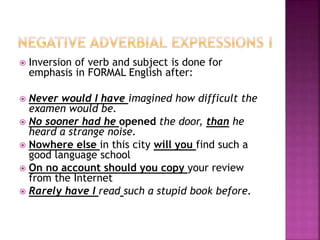
 Inversion of verb and subject is done for
emphasis in FORMAL English after:
 Never would I have imagined how difficult the
examen would be.
 No sooner had he opened the door, than he
heard a strange noise.
 Nowhere else in this city will you find such a
good language school
 On no account should you copy your review
from the Internet
 Rarely have I read such a stupid book before.
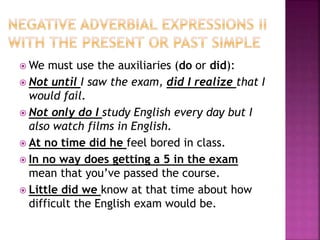
 We must use the auxiliaries (do or did):
 Not until I saw the exam, did I realize that I
would fail.
 Not only do I study English every day but I
also watch films in English.
 At no time did he feel bored in class.
 In no way does getting a 5 in the exam
mean that you’ve passed the course.
 Little did we know at that time about how
difficult the English exam would be.
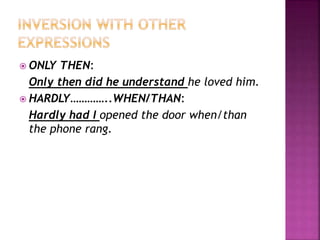
 ONLY THEN:
Only then did he understand he loved him.
 HARDLY…………..WHEN/THAN:
Hardly had I opened the door when/than
the phone rang.
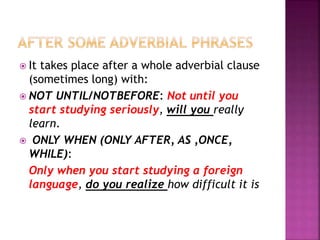
 It takes place after a whole adverbial clause
(sometimes long) with:
 NOT UNTIL/NOTBEFORE: Not until you
start studying seriously, will you really
learn.
 ONLY WHEN (ONLY AFTER, AS ,ONCE,
WHILE):
Only when you start studying a foreign
language, do you realize how difficult it is
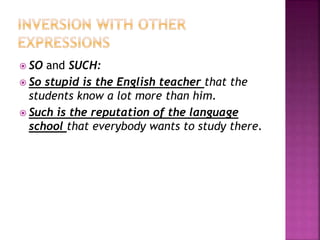
 SO and SUCH:
 So stupid is the English teacher that the
students know a lot more than him.
 Such is the reputation of the language
school that everybody wants to study there.
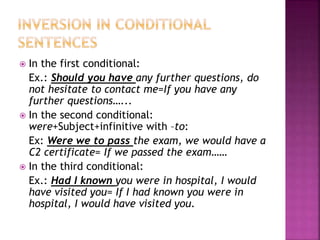
 In the first conditional:
Ex.: Should you have any further questions, do
not hesitate to contact me=If you have any
further questions…...
 In the second conditional:
were+Subject+infinitive with –to:
Ex: Were we to pass the exam, we would have a
C2 certificate= If we passed the exam……
 In the third conditional:
Ex.: Had I known you were in hospital, I would
have visited you= If I had known you were in
hospital, I would have visited you.
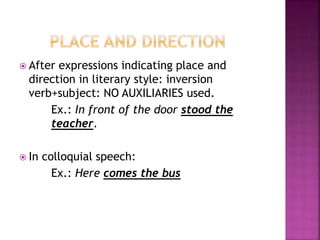
 After expressions indicating place and
direction in literary style: inversion
verb+subject: NO AUXILIARIES used.
Ex.: In front of the door stood the
teacher.
 In colloquial speech:
Ex.: Here comes the bus

Inversion: level C2

  • 1.
  • 2.
     Inversion isoften done after the following negative adverbials: NEVER (BEFORE), NOT UNTIL, NOT ONLY, NO SOONER…THAN, AT NO TIME, IN NO WAY, NOWHERE (ELSE), ON NO ACCOUNT, LITTLE, RARELY, SELDOM, UNDER/IN NO CIRCUMSTANCES Normal: I will not take a course with that teacher under any circumstances Dramatic inversion: Under no circumstances will I take a course with that teacher.
  • 3.
     Inversion ofverb and subject is done for emphasis in FORMAL English after:  Never would I have imagined how difficult the examen would be.  No sooner had he opened the door, than he heard a strange noise.  Nowhere else in this city will you find such a good language school  On no account should you copy your review from the Internet  Rarely have I read such a stupid book before.
  • 4.
     We mustuse the auxiliaries (do or did):  Not until I saw the exam, did I realize that I would fail.  Not only do I study English every day but I also watch films in English.  At no time did he feel bored in class.  In no way does getting a 5 in the exam mean that you’ve passed the course.  Little did we know at that time about how difficult the English exam would be.
  • 5.
     ONLY THEN: Onlythen did he understand he loved him.  HARDLY…………..WHEN/THAN: Hardly had I opened the door when/than the phone rang.
  • 6.
     It takesplace after a whole adverbial clause (sometimes long) with:  NOT UNTIL/NOTBEFORE: Not until you start studying seriously, will you really learn.  ONLY WHEN (ONLY AFTER, AS ,ONCE, WHILE): Only when you start studying a foreign language, do you realize how difficult it is
  • 7.
     SO andSUCH:  So stupid is the English teacher that the students know a lot more than him.  Such is the reputation of the language school that everybody wants to study there.
  • 8.
     In thefirst conditional: Ex.: Should you have any further questions, do not hesitate to contact me=If you have any further questions…...  In the second conditional: were+Subject+infinitive with –to: Ex: Were we to pass the exam, we would have a C2 certificate= If we passed the exam……  In the third conditional: Ex.: Had I known you were in hospital, I would have visited you= If I had known you were in hospital, I would have visited you.
  • 9.
     After expressionsindicating place and direction in literary style: inversion verb+subject: NO AUXILIARIES used. Ex.: In front of the door stood the teacher.  In colloquial speech: Ex.: Here comes the bus