High
Performance
Teams
Our Primary Objectives:
▪ Supporting project management with
people-related skills, tools & techniques
▪ Researching, developing and sharing knowledge
through three focus groups:
– Stakeholder Engagement Focus Group (SEFG)
– Communication Focus group (CFG)
– Working Abroad Focus Group (WAFG)
▪ Recognising a Team;
▪ The importance of Organisational Context and Values;
▪ ‘Agile’ Teamwork;
▪ Understanding & Managing Team Dynamics;
▪ Maintaining & Improving Team Productivity;
Areas of Discussion
Recognising a
Team
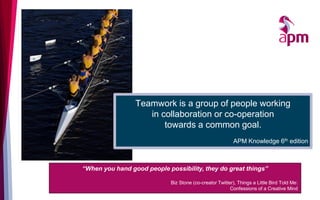
Teamwork is a group of people working
in collaboration or co-operation
towards a common goal.
APM Knowledge 6th edition
“When you hand good people possibility, they do great things”
Biz Stone (co-creator Twitter), Things a Little Bird Told Me:
Confessions of a Creative Mind
Team Characteristics
• Identity
• Close knit, trusting and transient
• Shared values
• Complementary skills
• Complementary roles
• Common goal, vision, purpose
• Visible and active leadership
• Clear formal roles and
responsibilities
• Clear and agreed ground rules
• Non-insular
• Resilient, Celebratory
“The strength of the team is each
individual member,
The strength of each member is the team”
Phil Jackson [American Professional Basketball Player,
Coach and Author]
Team
Make-up Individuals:
• With different skills and
personalities
• Come from different
backgrounds [culture,
organisation]
• Can be co-located or
distributed
Teams can be:
• Virtual
• Working in different
time zones
• Spanning organisations
What Makes a Team
High Performing?
The importance of
Organisational
Context & Values
Home Office Project Delivery Profession
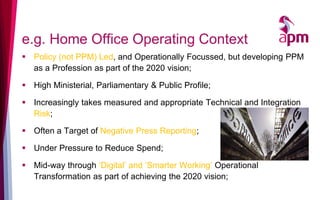
e.g. Home Office Operating Context
▪ Policy (not PPM) Led, and Operationally Focussed, but developing PPM
as a Profession as part of the 2020 vision;
▪ High Ministerial, Parliamentary & Public Profile;
▪ Increasingly takes measured and appropriate Technical and Integration
Risk;
▪ Often a Target of Negative Press Reporting;
▪ Under Pressure to Reduce Spend;
▪ Mid-way through ‘Digital’ and ‘Smarter Working’ Operational
Transformation as part of achieving the 2020 vision;
e.g. Home Office Excellence Campaign
▪ ‘Appreciative Enquiry’ & ‘Culture Call’;
▪ ‘Leadership in Action’;
▪ ‘Reward & Recognition’;
▪ ‘Early Intervention’;
▪ ‘IE Shadow Executive Board’;
▪ International Problem Solving.
I am at my best when:
• I trust people, and they trust me
back
• I am brave enough to speak out and
hear back
• I seek out and acknowledge the best
in everyone
• We join up and join together to make
a difference
• I take the lead and can make
change happen
• I am honest and courageous enough
to show when I am vulnerable
Culture Call
‘Organisational
communication
has reflected the
new positive
mood and people
see a greater
willingness to
celebrate
success’
Dr Valerie Gallow
[Facing into Change:
Culture Call at
Immigration
Enforcement] IES
Giving Back To The Community
HMPO’s Customer Service Management Team (CSMT), based in Southport, are finalists in the UK
National Customer Contact Centre Awards 2018 [‘Positive Impact on the Community’ Category – The
Community 100 Volunteering Programme].
‘Your team of people
are great... really
getting stuck into the
job they have been
given. They have been
a great help and
worked well alongside
regular volunteers and
staff. We have been so
happy with this
partnership and thank
you for organising’
Queenscourt Hospice
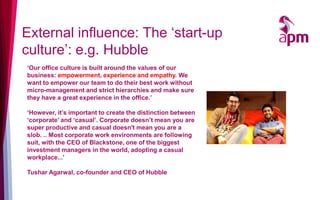
External influence: The ‘start-up
culture’: e.g. Hubble
‘Our office culture is built around the values of our
business: empowerment, experience and empathy. We
want to empower our team to do their best work without
micro-management and strict hierarchies and make sure
they have a great experience in the office.’
‘However, it’s important to create the distinction between
‘corporate’ and ‘casual’. Corporate doesn’t mean you are
super productive and casual doesn't mean you are a
slob. .. Most corporate work environments are following
suit, with the CEO of Blackstone, one of the biggest
investment managers in the world, adopting a casual
workplace...’
Tushar Agarwal, co-founder and CEO of Hubble
‘Agile’ Teamwork
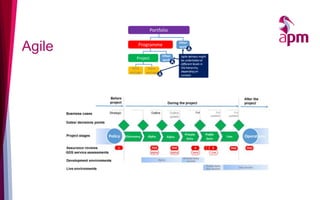
Agile
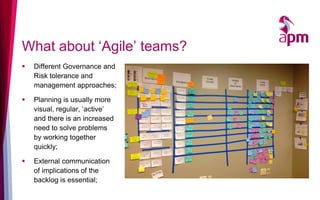
What about ‘Agile’ teams?
▪ Different Governance and
Risk tolerance and
management approaches;
▪ Planning is usually more
visual, regular, ‘active’
and there is an increased
need to solve problems
by working together
quickly;
▪ External communication
of implications of the
backlog is essential;
What’s different about working in an
‘Agile’ delivery team?
Which elements did you
experience?
• Planning & running the team
• Individual roles in the
team/behaviours
• Team development
Understanding
& Managing
Team Dynamics
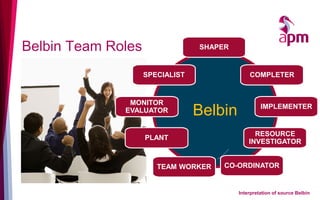
Belbin
Belbin Team Roles SHAPER
COMPLETER
IMPLEMENTER
RESOURCE
INVESTIGATOR
CO-ORDINATORTEAM WORKER
PLANT
MONITOR
EVALUATOR
SPECIALIST
Interpretation of source Belbin
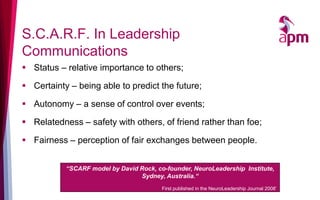
S.C.A.R.F. In Leadership
Communications
▪ Status – relative importance to others;
▪ Certainty – being able to predict the future;
▪ Autonomy – a sense of control over events;
▪ Relatedness – safety with others, of friend rather than foe;
▪ Fairness – perception of fair exchanges between people.
“SCARF model by David Rock, co-founder, NeuroLeadership Institute,
Sydney, Australia.“
First published in the NeuroLeadership Journal 2008’
Maintaining &
Improving Team
Productivity
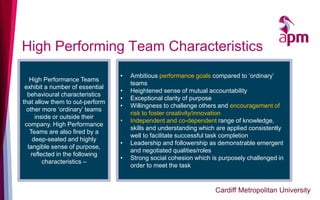
High Performing Team Characteristics
• Ambitious performance goals compared to ‘ordinary’
teams
• Heightened sense of mutual accountability
• Exceptional clarity of purpose
• Willingness to challenge others and encouragement of
risk to foster creativity/innovation
• Independent and co-dependent range of knowledge,
skills and understanding which are applied consistently
well to facilitate successful task completion
• Leadership and followership as demonstrable emergent
and negotiated qualities/roles
• Strong social cohesion which is purposely challenged in
order to meet the task
High Performance Teams
exhibit a number of essential
behavioural characteristics
that allow them to out-perform
other more ‘ordinary’ teams
inside or outside their
company. High Performance
Teams are also fired by a
deep-seated and highly
tangible sense of purpose,
reflected in the following
characteristics –
Cardiff Metropolitan University
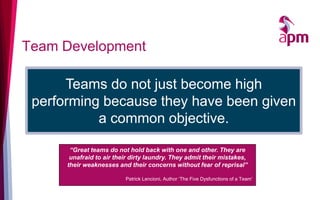
Team Development
Teams do not just become high
performing because they have been given
a common objective.
“Great teams do not hold back with one and other. They are
unafraid to air their dirty laundry. They admit their mistakes,
their weaknesses and their concerns without fear of reprisal”
Patrick Lencioni, Author ‘The Five Dysfunctions of a Team’
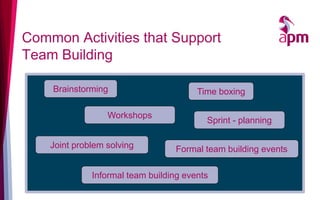
Common Activities that Support
Team Building
Brainstorming
Informal team building events
Formal team building events
Sprint - planning
Time boxing
Workshops
Joint problem solving
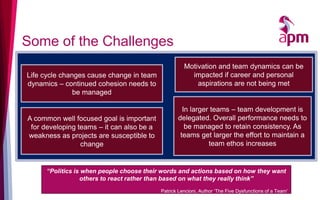
Some of the Challenges
Life cycle changes cause change in team
dynamics – continued cohesion needs to
be managed
“Politics is when people choose their words and actions based on how they want
others to react rather than based on what they really think”
Patrick Lencioni, Author ‘The Five Dysfunctions of a Team’
Motivation and team dynamics can be
impacted if career and personal
aspirations are not being met
A common well focused goal is important
for developing teams – it can also be a
weakness as projects are susceptible to
change
In larger teams – team development is
delegated. Overall performance needs to
be managed to retain consistency. As
teams get larger the effort to maintain a
team ethos increases
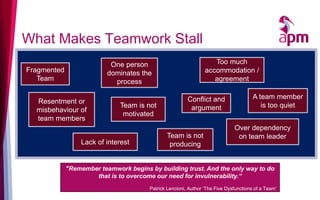
What Makes Teamwork Stall
Fragmented
Team
"Remember teamwork begins by building trust. And the only way to do
that is to overcome our need for invulnerability.“
Patrick Lencioni, Author ‘The Five Dysfunctions of a Team’
Lack of interest
Resentment or
misbehaviour of
team members
One person
dominates the
process
Team is not
motivated
A team member
is too quiet
Over dependency
on team leaderTeam is not
producing
Conflict and
argument
Too much
accommodation /
agreement
Further
Reading Katzenbach, JR and Smith.
D.K.,2005.
The Wisdom of Teams.
New York. N.Y.
Harper Business
Margerison C. and McKann, D.
1995
Team management: practical
new approaches. 2nd edition.
Didcot Management Books
2000
References
▪ http://thingsalittlebirdtoldme.com/
▪ http://www.employment-studies.co.uk/resource/facing-change-culture-call-immigration-enforcement
▪ http://www.open.edu/openlearn/science-maths-technology/engineering-and-technology/groups-and-teamwork/content-
section-0?active-tab=description-tab
▪ https://www.penguinrandomhouse.com/authors/62736/phil-jackson
▪ https://www.wiley.com/en-us/search?pq=patrick+lencioni%7Crelevance%7Cauthor%3APatrick+M.+Lencioni
▪ https://www.forbes.com/sites/erikaandersen/2013/05/31/21-quotes-from-henry-ford-on-business-leadership-and-
life/#52829338293c
▪ https://khub.net/govpdc
▪ https://www.gov.uk/government/publications/project-delivery-capability-framework-for-civil-servants
▪ https://www.youtube.com/channel/UCulllraGmP2xPJrTkvF2lBA
▪ https://www.virgin.com/entrepreneur/how-tech-start-ups-have-redefined-idea-company-culture
▪ https://www.apm.org.uk/about-us/apm-5-dimensions-of-professionalism/
▪ https://discover.office.com/catalysts-for-team-success
Thank You & Questions
Find out more about our work:
PeopleSIG@apm.org.uk
@PeopleSIG

High performance teams 18 April 2018

  • 1.
  • 2.
    Our Primary Objectives: ▪Supporting project management with people-related skills, tools & techniques ▪ Researching, developing and sharing knowledge through three focus groups: – Stakeholder Engagement Focus Group (SEFG) – Communication Focus group (CFG) – Working Abroad Focus Group (WAFG)
  • 3.
    ▪ Recognising aTeam; ▪ The importance of Organisational Context and Values; ▪ ‘Agile’ Teamwork; ▪ Understanding & Managing Team Dynamics; ▪ Maintaining & Improving Team Productivity; Areas of Discussion
  • 4.
  • 5.
    Teamwork is agroup of people working in collaboration or co-operation towards a common goal. APM Knowledge 6th edition “When you hand good people possibility, they do great things” Biz Stone (co-creator Twitter), Things a Little Bird Told Me: Confessions of a Creative Mind
  • 6.
    Team Characteristics • Identity •Close knit, trusting and transient • Shared values • Complementary skills • Complementary roles • Common goal, vision, purpose • Visible and active leadership • Clear formal roles and responsibilities • Clear and agreed ground rules • Non-insular • Resilient, Celebratory “The strength of the team is each individual member, The strength of each member is the team” Phil Jackson [American Professional Basketball Player, Coach and Author]
  • 7.
    Team Make-up Individuals: • Withdifferent skills and personalities • Come from different backgrounds [culture, organisation] • Can be co-located or distributed Teams can be: • Virtual • Working in different time zones • Spanning organisations
  • 8.
    What Makes aTeam High Performing?
  • 9.
  • 10.
    Home Office ProjectDelivery Profession
  • 11.
    e.g. Home OfficeOperating Context ▪ Policy (not PPM) Led, and Operationally Focussed, but developing PPM as a Profession as part of the 2020 vision; ▪ High Ministerial, Parliamentary & Public Profile; ▪ Increasingly takes measured and appropriate Technical and Integration Risk; ▪ Often a Target of Negative Press Reporting; ▪ Under Pressure to Reduce Spend; ▪ Mid-way through ‘Digital’ and ‘Smarter Working’ Operational Transformation as part of achieving the 2020 vision;
  • 12.
    e.g. Home OfficeExcellence Campaign ▪ ‘Appreciative Enquiry’ & ‘Culture Call’; ▪ ‘Leadership in Action’; ▪ ‘Reward & Recognition’; ▪ ‘Early Intervention’; ▪ ‘IE Shadow Executive Board’; ▪ International Problem Solving.
  • 13.
    I am atmy best when: • I trust people, and they trust me back • I am brave enough to speak out and hear back • I seek out and acknowledge the best in everyone • We join up and join together to make a difference • I take the lead and can make change happen • I am honest and courageous enough to show when I am vulnerable Culture Call ‘Organisational communication has reflected the new positive mood and people see a greater willingness to celebrate success’ Dr Valerie Gallow [Facing into Change: Culture Call at Immigration Enforcement] IES
  • 15.
    Giving Back ToThe Community HMPO’s Customer Service Management Team (CSMT), based in Southport, are finalists in the UK National Customer Contact Centre Awards 2018 [‘Positive Impact on the Community’ Category – The Community 100 Volunteering Programme]. ‘Your team of people are great... really getting stuck into the job they have been given. They have been a great help and worked well alongside regular volunteers and staff. We have been so happy with this partnership and thank you for organising’ Queenscourt Hospice
  • 16.
    External influence: The‘start-up culture’: e.g. Hubble ‘Our office culture is built around the values of our business: empowerment, experience and empathy. We want to empower our team to do their best work without micro-management and strict hierarchies and make sure they have a great experience in the office.’ ‘However, it’s important to create the distinction between ‘corporate’ and ‘casual’. Corporate doesn’t mean you are super productive and casual doesn't mean you are a slob. .. Most corporate work environments are following suit, with the CEO of Blackstone, one of the biggest investment managers in the world, adopting a casual workplace...’ Tushar Agarwal, co-founder and CEO of Hubble
  • 17.
  • 18.
  • 19.
    What about ‘Agile’teams? ▪ Different Governance and Risk tolerance and management approaches; ▪ Planning is usually more visual, regular, ‘active’ and there is an increased need to solve problems by working together quickly; ▪ External communication of implications of the backlog is essential;
  • 20.
    What’s different aboutworking in an ‘Agile’ delivery team? Which elements did you experience? • Planning & running the team • Individual roles in the team/behaviours • Team development
  • 21.
  • 22.
    Belbin Belbin Team RolesSHAPER COMPLETER IMPLEMENTER RESOURCE INVESTIGATOR CO-ORDINATORTEAM WORKER PLANT MONITOR EVALUATOR SPECIALIST Interpretation of source Belbin
  • 23.
    S.C.A.R.F. In Leadership Communications ▪Status – relative importance to others; ▪ Certainty – being able to predict the future; ▪ Autonomy – a sense of control over events; ▪ Relatedness – safety with others, of friend rather than foe; ▪ Fairness – perception of fair exchanges between people. “SCARF model by David Rock, co-founder, NeuroLeadership Institute, Sydney, Australia.“ First published in the NeuroLeadership Journal 2008’
  • 24.
  • 25.
    High Performing TeamCharacteristics • Ambitious performance goals compared to ‘ordinary’ teams • Heightened sense of mutual accountability • Exceptional clarity of purpose • Willingness to challenge others and encouragement of risk to foster creativity/innovation • Independent and co-dependent range of knowledge, skills and understanding which are applied consistently well to facilitate successful task completion • Leadership and followership as demonstrable emergent and negotiated qualities/roles • Strong social cohesion which is purposely challenged in order to meet the task High Performance Teams exhibit a number of essential behavioural characteristics that allow them to out-perform other more ‘ordinary’ teams inside or outside their company. High Performance Teams are also fired by a deep-seated and highly tangible sense of purpose, reflected in the following characteristics – Cardiff Metropolitan University
  • 26.
    Team Development Teams donot just become high performing because they have been given a common objective. “Great teams do not hold back with one and other. They are unafraid to air their dirty laundry. They admit their mistakes, their weaknesses and their concerns without fear of reprisal” Patrick Lencioni, Author ‘The Five Dysfunctions of a Team’
  • 27.
    Common Activities thatSupport Team Building Brainstorming Informal team building events Formal team building events Sprint - planning Time boxing Workshops Joint problem solving
  • 28.
    Some of theChallenges Life cycle changes cause change in team dynamics – continued cohesion needs to be managed “Politics is when people choose their words and actions based on how they want others to react rather than based on what they really think” Patrick Lencioni, Author ‘The Five Dysfunctions of a Team’ Motivation and team dynamics can be impacted if career and personal aspirations are not being met A common well focused goal is important for developing teams – it can also be a weakness as projects are susceptible to change In larger teams – team development is delegated. Overall performance needs to be managed to retain consistency. As teams get larger the effort to maintain a team ethos increases
  • 29.
    What Makes TeamworkStall Fragmented Team "Remember teamwork begins by building trust. And the only way to do that is to overcome our need for invulnerability.“ Patrick Lencioni, Author ‘The Five Dysfunctions of a Team’ Lack of interest Resentment or misbehaviour of team members One person dominates the process Team is not motivated A team member is too quiet Over dependency on team leaderTeam is not producing Conflict and argument Too much accommodation / agreement
  • 30.
    Further Reading Katzenbach, JRand Smith. D.K.,2005. The Wisdom of Teams. New York. N.Y. Harper Business Margerison C. and McKann, D. 1995 Team management: practical new approaches. 2nd edition. Didcot Management Books 2000
  • 31.
    References ▪ http://thingsalittlebirdtoldme.com/ ▪ http://www.employment-studies.co.uk/resource/facing-change-culture-call-immigration-enforcement ▪http://www.open.edu/openlearn/science-maths-technology/engineering-and-technology/groups-and-teamwork/content- section-0?active-tab=description-tab ▪ https://www.penguinrandomhouse.com/authors/62736/phil-jackson ▪ https://www.wiley.com/en-us/search?pq=patrick+lencioni%7Crelevance%7Cauthor%3APatrick+M.+Lencioni ▪ https://www.forbes.com/sites/erikaandersen/2013/05/31/21-quotes-from-henry-ford-on-business-leadership-and- life/#52829338293c ▪ https://khub.net/govpdc ▪ https://www.gov.uk/government/publications/project-delivery-capability-framework-for-civil-servants ▪ https://www.youtube.com/channel/UCulllraGmP2xPJrTkvF2lBA ▪ https://www.virgin.com/entrepreneur/how-tech-start-ups-have-redefined-idea-company-culture ▪ https://www.apm.org.uk/about-us/apm-5-dimensions-of-professionalism/ ▪ https://discover.office.com/catalysts-for-team-success
  • 32.
    Thank You &Questions Find out more about our work: PeopleSIG@apm.org.uk @PeopleSIG