The case for
self-organising teams
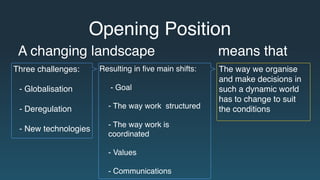
Resulting in five main shifts:
- Goal
- The way work structured
- The way work is
coordinated
- Values
- Communications
Three challenges:
- Globalisation
- Deregulation
- New technologies
A changing landscape means that
The way we organise
and make decisions in
such a dynamic world
has to change to suit
the conditions
Opening Position
What is meant by ‘self-organising’,
what are its requirements and why
do we need it?
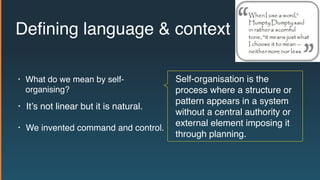
Self-organisation is the
process where a structure or
pattern appears in a system
without a central authority or
external element imposing it
through planning.
Defining language & context
• We invented command and control.
• It’s not linear but it is natural.
• What do we mean by self-
organising?
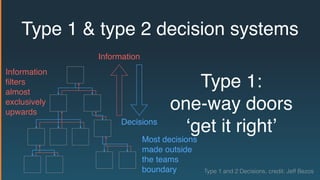
Type 1 & type 2 decision systems
Decisions
Information
Information
filters
almost
exclusively
upwards
Most decisions
made outside
the teams
boundary
Type 1:
one-way doors
‘get it right’
Type 1 and 2 Decisions, credit: Jeff Bezos
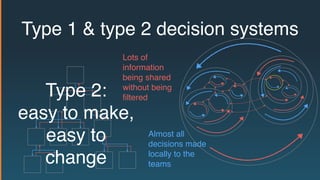
Type 1 & type 2 decision systems
Lots of
information
being shared
without being
filtered
Almost all
decisions made
locally to the
teams
Type 2:
easy to make,
easy to
change
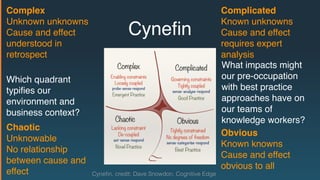
Cynefin
What impacts might
our pre-occupation
with best practice
approaches have on
our teams of
knowledge workers?
Which quadrant
typifies our
environment and
business context?
Complex
Unknown unknowns
Cause and effect
understood in
retrospect
Complicated
Known unknowns
Cause and effect
requires expert
analysis
Obvious
Known knowns
Cause and effect
obvious to all
Chaotic
Unknowable
No relationship
between cause and
effect Cynefin, credit: Dave Snowdon, Cognitive Edge
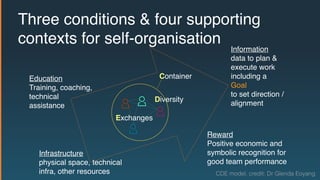
Education
Training, coaching,
technical
assistance
Infrastructure
physical space, technical
infra, other resources
Container
Diversity
Information
data to plan &
execute work
including a
Goal
to set direction /
alignment
Reward
Positive economic and
symbolic recognition for
good team performance
Exchanges
Three conditions & four supporting
contexts for self-organisation
CDE model, credit: Dr Glenda Eoyang
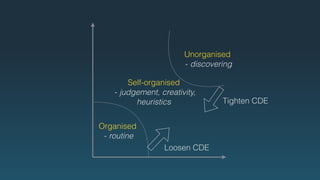
Unorganised
- discovering
Organised
- routine
Self-organised
- judgement, creativity,
heuristics Tighten CDE
Loosen CDE
How do we set up for,
nurture and sustain self-
organising teams?
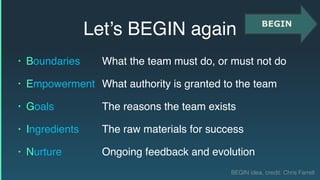
Let’s BEGIN again
• Boundaries
• Empowerment
• Goals
• Ingredients
• Nurture
What the team must do, or must not do
What authority is granted to the team
The reasons the team exists
The raw materials for success
Ongoing feedback and evolution
BEGIN idea, credit: Chris Farrell
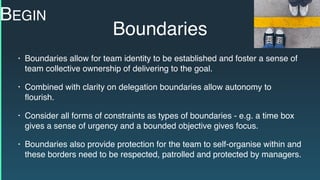
Boundaries
• Boundaries allow for team identity to be established and foster a sense of
team collective ownership of delivering to the goal.
• Combined with clarity on delegation boundaries allow autonomy to
flourish.
• Consider all forms of constraints as types of boundaries - e.g. a time box
gives a sense of urgency and a bounded objective gives focus.
• Boundaries also provide protection for the team to self-organise within and
these borders need to be respected, patrolled and protected by managers.
BEGIN
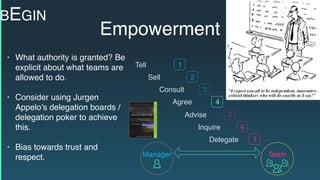
• What authority is granted? Be
explicit about what teams are
allowed to do.
• Consider using Jurgen
Appelo’s delegation boards /
delegation poker to achieve
this.
• Bias towards trust and
respect.
Empowerment
1
2
3
4
5
6
7
Tell
Sell
Consult
Agree
Advise
Inquire
Delegate
BEGIN
Manager Team
Goals
• Setting direction / purpose. Why does the team exist?
• Don’t control - tell them what the goal is not how to achieve it.
• Allow and expect people to organise themselves around the work
rather than the other way around.
• Having, owning and delivering to clear goals increases motivation
and engagement through a sense of shared purpose and
commitment.
BEGIN
Ingredients
• Humans
• technical skills required by the
problems being solved
• interpersonal skills to work as a team
• Coherent processes that support their
ways of working
• Things
• tools & infrastructure
• access to information
• ongoing education
Do your teams have the things that they need to thrive?
BEGIN
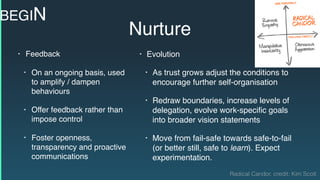
Nurture
• Feedback
• On an ongoing basis, used
to amplify / dampen
behaviours
• Offer feedback rather than
impose control
• Foster openness,
transparency and proactive
communications
• Evolution
• As trust grows adjust the conditions to
encourage further self-organisation
• Redraw boundaries, increase levels of
delegation, evolve work-specific goals
into broader vision statements
• Move from fail-safe towards safe-to-fail
(or better still, safe to learn). Expect
experimentation.
BEGIN
Radical Candor, credit: Kim Scott
Nurture
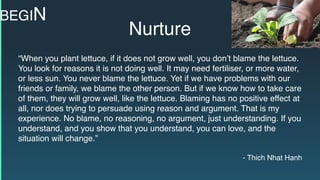
“When you plant lettuce, if it does not grow well, you don’t blame the lettuce.
You look for reasons it is not doing well. It may need fertiliser, or more water,
or less sun. You never blame the lettuce. Yet if we have problems with our
friends or family, we blame the other person. But if we know how to take care
of them, they will grow well, like the lettuce. Blaming has no positive effect at
all, nor does trying to persuade using reason and argument. That is my
experience. No blame, no reasoning, no argument, just understanding. If you
understand, and you show that you understand, you can love, and the
situation will change.”
- Thich Nhat Hanh
BEGIN
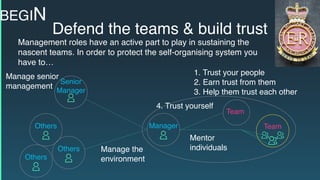
Defend the teams & build trust
Management roles have an active part to play in sustaining the
nascent teams. In order to protect the self-organising system you
have to…
Manager Team
Senior
Manager
Others
Mentor
individuals
Manage senior
management
Manage the
environment
4. Trust yourself
BEGIN
Others
Others
Team
1. Trust your people
2. Earn trust from them
3. Help them trust each other

Case for self organising teams

  • 1.
  • 2.
    Resulting in fivemain shifts: - Goal - The way work structured - The way work is coordinated - Values - Communications Three challenges: - Globalisation - Deregulation - New technologies A changing landscape means that The way we organise and make decisions in such a dynamic world has to change to suit the conditions Opening Position
  • 3.
    What is meantby ‘self-organising’, what are its requirements and why do we need it?
  • 4.
    Self-organisation is the processwhere a structure or pattern appears in a system without a central authority or external element imposing it through planning. Defining language & context • We invented command and control. • It’s not linear but it is natural. • What do we mean by self- organising?
  • 5.
    Type 1 &type 2 decision systems Decisions Information Information filters almost exclusively upwards Most decisions made outside the teams boundary Type 1: one-way doors ‘get it right’ Type 1 and 2 Decisions, credit: Jeff Bezos
  • 6.
    Type 1 &type 2 decision systems Lots of information being shared without being filtered Almost all decisions made locally to the teams Type 2: easy to make, easy to change
  • 7.
    Cynefin What impacts might ourpre-occupation with best practice approaches have on our teams of knowledge workers? Which quadrant typifies our environment and business context? Complex Unknown unknowns Cause and effect understood in retrospect Complicated Known unknowns Cause and effect requires expert analysis Obvious Known knowns Cause and effect obvious to all Chaotic Unknowable No relationship between cause and effect Cynefin, credit: Dave Snowdon, Cognitive Edge
  • 8.
    Education Training, coaching, technical assistance Infrastructure physical space,technical infra, other resources Container Diversity Information data to plan & execute work including a Goal to set direction / alignment Reward Positive economic and symbolic recognition for good team performance Exchanges Three conditions & four supporting contexts for self-organisation CDE model, credit: Dr Glenda Eoyang
  • 9.
    Unorganised - discovering Organised - routine Self-organised -judgement, creativity, heuristics Tighten CDE Loosen CDE
  • 10.
    How do weset up for, nurture and sustain self- organising teams?
  • 11.
    Let’s BEGIN again •Boundaries • Empowerment • Goals • Ingredients • Nurture What the team must do, or must not do What authority is granted to the team The reasons the team exists The raw materials for success Ongoing feedback and evolution BEGIN idea, credit: Chris Farrell
  • 12.
    Boundaries • Boundaries allowfor team identity to be established and foster a sense of team collective ownership of delivering to the goal. • Combined with clarity on delegation boundaries allow autonomy to flourish. • Consider all forms of constraints as types of boundaries - e.g. a time box gives a sense of urgency and a bounded objective gives focus. • Boundaries also provide protection for the team to self-organise within and these borders need to be respected, patrolled and protected by managers. BEGIN
  • 13.
    • What authorityis granted? Be explicit about what teams are allowed to do. • Consider using Jurgen Appelo’s delegation boards / delegation poker to achieve this. • Bias towards trust and respect. Empowerment 1 2 3 4 5 6 7 Tell Sell Consult Agree Advise Inquire Delegate BEGIN Manager Team
  • 14.
    Goals • Setting direction/ purpose. Why does the team exist? • Don’t control - tell them what the goal is not how to achieve it. • Allow and expect people to organise themselves around the work rather than the other way around. • Having, owning and delivering to clear goals increases motivation and engagement through a sense of shared purpose and commitment. BEGIN
  • 15.
    Ingredients • Humans • technicalskills required by the problems being solved • interpersonal skills to work as a team • Coherent processes that support their ways of working • Things • tools & infrastructure • access to information • ongoing education Do your teams have the things that they need to thrive? BEGIN
  • 16.
    Nurture • Feedback • Onan ongoing basis, used to amplify / dampen behaviours • Offer feedback rather than impose control • Foster openness, transparency and proactive communications • Evolution • As trust grows adjust the conditions to encourage further self-organisation • Redraw boundaries, increase levels of delegation, evolve work-specific goals into broader vision statements • Move from fail-safe towards safe-to-fail (or better still, safe to learn). Expect experimentation. BEGIN Radical Candor, credit: Kim Scott
  • 17.
    Nurture “When you plantlettuce, if it does not grow well, you don’t blame the lettuce. You look for reasons it is not doing well. It may need fertiliser, or more water, or less sun. You never blame the lettuce. Yet if we have problems with our friends or family, we blame the other person. But if we know how to take care of them, they will grow well, like the lettuce. Blaming has no positive effect at all, nor does trying to persuade using reason and argument. That is my experience. No blame, no reasoning, no argument, just understanding. If you understand, and you show that you understand, you can love, and the situation will change.” - Thich Nhat Hanh BEGIN
  • 18.
    Defend the teams& build trust Management roles have an active part to play in sustaining the nascent teams. In order to protect the self-organising system you have to… Manager Team Senior Manager Others Mentor individuals Manage senior management Manage the environment 4. Trust yourself BEGIN Others Others Team 1. Trust your people 2. Earn trust from them 3. Help them trust each other