Employability skills in the Social Sciences- Parent and Student expectations Kate Strudwick & Jill Jameson  October 2011
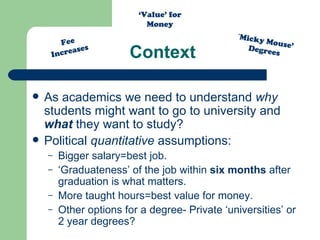
Context As academics we need to understand  why  students might want to go to university and  what  they want to study?  Political  quantitative  assumptions: Bigger salary=best job. ‘ Graduateness’ of the job within  six months  after graduation is what matters. More taught hours=best value for money. Other options for a degree- Private ‘universities’ or 2 year degrees? Fee Increases ‘ Micky Mouse’ Degrees ‘ Value’ for Money
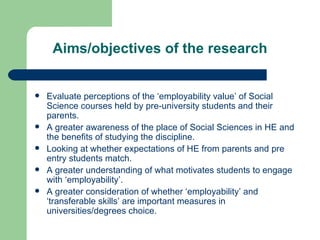
Aims/objectives of the research Evaluate perceptions of the ‘employability value’ of Social Science courses held by pre-university students and their parents. A greater awareness of the place of Social Sciences in HE and the benefits of studying the discipline. Looking at whether expectations of HE from parents and pre entry students match.  A greater understanding of what motivates students to engage with ‘employability’. A greater consideration of whether ‘employability’ and ‘transferable skills’ are important measures in universities/degrees choice.
Methodology Stage one:  Semi structured surveys with parents and pre-entry students  from 3 regional schools: Semi structured surveys with parents and pre-entry students at applicant open day: Stage two: Two Focus groups with year 11 and year 12 students  from two schools. One day employability showcase day
Awareness of the place of Social Sciences in HE:  Post school plans Majority  saw education as valuable for their future. Year 11: 89% intending to stay on & Year 12: 64% wanted to go to university.  Why? 68% to make them more ‘employable’  “I’d like to gain more qualifications at a higher level in order to get what I need for university and a job” 14% ‘didn’t know what else to do’. Influences:  Gain Information from parents, schools, teachers, friends.. But still see a need for: “…  more course content maybe student visits” (Year 11) Place of Social Science- viewed very positively by both open day and school students.
Pre-entry students: Their expectations: Student groups:  1. I want to experience “university life” (69%)  2. The job I want needs a degree (68%)  3. Graduates earn more money (67%)  … although linked to employability and careers, participants also saw the importance of  personal growth from ‘university life ’  Parents  particularly saw the value of the ‘university experience’: “ To engage full potential… not an opportunity to be missed.”   (Parent comment)
‘ Employability’ in the  curriculum: Students Applicant student comments about what they wanted: “ The ability to speak to people who are using the skills they have developed in their working life”. “ Preparation for career entry” Interviews “Help in what direction of employment to go in”. Both parents and students wanted some sort of ‘employability teaching’ in the curriculum…But many things beyond the curriculum were mentioned  under the ‘employability umbrella’: extra opportunities -volunteering/work experience outside of the curriculum; practical opportunities -meeting alumni
Parent views on what university should offer: “ Fantastic opportunities now available to them, and to embark on a course that hopefully will provide quality of future living and choices” . “ Better jobs prospects, meeting new people, being away from home and learning to grow up in an adult environment” Perception of Social Sciences skills: Open day parents were positive about the types of transferable skills their son or daughter would gain from a social science degree, in comparison to other degrees such as science, business and medicine. ‘ Employability’ in the curriculum: Parents
Value of Social Science in the workplace: Parents and students. Students and parents saw the Social Sciences  as leading to various careers including:   “ Social services/government services prison/ correctional institutions. Anything that involves communicating with individuals on a daily basis” (Applicant student). But there were wider options for instance: “ Government, policy thinking, planning..” (parent). And some parents saw the flexibility of the degree as potentially leading to: “ Virtually all jobs with the possible exception of specific skill work- medicine/ science” (parent).
Reputation: University as ‘Value for Money’ Whilst ‘value for money’ is seen as important, the students in the focus groups saw this in different ways: I would google a university- ask the best course for what ever courses… It is important if the university has got a better reputation than not…but once you get there you might find the university itself is better… While other students commented on what reputation means and the importance of it : The good points, good  teachers , that they  teach  well, if they do not they may not care, its important…
Concluding thoughts… Education is seen as a valuable by both parents and students for future opportunities. Employability is an important issue, but it is also about the ‘experience of university life’ and all the opportunities that this brings. Social Sciences came out well in terms of providing “value for money”, “employability” and transferable skills…with teaching being seen as particularly important for pre-entry students. Where do we go from here?

C-SAP showcase event October 2011: Employability skills in the social sciences

  • 1.
    Employability skills inthe Social Sciences- Parent and Student expectations Kate Strudwick & Jill Jameson October 2011
  • 2.
    Context As academicswe need to understand why students might want to go to university and what they want to study? Political quantitative assumptions: Bigger salary=best job. ‘ Graduateness’ of the job within six months after graduation is what matters. More taught hours=best value for money. Other options for a degree- Private ‘universities’ or 2 year degrees? Fee Increases ‘ Micky Mouse’ Degrees ‘ Value’ for Money
  • 3.
    Aims/objectives of theresearch Evaluate perceptions of the ‘employability value’ of Social Science courses held by pre-university students and their parents. A greater awareness of the place of Social Sciences in HE and the benefits of studying the discipline. Looking at whether expectations of HE from parents and pre entry students match. A greater understanding of what motivates students to engage with ‘employability’. A greater consideration of whether ‘employability’ and ‘transferable skills’ are important measures in universities/degrees choice.
  • 4.
    Methodology Stage one: Semi structured surveys with parents and pre-entry students from 3 regional schools: Semi structured surveys with parents and pre-entry students at applicant open day: Stage two: Two Focus groups with year 11 and year 12 students from two schools. One day employability showcase day
  • 5.
    Awareness of theplace of Social Sciences in HE: Post school plans Majority saw education as valuable for their future. Year 11: 89% intending to stay on & Year 12: 64% wanted to go to university. Why? 68% to make them more ‘employable’ “I’d like to gain more qualifications at a higher level in order to get what I need for university and a job” 14% ‘didn’t know what else to do’. Influences: Gain Information from parents, schools, teachers, friends.. But still see a need for: “… more course content maybe student visits” (Year 11) Place of Social Science- viewed very positively by both open day and school students.
  • 6.
    Pre-entry students: Theirexpectations: Student groups: 1. I want to experience “university life” (69%) 2. The job I want needs a degree (68%) 3. Graduates earn more money (67%) … although linked to employability and careers, participants also saw the importance of personal growth from ‘university life ’ Parents particularly saw the value of the ‘university experience’: “ To engage full potential… not an opportunity to be missed.” (Parent comment)
  • 7.
    ‘ Employability’ inthe curriculum: Students Applicant student comments about what they wanted: “ The ability to speak to people who are using the skills they have developed in their working life”. “ Preparation for career entry” Interviews “Help in what direction of employment to go in”. Both parents and students wanted some sort of ‘employability teaching’ in the curriculum…But many things beyond the curriculum were mentioned under the ‘employability umbrella’: extra opportunities -volunteering/work experience outside of the curriculum; practical opportunities -meeting alumni
  • 8.
    Parent views onwhat university should offer: “ Fantastic opportunities now available to them, and to embark on a course that hopefully will provide quality of future living and choices” . “ Better jobs prospects, meeting new people, being away from home and learning to grow up in an adult environment” Perception of Social Sciences skills: Open day parents were positive about the types of transferable skills their son or daughter would gain from a social science degree, in comparison to other degrees such as science, business and medicine. ‘ Employability’ in the curriculum: Parents
  • 9.
    Value of SocialScience in the workplace: Parents and students. Students and parents saw the Social Sciences as leading to various careers including: “ Social services/government services prison/ correctional institutions. Anything that involves communicating with individuals on a daily basis” (Applicant student). But there were wider options for instance: “ Government, policy thinking, planning..” (parent). And some parents saw the flexibility of the degree as potentially leading to: “ Virtually all jobs with the possible exception of specific skill work- medicine/ science” (parent).
  • 10.
    Reputation: University as‘Value for Money’ Whilst ‘value for money’ is seen as important, the students in the focus groups saw this in different ways: I would google a university- ask the best course for what ever courses… It is important if the university has got a better reputation than not…but once you get there you might find the university itself is better… While other students commented on what reputation means and the importance of it : The good points, good teachers , that they teach well, if they do not they may not care, its important…
  • 11.
    Concluding thoughts… Educationis seen as a valuable by both parents and students for future opportunities. Employability is an important issue, but it is also about the ‘experience of university life’ and all the opportunities that this brings. Social Sciences came out well in terms of providing “value for money”, “employability” and transferable skills…with teaching being seen as particularly important for pre-entry students. Where do we go from here?