Transforming education through data
Frank Bowley
DfE
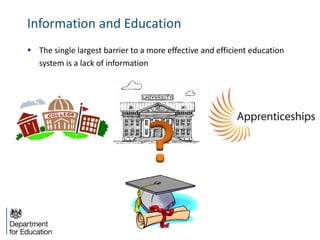
Information and Education
 The single largest barrier to a more effective and efficient education
system is a lack of information
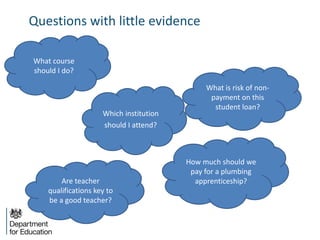
Questions with little evidence
What is risk of non-
payment on this
student loan?
Are teacher
qualifications key to
be a good teacher?
How much should we
pay for a plumbing
apprenticeship?
What course
should I do?
Which institution
should I attend?
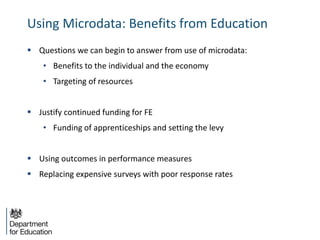
Using Microdata: Benefits from Education
 Questions we can begin to answer from use of microdata:
• Benefits to the individual and the economy
• Targeting of resources
 Justify continued funding for FE
• Funding of apprenticeships and setting the levy
 Using outcomes in performance measures
 Replacing expensive surveys with poor response rates
The LEO Project
 Matching data from a range of admin datasets to provide a
complete education and labour market record of individuals
 Current database contains most people under the age of
around 30 years old and mature students who have been in
the publicly funded education in the last 10 years
 The resultant dataset is:
 Large (tens of millions of people)
 Longitudinal – look at
 Based on individual data
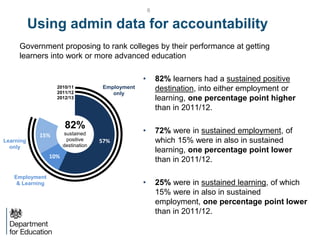
Using admin data for accountability
6
• 82% learners had a sustained positive
destination, into either employment or
learning, one percentage point higher
than in 2011/12.
• 72% were in sustained employment, of
which 15% were in also in sustained
learning, one percentage point lower
than in 2011/12.
• 25% were in sustained learning, of which
15% were in also in sustained
employment, one percentage point lower
than in 2011/12.
57%
10%
15%
82%
sustained
positive
destination
Employment
only
Learning
only
2010/11
2011/12
2012/13
Employment
& Learning
Government proposing to rank colleges by their performance at getting
learners into work or more advanced education
7
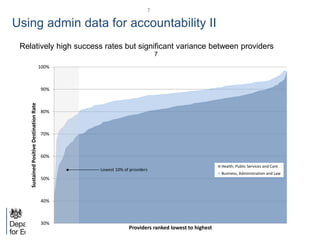
Using admin data for accountability II
7
30%
40%
50%
60%
70%
80%
90%
100%
SustainedPositiveDestinationRate
Providers ranked lowest to highest
Health, Public Services and Care
Business, Administration and Law
Lowest 10% of providers
Relatively high success rates but significant variance between providers
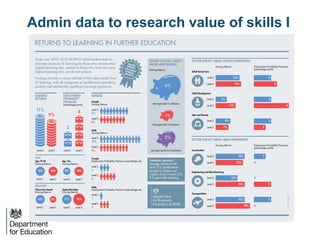
Admin data to research value of skills I
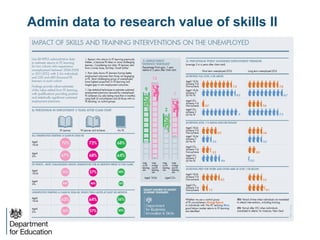
Admin data to research value of skills II
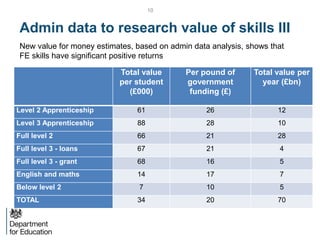
10
Total value
per student
(£000)
Per pound of
government
funding (£)
Total value per
year (£bn)
Level 2 Apprenticeship 61 26 12
Level 3 Apprenticeship 88 28 10
Full level 2 66 21 28
Full level 3 - loans 67 21 4
Full level 3 - grant 68 16 5
English and maths 14 17 7
Below level 2 7 10 5
TOTAL 34 20 70
Admin data to research value of skills III
New value for money estimates, based on admin data analysis, shows that
FE skills have significant positive returns
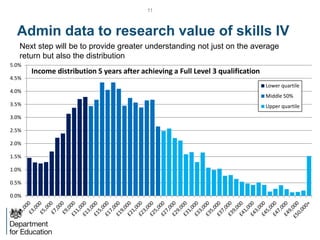
Admin data to research value of skills IV
11
0.0%
0.5%
1.0%
1.5%
2.0%
2.5%
3.0%
3.5%
4.0%
4.5%
5.0%
Income distribution 5 years after achieving a Full Level 3 qualification
Lower quartile
Middle 50%
Upper quartile
Next step will be to provide greater understanding not just on the average
return but also the distribution
12
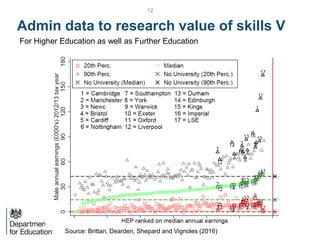
Source: Brittan, Dearden, Shepard and Vignoles (2016)
Admin data to research value of skills V
For Higher Education as well as Further Education
Matched data and social mobility
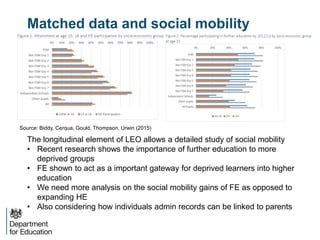
The longitudinal element of LEO allows a detailed study of social mobility
• Recent research shows the importance of further education to more
deprived groups
• FE shown to act as a important gateway for deprived learners into higher
education
• We need more analysis on the social mobility gains of FE as opposed to
expanding HE
• Also considering how individuals admin records can be linked to parents
Source: Biddy, Cerqua, Gould, Thompson, Urwin (2015)
What data can enabled
• LEO: more data, comprehensive coverage
• Investment POV for individuals and policy makers
• Credible information on courses
• Personalised interventions
• Deep understanding of the system and outcomes
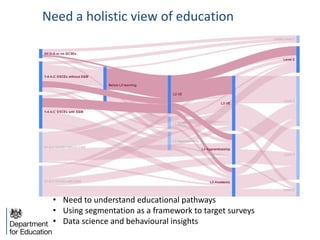
Need a holistic view of education
• Need to understand educational pathways
• Using segmentation as a framework to target surveys
• Data science and behavioural insights
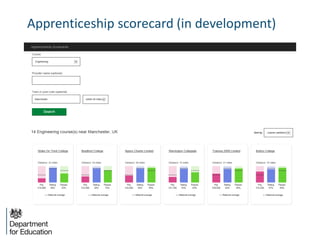
Apprenticeship scorecard (in development)
Q&A
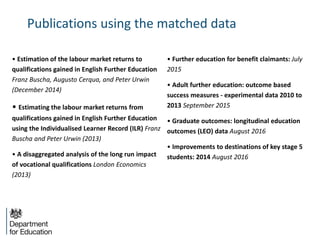
Publications using the matched data
• Estimation of the labour market returns to
qualifications gained in English Further Education
Franz Buscha, Augusto Cerqua, and Peter Urwin
(December 2014)
• Estimating the labour market returns from
qualifications gained in English Further Education
using the Individualised Learner Record (ILR) Franz
Buscha and Peter Urwin (2013)
• A disaggregated analysis of the long run impact
of vocational qualifications London Economics
(2013)
• Further education for benefit claimants: July
2015
• Adult further education: outcome based
success measures - experimental data 2010 to
2013 September 2015
• Graduate outcomes: longitudinal education
outcomes (LEO) data August 2016
• Improvements to destinations of key stage 5
students: 2014 August 2016

Transforming education through data

  • 1.
    Transforming education throughdata Frank Bowley DfE
  • 2.
    Information and Education The single largest barrier to a more effective and efficient education system is a lack of information
  • 3.
    Questions with littleevidence What is risk of non- payment on this student loan? Are teacher qualifications key to be a good teacher? How much should we pay for a plumbing apprenticeship? What course should I do? Which institution should I attend?
  • 4.
    Using Microdata: Benefitsfrom Education  Questions we can begin to answer from use of microdata: • Benefits to the individual and the economy • Targeting of resources  Justify continued funding for FE • Funding of apprenticeships and setting the levy  Using outcomes in performance measures  Replacing expensive surveys with poor response rates
  • 5.
    The LEO Project Matching data from a range of admin datasets to provide a complete education and labour market record of individuals  Current database contains most people under the age of around 30 years old and mature students who have been in the publicly funded education in the last 10 years  The resultant dataset is:  Large (tens of millions of people)  Longitudinal – look at  Based on individual data
  • 6.
    Using admin datafor accountability 6 • 82% learners had a sustained positive destination, into either employment or learning, one percentage point higher than in 2011/12. • 72% were in sustained employment, of which 15% were in also in sustained learning, one percentage point lower than in 2011/12. • 25% were in sustained learning, of which 15% were in also in sustained employment, one percentage point lower than in 2011/12. 57% 10% 15% 82% sustained positive destination Employment only Learning only 2010/11 2011/12 2012/13 Employment & Learning Government proposing to rank colleges by their performance at getting learners into work or more advanced education
  • 7.
    7 Using admin datafor accountability II 7 30% 40% 50% 60% 70% 80% 90% 100% SustainedPositiveDestinationRate Providers ranked lowest to highest Health, Public Services and Care Business, Administration and Law Lowest 10% of providers Relatively high success rates but significant variance between providers
  • 8.
    Admin data toresearch value of skills I
  • 9.
    Admin data toresearch value of skills II
  • 10.
    10 Total value per student (£000) Perpound of government funding (£) Total value per year (£bn) Level 2 Apprenticeship 61 26 12 Level 3 Apprenticeship 88 28 10 Full level 2 66 21 28 Full level 3 - loans 67 21 4 Full level 3 - grant 68 16 5 English and maths 14 17 7 Below level 2 7 10 5 TOTAL 34 20 70 Admin data to research value of skills III New value for money estimates, based on admin data analysis, shows that FE skills have significant positive returns
  • 11.
    Admin data toresearch value of skills IV 11 0.0% 0.5% 1.0% 1.5% 2.0% 2.5% 3.0% 3.5% 4.0% 4.5% 5.0% Income distribution 5 years after achieving a Full Level 3 qualification Lower quartile Middle 50% Upper quartile Next step will be to provide greater understanding not just on the average return but also the distribution
  • 12.
    12 Source: Brittan, Dearden,Shepard and Vignoles (2016) Admin data to research value of skills V For Higher Education as well as Further Education
  • 13.
    Matched data andsocial mobility The longitudinal element of LEO allows a detailed study of social mobility • Recent research shows the importance of further education to more deprived groups • FE shown to act as a important gateway for deprived learners into higher education • We need more analysis on the social mobility gains of FE as opposed to expanding HE • Also considering how individuals admin records can be linked to parents Source: Biddy, Cerqua, Gould, Thompson, Urwin (2015)
  • 14.
    What data canenabled • LEO: more data, comprehensive coverage • Investment POV for individuals and policy makers • Credible information on courses • Personalised interventions • Deep understanding of the system and outcomes
  • 15.
    Need a holisticview of education • Need to understand educational pathways • Using segmentation as a framework to target surveys • Data science and behavioural insights
  • 16.
  • 17.
  • 18.
    Publications using thematched data • Estimation of the labour market returns to qualifications gained in English Further Education Franz Buscha, Augusto Cerqua, and Peter Urwin (December 2014) • Estimating the labour market returns from qualifications gained in English Further Education using the Individualised Learner Record (ILR) Franz Buscha and Peter Urwin (2013) • A disaggregated analysis of the long run impact of vocational qualifications London Economics (2013) • Further education for benefit claimants: July 2015 • Adult further education: outcome based success measures - experimental data 2010 to 2013 September 2015 • Graduate outcomes: longitudinal education outcomes (LEO) data August 2016 • Improvements to destinations of key stage 5 students: 2014 August 2016