Mitglied der Helmholtz-Gemeinschaft

Institut für Bio- und Geowissenschaften
IBG-2: Pflanzenwissenschaften

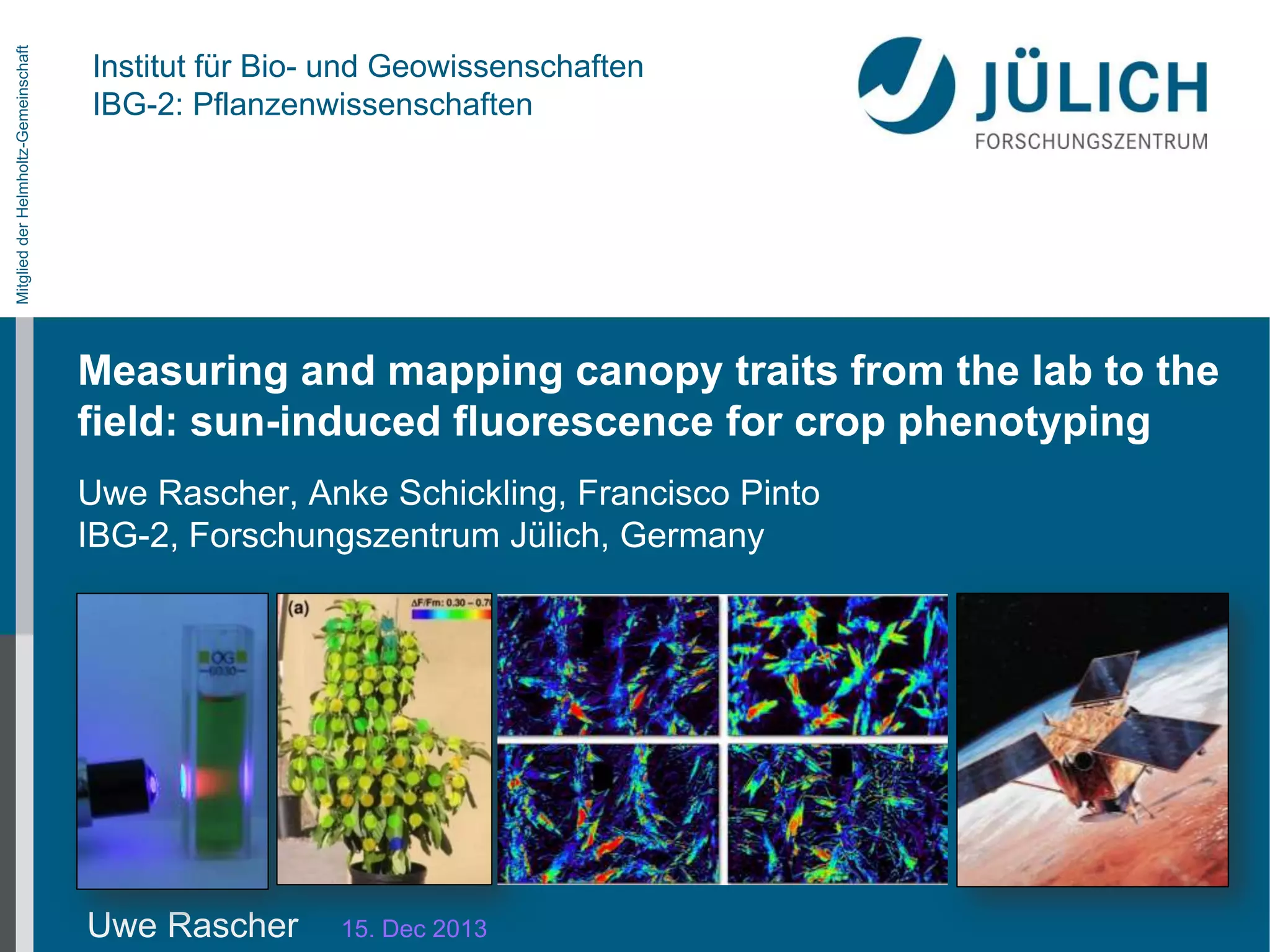
Measuring and mapping canopy traits from the lab to the
field: sun-induced fluorescence for crop phenotyping
Uwe Rascher, Anke Schickling, Francisco Pinto
IBG-2, Forschungszentrum Jülich, Germany

Uwe Rascher

15. Dec 2013
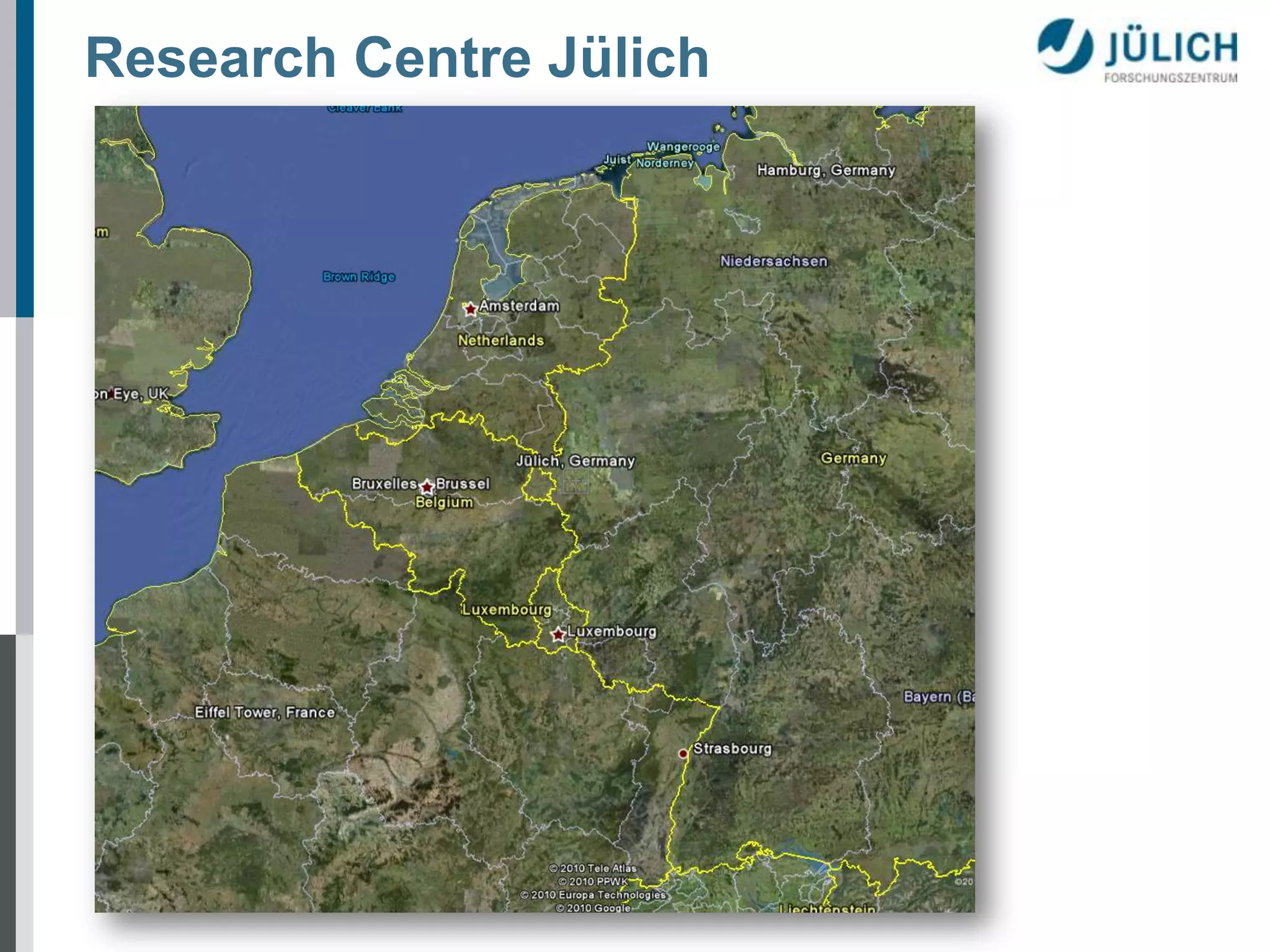
Research Centre Jülich
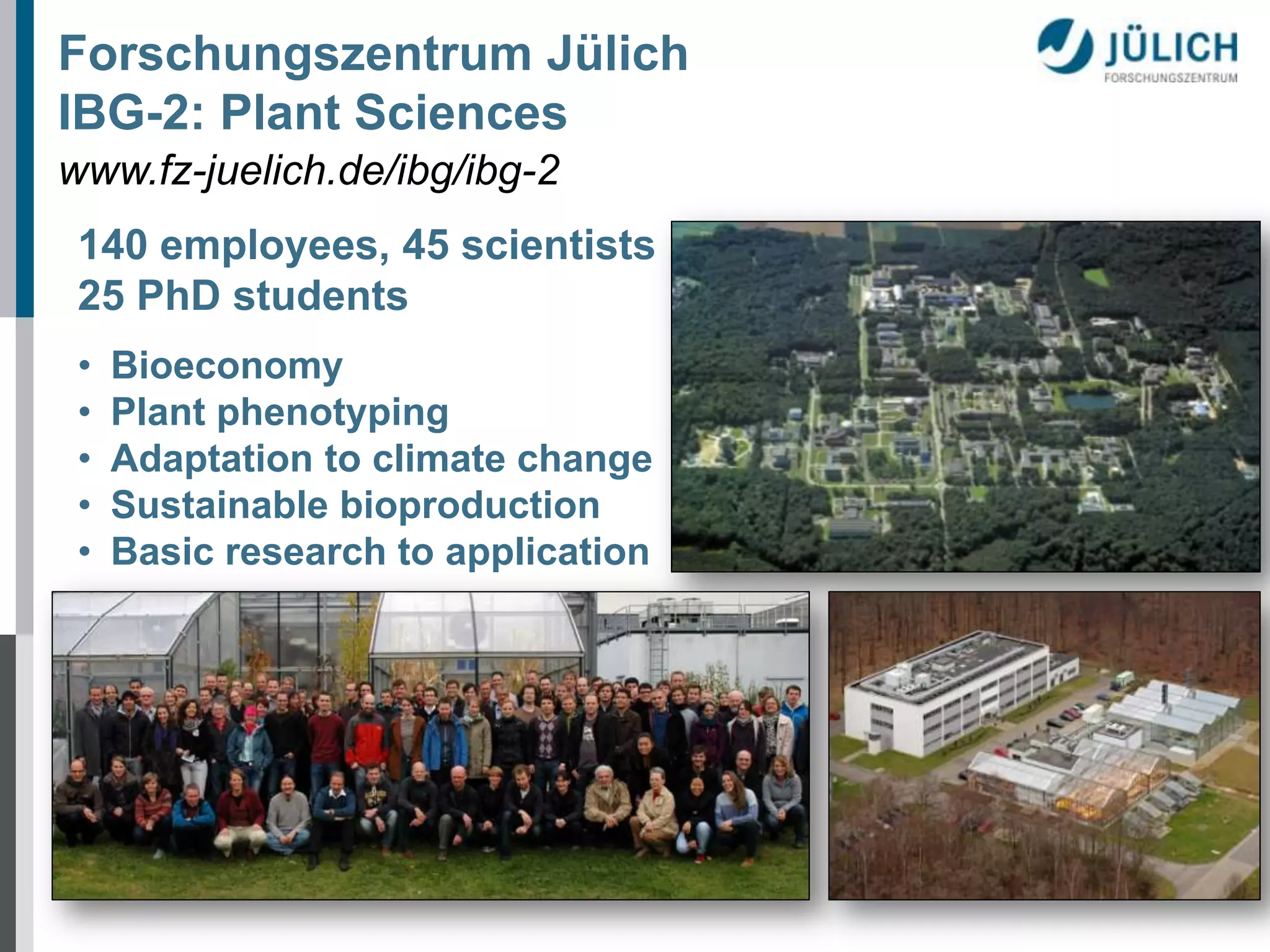
Forschungszentrum Jülich
IBG-2: Plant Sciences
www.fz-juelich.de/ibg/ibg-2
140 employees, 45 scientists
25 PhD students
•
•
•
•
•

Bioeconomy
Plant phenotyping
Adaptation to climate change
Sustainable bioproduction
Basic research to application
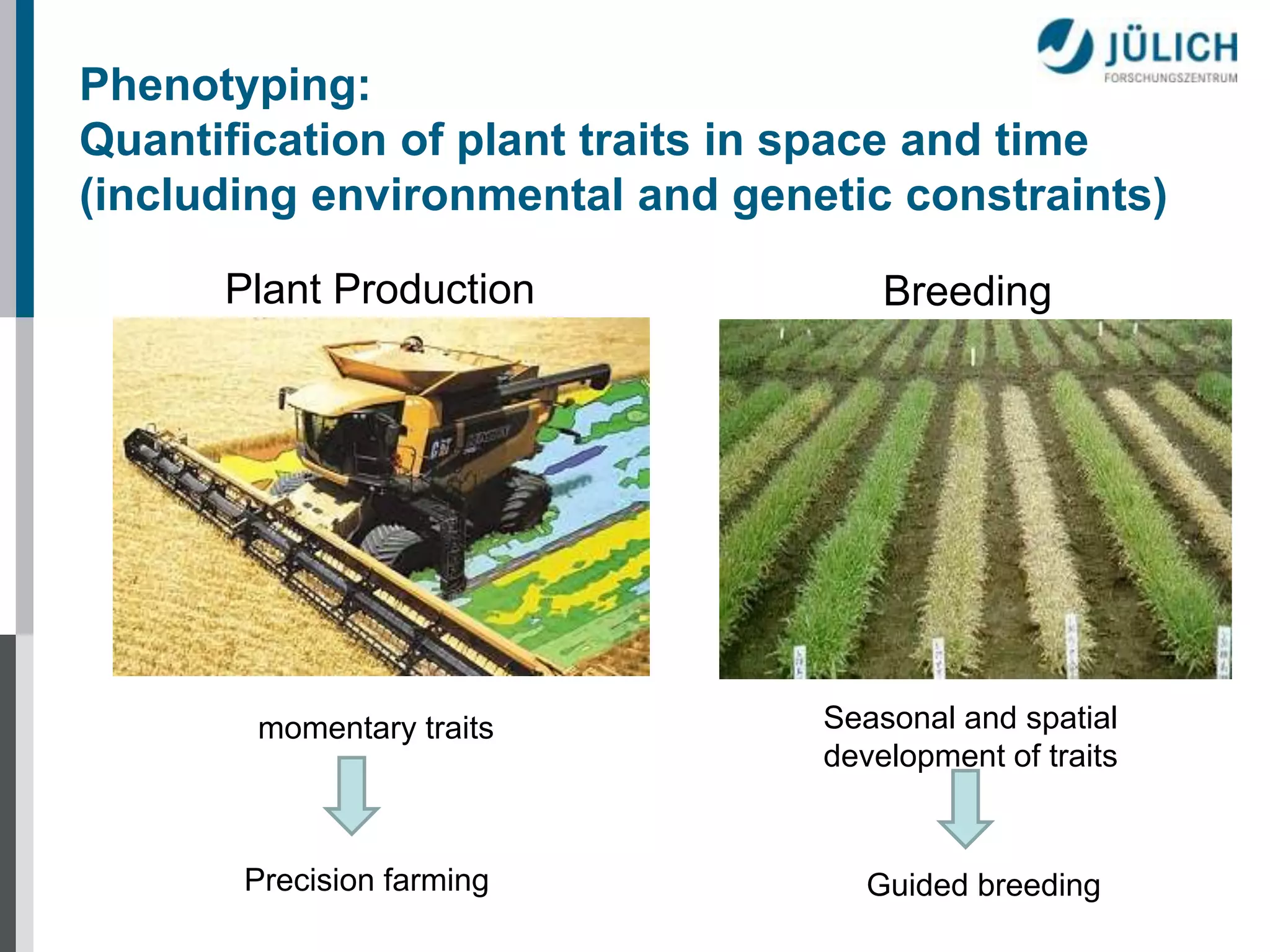
Phenotyping:
Quantification of plant traits in space and time
(including environmental and genetic constraints)
Plant Production

Breeding

momentary traits

Seasonal and spatial
development of traits

Precision farming

Guided breeding
Mitglied der Helmholtz-Gemeinschaft

Development of new measurement
approaches for field phenotyping /
Remote Sensing
- Imaging Spectroscopy
- 3-D canopy reconstruction
- sun-induced fluorescence
Mitglied der Helmholtz-Gemeinschaft

Development of new measurement
approaches for field phenotyping /
Remote Sensing
- Imaging Spectroscopy
- 3-D canopy reconstruction
- sun-induced fluorescence
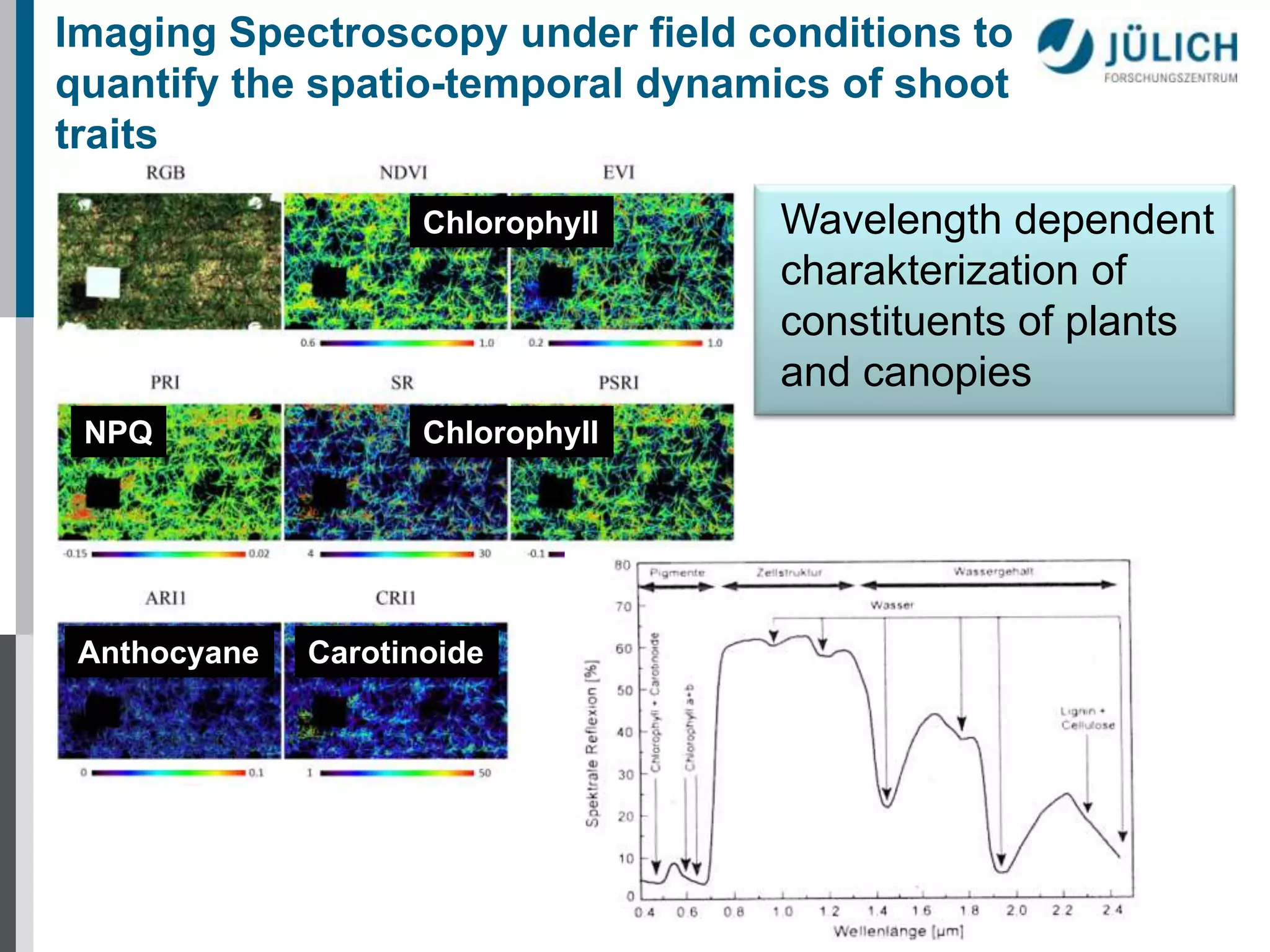
Imaging Spectroscopy under field conditions to
quantify the spatio-temporal dynamics of shoot
traits
Chlorophyll

NPQ

Anthocyane

Chlorophyll

Carotinoide

Wavelength dependent
charakterization of
constituents of plants
and canopies
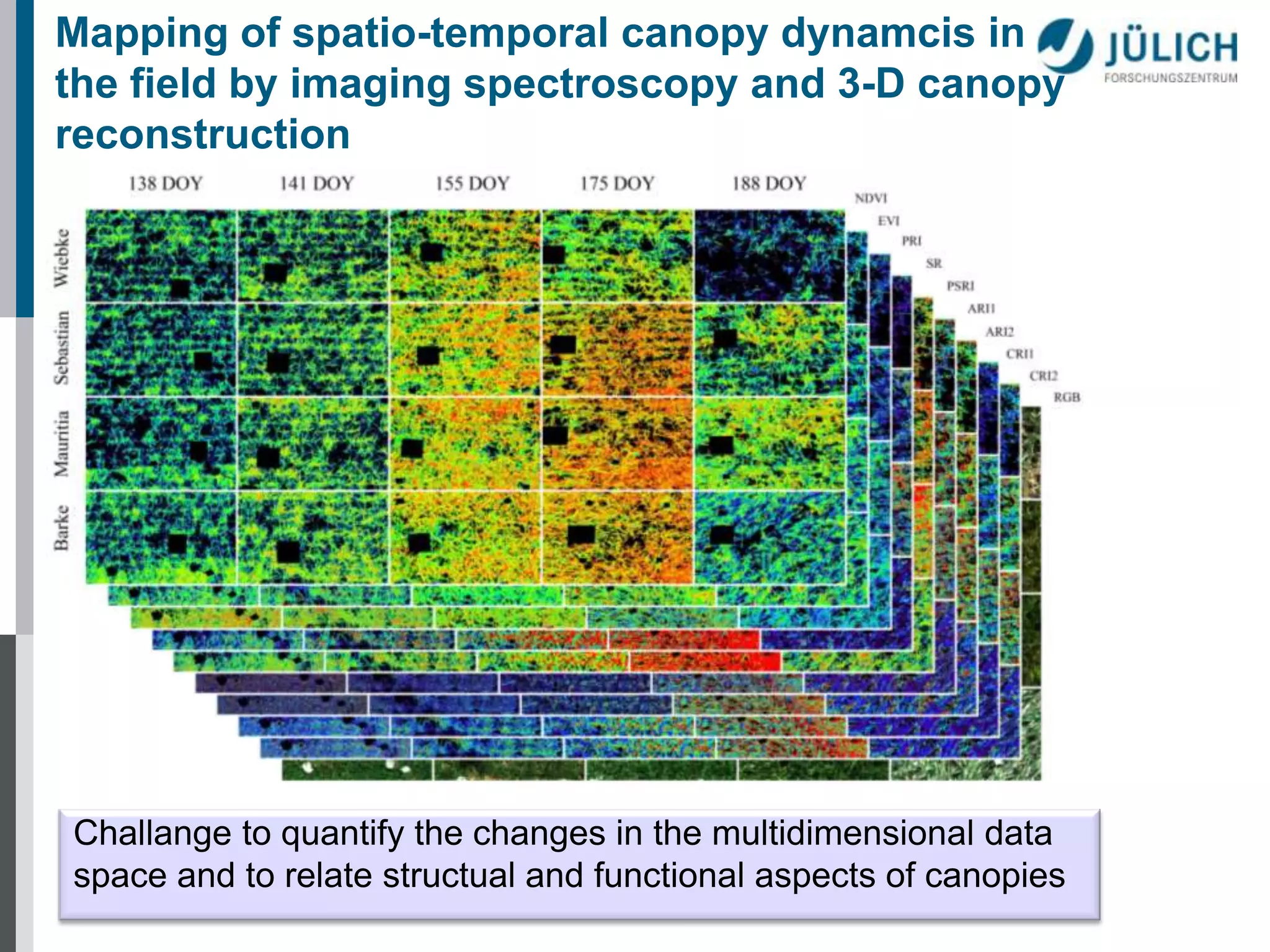
Mapping of spatio-temporal canopy dynamcis in
the field by imaging spectroscopy and 3-D canopy
reconstruction

Challange to quantify the changes in the multidimensional data
space and to relate structual and functional aspects of canopies
Mitglied der Helmholtz-Gemeinschaft

Development of new measurement
approaches for field phenotyping /
Remote Sensing
- Imaging Spectroscopy
- 3-D canopy reconstruction
- sun-induced fluorescence
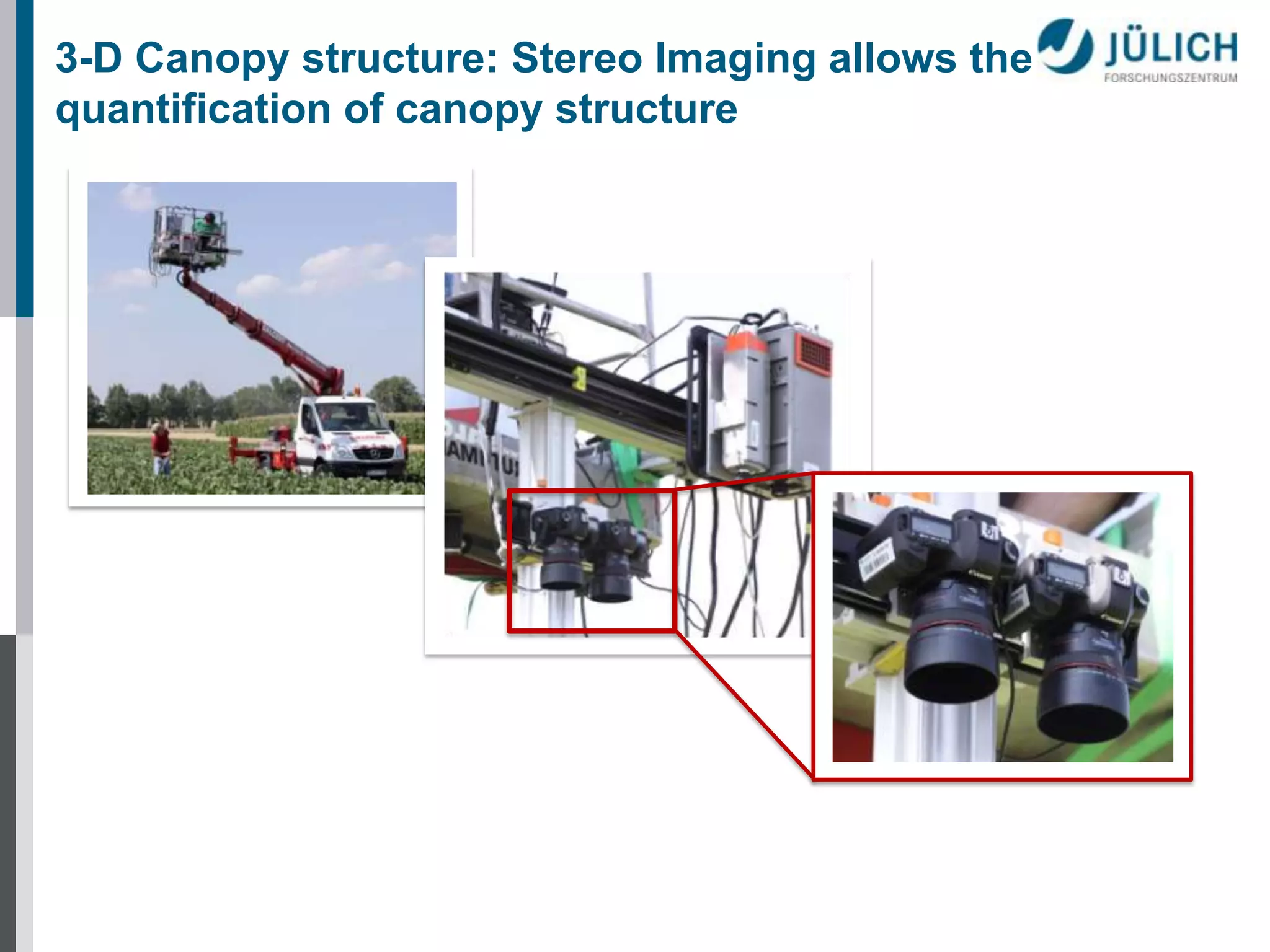
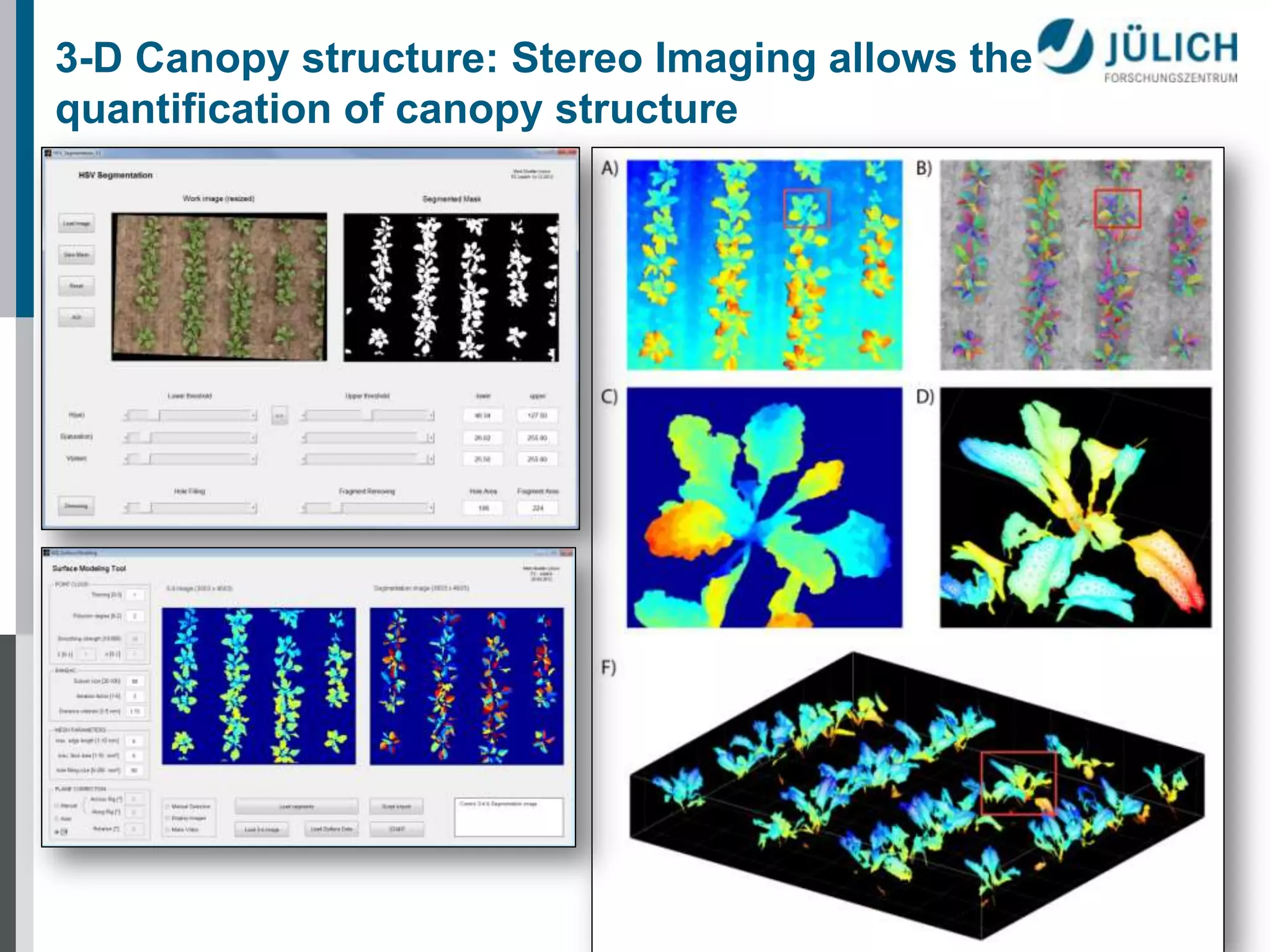
3-D Canopy structure: Stereo Imaging allows the
quantification of canopy structure
3-D Canopy structure: Stereo Imaging allows the
quantification of canopy structure
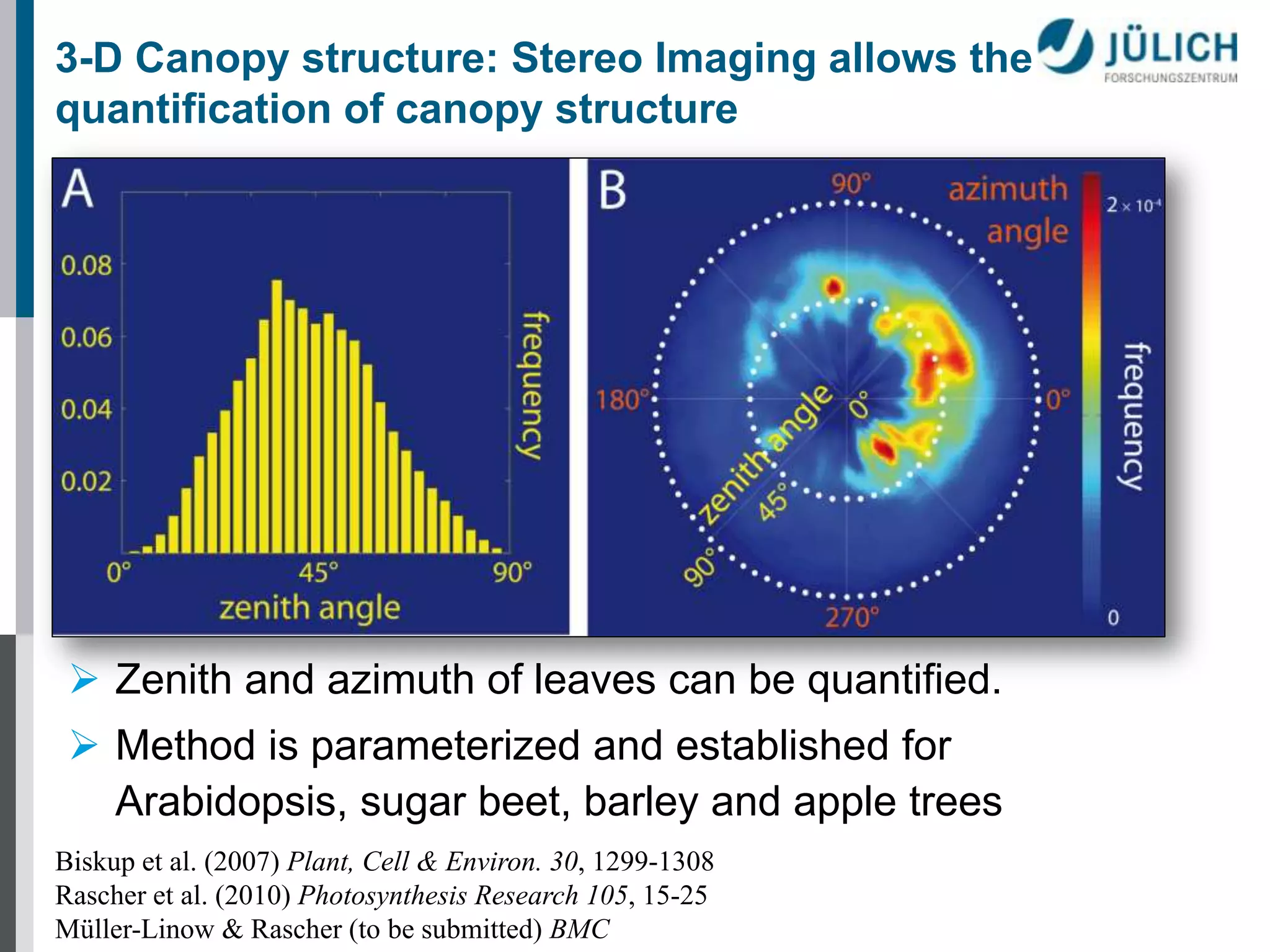
3-D Canopy structure: Stereo Imaging allows the
quantification of canopy structure

 Zenith and azimuth of leaves can be quantified.
 Method is parameterized and established for
Arabidopsis, sugar beet, barley and apple trees
Biskup et al. (2007) Plant, Cell & Environ. 30, 1299-1308
Rascher et al. (2010) Photosynthesis Research 105, 15-25
Müller-Linow & Rascher (to be submitted) BMC
Mitglied der Helmholtz-Gemeinschaft

Development of new measurement
approaches for field phenotyping /
Remote Sensing
- Imaging Spectroscopy
- 3-D canopy reconstruction
- sun-induced fluorescence
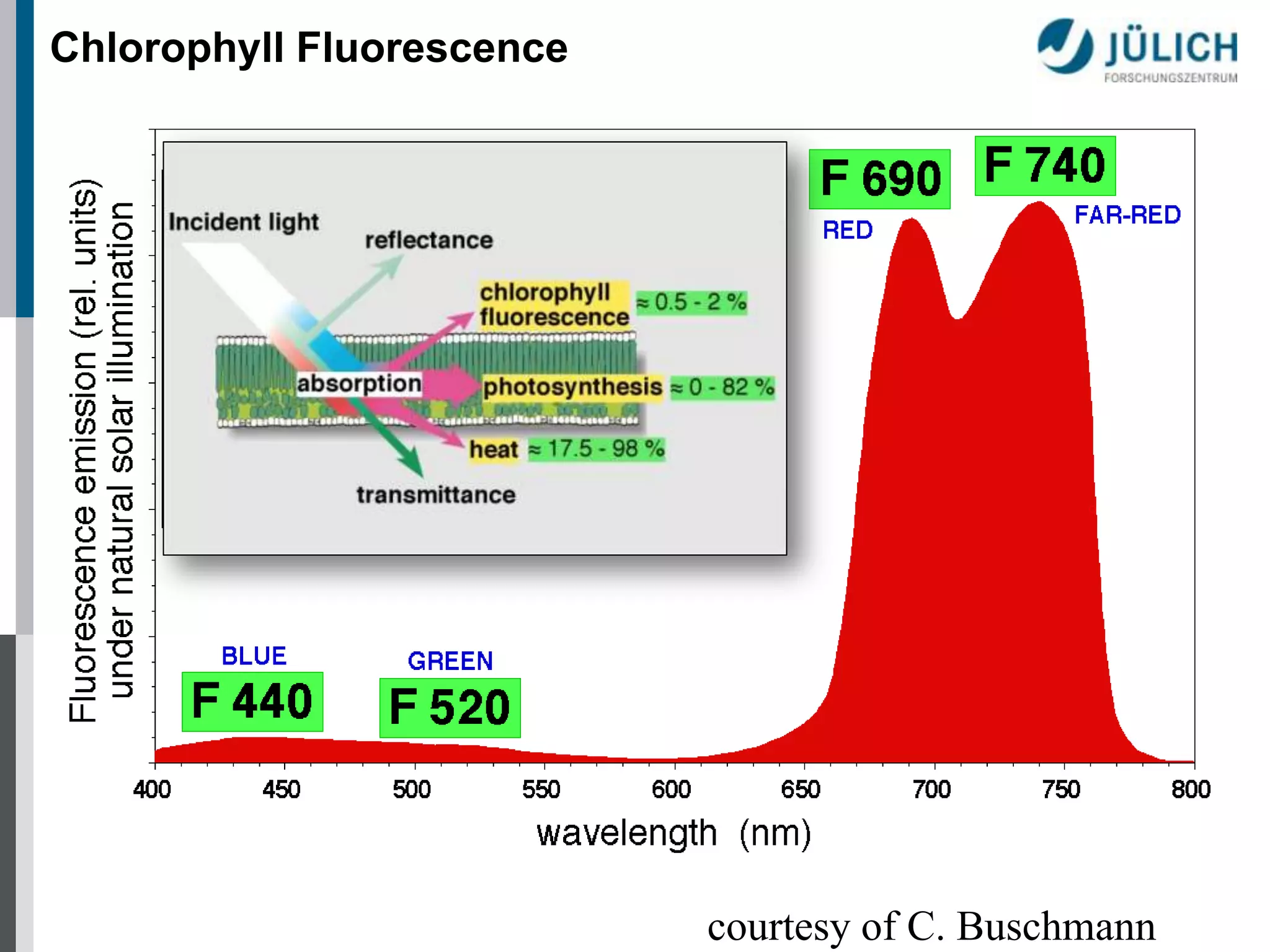
Chlorophyll Fluorescence

courtesy of C. Buschmann
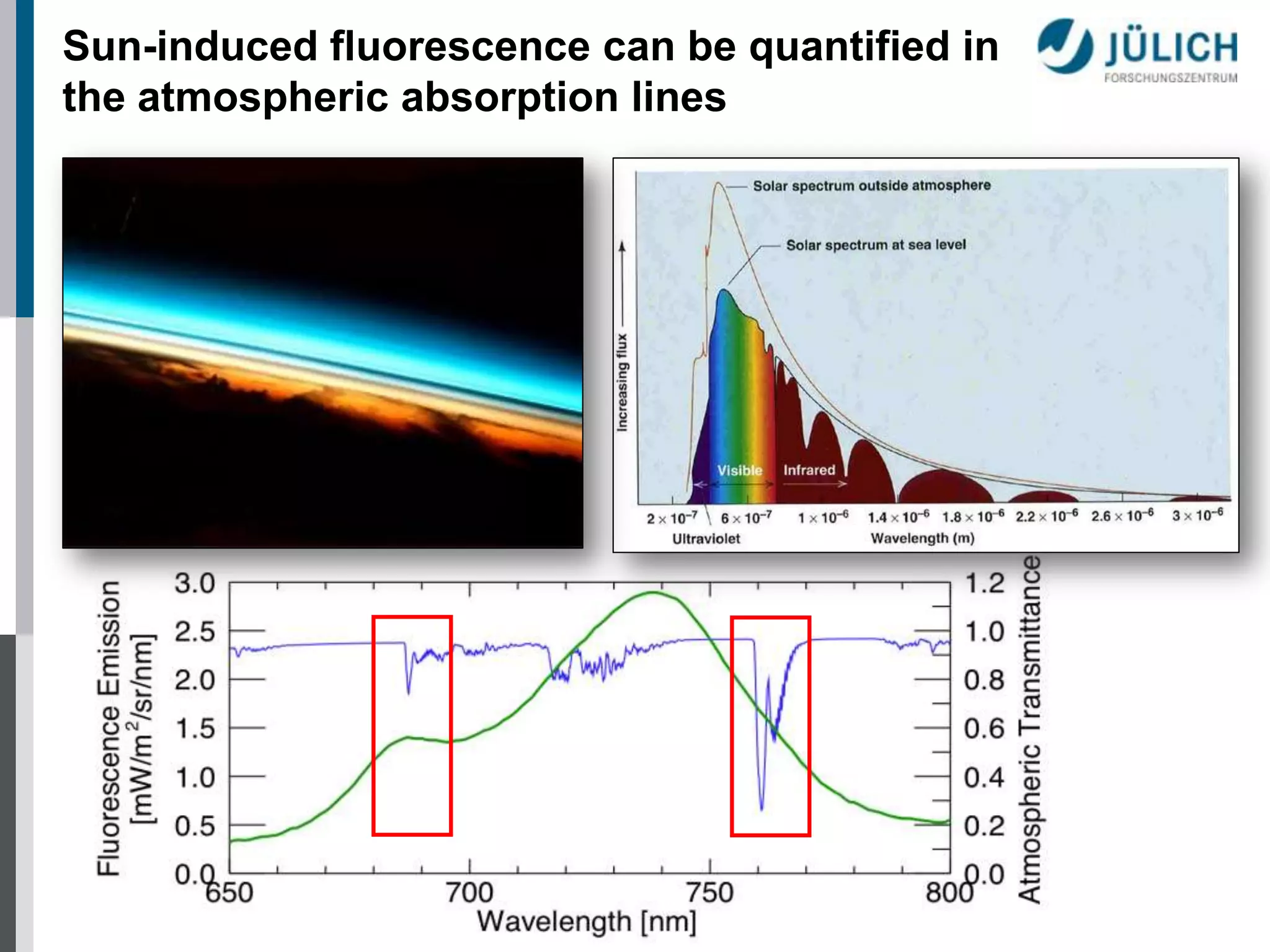
Sun-induced fluorescence can be quantified in
the atmospheric absorption lines
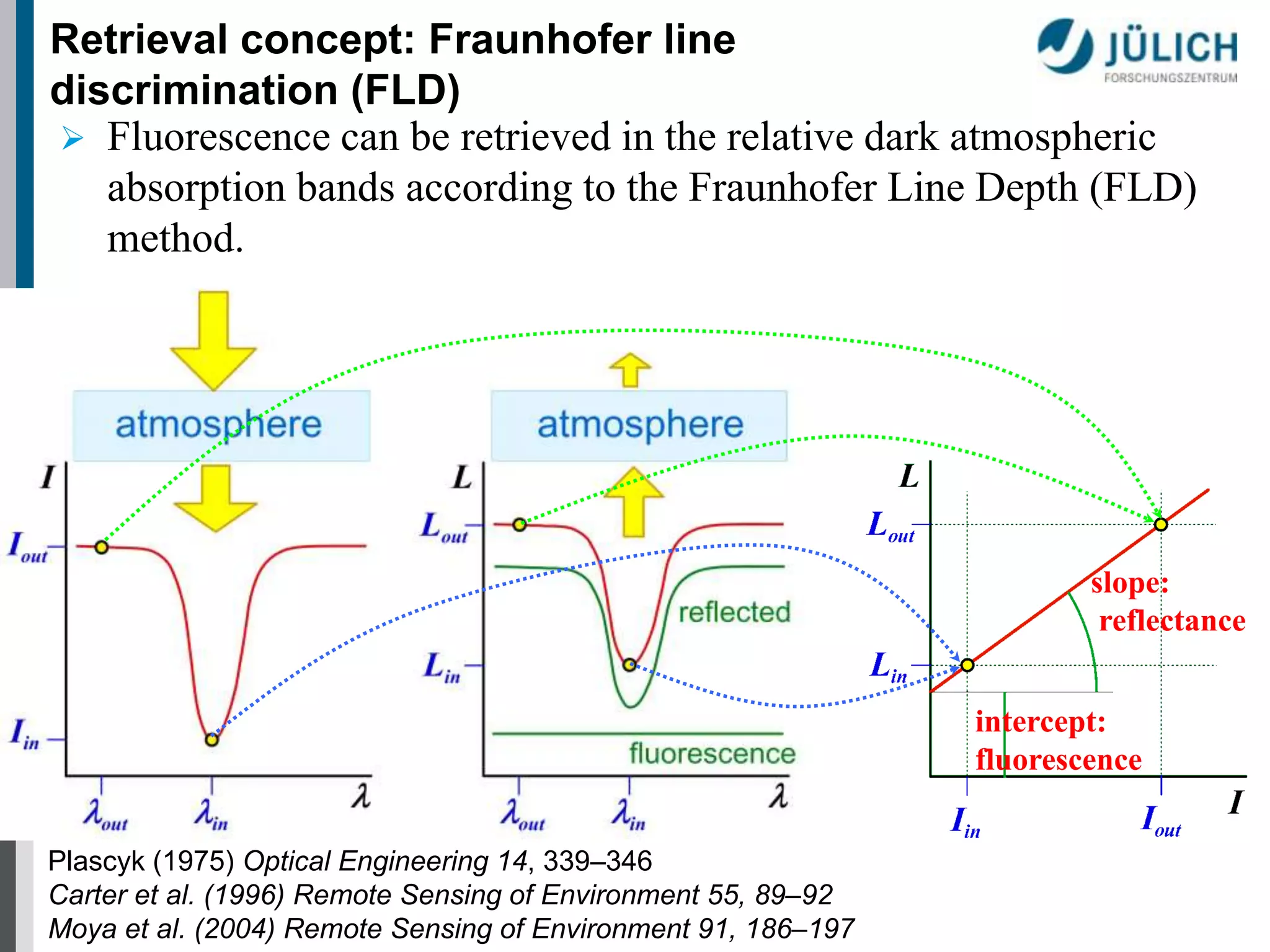
Retrieval concept: Fraunhofer line
discrimination (FLD)
 Fluorescence can be retrieved in the relative dark atmospheric
absorption bands according to the Fraunhofer Line Depth (FLD)
method.

slope:
reflectance
intercept:
fluorescence
Plascyk (1975) Optical Engineering 14, 339–346
Carter et al. (1996) Remote Sensing of Environment 55, 89–92
Moya et al. (2004) Remote Sensing of Environment 91, 186–197
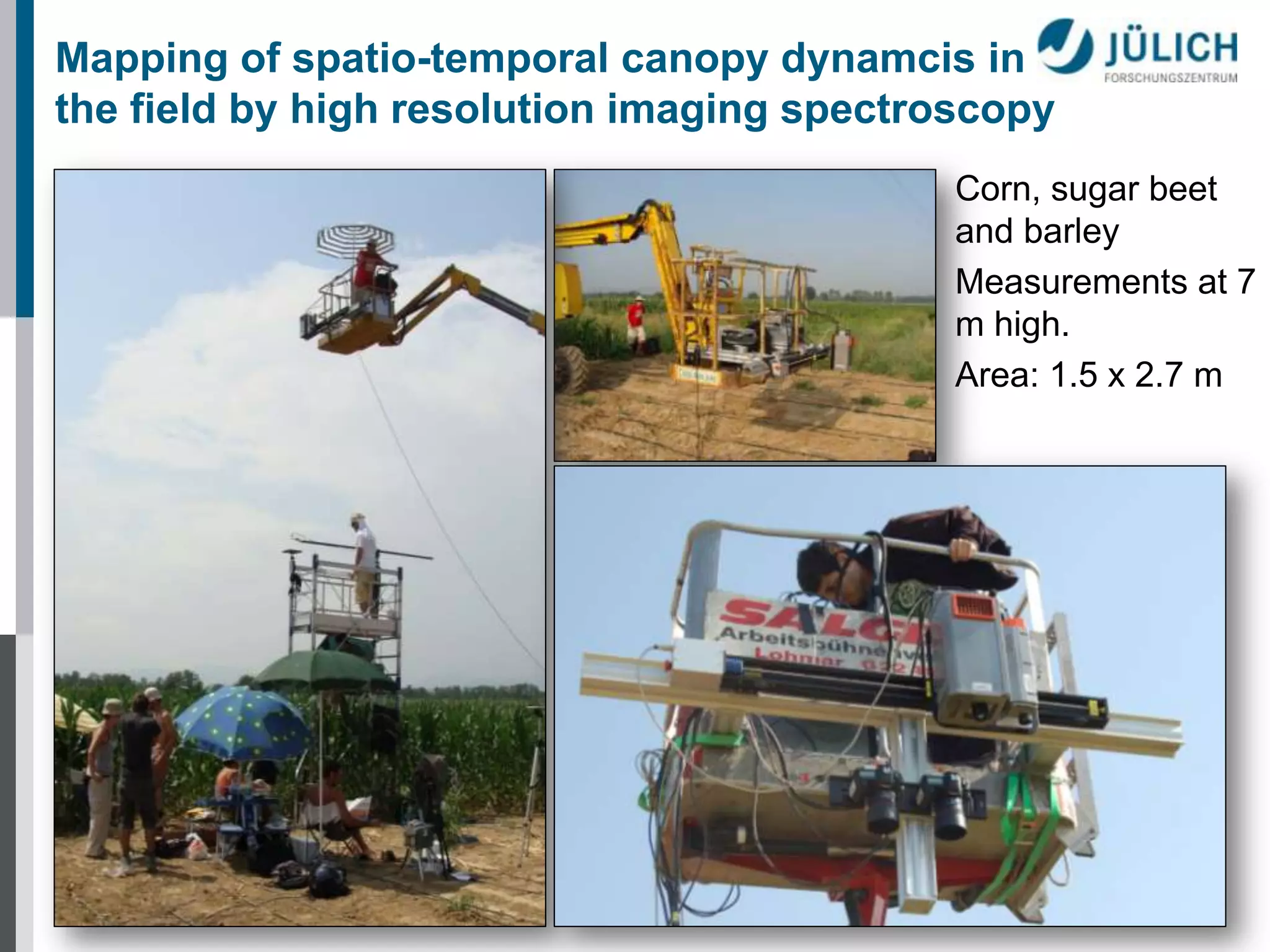
Mapping of spatio-temporal canopy dynamcis in
the field by high resolution imaging spectroscopy
Corn, sugar beet
and barley
Measurements at 7
m high.
Area: 1.5 x 2.7 m
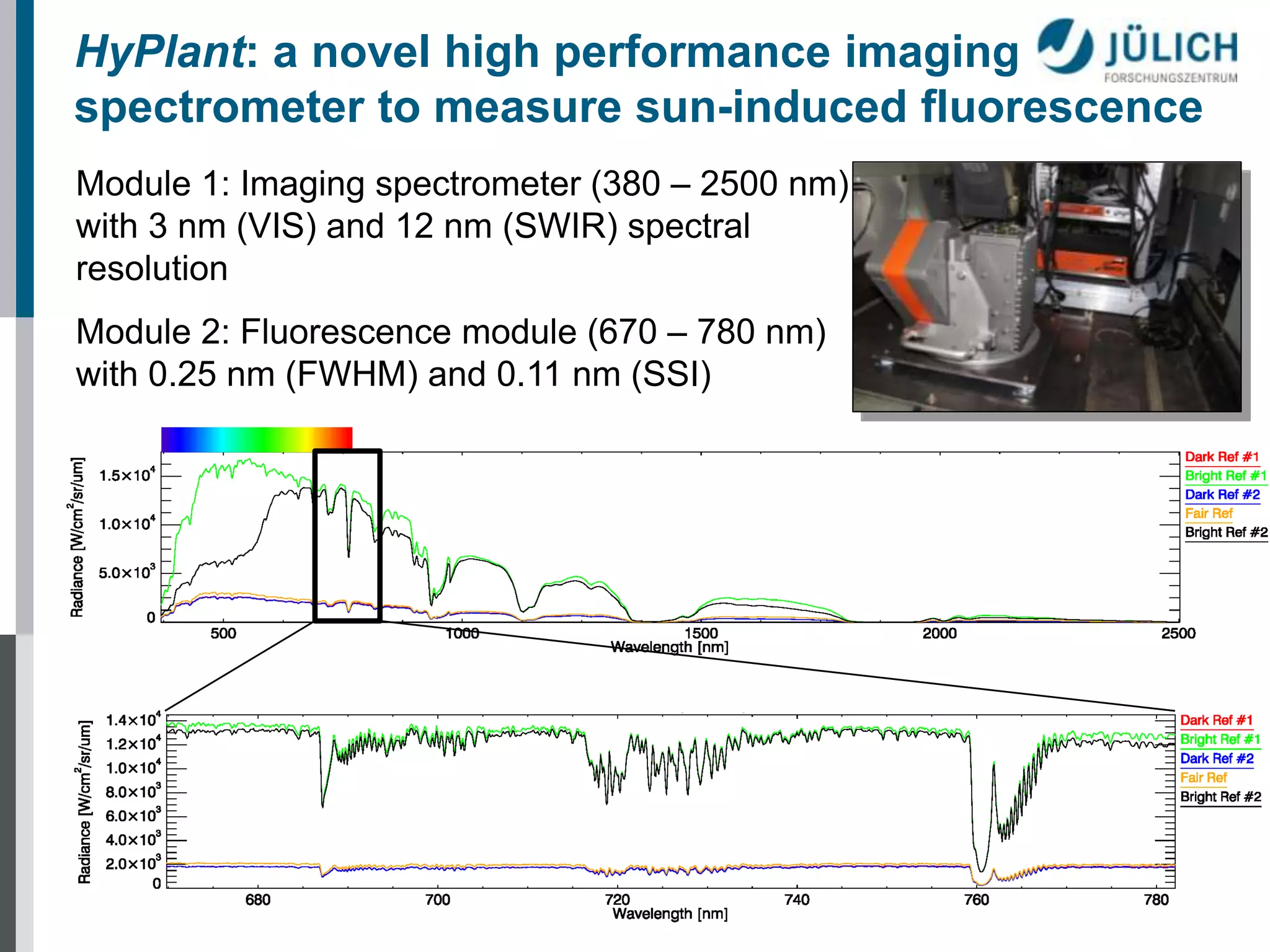
HyPlant: a novel high performance imaging
spectrometer to measure sun-induced fluorescence
Module 1: Imaging spectrometer (380 – 2500 nm)
with 3 nm (VIS) and 12 nm (SWIR) spectral
resolution
Module 2: Fluorescence module (670 – 780 nm)
with 0.25 nm (FWHM) and 0.11 nm (SSI)
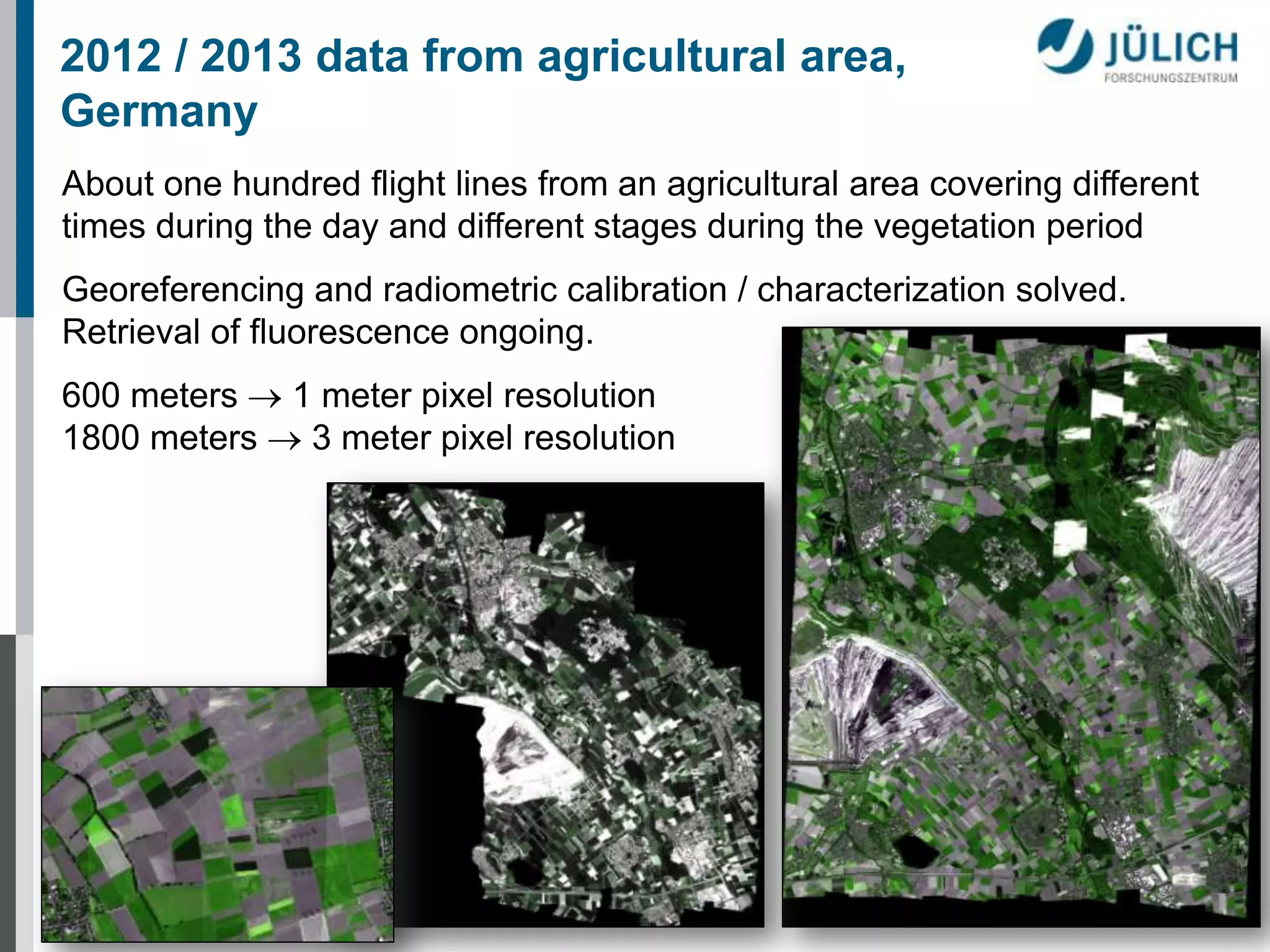
2012 / 2013 data from agricultural area,
Germany
About one hundred flight lines from an agricultural area covering different
times during the day and different stages during the vegetation period
Georeferencing and radiometric calibration / characterization solved.
Retrieval of fluorescence ongoing.
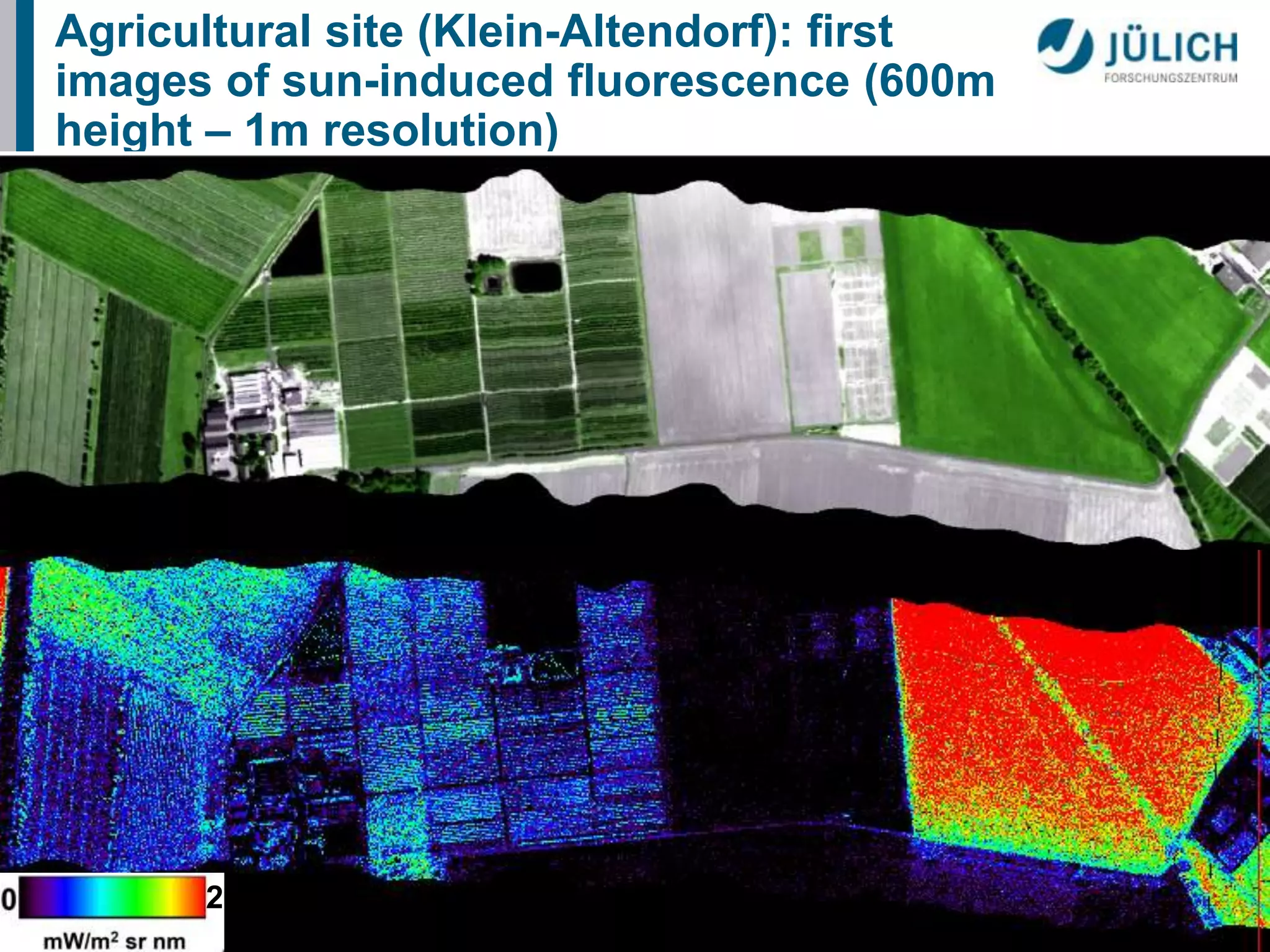
600 meters  1 meter pixel resolution
1800 meters  3 meter pixel resolution
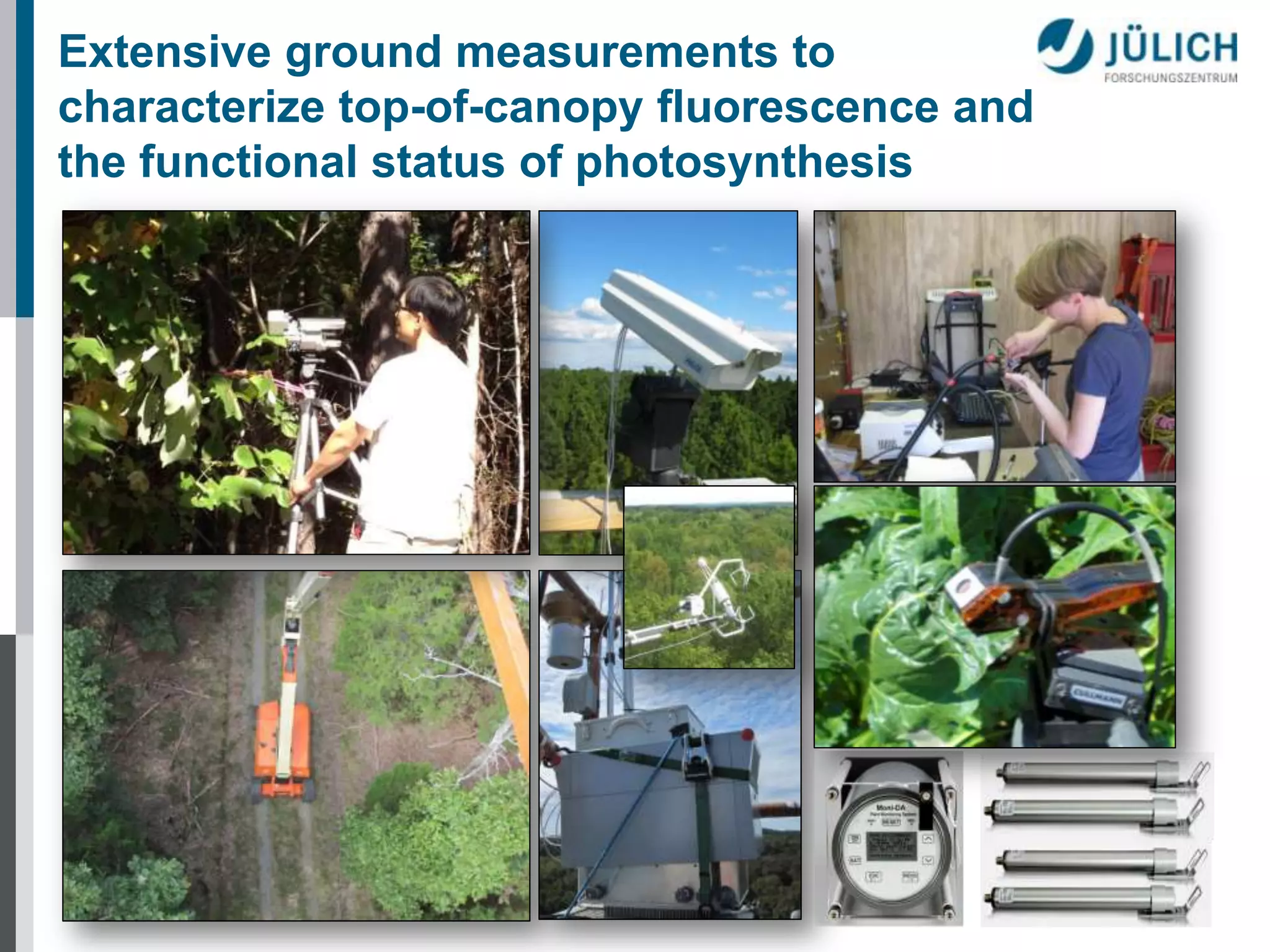
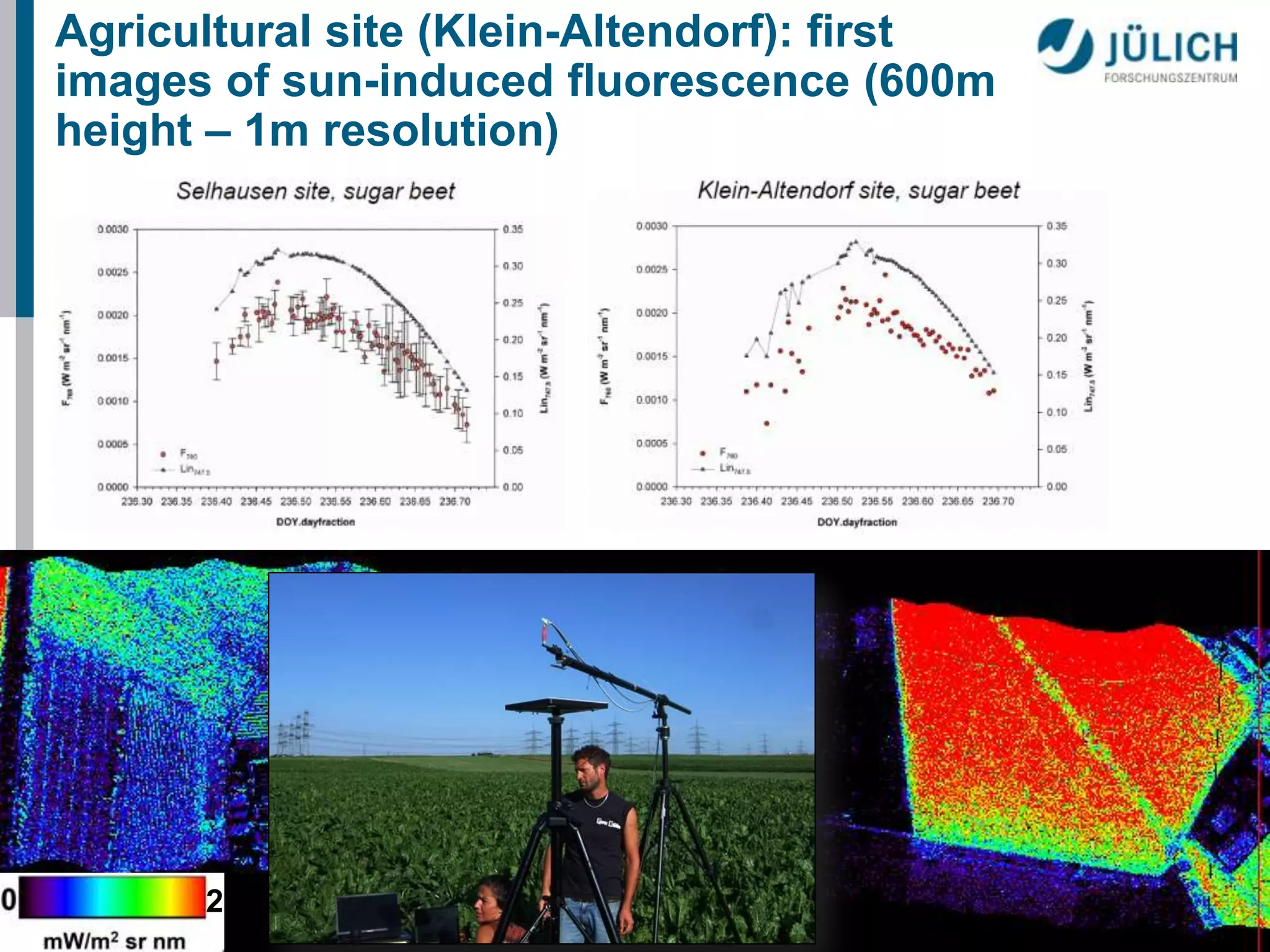
Extensive ground measurements to
characterize top-of-canopy fluorescence and
the functional status of photosynthesis
Agricultural site (Klein-Altendorf): first
images of sun-induced fluorescence (600m
height – 1m resolution)

2
Agricultural site (Klein-Altendorf): first
images of sun-induced fluorescence (600m
height – 1m resolution)

2
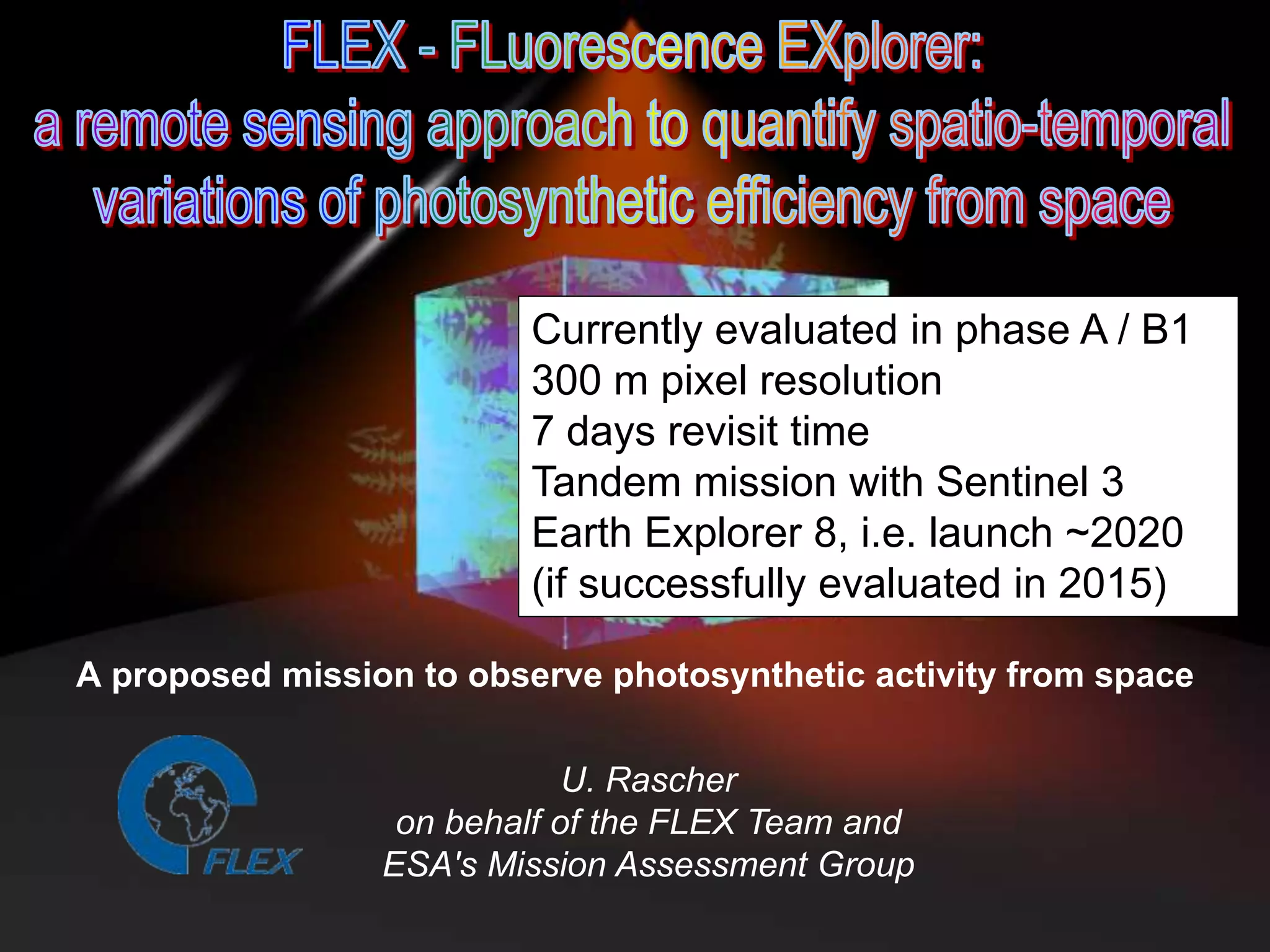
Currently evaluated in phase A / B1
300 m pixel resolution
7 days revisit time
Tandem mission with Sentinel 3
Earth Explorer 8, i.e. launch ~2020
(if successfully evaluated in 2015)
A proposed mission to observe photosynthetic activity from space
U. Rascher
on behalf of the FLEX Team and
ESA's Mission Assessment Group
Mitglied der Helmholtz-Gemeinschaft

Field Phenotyping
Development of Infrastructure
- PhenoCrops
- DPPN
- airborne sensors
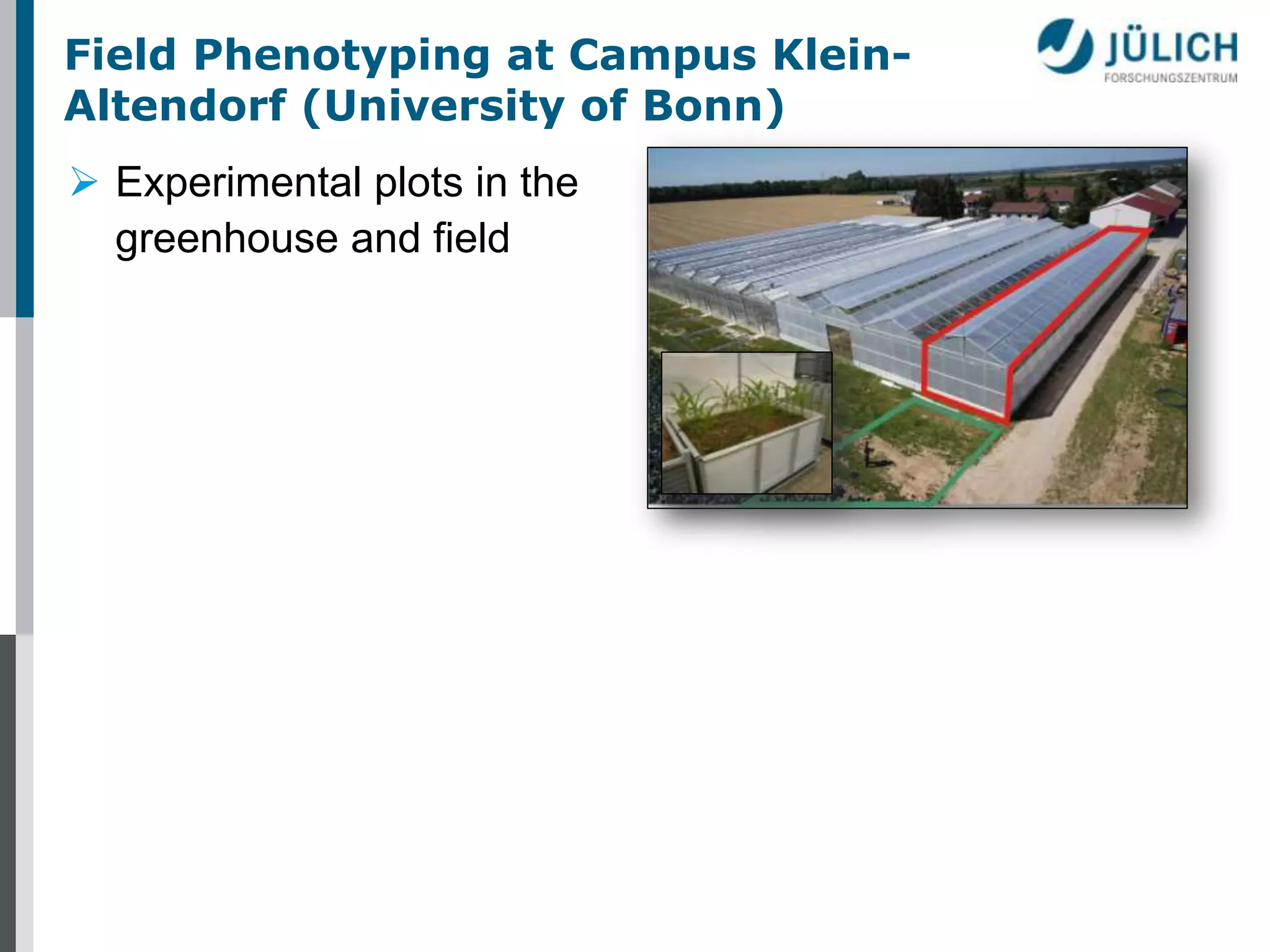
Field Phenotyping at Campus KleinAltendorf (University of Bonn)
 Experimental plots in the
greenhouse and field
Field Phenotyping at Campus KleinAltendorf (University of Bonn)
 Experimental plots in the
greenhouse and field
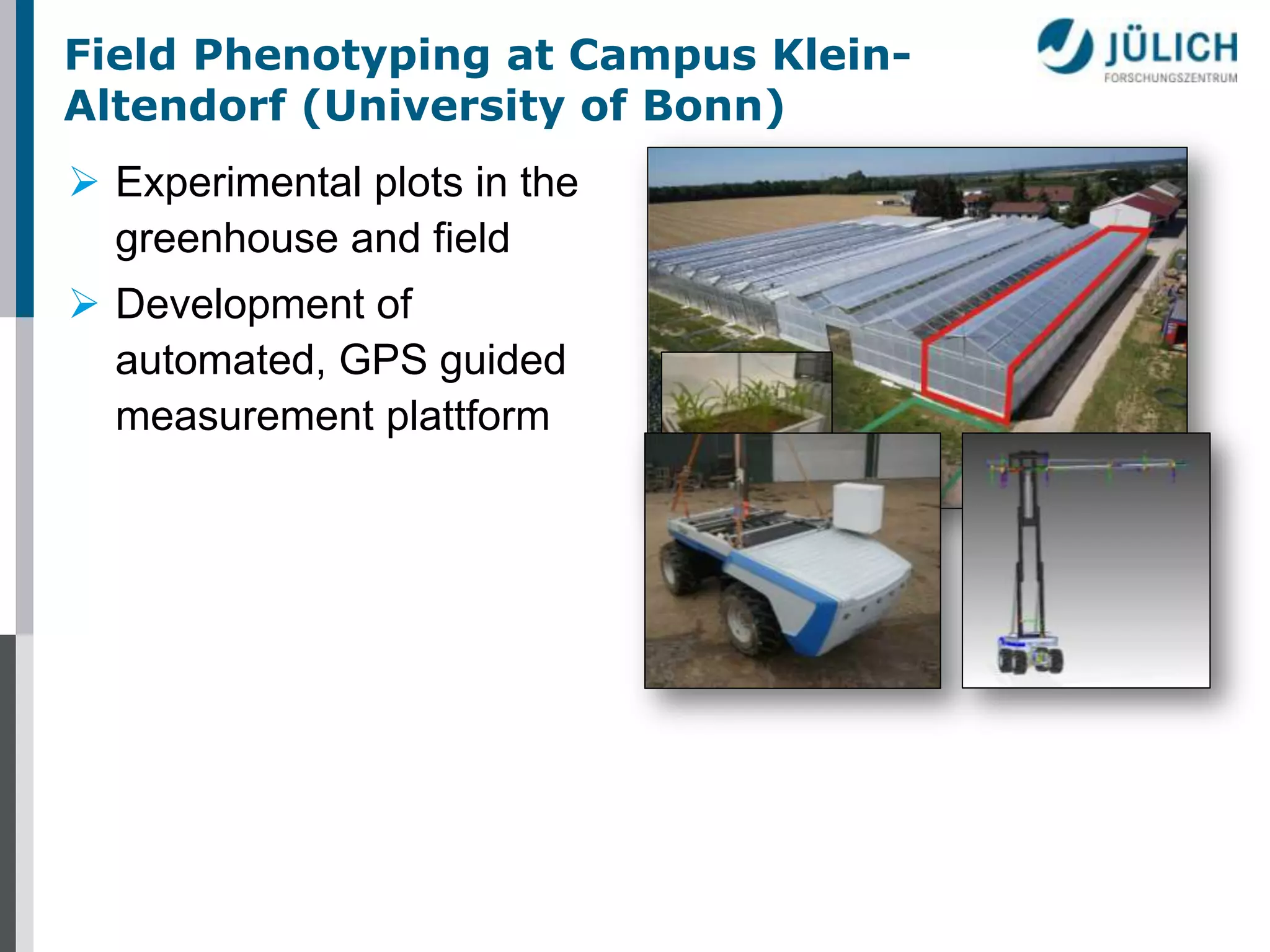
 Development of
automated, GPS guided
measurement plattform
Field Phenotyping at Campus KleinAltendorf (University of Bonn)
 Experimental plots in the
greenhouse and field
 Development of
automated, GPS guided
measurement plattform
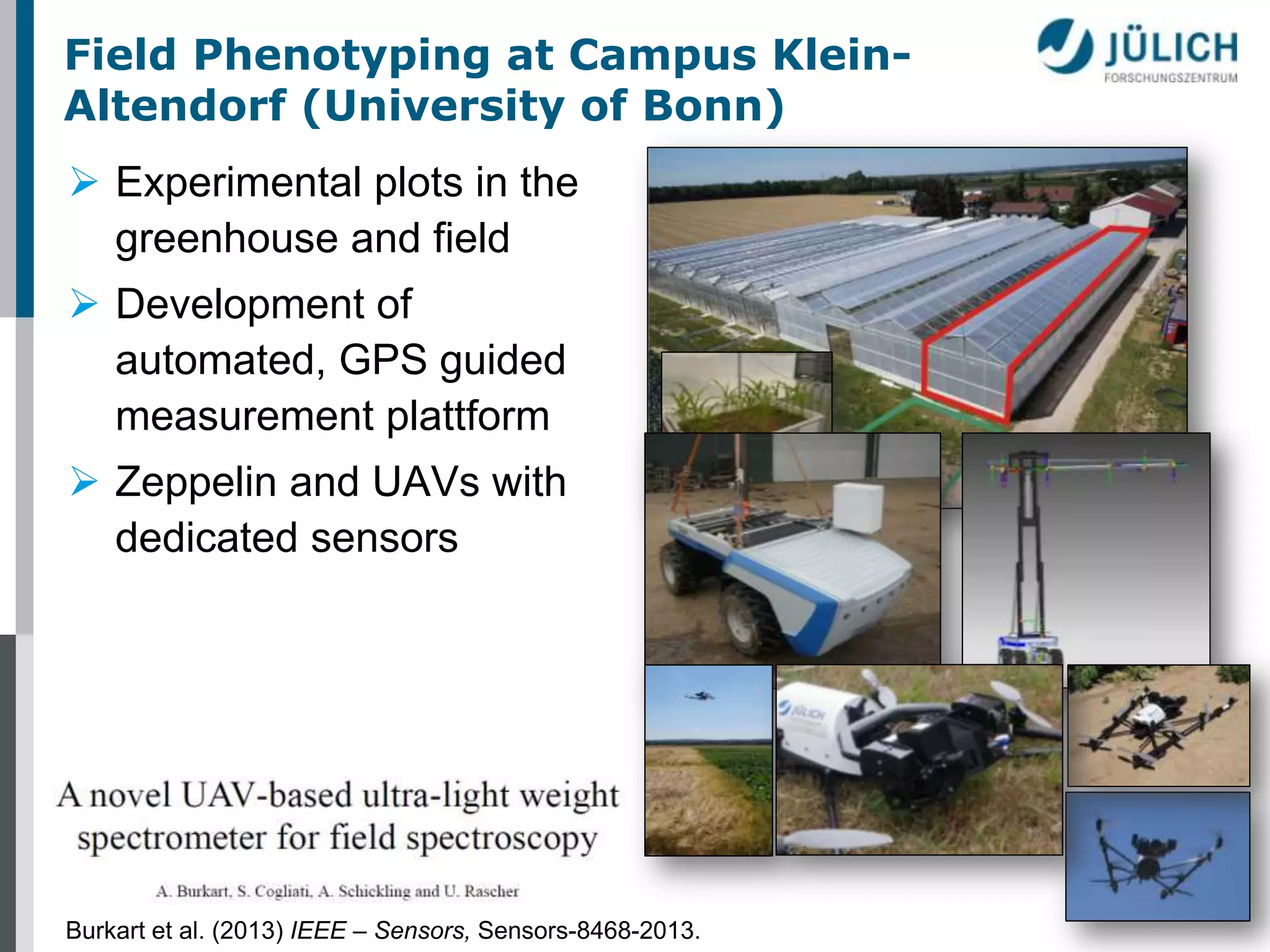
 Zeppelin and UAVs with
dedicated sensors

Burkart et al. (2013) IEEE – Sensors, Sensors-8468-2013.
Mitglied der Helmholtz-Gemeinschaft

Phenotyping – a networking approach

Developing and supporting
• Good Phenotyping Practice (GPP)
• Phenotyping platforms open for the
scientific community
• Efficient use of development and
infrastructure cost
• Technologies to be used in the community
Summary
Sun-induced fluorescence
 Can be retrieved using state-of-the-art spectrometers
and opens a new window in crop structure/function
 Top-of-canopy measurements and airborne
measurements allow the quantification of
 Canopy light absorption of active chlorophyll
(APARchl)

 Photosynthetic light use efficiency (LUE)

Challenges for the next years
 Development of operational instrument for top-ofcanopy fluorescence measurements
 Operational processing of airborne HyPlant data to
fluorescence products
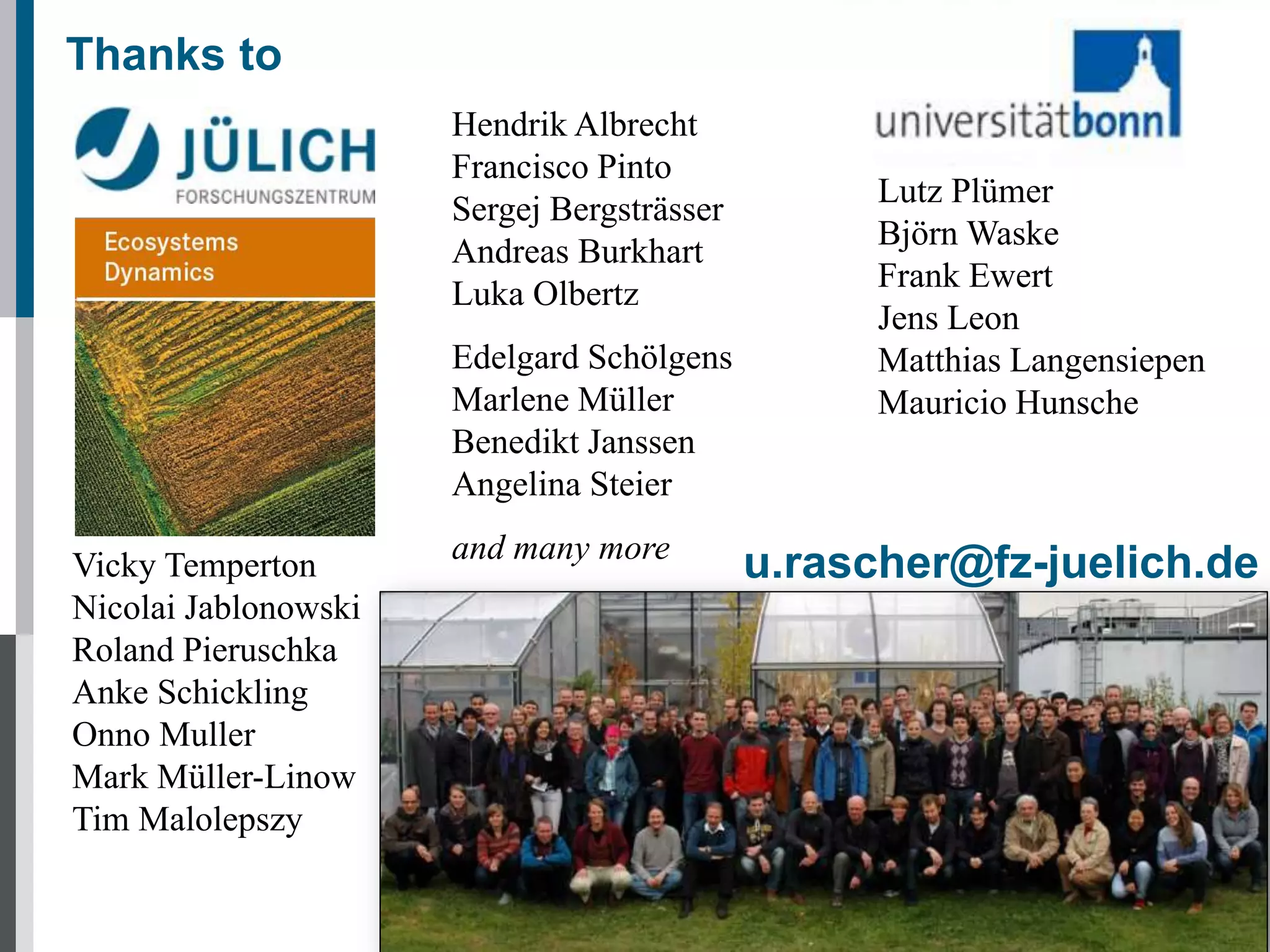
Thanks to
Hendrik Albrecht
Francisco Pinto
Sergej Bergsträsser
Andreas Burkhart
Luka Olbertz
Edelgard Schölgens
Marlene Müller
Benedikt Janssen
Angelina Steier
Vicky Temperton
Nicolai Jablonowski
Roland Pieruschka
Anke Schickling
Onno Muller
Mark Müller-Linow
Tim Malolepszy

and many more

Lutz Plümer
Björn Waske
Frank Ewert
Jens Leon
Matthias Langensiepen
Mauricio Hunsche

u.rascher@fz-juelich.de
Many Thanks to
Alexander Damm
Michael Schaepmann
Thomas Udelhoven
Luis Guanter
Joe Berry

Jose Moreno
Luis Alonso
Jochem Verelst
Micol Rossini
Roberto Colombo
Sergio Cogliati

Frantiszek Zemek
Jan Hanus
Lada Nedbal

Measuring and mapping canopy traits from the lab to the field: sun-induced fluorescence for crop phenotyping

  • 1.
    Mitglied der Helmholtz-Gemeinschaft Institutfür Bio- und Geowissenschaften IBG-2: Pflanzenwissenschaften Measuring and mapping canopy traits from the lab to the field: sun-induced fluorescence for crop phenotyping Uwe Rascher, Anke Schickling, Francisco Pinto IBG-2, Forschungszentrum Jülich, Germany Uwe Rascher 15. Dec 2013
  • 2.
  • 3.
    Forschungszentrum Jülich IBG-2: PlantSciences www.fz-juelich.de/ibg/ibg-2 140 employees, 45 scientists 25 PhD students • • • • • Bioeconomy Plant phenotyping Adaptation to climate change Sustainable bioproduction Basic research to application
  • 4.
    Phenotyping: Quantification of planttraits in space and time (including environmental and genetic constraints) Plant Production Breeding momentary traits Seasonal and spatial development of traits Precision farming Guided breeding
  • 5.
    Mitglied der Helmholtz-Gemeinschaft Developmentof new measurement approaches for field phenotyping / Remote Sensing - Imaging Spectroscopy - 3-D canopy reconstruction - sun-induced fluorescence
  • 6.
    Mitglied der Helmholtz-Gemeinschaft Developmentof new measurement approaches for field phenotyping / Remote Sensing - Imaging Spectroscopy - 3-D canopy reconstruction - sun-induced fluorescence
  • 7.
    Imaging Spectroscopy underfield conditions to quantify the spatio-temporal dynamics of shoot traits Chlorophyll NPQ Anthocyane Chlorophyll Carotinoide Wavelength dependent charakterization of constituents of plants and canopies
  • 8.
    Mapping of spatio-temporalcanopy dynamcis in the field by imaging spectroscopy and 3-D canopy reconstruction Challange to quantify the changes in the multidimensional data space and to relate structual and functional aspects of canopies
  • 9.
    Mitglied der Helmholtz-Gemeinschaft Developmentof new measurement approaches for field phenotyping / Remote Sensing - Imaging Spectroscopy - 3-D canopy reconstruction - sun-induced fluorescence
  • 10.
    3-D Canopy structure:Stereo Imaging allows the quantification of canopy structure
  • 11.
    3-D Canopy structure:Stereo Imaging allows the quantification of canopy structure
  • 12.
    3-D Canopy structure:Stereo Imaging allows the quantification of canopy structure  Zenith and azimuth of leaves can be quantified.  Method is parameterized and established for Arabidopsis, sugar beet, barley and apple trees Biskup et al. (2007) Plant, Cell & Environ. 30, 1299-1308 Rascher et al. (2010) Photosynthesis Research 105, 15-25 Müller-Linow & Rascher (to be submitted) BMC
  • 13.
    Mitglied der Helmholtz-Gemeinschaft Developmentof new measurement approaches for field phenotyping / Remote Sensing - Imaging Spectroscopy - 3-D canopy reconstruction - sun-induced fluorescence
  • 14.
  • 15.
    Sun-induced fluorescence canbe quantified in the atmospheric absorption lines
  • 16.
    Retrieval concept: Fraunhoferline discrimination (FLD)  Fluorescence can be retrieved in the relative dark atmospheric absorption bands according to the Fraunhofer Line Depth (FLD) method. slope: reflectance intercept: fluorescence Plascyk (1975) Optical Engineering 14, 339–346 Carter et al. (1996) Remote Sensing of Environment 55, 89–92 Moya et al. (2004) Remote Sensing of Environment 91, 186–197
  • 17.
    Mapping of spatio-temporalcanopy dynamcis in the field by high resolution imaging spectroscopy Corn, sugar beet and barley Measurements at 7 m high. Area: 1.5 x 2.7 m
  • 18.
    HyPlant: a novelhigh performance imaging spectrometer to measure sun-induced fluorescence Module 1: Imaging spectrometer (380 – 2500 nm) with 3 nm (VIS) and 12 nm (SWIR) spectral resolution Module 2: Fluorescence module (670 – 780 nm) with 0.25 nm (FWHM) and 0.11 nm (SSI)
  • 19.
    2012 / 2013data from agricultural area, Germany About one hundred flight lines from an agricultural area covering different times during the day and different stages during the vegetation period Georeferencing and radiometric calibration / characterization solved. Retrieval of fluorescence ongoing. 600 meters  1 meter pixel resolution 1800 meters  3 meter pixel resolution
  • 20.
    Extensive ground measurementsto characterize top-of-canopy fluorescence and the functional status of photosynthesis
  • 21.
    Agricultural site (Klein-Altendorf):first images of sun-induced fluorescence (600m height – 1m resolution) 2
  • 22.
    Agricultural site (Klein-Altendorf):first images of sun-induced fluorescence (600m height – 1m resolution) 2
  • 23.
    Currently evaluated inphase A / B1 300 m pixel resolution 7 days revisit time Tandem mission with Sentinel 3 Earth Explorer 8, i.e. launch ~2020 (if successfully evaluated in 2015) A proposed mission to observe photosynthetic activity from space U. Rascher on behalf of the FLEX Team and ESA's Mission Assessment Group
  • 24.
    Mitglied der Helmholtz-Gemeinschaft FieldPhenotyping Development of Infrastructure - PhenoCrops - DPPN - airborne sensors
  • 25.
    Field Phenotyping atCampus KleinAltendorf (University of Bonn)  Experimental plots in the greenhouse and field
  • 26.
    Field Phenotyping atCampus KleinAltendorf (University of Bonn)  Experimental plots in the greenhouse and field  Development of automated, GPS guided measurement plattform
  • 27.
    Field Phenotyping atCampus KleinAltendorf (University of Bonn)  Experimental plots in the greenhouse and field  Development of automated, GPS guided measurement plattform  Zeppelin and UAVs with dedicated sensors Burkart et al. (2013) IEEE – Sensors, Sensors-8468-2013.
  • 28.
    Mitglied der Helmholtz-Gemeinschaft Phenotyping– a networking approach Developing and supporting • Good Phenotyping Practice (GPP) • Phenotyping platforms open for the scientific community • Efficient use of development and infrastructure cost • Technologies to be used in the community
  • 29.
    Summary Sun-induced fluorescence  Canbe retrieved using state-of-the-art spectrometers and opens a new window in crop structure/function  Top-of-canopy measurements and airborne measurements allow the quantification of  Canopy light absorption of active chlorophyll (APARchl)  Photosynthetic light use efficiency (LUE) Challenges for the next years  Development of operational instrument for top-ofcanopy fluorescence measurements  Operational processing of airborne HyPlant data to fluorescence products
  • 30.
    Thanks to Hendrik Albrecht FranciscoPinto Sergej Bergsträsser Andreas Burkhart Luka Olbertz Edelgard Schölgens Marlene Müller Benedikt Janssen Angelina Steier Vicky Temperton Nicolai Jablonowski Roland Pieruschka Anke Schickling Onno Muller Mark Müller-Linow Tim Malolepszy and many more Lutz Plümer Björn Waske Frank Ewert Jens Leon Matthias Langensiepen Mauricio Hunsche u.rascher@fz-juelich.de
  • 31.
    Many Thanks to AlexanderDamm Michael Schaepmann Thomas Udelhoven Luis Guanter Joe Berry Jose Moreno Luis Alonso Jochem Verelst Micol Rossini Roberto Colombo Sergio Cogliati Frantiszek Zemek Jan Hanus Lada Nedbal