Cara A. Rockwell, Manuel R. Guariguata,
Mary Menton, Eriks Arroyo Quispe, Julia
Quaedvlieg, Eleanor Warren-Thomas
M. Simola
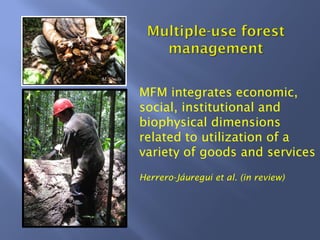
MFM integrates economic,
social, institutional and
biophysical dimensions
related to utilization of a
variety of goods and services
Herrero-Jáuregui et al. (in review)
Problem: Limited ecological evidence for
sustainable integration of NTFP and timber
harvests
Examples:
Plant species composition/abundance (Salick
et al. 1995)
Harvestable epiphyte biomass (Romero 1999)
Damage to B. excelsa adults (Guariguata et al.
2009)
Economic value of Carapa guianensis timber
and seed harvests (Klimas et al. 2012)
B. excelsa regeneration (Soriano et al. 2012)
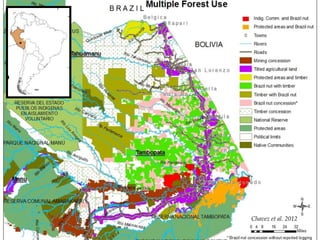
Chavez et al. 2012
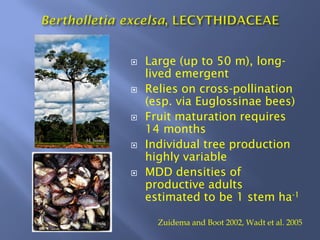
Large (up to 50 m), long-
lived emergent
Relies on cross-pollination
(esp. via Euglossinae bees)
Fruit maturation requires
14 months
Individual tree production
highly variable
MDD densities of
productive adults
estimated to be 1 stem ha-1
Zuidema and Boot 2002, Wadt et al. 2005
M. Simola
M. Simola
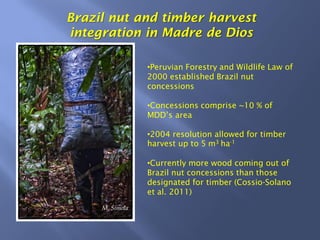
Brazil nut and timber harvest
integration in Madre de Dios
Peruvian Forestry and Wildlife Law of
2000 established Brazil nut
concessions
Concessions comprise ~10 % of
2004 resolution allowed for timber
harvest up to 5 m3 ha-1
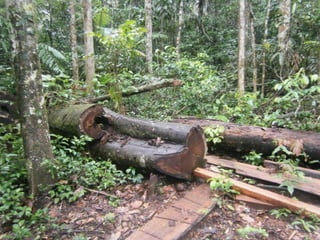
Currently more wood coming out of
Brazil nut concessions than those
designated for timber (Cossio-Solano
et al. 2011)
M. Simola
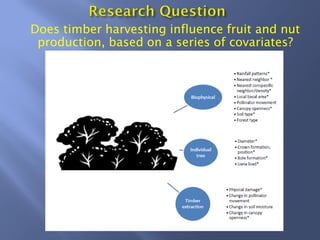
Does timber harvesting influence fruit and nut
production, based on a series of covariates?
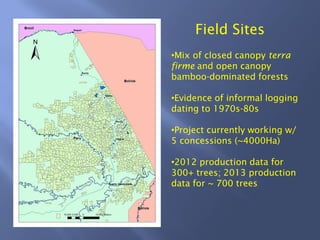
Field Sites
Mix of closed canopy terra
firme and open canopy
bamboo-dominated forests
Evidence of informal logging
dating to 1970s-80s
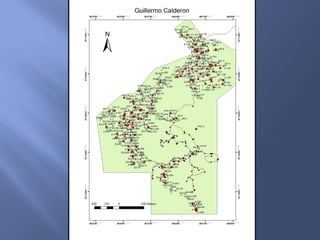
Project currently working w/
5 concessions (~4000Ha)
2012 production data for
300+ trees; 2013 production
data for ~ 700 trees
M. Simola
M. Simola
H. Kohagura Arrunátegui
Estimate Standard
Error
t
Value
Pr(>|t|)
(Intercept) 354.2 173.0 2.1 0.04*
Circumference 8.7 60.7 0.1 0.89
Circumference2 4.8 9.1 0.5 0.60
Log Distance -56.3 23.9 -2.4 0.02*
Presence Liana -49.2 30.4 -1.6 0.11
Presence Nail 50.0 35.0 1.4 0.16
Regression of distance to cut stump on fruit
count
How do we measure logging impacts on
individual tree production?
Independent variables that will be
included in future analyses: soil type,
crown diameter and position, location,
nearest neighbor, liana load, local basal
area, rainfall data, local logging intensity,
logging gap age, logging gap size,
physical damage
Expand the current study to include more
Inter-Oceanic Highway concessions as well
as concessions in Tambopata National
Reserve
Expand the current focus on productive B.
excelsa adults to also include advanced
regeneration
USAID (United States Agency for International Development)
Participating concession owners: Pedro L. Amao Gallegos, Pablo
Alegre Usca, Felicitas Ramirez Surco, Bertilda Arias de Simplicio,
Guillermo Calderon Ramirez
UNAMAD (Ing. Mishari Garcia Roca, Carlos N. Ancco Mamani,
Olivia Revilla Vera, Lorenzo Ccoycca Leon, Betxy Villarroel Panduro,
Hideki Kohagura Arrunátegui, Soledad Montesinos Ferro, Arikson
Nemecio Cruz Rafael, Delma Dominguez Salcedo, Merly Arancivia
Quispe, Luchina Atau Huaman, Erika Suarez Ccalluchi, Jhony
Alexander Grifa Juriuchi, Edwin Jurado Rojas, Frank Valera Tito,
Juan José Yucra Salas, Roger Quenta Hancco, Saúl Arocutipa
Coaquira)
SPDA (Sociedad Peruana de Derecho Ambiental)
ACCA (Asociación para la Conservación de la Cuenca Amazónica)
FEPROCAMD (Federación de Productores de Castaña de Madre de
Díos)
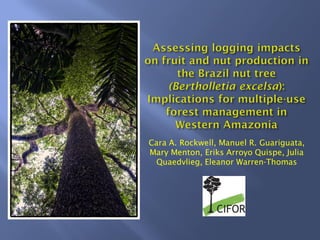
Assessing logging impacts on fruit and nut production in the Brazil nut tree (Bertholletia excelsa): Implications for multiple-use forest management in Western Amazonia

Assessing logging impacts on fruit and nut production in the Brazil nut tree (Bertholletia excelsa): Implications for multiple-use forest management in Western Amazonia

  • 1.
    Cara A. Rockwell,Manuel R. Guariguata, Mary Menton, Eriks Arroyo Quispe, Julia Quaedvlieg, Eleanor Warren-Thomas
  • 2.
    M. Simola MFM integrateseconomic, social, institutional and biophysical dimensions related to utilization of a variety of goods and services Herrero-Jáuregui et al. (in review)
  • 3.
    Problem: Limited ecologicalevidence for sustainable integration of NTFP and timber harvests Examples: Plant species composition/abundance (Salick et al. 1995) Harvestable epiphyte biomass (Romero 1999) Damage to B. excelsa adults (Guariguata et al. 2009) Economic value of Carapa guianensis timber and seed harvests (Klimas et al. 2012) B. excelsa regeneration (Soriano et al. 2012)
  • 4.
  • 5.
    Large (up to50 m), long- lived emergent Relies on cross-pollination (esp. via Euglossinae bees) Fruit maturation requires 14 months Individual tree production highly variable MDD densities of productive adults estimated to be 1 stem ha-1 Zuidema and Boot 2002, Wadt et al. 2005 M. Simola M. Simola
  • 6.
    Brazil nut andtimber harvest integration in Madre de Dios Peruvian Forestry and Wildlife Law of 2000 established Brazil nut concessions Concessions comprise ~10 % of 2004 resolution allowed for timber harvest up to 5 m3 ha-1 Currently more wood coming out of Brazil nut concessions than those designated for timber (Cossio-Solano et al. 2011) M. Simola
  • 9.
    Does timber harvestinginfluence fruit and nut production, based on a series of covariates?
  • 10.
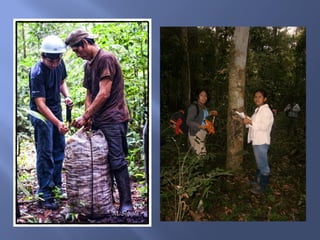
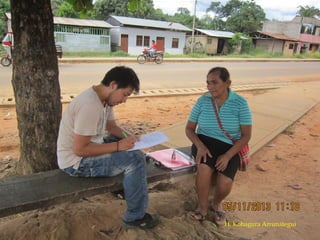
    Field Sites Mix ofclosed canopy terra firme and open canopy bamboo-dominated forests Evidence of informal logging dating to 1970s-80s Project currently working w/ 5 concessions (~4000Ha) 2012 production data for 300+ trees; 2013 production data for ~ 700 trees
  • 12.
  • 13.
  • 14.
  • 15.
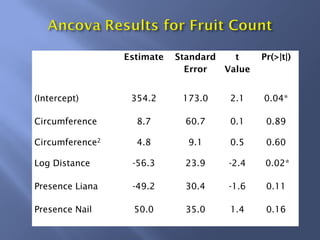
    Estimate Standard Error t Value Pr(>|t|) (Intercept) 354.2173.0 2.1 0.04* Circumference 8.7 60.7 0.1 0.89 Circumference2 4.8 9.1 0.5 0.60 Log Distance -56.3 23.9 -2.4 0.02* Presence Liana -49.2 30.4 -1.6 0.11 Presence Nail 50.0 35.0 1.4 0.16
  • 16.
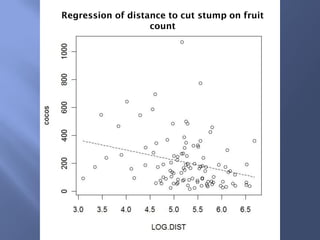
    Regression of distanceto cut stump on fruit count
  • 17.
    How do wemeasure logging impacts on individual tree production? Independent variables that will be included in future analyses: soil type, crown diameter and position, location, nearest neighbor, liana load, local basal area, rainfall data, local logging intensity, logging gap age, logging gap size, physical damage
  • 18.
    Expand the currentstudy to include more Inter-Oceanic Highway concessions as well as concessions in Tambopata National Reserve Expand the current focus on productive B. excelsa adults to also include advanced regeneration
  • 19.
    USAID (United StatesAgency for International Development) Participating concession owners: Pedro L. Amao Gallegos, Pablo Alegre Usca, Felicitas Ramirez Surco, Bertilda Arias de Simplicio, Guillermo Calderon Ramirez UNAMAD (Ing. Mishari Garcia Roca, Carlos N. Ancco Mamani, Olivia Revilla Vera, Lorenzo Ccoycca Leon, Betxy Villarroel Panduro, Hideki Kohagura Arrunátegui, Soledad Montesinos Ferro, Arikson Nemecio Cruz Rafael, Delma Dominguez Salcedo, Merly Arancivia Quispe, Luchina Atau Huaman, Erika Suarez Ccalluchi, Jhony Alexander Grifa Juriuchi, Edwin Jurado Rojas, Frank Valera Tito, Juan José Yucra Salas, Roger Quenta Hancco, Saúl Arocutipa Coaquira) SPDA (Sociedad Peruana de Derecho Ambiental) ACCA (Asociación para la Conservación de la Cuenca Amazónica) FEPROCAMD (Federación de Productores de Castaña de Madre de Díos)