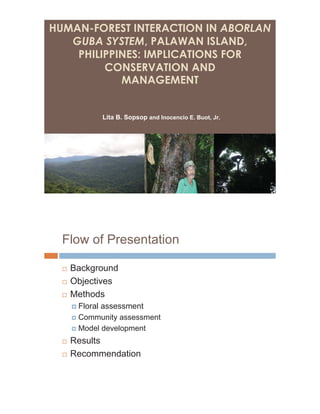

HUMAN-FOREST INTERACTION IN ABORLAN
   GUBA SYSTEM, PALAWAN ISLAND,
    PHILIPPINES: IMPLICATIONS FOR
         CONSERVATION AND
            MANAGEMENT


             Lita B. Sopsop and Inocencio E. Buot, Jr.


  Flow of Presentation

  …   Background
  …   Objectives
  …   Methods
      † Floral assessment
      † Community assessment

      † Model development

  …   Results
  …   Recommendation
Background
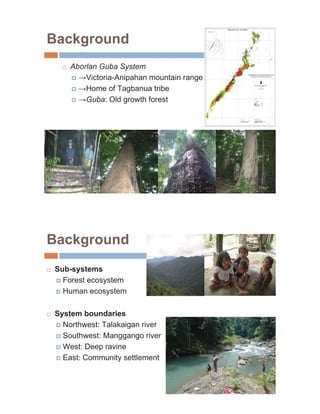
      …   Aborlan Guba System
          †   Victoria-Anipahan mountain range
          †   Home of Tagbanua tribe
          †   Guba: Old growth forest


Background
…   Sub-systems
    † Forest ecosystem

    † Human ecosystem


…   System boundaries
    † Northwest: Talakaigan river

    † Southwest: Manggango river

    † West: Deep ravine

    † East: Community settlement
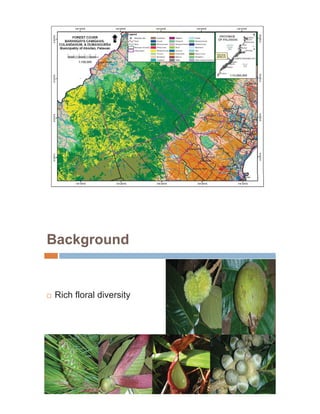
Background


…   Rich floral diversity
Background
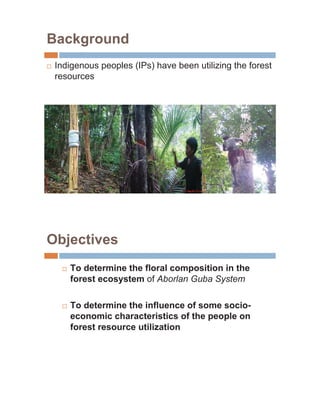
…   Indigenous peoples (IPs) have been utilizing the forest
    resources


Objectives
     …   To determine the floral composition in the
         forest ecosystem of Aborlan Guba System

     …   To determine the influence of some socio-
         economic characteristics of the people on
         forest resource utilization
Objectives

     …   To develop a model that would predict the
         forest cover change by factoring both
         current resource utilization and more
         sustainable management alternatives

     …   To formulate a sustainable plan for the
         management of Aborlan Guba System


Methods

…   Plant species collection: Quadrat technique
    (Mueller-Dombois & Ellenberg; Pacardo et al.,
    2000)

…   Nomenclature : most recent revision in the Flora
    Malesiana project
Methods
…   Community Assessment
           Key Informant Interview: know the direct users of
                               the forests
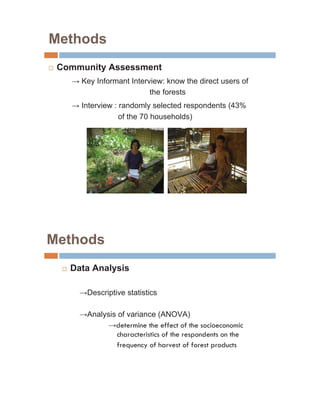
           Interview : randomly selected respondents (43%
                       of the 70 households)


Methods
     …   Data Analysis

            Descriptive statistics

            Analysis of variance (ANOVA)
                    determine the effect of the socioeconomic
                    characteristics of the respondents on the
                    frequency of harvest of forest products
Methods
     …   The Model


           Developed using STELLA

                     predict forest cover change : current
                  resource utilization and with government
                  intervention


Results: Floral Composition
…   324 plant species 192 genera & 89 families
    †   10% of 3,000-3,500 vascular plants in Palawan
    †   4% of 8,000 vascular plants in the Phil.


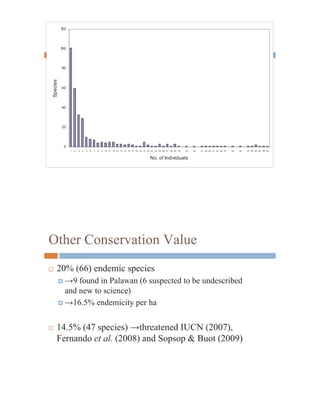
…   Many Rare Species
    †     59.9%   3 individuals or less
120


          100


           80
Species


           60


           40


           20


              0
                  1   2   3   4   5   6   7   8   9   10 11 12 13 14 15 16 17 18 19 21 22 23 24 25 26 27 28 29 30   33   35   37 38 39 41 42 44 47   52   54   57 58 60 62 68 85


                                                                                         No. of Individuals


Other Conservation Value
…    20% (66) endemic species
          †   9 found in Palawan (6 suspected to be undescribed
            and new to science)
          †   16.5% endemicity per ha

…    14.5% (47 species) threatened IUCN (2007),
     Fernando et al. (2008) and Sopsop & Buot (2009)
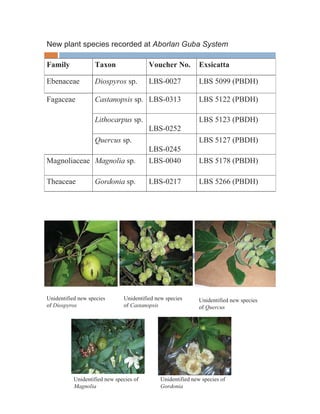
New plant species recorded at Aborlan Guba System

Family             Taxon                 Voucher No.          Exsicatta

Ebenaceae          Diospyros sp.         LBS-0027             LBS 5099 (PBDH)

Fagaceae           Castanopsis sp. LBS-0313                   LBS 5122 (PBDH)

                   Lithocarpus sp.                            LBS 5123 (PBDH)
                                         LBS-0252
                   Quercus sp.                                LBS 5127 (PBDH)
                                         LBS-0245
Magnoliaceae Magnolia sp.                LBS-0040             LBS 5178 (PBDH)

Theaceae           Gordonia sp.          LBS-0217             LBS 5266 (PBDH)


Unidentified new species       Unidentified new species       Unidentified new species
of Diospyros                   of Castanopsis                 of Quercus


           Unidentified new species of        Unidentified new species of
           Magnolia                           Gordonia
Implications
…   Aborlan Guba System has rich floral composition

…   Significant role in Palawan and in global biodiversity

…   Habitat destruction   local extinction of rare species
                          loss of overall biodiversity

…   Strictest measures    prevent any degradation of the
                          unique genetic resource


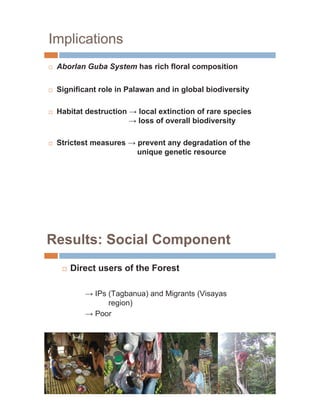
Results: Social Component
     …   Direct users of the Forest

              IPs (Tagbanua) and Migrants (Visayas
                  region)
              Poor
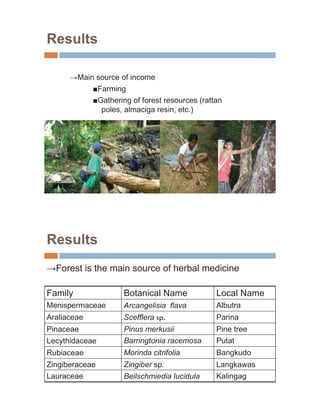
Results

         Main source of income
              Farming
              Gathering of forest resources (rattan
               poles, almaciga resin, etc.)


Results
  Forest is the main source of herbal medicine

Family                Botanical Name             Local Name
Menispermaceae        Arcangelisia flava         Albutra
Araliaceae            Scefflera sp.              Parina
Pinaceae              Pinus merkusii             Pine tree
Lecythidaceae         Barringtonia racemosa      Putat
Rubiaceae             Morinda citrifolia         Bangkudo
Zingiberaceae         Zingiber sp.               Langkawas
Lauraceae             Beilschmiedia lucidula     Kalingag
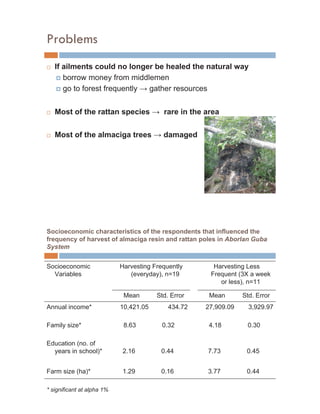
Problems
…   If ailments could no longer be healed the natural way
     † borrow money from middlemen

     † go to forest frequently gather resources


…   Most of the rattan species            rare in the area

…   Most of the almaciga trees            damaged


Socioeconomic characteristics of the respondents that influenced the
frequency of harvest of almaciga resin and rattan poles in Aborlan Guba
System


Socioeconomic               Harvesting Frequently       Harvesting Less
  Variables                    (everyday), n=19        Frequent (3X a week
                                                          or less), n=11

                             Mean       Std. Error     Mean       Std. Error
Annual income*              10,421.05       434.72    27,909.09     3,929.97

Family size*                 8.63         0.32         4.18        0.30

Education (no. of
  years in school)*         2.16         0.44         7.73         0.45


Farm size (ha)*             1.29         0.16         3.77         0.44

* significant at alpha 1%
Results
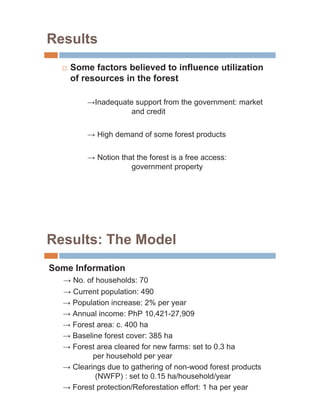
  …   Some factors believed to influence utilization
      of resources in the forest

            Inadequate support from the government: market
                      and credit

             High demand of some forest products

             Notion that the forest is a free access:
                       government property


Results: The Model
Some Information
      No. of households: 70
      Current population: 490
      Population increase: 2% per year
      Annual income: PhP 10,421-27,909
      Forest area: c. 400 ha
      Baseline forest cover: 385 ha
      Forest area cleared for new farms: set to 0.3 ha
            per household per year
      Clearings due to gathering of non-wood forest products
             (NWFP) : set to 0.15 ha/household/year
      Forest protection/Reforestation effort: 1 ha per year
Results: The Model

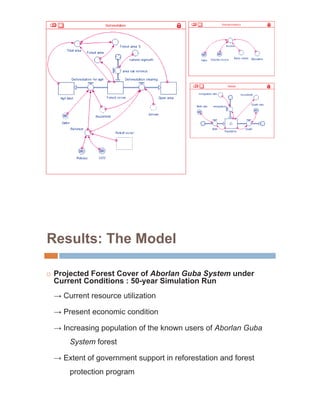
…   Projected Forest Cover of Aborlan Guba System under
    Current Conditions : 50-year Simulation Run
      Current resource utilization

      Present economic condition

      Increasing population of the known users of Aborlan Guba
        System forest

      Extent of government support in reforestation and forest
        protection program
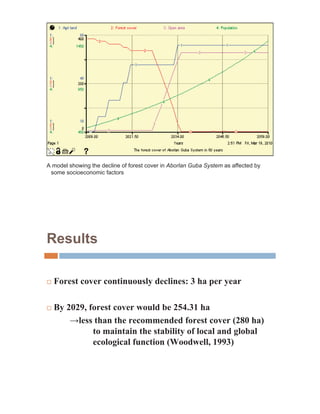
A model showing the decline of forest cover in Aborlan Guba System as affected by
 some socioeconomic factors


Results

…   Forest cover continuously declines: 3 ha per year

…   By 2029, forest cover would be 254.31 ha
          less than the recommended forest cover (280 ha)
              to maintain the stability of local and global
              ecological function (Woodwell, 1993)
Results
…   Projection

          $ 17,172 or PhP789,912 (PhP 46 dollar-peso
               exchange rate) will be lost annually based on
               the 3 ha annual forest loss


Implication
     …   Current resource utilization practices were not
         sustainable whether viewed from genetic,
         ecological or socioeconomic points of view
Implication
     …   Without government interventions sustainable
         management and/or adoption of conservation
         principles:

              The living conditions of local communities will
                    deteriorate
              The environment will become heavily degraded,
                    with very serious loss of biological diversity


Scenario Building
…   Alternative Management Scenario of Aborlan
    Guba System

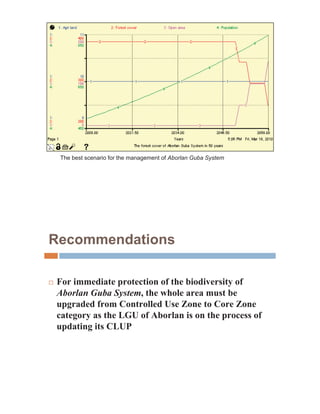
          Annual income from sale and outside source:
                increased to 35,000 and 5,000, respectively

          Population growth rate: reduced to 1%

          Reforestation and forest protection efforts of the
                government: increased to 2 ha per year
The best scenario for the management of Aborlan Guba System


Recommendations

…   For immediate protection of the biodiversity of
    Aborlan Guba System, the whole area must be
    upgraded from Controlled Use Zone to Core Zone
    category as the LGU of Aborlan is on the process of
    updating its CLUP
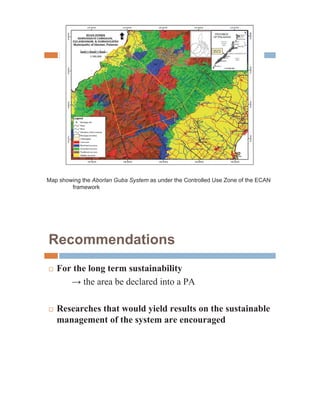
Map showing the Aborlan Guba System as under the Controlled Use Zone of the ECAN
        framework


Recommendations
…   For the long term sustainability
          the area be declared into a PA

…   Researches that would yield results on the sustainable
    management of the system are encouraged
Recommendations
…   The LGU and other organizations should help create
    employment opportunities for local people

…   The people must be empowered to maximize their
    full potentials in exploring various livelihood
    opportunities without depleting the forest resources

…   The community’s farming system practices must be
    strengthened to increase their income


Acknowledgement
…   Leonardo L. Co
…   Edwin R. Abucay
…   Leo Ocampo
MAYAD NA ADLAW
  (GOOD DAY)

HUMAN-FOREST INTERACTION IN ABORLAN, PALAWAN

  • 1.
    HUMAN-FOREST INTERACTION INABORLAN GUBA SYSTEM, PALAWAN ISLAND, PHILIPPINES: IMPLICATIONS FOR CONSERVATION AND MANAGEMENT Lita B. Sopsop and Inocencio E. Buot, Jr. Flow of Presentation … Background … Objectives … Methods † Floral assessment † Community assessment † Model development … Results … Recommendation
  • 2.
    Background … Aborlan Guba System † Victoria-Anipahan mountain range † Home of Tagbanua tribe † Guba: Old growth forest Background … Sub-systems † Forest ecosystem † Human ecosystem … System boundaries † Northwest: Talakaigan river † Southwest: Manggango river † West: Deep ravine † East: Community settlement
  • 3.
    Background … Rich floral diversity
  • 4.
    Background … Indigenous peoples (IPs) have been utilizing the forest resources Objectives … To determine the floral composition in the forest ecosystem of Aborlan Guba System … To determine the influence of some socio- economic characteristics of the people on forest resource utilization
  • 5.
    Objectives … To develop a model that would predict the forest cover change by factoring both current resource utilization and more sustainable management alternatives … To formulate a sustainable plan for the management of Aborlan Guba System Methods … Plant species collection: Quadrat technique (Mueller-Dombois & Ellenberg; Pacardo et al., 2000) … Nomenclature : most recent revision in the Flora Malesiana project
  • 6.
    Methods … Community Assessment Key Informant Interview: know the direct users of the forests Interview : randomly selected respondents (43% of the 70 households) Methods … Data Analysis Descriptive statistics Analysis of variance (ANOVA) determine the effect of the socioeconomic characteristics of the respondents on the frequency of harvest of forest products
  • 7.
    Methods … The Model Developed using STELLA predict forest cover change : current resource utilization and with government intervention Results: Floral Composition … 324 plant species 192 genera & 89 families † 10% of 3,000-3,500 vascular plants in Palawan † 4% of 8,000 vascular plants in the Phil. … Many Rare Species † 59.9% 3 individuals or less
  • 8.
    120 100 80 Species 60 40 20 0 1 2 3 4 5 6 7 8 9 10 11 12 13 14 15 16 17 18 19 21 22 23 24 25 26 27 28 29 30 33 35 37 38 39 41 42 44 47 52 54 57 58 60 62 68 85 No. of Individuals Other Conservation Value … 20% (66) endemic species † 9 found in Palawan (6 suspected to be undescribed and new to science) † 16.5% endemicity per ha … 14.5% (47 species) threatened IUCN (2007), Fernando et al. (2008) and Sopsop & Buot (2009)
  • 9.
    New plant speciesrecorded at Aborlan Guba System Family Taxon Voucher No. Exsicatta Ebenaceae Diospyros sp. LBS-0027 LBS 5099 (PBDH) Fagaceae Castanopsis sp. LBS-0313 LBS 5122 (PBDH) Lithocarpus sp. LBS 5123 (PBDH) LBS-0252 Quercus sp. LBS 5127 (PBDH) LBS-0245 Magnoliaceae Magnolia sp. LBS-0040 LBS 5178 (PBDH) Theaceae Gordonia sp. LBS-0217 LBS 5266 (PBDH) Unidentified new species Unidentified new species Unidentified new species of Diospyros of Castanopsis of Quercus Unidentified new species of Unidentified new species of Magnolia Gordonia
  • 10.
    Implications … Aborlan Guba System has rich floral composition … Significant role in Palawan and in global biodiversity … Habitat destruction local extinction of rare species loss of overall biodiversity … Strictest measures prevent any degradation of the unique genetic resource Results: Social Component … Direct users of the Forest IPs (Tagbanua) and Migrants (Visayas region) Poor
  • 11.
    Results Main source of income Farming Gathering of forest resources (rattan poles, almaciga resin, etc.) Results Forest is the main source of herbal medicine Family Botanical Name Local Name Menispermaceae Arcangelisia flava Albutra Araliaceae Scefflera sp. Parina Pinaceae Pinus merkusii Pine tree Lecythidaceae Barringtonia racemosa Putat Rubiaceae Morinda citrifolia Bangkudo Zingiberaceae Zingiber sp. Langkawas Lauraceae Beilschmiedia lucidula Kalingag
  • 12.
    Problems … If ailments could no longer be healed the natural way † borrow money from middlemen † go to forest frequently gather resources … Most of the rattan species rare in the area … Most of the almaciga trees damaged Socioeconomic characteristics of the respondents that influenced the frequency of harvest of almaciga resin and rattan poles in Aborlan Guba System Socioeconomic Harvesting Frequently Harvesting Less Variables (everyday), n=19 Frequent (3X a week or less), n=11 Mean Std. Error Mean Std. Error Annual income* 10,421.05 434.72 27,909.09 3,929.97 Family size* 8.63 0.32 4.18 0.30 Education (no. of years in school)* 2.16 0.44 7.73 0.45 Farm size (ha)* 1.29 0.16 3.77 0.44 * significant at alpha 1%
  • 13.
    Results … Some factors believed to influence utilization of resources in the forest Inadequate support from the government: market and credit High demand of some forest products Notion that the forest is a free access: government property Results: The Model Some Information No. of households: 70 Current population: 490 Population increase: 2% per year Annual income: PhP 10,421-27,909 Forest area: c. 400 ha Baseline forest cover: 385 ha Forest area cleared for new farms: set to 0.3 ha per household per year Clearings due to gathering of non-wood forest products (NWFP) : set to 0.15 ha/household/year Forest protection/Reforestation effort: 1 ha per year
  • 14.
    Results: The Model … Projected Forest Cover of Aborlan Guba System under Current Conditions : 50-year Simulation Run Current resource utilization Present economic condition Increasing population of the known users of Aborlan Guba System forest Extent of government support in reforestation and forest protection program
  • 15.
    A model showingthe decline of forest cover in Aborlan Guba System as affected by some socioeconomic factors Results … Forest cover continuously declines: 3 ha per year … By 2029, forest cover would be 254.31 ha less than the recommended forest cover (280 ha) to maintain the stability of local and global ecological function (Woodwell, 1993)
  • 16.
    Results … Projection $ 17,172 or PhP789,912 (PhP 46 dollar-peso exchange rate) will be lost annually based on the 3 ha annual forest loss Implication … Current resource utilization practices were not sustainable whether viewed from genetic, ecological or socioeconomic points of view
  • 17.
    Implication … Without government interventions sustainable management and/or adoption of conservation principles: The living conditions of local communities will deteriorate The environment will become heavily degraded, with very serious loss of biological diversity Scenario Building … Alternative Management Scenario of Aborlan Guba System Annual income from sale and outside source: increased to 35,000 and 5,000, respectively Population growth rate: reduced to 1% Reforestation and forest protection efforts of the government: increased to 2 ha per year
  • 18.
    The best scenariofor the management of Aborlan Guba System Recommendations … For immediate protection of the biodiversity of Aborlan Guba System, the whole area must be upgraded from Controlled Use Zone to Core Zone category as the LGU of Aborlan is on the process of updating its CLUP
  • 19.
    Map showing theAborlan Guba System as under the Controlled Use Zone of the ECAN framework Recommendations … For the long term sustainability the area be declared into a PA … Researches that would yield results on the sustainable management of the system are encouraged
  • 20.
    Recommendations … The LGU and other organizations should help create employment opportunities for local people … The people must be empowered to maximize their full potentials in exploring various livelihood opportunities without depleting the forest resources … The community’s farming system practices must be strengthened to increase their income Acknowledgement … Leonardo L. Co … Edwin R. Abucay … Leo Ocampo
  • 21.
    MAYAD NA ADLAW (GOOD DAY)