SENSORIMOTOR STAGE
I. SENSORIMOTOR INTELLIGENCE
Reflexes (0-1 month)
 Primary Circular Reactions (1-4 months)
 Secondary Circular Reactions (4-8 months)
 Coordination Reactions (8-12 months)

A. REFLEXES
Infant’s behaviors in this substage reflects innate
reflexes- automatic response to particular
stimuli
 They suck, grasp and cry
 Much of what happens at first is accidental
caused by random movements
 They use their abilities one at a time

B. PRIMARY CIRCULAR REACTIONS
Focused almost exclusively on their own bodies
and are repeated over and over again
 Infants gain a measure of control over their
bodies; they are able to combine them into more
complex actions

C. SECONDARY CIRCULAR REACTIONS
More active interest in their environment
 Increased manipulative and maneuvering
abilities
 In this stage, first primitive understanding of
cause and effect emerges

D. COORDINATION REACTIONS
Babies demonstrate intentional behavior
 Develop understanding of cause and effect relationship
 Combine behaviors in new ways to accomplish their
goals
 Imitation becomes a factor in learning
 Object permanence (8-10 months)

II. CHARACTERISTRICS OF INFANT
LANGUAGE DEVELOPMENT
Listening and Understanding
 Speaking and Communicating
 Book Knowledge and Appreciation
 Print Awareness and Early Writing

CHARACTERISTICS OF INFANT LANGUAGE
DEVELOPMENT











Newborns assimilate information immediately.
(Cowley, 2000)
Babies learn how to carry conversations quickly and
learning how to carry on conversations producing
patterns called rhythm. (goo-goo-ga-ga)
Infants channel their energy into seeing and hearing.
Infant first step in communication is having eye
contact with their mothers called gaze coupling.
Infants inherit qualities from parents and events that
happen in an infants’ life that shape their language
development.
Infants recognize familiar faces, voices and evens
smells.
STAGES IN LANGUAGE DEVELOPMENT
AGE

BEHAVIOR

0-3 Months

Hearing, startles, cries,
reacts to sounds
Gaze, attend to unfamiliar
faces
Responds to name, enjoys
games, recognizes names of
objects

4-6 months
7-12 months
STAGES OF VOCALIZATIONS
AGE

BEHAVIOR

0-2 months

Cooing, crying, laughing

3-6 months

Growls, squeals, vowels

7-12 months

Babbling consonants
COMMON BEHAVIORS OF INFANTS
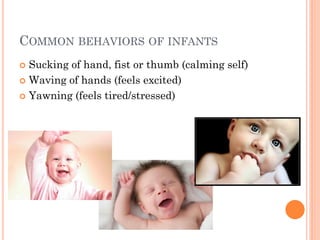
Sucking of hand, fist or thumb (calming self)
 Waving of hands (feels excited)
 Yawning (feels tired/stressed)

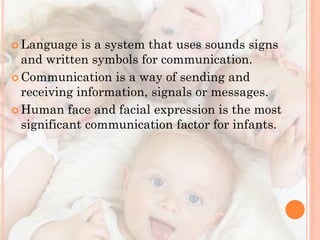
 Language

is a system that uses sounds signs
and written symbols for communication.
 Communication is a way of sending and
receiving information, signals or messages.
 Human face and facial expression is the most
significant communication factor for infants.
A. LISTENING AND UNDERSTANDING
Responds to sounds in the environment
> Turns in the directions of sounds
> Begins to identify sounds with particular
objects
 Begins to listen to words with understanding
 Begins to follow simple directions
 Demonstrates understanding of native and/or
English language
> Begins to attach meaning to the sounds,
gestures, signs and words they hear or see

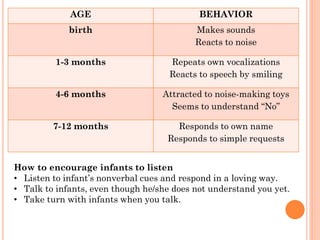
AGE

BEHAVIOR

birth

Makes sounds
Reacts to noise

1-3 months

Repeats own vocalizations
Reacts to speech by smiling

4-6 months

Attracted to noise-making toys
Seems to understand “No”

7-12 months

Responds to own name
Responds to simple requests

How to encourage infants to listen
• Listen to infant’s nonverbal cues and respond in a loving way.
• Talk to infants, even though he/she does not understand you yet.
• Take turn with infants when you talk.
LEARNING ENVIRONMENT FOR LISTENING
AND UNDERSTANDING
Stories, songs, words, games and daily schedules
in English and the languages of non-English
speaking children
 Durable cloth, board or vinyl books, soft toys, and
puppets which are accessible throughout the day

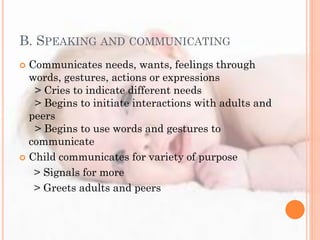
B. SPEAKING AND COMMUNICATING
Communicates needs, wants, feelings through
words, gestures, actions or expressions
> Cries to indicate different needs
> Begins to initiate interactions with adults and
peers
> Begins to use words and gestures to
communicate
 Child communicates for variety of purpose
> Signals for more
> Greets adults and peers

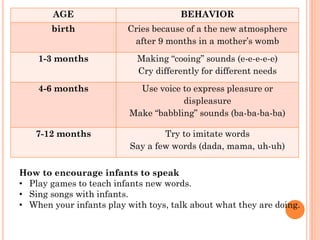
AGE

BEHAVIOR

birth

Cries because of a the new atmosphere
after 9 months in a mother’s womb

1-3 months

Making “cooing” sounds (e-e-e-e-e)
Cry differently for different needs

4-6 months

Use voice to express pleasure or
displeasure
Make “babbling” sounds (ba-ba-ba-ba)

7-12 months

Try to imitate words
Say a few words (dada, mama, uh-uh)

How to encourage infants to speak
• Play games to teach infants new words.
• Sing songs with infants.
• When your infants play with toys, talk about what they are doing.
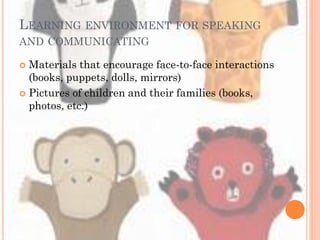
LEARNING ENVIRONMENT FOR SPEAKING
AND COMMUNICATING
Materials that encourage face-to-face interactions
(books, puppets, dolls, mirrors)
 Pictures of children and their families (books,
photos, etc.)

C. PRINT AWARENESS AND EARLY WRITING
Begins to develop eye-hand coordination
 Manipulates materials with increasing precision
> Reaches toys, shakes keys to make sound,
carries blanket
 Explores with writing materials

AGE

BEHAVIOR

birth

Not grasp any kind of objects
Cannot hold on to objects

1-3 months

Awkwardly grasp toys
Not have complete control over writing
or coloring tools

4-6 months

Reach for things he/she wants
Explore by putting objects in their
mouths
Scribble lines, shapes and more on
walls, floors and more
Rips and pulls materials

7-12 months

How to encourage infants to write
• Chucky tools are easier for small hands.
• Use washable materials to save on clean-up.
• Talk to infants about their scribbles.
LEARNING ENVIRONMENT FOR PRINT
AWARENESS AND EARLY WRITING
A variety of writing tools (large sheets of paper,
large crayons and pencils, large paint brushes,
etc.)
 Displays of children’s art around the room at
child’s eye level
 Pictures, posters, labels on cubbies and
materials, toy shelves, etc.

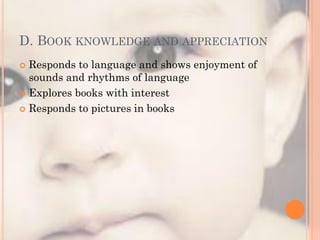
D. BOOK KNOWLEDGE AND APPRECIATION
Responds to language and shows enjoyment of
sounds and rhythms of language
 Explores books with interest
 Responds to pictures in books

AGE

BEHAVIOR

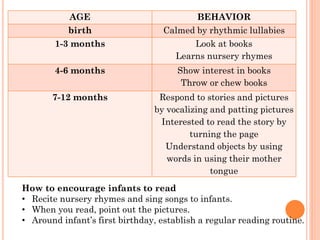
birth

Calmed by rhythmic lullabies

1-3 months

Look at books
Learns nursery rhymes

4-6 months

Show interest in books
Throw or chew books

7-12 months

Respond to stories and pictures
by vocalizing and patting pictures
Interested to read the story by
turning the page
Understand objects by using
words in using their mother
tongue

How to encourage infants to read
• Recite nursery rhymes and sing songs to infants.
• When you read, point out the pictures.
• Around infant’s first birthday, establish a regular reading routine.
LEARNING ENVIRONMENT FOR BOOK
KNOWLEDGE AND APPRECIATION
Many types of durable children’s books (cloth,
board, big books, etc.)
 Soft, cozy place for looking at books (soft chairs,
rugs, pillows, stuffed animals ,etc.)

III. DEVELOPMENTALLY APPROPRIATE
LANGUAGE ENVIRONMENTS FOR INFANTS
A loving grown-up has been called “The ideal
plaything for a baby”
 During the first month, there’s no need to
bombard the child with different stimuli

LANGUAGE AND LITERACY
Developmentally…
 Aware of sounds, touch, taste, sight
 Limited ways of communicating through cries and
coos
 Need to learn about the world and themselves
 Enjoys rhythm and rhyme, body awareness rhymes
Relationships
 Adults engage in one-to-one interactions with infant
using simple phrases, calm voice and eye contact
 Recognize that crying and body movements are the
infant’s way of communicating
 Frequently read to, sing to and talk to infants
 Warm, responsive interactions occur throughout the
day
 Know that infants are curious to each other
Book Characteristics
 Simple, graphic illustrations or photographs
 Familiar themes: family members, animals, items
in baby’s world
 Sturdy vinyl, cloth, or hard page books
 Should be available; they can reach them
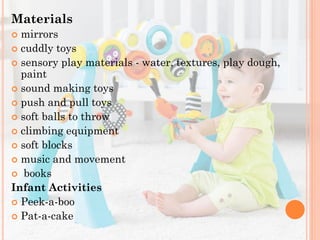
Materials
mirrors
 cuddly toys
 sensory play materials - water, textures, play dough,
paint
 sound making toys
 push and pull toys
 soft balls to throw
 climbing equipment
 soft blocks
 music and movement
 books
Infant Activities
 Peek-a-boo
 Pat-a-cake

Environment
 Pictures of infants and their families are hung at child
height (Promotes visual stimulation)
 Auditory environment is not over stimulating or
distracting
 Play areas are comfortable; pillows, foam mats, soft
carpets
 Sleeping area is separate from the active play area
 Toys are a size that allows infants to grasp, chew and
manipulate
 Various textures - especially softness
 Hang mobiles when infants can see and kick them.
Characteristics of the Adults
 warm, nurturing personality
 tolerates movement/noise
 models appropriate behavior
 reads/talks/listens to infant
 accepts different caregiving methods and techniques
 recognizes and accepts differences
 willing to learn
 reliable
 healthy
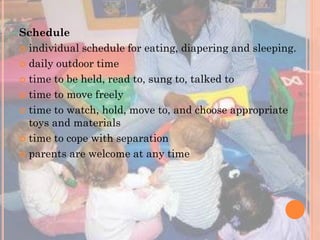
Schedule
 individual schedule for eating, diapering and sleeping.
 daily outdoor time
 time to be held, read to, sung to, talked to
 time to move freely
 time to watch, hold, move to, and choose appropriate
toys and materials
 time to cope with separation
 parents are welcome at any time
Curriculum for Infants
SOURCES












http://www.pbs.org/parents/education/readinglanguage/reading-milestones/baby-language-developmentmilestones/
http://edn.ne.gov/pdf/ELGLL.pdf
http://www.dss.virginia.gov/files/division/cc/provider_training_
development/intro_page/publications/milestones/milestones_in
dividually/05
http://www.docstoc.com/docs/87653125/DevelopmentallyAppropriate-Practices-for-Birth-Through-Age-8
http://www.childcarerockland.org/forms/DAP%20Infants.pdf
http://childhealthanddevelopment.files.wordpress.com/2011/06/
it_curriculum_module4.pdf
http://wiki.carr.org/db/attachments/emergentliteracy/38/1/agea
ppropriatebooks.pdf
Machado, J. (2003). Early childhood experiences in language
arts: emerging literacy early literacy. Clifton Park, N.Y. :
Thomson/Delmar Learning.

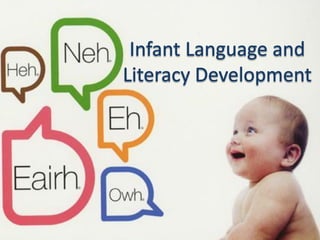
Infant language and literacy development

  • 2.
  • 3.
    I. SENSORIMOTOR INTELLIGENCE Reflexes(0-1 month)  Primary Circular Reactions (1-4 months)  Secondary Circular Reactions (4-8 months)  Coordination Reactions (8-12 months) 
  • 4.
    A. REFLEXES Infant’s behaviorsin this substage reflects innate reflexes- automatic response to particular stimuli  They suck, grasp and cry  Much of what happens at first is accidental caused by random movements  They use their abilities one at a time 
  • 5.
    B. PRIMARY CIRCULARREACTIONS Focused almost exclusively on their own bodies and are repeated over and over again  Infants gain a measure of control over their bodies; they are able to combine them into more complex actions 
  • 6.
    C. SECONDARY CIRCULARREACTIONS More active interest in their environment  Increased manipulative and maneuvering abilities  In this stage, first primitive understanding of cause and effect emerges 
  • 7.
    D. COORDINATION REACTIONS Babiesdemonstrate intentional behavior  Develop understanding of cause and effect relationship  Combine behaviors in new ways to accomplish their goals  Imitation becomes a factor in learning  Object permanence (8-10 months) 
  • 8.
    II. CHARACTERISTRICS OFINFANT LANGUAGE DEVELOPMENT Listening and Understanding  Speaking and Communicating  Book Knowledge and Appreciation  Print Awareness and Early Writing 
  • 9.
    CHARACTERISTICS OF INFANTLANGUAGE DEVELOPMENT       Newborns assimilate information immediately. (Cowley, 2000) Babies learn how to carry conversations quickly and learning how to carry on conversations producing patterns called rhythm. (goo-goo-ga-ga) Infants channel their energy into seeing and hearing. Infant first step in communication is having eye contact with their mothers called gaze coupling. Infants inherit qualities from parents and events that happen in an infants’ life that shape their language development. Infants recognize familiar faces, voices and evens smells.
  • 10.
    STAGES IN LANGUAGEDEVELOPMENT AGE BEHAVIOR 0-3 Months Hearing, startles, cries, reacts to sounds Gaze, attend to unfamiliar faces Responds to name, enjoys games, recognizes names of objects 4-6 months 7-12 months
  • 11.
    STAGES OF VOCALIZATIONS AGE BEHAVIOR 0-2months Cooing, crying, laughing 3-6 months Growls, squeals, vowels 7-12 months Babbling consonants
  • 12.
    COMMON BEHAVIORS OFINFANTS Sucking of hand, fist or thumb (calming self)  Waving of hands (feels excited)  Yawning (feels tired/stressed) 
  • 13.
     Language is asystem that uses sounds signs and written symbols for communication.  Communication is a way of sending and receiving information, signals or messages.  Human face and facial expression is the most significant communication factor for infants.
  • 14.
    A. LISTENING ANDUNDERSTANDING Responds to sounds in the environment > Turns in the directions of sounds > Begins to identify sounds with particular objects  Begins to listen to words with understanding  Begins to follow simple directions  Demonstrates understanding of native and/or English language > Begins to attach meaning to the sounds, gestures, signs and words they hear or see 
  • 15.
    AGE BEHAVIOR birth Makes sounds Reacts tonoise 1-3 months Repeats own vocalizations Reacts to speech by smiling 4-6 months Attracted to noise-making toys Seems to understand “No” 7-12 months Responds to own name Responds to simple requests How to encourage infants to listen • Listen to infant’s nonverbal cues and respond in a loving way. • Talk to infants, even though he/she does not understand you yet. • Take turn with infants when you talk.
  • 16.
    LEARNING ENVIRONMENT FORLISTENING AND UNDERSTANDING Stories, songs, words, games and daily schedules in English and the languages of non-English speaking children  Durable cloth, board or vinyl books, soft toys, and puppets which are accessible throughout the day 
  • 17.
    B. SPEAKING ANDCOMMUNICATING Communicates needs, wants, feelings through words, gestures, actions or expressions > Cries to indicate different needs > Begins to initiate interactions with adults and peers > Begins to use words and gestures to communicate  Child communicates for variety of purpose > Signals for more > Greets adults and peers 
  • 18.
    AGE BEHAVIOR birth Cries because ofa the new atmosphere after 9 months in a mother’s womb 1-3 months Making “cooing” sounds (e-e-e-e-e) Cry differently for different needs 4-6 months Use voice to express pleasure or displeasure Make “babbling” sounds (ba-ba-ba-ba) 7-12 months Try to imitate words Say a few words (dada, mama, uh-uh) How to encourage infants to speak • Play games to teach infants new words. • Sing songs with infants. • When your infants play with toys, talk about what they are doing.
  • 19.
    LEARNING ENVIRONMENT FORSPEAKING AND COMMUNICATING Materials that encourage face-to-face interactions (books, puppets, dolls, mirrors)  Pictures of children and their families (books, photos, etc.) 
  • 20.
    C. PRINT AWARENESSAND EARLY WRITING Begins to develop eye-hand coordination  Manipulates materials with increasing precision > Reaches toys, shakes keys to make sound, carries blanket  Explores with writing materials 
  • 21.
    AGE BEHAVIOR birth Not grasp anykind of objects Cannot hold on to objects 1-3 months Awkwardly grasp toys Not have complete control over writing or coloring tools 4-6 months Reach for things he/she wants Explore by putting objects in their mouths Scribble lines, shapes and more on walls, floors and more Rips and pulls materials 7-12 months How to encourage infants to write • Chucky tools are easier for small hands. • Use washable materials to save on clean-up. • Talk to infants about their scribbles.
  • 22.
    LEARNING ENVIRONMENT FORPRINT AWARENESS AND EARLY WRITING A variety of writing tools (large sheets of paper, large crayons and pencils, large paint brushes, etc.)  Displays of children’s art around the room at child’s eye level  Pictures, posters, labels on cubbies and materials, toy shelves, etc. 
  • 23.
    D. BOOK KNOWLEDGEAND APPRECIATION Responds to language and shows enjoyment of sounds and rhythms of language  Explores books with interest  Responds to pictures in books 
  • 24.
    AGE BEHAVIOR birth Calmed by rhythmiclullabies 1-3 months Look at books Learns nursery rhymes 4-6 months Show interest in books Throw or chew books 7-12 months Respond to stories and pictures by vocalizing and patting pictures Interested to read the story by turning the page Understand objects by using words in using their mother tongue How to encourage infants to read • Recite nursery rhymes and sing songs to infants. • When you read, point out the pictures. • Around infant’s first birthday, establish a regular reading routine.
  • 25.
    LEARNING ENVIRONMENT FORBOOK KNOWLEDGE AND APPRECIATION Many types of durable children’s books (cloth, board, big books, etc.)  Soft, cozy place for looking at books (soft chairs, rugs, pillows, stuffed animals ,etc.) 
  • 26.
    III. DEVELOPMENTALLY APPROPRIATE LANGUAGEENVIRONMENTS FOR INFANTS A loving grown-up has been called “The ideal plaything for a baby”  During the first month, there’s no need to bombard the child with different stimuli 
  • 27.
    LANGUAGE AND LITERACY Developmentally… Aware of sounds, touch, taste, sight  Limited ways of communicating through cries and coos  Need to learn about the world and themselves  Enjoys rhythm and rhyme, body awareness rhymes
  • 28.
    Relationships  Adults engagein one-to-one interactions with infant using simple phrases, calm voice and eye contact  Recognize that crying and body movements are the infant’s way of communicating  Frequently read to, sing to and talk to infants  Warm, responsive interactions occur throughout the day  Know that infants are curious to each other Book Characteristics  Simple, graphic illustrations or photographs  Familiar themes: family members, animals, items in baby’s world  Sturdy vinyl, cloth, or hard page books  Should be available; they can reach them
  • 29.
    Materials mirrors  cuddly toys sensory play materials - water, textures, play dough, paint  sound making toys  push and pull toys  soft balls to throw  climbing equipment  soft blocks  music and movement  books Infant Activities  Peek-a-boo  Pat-a-cake 
  • 30.
    Environment  Pictures ofinfants and their families are hung at child height (Promotes visual stimulation)  Auditory environment is not over stimulating or distracting  Play areas are comfortable; pillows, foam mats, soft carpets  Sleeping area is separate from the active play area  Toys are a size that allows infants to grasp, chew and manipulate  Various textures - especially softness  Hang mobiles when infants can see and kick them.
  • 31.
    Characteristics of theAdults  warm, nurturing personality  tolerates movement/noise  models appropriate behavior  reads/talks/listens to infant  accepts different caregiving methods and techniques  recognizes and accepts differences  willing to learn  reliable  healthy
  • 32.
    Schedule  individual schedulefor eating, diapering and sleeping.  daily outdoor time  time to be held, read to, sung to, talked to  time to move freely  time to watch, hold, move to, and choose appropriate toys and materials  time to cope with separation  parents are welcome at any time
  • 33.
  • 34.