A guide to References List
APA
DOCUMENTATION
Citing References in Text
 References in APA publications are cited
in text with an author- date citation
system and are listed alphabetically in the
references list;
 This style of citation briefly identifies the
source for readers and enables them to
locate the source of information in the
alphabetical reference list at the end of the
research paper;
 Each reference cited in text must appear
in the reference list, and each entry in the
reference list must be cited in text;
References list
 A list of every source that is made
reference to in the research paper;
 Provides the information necessary
for a reader to locate and retrieve
any source cited in the research
paper;
 Each source cited in the research
paper must appear on the reference
page, and vice versa;
Formatting the References List
 Start your list on a separate page after the text of your
document but before appendices;
 Continue to number pages consecutively;
 Center the heading References one inch from the top of the
page;
 Begin each entry flush with the left margin, but indent
subsequent lines one-half inch/ or five spaces;
 Double-space the entire list;
 List sources alphabetically by authors’ (or editors’) last names;
 If no author is given, alphabetize the source by the first word of
the title other than A, An, or The;
 If the list includes two or more works by the same author,
alphabetize them by title;
 Italicize titles and subtitles of books and periodicals;
 Do not italicize titles of articles, and do not enclose them in
quotation marks;
 For titles of books and articles, capitalize only the first word of
the title and the subtitle and any proper nouns or proper
adjectives;
 For titles of periodicals, capitalize all major words;
 Indent ½ inch from left margin after first line of entry
(hanging indentation);
 Use & rather than and for multiple authors;
 Alphabetize the entries in your list by the author's last
name, using the letter-by-letter system (ignore spaces and
other punctuation.);
 Only the initials of the first and middle names are given;
 For dates, spell out the names of months in the text of
your paper, but abbreviate them in the list of works cited,
except for May, June, and July;
 Use either the day-month-year style (22 July 1999) or the
month-day-year style (July 22, 1999) and be consistent;
 With the month-day-year style, be sure to add a comma
after the year unless another punctuation mark goes
there;
 If the work has more than seven authors, list the first six
authors and then use ellipses after the sixth author's
name;
 After the ellipses, list the last author's name of the work;
Order of References
Arrange entries in alphabetical order:
by the surname of the first author followed by initials
of the author's given name, and use the following rules
for:
Alphabetize by the author's surname:
Alphabetize letter by letter:
When alphabetizing surnames, remember that "nothing
precedes something":
Lopez, M. E., precedes Lopez de Molina, G.
Ibn Abdulaziz, T., precedes Ibn Nidal, A K. M.
Girard, J.-B., precedes Girard-Perregaux, A S.
Villa-Fuerte, S. A, precedes Villa-Lobos, J.
Benjamin, A S., precedes Ben Yaakov, D.
Publication Date:
 Give in parentheses the year when the work was published;
 For magazines, newsletters, and newspapers, give the year
and the exact date of the publication, separated by a comma
and enclosed in parentheses;
 If the date is given as a season, give the year and the season,
separated by a comma and enclosed in parentheses;
 For papers and posters presented at meetings, give the year
and month of the meeting, separated by a comma and
enclosed in parentheses;
 If no date is available, write n. d. in parentheses.
 For several volumes in a multi volume work or several
letters from the same collection, express the date as a range
of years from earliest to latest;
 Finish the element with a period after the closing
parenthesis;
Title
 Article or chapter title:
 Capitalize only the first letter of the word of the title and
of the subtitle, if any, and any proper nouns; do not
italicize the title or place quotation marks around it.
Finish the element with a period . E. g.:
 Mental and nervous diseases in the Russo-Japanese war:
A historical analysis.
 Periodical title: Journals, newsletters, and magazines:
 Give the periodical title in full, in uppercase and
lowercase letters. Italicize the name of the periodical:
Social Science Quarterly
 Nonperiodical title: Books and reports:
 Capitalize only the first word of the title and of the
subtitle, if any, and any proper nouns; italicize the title.
 Enclose additional information given on the publication
for its identification and retrieval (e.g., edition, report
number, volume number) in parentheses immediately after
the title;
 Development of entry-level tests to select FBI special agents
 When reports were written on typewriters,
the names of publications were underlined
because most typewriters had no way to print
italics;
 If you write a bibliography by hand, you
should still underline the names of
publications;
 But, if you use a computer, then publication
names should be in italics as they are below;
 Always check with your instructor
regarding their preference of using italics or
underlining.
UNDERLINING OR ITALICS?
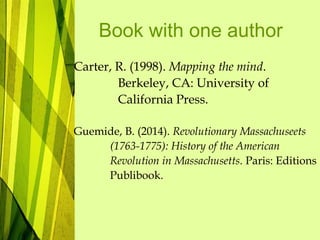
Book with one author
Carter, R. (1998). Mapping the mind.
Berkeley, CA: University of
California Press.
Guemide, B. (2014). Revolutionary Massachuseets
(1763-1775): History of the American
Revolution in Massachusetts. Paris: Editions
Publibook.
Book with two authors
Struck, W., Jr., & E. B. White. (1979).
The elements of style. (3rd ed.).
New York, NY: Macmillan.
Book with six or more
authors
Wolchik, S. A., S. G. West, I. N. Sandler,
J. Tein, D. Coatsworth, L. Lengua,
. …, J. Peterson. (2000). An experimental
evaluation of…
Book with no author
Merriam-Webster's collegiate dictionary.
(10th ed.). (1993). Springfield, MA:
Merriam-Webster.
Book with editors
Allison, M. T., &, I. E. Schneider. (Eds.).
(2000). Diversity and the recreation
profession: Organizational perspectives.
State College, PA: Venture.
Austin, J. (1995). The province of jurisprudence
determined. Rumble, W. E. (Ed.).
Cambridge, England: Cambridge
University Press.
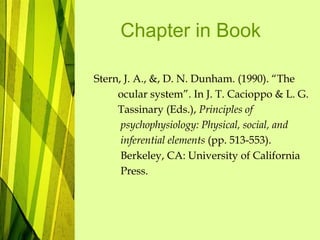
Chapter in Book
Stern, J. A., &, D. N. Dunham. (1990). “The
ocular system”. In J. T. Cacioppo & L. G.
Tassinary (Eds.), Principles of
psychophysiology: Physical, social, and
inferential elements (pp. 513-553).
Berkeley, CA: University of California
Press.
TRANSLATION
Al-Farabi, A. N. (1998). On the
perfect state (R. Walzer,
Trans.). Chicago, IL: Kazi.
The Our'an: Translation. (2000).
(Abdullah Yusuf Ali. Trans.)
Tahrike: Elmhurst.
EDITION OTHER THAN THE FIRST
Moore, G. S. (2002). Living with the
earth: Concepts in environmental
health science. (2nd ed.). New
York, NY: Lewis.
REPUBLISHED BOOK
Piaget, J. (1952). The Language and
thought of the child. London,
England: Routledge & Kegan
Paul. (Original work published
1932).
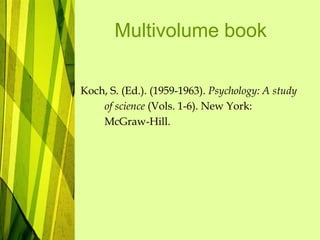
Multivolume book
Koch, S. (Ed.). (1959-1963). Psychology: A study
of science (Vols. 1-6). New York:
McGraw-Hill.
ARTICLE IN A JOURNAL PAGINATED BY VOLUME
O’Connell, D. C., & Kowal, S. (2003). Psycholinguistics:
A half century of monologism. The American
Journal of Psychology, 116, 191–212.
Bekerian, D. A. (1993). In search of the typical
eyewitness. American Psychologist, 48, 574-576.
Journals with Pagination by Issue
Sellard, S., & Mills, M. E. (1995). Administrative issues
for use of nurse practitioners. Journal of
Nursing Administration, 25 (5), 64-70.
Guemide. B., Chellali Benachaiba, and Med Bouzar.
(December, 2011). Exploiting ICT to improve
professional development for secondary school
teachers in Algeria via e-learning. Malaysian Journal of
Distance Education. 13 (2), 75- 93.
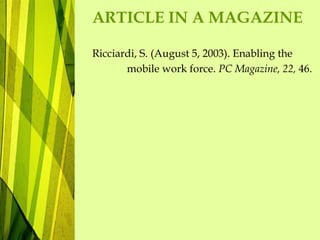
ARTICLE IN A MAGAZINE
Ricciardi, S. (August 5, 2003). Enabling the
mobile work force. PC Magazine, 22, 46.
Article in a newspaper
Faler, B. (August 29, 2003). Primary colors:
Race and fundraising. The Washington Post,
p. 5.
ARTICLE IN A REVIEW
Ringel, S. (2003). Multiculturalism and the
therapeutic process. Clinical Social Work
Journal, 31, 212–13.
PUBLISHED INTERVIEW
Smith, H. (October, 2002). [Interview with A.
Thompson]. The Sun, pp. 4–7.
Encyclopedia
Blaser, L. (1996). "Relativity". Gale encyclopedia
of science (Vol. 15, pp. 82-6). New York:
Gale Encyclopedia Co.
Faber, B. L. (2003). "Grasshopper". World book
encyclopedia (Vol. 8, pp. 327–28). Chicago: World
Book.
GOVERNMENT PUBLICATION
Office of the Federal Register. (2003). The United States
government manual 2003/2004. Washington, DC:
U.S. Government Printing Office.
U.S. Public Health Service. (1999). The surgeon general’s
call to action to prevent suicide. Retrieved from
http://www.mentalhealth.org/suicideprevention/call
toaction.asp
Group Author
American Psychological Association. (2001).
Publication manual of the American
Psychological Association (5th ed.). Washington,
DC.
Thesis
Ho, M. (2000). Coping strategies of counselling
professionals. (Unpublished master’s thesis).
Nanyang Technological University, Singapore.
DISSERTATION
Meeks, M. G. (2006). Between abolition and reform:
First-year writing programs, e-literacies, and
institutional change (Published Doctoral
dissertation). North Carolina: University of
North Carolina. Retrieved from
http://dc.lib.unc.edu/etd
CONFERENCE PROCEEDINGS
Mama, A. (2001). Challenging subjects: Gender
and power in African contexts. In
Proceedings of Nordic African Institute
Conference: Rethinking power in Africa.
Uppsala, Sweden, 9–18.
Guemide, B. (2012). Founding an E-government in
Algeria by 2014: Prospects and Constraints for
Implementation. Proceedings of the International
Conference for E- Democracy and Open Government
(CeDEM12). Krems, Austria, 267- 80.
TECHNICAL OR RESEARCH REPORT
McCool, R., Fikes, R., & McGuinness, D. (2003).
Semantic Web tools for enhanced authoring (Report
No. KSL-03–07). Stanford, CA: Knowledge
Systems Laboratory.
UNPUBLISHED PAPER PRESENTED AT A MEETING OR SYMPOSIUM
Jones, J. G. (February, 18, 1999). Mental health
intervention in mass casualty disasters. Paper
presented at the Rocky Mountain Region
Disaster Mental Health Conference,
Laramie, WY.
FILM, VIDEO, OR DVD
Stallone, S. (Director). (2007). John Rambo
[Motion picture]. United States:
Equity Pictures Medienfonds GmbH &
Co. KG IV.
Roper, M., Bulgaria Petya Evtimova & Galia
Kyuchukova (Directors).(2009). Undisputed III:
Redemption. [Motion picture]. United States:
Nu Image & Issac Florentine Film.
TELEVISION PROGRAM, SINGLE EPISODE
Imperioli, M. (Writer), & Buscemi, S. (Director).
(2002). "Everybody hurts" [Television
series episode]. In D. Chase (Executive
Producer), The Sopranos. New York, NY:
Home Box Office.
Turner, B. (Director). Rohrs, C. (Editor).
Sunrow, J. & Cochran, R. (Writers).
(2008). "5: 00 P. M. – 6: 00 P. M."
[Television series episode]. In
Sutherland. K. (Executive Producer),
24 Season 8. New York, NY:
Fox Broadcasting Company.
Videotape
National Institute on Mental Health. (1980).
Drug abuse [videotape]. Bethesda:
Author.
CD
The Avalanches. (2001). Frontier psychiatrist:
Since I left you [CD]. Los Angeles, CA:
Elektra/Asylum Records.
VIDEO WEB POST
Klusman, P. (February 13, 2008). An engineer’s guide to cats
[Video file]. Video posted to
http://www.youtube.com/watch?v=mHXBL6bzAR4
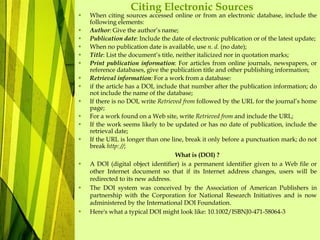
Citing Electronic Sources
• When citing sources accessed online or from an electronic database, include the
following elements:
• Author: Give the author’s name;
• Publication date: Include the date of electronic publication or of the latest update;
• When no publication date is available, use n. d. (no date);
• Title: List the document’s title, neither italicized nor in quotation marks;
• Print publication information: For articles from online journals, newspapers, or
reference databases, give the publication title and other publishing information;
• Retrieval information: For a work from a database:
• if the article has a DOI, include that number after the publication information; do
not include the name of the database;
• If there is no DOI, write Retrieved from followed by the URL for the journal’s home
page;
• For a work found on a Web site, write Retrieved from and include the URL;
• If the work seems likely to be updated or has no date of publication, include the
retrieval date;
• If the URL is longer than one line, break it only before a punctuation mark; do not
break http: //;
What is (DOI) ?
• A DOI (digital object identifier) is a permanent identifier given to a Web file or
other Internet document so that if its Internet address changes, users will be
redirected to its new address.
• The DOI system was conceived by the Association of American Publishers in
partnership with the Corporation for National Research Initiatives and is now
administered by the International DOI Foundation.
• Here's what a typical DOI might look like: 10.1002/ISBNJ0-471-58064-3
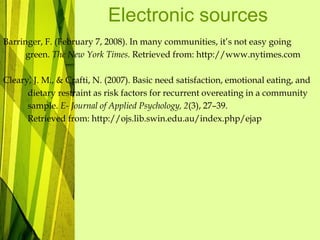
Electronic sources
Barringer, F. (February 7, 2008). In many communities, it’s not easy going
green. The New York Times. Retrieved from: http://www.nytimes.com
Cleary, J. M., & Crafti, N. (2007). Basic need satisfaction, emotional eating, and
dietary restraint as risk factors for recurrent overeating in a community
sample. E- Journal of Applied Psychology, 2(3), 27–39.
Retrieved from: http://ojs.lib.swin.edu.au/index.php/ejap
Web page
Green, C. (April 16, 2000). History & philosophy of psychology
web resources. Retrieved from
http://www.yorku.ca/dept.htm
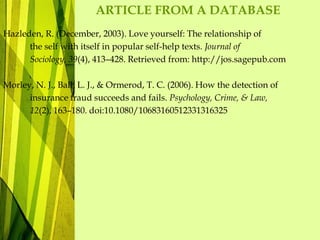
ARTICLE FROM A DATABASE
Hazleden, R. (December, 2003). Love yourself: The relationship of
the self with itself in popular self-help texts. Journal of
Sociology, 39(4), 413–428. Retrieved from: http://jos.sagepub.com
Morley, N. J., Ball, L. J., & Ormerod, T. C. (2006). How the detection of
insurance fraud succeeds and fails. Psychology, Crime, & Law,
12(2), 163–180. doi:10.1080/10683160512331316325
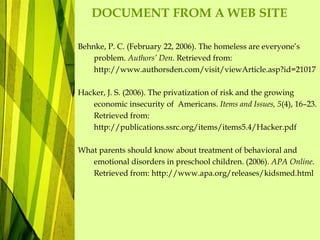
DOCUMENT FROM A WEB SITE
Behnke, P. C. (February 22, 2006). The homeless are everyone’s
problem. Authors’ Den. Retrieved from:
http://www.authorsden.com/visit/viewArticle.asp?id=21017
Hacker, J. S. (2006). The privatization of risk and the growing
economic insecurity of Americans. Items and Issues, 5(4), 16–23.
Retrieved from:
http://publications.ssrc.org/items/items5.4/Hacker.pdf
What parents should know about treatment of behavioral and
emotional disorders in preschool children. (2006). APA Online.
Retrieved from: http://www.apa.org/releases/kidsmed.html
Professional paper from Internet
Jacob, B. & Shoemaker, N. (n. d.). The Myers-Briggs Type
Indicator: An interpersonal tool for system administrators.
Retrieved from:
http://www.mindspring.com/nancyshoemaker/nes/mbti/
mbtipaper.pdf
For More Information
APA Manual Website:
www.apastyle.org
The End
Good luck with your work!
Enjoy your research!
Thanks for coming

Guide to APA References List

  • 1.
    A guide toReferences List APA DOCUMENTATION
  • 2.
    Citing References inText  References in APA publications are cited in text with an author- date citation system and are listed alphabetically in the references list;  This style of citation briefly identifies the source for readers and enables them to locate the source of information in the alphabetical reference list at the end of the research paper;  Each reference cited in text must appear in the reference list, and each entry in the reference list must be cited in text;
  • 3.
    References list  Alist of every source that is made reference to in the research paper;  Provides the information necessary for a reader to locate and retrieve any source cited in the research paper;  Each source cited in the research paper must appear on the reference page, and vice versa;
  • 4.
    Formatting the ReferencesList  Start your list on a separate page after the text of your document but before appendices;  Continue to number pages consecutively;  Center the heading References one inch from the top of the page;  Begin each entry flush with the left margin, but indent subsequent lines one-half inch/ or five spaces;  Double-space the entire list;  List sources alphabetically by authors’ (or editors’) last names;  If no author is given, alphabetize the source by the first word of the title other than A, An, or The;  If the list includes two or more works by the same author, alphabetize them by title;  Italicize titles and subtitles of books and periodicals;  Do not italicize titles of articles, and do not enclose them in quotation marks;  For titles of books and articles, capitalize only the first word of the title and the subtitle and any proper nouns or proper adjectives;  For titles of periodicals, capitalize all major words;
  • 5.
     Indent ½inch from left margin after first line of entry (hanging indentation);  Use & rather than and for multiple authors;  Alphabetize the entries in your list by the author's last name, using the letter-by-letter system (ignore spaces and other punctuation.);  Only the initials of the first and middle names are given;  For dates, spell out the names of months in the text of your paper, but abbreviate them in the list of works cited, except for May, June, and July;  Use either the day-month-year style (22 July 1999) or the month-day-year style (July 22, 1999) and be consistent;  With the month-day-year style, be sure to add a comma after the year unless another punctuation mark goes there;  If the work has more than seven authors, list the first six authors and then use ellipses after the sixth author's name;  After the ellipses, list the last author's name of the work;
  • 6.
    Order of References Arrangeentries in alphabetical order: by the surname of the first author followed by initials of the author's given name, and use the following rules for: Alphabetize by the author's surname: Alphabetize letter by letter: When alphabetizing surnames, remember that "nothing precedes something": Lopez, M. E., precedes Lopez de Molina, G. Ibn Abdulaziz, T., precedes Ibn Nidal, A K. M. Girard, J.-B., precedes Girard-Perregaux, A S. Villa-Fuerte, S. A, precedes Villa-Lobos, J. Benjamin, A S., precedes Ben Yaakov, D.
  • 7.
    Publication Date:  Givein parentheses the year when the work was published;  For magazines, newsletters, and newspapers, give the year and the exact date of the publication, separated by a comma and enclosed in parentheses;  If the date is given as a season, give the year and the season, separated by a comma and enclosed in parentheses;  For papers and posters presented at meetings, give the year and month of the meeting, separated by a comma and enclosed in parentheses;  If no date is available, write n. d. in parentheses.  For several volumes in a multi volume work or several letters from the same collection, express the date as a range of years from earliest to latest;  Finish the element with a period after the closing parenthesis;
  • 8.
    Title  Article orchapter title:  Capitalize only the first letter of the word of the title and of the subtitle, if any, and any proper nouns; do not italicize the title or place quotation marks around it. Finish the element with a period . E. g.:  Mental and nervous diseases in the Russo-Japanese war: A historical analysis.  Periodical title: Journals, newsletters, and magazines:  Give the periodical title in full, in uppercase and lowercase letters. Italicize the name of the periodical: Social Science Quarterly  Nonperiodical title: Books and reports:  Capitalize only the first word of the title and of the subtitle, if any, and any proper nouns; italicize the title.  Enclose additional information given on the publication for its identification and retrieval (e.g., edition, report number, volume number) in parentheses immediately after the title;  Development of entry-level tests to select FBI special agents
  • 9.
     When reportswere written on typewriters, the names of publications were underlined because most typewriters had no way to print italics;  If you write a bibliography by hand, you should still underline the names of publications;  But, if you use a computer, then publication names should be in italics as they are below;  Always check with your instructor regarding their preference of using italics or underlining. UNDERLINING OR ITALICS?
  • 10.
    Book with oneauthor Carter, R. (1998). Mapping the mind. Berkeley, CA: University of California Press. Guemide, B. (2014). Revolutionary Massachuseets (1763-1775): History of the American Revolution in Massachusetts. Paris: Editions Publibook.
  • 11.
    Book with twoauthors Struck, W., Jr., & E. B. White. (1979). The elements of style. (3rd ed.). New York, NY: Macmillan.
  • 12.
    Book with sixor more authors Wolchik, S. A., S. G. West, I. N. Sandler, J. Tein, D. Coatsworth, L. Lengua, . …, J. Peterson. (2000). An experimental evaluation of…
  • 13.
    Book with noauthor Merriam-Webster's collegiate dictionary. (10th ed.). (1993). Springfield, MA: Merriam-Webster.
  • 14.
    Book with editors Allison,M. T., &, I. E. Schneider. (Eds.). (2000). Diversity and the recreation profession: Organizational perspectives. State College, PA: Venture. Austin, J. (1995). The province of jurisprudence determined. Rumble, W. E. (Ed.). Cambridge, England: Cambridge University Press.
  • 15.
    Chapter in Book Stern,J. A., &, D. N. Dunham. (1990). “The ocular system”. In J. T. Cacioppo & L. G. Tassinary (Eds.), Principles of psychophysiology: Physical, social, and inferential elements (pp. 513-553). Berkeley, CA: University of California Press.
  • 16.
    TRANSLATION Al-Farabi, A. N.(1998). On the perfect state (R. Walzer, Trans.). Chicago, IL: Kazi. The Our'an: Translation. (2000). (Abdullah Yusuf Ali. Trans.) Tahrike: Elmhurst.
  • 17.
    EDITION OTHER THANTHE FIRST Moore, G. S. (2002). Living with the earth: Concepts in environmental health science. (2nd ed.). New York, NY: Lewis.
  • 18.
    REPUBLISHED BOOK Piaget, J.(1952). The Language and thought of the child. London, England: Routledge & Kegan Paul. (Original work published 1932).
  • 19.
    Multivolume book Koch, S.(Ed.). (1959-1963). Psychology: A study of science (Vols. 1-6). New York: McGraw-Hill.
  • 20.
    ARTICLE IN AJOURNAL PAGINATED BY VOLUME O’Connell, D. C., & Kowal, S. (2003). Psycholinguistics: A half century of monologism. The American Journal of Psychology, 116, 191–212. Bekerian, D. A. (1993). In search of the typical eyewitness. American Psychologist, 48, 574-576.
  • 21.
    Journals with Paginationby Issue Sellard, S., & Mills, M. E. (1995). Administrative issues for use of nurse practitioners. Journal of Nursing Administration, 25 (5), 64-70. Guemide. B., Chellali Benachaiba, and Med Bouzar. (December, 2011). Exploiting ICT to improve professional development for secondary school teachers in Algeria via e-learning. Malaysian Journal of Distance Education. 13 (2), 75- 93.
  • 22.
    ARTICLE IN AMAGAZINE Ricciardi, S. (August 5, 2003). Enabling the mobile work force. PC Magazine, 22, 46.
  • 23.
    Article in anewspaper Faler, B. (August 29, 2003). Primary colors: Race and fundraising. The Washington Post, p. 5.
  • 24.
    ARTICLE IN AREVIEW Ringel, S. (2003). Multiculturalism and the therapeutic process. Clinical Social Work Journal, 31, 212–13.
  • 25.
    PUBLISHED INTERVIEW Smith, H.(October, 2002). [Interview with A. Thompson]. The Sun, pp. 4–7.
  • 26.
    Encyclopedia Blaser, L. (1996)."Relativity". Gale encyclopedia of science (Vol. 15, pp. 82-6). New York: Gale Encyclopedia Co. Faber, B. L. (2003). "Grasshopper". World book encyclopedia (Vol. 8, pp. 327–28). Chicago: World Book.
  • 27.
    GOVERNMENT PUBLICATION Office ofthe Federal Register. (2003). The United States government manual 2003/2004. Washington, DC: U.S. Government Printing Office. U.S. Public Health Service. (1999). The surgeon general’s call to action to prevent suicide. Retrieved from http://www.mentalhealth.org/suicideprevention/call toaction.asp
  • 28.
    Group Author American PsychologicalAssociation. (2001). Publication manual of the American Psychological Association (5th ed.). Washington, DC.
  • 29.
    Thesis Ho, M. (2000).Coping strategies of counselling professionals. (Unpublished master’s thesis). Nanyang Technological University, Singapore.
  • 30.
    DISSERTATION Meeks, M. G.(2006). Between abolition and reform: First-year writing programs, e-literacies, and institutional change (Published Doctoral dissertation). North Carolina: University of North Carolina. Retrieved from http://dc.lib.unc.edu/etd
  • 31.
    CONFERENCE PROCEEDINGS Mama, A.(2001). Challenging subjects: Gender and power in African contexts. In Proceedings of Nordic African Institute Conference: Rethinking power in Africa. Uppsala, Sweden, 9–18. Guemide, B. (2012). Founding an E-government in Algeria by 2014: Prospects and Constraints for Implementation. Proceedings of the International Conference for E- Democracy and Open Government (CeDEM12). Krems, Austria, 267- 80.
  • 32.
    TECHNICAL OR RESEARCHREPORT McCool, R., Fikes, R., & McGuinness, D. (2003). Semantic Web tools for enhanced authoring (Report No. KSL-03–07). Stanford, CA: Knowledge Systems Laboratory.
  • 33.
    UNPUBLISHED PAPER PRESENTEDAT A MEETING OR SYMPOSIUM Jones, J. G. (February, 18, 1999). Mental health intervention in mass casualty disasters. Paper presented at the Rocky Mountain Region Disaster Mental Health Conference, Laramie, WY.
  • 34.
    FILM, VIDEO, ORDVD Stallone, S. (Director). (2007). John Rambo [Motion picture]. United States: Equity Pictures Medienfonds GmbH & Co. KG IV.
  • 35.
    Roper, M., BulgariaPetya Evtimova & Galia Kyuchukova (Directors).(2009). Undisputed III: Redemption. [Motion picture]. United States: Nu Image & Issac Florentine Film.
  • 36.
    TELEVISION PROGRAM, SINGLEEPISODE Imperioli, M. (Writer), & Buscemi, S. (Director). (2002). "Everybody hurts" [Television series episode]. In D. Chase (Executive Producer), The Sopranos. New York, NY: Home Box Office.
  • 37.
    Turner, B. (Director).Rohrs, C. (Editor). Sunrow, J. & Cochran, R. (Writers). (2008). "5: 00 P. M. – 6: 00 P. M." [Television series episode]. In Sutherland. K. (Executive Producer), 24 Season 8. New York, NY: Fox Broadcasting Company.
  • 38.
    Videotape National Institute onMental Health. (1980). Drug abuse [videotape]. Bethesda: Author.
  • 39.
    CD The Avalanches. (2001).Frontier psychiatrist: Since I left you [CD]. Los Angeles, CA: Elektra/Asylum Records.
  • 40.
    VIDEO WEB POST Klusman,P. (February 13, 2008). An engineer’s guide to cats [Video file]. Video posted to http://www.youtube.com/watch?v=mHXBL6bzAR4
  • 41.
    Citing Electronic Sources •When citing sources accessed online or from an electronic database, include the following elements: • Author: Give the author’s name; • Publication date: Include the date of electronic publication or of the latest update; • When no publication date is available, use n. d. (no date); • Title: List the document’s title, neither italicized nor in quotation marks; • Print publication information: For articles from online journals, newspapers, or reference databases, give the publication title and other publishing information; • Retrieval information: For a work from a database: • if the article has a DOI, include that number after the publication information; do not include the name of the database; • If there is no DOI, write Retrieved from followed by the URL for the journal’s home page; • For a work found on a Web site, write Retrieved from and include the URL; • If the work seems likely to be updated or has no date of publication, include the retrieval date; • If the URL is longer than one line, break it only before a punctuation mark; do not break http: //; What is (DOI) ? • A DOI (digital object identifier) is a permanent identifier given to a Web file or other Internet document so that if its Internet address changes, users will be redirected to its new address. • The DOI system was conceived by the Association of American Publishers in partnership with the Corporation for National Research Initiatives and is now administered by the International DOI Foundation. • Here's what a typical DOI might look like: 10.1002/ISBNJ0-471-58064-3
  • 42.
    Electronic sources Barringer, F.(February 7, 2008). In many communities, it’s not easy going green. The New York Times. Retrieved from: http://www.nytimes.com Cleary, J. M., & Crafti, N. (2007). Basic need satisfaction, emotional eating, and dietary restraint as risk factors for recurrent overeating in a community sample. E- Journal of Applied Psychology, 2(3), 27–39. Retrieved from: http://ojs.lib.swin.edu.au/index.php/ejap
  • 43.
    Web page Green, C.(April 16, 2000). History & philosophy of psychology web resources. Retrieved from http://www.yorku.ca/dept.htm
  • 44.
    ARTICLE FROM ADATABASE Hazleden, R. (December, 2003). Love yourself: The relationship of the self with itself in popular self-help texts. Journal of Sociology, 39(4), 413–428. Retrieved from: http://jos.sagepub.com Morley, N. J., Ball, L. J., & Ormerod, T. C. (2006). How the detection of insurance fraud succeeds and fails. Psychology, Crime, & Law, 12(2), 163–180. doi:10.1080/10683160512331316325
  • 45.
    DOCUMENT FROM AWEB SITE Behnke, P. C. (February 22, 2006). The homeless are everyone’s problem. Authors’ Den. Retrieved from: http://www.authorsden.com/visit/viewArticle.asp?id=21017 Hacker, J. S. (2006). The privatization of risk and the growing economic insecurity of Americans. Items and Issues, 5(4), 16–23. Retrieved from: http://publications.ssrc.org/items/items5.4/Hacker.pdf What parents should know about treatment of behavioral and emotional disorders in preschool children. (2006). APA Online. Retrieved from: http://www.apa.org/releases/kidsmed.html
  • 46.
    Professional paper fromInternet Jacob, B. & Shoemaker, N. (n. d.). The Myers-Briggs Type Indicator: An interpersonal tool for system administrators. Retrieved from: http://www.mindspring.com/nancyshoemaker/nes/mbti/ mbtipaper.pdf
  • 47.
    For More Information APAManual Website: www.apastyle.org
  • 49.
  • 50.
    Good luck withyour work!
  • 51.