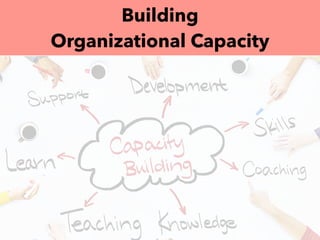
Building
Organizational Capacity
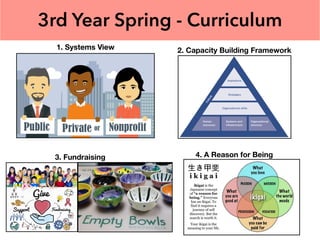
3rd Year Spring - Curriculum
1. Systems View 2. Capacity Building Framework
3. Fundraising 4. A Reason for Being
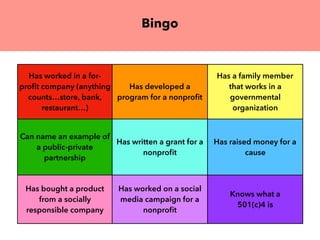
Bingo
Has worked in a for-
profit company (anything
counts…store, bank,
restaurant…)
Has developed a
program for a nonprofit
Has a family member
that works in a
governmental
organization
Can name an example of
a public-private
partnership
Has written a grant for a
nonprofit
Has raised money for a
cause
Has bought a product
from a socially
responsible company
Has worked on a social
media campaign for a
nonprofit
Knows what a 

501(c)4 is
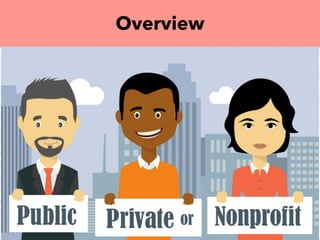
Overview
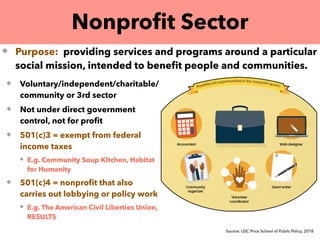
Nonprofit Sector
Purpose: providing services and programs around a particular
social mission, intended to benefit people and communities.
Voluntary/independent/charitable/
community or 3rd sector
Not under direct government
control, not for profit
501(c)3 = exempt from federal
income taxes
E.g. Community Soup Kitchen, Habitat
for Humanity
501(c)4 = nonprofit that also
carries out lobbying or policy work
E.g. The American Civil Liberties Union,
RESULTS
Source: USC Price School of Public Policy, 2018
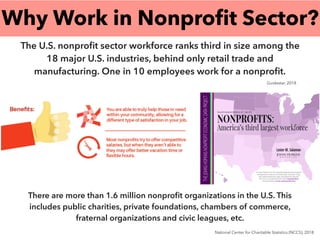
Why Work in Nonprofit Sector?
The U.S. nonprofit sector workforce ranks third in size among the
18 major U.S. industries, behind only retail trade and
manufacturing. One in 10 employees work for a nonprofit.
There are more than 1.6 million nonprofit organizations in the U.S. This
includes public charities, private foundations, chambers of commerce,
fraternal organizations and civic leagues, etc.
National Center for Charitable Statistics (NCCS), 2018
Guidestar, 2018
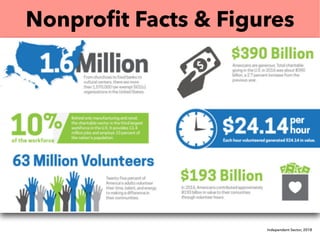
Nonprofit Facts & Figures
Independent Sector, 2018
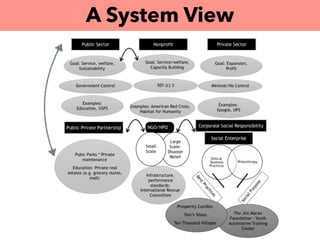
A System View
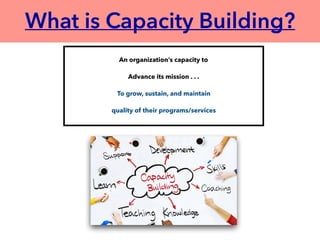
What is Capacity Building?
An organization’s capacity to
Advance its mission . . .
To grow, sustain, and maintain
quality of their programs/services
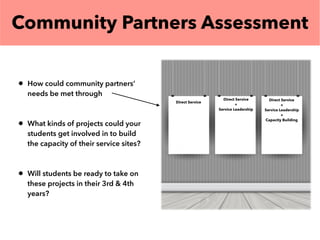
Community Partners Assessment
• How could community partners’
needs be met through
• What kinds of projects could your
students get involved in to build
the capacity of their service sites?
• Will students be ready to take on
these projects in their 3rd & 4th
years?
Direct Service
Direct Service
+
Service Leadership
Direct Service
+
Service Leadership
+
Capacity Building
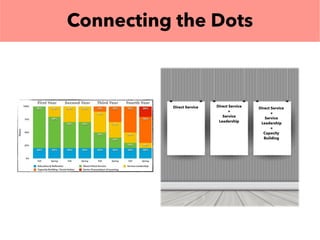
Connecting the Dots
Direct Service Direct Service
+
Service
Leadership
Direct Service
+
Service
Leadership
+
Capacity
Building
Frameworks
Leadership
Capacity
Adaptive
Capacity
Management
Capacity
Operational
Capacity
1.
IUPUI
Indiana University -
Purdue University -
Indianapolis
2.
Marguerite Casey
Foundation
Communication
Volunteer
Program
Dev.
Fundraising Research
3.
Bonner
Foundation
1
Mckinsey & Venture Philanthropy Partners (2001)
2
Marguerite Casey Foundation
3
Bonner Foundation
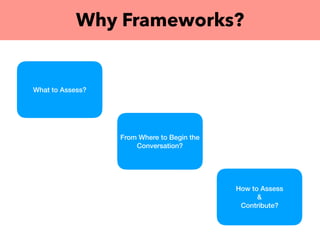
Why Frameworks?
1.
IUPUI
Indiana University -
Purdue University -
Indianapolis
2.
Marguerite Casey
Foundation
3.
Bonner
Foundation
What to Assess?
How to Assess
&
Contribute?
From Where to Begin the
Conversation?
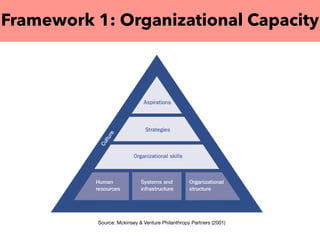
Framework 1: Organizational Capacity
Source: Mckinsey & Venture Philanthropy Partners (2001)
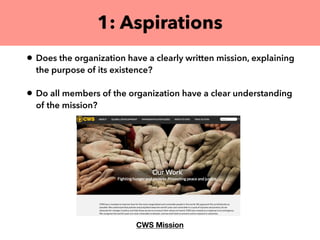
1: Aspirations
• Does the organization have a clearly written mission, explaining
the purpose of its existence?
• Do all members of the organization have a clear understanding
of the mission?
CWS Mission
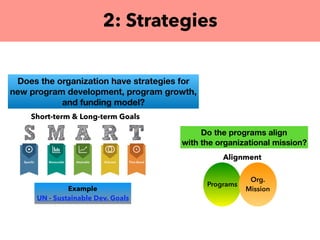
2: Strategies
Alignment
Programs
Org.
Mission
Short-term & Long-term Goals
Example
UN - Sustainable Dev. Goals
Does the organization have strategies for
new program development, program growth,
and funding model?
Do the programs align
with the organizational mission?
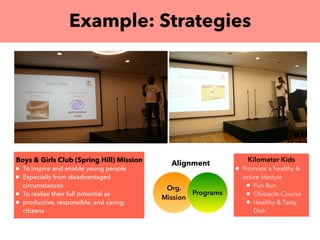
Example: Strategies
Alignment
Org.
Mission
Programs
Boys & Girls Club (Spring Hill) Mission
• To inspire and enable young people
• Especially from disadvantaged
circumstances
• To realize their full potential as
• productive, responsible, and caring
citizens
Kilometer Kids
• Promote a healthy &
active lifestyle
• Fun Run
• Obstacle Course
• Healthy & Tasty
Dish
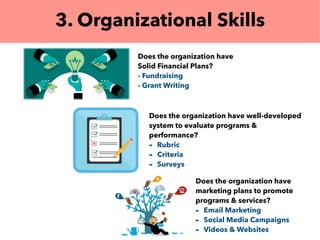
3. Organizational Skills
Does the organization have
Solid Financial Plans?
- Fundraising
- Grant Writing
Does the organization have well-developed
system to evaluate programs &
performance?
- Rubric
- Criteria
- Surveys
Does the organization have
marketing plans to promote
programs & services?
- Email Marketing
- Social Media Campaigns
- Videos & Websites
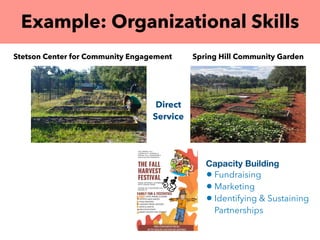
Example: Organizational Skills
Spring Hill Community GardenStetson Center for Community Engagement
Direct
Service
Capacity Building
• Fundraising
• Marketing
• Identifying & Sustaining
Partnerships
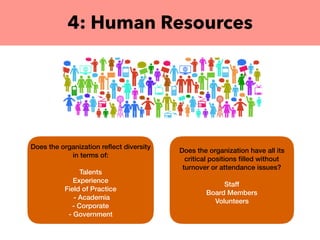
4: Human Resources
Does the organization reflect diversity
in terms of:
Talents
Experience
Field of Practice
- Academia
- Corporate
- Government
Does the organization have all its
critical positions filled without
turnover or attendance issues?
Staff
Board Members
Volunteers
Case Study 1
Rubicorn is a California-based organization whose mission is to help people, facing homelessness, economic
instability, or disability with achieving self-sufficiency. Its programs range from housing and job-training to
mental health care and money management.
Rubicon also owns three social-purpose businesses - a bakery, a landscaping service, and a home care business
for individuals with disabilities and the elderly - that employ adults with disability or low income.
Rubicon has adopted an innovative approach to human resources to run these businesses successfully. It is crucial
for Rubicon’s social enterprises to compete in the open market place successfully, so the other programs can be
supported. As a consequence, Rubicon places a great value on ensuring that it hires professional staff with
relevant business skills and experience - MBAs and the like. It compensates these people well above the standard
nonprofit rate, with its human resources department conducting regular salary surveys of comparable jobs in the
area. Additionally, it gives its managers a great deal of autonomy to run their own departments and it carefully
monitors performance.
Processing Questions:
•What type of challenge did this organization face in context of capacity building framework?
•How did they identify the challenge?
•What kinds of approaches did they take to address that challenge?
•How successful were these approaches in meeting the goals / addressing the challenges?
•Do you think it’s important to have a framework in mind, while implementing organizational capacity building
initiatives? Why?
•How are these case studies relevant for you as Bonners?
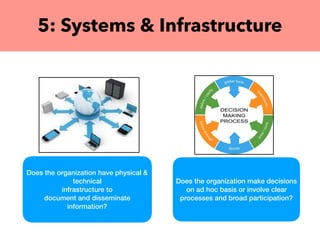
5: Systems & Infrastructure
Does the organization have physical &
technical
infrastructure to
document and disseminate
information?
Does the organization make decisions
on ad hoc basis or involve clear
processes and broad participation?
Case Study 2
Robert Enterprise Development Fund supported Rubicon with systems initiative: a social impact
tracking system. This system would allow Rubicon to quantify how well it was delivering in terms of
changing lives. The central feature of Rubicon’s measurement system was database to track client flows
and outcomes. Before beginning to develop the software to manage this database, teams mapped the
client flow through the Rubicon system and defined the key indicators that the database would track.
The management consistently communicated about the system with the staff, so they all clearly
understood the purpose behind learning and managing a new software program. Once the system
was ready, Rubicon invested significant time training its staff in running the system and securing
organizational buy-in to its value. Similar thought went to testing and actual software development.
The software served the purpose and Rubicon could clearly demonstrate the impact it had made in the
community by serving more people (800 in 1994 to 4,000 in 2000). Participants reported increase in
their income and lifestyle (housing) and decreased dependence on public assistance.
Processing Questions:
•What type of challenge did this organization face in context of capacity building framework?
•How did they identify the challenge?
•What kinds of approaches did they take to address that challenge?
•How successful were these approaches in meeting the goals / addressing the challenges?
•Do you think it’s important to have a framework in mind, while implementing organizational capacity
building initiatives? Why?
•How are these case studies relevant for you as Bonners?
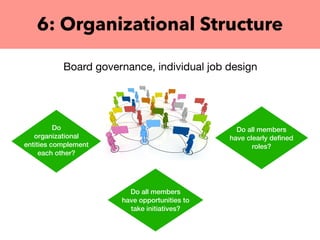
6: Organizational Structure
Board governance, individual job design
Do
organizational
entities complement
each other?
Do all members
have clearly defined
roles?
Do all members
have opportunities to
take initiatives?
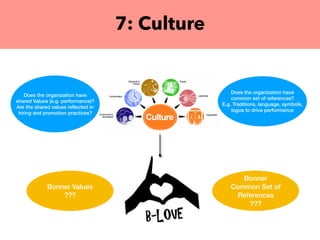
7: Culture
Does the organization have
shared Values (e.g. performance)?
Are the shared values reflected in
hiring and promotion practices?
Does the organization have
common set of references?
E.g. Traditions, language, symbols,
logos to drive performance
Bonner
Common Set of
References
???
Bonner Values
???
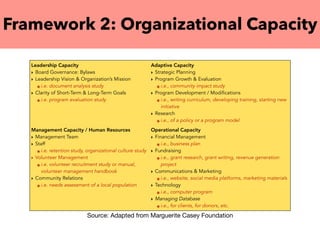
Framework 2: Organizational Capacity
Source: Adapted from Marguerite Casey Foundation
Leadership Capacity
‣ Board Governance: Bylaws
‣ Leadership Vision & Organization’s Mission
๏i.e. document analysis study
‣ Clarity of Short-Term & Long-Term Goals
๏i.e. program evaluation study
Adaptive Capacity
‣ Strategic Planning
‣ Program Growth & Evaluation
๏i.e., community impact study
‣ Program Development / Modifications
๏i.e., writing curriculum, developing training, starting new
initiative
‣ Research
๏i.e., of a policy or a program model
Management Capacity / Human Resources
‣ Management Team
‣ Staff
๏i.e. retention study, organizational culture study
‣ Volunteer Management
๏i.e. volunteer recruitment study or manual,
volunteer management handbook
‣ Community Relations
๏i.e. needs assessment of a local population
Operational Capacity
‣ Financial Management
๏i.e., business plan
‣ Fundraising
๏i.e., grant research, grant writing, revenue generation
project
‣ Communications & Marketing
๏i.e., website, social media platforms, marketing materials
‣ Technology
๏i.e., computer program
‣ Managing Database
๏i.e., for clients, for donors, etc.
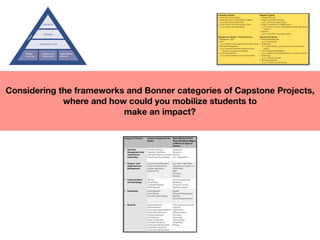
Framework 3: Organizational Capacity
Source: Bonner Foundation
Communication
Volunteer
Program
Dev.
Fundraising Research
Considering the frameworks and Bonner categories of Capstone Projects,
where and how could you mobilize students to
make an impact?

Building Organizational Capacity Preview and Feedback

  • 1.
  • 2.
    3rd Year Spring- Curriculum 1. Systems View 2. Capacity Building Framework 3. Fundraising 4. A Reason for Being
  • 3.
    Bingo Has worked ina for- profit company (anything counts…store, bank, restaurant…) Has developed a program for a nonprofit Has a family member that works in a governmental organization Can name an example of a public-private partnership Has written a grant for a nonprofit Has raised money for a cause Has bought a product from a socially responsible company Has worked on a social media campaign for a nonprofit Knows what a 
 501(c)4 is
  • 4.
  • 5.
    Nonprofit Sector Purpose: providingservices and programs around a particular social mission, intended to benefit people and communities. Voluntary/independent/charitable/ community or 3rd sector Not under direct government control, not for profit 501(c)3 = exempt from federal income taxes E.g. Community Soup Kitchen, Habitat for Humanity 501(c)4 = nonprofit that also carries out lobbying or policy work E.g. The American Civil Liberties Union, RESULTS Source: USC Price School of Public Policy, 2018
  • 6.
    Why Work inNonprofit Sector? The U.S. nonprofit sector workforce ranks third in size among the 18 major U.S. industries, behind only retail trade and manufacturing. One in 10 employees work for a nonprofit. There are more than 1.6 million nonprofit organizations in the U.S. This includes public charities, private foundations, chambers of commerce, fraternal organizations and civic leagues, etc. National Center for Charitable Statistics (NCCS), 2018 Guidestar, 2018
  • 7.
    Nonprofit Facts &Figures Independent Sector, 2018
  • 8.
  • 9.
    What is CapacityBuilding? An organization’s capacity to Advance its mission . . . To grow, sustain, and maintain quality of their programs/services
  • 10.
    Community Partners Assessment •How could community partners’ needs be met through • What kinds of projects could your students get involved in to build the capacity of their service sites? • Will students be ready to take on these projects in their 3rd & 4th years? Direct Service Direct Service + Service Leadership Direct Service + Service Leadership + Capacity Building
  • 11.
    Connecting the Dots DirectService Direct Service + Service Leadership Direct Service + Service Leadership + Capacity Building
  • 12.
    Frameworks Leadership Capacity Adaptive Capacity Management Capacity Operational Capacity 1. IUPUI Indiana University - PurdueUniversity - Indianapolis 2. Marguerite Casey Foundation Communication Volunteer Program Dev. Fundraising Research 3. Bonner Foundation 1 Mckinsey & Venture Philanthropy Partners (2001) 2 Marguerite Casey Foundation 3 Bonner Foundation
  • 13.
    Why Frameworks? 1. IUPUI Indiana University- Purdue University - Indianapolis 2. Marguerite Casey Foundation 3. Bonner Foundation What to Assess? How to Assess & Contribute? From Where to Begin the Conversation?
  • 14.
    Framework 1: OrganizationalCapacity Source: Mckinsey & Venture Philanthropy Partners (2001)
  • 15.
    1: Aspirations • Doesthe organization have a clearly written mission, explaining the purpose of its existence? • Do all members of the organization have a clear understanding of the mission? CWS Mission
  • 16.
    2: Strategies Alignment Programs Org. Mission Short-term &Long-term Goals Example UN - Sustainable Dev. Goals Does the organization have strategies for new program development, program growth, and funding model? Do the programs align with the organizational mission?
  • 17.
    Example: Strategies Alignment Org. Mission Programs Boys &Girls Club (Spring Hill) Mission • To inspire and enable young people • Especially from disadvantaged circumstances • To realize their full potential as • productive, responsible, and caring citizens Kilometer Kids • Promote a healthy & active lifestyle • Fun Run • Obstacle Course • Healthy & Tasty Dish
  • 18.
    3. Organizational Skills Doesthe organization have Solid Financial Plans? - Fundraising - Grant Writing Does the organization have well-developed system to evaluate programs & performance? - Rubric - Criteria - Surveys Does the organization have marketing plans to promote programs & services? - Email Marketing - Social Media Campaigns - Videos & Websites
  • 19.
    Example: Organizational Skills SpringHill Community GardenStetson Center for Community Engagement Direct Service Capacity Building • Fundraising • Marketing • Identifying & Sustaining Partnerships
  • 20.
    4: Human Resources Doesthe organization reflect diversity in terms of: Talents Experience Field of Practice - Academia - Corporate - Government Does the organization have all its critical positions filled without turnover or attendance issues? Staff Board Members Volunteers
  • 21.
    Case Study 1 Rubicornis a California-based organization whose mission is to help people, facing homelessness, economic instability, or disability with achieving self-sufficiency. Its programs range from housing and job-training to mental health care and money management. Rubicon also owns three social-purpose businesses - a bakery, a landscaping service, and a home care business for individuals with disabilities and the elderly - that employ adults with disability or low income. Rubicon has adopted an innovative approach to human resources to run these businesses successfully. It is crucial for Rubicon’s social enterprises to compete in the open market place successfully, so the other programs can be supported. As a consequence, Rubicon places a great value on ensuring that it hires professional staff with relevant business skills and experience - MBAs and the like. It compensates these people well above the standard nonprofit rate, with its human resources department conducting regular salary surveys of comparable jobs in the area. Additionally, it gives its managers a great deal of autonomy to run their own departments and it carefully monitors performance. Processing Questions: •What type of challenge did this organization face in context of capacity building framework? •How did they identify the challenge? •What kinds of approaches did they take to address that challenge? •How successful were these approaches in meeting the goals / addressing the challenges? •Do you think it’s important to have a framework in mind, while implementing organizational capacity building initiatives? Why? •How are these case studies relevant for you as Bonners?
  • 22.
    5: Systems &Infrastructure Does the organization have physical & technical infrastructure to document and disseminate information? Does the organization make decisions on ad hoc basis or involve clear processes and broad participation?
  • 23.
    Case Study 2 RobertEnterprise Development Fund supported Rubicon with systems initiative: a social impact tracking system. This system would allow Rubicon to quantify how well it was delivering in terms of changing lives. The central feature of Rubicon’s measurement system was database to track client flows and outcomes. Before beginning to develop the software to manage this database, teams mapped the client flow through the Rubicon system and defined the key indicators that the database would track. The management consistently communicated about the system with the staff, so they all clearly understood the purpose behind learning and managing a new software program. Once the system was ready, Rubicon invested significant time training its staff in running the system and securing organizational buy-in to its value. Similar thought went to testing and actual software development. The software served the purpose and Rubicon could clearly demonstrate the impact it had made in the community by serving more people (800 in 1994 to 4,000 in 2000). Participants reported increase in their income and lifestyle (housing) and decreased dependence on public assistance. Processing Questions: •What type of challenge did this organization face in context of capacity building framework? •How did they identify the challenge? •What kinds of approaches did they take to address that challenge? •How successful were these approaches in meeting the goals / addressing the challenges? •Do you think it’s important to have a framework in mind, while implementing organizational capacity building initiatives? Why? •How are these case studies relevant for you as Bonners?
  • 24.
    6: Organizational Structure Boardgovernance, individual job design Do organizational entities complement each other? Do all members have clearly defined roles? Do all members have opportunities to take initiatives?
  • 25.
    7: Culture Does theorganization have shared Values (e.g. performance)? Are the shared values reflected in hiring and promotion practices? Does the organization have common set of references? E.g. Traditions, language, symbols, logos to drive performance Bonner Common Set of References ??? Bonner Values ???
  • 26.
    Framework 2: OrganizationalCapacity Source: Adapted from Marguerite Casey Foundation Leadership Capacity ‣ Board Governance: Bylaws ‣ Leadership Vision & Organization’s Mission ๏i.e. document analysis study ‣ Clarity of Short-Term & Long-Term Goals ๏i.e. program evaluation study Adaptive Capacity ‣ Strategic Planning ‣ Program Growth & Evaluation ๏i.e., community impact study ‣ Program Development / Modifications ๏i.e., writing curriculum, developing training, starting new initiative ‣ Research ๏i.e., of a policy or a program model Management Capacity / Human Resources ‣ Management Team ‣ Staff ๏i.e. retention study, organizational culture study ‣ Volunteer Management ๏i.e. volunteer recruitment study or manual, volunteer management handbook ‣ Community Relations ๏i.e. needs assessment of a local population Operational Capacity ‣ Financial Management ๏i.e., business plan ‣ Fundraising ๏i.e., grant research, grant writing, revenue generation project ‣ Communications & Marketing ๏i.e., website, social media platforms, marketing materials ‣ Technology ๏i.e., computer program ‣ Managing Database ๏i.e., for clients, for donors, etc.
  • 27.
    Framework 3: OrganizationalCapacity Source: Bonner Foundation Communication Volunteer Program Dev. Fundraising Research
  • 28.
    Considering the frameworksand Bonner categories of Capstone Projects, where and how could you mobilize students to make an impact?