 M. Bilal Khan (BCS02153260)
 Zubair Ali (BCS02153252)
 Muzamil Zafar (BCS02153215)
 Hyper-Threading is a technology used by
some Intel microprocessor’s that allows a
single microprocessor to act like two separate
processors to the operating system and the
application program’s that use it. HT allows
the processor to work more efficiently by
processing two sets of instructions at the
same time, making it look like two logical
processors.
 This enables a processor to perform
tasks faster (usually 25% - 40% speed
increase) than non-HT enabled
processor.
 Adds support for multithreaded code,
and improves reaction and response
times.
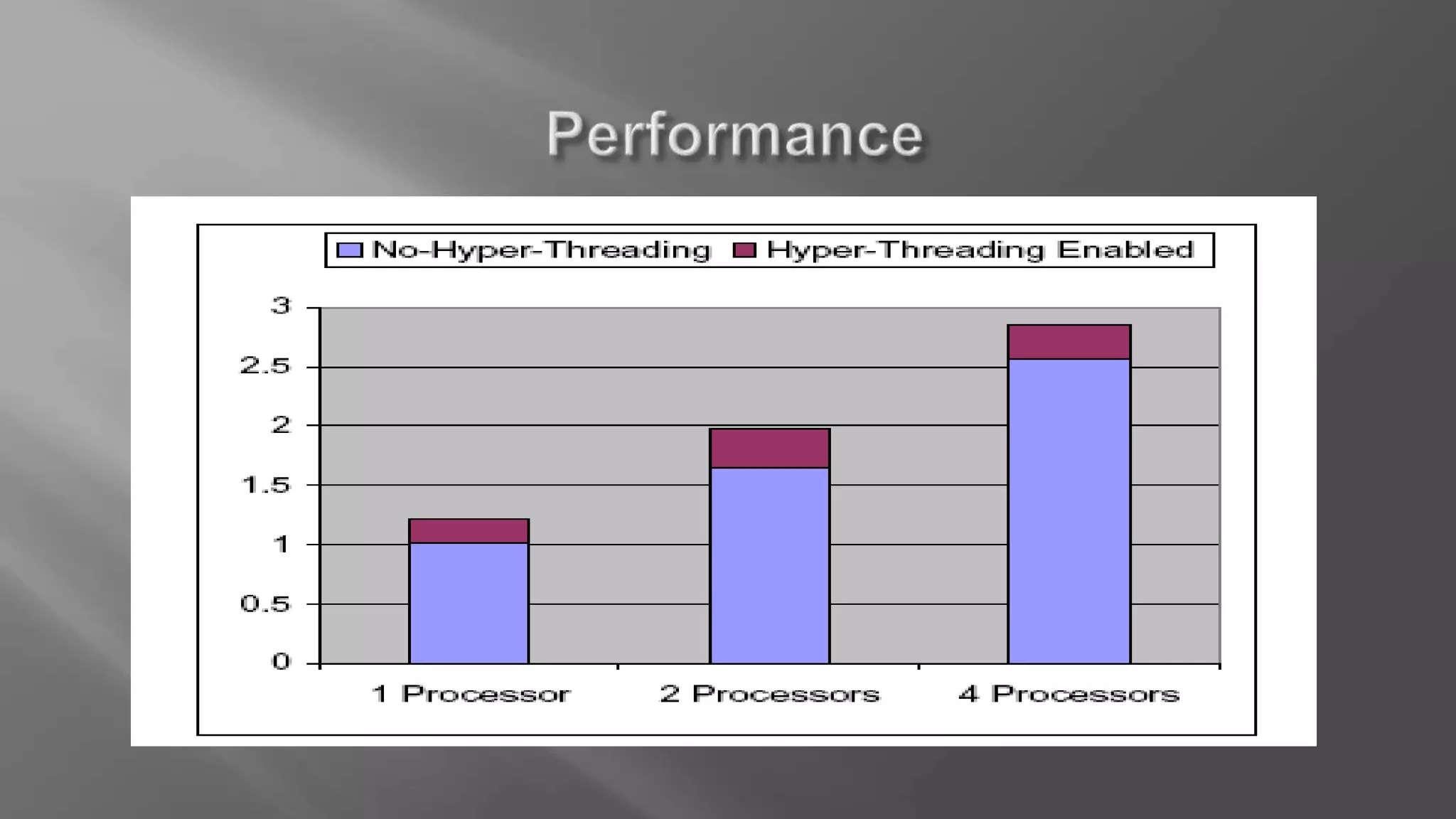
 Hyper-threading can boost system performance
by up to 30%. For dual socket systems, hyper-
threading can boost performance by up to
15%. For quad-socket (or higher) systems,
performance testing with and without hyper-
threading enabled is recommended.
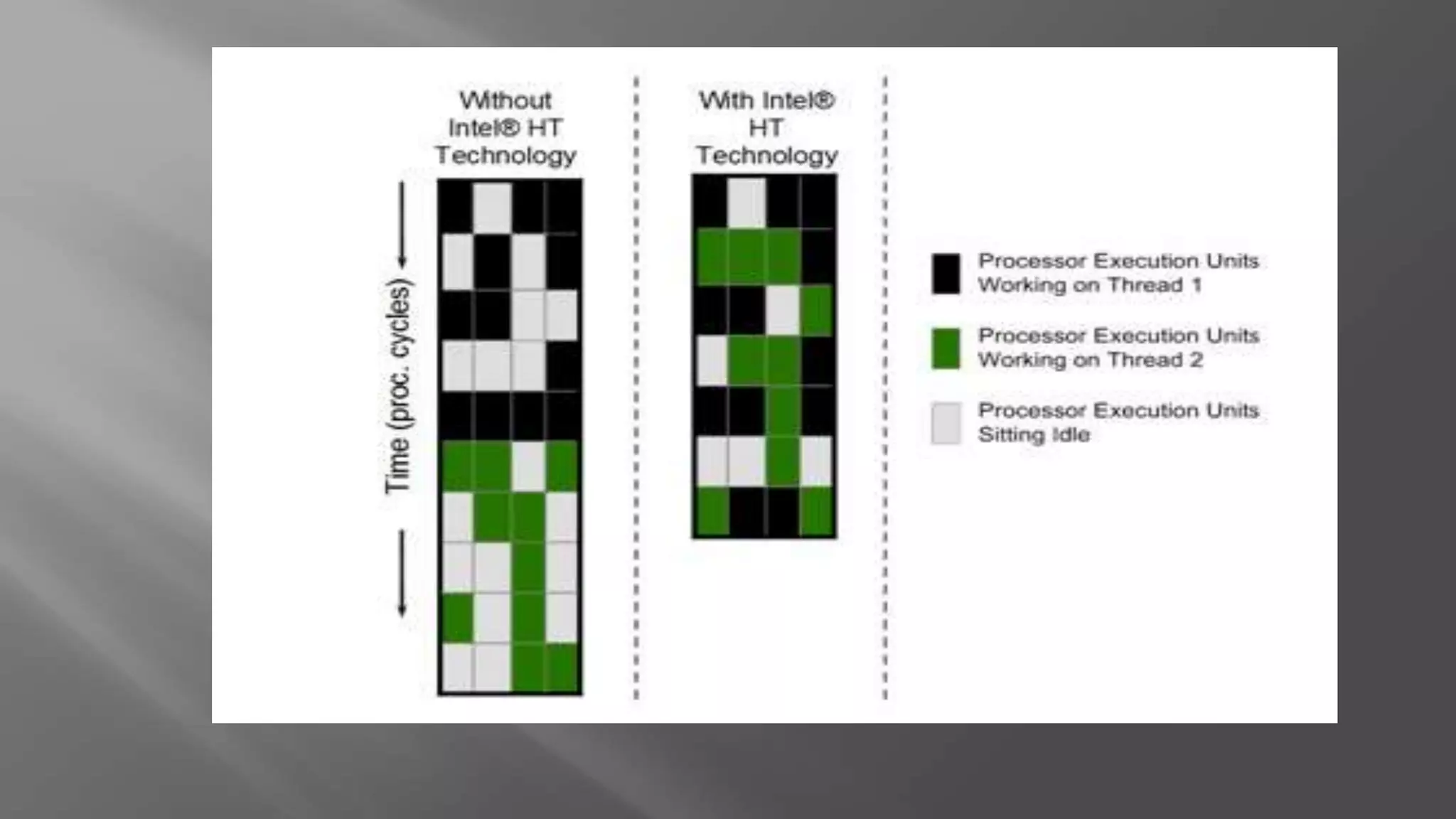
 In the diagram below, we see an example of how
processing performance can be improved with Intel HT
Technology. Each 64-bit Intel Xeon processor includes
four execution units per core. With Intel HT
Technology disabled, the core’s execution can only
work on instructions from Thread 1 or from Thread
2. As expected, during many of the clock cycles, some
execution units are idle. With Hyper-Threading
enabled, the execution units can process instructions
from both Thread 1 and Thread 2 simultaneously. In
this example, hyper-threading reduces the required
number of clock cycles from 10 to 7.
 Faster clock speeds are an important
way to deliver more computing
power. But clock speed is only half
the story. The other route to higher
performance is to accomplish more
work on each clock cycle, and that's
where Hyper-Threading Technology
comes in.
 As threads are processed, some of the internal
components of the core called execution units.
 EU’s are frequently idle during each clock cycle.
 By enabling hyper-threading, the execution units
can process instructions from two threads
simultaneously, which means fewer execution
units will be idle during each clock cycle.
 As a result, enabling hyper-threading may
significantly boost system performance.
I. Run demanding applications simultaneously while
maintaining system responsiveness
II. Keep systems protected, efficient, and manageable
while minimizing impact on productivity
III. Provide headroom for future business growth and new
solution capabilities
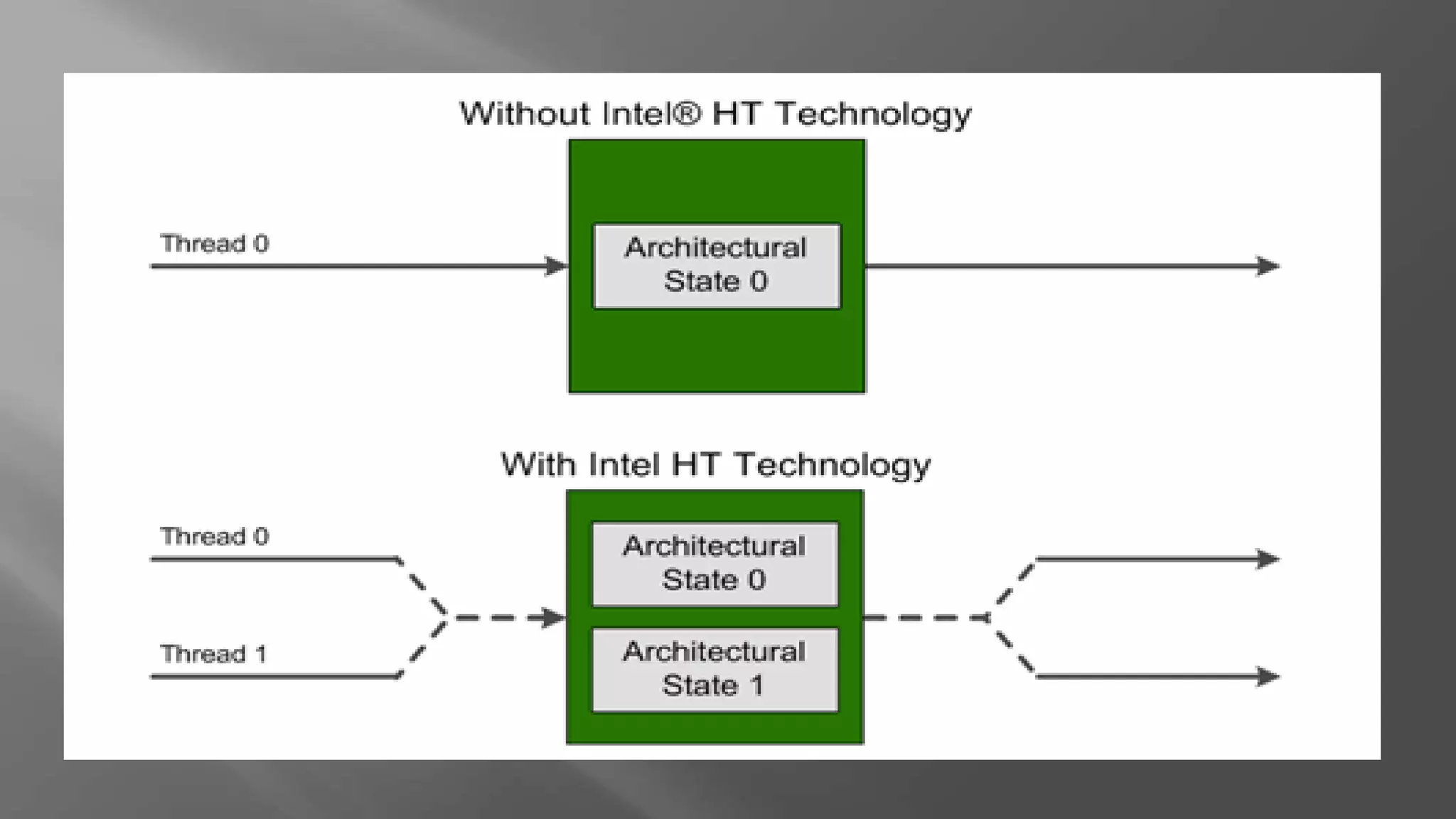
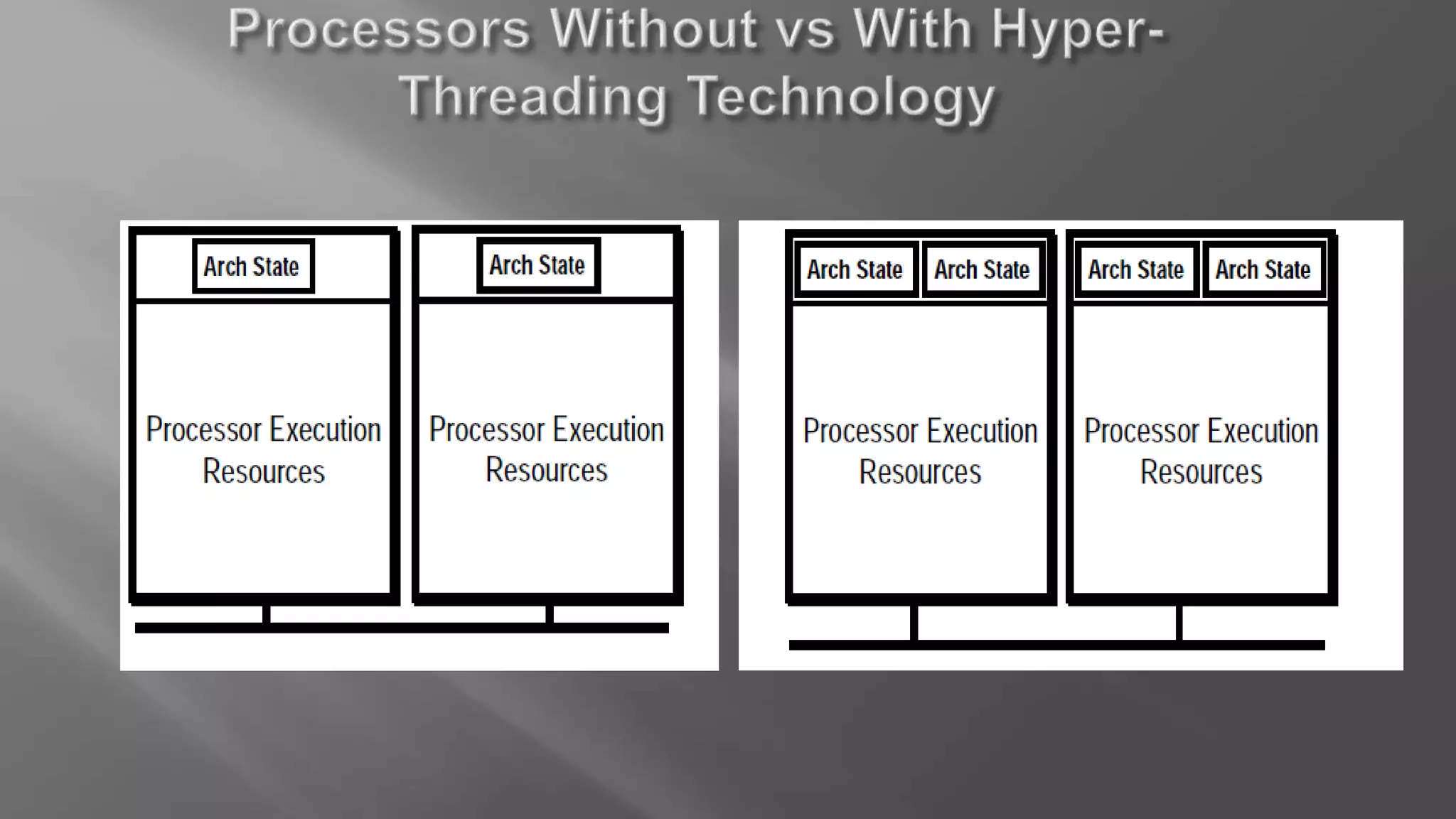
 The Architecture State consists of registers including the
general-purpose registers, the control registers, the
advanced programmable interrupt controller (APIC)
registers, and some machine state registers.
 In 2002, Intel releases the first Xeon processor
model with Hyper Threading.
 Several goals were at the heart of the micro
architecture design choices made for the Intel
Xeon processor.
 1st goal was to minimize the die area cost of
implementing HT Technology. The die area cost of the
first implementation was less than 5% of the total die
area.
 2nd goal was to ensure that when one logical processor is
stalled the other logical processor could continue to
make forward progress. A logical processor may be
temporarily stalled for a variety of reasons, including
servicing cache misses, handling branch miss
predictions, or waiting for the results of previous
instructions.
 This is accomplished by partitioning the threads.
 3rd goal was to allow a processor running only one
active software thread to run at the same speed on a
processor with HT Technology as on a processor
without this capability.
i. Possible increased speed
up
ii. Uses less space compared
to another core physically
i. Can’t take advantage in
single threaded software.
ii. Increase Power
Consumption
iii. Heat Output
iv. older operating systems
does not support
Thanks to Intel® HT Technology, businesses can:
I. Improve productivity by doing more simultaneously without
slowing down
II. Provide fast response times for Internet and e-commerce
applications, enhancing customer experiences
III. Increase the number of transactions that can be processed
simultaneously
IV. Utilize existing 32-bit application technologies while
maintaining 64-bit future readiness
Intel’s Hyper-Threading Technology brings the
concept of simultaneous multi-threading to the Intel
Architecture. This is a significant new technology
direction for Intel’s future processors. It will become
increasingly important going forward as it adds a new
technique for obtaining additional performance for
lower transistor and power costs.
 The following documents are referenced in this application note,
and provide background or supporting information for
understanding the topics presented in this document.
Intel® 64 and IA-32 Architectures Optimization Reference
Manual
 Using Spin-Loops on Intel® Pentium® 4 Processor and Intel®
Xeon® Processor,
 Intel Application Note AP-949
Intel hyper threading presentation

Intel hyper threading presentation

  • 2.
     M. BilalKhan (BCS02153260)  Zubair Ali (BCS02153252)  Muzamil Zafar (BCS02153215)
  • 4.
     Hyper-Threading isa technology used by some Intel microprocessor’s that allows a single microprocessor to act like two separate processors to the operating system and the application program’s that use it. HT allows the processor to work more efficiently by processing two sets of instructions at the same time, making it look like two logical processors.
  • 5.
     This enablesa processor to perform tasks faster (usually 25% - 40% speed increase) than non-HT enabled processor.  Adds support for multithreaded code, and improves reaction and response times.
  • 6.
     Hyper-threading canboost system performance by up to 30%. For dual socket systems, hyper- threading can boost performance by up to 15%. For quad-socket (or higher) systems, performance testing with and without hyper- threading enabled is recommended.
  • 7.
     In thediagram below, we see an example of how processing performance can be improved with Intel HT Technology. Each 64-bit Intel Xeon processor includes four execution units per core. With Intel HT Technology disabled, the core’s execution can only work on instructions from Thread 1 or from Thread 2. As expected, during many of the clock cycles, some execution units are idle. With Hyper-Threading enabled, the execution units can process instructions from both Thread 1 and Thread 2 simultaneously. In this example, hyper-threading reduces the required number of clock cycles from 10 to 7.
  • 9.
     Faster clockspeeds are an important way to deliver more computing power. But clock speed is only half the story. The other route to higher performance is to accomplish more work on each clock cycle, and that's where Hyper-Threading Technology comes in.
  • 11.
     As threadsare processed, some of the internal components of the core called execution units.  EU’s are frequently idle during each clock cycle.  By enabling hyper-threading, the execution units can process instructions from two threads simultaneously, which means fewer execution units will be idle during each clock cycle.  As a result, enabling hyper-threading may significantly boost system performance.
  • 13.
    I. Run demandingapplications simultaneously while maintaining system responsiveness II. Keep systems protected, efficient, and manageable while minimizing impact on productivity III. Provide headroom for future business growth and new solution capabilities
  • 14.
     The ArchitectureState consists of registers including the general-purpose registers, the control registers, the advanced programmable interrupt controller (APIC) registers, and some machine state registers.
  • 16.
     In 2002,Intel releases the first Xeon processor model with Hyper Threading.  Several goals were at the heart of the micro architecture design choices made for the Intel Xeon processor.
  • 17.
     1st goalwas to minimize the die area cost of implementing HT Technology. The die area cost of the first implementation was less than 5% of the total die area.
  • 18.
     2nd goalwas to ensure that when one logical processor is stalled the other logical processor could continue to make forward progress. A logical processor may be temporarily stalled for a variety of reasons, including servicing cache misses, handling branch miss predictions, or waiting for the results of previous instructions.  This is accomplished by partitioning the threads.
  • 19.
     3rd goalwas to allow a processor running only one active software thread to run at the same speed on a processor with HT Technology as on a processor without this capability.
  • 20.
    i. Possible increasedspeed up ii. Uses less space compared to another core physically i. Can’t take advantage in single threaded software. ii. Increase Power Consumption iii. Heat Output iv. older operating systems does not support
  • 21.
    Thanks to Intel®HT Technology, businesses can: I. Improve productivity by doing more simultaneously without slowing down II. Provide fast response times for Internet and e-commerce applications, enhancing customer experiences III. Increase the number of transactions that can be processed simultaneously IV. Utilize existing 32-bit application technologies while maintaining 64-bit future readiness
  • 23.
    Intel’s Hyper-Threading Technologybrings the concept of simultaneous multi-threading to the Intel Architecture. This is a significant new technology direction for Intel’s future processors. It will become increasingly important going forward as it adds a new technique for obtaining additional performance for lower transistor and power costs.
  • 24.
     The followingdocuments are referenced in this application note, and provide background or supporting information for understanding the topics presented in this document. Intel® 64 and IA-32 Architectures Optimization Reference Manual  Using Spin-Loops on Intel® Pentium® 4 Processor and Intel® Xeon® Processor,  Intel Application Note AP-949