Medical college of wasit
Department of medicine
Case sheet history
Thing to remember :-
1) Stand on the right side of the patient with good confidence .
2) Introduce yourself as a medical student not as a doctor . ( you may face difficult
question ).
3) Talk the patient gently with clear comprehensible words .
4) Remember don’t hurt the patient in your speak & touch .
I.D :-
Name :-
Age :-
Sex :-
Occupation :-
Address :-
Religion :-
Marital status :-
Residency :-
Date of admission :-
Blood group & RH :-
Chief compliant & duration :-
These compartment posses the main cause that made the patient get hospital & here you
should avoid the medical terms . It should be a symptom not a sign .
* The symptom discovered by a patient & the sign observed by a doctor .
Example :-
 Diarrhea = frequent bowel motion
 Constipation = infrequent bowel motion
 Vomiting = explosion of gastric content or ( same term )
 Fever = increase body temp.
 Dysphagia = difficulty in swallowing
 Dysponea = shortness of breath
 Fit = abnormal involuntary movement
 Headache = same term
 Pain = same term
 Edema = swelling of part of the body
 Jaundice = yellow discoloration of the skin & sclera
 Hematemesis = blood on vomitus
BY : OSAMA HADI
 Hemoptysis = blood in sputum
 Cyanosis = bluish discoloration of the skin & sclera
 Weakness = same term
 Mass = same term
* common fault :- Hypertension is not a chief compliant but may belong to headache .
History of present illness :-
It is the main part of the history & should be careful to :
1) Write as paragraph.
2) Avoid medical term .
3) Avoid leading question .
4) In this part you should discuss the system that the chief complaint belongs to .
5) Write the status of the patient after admission & receiving therapy ,is he /she feeling
well or not ?
How to start present illness ?
By two ways :-
1) If the patient has a chronic condition previously such as ( diabetes , hypertension …)
write as : the patient is a known case of …… for duration presented with …..
2) The condition started when the patient ( suddenly or gradually ) complained
of ……
what are the questions to ask ?
 Pain - Site .
 Continuous or intermittent ?
 Localized or diffused ?
 Radiation .
 Intensity ( severe , moderate ) .
 Character ( stabbing , colicky , …) .
 Aggravating factors .
 Relief factors .
 Associated symptoms .
 Time & duration .
 Fever ( 36.6 - 37.4 c )
_ Sudden or gradual ?
 Grade of fever .
 Pattern of fever .
 Aggravating factors .
 Relief factors .
 Associated with chills ?
* There are many patterns of fever :-
1) Continuous fever : daily fluctuation do not exceed 1 c ( typhoid fever ).
2) Remittent fever : daily fluctuations exceed 2 c ,but never touch normal ( brucellosis
, T.B ) .
3) Intermittent fever : temp. touch normal for several hours in a day ( JRA , malaria ).
4) Quotidian : when the paroxysm of the intermittent fever occurs daily ( every day ).
5) Tertian : when the paroxysm of the fever occurs on the alternate day ( every 48
hours ).
6) Quartan : there is interval of 2 days between consecutive attacks .
7) Pel Ebstein fever : in Hodgkin's disease , the temp. range between ( 38.8 - 39.5 c).
* Common causes of fever :-
It could be classified under that due to :
o Infectious disease .
o Connective tissue disease .
o Malignant disease .
o Miscellaneous .
 Diarrhea - Frequency .
 Continuous or intermittent ? if intermittent duration of period
during which patient free from symptom & had symptom .
 Color , quantity , order , content .
 Is the diarrhea accompanied with mucous or blood ?
 Associated with other symptom ( loss of weight , fever , vomiting
, abdominal pain ) .
 History of food intake before the episode ( food poisoning ) .
 History of tinnismus .
 History of diarrhea in the same vicinity .
* Common cause of diarrhea :-
1) Chronic :-
 Irritable bowel syndrome .
 Inflammatory bowel disease .
 Malabsorption .
 Laxative abuse .
 Drug therapy .
 Hyperthyroidism .
 Post - bowel resection .
 Colorectal cancer .
2) Acute :-
 Infective gastroenteritis .
 Drug ex. antibiotic .
 Vomiting - Frequency .
 Forceful or projectile ( meningitis ) ?
 Relationship between food & vomiting .
 Any special time of vomiting .
 What is the amount , smell , color & content of vomitus ?
 Any blood in vomitus ? amount & color .
 Associated symptoms .
* Common cause of vomiting :-
1) Neurological :-
 Raise intracranial pressure e.g. brain tumor .
 Middle ear disorder e.g. lybrinthitis .
 Migraine .
2) Severe pain :-
 Myocardial infarction , renal colic .
3) Drug :-
 Alcohol , digoxin , cytotoxic agent .
4) Metabolic / endocrine :-
 Pregnancy .
 Diabetic ketoacidosis .
 Addison's disease .
5) Psychological :-
 Anorexia nervosa .
6) Alimentary :-
 Food poison .
 Hematemesis
* Common cause of hematemesis :-
1) Gastric ulcer .
2) Duodenal ulcer .
3) Esophagitis , gastritis .
4) Varices of esophaguse .
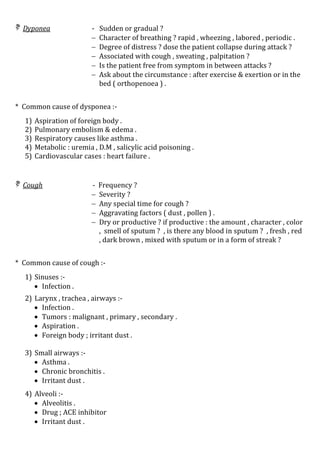
 Dyponea - Sudden or gradual ?
 Character of breathing ? rapid , wheezing , labored , periodic .
 Degree of distress ? dose the patient collapse during attack ?
 Associated with cough , sweating , palpitation ?
 Is the patient free from symptom in between attacks ?
 Ask about the circumstance : after exercise & exertion or in the
bed ( orthopenoea ) .
* Common cause of dysponea :-
1) Aspiration of foreign body .
2) Pulmonary embolism & edema .
3) Respiratory causes like asthma .
4) Metabolic : uremia , D.M , salicylic acid poisoning .
5) Cardiovascular cases : heart failure .
 Cough - Frequency ?
 Severity ?
 Any special time for cough ?
 Aggravating factors ( dust , pollen ) .
 Dry or productive ? if productive : the amount , character , color
, smell of sputum ? , is there any blood in sputum ? , fresh , red
, dark brown , mixed with sputum or in a form of streak ?
* Common cause of cough :-
1) Sinuses :-
 Infection .
2) Larynx , trachea , airways :-
 Infection .
 Tumors : malignant , primary , secondary .
 Aspiration .
 Foreign body ; irritant dust .
3) Small airways :-
 Asthma .
 Chronic bronchitis .
 Irritant dust .
4) Alveoli :-
 Alveolitis .
 Drug ; ACE inhibitor
 Irritant dust .
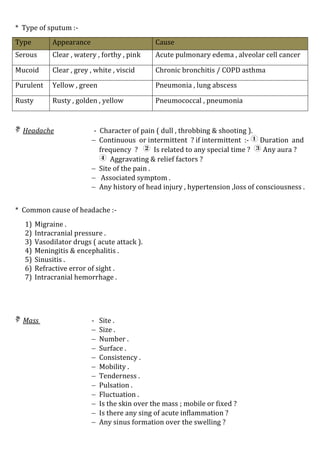
* Type of sputum :-
Type Appearance Cause
Serous Clear , watery , forthy , pink Acute pulmonary edema , alveolar cell cancer
Mucoid Clear , grey , white , viscid Chronic bronchitis / COPD asthma
Purulent Yellow , green Pneumonia , lung abscess
Rusty Rusty , golden , yellow Pneumococcal , pneumonia
 Headache - Character of pain ( dull , throbbing & shooting ).
 Continuous or intermittent ? if intermittent :-  Duration and
frequency ?  Is related to any special time ?  Any aura ?
 Aggravating & relief factors ?
 Site of the pain .
 Associated symptom .
 Any history of head injury , hypertension ,loss of consciousness .
* Common cause of headache :-
1) Migraine .
2) Intracranial pressure .
3) Vasodilator drugs ( acute attack ).
4) Meningitis & encephalitis .
5) Sinusitis .
6) Refractive error of sight .
7) Intracranial hemorrhage .
 Mass - Site .
 Size .
 Number .
 Surface .
 Consistency .
 Mobility .
 Tenderness .
 Pulsation .
 Fluctuation .
 Is the skin over the mass ; mobile or fixed ?
 Is there any sing of acute inflammation ?
 Any sinus formation over the swelling ?
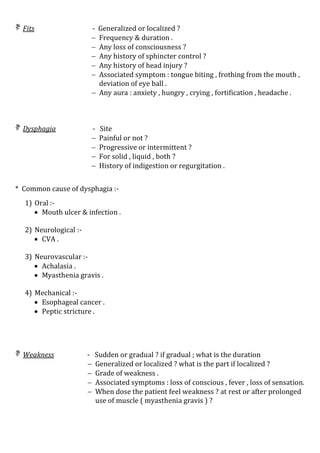
 Fits - Generalized or localized ?
 Frequency & duration .
 Any loss of consciousness ?
 Any history of sphincter control ?
 Any history of head injury ?
 Associated symptom : tongue biting , frothing from the mouth ,
deviation of eye ball .
 Any aura : anxiety , hungry , crying , fortification , headache .
 Dysphagia - Site
 Painful or not ?
 Progressive or intermittent ?
 For solid , liquid , both ?
 History of indigestion or regurgitation .
* Common cause of dysphagia :-
1) Oral :-
 Mouth ulcer & infection .
2) Neurological :-
 CVA .
3) Neurovascular :-
 Achalasia .
 Myasthenia gravis .
4) Mechanical :-
 Esophageal cancer .
 Peptic stricture .
 Weakness - Sudden or gradual ? if gradual ; what is the duration
 Generalized or localized ? what is the part if localized ?
 Grade of weakness .
 Associated symptoms : loss of conscious , fever , loss of sensation.
 When dose the patient feel weakness ? at rest or after prolonged
use of muscle ( myasthenia gravis ) ?
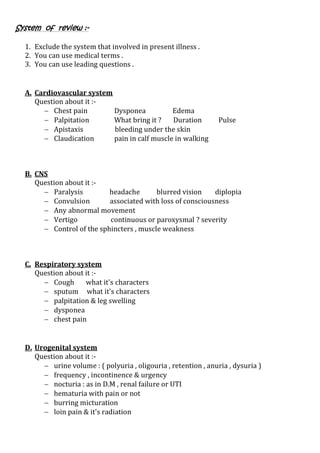
System of review :-
1. Exclude the system that involved in present illness .
2. You can use medical terms .
3. You can use leading questions .
A. Cardiovascular system
Question about it :-
 Chest pain Dysponea Edema
 Palpitation What bring it ? Duration Pulse
 Apistaxis bleeding under the skin
 Claudication pain in calf muscle in walking
B. CNS
Question about it :-
 Paralysis headache blurred vision diplopia
 Convulsion associated with loss of consciousness
 Any abnormal movement
 Vertigo continuous or paroxysmal ? severity
 Control of the sphincters , muscle weakness
C. Respiratory system
Question about it :-
 Cough what it's characters
 sputum what it's characters
 palpitation & leg swelling
 dysponea
 chest pain
D. Urogenital system
Question about it :-
 urine volume : ( polyuria , oligouria , retention , anuria , dysuria )
 frequency , incontinence & urgency
 nocturia : as in D.M , renal failure or UTI
 hematuria with pain or not
 burring micturation
 loin pain & it's radiation
E. GIT
Question about it :-
 Appetite
 Nausea
 Vomiting & it's characteristic
 Dysphagia : Type of food
 Salivation
 Heart burn
 Thirst
 Abdominal pain
 Abdominal distension
 Diarrhea
 Constipation
 Melaena : dark stool of indigested food
 Hematochaasia : fresh blood in stool
 Use of laxative
 Acidity
 Hematemesis
 Tinnismus : pain in defecation
 Flatulence
F. Locomotor system
Question about it :-
 Arthralgia :whish joint
 Myelgia & bone ache
 Disturbance of gait
 Deformity or any abnormality of skeletal system
 Joint swelling
G. Integumentary system
Question about it :-
 Rash : duration & associated with pain ?
 Hyperpigmentation
 Loss of hair & skin pigmentation
 Hair over growth
 Family history of skin disease
Past history :-
1. Medical history
This part include the chronic disease ………….
The patient is a known case :- diabetes mellitus , hypertension , ulcer , T.B , asthma ,
any previous hospitalization
2. Surgical history
Any operation in the past ( include any gynecological sex )
Drug history :-
Write if the patient on therapy
1) Antibiotic
2) Radiotherapy
3) Allergy to penicillin , aspirin , sulph drug
4) Psychotropic drug
5) Blood transfusion
6) Vaccination
7) Steroid
Menstrual history :-
Question about it :-
1) Age of the menarche
2) Age of menopause
3) Amount of blood loss
4) Amenorrhea
5) Abortion = fetal loss
6) Normal vaginal delivery = caesarian section
Family history :-
Question about it :-
1) No. of sister , brother , daughter , sons & there health .
2) Are the parent alive or not ? Are they relatives or not ?
3) Any familiar disease .
Personal & social history :-
Question about it :-
1) Smoker or not ?
2) Alcoholic or not ?
3) Any special habit ( bird collector ) .
4) Economic & nutritional state .
5) Living in large or small place ?
6) Water supplementation ( tab , river water )?
7) In rural urban place .
8) Is there any domestic animal ?
9) Level of education .
10) Martial state .
Summary :-
Name , age , sex , address , date of admission , chief complaint and brief explain of present
illness.

Case sheet-of-history

  • 1.
    Medical college ofwasit Department of medicine Case sheet history Thing to remember :- 1) Stand on the right side of the patient with good confidence . 2) Introduce yourself as a medical student not as a doctor . ( you may face difficult question ). 3) Talk the patient gently with clear comprehensible words . 4) Remember don’t hurt the patient in your speak & touch . I.D :- Name :- Age :- Sex :- Occupation :- Address :- Religion :- Marital status :- Residency :- Date of admission :- Blood group & RH :- Chief compliant & duration :- These compartment posses the main cause that made the patient get hospital & here you should avoid the medical terms . It should be a symptom not a sign . * The symptom discovered by a patient & the sign observed by a doctor . Example :-  Diarrhea = frequent bowel motion  Constipation = infrequent bowel motion  Vomiting = explosion of gastric content or ( same term )  Fever = increase body temp.  Dysphagia = difficulty in swallowing  Dysponea = shortness of breath  Fit = abnormal involuntary movement  Headache = same term  Pain = same term  Edema = swelling of part of the body  Jaundice = yellow discoloration of the skin & sclera  Hematemesis = blood on vomitus BY : OSAMA HADI
  • 2.
     Hemoptysis =blood in sputum  Cyanosis = bluish discoloration of the skin & sclera  Weakness = same term  Mass = same term * common fault :- Hypertension is not a chief compliant but may belong to headache . History of present illness :- It is the main part of the history & should be careful to : 1) Write as paragraph. 2) Avoid medical term . 3) Avoid leading question . 4) In this part you should discuss the system that the chief complaint belongs to . 5) Write the status of the patient after admission & receiving therapy ,is he /she feeling well or not ? How to start present illness ? By two ways :- 1) If the patient has a chronic condition previously such as ( diabetes , hypertension …) write as : the patient is a known case of …… for duration presented with ….. 2) The condition started when the patient ( suddenly or gradually ) complained of …… what are the questions to ask ?  Pain - Site .  Continuous or intermittent ?  Localized or diffused ?  Radiation .  Intensity ( severe , moderate ) .  Character ( stabbing , colicky , …) .  Aggravating factors .  Relief factors .  Associated symptoms .  Time & duration .  Fever ( 36.6 - 37.4 c ) _ Sudden or gradual ?  Grade of fever .  Pattern of fever .  Aggravating factors .  Relief factors .  Associated with chills ?
  • 3.
    * There aremany patterns of fever :- 1) Continuous fever : daily fluctuation do not exceed 1 c ( typhoid fever ). 2) Remittent fever : daily fluctuations exceed 2 c ,but never touch normal ( brucellosis , T.B ) . 3) Intermittent fever : temp. touch normal for several hours in a day ( JRA , malaria ). 4) Quotidian : when the paroxysm of the intermittent fever occurs daily ( every day ). 5) Tertian : when the paroxysm of the fever occurs on the alternate day ( every 48 hours ). 6) Quartan : there is interval of 2 days between consecutive attacks . 7) Pel Ebstein fever : in Hodgkin's disease , the temp. range between ( 38.8 - 39.5 c). * Common causes of fever :- It could be classified under that due to : o Infectious disease . o Connective tissue disease . o Malignant disease . o Miscellaneous .  Diarrhea - Frequency .  Continuous or intermittent ? if intermittent duration of period during which patient free from symptom & had symptom .  Color , quantity , order , content .  Is the diarrhea accompanied with mucous or blood ?  Associated with other symptom ( loss of weight , fever , vomiting , abdominal pain ) .  History of food intake before the episode ( food poisoning ) .  History of tinnismus .  History of diarrhea in the same vicinity . * Common cause of diarrhea :- 1) Chronic :-  Irritable bowel syndrome .  Inflammatory bowel disease .  Malabsorption .  Laxative abuse .  Drug therapy .  Hyperthyroidism .  Post - bowel resection .  Colorectal cancer .
  • 4.
    2) Acute :- Infective gastroenteritis .  Drug ex. antibiotic .  Vomiting - Frequency .  Forceful or projectile ( meningitis ) ?  Relationship between food & vomiting .  Any special time of vomiting .  What is the amount , smell , color & content of vomitus ?  Any blood in vomitus ? amount & color .  Associated symptoms . * Common cause of vomiting :- 1) Neurological :-  Raise intracranial pressure e.g. brain tumor .  Middle ear disorder e.g. lybrinthitis .  Migraine . 2) Severe pain :-  Myocardial infarction , renal colic . 3) Drug :-  Alcohol , digoxin , cytotoxic agent . 4) Metabolic / endocrine :-  Pregnancy .  Diabetic ketoacidosis .  Addison's disease . 5) Psychological :-  Anorexia nervosa . 6) Alimentary :-  Food poison .  Hematemesis * Common cause of hematemesis :- 1) Gastric ulcer . 2) Duodenal ulcer . 3) Esophagitis , gastritis . 4) Varices of esophaguse .
  • 5.
     Dyponea -Sudden or gradual ?  Character of breathing ? rapid , wheezing , labored , periodic .  Degree of distress ? dose the patient collapse during attack ?  Associated with cough , sweating , palpitation ?  Is the patient free from symptom in between attacks ?  Ask about the circumstance : after exercise & exertion or in the bed ( orthopenoea ) . * Common cause of dysponea :- 1) Aspiration of foreign body . 2) Pulmonary embolism & edema . 3) Respiratory causes like asthma . 4) Metabolic : uremia , D.M , salicylic acid poisoning . 5) Cardiovascular cases : heart failure .  Cough - Frequency ?  Severity ?  Any special time for cough ?  Aggravating factors ( dust , pollen ) .  Dry or productive ? if productive : the amount , character , color , smell of sputum ? , is there any blood in sputum ? , fresh , red , dark brown , mixed with sputum or in a form of streak ? * Common cause of cough :- 1) Sinuses :-  Infection . 2) Larynx , trachea , airways :-  Infection .  Tumors : malignant , primary , secondary .  Aspiration .  Foreign body ; irritant dust . 3) Small airways :-  Asthma .  Chronic bronchitis .  Irritant dust . 4) Alveoli :-  Alveolitis .  Drug ; ACE inhibitor  Irritant dust .
  • 6.
    * Type ofsputum :- Type Appearance Cause Serous Clear , watery , forthy , pink Acute pulmonary edema , alveolar cell cancer Mucoid Clear , grey , white , viscid Chronic bronchitis / COPD asthma Purulent Yellow , green Pneumonia , lung abscess Rusty Rusty , golden , yellow Pneumococcal , pneumonia  Headache - Character of pain ( dull , throbbing & shooting ).  Continuous or intermittent ? if intermittent :-  Duration and frequency ?  Is related to any special time ?  Any aura ?  Aggravating & relief factors ?  Site of the pain .  Associated symptom .  Any history of head injury , hypertension ,loss of consciousness . * Common cause of headache :- 1) Migraine . 2) Intracranial pressure . 3) Vasodilator drugs ( acute attack ). 4) Meningitis & encephalitis . 5) Sinusitis . 6) Refractive error of sight . 7) Intracranial hemorrhage .  Mass - Site .  Size .  Number .  Surface .  Consistency .  Mobility .  Tenderness .  Pulsation .  Fluctuation .  Is the skin over the mass ; mobile or fixed ?  Is there any sing of acute inflammation ?  Any sinus formation over the swelling ?
  • 7.
     Fits -Generalized or localized ?  Frequency & duration .  Any loss of consciousness ?  Any history of sphincter control ?  Any history of head injury ?  Associated symptom : tongue biting , frothing from the mouth , deviation of eye ball .  Any aura : anxiety , hungry , crying , fortification , headache .  Dysphagia - Site  Painful or not ?  Progressive or intermittent ?  For solid , liquid , both ?  History of indigestion or regurgitation . * Common cause of dysphagia :- 1) Oral :-  Mouth ulcer & infection . 2) Neurological :-  CVA . 3) Neurovascular :-  Achalasia .  Myasthenia gravis . 4) Mechanical :-  Esophageal cancer .  Peptic stricture .  Weakness - Sudden or gradual ? if gradual ; what is the duration  Generalized or localized ? what is the part if localized ?  Grade of weakness .  Associated symptoms : loss of conscious , fever , loss of sensation.  When dose the patient feel weakness ? at rest or after prolonged use of muscle ( myasthenia gravis ) ?
  • 8.
    System of review:- 1. Exclude the system that involved in present illness . 2. You can use medical terms . 3. You can use leading questions . A. Cardiovascular system Question about it :-  Chest pain Dysponea Edema  Palpitation What bring it ? Duration Pulse  Apistaxis bleeding under the skin  Claudication pain in calf muscle in walking B. CNS Question about it :-  Paralysis headache blurred vision diplopia  Convulsion associated with loss of consciousness  Any abnormal movement  Vertigo continuous or paroxysmal ? severity  Control of the sphincters , muscle weakness C. Respiratory system Question about it :-  Cough what it's characters  sputum what it's characters  palpitation & leg swelling  dysponea  chest pain D. Urogenital system Question about it :-  urine volume : ( polyuria , oligouria , retention , anuria , dysuria )  frequency , incontinence & urgency  nocturia : as in D.M , renal failure or UTI  hematuria with pain or not  burring micturation  loin pain & it's radiation
  • 9.
    E. GIT Question aboutit :-  Appetite  Nausea  Vomiting & it's characteristic  Dysphagia : Type of food  Salivation  Heart burn  Thirst  Abdominal pain  Abdominal distension  Diarrhea  Constipation  Melaena : dark stool of indigested food  Hematochaasia : fresh blood in stool  Use of laxative  Acidity  Hematemesis  Tinnismus : pain in defecation  Flatulence F. Locomotor system Question about it :-  Arthralgia :whish joint  Myelgia & bone ache  Disturbance of gait  Deformity or any abnormality of skeletal system  Joint swelling G. Integumentary system Question about it :-  Rash : duration & associated with pain ?  Hyperpigmentation  Loss of hair & skin pigmentation  Hair over growth  Family history of skin disease
  • 10.
    Past history :- 1.Medical history This part include the chronic disease …………. The patient is a known case :- diabetes mellitus , hypertension , ulcer , T.B , asthma , any previous hospitalization 2. Surgical history Any operation in the past ( include any gynecological sex ) Drug history :- Write if the patient on therapy 1) Antibiotic 2) Radiotherapy 3) Allergy to penicillin , aspirin , sulph drug 4) Psychotropic drug 5) Blood transfusion 6) Vaccination 7) Steroid Menstrual history :- Question about it :- 1) Age of the menarche 2) Age of menopause 3) Amount of blood loss 4) Amenorrhea 5) Abortion = fetal loss 6) Normal vaginal delivery = caesarian section Family history :- Question about it :- 1) No. of sister , brother , daughter , sons & there health . 2) Are the parent alive or not ? Are they relatives or not ? 3) Any familiar disease .
  • 11.
    Personal & socialhistory :- Question about it :- 1) Smoker or not ? 2) Alcoholic or not ? 3) Any special habit ( bird collector ) . 4) Economic & nutritional state . 5) Living in large or small place ? 6) Water supplementation ( tab , river water )? 7) In rural urban place . 8) Is there any domestic animal ? 9) Level of education . 10) Martial state . Summary :- Name , age , sex , address , date of admission , chief complaint and brief explain of present illness.