Dr. Hassan Al-Sukhni
DECISION SUPPORT SYSTEMS
INTRODUCTION
• Decision makers are faced with increasingly stressful
environments – highly competitive, fast-paced, near real-time,
overloaded with information, data distributed throughout the
enterprise, and multinational in scope.
• The combination of the Internet enabling speed and access, and
the maturation of artificial intelligence techniques, has led to
sophisticated aids to support decision making under these risky
and uncertain conditions.
• These aids have the potential to improve decision making by
suggesting solutions that are better than those made by the
human alone.
• They are increasingly available in diverse fields from medical
diagnosis to traffic control to engineering applications.
DECISION SUPPORT SYSTEM
• A Decision Support System (DSS) is an interactive
computer-based system or subsystem intended to help
decision makers use communications technologies, data,
documents, knowledge and/or models to identify and solve
problems, complete decision process tasks, and make
decisions.
• Decision Support System is a general term for any
computer application that enhances a person or group’s
ability to make decisions.
• Also, Decision Support Systems refers to an academic field
of research that involves designing and studying Decision
Support Systems in their context of use.
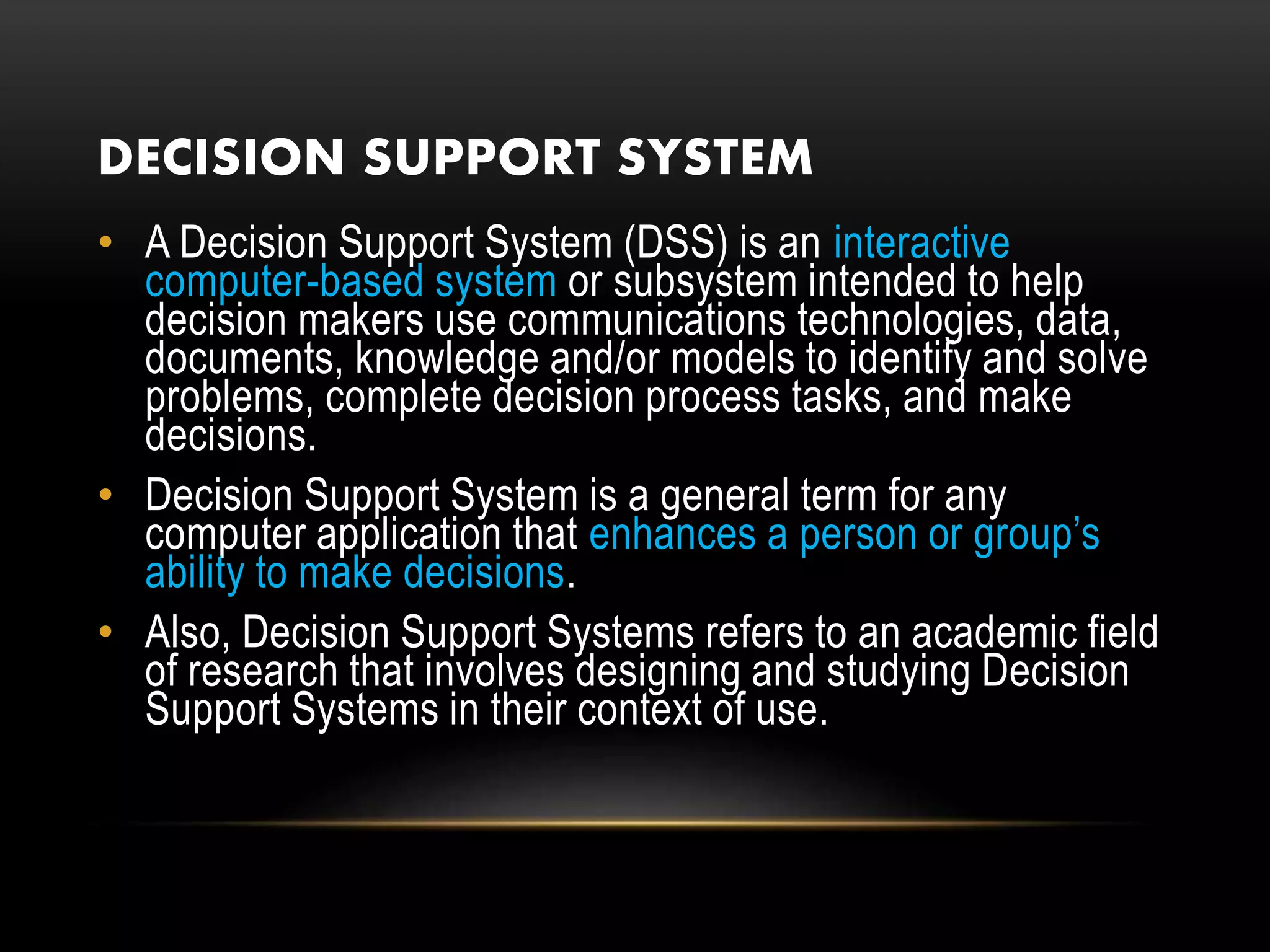
INTRODUCTION
Inquiring
Organization
Decision Making
Process for DSS
Knowledge
Management
New
Decision Making
Paradigm
for DSS
Unbounded
Systems
Thinking
(UST)
Singerian
Organizational
Model
THE DECISION SUPPORT PARADIGM
HISTORY OF DSS
INTRODUCTION
• In the 1960s, researchers began systematically studying the use of
computerized quantitative models to assist in decision making and planning
(Raymond, 1966; Turban, 1967; Urban, 1967, Holt and Huber, 1969). Ferguson
and Jones (1969) reported the first experimental study using a computer aided
decision system. They investigated a production scheduling application running
on an IBM 7094. In retrospect, a major historical turning point was Michael S.
Scott Morton's (1967) dissertation field research at Harvard University.
• Scott Morton’s study involved building, implementing and then
testing an interactive, model-driven management decision system.
Fellow Harvard Ph.D. student Andrew McCosh asserts that the
“concept of decision support systems was first articulated by Scott
Morton in February 1964 in a basement office in Sherman Hall,
Harvard Business School” (McCosh email, 2002) in a discussion they
had about Scott Morton’s dissertation. During 1966, Scott Morton
(1971) studied how computers and analytical models could help
managers make a recurring key business planning decision. He
conducted an experiment in which managers actually used a
Management Decision System (MDS). Marketing and production
managers used an MDS to coordinate production planning for laundry
equipment. The MDS ran on an IDI 21 inch CRT with a light pen
connected using a 2400 bps modem to a pair of Univac 494 systems.
• The pioneering work of George Dantzig, Douglas Engelbart and Jay
Forrester likely influenced the feasibility of building computerized decision
support systems. In 1952, Dantzig became a research mathematician at the
Rand Corporation, where he began implementing linear programming on its
experimental computers. In the mid-1960s, Engelbart and colleagues
developed the first hypermedia—groupware system called NLS
(oNLine System). NLS facilitated the creation of digital libraries and the
storage and retrieval of electronic documents using hypertext. NLS also
provided for on-screen video teleconferencing and was a forerunner to group
decision support systems. Forrester was involved in building the SAGE
(Semi-Automatic Ground Environment) air defense system for North
Americacompleted in 1962. SAGE is probably the first computerized data-
driven DSS. Also, Professor Forrester started the System Dynamics Group at
the Massachusetts Institute of Technology Sloan School. His work on
corporate modeling led to programming DYNAMO, a general simulation
compiler.
• In 1960, J.C.R. Licklider published his ideas about the future role of multiaccess
interactive computing in a paper titled “Man-Computer Symbiosis.” He saw man-
computer interaction as enhancing both the quality and efficiency of human
problem solving and his paper provided a guide for decades of computer research
to follow. Licklider was the architect of Project MAC at MIT that furthered the
study of interactive computing.
• By April 1964, the development of the IBM System 360 and other more powerful
mainframe systems made it practical and cost-effective to develop Management
Information Systems (MIS) for large companies (cf., Davis, 1974). These early
MIS focused on providing managers with structured, periodic reports and the
information was primarily from accounting and transaction processing systems,
but the systems did not provide interactive support to assist managers in decision
making.
• Around 1970 business journals started to publish articles on management
decision systems, strategic planning systems and decision support systems
(cf., Sprague and Watson 1979).. For example, Scott Morton and
colleagues McCosh and Stephens published decision support related articles in
1968. The first use of the term decision support system was in Gorry and Scott-
Morton’s (1971) Sloan Management Review article. They argued that
Management Information Systems primarily focused on structured decisions and
suggested that the supporting information systems for semi-structured and
unstructured decisions should be termed “Decision Support Systems”.
• T.P. Gerrity, Jr. focused on Decision Support Systems design issues in his 1971
Sloan Management Review article titled "The Design of Man-Machine Decision
Systems: An Application to Portfolio Management". The article was based on his
MIT Ph.D. dissertation. His system was designed to support investment managers
in their daily administration of a clients' stock portfolio.
• John D.C. Little, also at Massachusetts Institute of Technology, was studying
DSS for marketing. Little and Lodish (1969) reported research on MEDIAC, a
media planning support system. Also, Little(1970) identified criteria for
designing models and systems to support management decision-making. His four
criteria included: robustness, ease of control, simplicity, and completeness of
relevant detail. All four criteria remain relevant in evaluating modern Decision
Support Systems. By 1975, Little was expanding the frontiers of computer-
supported modeling. His DSS called Brandaid was designed to support product,
promotion, pricing and advertising decisions. Little also helped develop the
financial and marketing modeling language known as EXPRESS.
• In 1974, Gordon Davis, a Professor at the University of Minnesota, published his
influential text on Management Information Systems. He defined a Management
Information System as "an integrated, man/machine system for providing
information to support the operations, management, and decision-making
functions in an organization. (p. 5)." Davis's Chapter 12 was titled "Information
System Support for Decision Making" and Chapter 13 was titled "Information
System Support for Planning and Control". Davis’s framework incorporated
computerized decision support systems into the emerging field of management
information systems.
• Peter Keen and Charles Stabell claim the concept of decision support systems
evolved from "the theoretical studies of organizational decisionmaking done at
the Carnegie Institute of Technology during the late 1950s and early '60s and the
technical work on interactive computer systems, mainly carried out at the
Massachusetts Institute of Technology in the 1960s. (Keen and Scott Morton,
1978)". Herbert Simon’s books (1947, 1960) and articles provide a context for
understanding and supporting decision making.
• In 1995, Hans Klein and Leif Methlie noted “A study of the origin of DSS has
still to be written. It seems that the first DSS papers were published by PhD
students or professors in business schools, who had access to the first time-
sharing computer system: Project MAC at the Sloan School, the Dartmouth Time
Sharing Systems at the Tuck School. In France, HEC was the first French
business school to have a time-sharing system (installed in 1967), and the
first DSS papers were published by professors of the School in 1970. (p. 112).”
BASIC CONCEPTS OF DSS
STAGES OF DECISION MAKING
(FROM HERBERT SIMON)
• Intelligence (in the military sense of gathering
information)
• Design (Identifying the alternatives, structuring how
the decision will be made)
• Choice (Picking an alternative or making the
judgment)
• [Implementation – later added by other authors]
• [Evaluation]
STRUCTURED VS UNSTRUCTURED
DECISION STAGES
• Each stage can be Structured (automated) or Unstructured
• “Structured” means that there is an algorithm, mathematical
formula, or decision rule to accomplish the entire stage. The
algorithm can be implemented manually or it can be
computerized, but the steps are so detailed that no little or no
human judgment would be needed.
• Any decision stage that is not structured is unstructured
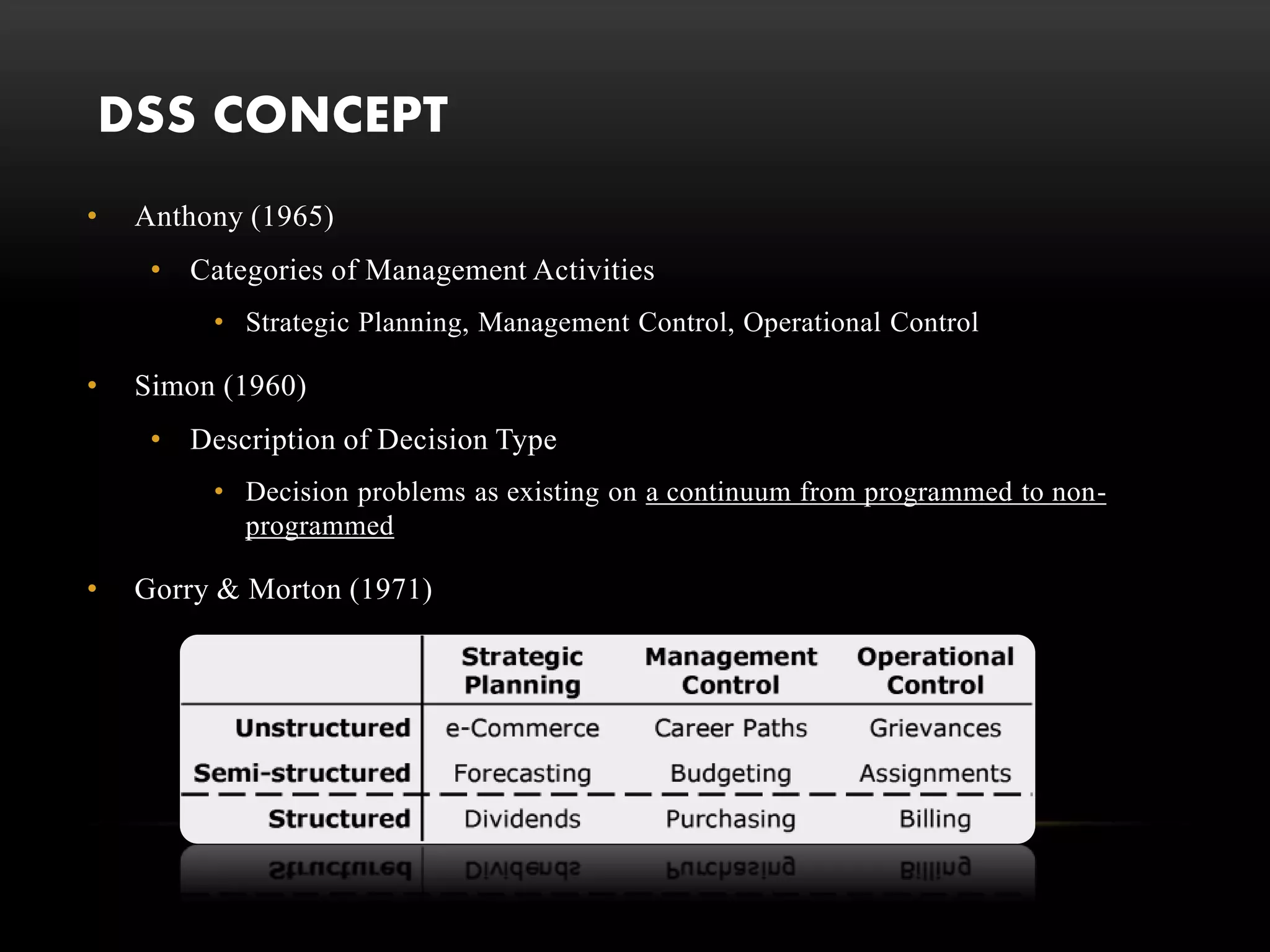
DSS CONCEPT
• Anthony (1965)
• Categories of Management Activities
• Strategic Planning, Management Control, Operational Control
• Simon (1960)
• Description of Decision Type
• Decision problems as existing on a continuum from programmed to non-
programmed
• Gorry & Morton (1971)
STRUCTURED, SEMI-STRUCTURED, AND
UNSTRUCTURED DECISIONS
• In a structured decision all three stages are structured
• In a non-structured decision all three stages are unstructured
• A semi-structured decision is one in which part, but not all, of the decision is
structured.
KEY POINT:
• The realm of Decision Support Systems is Semi-Structured and unstructured
Decisions…the type of decisions that can benefit from “decision support” but
the human decision maker is still involved.
THOUGHT QUESTIONS:
• How is a DSS different than a Transaction Processing System?
• (Power: last paragraph on page 8)
• What does the term “MIS” mean to you?
• How does the term “MIS” relate to DSS?
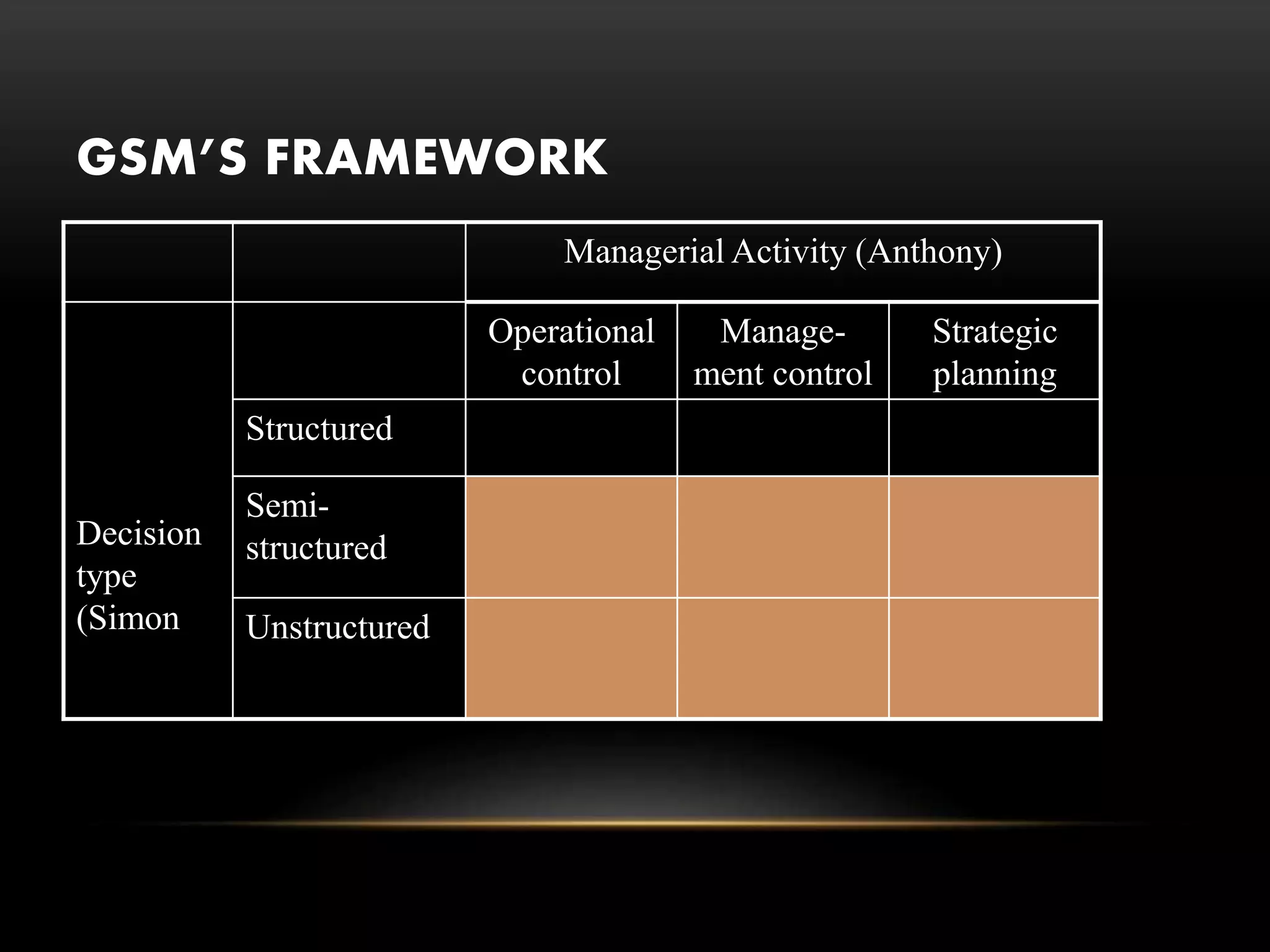
GSM’S FRAMEWORK
Managerial Activity (Anthony)
Decision
type
(Simon
Operational
control
Manage-
ment control
Strategic
planning
Structured
Semi-
structured
Unstructured
SOME ORGANIZING FRAMEWORKS
AND EXAMPLES OF DSS
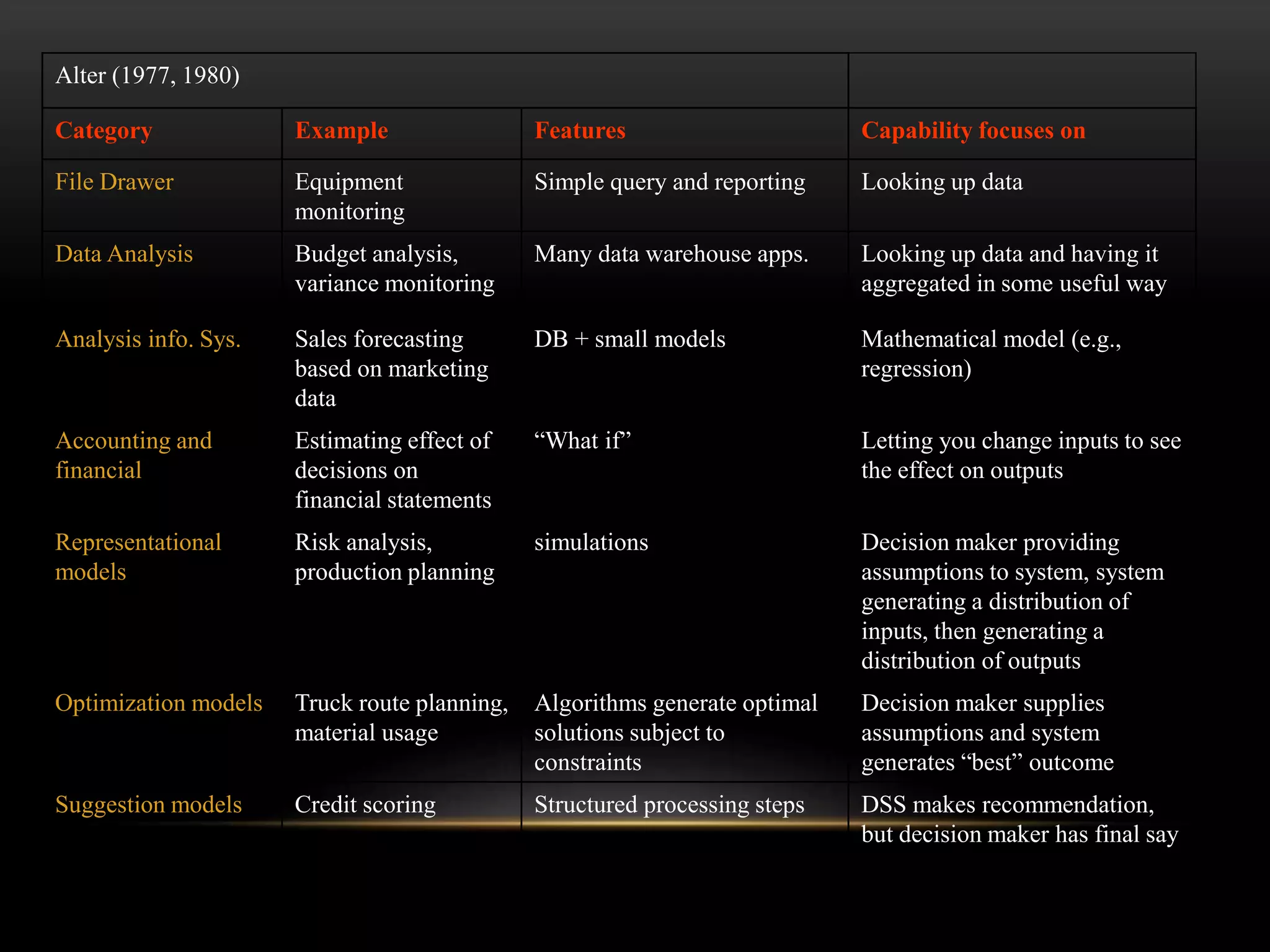
Alter (1977, 1980)
Category Example Features Capability focuses on
File Drawer Equipment
monitoring
Simple query and reporting Looking up data
Data Analysis Budget analysis,
variance monitoring
Many data warehouse apps. Looking up data and having it
aggregated in some useful way
Analysis info. Sys. Sales forecasting
based on marketing
data
DB + small models Mathematical model (e.g.,
regression)
Accounting and
financial
Estimating effect of
decisions on
financial statements
“What if” Letting you change inputs to see
the effect on outputs
Representational
models
Risk analysis,
production planning
simulations Decision maker providing
assumptions to system, system
generating a distribution of
inputs, then generating a
distribution of outputs
Optimization models Truck route planning,
material usage
Algorithms generate optimal
solutions subject to
constraints
Decision maker supplies
assumptions and system
generates “best” outcome
Suggestion models Credit scoring Structured processing steps DSS makes recommendation,
but decision maker has final say
•Text oriented DSS
•DB-oriented
•Spreadsheet oriented
•Solver oriented
•Rule oriented
HOLSAPPLE AND WHINSTON
(1996) FIVE TYPES OF DSS
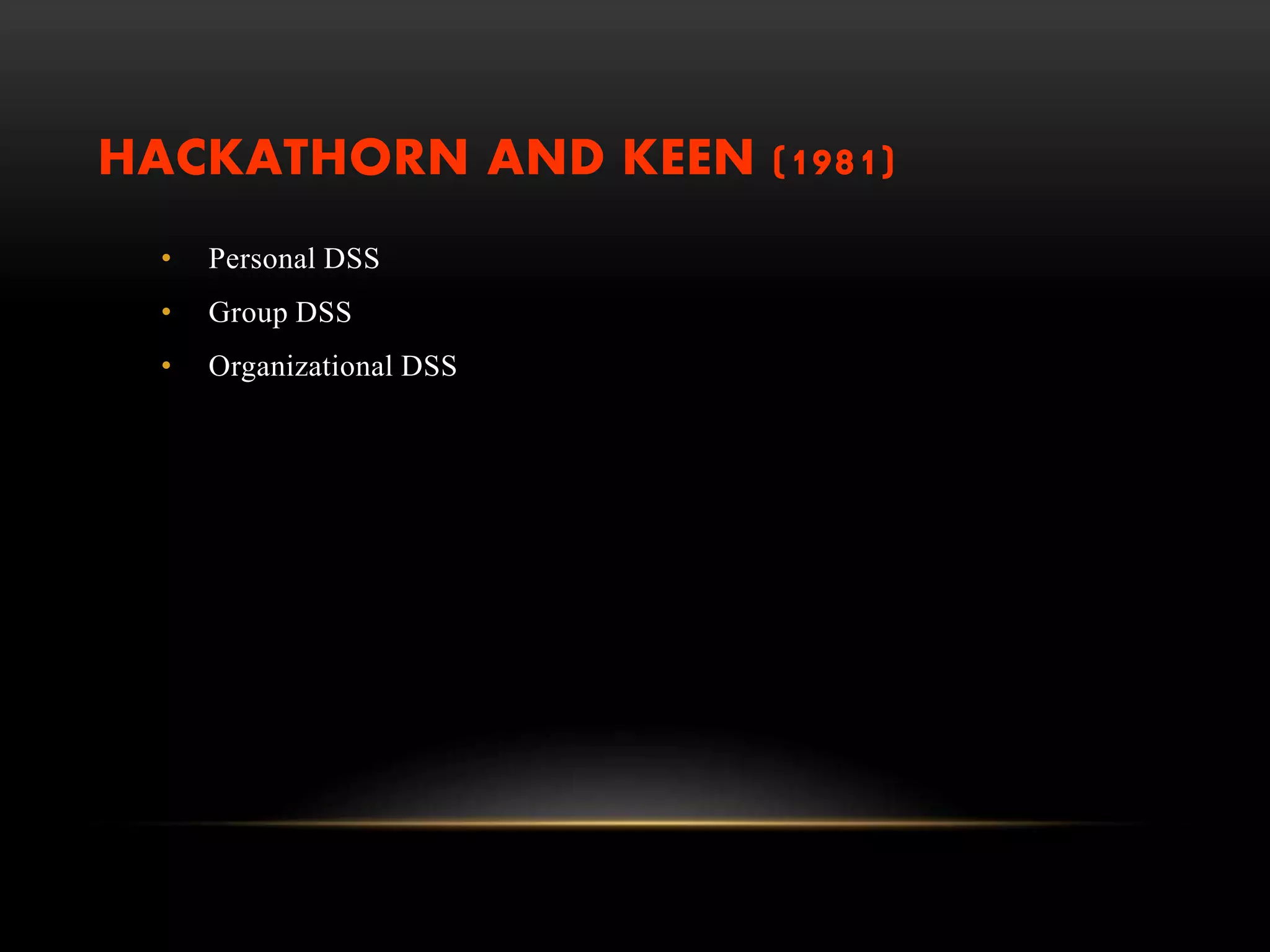
HACKATHORN AND KEEN (1981)
• Personal DSS
• Group DSS
• Organizational DSS
SPECIFIC PROBLEM/ORGANIZATION
VERSUS
GENERAL DSS GENERATOR
Can you say
VISICALC?
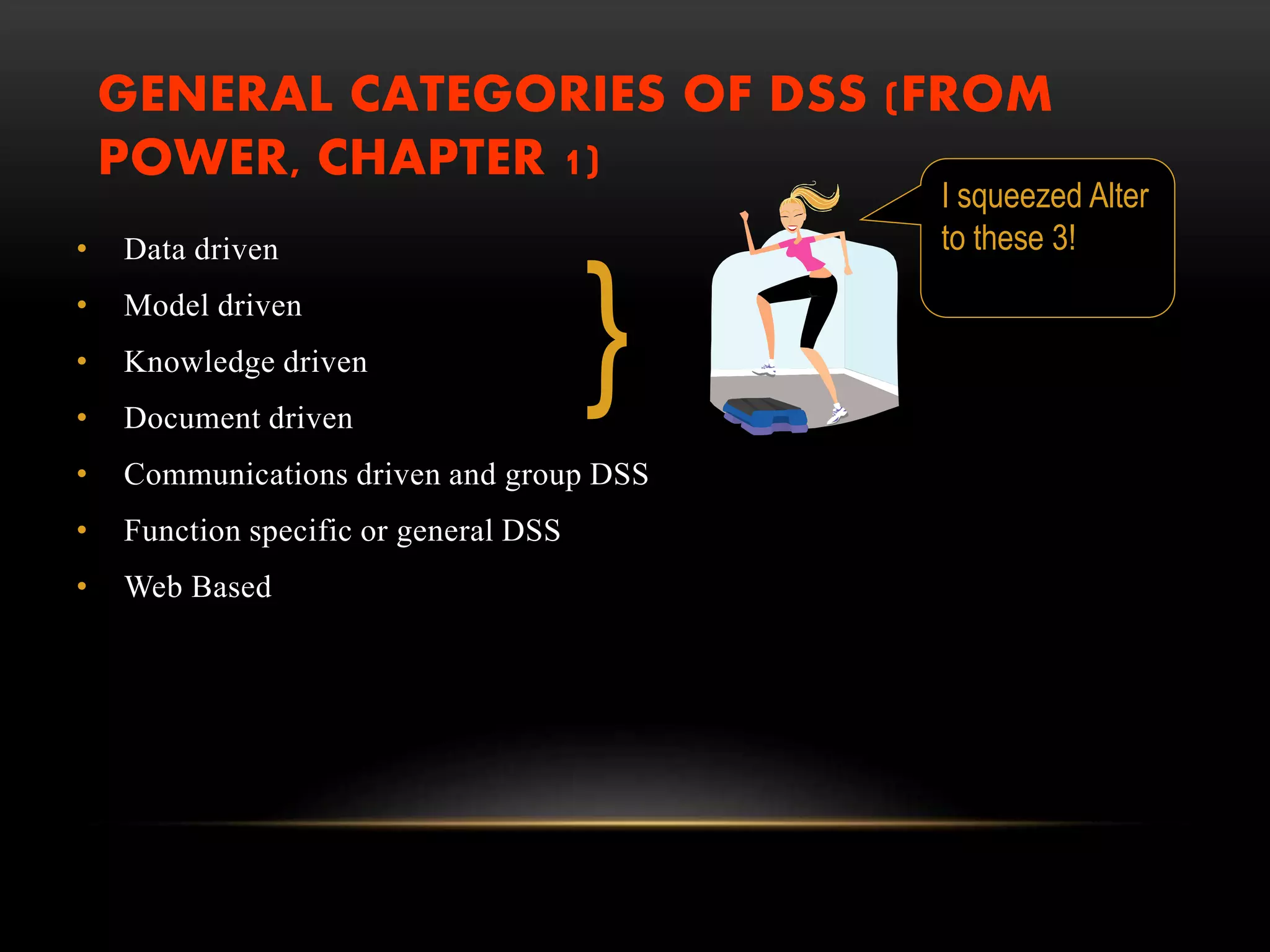
GENERAL CATEGORIES OF DSS (FROM
POWER, CHAPTER 1)
• Data driven
• Model driven
• Knowledge driven
• Document driven
• Communications driven and group DSS
• Function specific or general DSS
• Web Based
}
I squeezed Alter
to these 3!
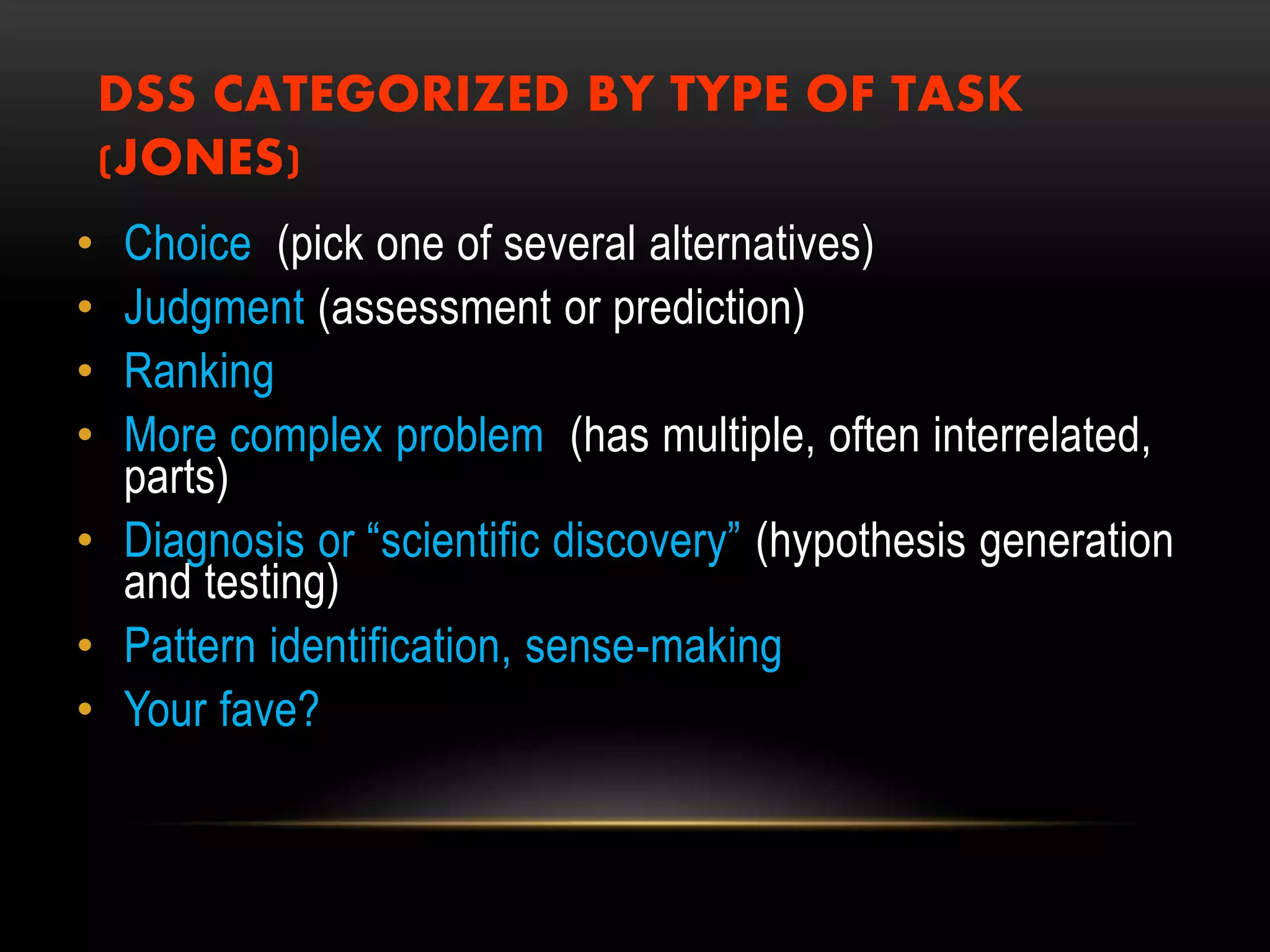
DSS CATEGORIZED BY TYPE OF TASK
(JONES)
• Choice (pick one of several alternatives)
• Judgment (assessment or prediction)
• Ranking
• More complex problem (has multiple, often interrelated,
parts)
• Diagnosis or “scientific discovery” (hypothesis generation
and testing)
• Pattern identification, sense-making
• Your fave?
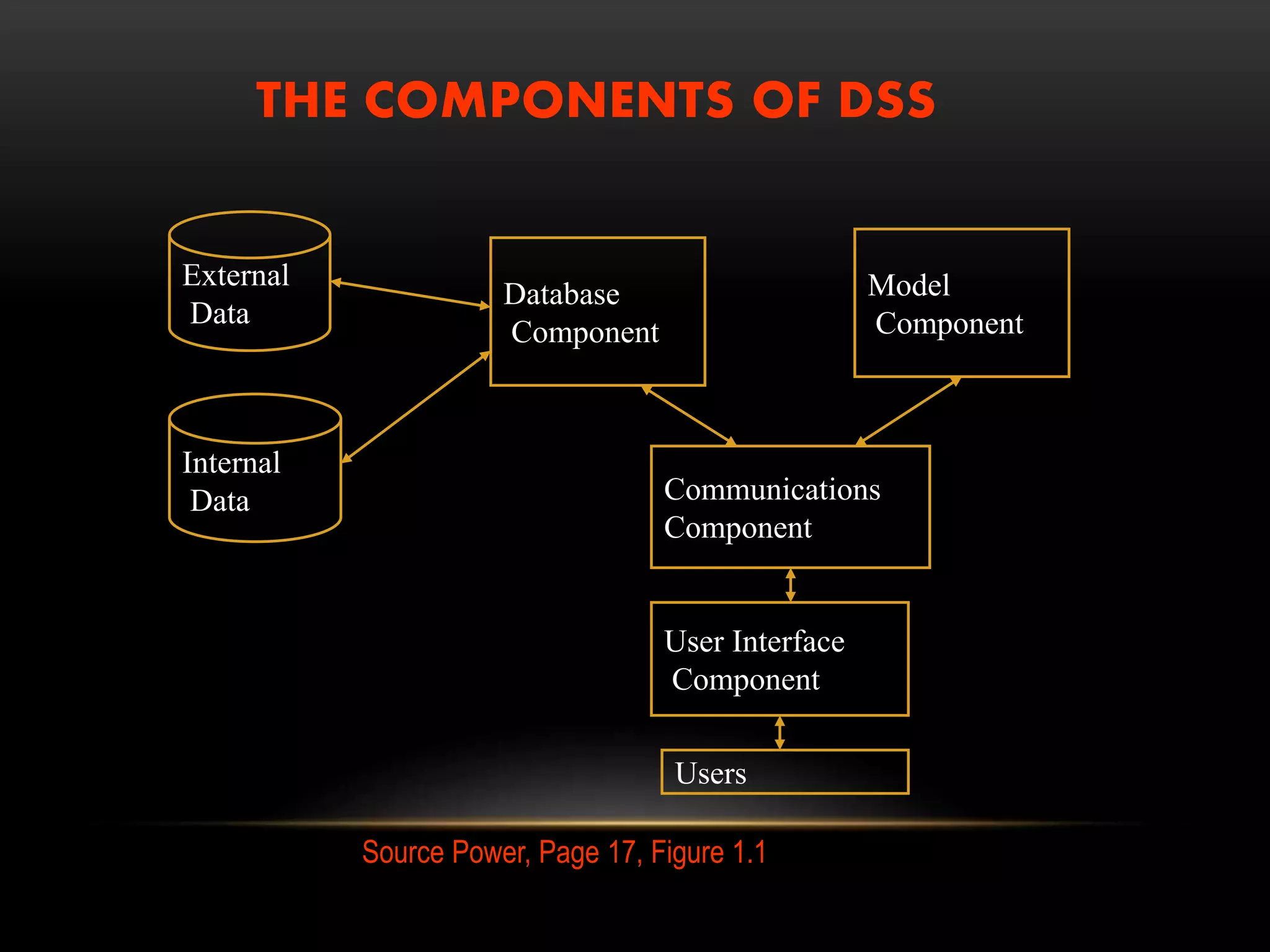
Source Power, Page 17, Figure 1.1
External
Data
Internal
Data
Database
Component
User Interface
Component
Model
Component
Communications
Component
Users
THE COMPONENTS OF DSS
DSS CLASSIFICATION VIEWED FROM
THREE DIRECTIONS
Decision
Task
Technology
Decision
Maker(s)
DSS PARADIGM AND
ARCHITECTURE
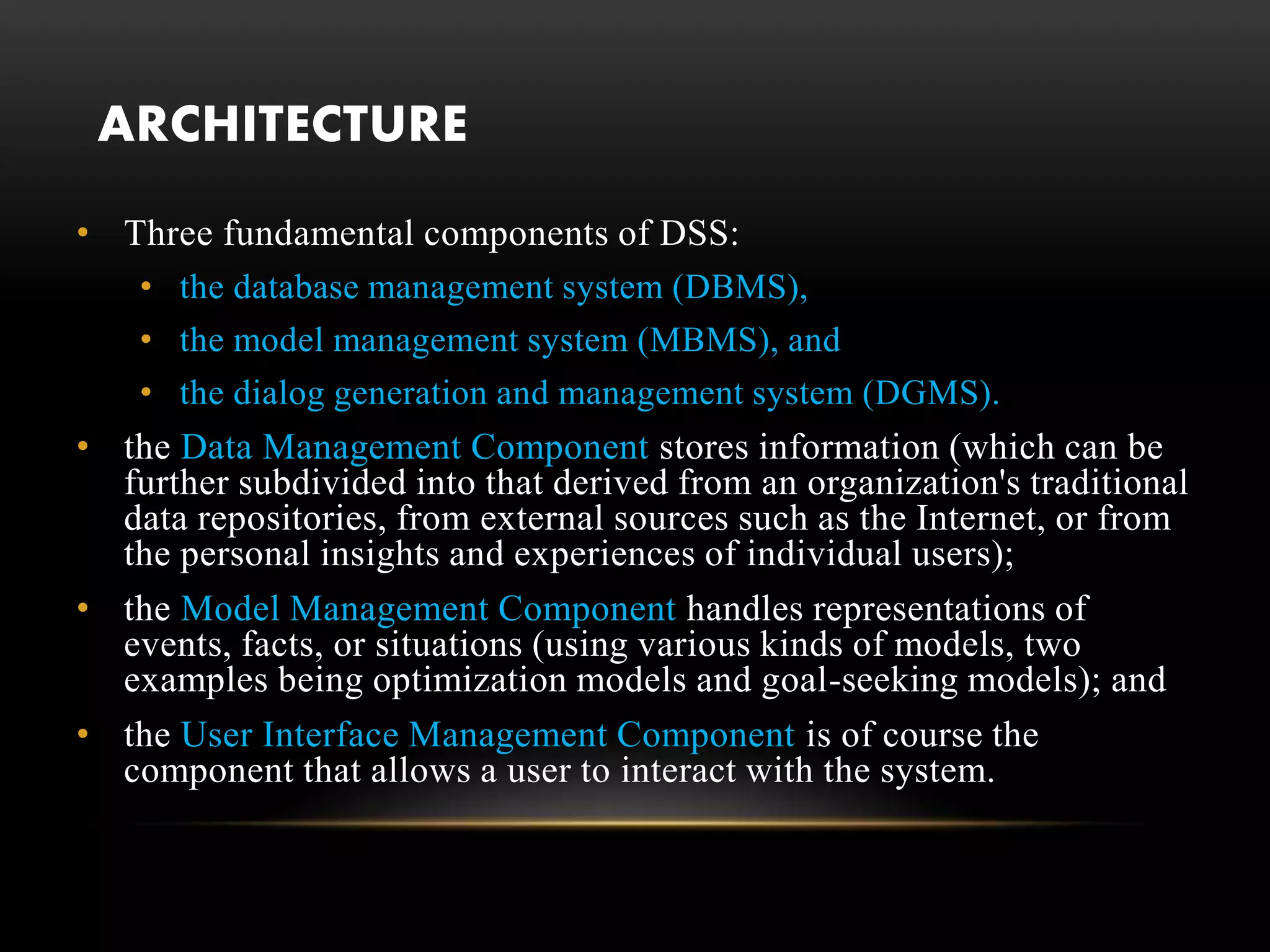
ARCHITECTURE
• Three fundamental components of DSS:
• the database management system (DBMS),
• the model management system (MBMS), and
• the dialog generation and management system (DGMS).
• the Data Management Component stores information (which can be
further subdivided into that derived from an organization's traditional
data repositories, from external sources such as the Internet, or from
the personal insights and experiences of individual users);
• the Model Management Component handles representations of
events, facts, or situations (using various kinds of models, two
examples being optimization models and goal-seeking models); and
• the User Interface Management Component is of course the
component that allows a user to interact with the system.
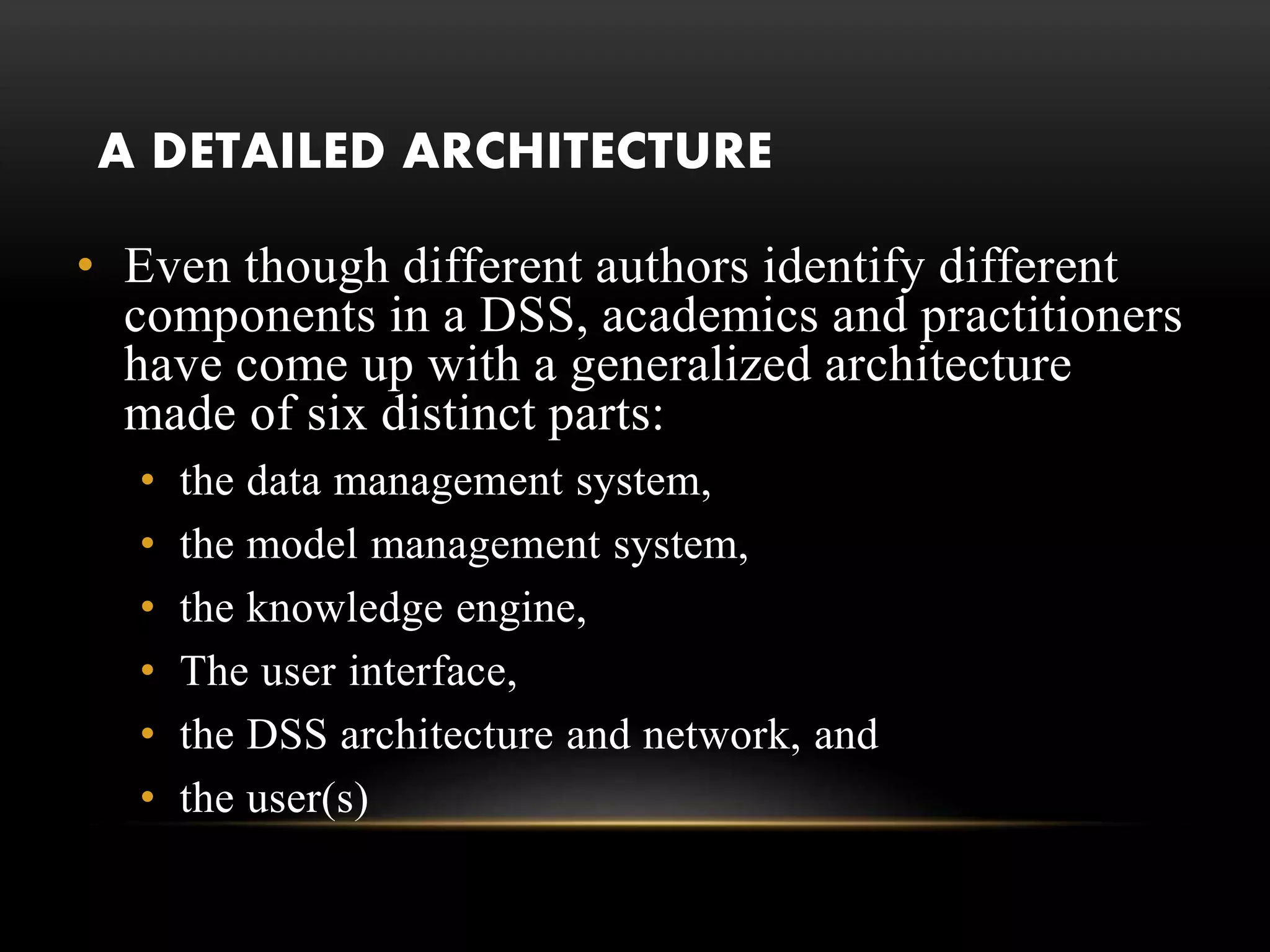
A DETAILED ARCHITECTURE
• Even though different authors identify different
components in a DSS, academics and practitioners
have come up with a generalized architecture
made of six distinct parts:
• the data management system,
• the model management system,
• the knowledge engine,
• The user interface,
• the DSS architecture and network, and
• the user(s)
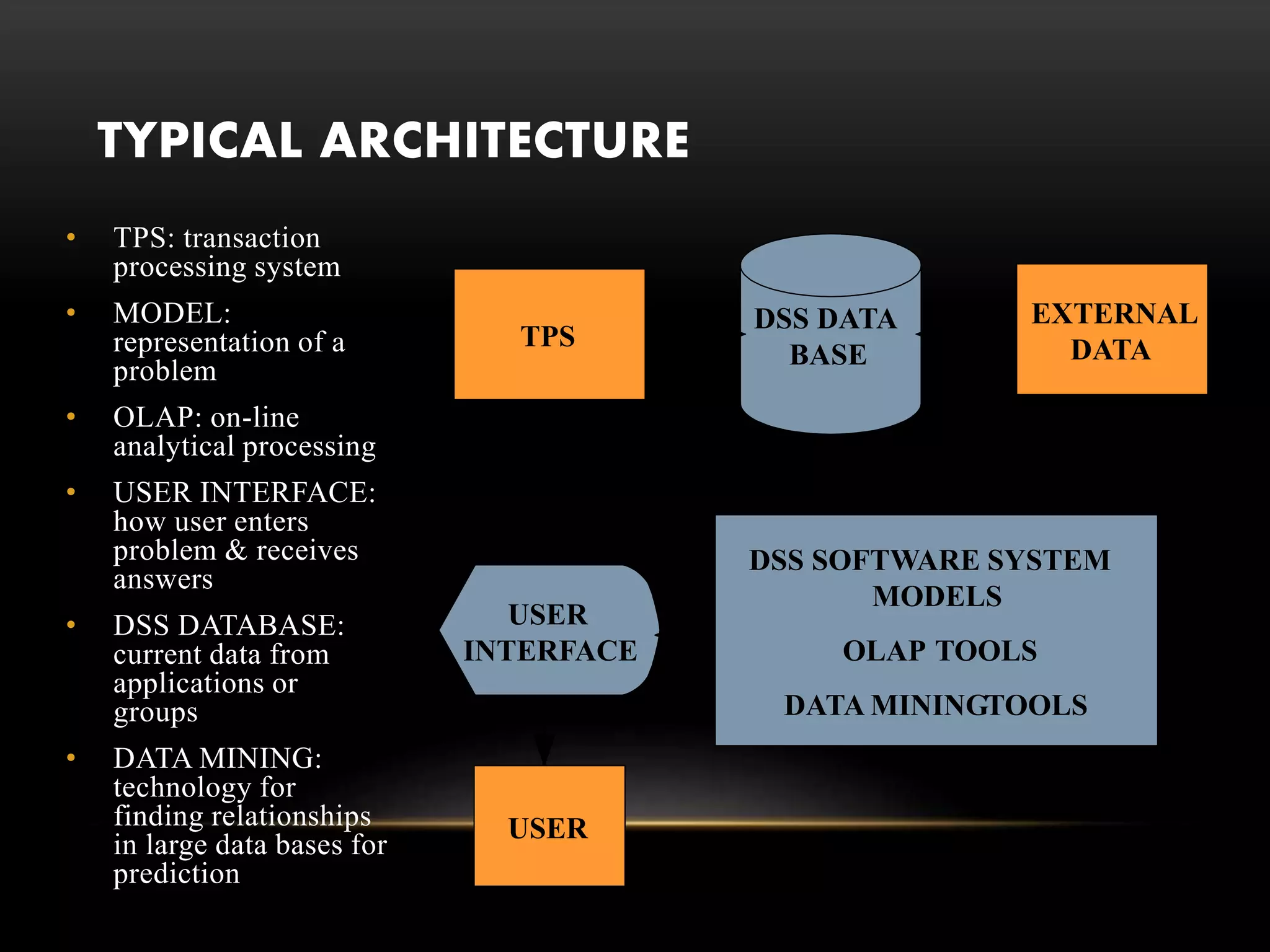
TYPICAL ARCHITECTURE
• TPS: transaction
processing system
• MODEL:
representation of a
problem
• OLAP: on-line
analytical processing
• USER INTERFACE:
how user enters
problem & receives
answers
• DSS DATABASE:
current data from
applications or
groups
• DATA MINING:
technology for
finding relationships
in large data bases for
prediction
TPS
EXTERNAL
DATA
DSS DATA
BASE
DSS SOFTWARE SYSTEM
MODELS
OLAP TOOLS
DATA MININGTOOLS
USER
INTERFACE
USER

Decision Support System - Presentation Slides

  • 1.
  • 2.
    INTRODUCTION • Decision makersare faced with increasingly stressful environments – highly competitive, fast-paced, near real-time, overloaded with information, data distributed throughout the enterprise, and multinational in scope. • The combination of the Internet enabling speed and access, and the maturation of artificial intelligence techniques, has led to sophisticated aids to support decision making under these risky and uncertain conditions. • These aids have the potential to improve decision making by suggesting solutions that are better than those made by the human alone. • They are increasingly available in diverse fields from medical diagnosis to traffic control to engineering applications.
  • 3.
    DECISION SUPPORT SYSTEM •A Decision Support System (DSS) is an interactive computer-based system or subsystem intended to help decision makers use communications technologies, data, documents, knowledge and/or models to identify and solve problems, complete decision process tasks, and make decisions. • Decision Support System is a general term for any computer application that enhances a person or group’s ability to make decisions. • Also, Decision Support Systems refers to an academic field of research that involves designing and studying Decision Support Systems in their context of use.
  • 4.
    INTRODUCTION Inquiring Organization Decision Making Process forDSS Knowledge Management New Decision Making Paradigm for DSS Unbounded Systems Thinking (UST) Singerian Organizational Model
  • 5.
  • 6.
  • 7.
    INTRODUCTION • In the1960s, researchers began systematically studying the use of computerized quantitative models to assist in decision making and planning (Raymond, 1966; Turban, 1967; Urban, 1967, Holt and Huber, 1969). Ferguson and Jones (1969) reported the first experimental study using a computer aided decision system. They investigated a production scheduling application running on an IBM 7094. In retrospect, a major historical turning point was Michael S. Scott Morton's (1967) dissertation field research at Harvard University.
  • 8.
    • Scott Morton’sstudy involved building, implementing and then testing an interactive, model-driven management decision system. Fellow Harvard Ph.D. student Andrew McCosh asserts that the “concept of decision support systems was first articulated by Scott Morton in February 1964 in a basement office in Sherman Hall, Harvard Business School” (McCosh email, 2002) in a discussion they had about Scott Morton’s dissertation. During 1966, Scott Morton (1971) studied how computers and analytical models could help managers make a recurring key business planning decision. He conducted an experiment in which managers actually used a Management Decision System (MDS). Marketing and production managers used an MDS to coordinate production planning for laundry equipment. The MDS ran on an IDI 21 inch CRT with a light pen connected using a 2400 bps modem to a pair of Univac 494 systems.
  • 9.
    • The pioneeringwork of George Dantzig, Douglas Engelbart and Jay Forrester likely influenced the feasibility of building computerized decision support systems. In 1952, Dantzig became a research mathematician at the Rand Corporation, where he began implementing linear programming on its experimental computers. In the mid-1960s, Engelbart and colleagues developed the first hypermedia—groupware system called NLS (oNLine System). NLS facilitated the creation of digital libraries and the storage and retrieval of electronic documents using hypertext. NLS also provided for on-screen video teleconferencing and was a forerunner to group decision support systems. Forrester was involved in building the SAGE (Semi-Automatic Ground Environment) air defense system for North Americacompleted in 1962. SAGE is probably the first computerized data- driven DSS. Also, Professor Forrester started the System Dynamics Group at the Massachusetts Institute of Technology Sloan School. His work on corporate modeling led to programming DYNAMO, a general simulation compiler.
  • 10.
    • In 1960,J.C.R. Licklider published his ideas about the future role of multiaccess interactive computing in a paper titled “Man-Computer Symbiosis.” He saw man- computer interaction as enhancing both the quality and efficiency of human problem solving and his paper provided a guide for decades of computer research to follow. Licklider was the architect of Project MAC at MIT that furthered the study of interactive computing. • By April 1964, the development of the IBM System 360 and other more powerful mainframe systems made it practical and cost-effective to develop Management Information Systems (MIS) for large companies (cf., Davis, 1974). These early MIS focused on providing managers with structured, periodic reports and the information was primarily from accounting and transaction processing systems, but the systems did not provide interactive support to assist managers in decision making.
  • 11.
    • Around 1970business journals started to publish articles on management decision systems, strategic planning systems and decision support systems (cf., Sprague and Watson 1979).. For example, Scott Morton and colleagues McCosh and Stephens published decision support related articles in 1968. The first use of the term decision support system was in Gorry and Scott- Morton’s (1971) Sloan Management Review article. They argued that Management Information Systems primarily focused on structured decisions and suggested that the supporting information systems for semi-structured and unstructured decisions should be termed “Decision Support Systems”. • T.P. Gerrity, Jr. focused on Decision Support Systems design issues in his 1971 Sloan Management Review article titled "The Design of Man-Machine Decision Systems: An Application to Portfolio Management". The article was based on his MIT Ph.D. dissertation. His system was designed to support investment managers in their daily administration of a clients' stock portfolio.
  • 12.
    • John D.C.Little, also at Massachusetts Institute of Technology, was studying DSS for marketing. Little and Lodish (1969) reported research on MEDIAC, a media planning support system. Also, Little(1970) identified criteria for designing models and systems to support management decision-making. His four criteria included: robustness, ease of control, simplicity, and completeness of relevant detail. All four criteria remain relevant in evaluating modern Decision Support Systems. By 1975, Little was expanding the frontiers of computer- supported modeling. His DSS called Brandaid was designed to support product, promotion, pricing and advertising decisions. Little also helped develop the financial and marketing modeling language known as EXPRESS.
  • 13.
    • In 1974,Gordon Davis, a Professor at the University of Minnesota, published his influential text on Management Information Systems. He defined a Management Information System as "an integrated, man/machine system for providing information to support the operations, management, and decision-making functions in an organization. (p. 5)." Davis's Chapter 12 was titled "Information System Support for Decision Making" and Chapter 13 was titled "Information System Support for Planning and Control". Davis’s framework incorporated computerized decision support systems into the emerging field of management information systems. • Peter Keen and Charles Stabell claim the concept of decision support systems evolved from "the theoretical studies of organizational decisionmaking done at the Carnegie Institute of Technology during the late 1950s and early '60s and the technical work on interactive computer systems, mainly carried out at the Massachusetts Institute of Technology in the 1960s. (Keen and Scott Morton, 1978)". Herbert Simon’s books (1947, 1960) and articles provide a context for understanding and supporting decision making.
  • 14.
    • In 1995,Hans Klein and Leif Methlie noted “A study of the origin of DSS has still to be written. It seems that the first DSS papers were published by PhD students or professors in business schools, who had access to the first time- sharing computer system: Project MAC at the Sloan School, the Dartmouth Time Sharing Systems at the Tuck School. In France, HEC was the first French business school to have a time-sharing system (installed in 1967), and the first DSS papers were published by professors of the School in 1970. (p. 112).”
  • 15.
  • 16.
    STAGES OF DECISIONMAKING (FROM HERBERT SIMON) • Intelligence (in the military sense of gathering information) • Design (Identifying the alternatives, structuring how the decision will be made) • Choice (Picking an alternative or making the judgment) • [Implementation – later added by other authors] • [Evaluation]
  • 17.
    STRUCTURED VS UNSTRUCTURED DECISIONSTAGES • Each stage can be Structured (automated) or Unstructured • “Structured” means that there is an algorithm, mathematical formula, or decision rule to accomplish the entire stage. The algorithm can be implemented manually or it can be computerized, but the steps are so detailed that no little or no human judgment would be needed. • Any decision stage that is not structured is unstructured
  • 18.
    DSS CONCEPT • Anthony(1965) • Categories of Management Activities • Strategic Planning, Management Control, Operational Control • Simon (1960) • Description of Decision Type • Decision problems as existing on a continuum from programmed to non- programmed • Gorry & Morton (1971)
  • 19.
    STRUCTURED, SEMI-STRUCTURED, AND UNSTRUCTUREDDECISIONS • In a structured decision all three stages are structured • In a non-structured decision all three stages are unstructured • A semi-structured decision is one in which part, but not all, of the decision is structured.
  • 20.
    KEY POINT: • Therealm of Decision Support Systems is Semi-Structured and unstructured Decisions…the type of decisions that can benefit from “decision support” but the human decision maker is still involved.
  • 21.
    THOUGHT QUESTIONS: • Howis a DSS different than a Transaction Processing System? • (Power: last paragraph on page 8) • What does the term “MIS” mean to you? • How does the term “MIS” relate to DSS?
  • 22.
    GSM’S FRAMEWORK Managerial Activity(Anthony) Decision type (Simon Operational control Manage- ment control Strategic planning Structured Semi- structured Unstructured
  • 23.
  • 24.
    Alter (1977, 1980) CategoryExample Features Capability focuses on File Drawer Equipment monitoring Simple query and reporting Looking up data Data Analysis Budget analysis, variance monitoring Many data warehouse apps. Looking up data and having it aggregated in some useful way Analysis info. Sys. Sales forecasting based on marketing data DB + small models Mathematical model (e.g., regression) Accounting and financial Estimating effect of decisions on financial statements “What if” Letting you change inputs to see the effect on outputs Representational models Risk analysis, production planning simulations Decision maker providing assumptions to system, system generating a distribution of inputs, then generating a distribution of outputs Optimization models Truck route planning, material usage Algorithms generate optimal solutions subject to constraints Decision maker supplies assumptions and system generates “best” outcome Suggestion models Credit scoring Structured processing steps DSS makes recommendation, but decision maker has final say
  • 25.
    •Text oriented DSS •DB-oriented •Spreadsheetoriented •Solver oriented •Rule oriented HOLSAPPLE AND WHINSTON (1996) FIVE TYPES OF DSS
  • 26.
    HACKATHORN AND KEEN(1981) • Personal DSS • Group DSS • Organizational DSS
  • 27.
    SPECIFIC PROBLEM/ORGANIZATION VERSUS GENERAL DSSGENERATOR Can you say VISICALC?
  • 28.
    GENERAL CATEGORIES OFDSS (FROM POWER, CHAPTER 1) • Data driven • Model driven • Knowledge driven • Document driven • Communications driven and group DSS • Function specific or general DSS • Web Based } I squeezed Alter to these 3!
  • 29.
    DSS CATEGORIZED BYTYPE OF TASK (JONES) • Choice (pick one of several alternatives) • Judgment (assessment or prediction) • Ranking • More complex problem (has multiple, often interrelated, parts) • Diagnosis or “scientific discovery” (hypothesis generation and testing) • Pattern identification, sense-making • Your fave?
  • 30.
    Source Power, Page17, Figure 1.1 External Data Internal Data Database Component User Interface Component Model Component Communications Component Users THE COMPONENTS OF DSS
  • 31.
    DSS CLASSIFICATION VIEWEDFROM THREE DIRECTIONS Decision Task Technology Decision Maker(s)
  • 32.
  • 33.
    ARCHITECTURE • Three fundamentalcomponents of DSS: • the database management system (DBMS), • the model management system (MBMS), and • the dialog generation and management system (DGMS). • the Data Management Component stores information (which can be further subdivided into that derived from an organization's traditional data repositories, from external sources such as the Internet, or from the personal insights and experiences of individual users); • the Model Management Component handles representations of events, facts, or situations (using various kinds of models, two examples being optimization models and goal-seeking models); and • the User Interface Management Component is of course the component that allows a user to interact with the system.
  • 34.
    A DETAILED ARCHITECTURE •Even though different authors identify different components in a DSS, academics and practitioners have come up with a generalized architecture made of six distinct parts: • the data management system, • the model management system, • the knowledge engine, • The user interface, • the DSS architecture and network, and • the user(s)
  • 35.
    TYPICAL ARCHITECTURE • TPS:transaction processing system • MODEL: representation of a problem • OLAP: on-line analytical processing • USER INTERFACE: how user enters problem & receives answers • DSS DATABASE: current data from applications or groups • DATA MINING: technology for finding relationships in large data bases for prediction TPS EXTERNAL DATA DSS DATA BASE DSS SOFTWARE SYSTEM MODELS OLAP TOOLS DATA MININGTOOLS USER INTERFACE USER