Dampness in BuildingsDampness in Buildings
Causes of Dampness inCauses of Dampness in
BuildingsBuildings
Remedial measuresRemedial measures
BY : Ashar GillBY : Ashar Gill
TopicsTopics
• DefinitionsDefinitions
• Types of DampnessTypes of Dampness
• Causes of DampnessCauses of Dampness
• Effects of DampnessEffects of Dampness
• Remidial measuresRemidial measures
• Classification of Damp proofing materialClassification of Damp proofing material
DefinitionsDefinitions
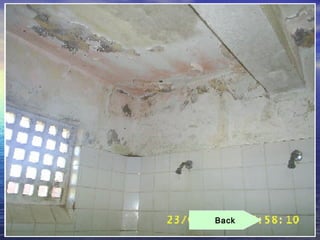
• DampnessDampness
– The excess entry or penetration of moisture inside a buildingThe excess entry or penetration of moisture inside a building
through itsthrough its
– FloorsFloors
– Walls andWalls and
– RoofsRoofs
is called Dampness.is called Dampness.
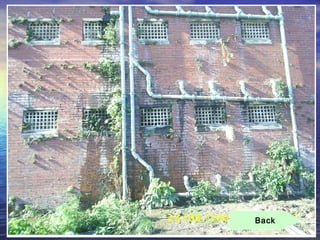
Dampness is dangerous both forDampness is dangerous both for
InmatesInmates
BuildingBuilding
• Due to dampness the building become unhygienic.Due to dampness the building become unhygienic.
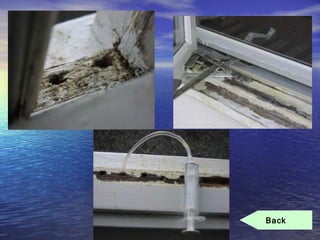
• Dampness in buildings is a risk factor for health effects.Dampness in buildings is a risk factor for health effects.
DefinitionsDefinitions
• Peeling offPeeling off
– This term is related to plaster and it means that theThis term is related to plaster and it means that the
plaster surface get disfigured.plaster surface get disfigured.
• Blistered and BleachedBlistered and Bleached
– These term are related to PaintingThese term are related to Painting
• DPCDPC (Damp proof course)(Damp proof course)
– It is a continuous layer of impervious materialIt is a continuous layer of impervious material
between source of dampness and building componentbetween source of dampness and building component
Types of DampnessTypes of Dampness
• Based on the movement of moisture the
dampness can be of the following three
types.
1. Rising or capillary dampness.
2. Falling or penetrating dampness.
3. Condensation dampness.
Causes of DampnessCauses of Dampness
• Following are the main causes of dampness inFollowing are the main causes of dampness in
a buildinga building
1.1. Rain penetrationRain penetration
2.2. Level of siteLevel of site
3.3. Drainability of the SoilDrainability of the Soil
4.4. Climatic conditionsClimatic conditions
5.5. Defective OrientationDefective Orientation
6.6. Entraped moisture in the buildingEntraped moisture in the building
7.7. Defective construction materialDefective construction material
8.8. Defective construstionDefective construstion
9.9. Moisture originates in the building.Moisture originates in the building.
Causes of DampnessCauses of Dampness
1.1. Rain penetrationRain penetration
• It is the main source of dampness. Heavy rain of shortIt is the main source of dampness. Heavy rain of short
duration is less dangerous. rain water enters through joints,duration is less dangerous. rain water enters through joints,
cracks and porous bricks or stones.cracks and porous bricks or stones.
1.1. Level of siteLevel of site
• Low laying building sites are effected by the depositingLow laying building sites are effected by the depositing
surface water and underground water.surface water and underground water.
1.1. Drainability of the SoilDrainability of the Soil
• Course grained soils like Sandy or gravely soils providesCourse grained soils like Sandy or gravely soils provides
good drainibility conditions and fine grained soils like claygood drainibility conditions and fine grained soils like clay
retain water and cause dampness.retain water and cause dampness.
Causes of DampnessCauses of Dampness
4.4. Climatic conditionsClimatic conditions
• In cold climatic condition dampness causes dueIn cold climatic condition dampness causes due
to condensation of water vapors.to condensation of water vapors.
4.4. Defective OrientationDefective Orientation
• If building is exposed to direct rain showers andIf building is exposed to direct rain showers and
less sun rays then it cause dampness.less sun rays then it cause dampness.
4.4. Entrapped moisture in the buildingEntrapped moisture in the building
1.1. Due Over soaked bricks and use of salty orDue Over soaked bricks and use of salty or
alkaline water results dampness in building.alkaline water results dampness in building.
Causes of DampnessCauses of Dampness
7.7. Defective construction materialDefective construction material
• Porous bricks, soft stones, alkaline water etc.Porous bricks, soft stones, alkaline water etc.
cause dampness of building.cause dampness of building.
7.7. Defective constructionDefective construction
• Through defective joints of parapet, copping andThrough defective joints of parapet, copping and
masonry joints moisture can enter in the building.masonry joints moisture can enter in the building.
7.7. Moisture originates in the building.Moisture originates in the building.
• It is due to the leakage through water supply orIt is due to the leakage through water supply or
sanitary system of building.sanitary system of building.
Effects of DampnessEffects of Dampness
• Following are the harmful effects of dampness inFollowing are the harmful effects of dampness in
buildings.buildings.
– Building become esthetically poor.Building become esthetically poor.
– It causeIt cause dry Rotdry Rot to the wooden members provided in theto the wooden members provided in the
building.building.
– It cause corrosion of metals used in building.It cause corrosion of metals used in building.
– Plaster peels off.Plaster peels off.
– Paint blistered and bleached and the surface disfigured.Paint blistered and bleached and the surface disfigured.
– Holes and pits are formed in topping of floors.Holes and pits are formed in topping of floors.
– Efflorescence occurs and bricks disintegrate and turn in toEfflorescence occurs and bricks disintegrate and turn in to
powder.powder.
– Un hygienic conditions in building.Un hygienic conditions in building.
Remedial MeasuresRemedial Measures
• By Damp Proofing Courses (DPC)By Damp Proofing Courses (DPC)
• By surface treatmentBy surface treatment
• By water proofing constructionBy water proofing construction
• By special devices/techniquesBy special devices/techniques
ByBy
Damp Proofing CoursesDamp Proofing Courses
DPCDPC
Damp proofing materialDamp proofing material
• Classification of Damp proofing materialClassification of Damp proofing material
• Qualities of a good Damp proofingQualities of a good Damp proofing
MaterialMaterial
• Important places for Damp proofingImportant places for Damp proofing
materials.materials.
Classification of Damp proofingClassification of Damp proofing
materialmaterial
• Flexible MaterialsFlexible Materials
• Material which do not crack and deformMaterial which do not crack and deform
due to loadings.due to loadings.
– Bitumen Mastic (Mastic Asphalt)Bitumen Mastic (Mastic Asphalt)
– Bitumen feltBitumen felt
– Hot BitumenHot Bitumen
– Metal SheetsMetal Sheets
• Rigid MaterialsRigid Materials
• Materials that cannot resist transverseMaterials that cannot resist transverse
stresses.stresses.
– Rich ConcreteRich Concrete
– MortarMortar
– BricksBricks
– Stone SlabsStone Slabs
Flexible MaterialsFlexible Materials
– Bitumen Mastic (Mastic Asphalt)Bitumen Mastic (Mastic Asphalt)
• Hot Bitumen or Asphalt + SandHot Bitumen or Asphalt + Sand
• Applied in hot state in 1” to 2” (2 cm to 5 cm)Applied in hot state in 1” to 2” (2 cm to 5 cm)
– Bitumen feltBitumen felt
• 6 mm thick bitumen sheet available in roll form6 mm thick bitumen sheet available in roll form
– Hot BitumenHot Bitumen
• It is sprayed at @ 1.75 kg/mIt is sprayed at @ 1.75 kg/m22
– Metal SheetsMetal Sheets
– Lead, copper, Aluminum sheets can be usedLead, copper, Aluminum sheets can be used
• Lead can react chemically with cement so should be laid inLead can react chemically with cement so should be laid in
lime mortar.lime mortar.
• Minimum thickness of copper sheets should be 3 mm .Minimum thickness of copper sheets should be 3 mm .
Rigid MaterialsRigid Materials
– Rich ConcreteRich Concrete
• 1” to 2-1/2” thick layer of P.C.C (1:2:4) painted with hot1” to 2-1/2” thick layer of P.C.C (1:2:4) painted with hot
bitumen is appliedbitumen is applied
– MortarMortar
• Rich or fat cement mortar CS(!:3) is laid in ¾” thickness (2Rich or fat cement mortar CS(!:3) is laid in ¾” thickness (2
cm) as vertical DPC.cm) as vertical DPC.
• Painted with bitumenPainted with bitumen
– BricksBricks
• Over burnt bricks are used in two layers in CS(1:3) mortarOver burnt bricks are used in two layers in CS(1:3) mortar
– Stone SlabsStone Slabs
• Two layers of stone slabs in lime cement and sand mortarTwo layers of stone slabs in lime cement and sand mortar
(1:1:6) is provided in areas where stone is easily available.(1:1:6) is provided in areas where stone is easily available.
Qualities of a good Damp proofingQualities of a good Damp proofing
MaterialMaterial
1.1. ImperviousImpervious
2.2. DurableDurable
3.3. Non disintegratableNon disintegratable
4.4. Stable under the loadingStable under the loading
5.5. Level finishLevel finish
6.6. Full coverage of wall thicknessFull coverage of wall thickness
7.7. AvailabilityAvailability
8.8. EconomicalEconomical
Important places for Damp proofingImportant places for Damp proofing
materialsmaterials
• At Plinth Level (in walls ) (external &At Plinth Level (in walls ) (external &
Internal)Internal)
• Parapet wallsParapet walls
• Window sillWindow sill
• Basements and Under ground FloorsBasements and Under ground Floors
Back
Back
Dampness in buildings is aDampness in buildings is a
risk factor for health effectsrisk factor for health effects
Associations found with cough, asthma,Associations found with cough, asthma,
tiredness, airway infectiontiredness, airway infection
– Increased relative risk 1.4-2.2Increased relative risk 1.4-2.2
Back
Ozone-generating OOzone-generating O33 “Air Purifiers”“Air Purifiers”
• Portable electronic appliancesPortable electronic appliances
• Release ozone gasRelease ozone gas by designby design oror as a by-as a by-
productproduct (“ozone generators” versus(“ozone generators” versus
ionizers & electrostatic precipitators)ionizers & electrostatic precipitators)
– Ozone generators 300 - 400 ppbOzone generators 300 - 400 ppb
– Personal air purifiers ~ 100 ppbPersonal air purifiers ~ 100 ppb
Back
What is condensation?What is condensation?
Condensation is the formation of liquid drops from waterCondensation is the formation of liquid drops from water
vapor.vapor.
More DetailsMore Details
It is the process which creates clouds, and so isIt is the process which creates clouds, and so is
necessary for rain and snow formation as well.necessary for rain and snow formation as well.
Condensation usually occurs when a parcel of rising airCondensation usually occurs when a parcel of rising air
expands and cools. If it cools enough, some of the waterexpands and cools. If it cools enough, some of the water
vapor molecules clump together faster than they are tornvapor molecules clump together faster than they are torn
apart from their thermal energy. A very important part ofapart from their thermal energy. A very important part of
this process is the release of the latent heat ofthis process is the release of the latent heat of
condensation. This is the heat that was absorbed whencondensation. This is the heat that was absorbed when
the water was originally evaporated from the surface ofthe water was originally evaporated from the surface of
the Earth. The heat removed from the surface throughthe Earth. The heat removed from the surface through
evaporation is released again up in the atmosphere whenevaporation is released again up in the atmosphere when
clouds form. This process keeps the Earth's climateclouds form. This process keeps the Earth's climate
cooler that it would otherwise be if there were no water.cooler that it would otherwise be if there were no water.
Another way in which condensation occurs is during theAnother way in which condensation occurs is during the
formation of dews.formation of dews.
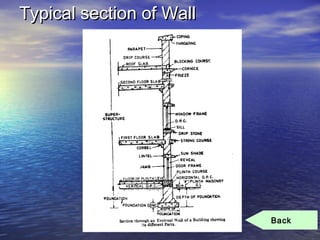
Typical section of WallTypical section of Wall
Back
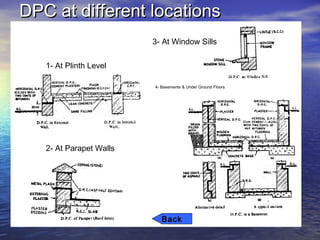
DPC at different locationsDPC at different locations
Back
1- At Plinth Level
2- At Parapet Walls
3- At Window Sills
4- Basements & Under Ground Floors
Back
Difference of Bitumen and AsphaltDifference of Bitumen and Asphalt
• Bitumen can be found in Nature.Bitumen can be found in Nature.
• Asphalt is a manufactured product,Asphalt is a manufactured product,
produced by refining crude oil by heatingproduced by refining crude oil by heating
at 300at 300 oo
C in a distillation column.C in a distillation column.
• Naphthene base crude oils are suitableNaphthene base crude oils are suitable
Naphthene base crude oilsNaphthene base crude oils
• Crude oil containing asphaltic materialsCrude oil containing asphaltic materials
but very little or no paraffin wax. This typebut very little or no paraffin wax. This type
of oil is suitable for making gasoline,of oil is suitable for making gasoline,
lubricating oil and asphalt. It is also calledlubricating oil and asphalt. It is also called
asphalt-base crude.asphalt-base crude.
Practical Advice forPractical Advice for
Reducing Excessive Moisture*Reducing Excessive Moisture*
• Fix roof and plumbing leaks right awayFix roof and plumbing leaks right away
• Check for standing waterCheck for standing water (e.g., basement & refrig drip pan)(e.g., basement & refrig drip pan)
• Make sure rain drains away from house (& irrigation)Make sure rain drains away from house (& irrigation)
• Vent clothes dryer to the outsideVent clothes dryer to the outside
• Ensure adequate ventilation (from outside) andEnsure adequate ventilation (from outside) and
circulation (inside). Use fans that vent air to the outsidecirculation (inside). Use fans that vent air to the outside
when bathing, showering, and cookingwhen bathing, showering, and cooking
• After flooding, remove any wet or damp material rightAfter flooding, remove any wet or damp material right
away and start drying (with fans).away and start drying (with fans). Pull up carpets.Pull up carpets.
** Mold in My Home: What Do I Do?Mold in My Home: What Do I Do?,, CHDS 2004CHDS 2004

Dampness in buildings

  • 1.
    Dampness in BuildingsDampnessin Buildings Causes of Dampness inCauses of Dampness in BuildingsBuildings Remedial measuresRemedial measures BY : Ashar GillBY : Ashar Gill
  • 2.
    TopicsTopics • DefinitionsDefinitions • Typesof DampnessTypes of Dampness • Causes of DampnessCauses of Dampness • Effects of DampnessEffects of Dampness • Remidial measuresRemidial measures • Classification of Damp proofing materialClassification of Damp proofing material
  • 3.
    DefinitionsDefinitions • DampnessDampness – Theexcess entry or penetration of moisture inside a buildingThe excess entry or penetration of moisture inside a building through itsthrough its – FloorsFloors – Walls andWalls and – RoofsRoofs is called Dampness.is called Dampness. Dampness is dangerous both forDampness is dangerous both for InmatesInmates BuildingBuilding • Due to dampness the building become unhygienic.Due to dampness the building become unhygienic. • Dampness in buildings is a risk factor for health effects.Dampness in buildings is a risk factor for health effects.
  • 4.
    DefinitionsDefinitions • Peeling offPeelingoff – This term is related to plaster and it means that theThis term is related to plaster and it means that the plaster surface get disfigured.plaster surface get disfigured. • Blistered and BleachedBlistered and Bleached – These term are related to PaintingThese term are related to Painting • DPCDPC (Damp proof course)(Damp proof course) – It is a continuous layer of impervious materialIt is a continuous layer of impervious material between source of dampness and building componentbetween source of dampness and building component
  • 5.
    Types of DampnessTypesof Dampness • Based on the movement of moisture the dampness can be of the following three types. 1. Rising or capillary dampness. 2. Falling or penetrating dampness. 3. Condensation dampness.
  • 6.
    Causes of DampnessCausesof Dampness • Following are the main causes of dampness inFollowing are the main causes of dampness in a buildinga building 1.1. Rain penetrationRain penetration 2.2. Level of siteLevel of site 3.3. Drainability of the SoilDrainability of the Soil 4.4. Climatic conditionsClimatic conditions 5.5. Defective OrientationDefective Orientation 6.6. Entraped moisture in the buildingEntraped moisture in the building 7.7. Defective construction materialDefective construction material 8.8. Defective construstionDefective construstion 9.9. Moisture originates in the building.Moisture originates in the building.
  • 7.
    Causes of DampnessCausesof Dampness 1.1. Rain penetrationRain penetration • It is the main source of dampness. Heavy rain of shortIt is the main source of dampness. Heavy rain of short duration is less dangerous. rain water enters through joints,duration is less dangerous. rain water enters through joints, cracks and porous bricks or stones.cracks and porous bricks or stones. 1.1. Level of siteLevel of site • Low laying building sites are effected by the depositingLow laying building sites are effected by the depositing surface water and underground water.surface water and underground water. 1.1. Drainability of the SoilDrainability of the Soil • Course grained soils like Sandy or gravely soils providesCourse grained soils like Sandy or gravely soils provides good drainibility conditions and fine grained soils like claygood drainibility conditions and fine grained soils like clay retain water and cause dampness.retain water and cause dampness.
  • 8.
    Causes of DampnessCausesof Dampness 4.4. Climatic conditionsClimatic conditions • In cold climatic condition dampness causes dueIn cold climatic condition dampness causes due to condensation of water vapors.to condensation of water vapors. 4.4. Defective OrientationDefective Orientation • If building is exposed to direct rain showers andIf building is exposed to direct rain showers and less sun rays then it cause dampness.less sun rays then it cause dampness. 4.4. Entrapped moisture in the buildingEntrapped moisture in the building 1.1. Due Over soaked bricks and use of salty orDue Over soaked bricks and use of salty or alkaline water results dampness in building.alkaline water results dampness in building.
  • 9.
    Causes of DampnessCausesof Dampness 7.7. Defective construction materialDefective construction material • Porous bricks, soft stones, alkaline water etc.Porous bricks, soft stones, alkaline water etc. cause dampness of building.cause dampness of building. 7.7. Defective constructionDefective construction • Through defective joints of parapet, copping andThrough defective joints of parapet, copping and masonry joints moisture can enter in the building.masonry joints moisture can enter in the building. 7.7. Moisture originates in the building.Moisture originates in the building. • It is due to the leakage through water supply orIt is due to the leakage through water supply or sanitary system of building.sanitary system of building.
  • 10.
    Effects of DampnessEffectsof Dampness • Following are the harmful effects of dampness inFollowing are the harmful effects of dampness in buildings.buildings. – Building become esthetically poor.Building become esthetically poor. – It causeIt cause dry Rotdry Rot to the wooden members provided in theto the wooden members provided in the building.building. – It cause corrosion of metals used in building.It cause corrosion of metals used in building. – Plaster peels off.Plaster peels off. – Paint blistered and bleached and the surface disfigured.Paint blistered and bleached and the surface disfigured. – Holes and pits are formed in topping of floors.Holes and pits are formed in topping of floors. – Efflorescence occurs and bricks disintegrate and turn in toEfflorescence occurs and bricks disintegrate and turn in to powder.powder. – Un hygienic conditions in building.Un hygienic conditions in building.
  • 11.
    Remedial MeasuresRemedial Measures •By Damp Proofing Courses (DPC)By Damp Proofing Courses (DPC) • By surface treatmentBy surface treatment • By water proofing constructionBy water proofing construction • By special devices/techniquesBy special devices/techniques
  • 12.
    ByBy Damp Proofing CoursesDampProofing Courses DPCDPC
  • 13.
    Damp proofing materialDampproofing material • Classification of Damp proofing materialClassification of Damp proofing material • Qualities of a good Damp proofingQualities of a good Damp proofing MaterialMaterial • Important places for Damp proofingImportant places for Damp proofing materials.materials.
  • 14.
    Classification of DampproofingClassification of Damp proofing materialmaterial • Flexible MaterialsFlexible Materials • Material which do not crack and deformMaterial which do not crack and deform due to loadings.due to loadings. – Bitumen Mastic (Mastic Asphalt)Bitumen Mastic (Mastic Asphalt) – Bitumen feltBitumen felt – Hot BitumenHot Bitumen – Metal SheetsMetal Sheets • Rigid MaterialsRigid Materials • Materials that cannot resist transverseMaterials that cannot resist transverse stresses.stresses. – Rich ConcreteRich Concrete – MortarMortar – BricksBricks – Stone SlabsStone Slabs
  • 15.
    Flexible MaterialsFlexible Materials –Bitumen Mastic (Mastic Asphalt)Bitumen Mastic (Mastic Asphalt) • Hot Bitumen or Asphalt + SandHot Bitumen or Asphalt + Sand • Applied in hot state in 1” to 2” (2 cm to 5 cm)Applied in hot state in 1” to 2” (2 cm to 5 cm) – Bitumen feltBitumen felt • 6 mm thick bitumen sheet available in roll form6 mm thick bitumen sheet available in roll form – Hot BitumenHot Bitumen • It is sprayed at @ 1.75 kg/mIt is sprayed at @ 1.75 kg/m22 – Metal SheetsMetal Sheets – Lead, copper, Aluminum sheets can be usedLead, copper, Aluminum sheets can be used • Lead can react chemically with cement so should be laid inLead can react chemically with cement so should be laid in lime mortar.lime mortar. • Minimum thickness of copper sheets should be 3 mm .Minimum thickness of copper sheets should be 3 mm .
  • 16.
    Rigid MaterialsRigid Materials –Rich ConcreteRich Concrete • 1” to 2-1/2” thick layer of P.C.C (1:2:4) painted with hot1” to 2-1/2” thick layer of P.C.C (1:2:4) painted with hot bitumen is appliedbitumen is applied – MortarMortar • Rich or fat cement mortar CS(!:3) is laid in ¾” thickness (2Rich or fat cement mortar CS(!:3) is laid in ¾” thickness (2 cm) as vertical DPC.cm) as vertical DPC. • Painted with bitumenPainted with bitumen – BricksBricks • Over burnt bricks are used in two layers in CS(1:3) mortarOver burnt bricks are used in two layers in CS(1:3) mortar – Stone SlabsStone Slabs • Two layers of stone slabs in lime cement and sand mortarTwo layers of stone slabs in lime cement and sand mortar (1:1:6) is provided in areas where stone is easily available.(1:1:6) is provided in areas where stone is easily available.
  • 17.
    Qualities of agood Damp proofingQualities of a good Damp proofing MaterialMaterial 1.1. ImperviousImpervious 2.2. DurableDurable 3.3. Non disintegratableNon disintegratable 4.4. Stable under the loadingStable under the loading 5.5. Level finishLevel finish 6.6. Full coverage of wall thicknessFull coverage of wall thickness 7.7. AvailabilityAvailability 8.8. EconomicalEconomical
  • 18.
    Important places forDamp proofingImportant places for Damp proofing materialsmaterials • At Plinth Level (in walls ) (external &At Plinth Level (in walls ) (external & Internal)Internal) • Parapet wallsParapet walls • Window sillWindow sill • Basements and Under ground FloorsBasements and Under ground Floors
  • 19.
  • 20.
  • 21.
    Dampness in buildingsis aDampness in buildings is a risk factor for health effectsrisk factor for health effects Associations found with cough, asthma,Associations found with cough, asthma, tiredness, airway infectiontiredness, airway infection – Increased relative risk 1.4-2.2Increased relative risk 1.4-2.2 Back
  • 22.
    Ozone-generating OOzone-generating O33“Air Purifiers”“Air Purifiers” • Portable electronic appliancesPortable electronic appliances • Release ozone gasRelease ozone gas by designby design oror as a by-as a by- productproduct (“ozone generators” versus(“ozone generators” versus ionizers & electrostatic precipitators)ionizers & electrostatic precipitators) – Ozone generators 300 - 400 ppbOzone generators 300 - 400 ppb – Personal air purifiers ~ 100 ppbPersonal air purifiers ~ 100 ppb Back
  • 23.
    What is condensation?Whatis condensation? Condensation is the formation of liquid drops from waterCondensation is the formation of liquid drops from water vapor.vapor. More DetailsMore Details It is the process which creates clouds, and so isIt is the process which creates clouds, and so is necessary for rain and snow formation as well.necessary for rain and snow formation as well. Condensation usually occurs when a parcel of rising airCondensation usually occurs when a parcel of rising air expands and cools. If it cools enough, some of the waterexpands and cools. If it cools enough, some of the water vapor molecules clump together faster than they are tornvapor molecules clump together faster than they are torn apart from their thermal energy. A very important part ofapart from their thermal energy. A very important part of this process is the release of the latent heat ofthis process is the release of the latent heat of condensation. This is the heat that was absorbed whencondensation. This is the heat that was absorbed when the water was originally evaporated from the surface ofthe water was originally evaporated from the surface of the Earth. The heat removed from the surface throughthe Earth. The heat removed from the surface through evaporation is released again up in the atmosphere whenevaporation is released again up in the atmosphere when clouds form. This process keeps the Earth's climateclouds form. This process keeps the Earth's climate cooler that it would otherwise be if there were no water.cooler that it would otherwise be if there were no water. Another way in which condensation occurs is during theAnother way in which condensation occurs is during the formation of dews.formation of dews.
  • 24.
    Typical section ofWallTypical section of Wall Back
  • 25.
    DPC at differentlocationsDPC at different locations Back 1- At Plinth Level 2- At Parapet Walls 3- At Window Sills 4- Basements & Under Ground Floors
  • 26.
  • 27.
    Difference of Bitumenand AsphaltDifference of Bitumen and Asphalt • Bitumen can be found in Nature.Bitumen can be found in Nature. • Asphalt is a manufactured product,Asphalt is a manufactured product, produced by refining crude oil by heatingproduced by refining crude oil by heating at 300at 300 oo C in a distillation column.C in a distillation column. • Naphthene base crude oils are suitableNaphthene base crude oils are suitable
  • 28.
    Naphthene base crudeoilsNaphthene base crude oils • Crude oil containing asphaltic materialsCrude oil containing asphaltic materials but very little or no paraffin wax. This typebut very little or no paraffin wax. This type of oil is suitable for making gasoline,of oil is suitable for making gasoline, lubricating oil and asphalt. It is also calledlubricating oil and asphalt. It is also called asphalt-base crude.asphalt-base crude.
  • 29.
    Practical Advice forPracticalAdvice for Reducing Excessive Moisture*Reducing Excessive Moisture* • Fix roof and plumbing leaks right awayFix roof and plumbing leaks right away • Check for standing waterCheck for standing water (e.g., basement & refrig drip pan)(e.g., basement & refrig drip pan) • Make sure rain drains away from house (& irrigation)Make sure rain drains away from house (& irrigation) • Vent clothes dryer to the outsideVent clothes dryer to the outside • Ensure adequate ventilation (from outside) andEnsure adequate ventilation (from outside) and circulation (inside). Use fans that vent air to the outsidecirculation (inside). Use fans that vent air to the outside when bathing, showering, and cookingwhen bathing, showering, and cooking • After flooding, remove any wet or damp material rightAfter flooding, remove any wet or damp material right away and start drying (with fans).away and start drying (with fans). Pull up carpets.Pull up carpets. ** Mold in My Home: What Do I Do?Mold in My Home: What Do I Do?,, CHDS 2004CHDS 2004

Editor's Notes

  • #23 Ozone-generating “air purifiers” are portable appliances that purportedly remove indoor air pollutants by using an electronic technology. There are two types of ozone-generating air purifiers, or air cleaners. First, some are designed to purposely emit ozone. The ozone is produced by electrical discharges or sparking. The amount of ozone produced varies by the size of the unit and the output settings on the unit. These devices typically do nothing more than generate ozone – they do not collect or trap particles or gases. Some other types of electronic air cleaners generate ozone as a by-product of the technology they use to remove particles from the air. For example, ionizers produce negative ions that attach to particles in the room, causing them to deposit on the floor, walls, and other surfaces in the room. Electrostatic precipitators electrically charge particles, and then them trap them with oppositely charged plates inside the device. Although a few studies have shown that some models of ionizers and electrostatic precipitators can sometimes emit ozone at elevated levels, our focus today is on ozone generators, or those that emit ozone purposely, because they appear to pose the greatest health risk. So, for the rest of this presentation, I will use the term “ozone generators” to refer to those devices that purposely emit ozone.