

EXPRESSIONISM- A SIMPLE MEANING
Expressionism is an art movement that came into
being when artists became more concerned with
expressing their feeling on an occurrence or object
than with creating a photo realistic
painting. Expressionism occurred mostly in
Germany and sometimes it is called “German
Expressionism” instead. Expressionist artists used
exaggerated colors, aggressive brush strokes,
exaggeration and distortion to paint.
Key features of Expressionism:
• Expressionist artist used strong emotional colours and
wild brush strokes.
• The stressed irrationality of the world, the natural and
the social world
• The world of the supernatural was a strong influence, of
ghosts, magic, monsters, strange things happening, to
mythic tales, etc.
• Individual alienation from the natural world and from the
social world — The individual does not feel like they
belong in either the social world or the natural world and
are alone and abandoned.
• The impact of industrial, capitalist society on human
beings.
SOME FACTS:
 Expressionist artists also used German and Nordic
folk myths and art techniques, of the European
Middle Ages, of between 1000 — 1453.
 These produced by carving images on wood, the
wood is inked and pressed onto paper. This prints
rough images with very strong, strange angles.
 They also used art techniques and ideas of non-
European art, such as African and Asian arts.
SOME FACTS- CONT.
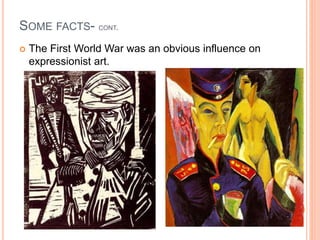
 The First World War was an obvious influence on
expressionist art.
WHAT THEY AIMED AT?
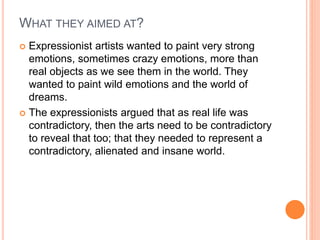
 Expressionist artists wanted to paint very strong
emotions, sometimes crazy emotions, more than
real objects as we see them in the world. They
wanted to paint wild emotions and the world of
dreams.
 The expressionists argued that as real life was
contradictory, then the arts need to be contradictory
to reveal that too; that they needed to represent a
contradictory, alienated and insane world.
NOW, BACK TO EDVARD
MUNCH!!
WHO?
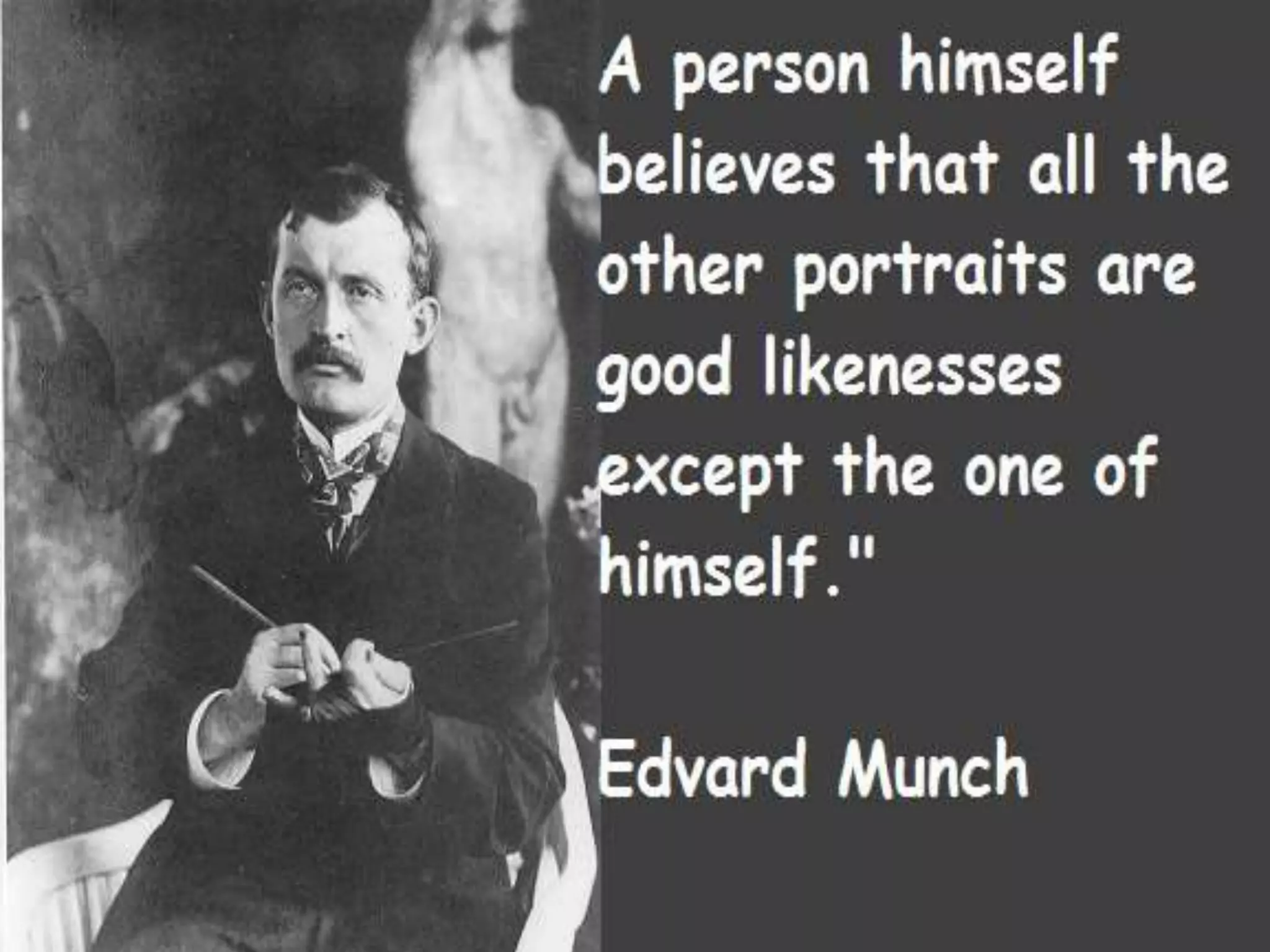
 Edvard Munch was born in Norway in 1863, and
was raised in Christiania (known as Oslo today).
 When he was five his mother died. When he was
14 his sister died.
 Was raised by father who suffered from mental
illness.
 He decided to become a painter at the age of 17.
 He had his first private exhibition in 1889, the same
year his father died.
WHAT?
 From about 1892, to 1908, Munch split most of his
time in Paris and in Berlin; it was in 1909 which he
decided to return to his hometown, and go back to
Norway.
 During this period, much of the work that was
created by Edvard Munch depicted his interest in
nature, and it was also noted that the tones and
colors that he used in these pieces, did add more
color, and seemed a bit more cheerful.
 From this period, up to his death, Edvard Munch
remained in Norway, and much of his work that was
created from this period on, seemed to take on the
similar, colorful approach which he had adopted,
since returning home in 1909.
HOW?
 A majority of the works which Edvard Munch
created, were referred to as the style known as
symbolism.
 Many of Munch's works depict life and death
scenes, love and terror, and the feeling of
loneliness was often a feeling which viewers would
note that his work patterns focused on.
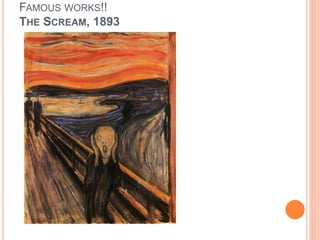
FAMOUS WORKS!!
THE SCREAM, 1893
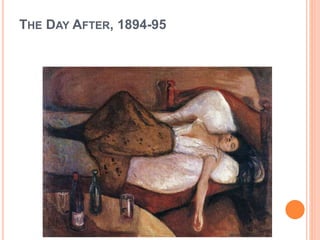
THE DAY AFTER, 1894-95
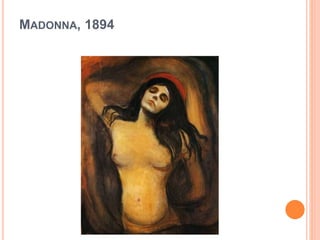
MADONNA, 1894
INFLUENCES
Impressionist Artists:-
 Claude Monet
 Edouard Manet
Post- Impressionist Artists:-
 Van Gogh
 Paul Cezzane
 Gauguin
And suprisingly, Sigmund Freud.
THE SAD PART
 Edvard Munch passed away in 1944, in a small
town which was just outside of his home town in
Oslo.
 A total of 15,400 prints were donated, 4500
drawings and water color art was donated, and six
sculptures which Edvard Munch had created, were
all turned over to the Oslo government, and were
used as display pieces in many locations.
 Munch Museum of Art was created by the
Norwegian Government.
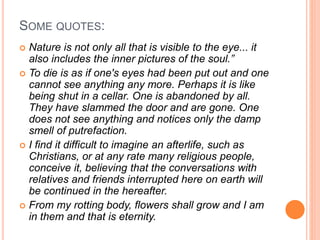
SOME QUOTES:
 Nature is not only all that is visible to the eye... it
also includes the inner pictures of the soul.”
 To die is as if one's eyes had been put out and one
cannot see anything any more. Perhaps it is like
being shut in a cellar. One is abandoned by all.
They have slammed the door and are gone. One
does not see anything and notices only the damp
smell of putrefaction.
 I find it difficult to imagine an afterlife, such as
Christians, or at any rate many religious people,
conceive it, believing that the conversations with
relatives and friends interrupted here on earth will
be continued in the hereafter.
 From my rotting body, flowers shall grow and I am
in them and that is eternity.
Expressionism and munch

Expressionism and munch

  • 2.
    EXPRESSIONISM- A SIMPLEMEANING Expressionism is an art movement that came into being when artists became more concerned with expressing their feeling on an occurrence or object than with creating a photo realistic painting. Expressionism occurred mostly in Germany and sometimes it is called “German Expressionism” instead. Expressionist artists used exaggerated colors, aggressive brush strokes, exaggeration and distortion to paint.
  • 3.
    Key features ofExpressionism: • Expressionist artist used strong emotional colours and wild brush strokes. • The stressed irrationality of the world, the natural and the social world • The world of the supernatural was a strong influence, of ghosts, magic, monsters, strange things happening, to mythic tales, etc. • Individual alienation from the natural world and from the social world — The individual does not feel like they belong in either the social world or the natural world and are alone and abandoned. • The impact of industrial, capitalist society on human beings.
  • 4.
    SOME FACTS:  Expressionistartists also used German and Nordic folk myths and art techniques, of the European Middle Ages, of between 1000 — 1453.  These produced by carving images on wood, the wood is inked and pressed onto paper. This prints rough images with very strong, strange angles.  They also used art techniques and ideas of non- European art, such as African and Asian arts.
  • 5.
    SOME FACTS- CONT. The First World War was an obvious influence on expressionist art.
  • 6.
    WHAT THEY AIMEDAT?  Expressionist artists wanted to paint very strong emotions, sometimes crazy emotions, more than real objects as we see them in the world. They wanted to paint wild emotions and the world of dreams.  The expressionists argued that as real life was contradictory, then the arts need to be contradictory to reveal that too; that they needed to represent a contradictory, alienated and insane world.
  • 9.
    NOW, BACK TOEDVARD MUNCH!!
  • 10.
    WHO?  Edvard Munchwas born in Norway in 1863, and was raised in Christiania (known as Oslo today).  When he was five his mother died. When he was 14 his sister died.  Was raised by father who suffered from mental illness.  He decided to become a painter at the age of 17.  He had his first private exhibition in 1889, the same year his father died.
  • 11.
    WHAT?  From about1892, to 1908, Munch split most of his time in Paris and in Berlin; it was in 1909 which he decided to return to his hometown, and go back to Norway.  During this period, much of the work that was created by Edvard Munch depicted his interest in nature, and it was also noted that the tones and colors that he used in these pieces, did add more color, and seemed a bit more cheerful.  From this period, up to his death, Edvard Munch remained in Norway, and much of his work that was created from this period on, seemed to take on the similar, colorful approach which he had adopted, since returning home in 1909.
  • 12.
    HOW?  A majorityof the works which Edvard Munch created, were referred to as the style known as symbolism.  Many of Munch's works depict life and death scenes, love and terror, and the feeling of loneliness was often a feeling which viewers would note that his work patterns focused on.
  • 13.
  • 14.
  • 15.
  • 16.
    INFLUENCES Impressionist Artists:-  ClaudeMonet  Edouard Manet Post- Impressionist Artists:-  Van Gogh  Paul Cezzane  Gauguin And suprisingly, Sigmund Freud.
  • 17.
    THE SAD PART Edvard Munch passed away in 1944, in a small town which was just outside of his home town in Oslo.  A total of 15,400 prints were donated, 4500 drawings and water color art was donated, and six sculptures which Edvard Munch had created, were all turned over to the Oslo government, and were used as display pieces in many locations.  Munch Museum of Art was created by the Norwegian Government.
  • 18.
    SOME QUOTES:  Natureis not only all that is visible to the eye... it also includes the inner pictures of the soul.”  To die is as if one's eyes had been put out and one cannot see anything any more. Perhaps it is like being shut in a cellar. One is abandoned by all. They have slammed the door and are gone. One does not see anything and notices only the damp smell of putrefaction.  I find it difficult to imagine an afterlife, such as Christians, or at any rate many religious people, conceive it, believing that the conversations with relatives and friends interrupted here on earth will be continued in the hereafter.  From my rotting body, flowers shall grow and I am in them and that is eternity.