



Change the way you
teach and they learn!
Dr. Arindam Ghosh
Associate Professor
Biochemistry
IQ City Medical College, Durgapur
3/26/2019 1
Dr.Arindam Ghosh, Associate
Professor, Biochemistry, IQ City MC.
3/26/2019 2
Dr.Arindam Ghosh, Associate
Professor, Biochemistry, IQ City MC.
3/26/2019 3
Dr.Arindam Ghosh, Associate
Professor, Biochemistry, IQ City MC.
3/26/2019 4
Dr.Arindam Ghosh, Associate
Professor, Biochemistry, IQ City MC.
Learning Objectives
 Knowing the various teaching learning
methods.
 Application of suitable of suitable
methods to various competencies.
 Improving existing method of teaching
and learning to impart better quality of
Medical Education.
3/26/2019 5
Dr.Arindam Ghosh, Associate
Professor, Biochemistry, IQ City MC.
Teaching Vs Learning?
3/26/2019 6
Dr.Arindam Ghosh, Associate
Professor, Biochemistry, IQ City MC.
3/26/2019 7
Dr.Arindam Ghosh, Associate
Professor, Biochemistry, IQ City MC.
3/26/2019 8
Dr.Arindam Ghosh, Associate
Professor, Biochemistry, IQ City MC.
Broad Classification
Methods for Large Group
Teaching
Methods for Small Group
Teaching
3/26/2019 9
Dr.Arindam Ghosh, Associate
Professor, Biochemistry, IQ City MC.
Large Group
 Lectures
 Practical
 Brain Storming
 Quizzes and Short Answers
 Computer Aided Teaching
 Clinical Case Discussion
 Debates and Seminars
 Buzz sessions
3/26/2019 10
Dr.Arindam Ghosh, Associate
Professor, Biochemistry, IQ City MC.
Small Group
 Small Group Discussion
 Doap Session
 One-to-one discussion,
 Buzz groups,
 Brainstorming
 Role playing
 Horseshoe
3/26/2019 11
Dr.Arindam Ghosh, Associate
Professor, Biochemistry, IQ City MC.
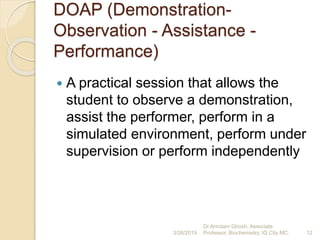
DOAP (Demonstration-
Observation - Assistance -
Performance)
 A practical session that allows the
student to observe a demonstration,
assist the performer, perform in a
simulated environment, perform under
supervision or perform independently
3/26/2019 12
Dr.Arindam Ghosh, Associate
Professor, Biochemistry, IQ City MC.
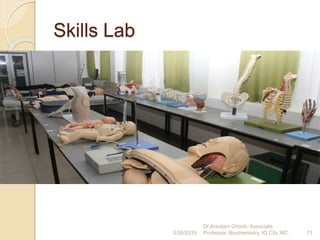
Skills Lab
3/26/2019 13
Dr.Arindam Ghosh, Associate
Professor, Biochemistry, IQ City MC.
3/26/2019 14
Dr.Arindam Ghosh, Associate
Professor, Biochemistry, IQ City MC.
3/26/2019 15
Dr.Arindam Ghosh, Associate
Professor, Biochemistry, IQ City MC.
3/26/2019 16
Dr.Arindam Ghosh, Associate
Professor, Biochemistry, IQ City MC.
3/26/2019 17
Dr.Arindam Ghosh, Associate
Professor, Biochemistry, IQ City MC.
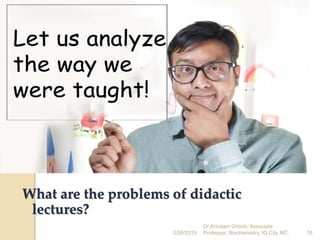
What are the problems of didactic
lectures?
3/26/2019 18
Dr.Arindam Ghosh, Associate
Professor, Biochemistry, IQ City MC.
Problems of a didactic lecture….
Learners are passive
No feedback
Students' attention wanes quickly
Boring unless well prepared
3/26/2019 19
Dr.Arindam Ghosh, Associate
Professor, Biochemistry, IQ City MC.
Information forgotten quickly
Presumes that all students learn at same pace
No modification of attitudes
Not suited for higher orders of thinking & motor
skills
3/26/2019 20
Dr.Arindam Ghosh, Associate
Professor, Biochemistry, IQ City MC.
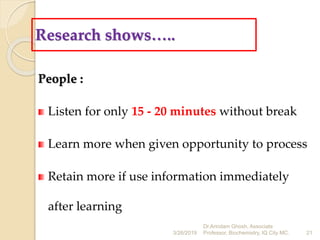
Research shows…..
People :
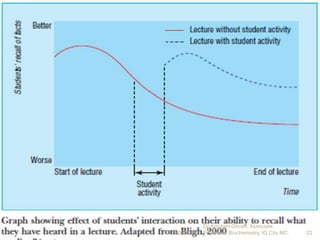
Listen for only 15 - 20 minutes without break
Learn more when given opportunity to process
Retain more if use information immediately
after learning
3/26/2019 21
Dr.Arindam Ghosh, Associate
Professor, Biochemistry, IQ City MC.
3/26/2019 22
Dr.Arindam Ghosh, Associate
Professor, Biochemistry, IQ City MC.
3/26/2019 23
Dr.Arindam Ghosh, Associate
Professor, Biochemistry, IQ City MC.
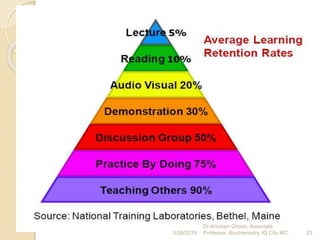
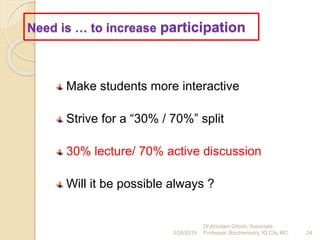
Need is … to increase participation
Make students more interactive
Strive for a “30% / 70%” split
30% lecture/ 70% active discussion
Will it be possible always ?
3/26/2019 24
Dr.Arindam Ghosh, Associate
Professor, Biochemistry, IQ City MC.
Interactive teaching methods
For Large Groups:
3/26/2019 25
Dr.Arindam Ghosh, Associate
Professor, Biochemistry, IQ City MC.
Putting questions to the
audience:
‘are there any questions?’
Silence
3/26/2019 26
Dr.Arindam Ghosh, Associate
Professor, Biochemistry, IQ City MC.
Questions can stimulate interest
Arouse attention in students
Teacher’s way should be non-threaten
He or she should wait for a response of the
student
3/26/2019 27
Dr.Arindam Ghosh, Associate
Professor, Biochemistry, IQ City MC.
Write a question on paper and turn it in, you
can then address some or all of these in a
relatively anonymous and non threatening
way
3/26/2019 28
Dr.Arindam Ghosh, Associate
Professor, Biochemistry, IQ City MC.
Interactive lecture requires….
 Teacher Facilitator who has to
 modify lecture content to:
 allow discussion
 make change of pace
 receive and solve students’ queries
 capable for above without loss of flow or
content
3/26/2019 29
Dr.Arindam Ghosh, Associate
Professor, Biochemistry, IQ City MC.
Interactive teaching is suitable for …..
a) Large class
b) Small class
c) Both
3/26/2019 30
Dr.Arindam Ghosh, Associate
Professor, Biochemistry, IQ City MC.
Please remember….
 number of students in class does not
determine application of interactive lecture
 very small groups can be non-interactive,
and
interactive techniques can be applied in
large class
3/26/2019 31
Dr.Arindam Ghosh, Associate
Professor, Biochemistry, IQ City MC.
Benefits of interactive teaching and
learning:
1) Active Involvement
2) Increased attention and motivation
3) Higher Level of thinking
3/26/2019 32
Dr.Arindam Ghosh, Associate
Professor, Biochemistry, IQ City MC.
3/26/2019 33
Dr.Arindam Ghosh, Associate
Professor, Biochemistry, IQ City MC.
Media for large group:
Computer presentation systems e.g.
PowerPoint
Handouts
‘Blackboards’ / Greenboards / Whiteboards
Overhead projector
35-mm slide projector
Interactive board
Videos (short segments) 3/26/2019 34
Dr.Arindam Ghosh, Associate
Professor, Biochemistry, IQ City MC.
PowerPoint presentation:
Select Colours that Have High Contrast. ...
Pick Fonts that are Large Enough. ...
Use Bullet Points. ...
1-6-6 Rule: 1 slide - one main idea
Six bullet points
Six words per bullet
3/26/2019 35
Dr.Arindam Ghosh, Associate
Professor, Biochemistry, IQ City MC.
Handouts:
Written material
Students participate more in thinking about
the concepts
Rather than writing down every word of the
lecture
3/26/2019 36
Dr.Arindam Ghosh, Associate
Professor, Biochemistry, IQ City MC.
Audio Visual Aids:
Flip charts and white boards allow for the creation
of diagram which is very helpful in medical
science.
Multimedia and computer assisted learning also
promotes interaction.
3/26/2019 37
Dr.Arindam Ghosh, Associate
Professor, Biochemistry, IQ City MC.
Brain Storming:
Invites answers to a question or problem from
the audience and writes them, without comment
Answers are used for the next part of the lecture
or to give students an idea of where they are
before they move on
By writing answers, allow the students to learn
from each other 3/26/2019 38
Dr.Arindam Ghosh, Associate
Professor, Biochemistry, IQ City MC.
Quizzes and Short Answers:
Quizzes or short answers can be used at
the beginning
or
End of a class to provide a "check-up" on
learning to summarize the information
3/26/2019 39
Dr.Arindam Ghosh, Associate
Professor, Biochemistry, IQ City MC.
Computer Aided Teaching:
Interactive teaching in a large group
can be done with the help of computers.
An alternative approach is the use of
flash cards.
3/26/2019 40
Dr.Arindam Ghosh, Associate
Professor, Biochemistry, IQ City MC.
Clinical Case Discussion:
This is a very common method used by
medical teachers.
Increases interest and promotes problem
solving.
3/26/2019 41
Dr.Arindam Ghosh, Associate
Professor, Biochemistry, IQ City MC.
Debates and Seminars:
Debates – students in two different sides of the
issue
Seminars – after completion of one topic.
Increased attention in students and thus
increasing inter activity
3/26/2019 42
Dr.Arindam Ghosh, Associate
Professor, Biochemistry, IQ City MC.
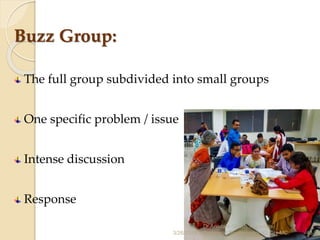
Buzz Group:
The full group subdivided into small groups
One specific problem / issue
Intense discussion
Response
3/26/2019 43
Dr.Arindam Ghosh, Associate
Professor, Biochemistry, IQ City MC.
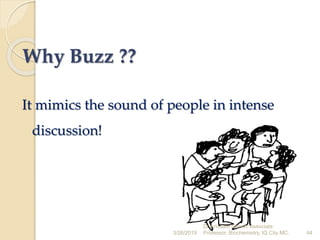
Why Buzz ??
It mimics the sound of people in intense
discussion!
3/26/2019 44
Dr.Arindam Ghosh, Associate
Professor, Biochemistry, IQ City MC.
For small groups:
One-to-one discussion,
Buzz groups,
Brainstorming
Role playing
Horseshoe
3/26/2019 45
Dr.Arindam Ghosh, Associate
Professor, Biochemistry, IQ City MC.
One-to one discussion:
Used with a group of almost any size
Useful as an ‘icebreaker’ when the group first
meets
Enhance listening skills
Used to discuss controversial or ethical
issues
Feedback
3/26/2019 46
Dr.Arindam Ghosh, Associate
Professor, Biochemistry, IQ City MC.
Role playing:
 Teaching interpersonal and communication
skills, particularly in areas with a high
emotional content
 Helpful in changing perceptions and in
developing empathy
3/26/2019 47
Dr.Arindam Ghosh, Associate
Professor, Biochemistry, IQ City MC.
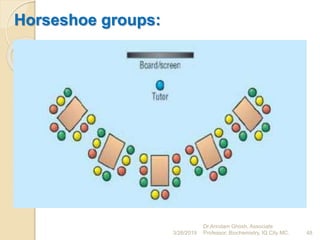
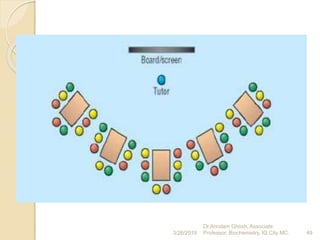
Horseshoe groups:
Common practice in workshops - lecture and
discussion formats
Groups are arranged around tables, with each
group in a horseshoe formation with the open
end facing the front
3/26/2019 48
Dr.Arindam Ghosh, Associate
Professor, Biochemistry, IQ City MC.
3/26/2019 49
Dr.Arindam Ghosh, Associate
Professor, Biochemistry, IQ City MC.
Benefits of small group:
Active participation
Face-to-face contact
Purposeful activity
3/26/2019 50
Dr.Arindam Ghosh, Associate
Professor, Biochemistry, IQ City MC.
Media for teaching small groups:
Electronic mail (e-mail) to communicate with
one or more students
Electronic discussion groups (Whatsapp)
Conferencing techniques using computer,
sound and video.
3/26/2019 51
Dr.Arindam Ghosh, Associate
Professor, Biochemistry, IQ City MC.
Summary
 Large Group
◦ Lectures
◦ Practical
◦ Clinical Case
Discussions
◦ Bed Side Clinics
◦ Skills Lab
 Small Group
◦ Group discussions
◦ DOAP sessions
◦ Skills lab
◦ Bed side clinics
◦ Practical
◦ Problem cards
3/26/2019 52
Dr.Arindam Ghosh, Associate
Professor, Biochemistry, IQ City MC.
3/26/2019 53
Dr.Arindam Ghosh, Associate
Professor, Biochemistry, IQ City MC.

Teaching learning methods mci revised basic course workshop curriculum aetcom module

  • 1.
    Change the wayyou teach and they learn! Dr. Arindam Ghosh Associate Professor Biochemistry IQ City Medical College, Durgapur 3/26/2019 1 Dr.Arindam Ghosh, Associate Professor, Biochemistry, IQ City MC.
  • 2.
    3/26/2019 2 Dr.Arindam Ghosh,Associate Professor, Biochemistry, IQ City MC.
  • 3.
    3/26/2019 3 Dr.Arindam Ghosh,Associate Professor, Biochemistry, IQ City MC.
  • 4.
    3/26/2019 4 Dr.Arindam Ghosh,Associate Professor, Biochemistry, IQ City MC.
  • 5.
    Learning Objectives  Knowingthe various teaching learning methods.  Application of suitable of suitable methods to various competencies.  Improving existing method of teaching and learning to impart better quality of Medical Education. 3/26/2019 5 Dr.Arindam Ghosh, Associate Professor, Biochemistry, IQ City MC.
  • 6.
    Teaching Vs Learning? 3/26/20196 Dr.Arindam Ghosh, Associate Professor, Biochemistry, IQ City MC.
  • 7.
    3/26/2019 7 Dr.Arindam Ghosh,Associate Professor, Biochemistry, IQ City MC.
  • 8.
    3/26/2019 8 Dr.Arindam Ghosh,Associate Professor, Biochemistry, IQ City MC.
  • 9.
    Broad Classification Methods forLarge Group Teaching Methods for Small Group Teaching 3/26/2019 9 Dr.Arindam Ghosh, Associate Professor, Biochemistry, IQ City MC.
  • 10.
    Large Group  Lectures Practical  Brain Storming  Quizzes and Short Answers  Computer Aided Teaching  Clinical Case Discussion  Debates and Seminars  Buzz sessions 3/26/2019 10 Dr.Arindam Ghosh, Associate Professor, Biochemistry, IQ City MC.
  • 11.
    Small Group  SmallGroup Discussion  Doap Session  One-to-one discussion,  Buzz groups,  Brainstorming  Role playing  Horseshoe 3/26/2019 11 Dr.Arindam Ghosh, Associate Professor, Biochemistry, IQ City MC.
  • 12.
    DOAP (Demonstration- Observation -Assistance - Performance)  A practical session that allows the student to observe a demonstration, assist the performer, perform in a simulated environment, perform under supervision or perform independently 3/26/2019 12 Dr.Arindam Ghosh, Associate Professor, Biochemistry, IQ City MC.
  • 13.
    Skills Lab 3/26/2019 13 Dr.ArindamGhosh, Associate Professor, Biochemistry, IQ City MC.
  • 14.
    3/26/2019 14 Dr.Arindam Ghosh,Associate Professor, Biochemistry, IQ City MC.
  • 15.
    3/26/2019 15 Dr.Arindam Ghosh,Associate Professor, Biochemistry, IQ City MC.
  • 16.
    3/26/2019 16 Dr.Arindam Ghosh,Associate Professor, Biochemistry, IQ City MC.
  • 17.
    3/26/2019 17 Dr.Arindam Ghosh,Associate Professor, Biochemistry, IQ City MC.
  • 18.
    What are theproblems of didactic lectures? 3/26/2019 18 Dr.Arindam Ghosh, Associate Professor, Biochemistry, IQ City MC.
  • 19.
    Problems of adidactic lecture…. Learners are passive No feedback Students' attention wanes quickly Boring unless well prepared 3/26/2019 19 Dr.Arindam Ghosh, Associate Professor, Biochemistry, IQ City MC.
  • 20.
    Information forgotten quickly Presumesthat all students learn at same pace No modification of attitudes Not suited for higher orders of thinking & motor skills 3/26/2019 20 Dr.Arindam Ghosh, Associate Professor, Biochemistry, IQ City MC.
  • 21.
    Research shows….. People : Listenfor only 15 - 20 minutes without break Learn more when given opportunity to process Retain more if use information immediately after learning 3/26/2019 21 Dr.Arindam Ghosh, Associate Professor, Biochemistry, IQ City MC.
  • 22.
    3/26/2019 22 Dr.Arindam Ghosh,Associate Professor, Biochemistry, IQ City MC.
  • 23.
    3/26/2019 23 Dr.Arindam Ghosh,Associate Professor, Biochemistry, IQ City MC.
  • 24.
    Need is …to increase participation Make students more interactive Strive for a “30% / 70%” split 30% lecture/ 70% active discussion Will it be possible always ? 3/26/2019 24 Dr.Arindam Ghosh, Associate Professor, Biochemistry, IQ City MC.
  • 25.
    Interactive teaching methods ForLarge Groups: 3/26/2019 25 Dr.Arindam Ghosh, Associate Professor, Biochemistry, IQ City MC.
  • 26.
    Putting questions tothe audience: ‘are there any questions?’ Silence 3/26/2019 26 Dr.Arindam Ghosh, Associate Professor, Biochemistry, IQ City MC.
  • 27.
    Questions can stimulateinterest Arouse attention in students Teacher’s way should be non-threaten He or she should wait for a response of the student 3/26/2019 27 Dr.Arindam Ghosh, Associate Professor, Biochemistry, IQ City MC.
  • 28.
    Write a questionon paper and turn it in, you can then address some or all of these in a relatively anonymous and non threatening way 3/26/2019 28 Dr.Arindam Ghosh, Associate Professor, Biochemistry, IQ City MC.
  • 29.
    Interactive lecture requires…. Teacher Facilitator who has to  modify lecture content to:  allow discussion  make change of pace  receive and solve students’ queries  capable for above without loss of flow or content 3/26/2019 29 Dr.Arindam Ghosh, Associate Professor, Biochemistry, IQ City MC.
  • 30.
    Interactive teaching issuitable for ….. a) Large class b) Small class c) Both 3/26/2019 30 Dr.Arindam Ghosh, Associate Professor, Biochemistry, IQ City MC.
  • 31.
    Please remember….  numberof students in class does not determine application of interactive lecture  very small groups can be non-interactive, and interactive techniques can be applied in large class 3/26/2019 31 Dr.Arindam Ghosh, Associate Professor, Biochemistry, IQ City MC.
  • 32.
    Benefits of interactiveteaching and learning: 1) Active Involvement 2) Increased attention and motivation 3) Higher Level of thinking 3/26/2019 32 Dr.Arindam Ghosh, Associate Professor, Biochemistry, IQ City MC.
  • 33.
    3/26/2019 33 Dr.Arindam Ghosh,Associate Professor, Biochemistry, IQ City MC.
  • 34.
    Media for largegroup: Computer presentation systems e.g. PowerPoint Handouts ‘Blackboards’ / Greenboards / Whiteboards Overhead projector 35-mm slide projector Interactive board Videos (short segments) 3/26/2019 34 Dr.Arindam Ghosh, Associate Professor, Biochemistry, IQ City MC.
  • 35.
    PowerPoint presentation: Select Coloursthat Have High Contrast. ... Pick Fonts that are Large Enough. ... Use Bullet Points. ... 1-6-6 Rule: 1 slide - one main idea Six bullet points Six words per bullet 3/26/2019 35 Dr.Arindam Ghosh, Associate Professor, Biochemistry, IQ City MC.
  • 36.
    Handouts: Written material Students participatemore in thinking about the concepts Rather than writing down every word of the lecture 3/26/2019 36 Dr.Arindam Ghosh, Associate Professor, Biochemistry, IQ City MC.
  • 37.
    Audio Visual Aids: Flipcharts and white boards allow for the creation of diagram which is very helpful in medical science. Multimedia and computer assisted learning also promotes interaction. 3/26/2019 37 Dr.Arindam Ghosh, Associate Professor, Biochemistry, IQ City MC.
  • 38.
    Brain Storming: Invites answersto a question or problem from the audience and writes them, without comment Answers are used for the next part of the lecture or to give students an idea of where they are before they move on By writing answers, allow the students to learn from each other 3/26/2019 38 Dr.Arindam Ghosh, Associate Professor, Biochemistry, IQ City MC.
  • 39.
    Quizzes and ShortAnswers: Quizzes or short answers can be used at the beginning or End of a class to provide a "check-up" on learning to summarize the information 3/26/2019 39 Dr.Arindam Ghosh, Associate Professor, Biochemistry, IQ City MC.
  • 40.
    Computer Aided Teaching: Interactiveteaching in a large group can be done with the help of computers. An alternative approach is the use of flash cards. 3/26/2019 40 Dr.Arindam Ghosh, Associate Professor, Biochemistry, IQ City MC.
  • 41.
    Clinical Case Discussion: Thisis a very common method used by medical teachers. Increases interest and promotes problem solving. 3/26/2019 41 Dr.Arindam Ghosh, Associate Professor, Biochemistry, IQ City MC.
  • 42.
    Debates and Seminars: Debates– students in two different sides of the issue Seminars – after completion of one topic. Increased attention in students and thus increasing inter activity 3/26/2019 42 Dr.Arindam Ghosh, Associate Professor, Biochemistry, IQ City MC.
  • 43.
    Buzz Group: The fullgroup subdivided into small groups One specific problem / issue Intense discussion Response 3/26/2019 43 Dr.Arindam Ghosh, Associate Professor, Biochemistry, IQ City MC.
  • 44.
    Why Buzz ?? Itmimics the sound of people in intense discussion! 3/26/2019 44 Dr.Arindam Ghosh, Associate Professor, Biochemistry, IQ City MC.
  • 45.
    For small groups: One-to-onediscussion, Buzz groups, Brainstorming Role playing Horseshoe 3/26/2019 45 Dr.Arindam Ghosh, Associate Professor, Biochemistry, IQ City MC.
  • 46.
    One-to one discussion: Usedwith a group of almost any size Useful as an ‘icebreaker’ when the group first meets Enhance listening skills Used to discuss controversial or ethical issues Feedback 3/26/2019 46 Dr.Arindam Ghosh, Associate Professor, Biochemistry, IQ City MC.
  • 47.
    Role playing:  Teachinginterpersonal and communication skills, particularly in areas with a high emotional content  Helpful in changing perceptions and in developing empathy 3/26/2019 47 Dr.Arindam Ghosh, Associate Professor, Biochemistry, IQ City MC.
  • 48.
    Horseshoe groups: Common practicein workshops - lecture and discussion formats Groups are arranged around tables, with each group in a horseshoe formation with the open end facing the front 3/26/2019 48 Dr.Arindam Ghosh, Associate Professor, Biochemistry, IQ City MC.
  • 49.
    3/26/2019 49 Dr.Arindam Ghosh,Associate Professor, Biochemistry, IQ City MC.
  • 50.
    Benefits of smallgroup: Active participation Face-to-face contact Purposeful activity 3/26/2019 50 Dr.Arindam Ghosh, Associate Professor, Biochemistry, IQ City MC.
  • 51.
    Media for teachingsmall groups: Electronic mail (e-mail) to communicate with one or more students Electronic discussion groups (Whatsapp) Conferencing techniques using computer, sound and video. 3/26/2019 51 Dr.Arindam Ghosh, Associate Professor, Biochemistry, IQ City MC.
  • 52.
    Summary  Large Group ◦Lectures ◦ Practical ◦ Clinical Case Discussions ◦ Bed Side Clinics ◦ Skills Lab  Small Group ◦ Group discussions ◦ DOAP sessions ◦ Skills lab ◦ Bed side clinics ◦ Practical ◦ Problem cards 3/26/2019 52 Dr.Arindam Ghosh, Associate Professor, Biochemistry, IQ City MC.
  • 53.
    3/26/2019 53 Dr.Arindam Ghosh,Associate Professor, Biochemistry, IQ City MC.