By : ANUBHAV SHARMA
3RD YEAR { ME }
1508240028
Guide : Dr. MUNISH CHHABARA
HOD {ME Dept.}
INTRODUCTION
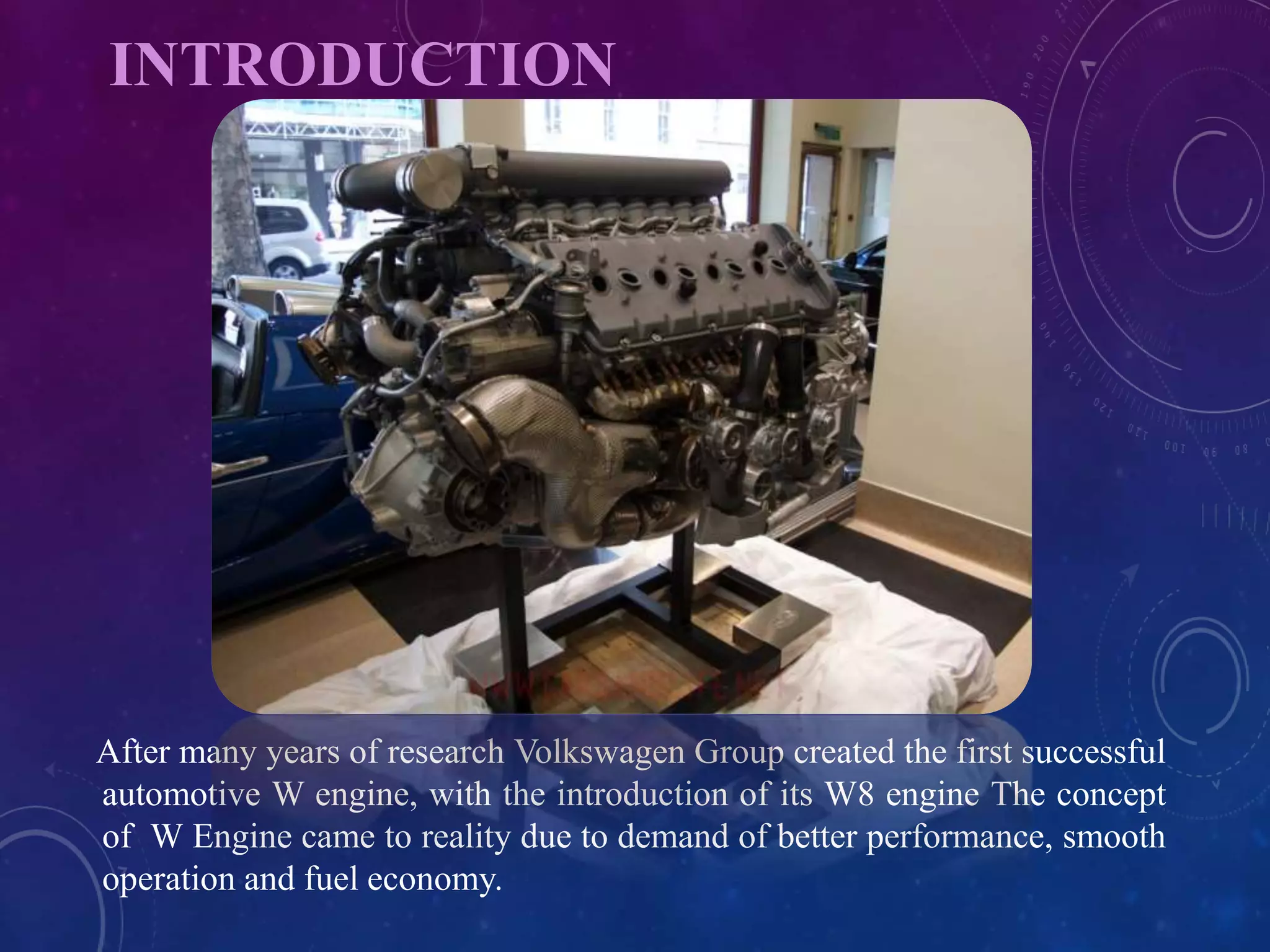
After many years of research Volkswagen Group created the first successful
automotive W engine, with the introduction of its W8 engine The concept
of W Engine came to reality due to demand of better performance, smooth
operation and fuel economy.
BUGATTI VEYRON EB16.4
WHAT DOES THE W MEAN IN ‘W ENGINE’ ?
With the aim of building even more compact engines with a large
number of cylinders, the design features of the V and VR engines
were combined to produce the W engines.
When the this engine was viewed from the front, the cylinder
arrangement looks like a double-V. Put the two Vs of the right and left
cylinder banks together, and you get a W. This is how the name “W
engine” came about.
VR ENGINES
The need for a powerful
alternative suitable for
transverse mounting for use
in small to mid-size vehicles
saw the development of the
VR engine. Six cylinders,
offset at a V-angle of 15
degrees, are accommodated
in a fairly slender and very
short engine block.
DESIGN PRINCIPLE
W ENGINES
As with the V engine, the cylinders are distributed into two banks and in
the VR engine, the cylinders within each bank maintain a V-angle of 15
degrees.
In the W engines, combination of two “VR banks” of cylinders are
aligned at a V-angle of 72 degrees in relation to one another.
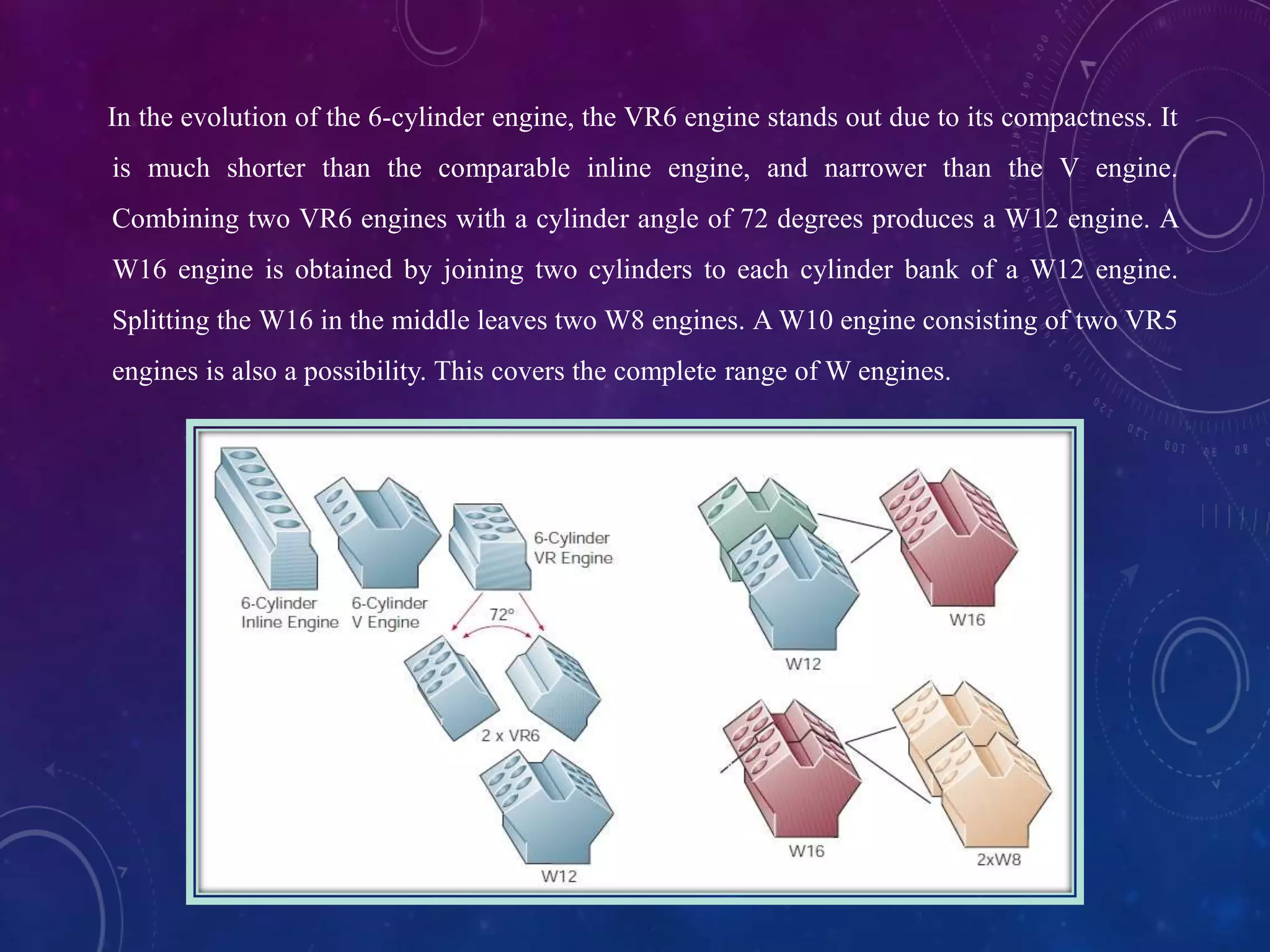
In the evolution of the 6-cylinder engine, the VR6 engine stands out due to its compactness. It
is much shorter than the comparable inline engine, and narrower than the V engine.
Combining two VR6 engines with a cylinder angle of 72 degrees produces a W12 engine. A
W16 engine is obtained by joining two cylinders to each cylinder bank of a W12 engine.
Splitting the W16 in the middle leaves two W8 engines. A W10 engine consisting of two VR5
engines is also a possibility. This covers the complete range of W engines.
COMPARISON BETWEEN V & W ENGINE
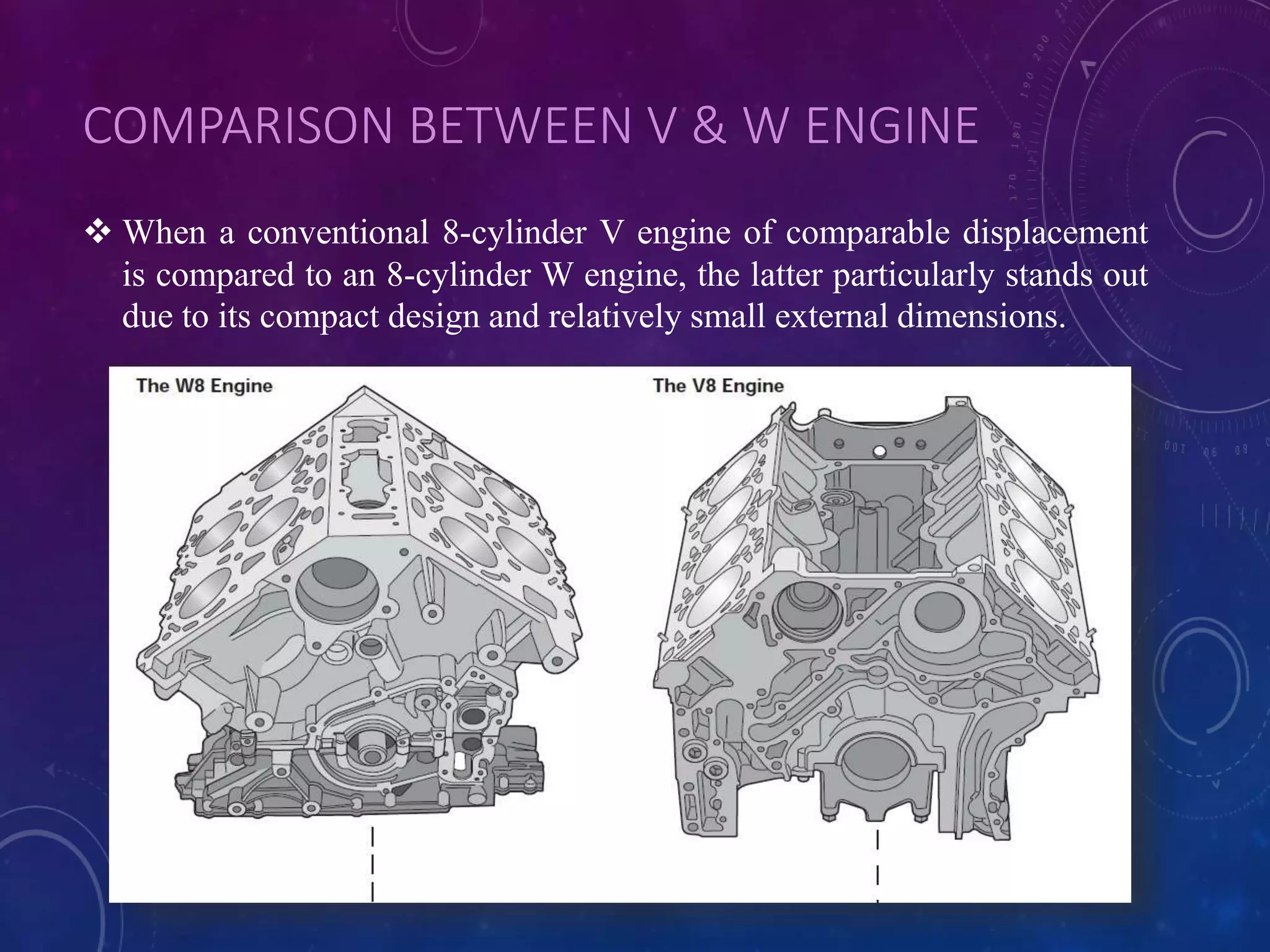
 When a conventional 8-cylinder V engine of comparable displacement
is compared to an 8-cylinder W engine, the latter particularly stands out
due to its compact design and relatively small external dimensions.
This is also reflected in a comparison of the crankshafts. The compact
design of the 12 cylinder W engine is highlighted by the fact that it has
even smaller external dimensions than a conventional V8 engine.
Depending on the number of cylinders, the W principle therefore saves
material and weight.
W ENGINE SPECIFICATIONS:
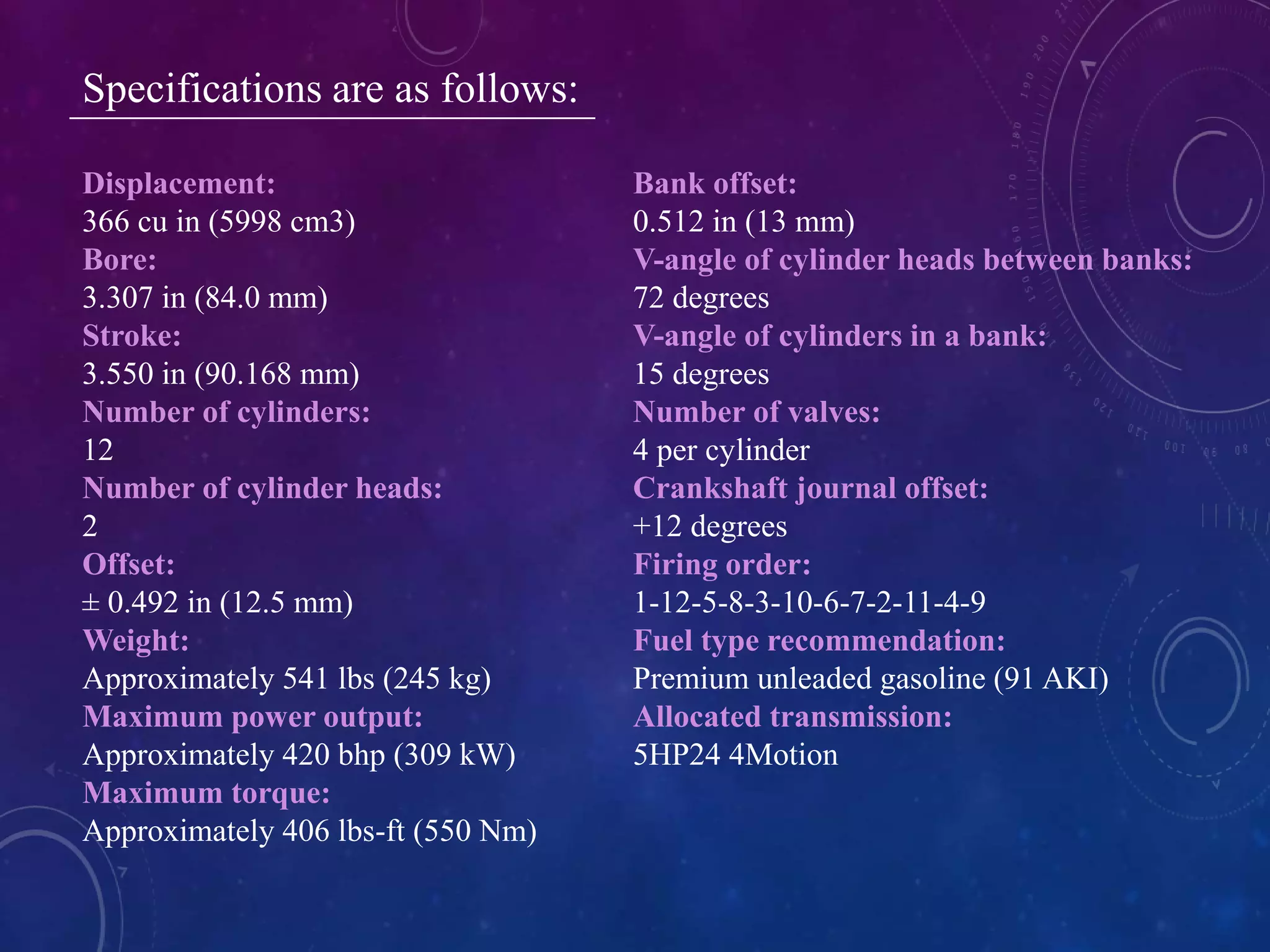
Specifications are as follows:
Displacement:
366 cu in (5998 cm3)
Bore:
3.307 in (84.0 mm)
Stroke:
3.550 in (90.168 mm)
Number of cylinders:
12
Number of cylinder heads:
2
Offset:
± 0.492 in (12.5 mm)
Weight:
Approximately 541 lbs (245 kg)
Maximum power output:
Approximately 420 bhp (309 kW)
Maximum torque:
Approximately 406 lbs-ft (550 Nm)
Bank offset:
0.512 in (13 mm)
V-angle of cylinder heads between banks:
72 degrees
V-angle of cylinders in a bank:
15 degrees
Number of valves:
4 per cylinder
Crankshaft journal offset:
+12 degrees
Firing order:
1-12-5-8-3-10-6-7-2-11-4-9
Fuel type recommendation:
Premium unleaded gasoline (91 AKI)
Allocated transmission:
5HP24 4Motion
ENGINE COMPONENTS
W engines include the following components:
 Cylinder block
Crankcase lower section with bearing support
Crankshaft with connecting rods and pistons
Balancing shafts
Cylinder heads
Oil sump and oil pump
Crankshaft drive
Timing chain drive
Belt drive for auxiliary components
Multi-part intake manifold
The crankshafts are manufactured from forged tempered steel. Each pair of
connecting rods runs between two main bearings. The drive gear of the oil is
pressed against the outer main bearing and held in place by the vibration damper.
The connecting rods are made of forged steel and are only 0.512 inch
(13 mm) thick. They are of a trapezoidal construction and are cut
during the production process. To ensure better oil exchange, two
grooves are milled in the side faces of the connecting rod bearing caps.
The W8 engine has two
balancing shafts to
compensate for the forces of
inertia. The two shafts are
housed in the crankcase. The
upper balancing shaft is
driven by the crankshaft and
a toothed belt. There is a
groove at the gear wheel end
of the balancing shaft.
Each of the cylinder heads in
the two W engines has an
intake camshaft and an exhaust
camshaft with camshaft
adjusters attached to their end
faces. Due to the cylinder
arrangement, short and long
valves as well as short and long
inlet and exhaust ports alternate
with one another.
ENGINE LUBRICATION
The oil is guided from the central
oil passage of the crankcase upper
section to small nozzles at the base
of the cylinder bores. Here, the oil
is sprayed below the pistons to
lubricate the piston contact faces
and piston pins, and cool the
pistons.
The oil is routed through holes from the
central oil passage to the crankshaft.
Then it is forced through grooves in the
backs of the lower bearing shells to the
upper bearing shells. There it reaches
the crankshaft through five holes in the
upper bearing shell.
WORKING OF W ENGINE
PROS & CONS
PROS :
 Large 8L Engine .
 Comparatively Small Size As Compared To V
Engine .
 Large Displacement So Having Large Output Power .
 Fires After Every 45 ̊.
 Smooth Power Delivery .
CONS :
 Cost Of Production Is Much Expensive .
 Very High Complexity As 64 Valves, 4 Turbo Chargers Are To Be Placed .
 Much Heavy { 400 Kg Or 880 Lbs }
 Constricted Cylinder Bore Size .
W ENGINE

W ENGINE

  • 1.
    By : ANUBHAVSHARMA 3RD YEAR { ME } 1508240028 Guide : Dr. MUNISH CHHABARA HOD {ME Dept.}
  • 2.
    INTRODUCTION After many yearsof research Volkswagen Group created the first successful automotive W engine, with the introduction of its W8 engine The concept of W Engine came to reality due to demand of better performance, smooth operation and fuel economy.
  • 3.
  • 4.
    WHAT DOES THEW MEAN IN ‘W ENGINE’ ? With the aim of building even more compact engines with a large number of cylinders, the design features of the V and VR engines were combined to produce the W engines. When the this engine was viewed from the front, the cylinder arrangement looks like a double-V. Put the two Vs of the right and left cylinder banks together, and you get a W. This is how the name “W engine” came about.
  • 5.
    VR ENGINES The needfor a powerful alternative suitable for transverse mounting for use in small to mid-size vehicles saw the development of the VR engine. Six cylinders, offset at a V-angle of 15 degrees, are accommodated in a fairly slender and very short engine block. DESIGN PRINCIPLE
  • 6.
    W ENGINES As withthe V engine, the cylinders are distributed into two banks and in the VR engine, the cylinders within each bank maintain a V-angle of 15 degrees. In the W engines, combination of two “VR banks” of cylinders are aligned at a V-angle of 72 degrees in relation to one another.
  • 7.
    In the evolutionof the 6-cylinder engine, the VR6 engine stands out due to its compactness. It is much shorter than the comparable inline engine, and narrower than the V engine. Combining two VR6 engines with a cylinder angle of 72 degrees produces a W12 engine. A W16 engine is obtained by joining two cylinders to each cylinder bank of a W12 engine. Splitting the W16 in the middle leaves two W8 engines. A W10 engine consisting of two VR5 engines is also a possibility. This covers the complete range of W engines.
  • 8.
    COMPARISON BETWEEN V& W ENGINE  When a conventional 8-cylinder V engine of comparable displacement is compared to an 8-cylinder W engine, the latter particularly stands out due to its compact design and relatively small external dimensions.
  • 9.
    This is alsoreflected in a comparison of the crankshafts. The compact design of the 12 cylinder W engine is highlighted by the fact that it has even smaller external dimensions than a conventional V8 engine. Depending on the number of cylinders, the W principle therefore saves material and weight.
  • 10.
  • 11.
    Specifications are asfollows: Displacement: 366 cu in (5998 cm3) Bore: 3.307 in (84.0 mm) Stroke: 3.550 in (90.168 mm) Number of cylinders: 12 Number of cylinder heads: 2 Offset: ± 0.492 in (12.5 mm) Weight: Approximately 541 lbs (245 kg) Maximum power output: Approximately 420 bhp (309 kW) Maximum torque: Approximately 406 lbs-ft (550 Nm) Bank offset: 0.512 in (13 mm) V-angle of cylinder heads between banks: 72 degrees V-angle of cylinders in a bank: 15 degrees Number of valves: 4 per cylinder Crankshaft journal offset: +12 degrees Firing order: 1-12-5-8-3-10-6-7-2-11-4-9 Fuel type recommendation: Premium unleaded gasoline (91 AKI) Allocated transmission: 5HP24 4Motion
  • 12.
  • 13.
    W engines includethe following components:  Cylinder block Crankcase lower section with bearing support Crankshaft with connecting rods and pistons Balancing shafts Cylinder heads Oil sump and oil pump Crankshaft drive Timing chain drive Belt drive for auxiliary components Multi-part intake manifold
  • 14.
    The crankshafts aremanufactured from forged tempered steel. Each pair of connecting rods runs between two main bearings. The drive gear of the oil is pressed against the outer main bearing and held in place by the vibration damper.
  • 15.
    The connecting rodsare made of forged steel and are only 0.512 inch (13 mm) thick. They are of a trapezoidal construction and are cut during the production process. To ensure better oil exchange, two grooves are milled in the side faces of the connecting rod bearing caps.
  • 16.
    The W8 enginehas two balancing shafts to compensate for the forces of inertia. The two shafts are housed in the crankcase. The upper balancing shaft is driven by the crankshaft and a toothed belt. There is a groove at the gear wheel end of the balancing shaft. Each of the cylinder heads in the two W engines has an intake camshaft and an exhaust camshaft with camshaft adjusters attached to their end faces. Due to the cylinder arrangement, short and long valves as well as short and long inlet and exhaust ports alternate with one another.
  • 17.
    ENGINE LUBRICATION The oilis guided from the central oil passage of the crankcase upper section to small nozzles at the base of the cylinder bores. Here, the oil is sprayed below the pistons to lubricate the piston contact faces and piston pins, and cool the pistons. The oil is routed through holes from the central oil passage to the crankshaft. Then it is forced through grooves in the backs of the lower bearing shells to the upper bearing shells. There it reaches the crankshaft through five holes in the upper bearing shell.
  • 18.
  • 19.
    PROS & CONS PROS:  Large 8L Engine .  Comparatively Small Size As Compared To V Engine .  Large Displacement So Having Large Output Power .  Fires After Every 45 ̊.  Smooth Power Delivery . CONS :  Cost Of Production Is Much Expensive .  Very High Complexity As 64 Valves, 4 Turbo Chargers Are To Be Placed .  Much Heavy { 400 Kg Or 880 Lbs }  Constricted Cylinder Bore Size .