Splice DDS OpenSplice DDS OpenSplice DDS OpenSplice DDS OpenSplice DDS OpenSplice DDS OpenSplice DDS OpenSplice DDS OpenSplice DDS


                               SimD
                                  The Simple DDS API
       :: http://www.opensplice.org :: http://www.opensplice.com :: http://www.prismtech.com ::


                                                    Angelo Corsaro, Ph.D.
                                                      Chief Technology Officer
                                                               PrismTech
                                                       OMG DDS SIG Co-Chair
                                                    angelo.corsaro@prismtech.com


Splice DDS OpenSplice DDS OpenSplice DDS OpenSplice DDS OpenSplice DDS OpenSplice DDS OpenSplice DDS OpenSplice DDS OpenSplice DDS
SimD
                              The Simple DDS API
:: http://www.opensplice.org :: http://www.opensplice.com :: http://www.prismtech.com ::


                                                                        Background
OpenSplice DDS OpenSplice DDS OpenSplice DDS OpenSplice DDS OpenSplice DD
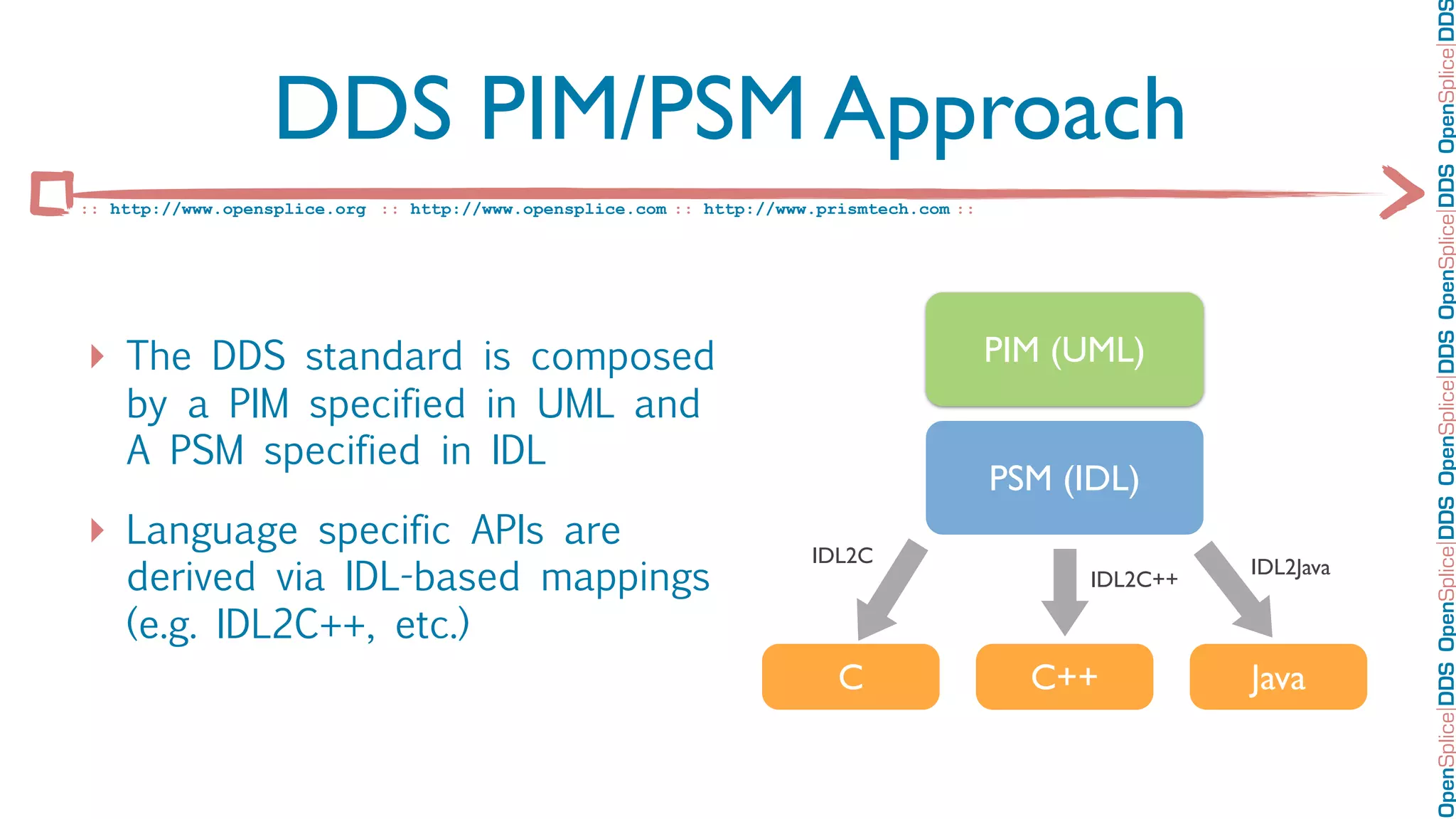
                  DDS PIM/PSM Approach
:: http://www.opensplice.org :: http://www.opensplice.com :: http://www.prismtech.com ::


‣ The DDS standard is composed                                                             PIM (UML)
    by a PIM specified in UML and
    A PSM specified in IDL
                                                                                           PSM (IDL)
‣ Language specific APIs are                                           IDL2C
    derived via IDL-based mappings                                                               IDL2C++
                                                                                                           IDL2Java

    (e.g. IDL2C++, etc.)
                                                                          C                  C++           Java
OpenSplice DDS OpenSplice DDS OpenSplice DDS OpenSplice DDS OpenSplice DD
                        What is the problem?
:: http://www.opensplice.org :: http://www.opensplice.com :: http://www.prismtech.com ::


   ‣ IDL is very good for describing DDS Topic Types, yet...
   ‣ IDL’s biggest strength, namely (programming) language
       independence, becomes its biggest weakness when trying to
       define APIs that are well integrated with a programming
       language

   ‣ For some programming languages (e.g. C++) the IDL2C++
       mapping is “seasoned”
OpenSplice DDS OpenSplice DDS OpenSplice DDS OpenSplice DDS OpenSplice DD
                      Why is this a problem?
:: http://www.opensplice.org :: http://www.opensplice.com :: http://www.prismtech.com ::


   ‣ Resulting DDS APIs are more complicated than they should
   ‣ API don’t feel natural to programmers
   ‣ API (esp. for C++) don’t integrate well with standard libraries
       nor implements common idioms/patterns.
OpenSplice DDS OpenSplice DDS OpenSplice DDS OpenSplice DDS OpenSplice DD
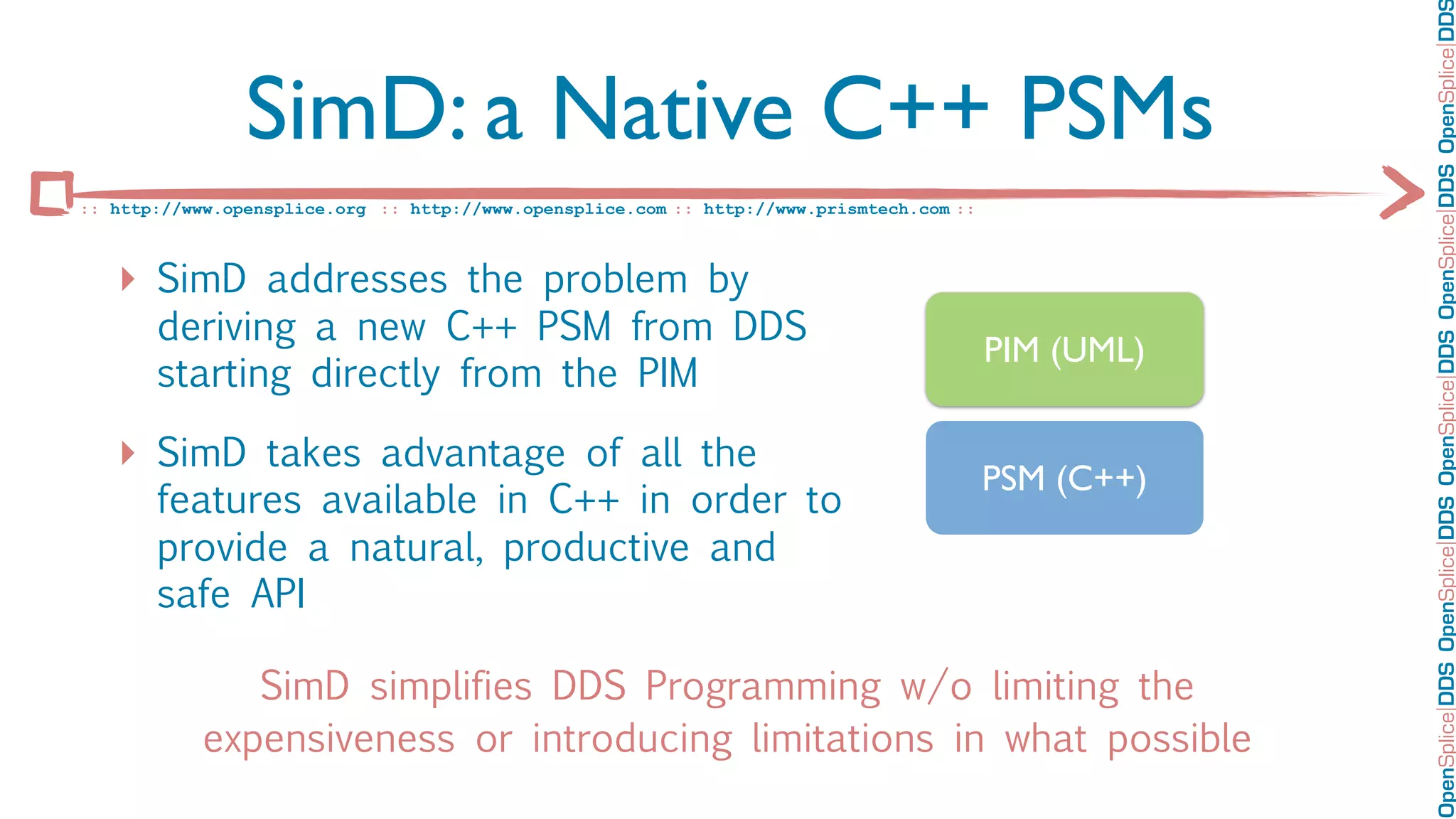
                SimD: a Native C++ PSMs
:: http://www.opensplice.org :: http://www.opensplice.com :: http://www.prismtech.com ::


   ‣ SimD addresses the problem by
       deriving a new C++ PSM from DDS
                                                                                           PIM (UML)
       starting directly from the PIM

   ‣ SimD takes advantage of all the                                                       PSM (C++)
       features available in C++ in order to
       provide a natural, productive and
       safe API

               SimD simplifies DDS Programming w/o limiting the
            expensiveness or introducing limitations in what possible
OpenSplice DDS OpenSplice DDS OpenSplice DDS OpenSplice DDS OpenSplice DD
                             SimD in a Nutshell
:: http://www.opensplice.org :: http://www.opensplice.com :: http://www.prismtech.com ::


   ‣ Provides transparent, safe, precise and real-time automatic
       memory management

   ‣ Takes advantage of C++ Template Meta-programming to
       automate tasks such as type registration and provide a
       strongly typed API (no downcast ever!)

   ‣ Provides a DDS API that exploits Iterators and containers as
       well as other C++ Standard Types

   ‣ DDS Events are types and are using Signal/Slots
SimD
                              The Simple DDS API
:: http://www.opensplice.org :: http://www.opensplice.com :: http://www.prismtech.com ::


                                                                            Looking at
                                                                            a DDS App...
OpenSplice DDS OpenSplice DDS OpenSplice DDS OpenSplice DDS OpenSplice DD
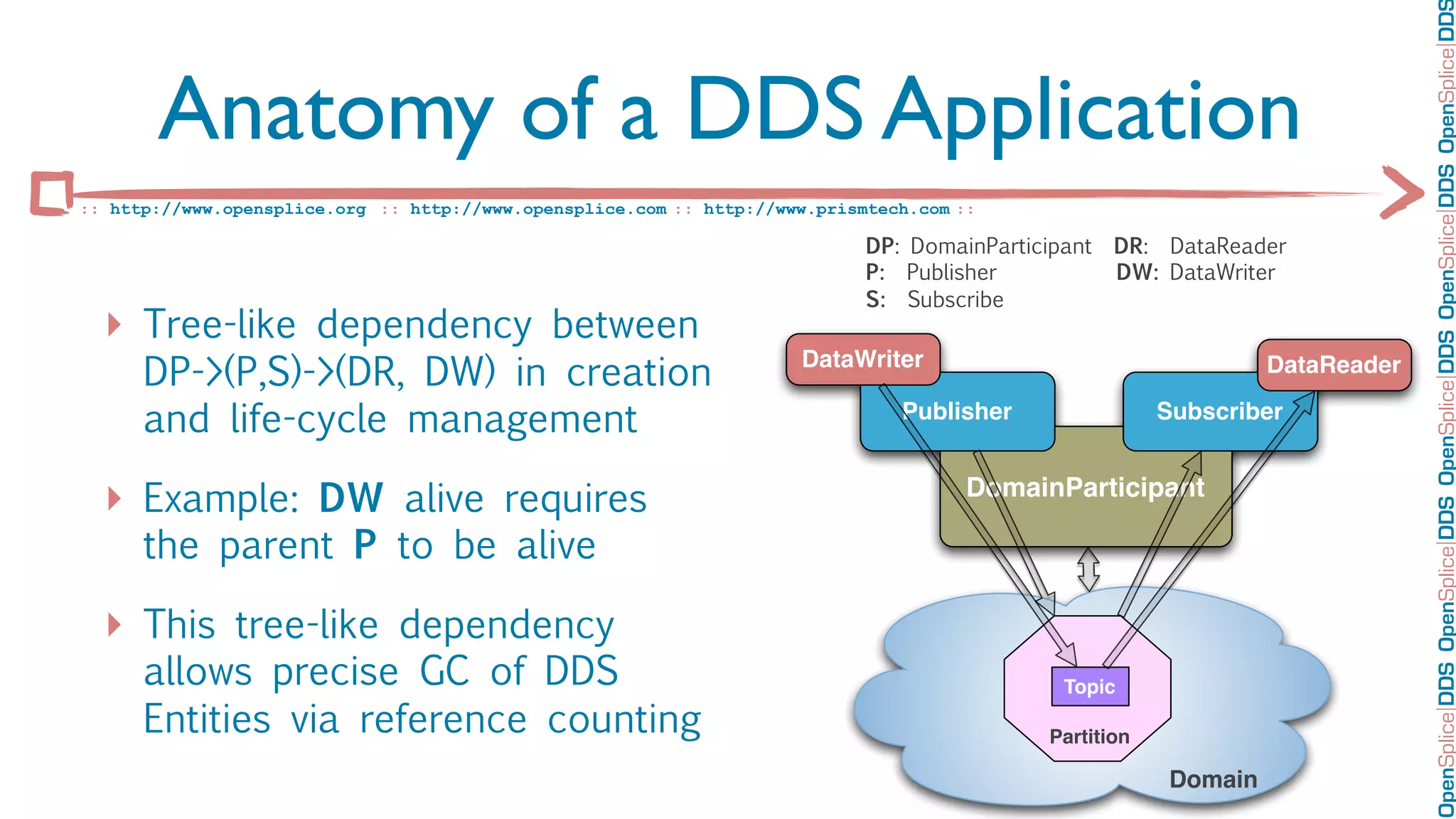
       Anatomy of a DDS Application
:: http://www.opensplice.org :: http://www.opensplice.com :: http://www.prismtech.com ::

                                                                             DP: DomainParticipant   DR: DataReader
                                                                             P: Publisher            DW: DataWriter
                                                                             S: Subscribe
  ‣ Tree-like dependency between
      DP->(P,S)->(DR, DW) in creation                                 DataWriter                                   DataReader

      and life-cycle management                                                 Publisher                 Subscriber


  ‣ Example: DW alive requires                                                         DomainParticipant

      the parent P to be alive

  ‣ This tree-like dependency
      allows precise GC of DDS                                                                 Topic
      Entities via reference counting                                                         Partition

                                                                                                          Domain
OpenSplice DDS OpenSplice DDS OpenSplice DDS OpenSplice DDS OpenSplice DD
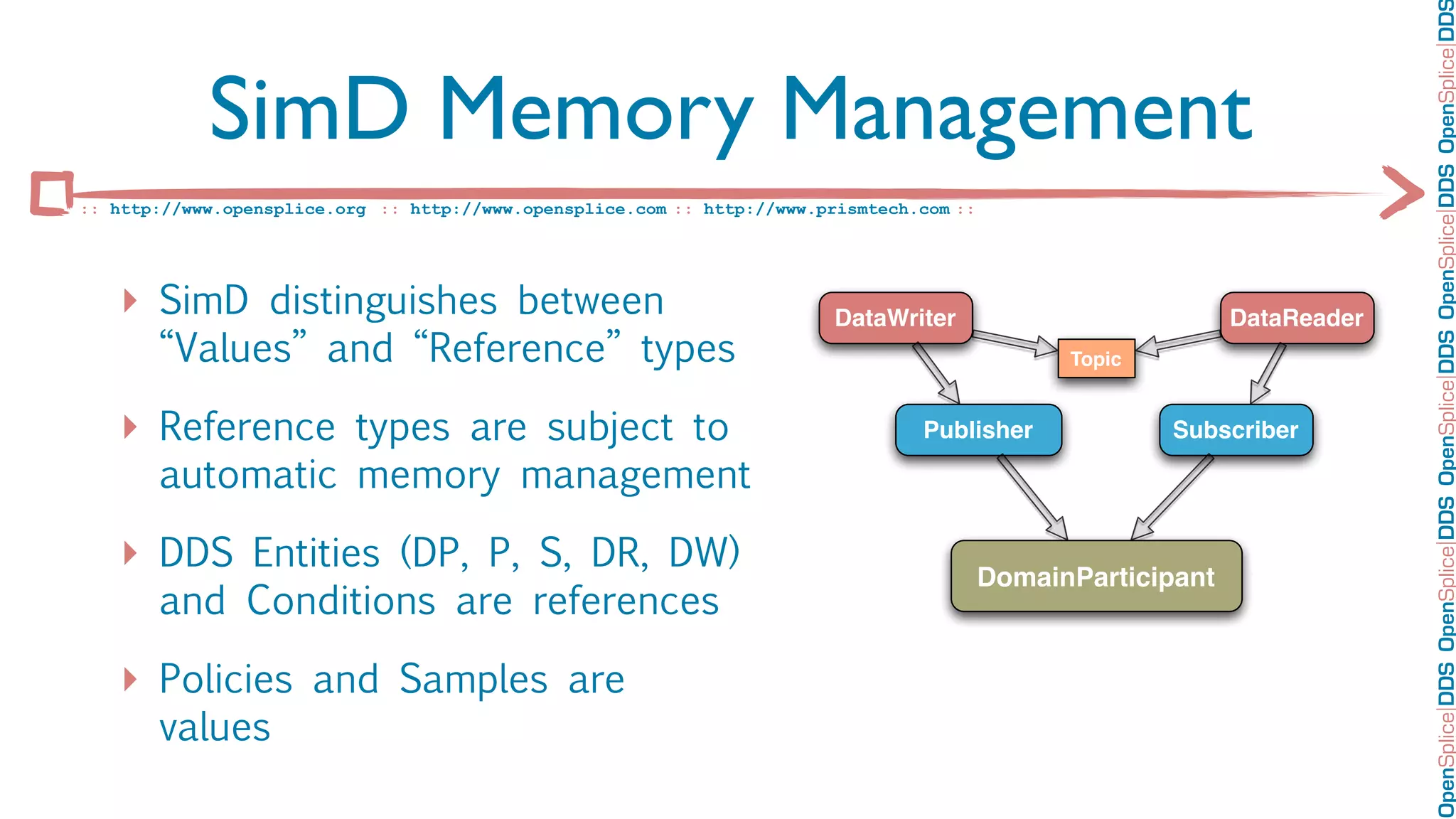
            SimD Memory Management
:: http://www.opensplice.org :: http://www.opensplice.com :: http://www.prismtech.com ::


   ‣ SimD distinguishes between                                           DataWriter                           DataReader
       “Values” and “Reference” types                                                            Topic


   ‣ Reference types are subject to                                               Publisher              Subscriber

       automatic memory management

   ‣ DDS Entities (DP, P, S, DR, DW)                                                       DomainParticipant
       and Conditions are references

   ‣ Policies and Samples are
       values
SimD
                              The Simple DDS API
:: http://www.opensplice.org :: http://www.opensplice.com :: http://www.prismtech.com ::


                                             SimD: Step By Step
OpenSplice DDS OpenSplice DDS OpenSplice DDS OpenSplice DDS OpenSplice DD
                                   DDS App Steps
:: http://www.opensplice.org :: http://www.opensplice.com :: http://www.prismtech.com ::


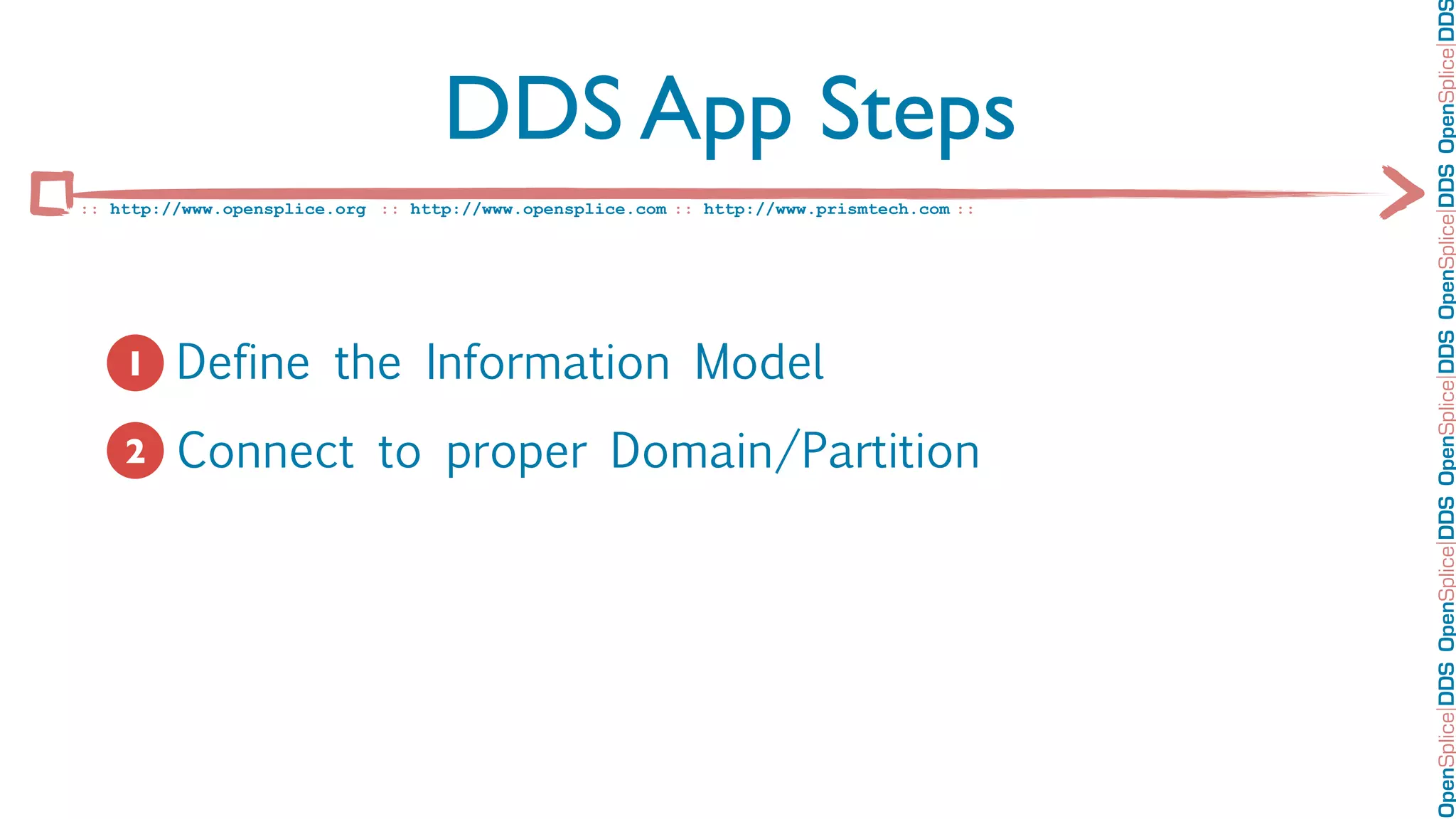
   1. Define the Information Model
   1
OpenSplice DDS OpenSplice DDS OpenSplice DDS OpenSplice DDS OpenSplice DD
                                   DDS App Steps
:: http://www.opensplice.org :: http://www.opensplice.com :: http://www.prismtech.com ::


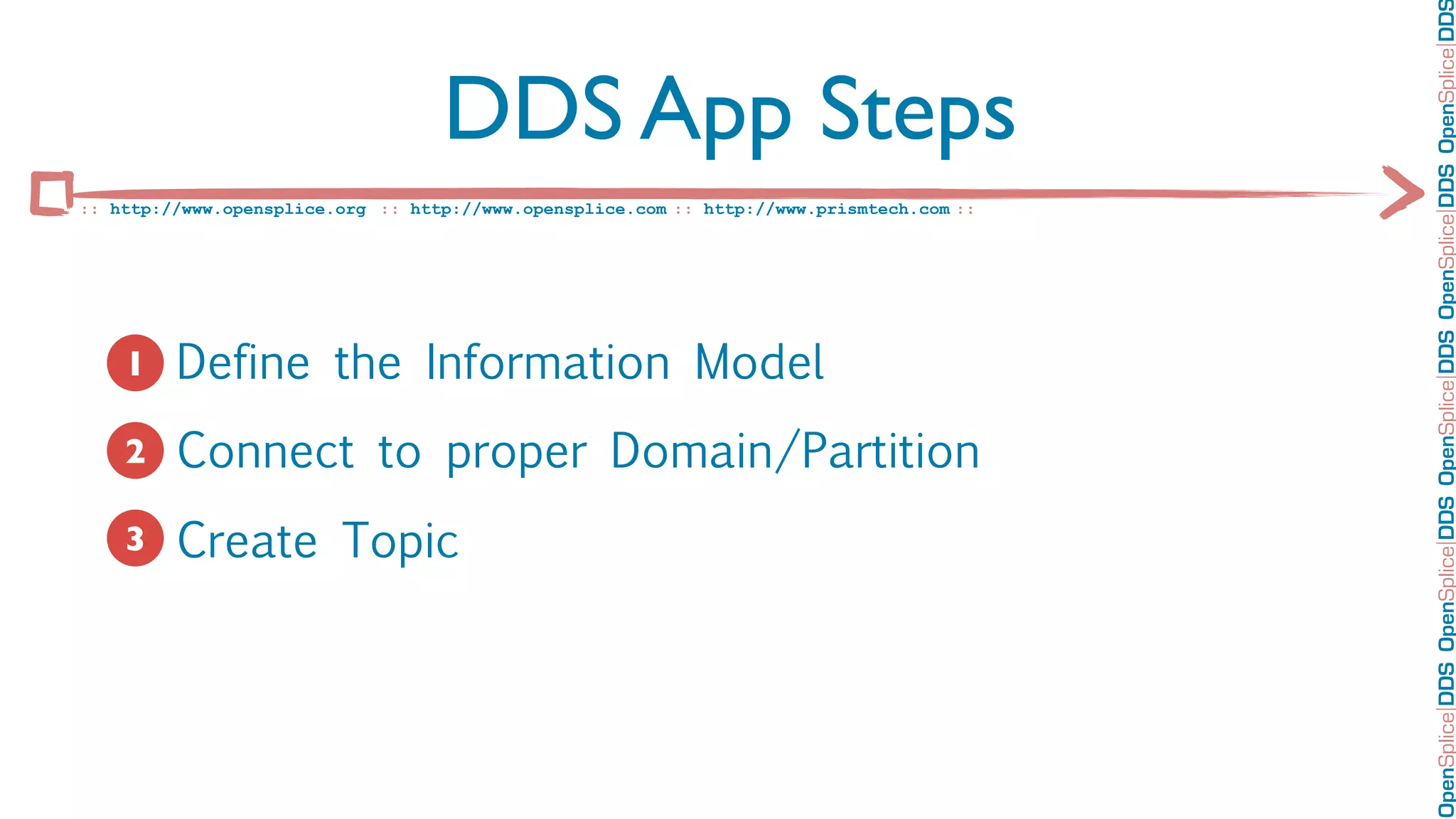
   1. Define the Information Model
   1

   2. Connect to proper Domain/Partition
   2
OpenSplice DDS OpenSplice DDS OpenSplice DDS OpenSplice DDS OpenSplice DD
                                   DDS App Steps
:: http://www.opensplice.org :: http://www.opensplice.com :: http://www.prismtech.com ::


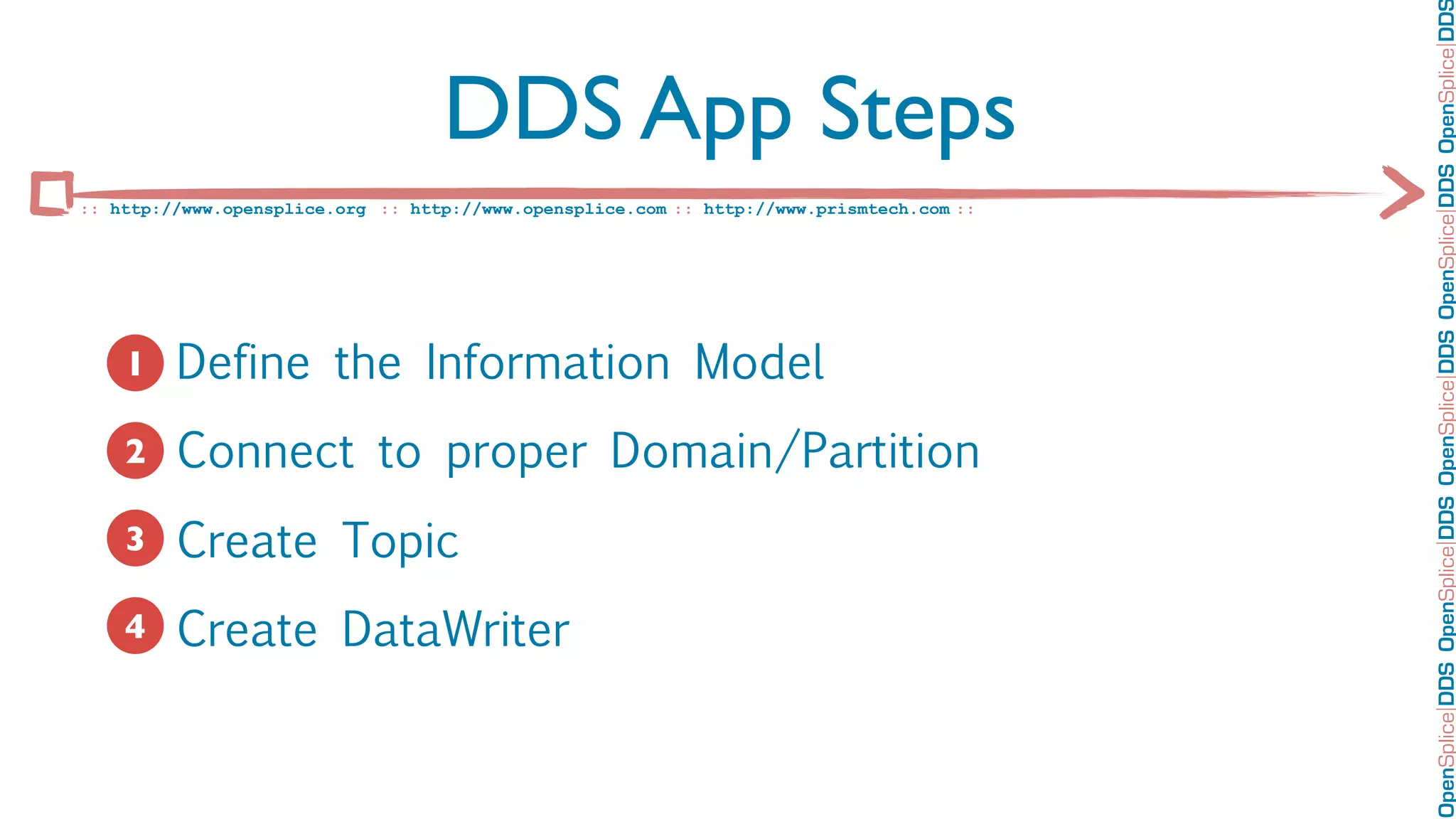
   1. Define the Information Model
   1

   2. Connect to proper Domain/Partition
   2

   3. Create Topic
   3
OpenSplice DDS OpenSplice DDS OpenSplice DDS OpenSplice DDS OpenSplice DD
                                   DDS App Steps
:: http://www.opensplice.org :: http://www.opensplice.com :: http://www.prismtech.com ::


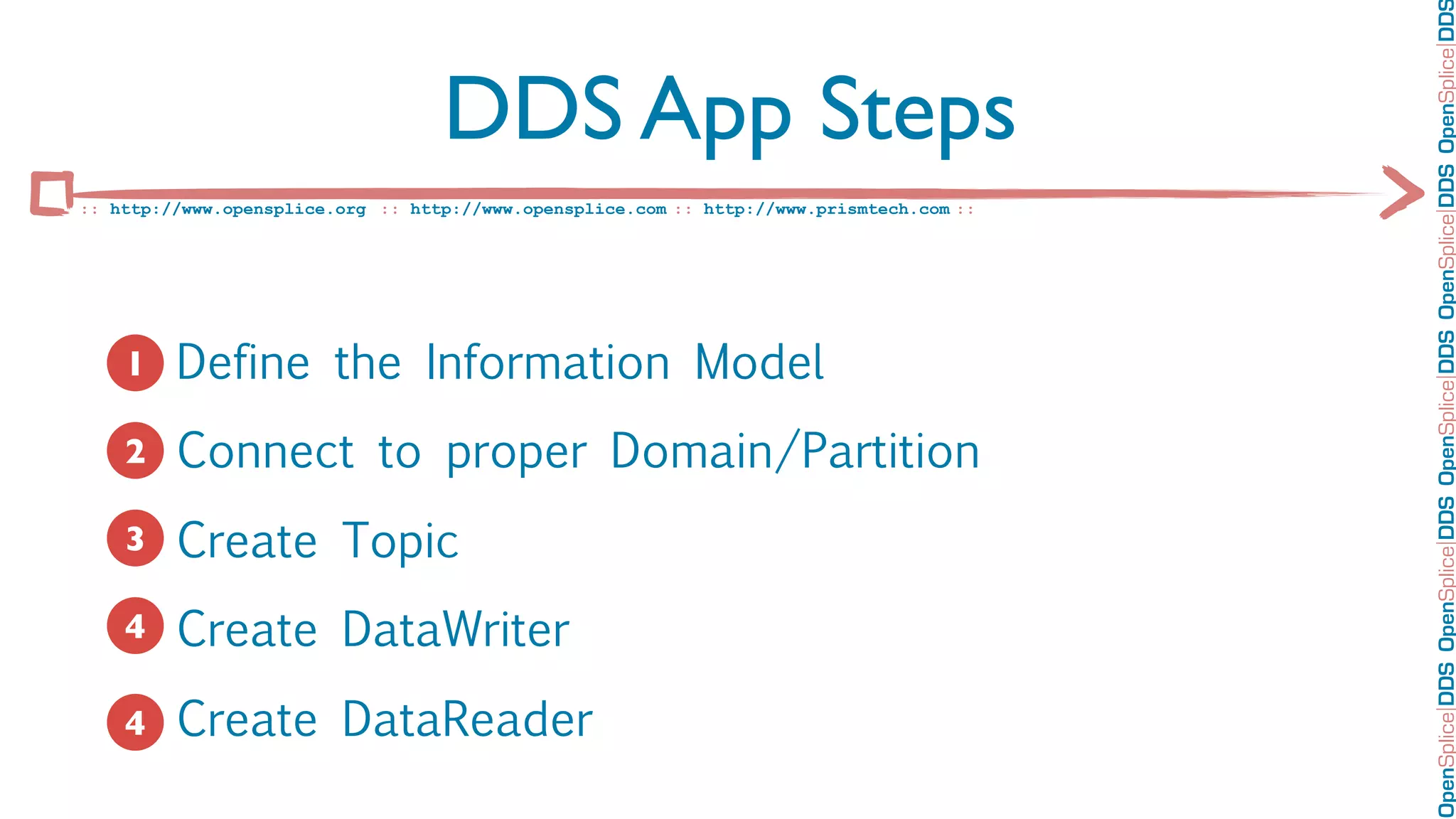
   1. Define the Information Model
   1

   2. Connect to proper Domain/Partition
   2

   3. Create Topic
   3

   4. Create DataWriter
   4
OpenSplice DDS OpenSplice DDS OpenSplice DDS OpenSplice DDS OpenSplice DD
                                   DDS App Steps
:: http://www.opensplice.org :: http://www.opensplice.com :: http://www.prismtech.com ::


   1. Define the Information Model
   1

   2. Connect to proper Domain/Partition
   2

   3. Create Topic
   3

   4. Create DataWriter
   4

   5. Create DataReader
   4
OpenSplice DDS OpenSplice DDS OpenSplice DDS OpenSplice DDS OpenSplice DD
               Temperature Control App.
:: http://www.opensplice.org :: http://www.opensplice.com :: http://www.prismtech.com ::


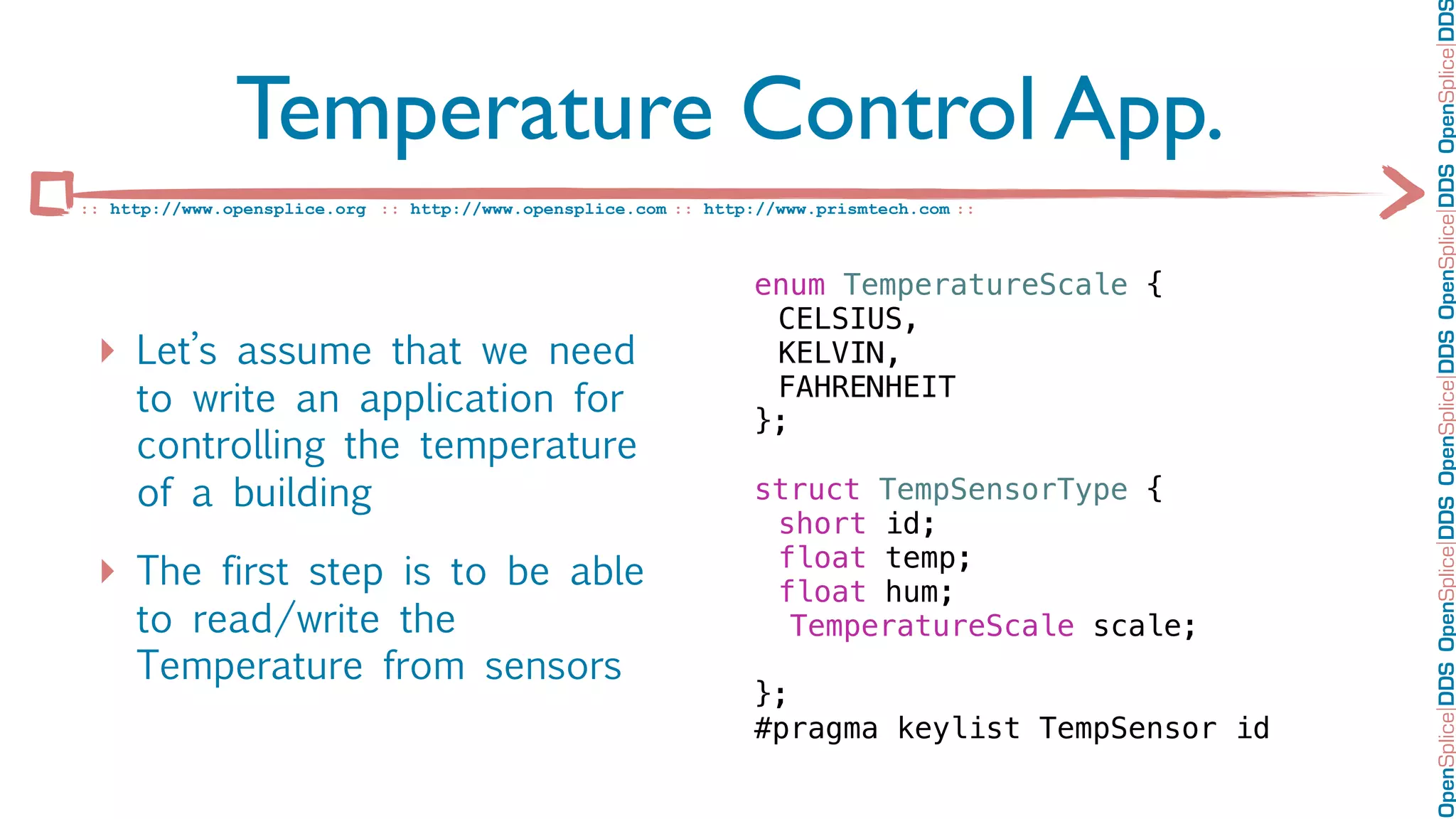
                                                                  enum TemperatureScale {
                                                                  ! CELSIUS,
 ‣ Let’s assume that we need                                      ! KELVIN,
     to write an application for                                  ! FAHRENHEIT
                                                                  };
     controlling the temperature                                  !
     of a building                                                struct TempSensorType {
                                                                  ! short id;
                                                                  ! float temp;
 ‣ The first step is to be able                                   ! float hum;
     to read/write the                                               TemperatureScale scale;
     Temperature from sensors
                                                                  };
                                                                  #pragma keylist TempSensor id
OpenSplice DDS OpenSplice DDS OpenSplice DDS OpenSplice DDS OpenSplice DD
                                     SimD Runtime
:: http://www.opensplice.org :: http://www.opensplice.com :: http://www.prismtech.com ::


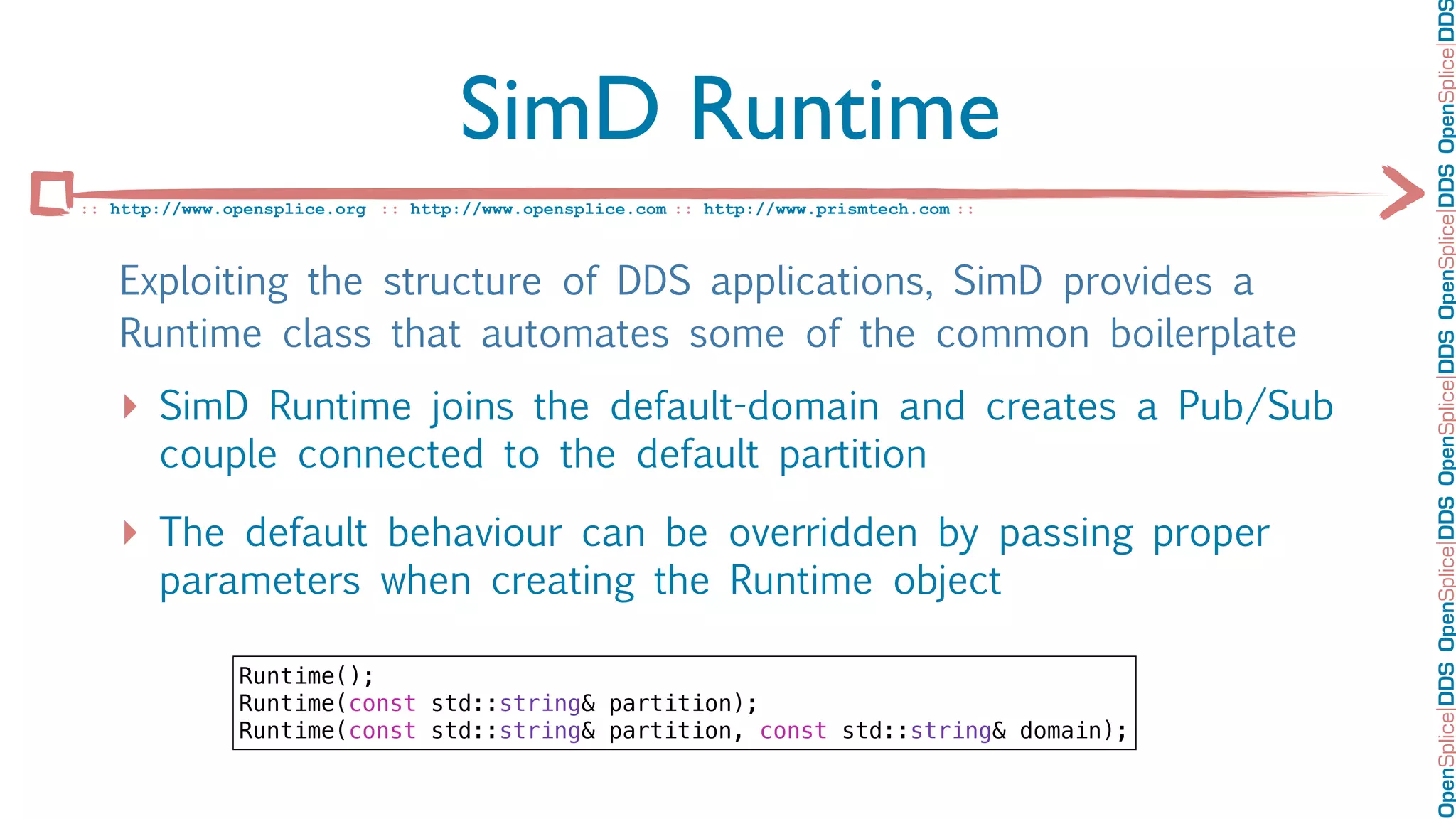
   Exploiting the structure of DDS applications, SimD provides a
   Runtime class that automates some of the common boilerplate
   ‣ SimD Runtime joins the default-domain and creates a Pub/Sub
       couple connected to the default partition

   ‣ The default behaviour can be overridden by passing proper
       parameters when creating the Runtime object

               Runtime();
               Runtime(const std::string& partition);
               Runtime(const std::string& partition, const std::string& domain);
OpenSplice DDS OpenSplice DDS OpenSplice DDS OpenSplice DDS OpenSplice DD
                                           SimD Topic
:: http://www.opensplice.org :: http://www.opensplice.com :: http://www.prismtech.com ::


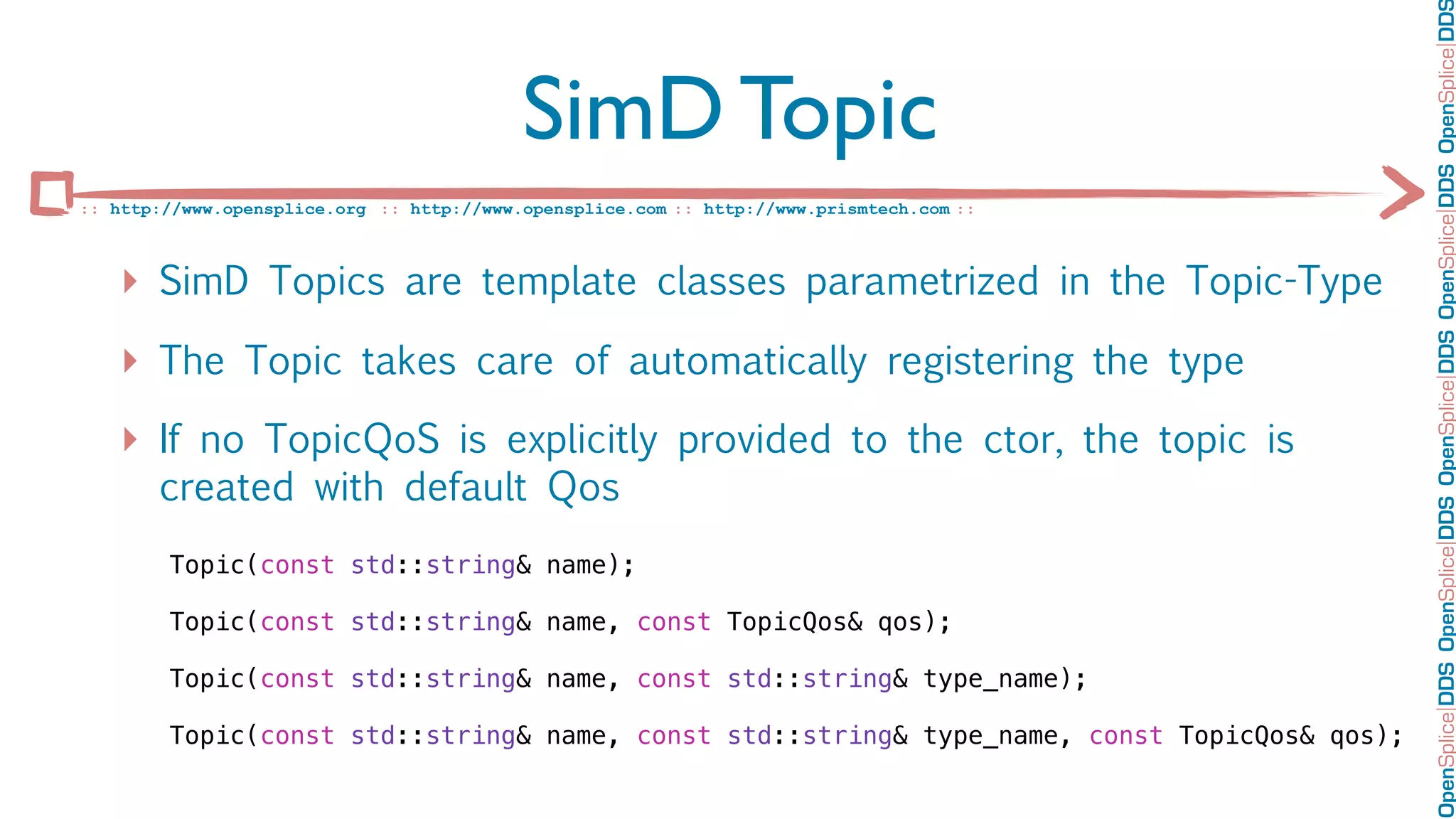
   ‣ SimD Topics are template classes parametrized in the Topic-Type
   ‣ The Topic takes care of automatically registering the type
   ‣ If no TopicQoS is explicitly provided to the ctor, the topic is
       created with default Qos
        Topic(const std::string& name);

        Topic(const std::string& name, const TopicQos& qos);

        Topic(const std::string& name, const std::string& type_name);

        Topic(const std::string& name, const std::string& type_name, const TopicQos& qos);
OpenSplice DDS OpenSplice DDS OpenSplice DDS OpenSplice DDS OpenSplice DD
  Registering the TempSensor Topic
:: http://www.opensplice.org :: http://www.opensplice.com :: http://www.prismtech.com ::


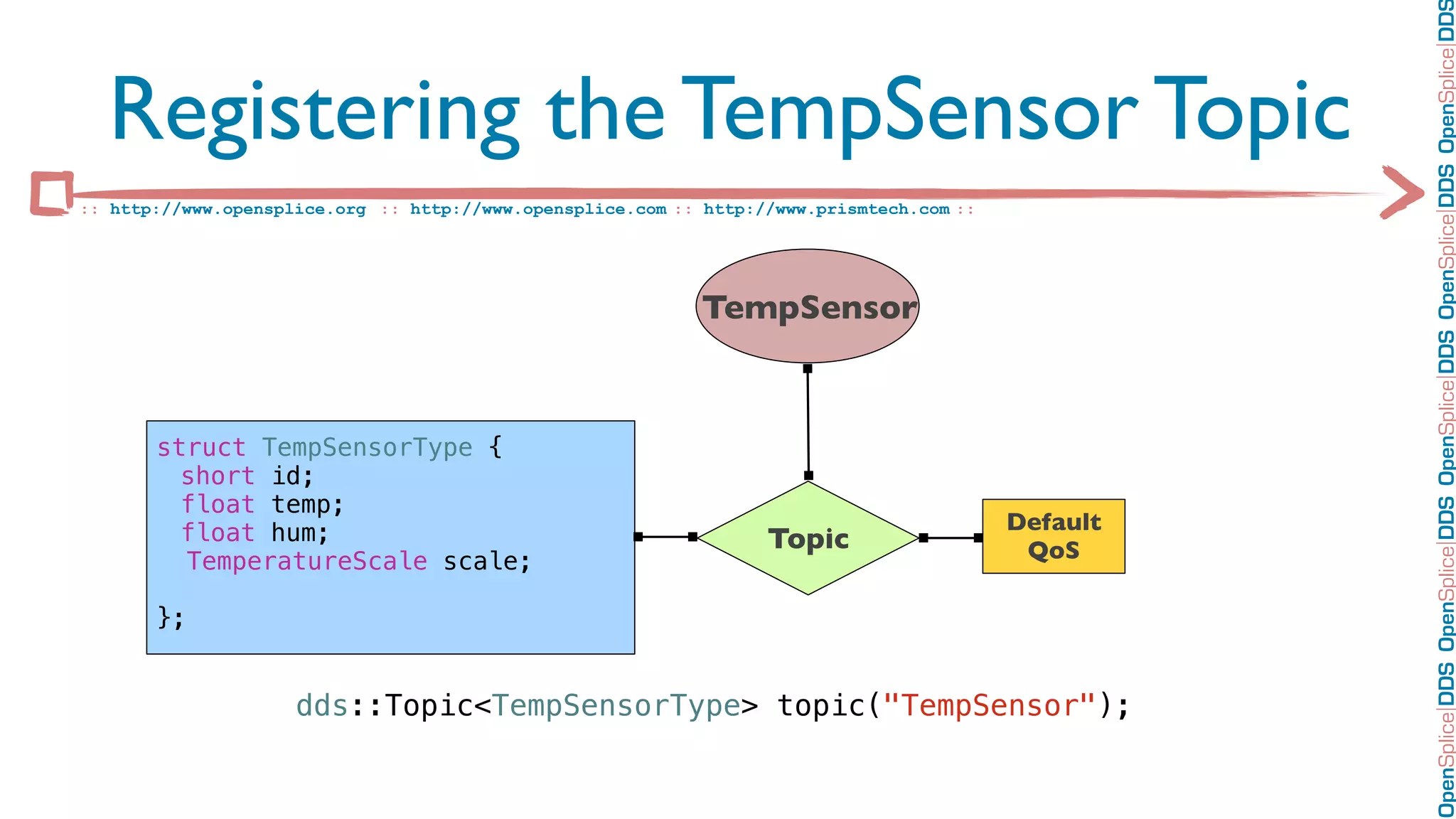
                                                             TempSensor


       struct TempSensorType {
       ! short id;
       ! float temp;
       ! float hum;                                                                        Default
                                                                   Topic                    QoS
         TemperatureScale scale;

       };


                     dds::Topic<TempSensorType> topic("TempSensor");
OpenSplice DDS OpenSplice DDS OpenSplice DDS OpenSplice DDS OpenSplice DD
                              SimD DataWriter
:: http://www.opensplice.org :: http://www.opensplice.com :: http://www.prismtech.com ::


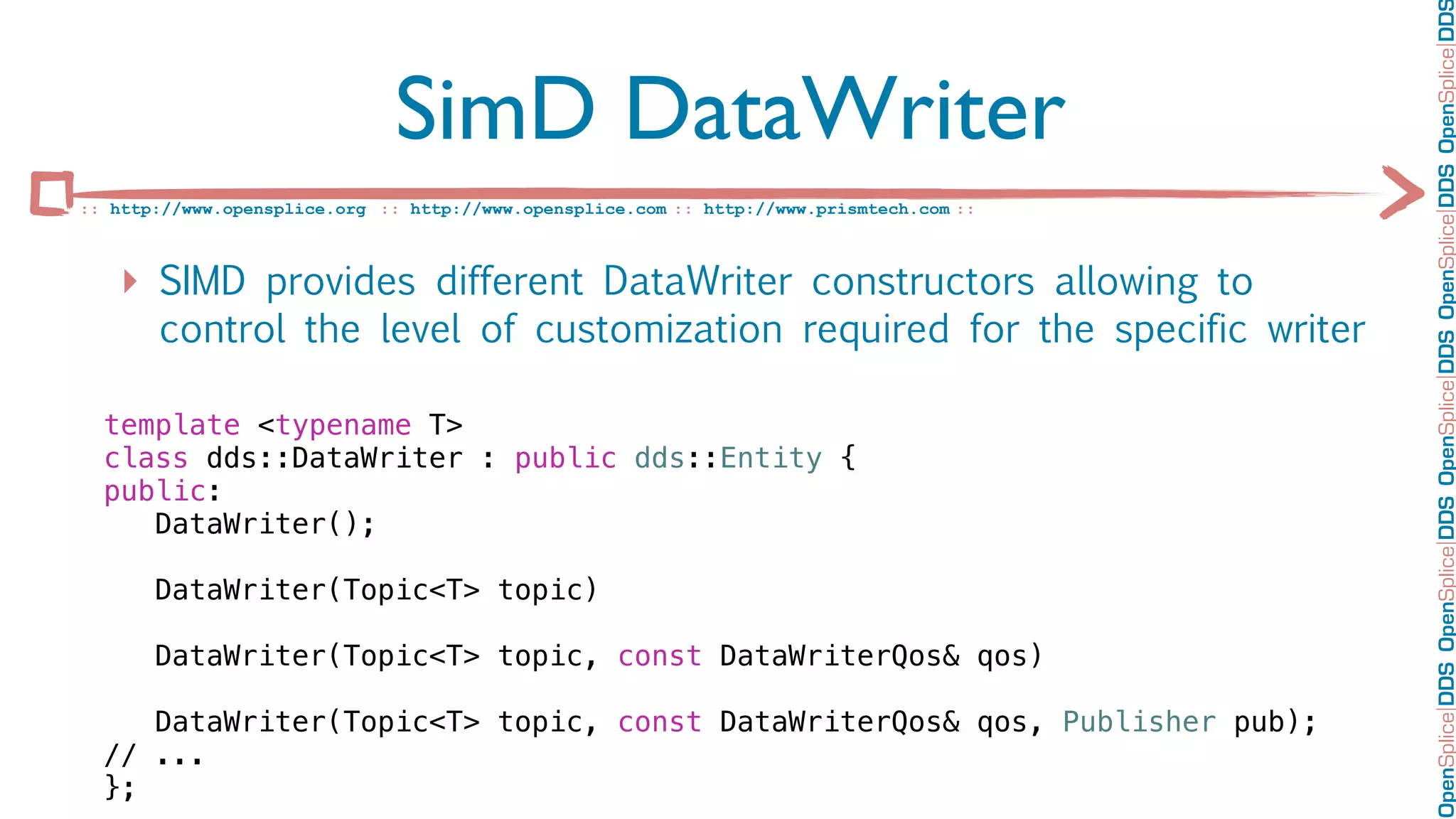
   ‣ SIMD provides different DataWriter constructors allowing to
       control the level of customization required for the specific writer

  template <typename T>
  class dds::DataWriter : public dds::Entity {
  public:
     DataWriter();

       DataWriter(Topic<T> topic)

       DataWriter(Topic<T> topic, const DataWriterQos& qos)

     DataWriter(Topic<T> topic, const DataWriterQos& qos, Publisher pub);
  // ...
  };
OpenSplice DDS OpenSplice DDS OpenSplice DDS OpenSplice DDS OpenSplice DD
                   Writing Data with SimD
:: http://www.opensplice.org :: http://www.opensplice.com :: http://www.prismtech.com ::


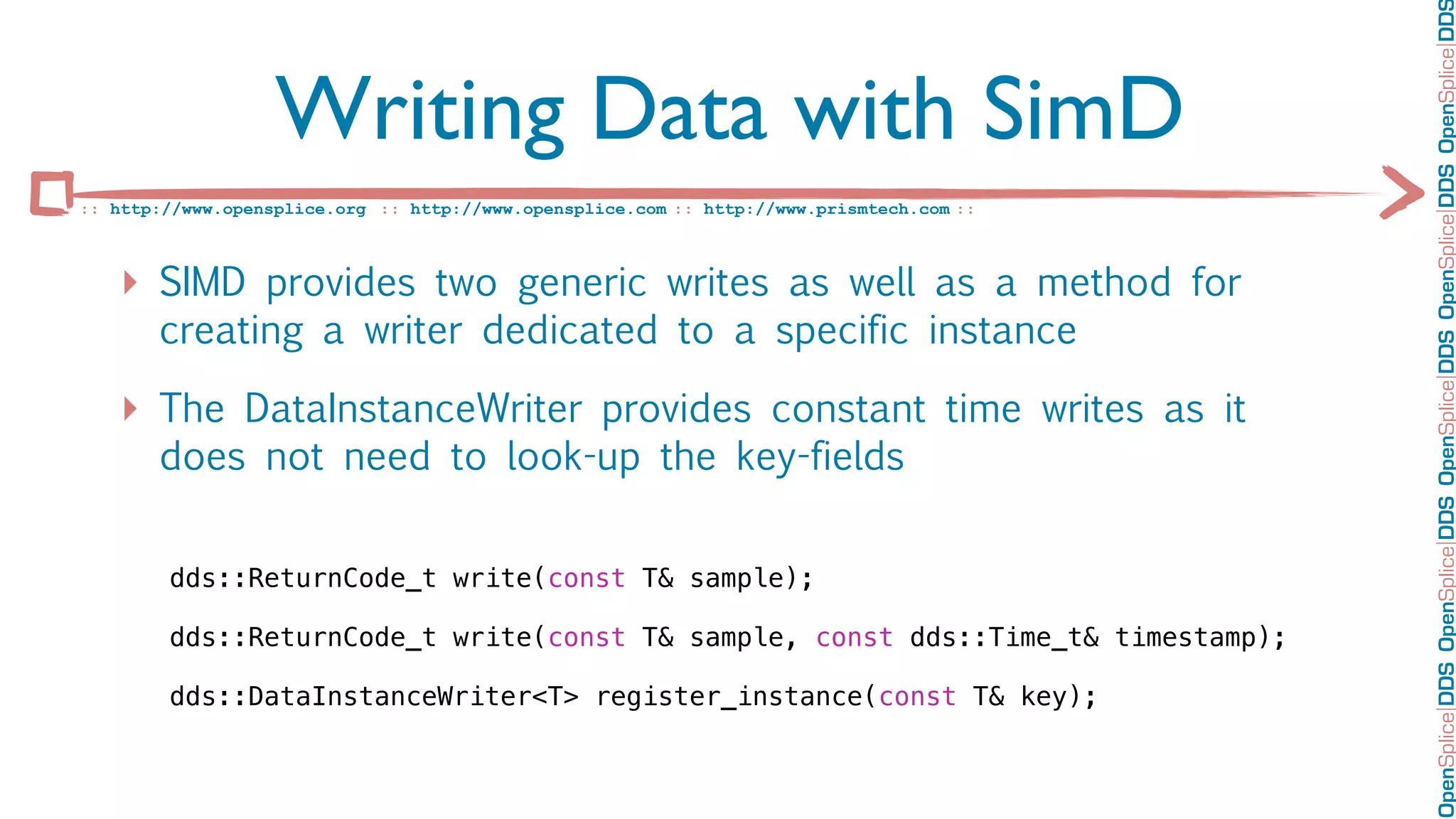
   ‣ SIMD provides two generic writes as well as a method for
       creating a writer dedicated to a specific instance

   ‣ The DataInstanceWriter provides constant time writes as it
       does not need to look-up the key-fields


        dds::ReturnCode_t write(const T& sample);

        dds::ReturnCode_t write(const T& sample, const dds::Time_t& timestamp);

        dds::DataInstanceWriter<T> register_instance(const T& key);
OpenSplice DDS OpenSplice DDS OpenSplice DDS OpenSplice DDS OpenSplice DD
          Writing TempSensor Samples
:: http://www.opensplice.org :: http://www.opensplice.com :: http://www.prismtech.com ::


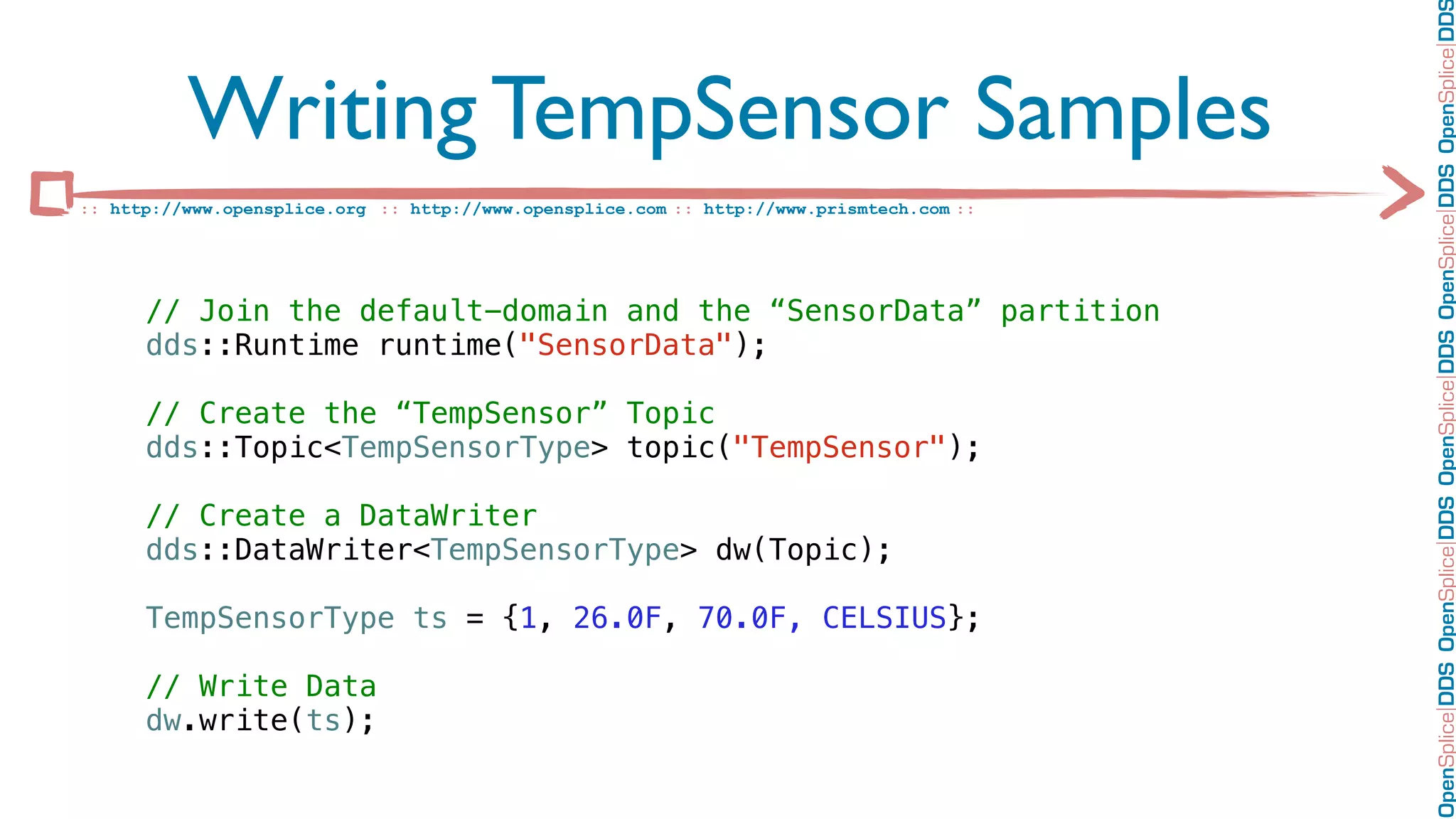
      // Join the default-domain and the “SensorData” partition
      dds::Runtime runtime("SensorData");

      // Create the “TempSensor” Topic
      dds::Topic<TempSensorType> topic("TempSensor");

      // Create a DataWriter
      dds::DataWriter<TempSensorType> dw(Topic);

      TempSensorType ts = {1, 26.0F, 70.0F, CELSIUS};

      // Write Data
      dw.write(ts);
OpenSplice DDS OpenSplice DDS OpenSplice DDS OpenSplice DDS OpenSplice DD
                    Writing Data with QoS
:: http://www.opensplice.org :: http://www.opensplice.com :: http://www.prismtech.com ::

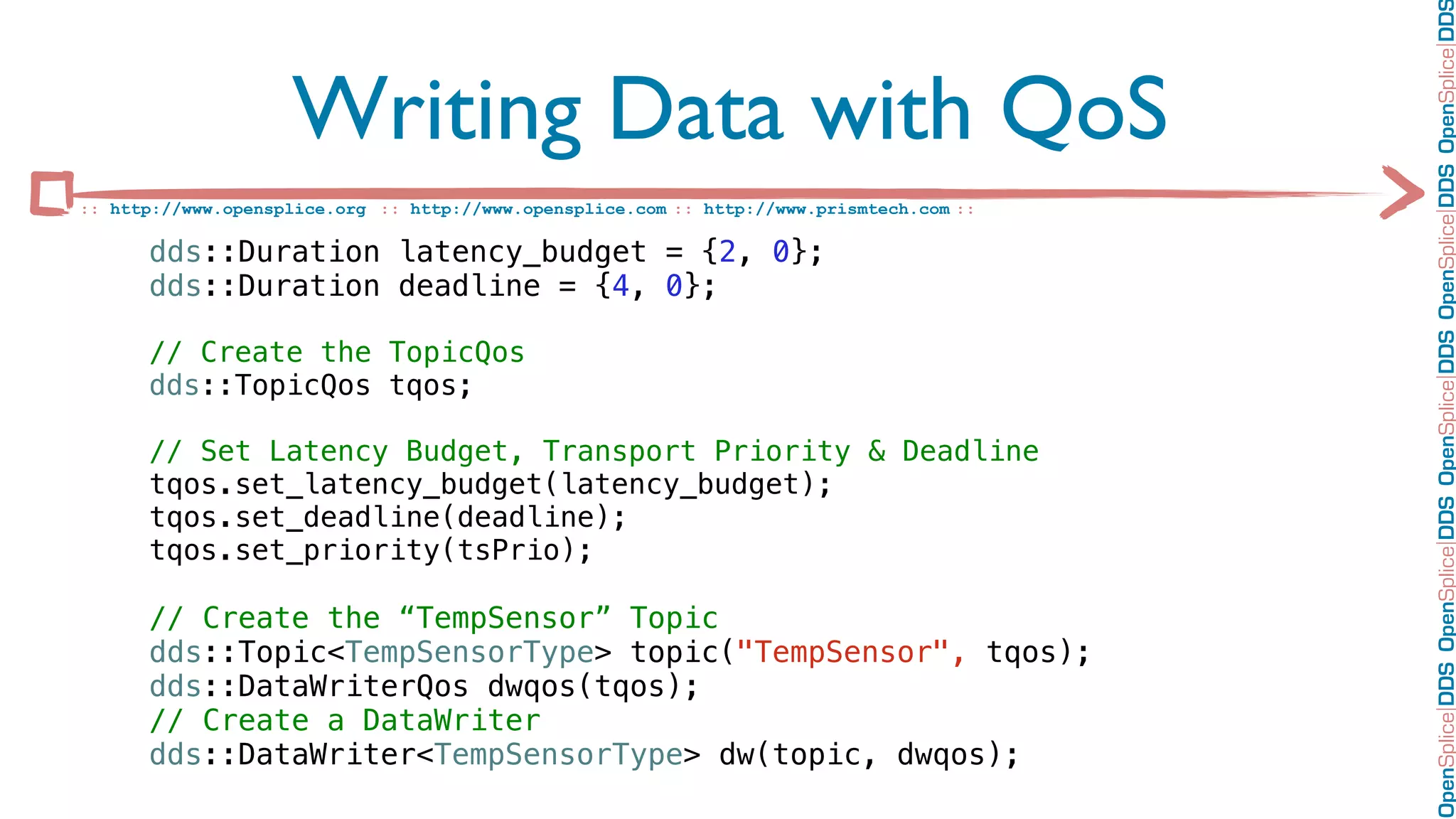
      dds::Duration latency_budget = {2, 0};
      dds::Duration deadline = {4, 0};

      // Create the TopicQos
      dds::TopicQos tqos;

      // Set Latency Budget, Transport Priority & Deadline
      tqos.set_latency_budget(latency_budget);
      tqos.set_deadline(deadline);
      tqos.set_priority(tsPrio);

      // Create the “TempSensor” Topic
      dds::Topic<TempSensorType> topic("TempSensor", tqos);
      dds::DataWriterQos dwqos(tqos);
      // Create a DataWriter
      dds::DataWriter<TempSensorType> dw(topic, dwqos);
OpenSplice DDS OpenSplice DDS OpenSplice DDS OpenSplice DDS OpenSplice DD
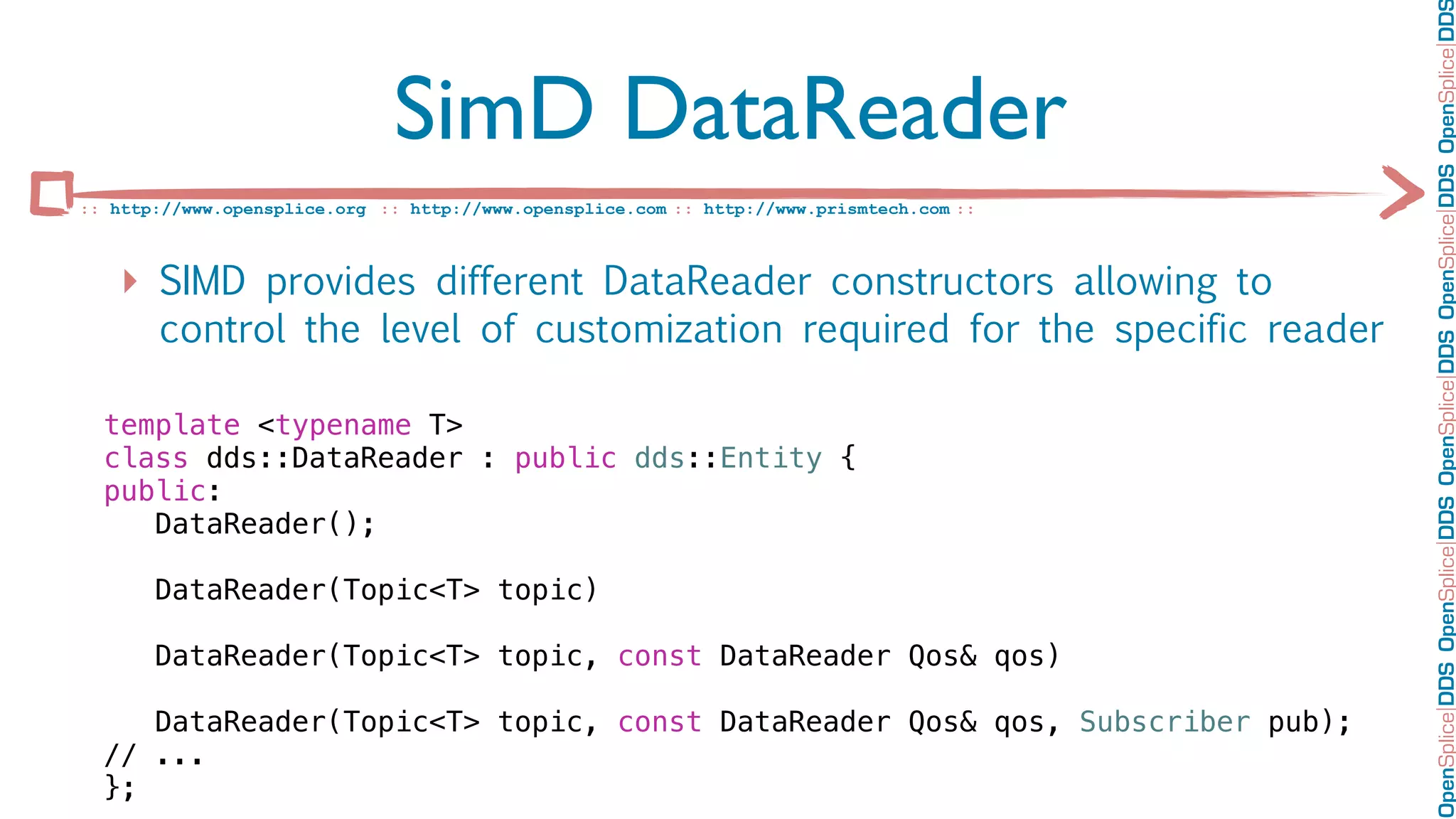
                              SimD DataReader
:: http://www.opensplice.org :: http://www.opensplice.com :: http://www.prismtech.com ::


   ‣ SIMD provides different DataReader constructors allowing to
       control the level of customization required for the specific reader

  template <typename T>
  class dds::DataReader : public dds::Entity {
  public:
     DataReader();

       DataReader(Topic<T> topic)

       DataReader(Topic<T> topic, const DataReader Qos& qos)

     DataReader(Topic<T> topic, const DataReader Qos& qos, Subscriber pub);
  // ...
  };
OpenSplice DDS OpenSplice DDS OpenSplice DDS OpenSplice DDS OpenSplice DD
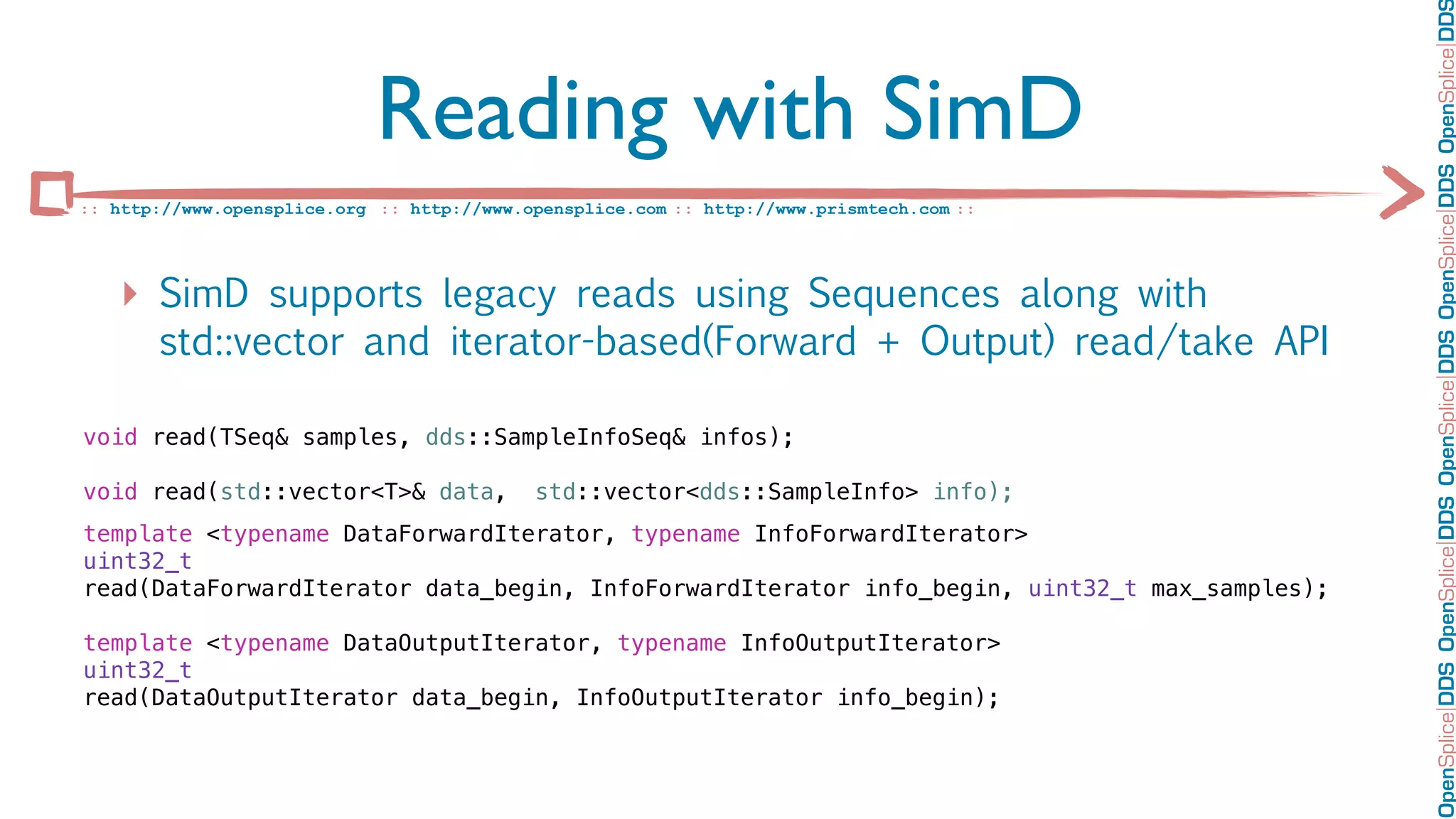
                             Reading with SimD
:: http://www.opensplice.org :: http://www.opensplice.com :: http://www.prismtech.com ::


   ‣ SimD supports legacy reads using Sequences along with
       std::vector and iterator-based(Forward + Output) read/take API

void read(TSeq& samples, dds::SampleInfoSeq& infos);

void read(std::vector<T>& data,             std::vector<dds::SampleInfo> info);
template <typename DataForwardIterator, typename InfoForwardIterator>
uint32_t
read(DataForwardIterator data_begin, InfoForwardIterator info_begin, uint32_t max_samples);

template <typename DataOutputIterator, typename InfoOutputIterator>
uint32_t
read(DataOutputIterator data_begin, InfoOutputIterator info_begin);
OpenSplice DDS OpenSplice DDS OpenSplice DDS OpenSplice DDS OpenSplice DD
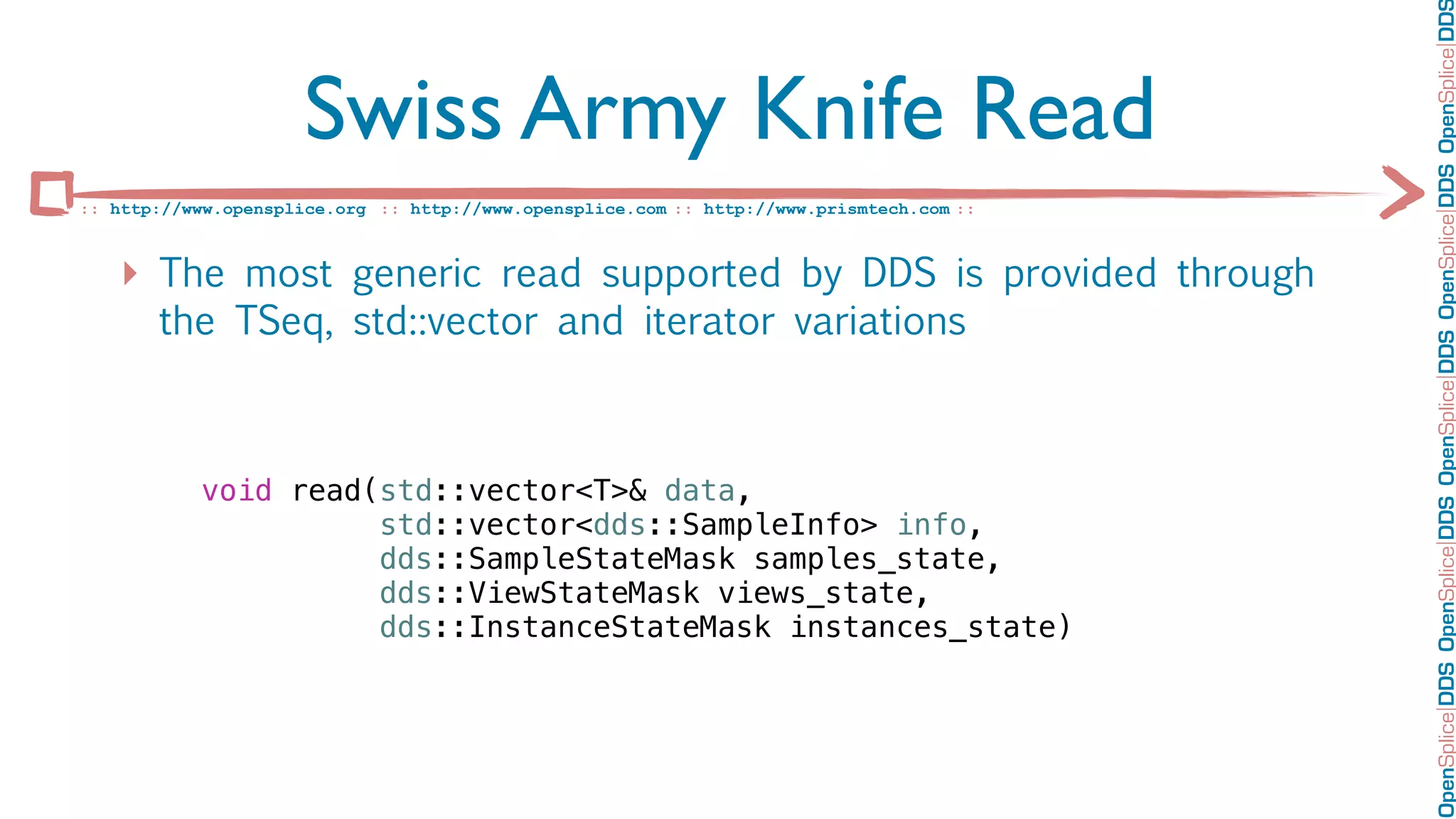
                      Swiss Army Knife Read
:: http://www.opensplice.org :: http://www.opensplice.com :: http://www.prismtech.com ::


   ‣ The most generic read supported by DDS is provided through
       the TSeq, std::vector and iterator variations


           void read(std::vector<T>& data,
                     std::vector<dds::SampleInfo> info,
                     dds::SampleStateMask samples_state,
                     dds::ViewStateMask views_state,
                     dds::InstanceStateMask instances_state)
OpenSplice DDS OpenSplice DDS OpenSplice DDS OpenSplice DDS OpenSplice DD
          Reading TempSensor Samples
:: http://www.opensplice.org :: http://www.opensplice.com :: http://www.prismtech.com ::


             // Join the default-domain and the “SensorData” partition
             dds::Runtime runtime("SensorData");

             // Create the “TempSensor” Topic
             dds::Topic<TempSensorType> topic("TempSensor");

             // Create a DataReader
             dds::DataReader<TempSensorType> dr(topic);

             std::vector<TemSensorType> data;
             std::vector<SampleInfo> info;

             while (true) {
                dr.read(data, info);
                for (int i =0; i < data.length(); ++i)
                   std::cout << data[i] << std::endl;
                sleep(1);
             }
OpenSplice DDS OpenSplice DDS OpenSplice DDS OpenSplice DDS OpenSplice DD
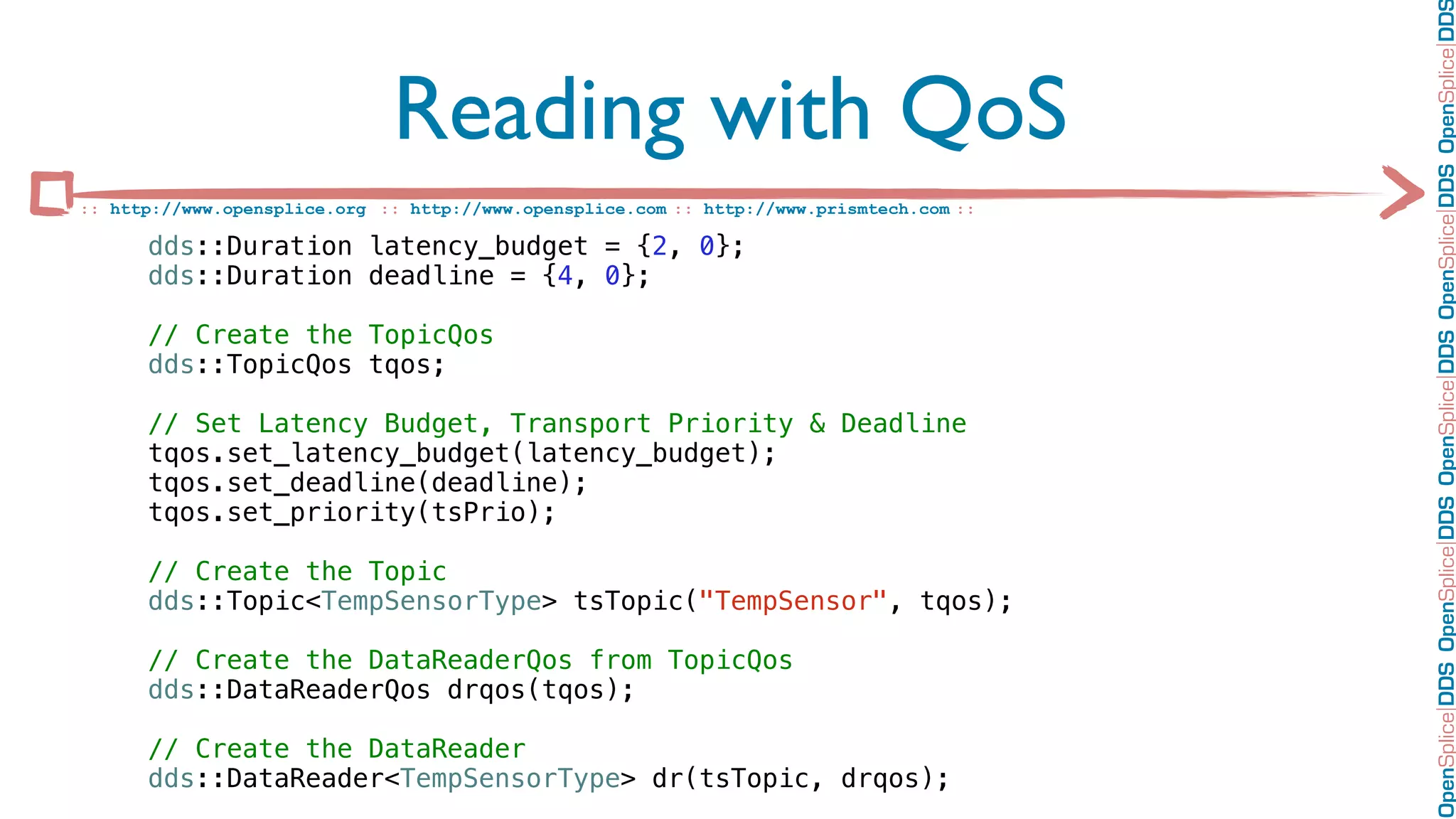
                              Reading with QoS
:: http://www.opensplice.org :: http://www.opensplice.com :: http://www.prismtech.com ::

      dds::Duration latency_budget = {2, 0};
      dds::Duration deadline = {4, 0};

      // Create the TopicQos
      dds::TopicQos tqos;

      // Set Latency Budget, Transport Priority & Deadline
      tqos.set_latency_budget(latency_budget);
      tqos.set_deadline(deadline);
      tqos.set_priority(tsPrio);

      // Create the Topic
      dds::Topic<TempSensorType> tsTopic("TempSensor", tqos);

      // Create the DataReaderQos from TopicQos
      dds::DataReaderQos drqos(tqos);

      // Create the DataReader
      dds::DataReader<TempSensorType> dr(tsTopic, drqos);
OpenSplice DDS OpenSplice DDS OpenSplice DDS OpenSplice DDS OpenSplice DD
                                    SimD WaitSets
:: http://www.opensplice.org :: http://www.opensplice.com :: http://www.prismtech.com ::


   ‣ SimD WaitSets provides an improved usability along with
       new behaviour

   ‣ SimD WaitSets and Conditions are strongly typed
   ‣ SimD WaitSet rely on C++ functors to handle condition
       triggering (handling is done in the context of a user call)

   ‣ Let’s see them in action...
OpenSplice DDS OpenSplice DDS OpenSplice DDS OpenSplice DDS OpenSplice DD
                             Condition Handler
:: http://www.opensplice.org :: http://www.opensplice.com :: http://www.prismtech.com ::


  class TempSensorDataHandler {
  public:
     void operator() (dds::DataReader<TempSensorType>& reader) {
        std::vector<TempSensorType> data;
        std::vector<dds::SampleInfo>      info;
        reader.read(data, info);
        //[NOTE #1] Do whatever is needed with the data
     }
  };
OpenSplice DDS OpenSplice DDS OpenSplice DDS OpenSplice DDS OpenSplice DD
                                      SimD WaitSets
  :: http://www.opensplice.org :: http://www.opensplice.com :: http://www.prismtech.com ::


dds::DataReader<TempSensorType> dr(topic);
                                                                   //[NOTE #4] Wait for some condition to
//[NOTE #1]: Create an instance of                                 // become active, and retrieve all active
//the handler                                                      // conditions
TempSensorDataHandler handler;                                     auto conds = ws.wait(timeout);

//[NOTE #2]: Create a read condition for                           //[NOTE #5] Execute the condition handlers
// the given reader                                                for (auto i = conds.begin();
auto rcond =                                                            i < conds.end(); ++i)
   dr.create_readcondition(handler);                                  i->execute();

//[NOTE #3]: Create a Waitset and attach
// the condition                                                   //[NOTE #5] Automatically dispatch the
dds::WaitSet ws;                                                   // condition handlers when conditions
ws.attach(rcond);                                                  //are notified
                                                                   ws.dispatch(timeout);
dds::Duration timeout = {1, 0};
OpenSplice DDS OpenSplice DDS OpenSplice DDS OpenSplice DDS OpenSplice DD
                                SimD “Listeners”
:: http://www.opensplice.org :: http://www.opensplice.com :: http://www.prismtech.com ::


   ‣ SimD takes a different approach to DDS event notifications
   ‣ SimD associate a type to each event that DDS entities might
       ever raise

   ‣ Handlers can be connected only for supported events
   ‣ Handlers can be attached to individual events
   ‣ Handler can be any C++ callable entity that matches the
       expected signature, e.g., function, functor, methods
OpenSplice DDS OpenSplice DDS OpenSplice DDS OpenSplice DDS OpenSplice DD
                                     Event Handler
:: http://www.opensplice.org :: http://www.opensplice.com :: http://www.prismtech.com ::


         class TempSensorDataHandler {
         public:
            void handle_data(dds::DataReader<TempSensorType>& reader) {
               std::cout << "Reading..." << std::endl;
               std::vector<TempSensorType> data;
               std::vector<dds::SampleInfo>      info;
               reader.read(data, info);
               //[NOTE #1] Do whatever is needed with the data
            }
         };
OpenSplice DDS OpenSplice DDS OpenSplice DDS OpenSplice DDS OpenSplice DD
                           Registering Handler
:: http://www.opensplice.org :: http://www.opensplice.com :: http://www.prismtech.com ::


        dds::DataReader<TempSensorType> dr(topic);

        //[NOTE #1]: Create an instance of the handler
        TempSensorDataHandler handler;


        auto func =
           boost::bind(TempSensorDataHandler::handle_data,
                       &handler, _1);

        //[NOTE #2]: Register the handler for the relevant event
        auto connection =
           dr.connect<on_data_available>(func);
SimD
                              The Simple DDS API
:: http://www.opensplice.org :: http://www.opensplice.com :: http://www.prismtech.com ::


                                                                                           Demo
SimD
                              The Simple DDS API
:: http://www.opensplice.org :: http://www.opensplice.com :: http://www.prismtech.com ::


                                                                                           StatuS
OpenSplice DDS OpenSplice DDS OpenSplice DDS OpenSplice DDS OpenSplice DD
                                         SimD Status
:: http://www.opensplice.org :: http://www.opensplice.com :: http://www.prismtech.com ::


   ‣ SimD has been an incubator for the new ISO C++ DDS PSM
   ‣ The code is already used by several OpenSplice DDS users in
       both R&D as well as commercial applications

   ‣ SimD API will transition to v1.x only after the adoption of the
       new C++ PSM so to ensure stable API with v1.x
OpenSplice DDS OpenSplice DDS OpenSplice DDS OpenSplice DDS OpenSplice DD
                                 SimD Availability
:: http://www.opensplice.org :: http://www.opensplice.com :: http://www.prismtech.com ::


   ‣ SimD is an OpenSource
      project licensed under LGPL

   ‣ SimD is available for Linux/
      Unix/Windows at:

                   http://code.google.com/p/simd-cxx/
SimD
                              The Simple DDS API
:: http://www.opensplice.org :: http://www.opensplice.com :: http://www.prismtech.com ::


                                                                           Summing Up
                                                                                   +/-
OpenSplice DDS OpenSplice DDS OpenSplice DDS OpenSplice DDS OpenSplice DD
                                        Summing Up
:: http://www.opensplice.org :: http://www.opensplice.com :: http://www.prismtech.com ::


   ‣ SimD provides a safe, efficient and productive C++ API for
       DDS

   ‣ SimD has been instrumental in experimenting ideas for
       evolving the ISO C++ DDS PSM

   ‣ SimD code is already pretty robust and used by a large
       community

SimD

  • 1.
    Splice DDS OpenSpliceDDS OpenSplice DDS OpenSplice DDS OpenSplice DDS OpenSplice DDS OpenSplice DDS OpenSplice DDS OpenSplice DDS SimD The Simple DDS API :: http://www.opensplice.org :: http://www.opensplice.com :: http://www.prismtech.com :: Angelo Corsaro, Ph.D. Chief Technology Officer PrismTech OMG DDS SIG Co-Chair angelo.corsaro@prismtech.com Splice DDS OpenSplice DDS OpenSplice DDS OpenSplice DDS OpenSplice DDS OpenSplice DDS OpenSplice DDS OpenSplice DDS OpenSplice DDS
  • 2.
    SimD The Simple DDS API :: http://www.opensplice.org :: http://www.opensplice.com :: http://www.prismtech.com :: Background
  • 3.
    OpenSplice DDS OpenSpliceDDS OpenSplice DDS OpenSplice DDS OpenSplice DD DDS PIM/PSM Approach :: http://www.opensplice.org :: http://www.opensplice.com :: http://www.prismtech.com :: ‣ The DDS standard is composed PIM (UML) by a PIM specified in UML and A PSM specified in IDL PSM (IDL) ‣ Language specific APIs are IDL2C derived via IDL-based mappings IDL2C++ IDL2Java (e.g. IDL2C++, etc.) C C++ Java
  • 4.
    OpenSplice DDS OpenSpliceDDS OpenSplice DDS OpenSplice DDS OpenSplice DD What is the problem? :: http://www.opensplice.org :: http://www.opensplice.com :: http://www.prismtech.com :: ‣ IDL is very good for describing DDS Topic Types, yet... ‣ IDL’s biggest strength, namely (programming) language independence, becomes its biggest weakness when trying to define APIs that are well integrated with a programming language ‣ For some programming languages (e.g. C++) the IDL2C++ mapping is “seasoned”
  • 5.
    OpenSplice DDS OpenSpliceDDS OpenSplice DDS OpenSplice DDS OpenSplice DD Why is this a problem? :: http://www.opensplice.org :: http://www.opensplice.com :: http://www.prismtech.com :: ‣ Resulting DDS APIs are more complicated than they should ‣ API don’t feel natural to programmers ‣ API (esp. for C++) don’t integrate well with standard libraries nor implements common idioms/patterns.
  • 6.
    OpenSplice DDS OpenSpliceDDS OpenSplice DDS OpenSplice DDS OpenSplice DD SimD: a Native C++ PSMs :: http://www.opensplice.org :: http://www.opensplice.com :: http://www.prismtech.com :: ‣ SimD addresses the problem by deriving a new C++ PSM from DDS PIM (UML) starting directly from the PIM ‣ SimD takes advantage of all the PSM (C++) features available in C++ in order to provide a natural, productive and safe API SimD simplifies DDS Programming w/o limiting the expensiveness or introducing limitations in what possible
  • 7.
    OpenSplice DDS OpenSpliceDDS OpenSplice DDS OpenSplice DDS OpenSplice DD SimD in a Nutshell :: http://www.opensplice.org :: http://www.opensplice.com :: http://www.prismtech.com :: ‣ Provides transparent, safe, precise and real-time automatic memory management ‣ Takes advantage of C++ Template Meta-programming to automate tasks such as type registration and provide a strongly typed API (no downcast ever!) ‣ Provides a DDS API that exploits Iterators and containers as well as other C++ Standard Types ‣ DDS Events are types and are using Signal/Slots
  • 8.
    SimD The Simple DDS API :: http://www.opensplice.org :: http://www.opensplice.com :: http://www.prismtech.com :: Looking at a DDS App...
  • 9.
    OpenSplice DDS OpenSpliceDDS OpenSplice DDS OpenSplice DDS OpenSplice DD Anatomy of a DDS Application :: http://www.opensplice.org :: http://www.opensplice.com :: http://www.prismtech.com :: DP: DomainParticipant DR: DataReader P: Publisher DW: DataWriter S: Subscribe ‣ Tree-like dependency between DP->(P,S)->(DR, DW) in creation DataWriter DataReader and life-cycle management Publisher Subscriber ‣ Example: DW alive requires DomainParticipant the parent P to be alive ‣ This tree-like dependency allows precise GC of DDS Topic Entities via reference counting Partition Domain
  • 10.
    OpenSplice DDS OpenSpliceDDS OpenSplice DDS OpenSplice DDS OpenSplice DD SimD Memory Management :: http://www.opensplice.org :: http://www.opensplice.com :: http://www.prismtech.com :: ‣ SimD distinguishes between DataWriter DataReader “Values” and “Reference” types Topic ‣ Reference types are subject to Publisher Subscriber automatic memory management ‣ DDS Entities (DP, P, S, DR, DW) DomainParticipant and Conditions are references ‣ Policies and Samples are values
  • 11.
    SimD The Simple DDS API :: http://www.opensplice.org :: http://www.opensplice.com :: http://www.prismtech.com :: SimD: Step By Step
  • 12.
    OpenSplice DDS OpenSpliceDDS OpenSplice DDS OpenSplice DDS OpenSplice DD DDS App Steps :: http://www.opensplice.org :: http://www.opensplice.com :: http://www.prismtech.com :: 1. Define the Information Model 1
  • 13.
    OpenSplice DDS OpenSpliceDDS OpenSplice DDS OpenSplice DDS OpenSplice DD DDS App Steps :: http://www.opensplice.org :: http://www.opensplice.com :: http://www.prismtech.com :: 1. Define the Information Model 1 2. Connect to proper Domain/Partition 2
  • 14.
    OpenSplice DDS OpenSpliceDDS OpenSplice DDS OpenSplice DDS OpenSplice DD DDS App Steps :: http://www.opensplice.org :: http://www.opensplice.com :: http://www.prismtech.com :: 1. Define the Information Model 1 2. Connect to proper Domain/Partition 2 3. Create Topic 3
  • 15.
    OpenSplice DDS OpenSpliceDDS OpenSplice DDS OpenSplice DDS OpenSplice DD DDS App Steps :: http://www.opensplice.org :: http://www.opensplice.com :: http://www.prismtech.com :: 1. Define the Information Model 1 2. Connect to proper Domain/Partition 2 3. Create Topic 3 4. Create DataWriter 4
  • 16.
    OpenSplice DDS OpenSpliceDDS OpenSplice DDS OpenSplice DDS OpenSplice DD DDS App Steps :: http://www.opensplice.org :: http://www.opensplice.com :: http://www.prismtech.com :: 1. Define the Information Model 1 2. Connect to proper Domain/Partition 2 3. Create Topic 3 4. Create DataWriter 4 5. Create DataReader 4
  • 17.
    OpenSplice DDS OpenSpliceDDS OpenSplice DDS OpenSplice DDS OpenSplice DD Temperature Control App. :: http://www.opensplice.org :: http://www.opensplice.com :: http://www.prismtech.com :: enum TemperatureScale { ! CELSIUS, ‣ Let’s assume that we need ! KELVIN, to write an application for ! FAHRENHEIT }; controlling the temperature ! of a building struct TempSensorType { ! short id; ! float temp; ‣ The first step is to be able ! float hum; to read/write the TemperatureScale scale; Temperature from sensors }; #pragma keylist TempSensor id
  • 18.
    OpenSplice DDS OpenSpliceDDS OpenSplice DDS OpenSplice DDS OpenSplice DD SimD Runtime :: http://www.opensplice.org :: http://www.opensplice.com :: http://www.prismtech.com :: Exploiting the structure of DDS applications, SimD provides a Runtime class that automates some of the common boilerplate ‣ SimD Runtime joins the default-domain and creates a Pub/Sub couple connected to the default partition ‣ The default behaviour can be overridden by passing proper parameters when creating the Runtime object Runtime(); Runtime(const std::string& partition); Runtime(const std::string& partition, const std::string& domain);
  • 19.
    OpenSplice DDS OpenSpliceDDS OpenSplice DDS OpenSplice DDS OpenSplice DD SimD Topic :: http://www.opensplice.org :: http://www.opensplice.com :: http://www.prismtech.com :: ‣ SimD Topics are template classes parametrized in the Topic-Type ‣ The Topic takes care of automatically registering the type ‣ If no TopicQoS is explicitly provided to the ctor, the topic is created with default Qos Topic(const std::string& name); Topic(const std::string& name, const TopicQos& qos); Topic(const std::string& name, const std::string& type_name); Topic(const std::string& name, const std::string& type_name, const TopicQos& qos);
  • 20.
    OpenSplice DDS OpenSpliceDDS OpenSplice DDS OpenSplice DDS OpenSplice DD Registering the TempSensor Topic :: http://www.opensplice.org :: http://www.opensplice.com :: http://www.prismtech.com :: TempSensor struct TempSensorType { ! short id; ! float temp; ! float hum; Default Topic QoS TemperatureScale scale; }; dds::Topic<TempSensorType> topic("TempSensor");
  • 21.
    OpenSplice DDS OpenSpliceDDS OpenSplice DDS OpenSplice DDS OpenSplice DD SimD DataWriter :: http://www.opensplice.org :: http://www.opensplice.com :: http://www.prismtech.com :: ‣ SIMD provides different DataWriter constructors allowing to control the level of customization required for the specific writer template <typename T> class dds::DataWriter : public dds::Entity { public: DataWriter(); DataWriter(Topic<T> topic) DataWriter(Topic<T> topic, const DataWriterQos& qos) DataWriter(Topic<T> topic, const DataWriterQos& qos, Publisher pub); // ... };
  • 22.
    OpenSplice DDS OpenSpliceDDS OpenSplice DDS OpenSplice DDS OpenSplice DD Writing Data with SimD :: http://www.opensplice.org :: http://www.opensplice.com :: http://www.prismtech.com :: ‣ SIMD provides two generic writes as well as a method for creating a writer dedicated to a specific instance ‣ The DataInstanceWriter provides constant time writes as it does not need to look-up the key-fields dds::ReturnCode_t write(const T& sample); dds::ReturnCode_t write(const T& sample, const dds::Time_t& timestamp); dds::DataInstanceWriter<T> register_instance(const T& key);
  • 23.
    OpenSplice DDS OpenSpliceDDS OpenSplice DDS OpenSplice DDS OpenSplice DD Writing TempSensor Samples :: http://www.opensplice.org :: http://www.opensplice.com :: http://www.prismtech.com :: // Join the default-domain and the “SensorData” partition dds::Runtime runtime("SensorData"); // Create the “TempSensor” Topic dds::Topic<TempSensorType> topic("TempSensor"); // Create a DataWriter dds::DataWriter<TempSensorType> dw(Topic); TempSensorType ts = {1, 26.0F, 70.0F, CELSIUS}; // Write Data dw.write(ts);
  • 24.
    OpenSplice DDS OpenSpliceDDS OpenSplice DDS OpenSplice DDS OpenSplice DD Writing Data with QoS :: http://www.opensplice.org :: http://www.opensplice.com :: http://www.prismtech.com :: dds::Duration latency_budget = {2, 0}; dds::Duration deadline = {4, 0}; // Create the TopicQos dds::TopicQos tqos; // Set Latency Budget, Transport Priority & Deadline tqos.set_latency_budget(latency_budget); tqos.set_deadline(deadline); tqos.set_priority(tsPrio); // Create the “TempSensor” Topic dds::Topic<TempSensorType> topic("TempSensor", tqos); dds::DataWriterQos dwqos(tqos); // Create a DataWriter dds::DataWriter<TempSensorType> dw(topic, dwqos);
  • 25.
    OpenSplice DDS OpenSpliceDDS OpenSplice DDS OpenSplice DDS OpenSplice DD SimD DataReader :: http://www.opensplice.org :: http://www.opensplice.com :: http://www.prismtech.com :: ‣ SIMD provides different DataReader constructors allowing to control the level of customization required for the specific reader template <typename T> class dds::DataReader : public dds::Entity { public: DataReader(); DataReader(Topic<T> topic) DataReader(Topic<T> topic, const DataReader Qos& qos) DataReader(Topic<T> topic, const DataReader Qos& qos, Subscriber pub); // ... };
  • 26.
    OpenSplice DDS OpenSpliceDDS OpenSplice DDS OpenSplice DDS OpenSplice DD Reading with SimD :: http://www.opensplice.org :: http://www.opensplice.com :: http://www.prismtech.com :: ‣ SimD supports legacy reads using Sequences along with std::vector and iterator-based(Forward + Output) read/take API void read(TSeq& samples, dds::SampleInfoSeq& infos); void read(std::vector<T>& data, std::vector<dds::SampleInfo> info); template <typename DataForwardIterator, typename InfoForwardIterator> uint32_t read(DataForwardIterator data_begin, InfoForwardIterator info_begin, uint32_t max_samples); template <typename DataOutputIterator, typename InfoOutputIterator> uint32_t read(DataOutputIterator data_begin, InfoOutputIterator info_begin);
  • 27.
    OpenSplice DDS OpenSpliceDDS OpenSplice DDS OpenSplice DDS OpenSplice DD Swiss Army Knife Read :: http://www.opensplice.org :: http://www.opensplice.com :: http://www.prismtech.com :: ‣ The most generic read supported by DDS is provided through the TSeq, std::vector and iterator variations void read(std::vector<T>& data, std::vector<dds::SampleInfo> info, dds::SampleStateMask samples_state, dds::ViewStateMask views_state, dds::InstanceStateMask instances_state)
  • 28.
    OpenSplice DDS OpenSpliceDDS OpenSplice DDS OpenSplice DDS OpenSplice DD Reading TempSensor Samples :: http://www.opensplice.org :: http://www.opensplice.com :: http://www.prismtech.com :: // Join the default-domain and the “SensorData” partition dds::Runtime runtime("SensorData"); // Create the “TempSensor” Topic dds::Topic<TempSensorType> topic("TempSensor"); // Create a DataReader dds::DataReader<TempSensorType> dr(topic); std::vector<TemSensorType> data; std::vector<SampleInfo> info; while (true) { dr.read(data, info); for (int i =0; i < data.length(); ++i) std::cout << data[i] << std::endl; sleep(1); }
  • 29.
    OpenSplice DDS OpenSpliceDDS OpenSplice DDS OpenSplice DDS OpenSplice DD Reading with QoS :: http://www.opensplice.org :: http://www.opensplice.com :: http://www.prismtech.com :: dds::Duration latency_budget = {2, 0}; dds::Duration deadline = {4, 0}; // Create the TopicQos dds::TopicQos tqos; // Set Latency Budget, Transport Priority & Deadline tqos.set_latency_budget(latency_budget); tqos.set_deadline(deadline); tqos.set_priority(tsPrio); // Create the Topic dds::Topic<TempSensorType> tsTopic("TempSensor", tqos); // Create the DataReaderQos from TopicQos dds::DataReaderQos drqos(tqos); // Create the DataReader dds::DataReader<TempSensorType> dr(tsTopic, drqos);
  • 30.
    OpenSplice DDS OpenSpliceDDS OpenSplice DDS OpenSplice DDS OpenSplice DD SimD WaitSets :: http://www.opensplice.org :: http://www.opensplice.com :: http://www.prismtech.com :: ‣ SimD WaitSets provides an improved usability along with new behaviour ‣ SimD WaitSets and Conditions are strongly typed ‣ SimD WaitSet rely on C++ functors to handle condition triggering (handling is done in the context of a user call) ‣ Let’s see them in action...
  • 31.
    OpenSplice DDS OpenSpliceDDS OpenSplice DDS OpenSplice DDS OpenSplice DD Condition Handler :: http://www.opensplice.org :: http://www.opensplice.com :: http://www.prismtech.com :: class TempSensorDataHandler { public: void operator() (dds::DataReader<TempSensorType>& reader) { std::vector<TempSensorType> data; std::vector<dds::SampleInfo> info; reader.read(data, info); //[NOTE #1] Do whatever is needed with the data } };
  • 32.
    OpenSplice DDS OpenSpliceDDS OpenSplice DDS OpenSplice DDS OpenSplice DD SimD WaitSets :: http://www.opensplice.org :: http://www.opensplice.com :: http://www.prismtech.com :: dds::DataReader<TempSensorType> dr(topic); //[NOTE #4] Wait for some condition to //[NOTE #1]: Create an instance of // become active, and retrieve all active //the handler // conditions TempSensorDataHandler handler; auto conds = ws.wait(timeout); //[NOTE #2]: Create a read condition for //[NOTE #5] Execute the condition handlers // the given reader for (auto i = conds.begin(); auto rcond = i < conds.end(); ++i) dr.create_readcondition(handler); i->execute(); //[NOTE #3]: Create a Waitset and attach // the condition //[NOTE #5] Automatically dispatch the dds::WaitSet ws; // condition handlers when conditions ws.attach(rcond); //are notified ws.dispatch(timeout); dds::Duration timeout = {1, 0};
  • 33.
    OpenSplice DDS OpenSpliceDDS OpenSplice DDS OpenSplice DDS OpenSplice DD SimD “Listeners” :: http://www.opensplice.org :: http://www.opensplice.com :: http://www.prismtech.com :: ‣ SimD takes a different approach to DDS event notifications ‣ SimD associate a type to each event that DDS entities might ever raise ‣ Handlers can be connected only for supported events ‣ Handlers can be attached to individual events ‣ Handler can be any C++ callable entity that matches the expected signature, e.g., function, functor, methods
  • 34.
    OpenSplice DDS OpenSpliceDDS OpenSplice DDS OpenSplice DDS OpenSplice DD Event Handler :: http://www.opensplice.org :: http://www.opensplice.com :: http://www.prismtech.com :: class TempSensorDataHandler { public: void handle_data(dds::DataReader<TempSensorType>& reader) { std::cout << "Reading..." << std::endl; std::vector<TempSensorType> data; std::vector<dds::SampleInfo> info; reader.read(data, info); //[NOTE #1] Do whatever is needed with the data } };
  • 35.
    OpenSplice DDS OpenSpliceDDS OpenSplice DDS OpenSplice DDS OpenSplice DD Registering Handler :: http://www.opensplice.org :: http://www.opensplice.com :: http://www.prismtech.com :: dds::DataReader<TempSensorType> dr(topic); //[NOTE #1]: Create an instance of the handler TempSensorDataHandler handler; auto func = boost::bind(TempSensorDataHandler::handle_data, &handler, _1); //[NOTE #2]: Register the handler for the relevant event auto connection = dr.connect<on_data_available>(func);
  • 36.
    SimD The Simple DDS API :: http://www.opensplice.org :: http://www.opensplice.com :: http://www.prismtech.com :: Demo
  • 37.
    SimD The Simple DDS API :: http://www.opensplice.org :: http://www.opensplice.com :: http://www.prismtech.com :: StatuS
  • 38.
    OpenSplice DDS OpenSpliceDDS OpenSplice DDS OpenSplice DDS OpenSplice DD SimD Status :: http://www.opensplice.org :: http://www.opensplice.com :: http://www.prismtech.com :: ‣ SimD has been an incubator for the new ISO C++ DDS PSM ‣ The code is already used by several OpenSplice DDS users in both R&D as well as commercial applications ‣ SimD API will transition to v1.x only after the adoption of the new C++ PSM so to ensure stable API with v1.x
  • 39.
    OpenSplice DDS OpenSpliceDDS OpenSplice DDS OpenSplice DDS OpenSplice DD SimD Availability :: http://www.opensplice.org :: http://www.opensplice.com :: http://www.prismtech.com :: ‣ SimD is an OpenSource project licensed under LGPL ‣ SimD is available for Linux/ Unix/Windows at: http://code.google.com/p/simd-cxx/
  • 40.
    SimD The Simple DDS API :: http://www.opensplice.org :: http://www.opensplice.com :: http://www.prismtech.com :: Summing Up +/-
  • 41.
    OpenSplice DDS OpenSpliceDDS OpenSplice DDS OpenSplice DDS OpenSplice DD Summing Up :: http://www.opensplice.org :: http://www.opensplice.com :: http://www.prismtech.com :: ‣ SimD provides a safe, efficient and productive C++ API for DDS ‣ SimD has been instrumental in experimenting ideas for evolving the ISO C++ DDS PSM ‣ SimD code is already pretty robust and used by a large community