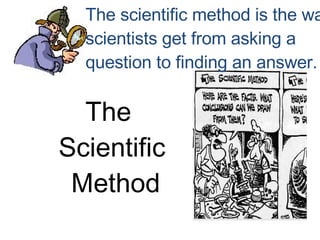
The  Scientific Method The scientific method is the way  scientists get from asking a  question to finding an answer.
Scientific Terminology data:  information that you collect and record when you make observations  or during an experiment scientific method:  The process scientists use to find answers to questions or to find solutions to problems. The method uses organized steps to gather information and to test ideas. five senses:  hear, see, smell, feel, and taste model:  a representation of an actual object made to help you see things that  cannot be observed easily experiment:  the plan or test you design to find answers or to solve a problem hypothesis:  a sensible guess or prediction of what you expect the answer to your question may be
 
Identify a problem & Research the problem Step 1 State Problem or Question:  What do you want to learn? What do you want to know in the world? What do you observe? Research:   Find out as much as you can. Research enough information about your problem or question.
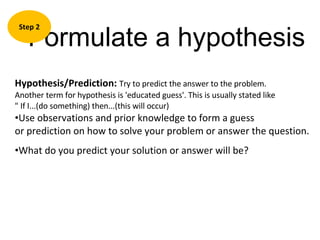
Formulate a hypothesis Step 2 Hypothesis/Prediction:  Try to predict the answer to the problem.  Another term for hypothesis is 'educated guess'. This is usually stated like  " If I...(do something) then...(this will occur) Use observations and prior knowledge to form a guess  or prediction on how to solve your problem or answer the question. What do you predict your solution or answer will be?
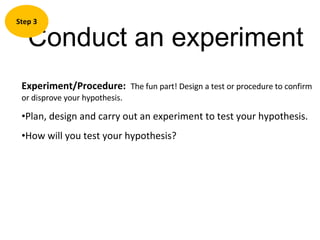
Conduct an experiment Step 3 Experiment/Procedure:  The fun part! Design a test or procedure to confirm  or disprove your hypothesis.  Plan, design and carry out an experiment to test your hypothesis. How will you test your hypothesis?
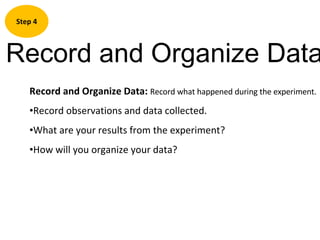
Record and Organize Data Step 4 Record and Organize Data:  Record what happened during the experiment.  Record observations and data collected. What are your results from the experiment? How will you organize your data?
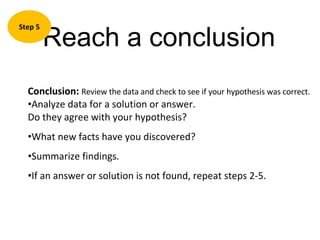
Reach a conclusion Step 5 Conclusion:   Review the data and check to see if your hypothesis was correct.  Analyze data for a solution or answer.  Do they agree with your hypothesis? What new facts have you discovered? Summarize findings. If an answer or solution is not found, repeat steps 2-5.
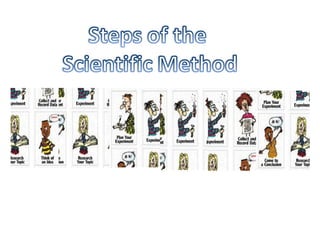
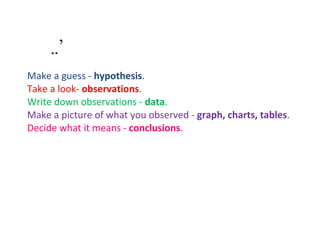
’ Make a guess -  hypothesis .  Take a look-  observations .  Write down observations -  data .  Make a picture of what you observed -  graph, charts, tables .  Decide what it means -  conclusions .

Scientific Methodintro

  • 1.
    The ScientificMethod The scientific method is the way scientists get from asking a question to finding an answer.
  • 2.
    Scientific Terminology data: information that you collect and record when you make observations or during an experiment scientific method: The process scientists use to find answers to questions or to find solutions to problems. The method uses organized steps to gather information and to test ideas. five senses: hear, see, smell, feel, and taste model: a representation of an actual object made to help you see things that cannot be observed easily experiment: the plan or test you design to find answers or to solve a problem hypothesis: a sensible guess or prediction of what you expect the answer to your question may be
  • 3.
  • 4.
    Identify a problem& Research the problem Step 1 State Problem or Question: What do you want to learn? What do you want to know in the world? What do you observe? Research: Find out as much as you can. Research enough information about your problem or question.
  • 5.
    Formulate a hypothesisStep 2 Hypothesis/Prediction: Try to predict the answer to the problem. Another term for hypothesis is 'educated guess'. This is usually stated like " If I...(do something) then...(this will occur) Use observations and prior knowledge to form a guess or prediction on how to solve your problem or answer the question. What do you predict your solution or answer will be?
  • 6.
    Conduct an experimentStep 3 Experiment/Procedure: The fun part! Design a test or procedure to confirm or disprove your hypothesis. Plan, design and carry out an experiment to test your hypothesis. How will you test your hypothesis?
  • 7.
    Record and OrganizeData Step 4 Record and Organize Data: Record what happened during the experiment. Record observations and data collected. What are your results from the experiment? How will you organize your data?
  • 8.
    Reach a conclusionStep 5 Conclusion: Review the data and check to see if your hypothesis was correct. Analyze data for a solution or answer. Do they agree with your hypothesis? What new facts have you discovered? Summarize findings. If an answer or solution is not found, repeat steps 2-5.
  • 9.
    ’ Make aguess - hypothesis . Take a look- observations . Write down observations - data . Make a picture of what you observed - graph, charts, tables . Decide what it means - conclusions .