SCIENTIFIC METHOD
IT IS THE SYSTEMATIC AND
ORGANIZED WAY OF
SOLVING PROBLEMS.
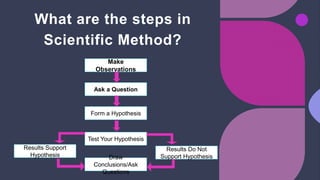
What are the steps in
Scientific Method?
Make
Observations
Ask a Question
Results Support
Hypothesis
Results Do Not
Support Hypothesis
Draw
Conclusions/Ask
Questions
Test Your Hypothesis
Form a Hypothesis
Make Observation
• Mario observed that the color of the
water in the stream in their place
changes to dark brown during heavy
rains. He wanted to find out what
causes this. He visited the place, and
he noticed that few plants are present
in the area.
Ask a Question or
Identifying the Problem
• A problem is a scientific question
that can be answered by
gathering evidence. In this
situation, Mario identifies the
problem:
• Problem: What causes the water
in the stream to change color
Forming a Hypothesis
1. Ask lots of “WHY” questions.
2. Look for connections between
important variables.
3. Suggest possible explanations
for these connections.
Note: Make sue the explanations
can be tested.
Hypothesis
- Is a tentative
explanation to
the problem.
- It is a
prediction
about the
outcome of the
experiment.
Example:
• Mario formulated the following
hypotheses:
• Mario’s hypotheses:
1. The loose soil causes the water to
become muddy during heavy rains.
.
2. If plenty plants are present in the area,
then the water in the stream will not change
its color.
Testing a Hypothesis
1. Think of the different kinds of data that
could be used to test the hypothesis.
2. Choose the best method to collect this
data:
• Perform an experiment (in the lab)
• Observe the natural world (in the field)
• Make a model (on a computer)
3. Plan a procedure and gather data.
Note: Make sure that the procedure can be
repeated.
Is done by
experimentation,
which is a
systematic
procedure to
answer the
problem.
Example
:
• Mario designs an experiment with variables to
test his hypotheses. He decided that he could
do an experiment using two pans with soil in
them: one with growing grasses and the other
without. The pans will be tilted, and water will
be sprinkled over them.
• He listed the materials he would need and wrote
down the procedure to test the hypotheses.
• Materials: two pans half-filled with soil,
one pan with grasses on the surface, two
blocks of wood of the same size, two
water sprinklers with 500 ml of water,
beaker or graduated cylinder
• Procedure:
1.
2.
3.
4.
5.
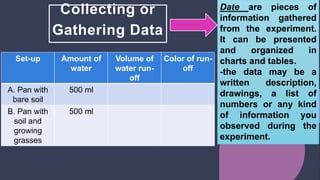
Collecting or
Gathering Data
Date are pieces of
information gathered
from the experiment.
It can be presented
and organized in
charts and tables.
-the data may be a
written description,
drawings, a list of
numbers or any kind
of information you
observed during the
experiment.
Set-up Amount of
water
Volume of
water run-
off
Color of run-
off
A. Pan with
bare soil
500 ml
B. Pan with
soil and
growing
grasses
500 ml
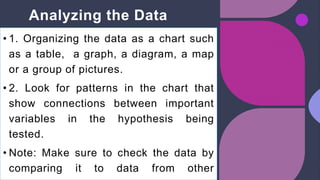
Analyzing the Data
• 1. Organizing the data as a chart such
as a table, a graph, a diagram, a map
or a group of pictures.
• 2. Look for patterns in the chart that
show connections between important
variables in the hypothesis being
tested.
• Note: Make sure to check the data by
comparing it to data from other
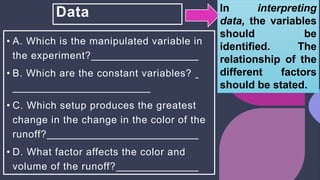
Data
• A. Which is the manipulated variable in
the experiment?
• B. Which are the constant variables?
• C. Which setup produces the greatest
change in the change in the color of the
runoff?
• D. What factor affects the color and
volume of the runoff?
In interpreting
data, the variables
should be
identified. The
relationship of the
different factors
should be stated.
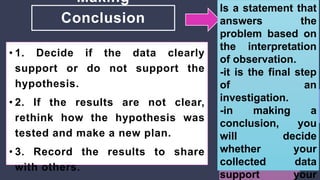
Making
Conclusion
• 1. Decide if the data clearly
support or do not support the
hypothesis.
• 2. If the results are not clear,
rethink how the hypothesis was
tested and make a new plan.
• 3. Record the results to share
with others.
Is a statement that
answers the
problem based on
the interpretation
of observation.
-it is the final step
of an
investigation.
-in making a
conclusion, you
will decide
whether your
collected data
support your
Example:
• Therefore, soil without plants in
elevated places causes the runoff to
become muddy during heavy rain.
Skills
•Scientists use many skills as they
work through the scientific
method. Skills help them gather
information and answer questions
they have about the world around
us. Here are some skills they use:
Observation
• Use your senses to learn about
an object or an event.
Form a Hypothesis
• Use your senses to learn about
an object or an event.
Communicate
• Share information with others.
Classify
• Place things with similar
properties into groups
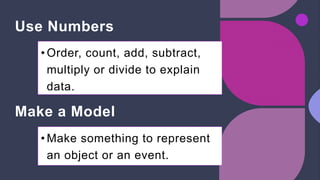
Use Numbers
• Order, count, add, subtract,
multiply or divide to explain
data.
Make a Model
• Make something to represent
an object or an event.
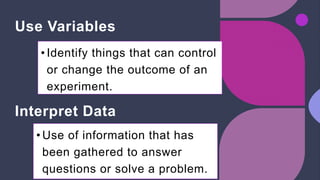
Use Variables
• Identify things that can control
or change the outcome of an
experiment.
Interpret Data
• Use of information that has
been gathered to answer
questions or solve a problem.
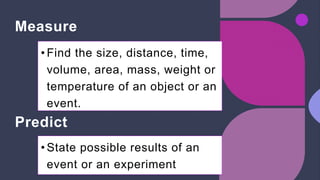
Measure
• Find the size, distance, time,
volume, area, mass, weight or
temperature of an object or an
event.
Predict
• State possible results of an
event or an experiment
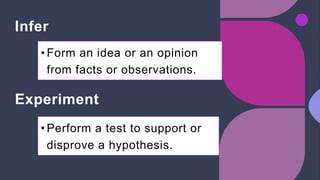
Infer
• Form an idea or an opinion
from facts or observations.
Experiment
• Perform a test to support or
disprove a hypothesis.

SCIENTIFIC METHODS.pptx

  • 1.
    SCIENTIFIC METHOD IT ISTHE SYSTEMATIC AND ORGANIZED WAY OF SOLVING PROBLEMS.
  • 2.
    What are thesteps in Scientific Method? Make Observations Ask a Question Results Support Hypothesis Results Do Not Support Hypothesis Draw Conclusions/Ask Questions Test Your Hypothesis Form a Hypothesis
  • 3.
    Make Observation • Marioobserved that the color of the water in the stream in their place changes to dark brown during heavy rains. He wanted to find out what causes this. He visited the place, and he noticed that few plants are present in the area.
  • 4.
    Ask a Questionor Identifying the Problem • A problem is a scientific question that can be answered by gathering evidence. In this situation, Mario identifies the problem: • Problem: What causes the water in the stream to change color
  • 5.
    Forming a Hypothesis 1.Ask lots of “WHY” questions. 2. Look for connections between important variables. 3. Suggest possible explanations for these connections. Note: Make sue the explanations can be tested. Hypothesis - Is a tentative explanation to the problem. - It is a prediction about the outcome of the experiment.
  • 6.
    Example: • Mario formulatedthe following hypotheses: • Mario’s hypotheses: 1. The loose soil causes the water to become muddy during heavy rains. . 2. If plenty plants are present in the area, then the water in the stream will not change its color.
  • 7.
    Testing a Hypothesis 1.Think of the different kinds of data that could be used to test the hypothesis. 2. Choose the best method to collect this data: • Perform an experiment (in the lab) • Observe the natural world (in the field) • Make a model (on a computer) 3. Plan a procedure and gather data. Note: Make sure that the procedure can be repeated. Is done by experimentation, which is a systematic procedure to answer the problem.
  • 8.
    Example : • Mario designsan experiment with variables to test his hypotheses. He decided that he could do an experiment using two pans with soil in them: one with growing grasses and the other without. The pans will be tilted, and water will be sprinkled over them. • He listed the materials he would need and wrote down the procedure to test the hypotheses.
  • 9.
    • Materials: twopans half-filled with soil, one pan with grasses on the surface, two blocks of wood of the same size, two water sprinklers with 500 ml of water, beaker or graduated cylinder • Procedure: 1. 2. 3. 4. 5.
  • 10.
    Collecting or Gathering Data Dateare pieces of information gathered from the experiment. It can be presented and organized in charts and tables. -the data may be a written description, drawings, a list of numbers or any kind of information you observed during the experiment. Set-up Amount of water Volume of water run- off Color of run- off A. Pan with bare soil 500 ml B. Pan with soil and growing grasses 500 ml
  • 11.
    Analyzing the Data •1. Organizing the data as a chart such as a table, a graph, a diagram, a map or a group of pictures. • 2. Look for patterns in the chart that show connections between important variables in the hypothesis being tested. • Note: Make sure to check the data by comparing it to data from other
  • 12.
    Data • A. Whichis the manipulated variable in the experiment? • B. Which are the constant variables? • C. Which setup produces the greatest change in the change in the color of the runoff? • D. What factor affects the color and volume of the runoff? In interpreting data, the variables should be identified. The relationship of the different factors should be stated.
  • 13.
    Making Conclusion • 1. Decideif the data clearly support or do not support the hypothesis. • 2. If the results are not clear, rethink how the hypothesis was tested and make a new plan. • 3. Record the results to share with others. Is a statement that answers the problem based on the interpretation of observation. -it is the final step of an investigation. -in making a conclusion, you will decide whether your collected data support your
  • 14.
    Example: • Therefore, soilwithout plants in elevated places causes the runoff to become muddy during heavy rain.
  • 15.
    Skills •Scientists use manyskills as they work through the scientific method. Skills help them gather information and answer questions they have about the world around us. Here are some skills they use:
  • 16.
    Observation • Use yoursenses to learn about an object or an event. Form a Hypothesis • Use your senses to learn about an object or an event.
  • 17.
    Communicate • Share informationwith others. Classify • Place things with similar properties into groups
  • 18.
    Use Numbers • Order,count, add, subtract, multiply or divide to explain data. Make a Model • Make something to represent an object or an event.
  • 19.
    Use Variables • Identifythings that can control or change the outcome of an experiment. Interpret Data • Use of information that has been gathered to answer questions or solve a problem.
  • 20.
    Measure • Find thesize, distance, time, volume, area, mass, weight or temperature of an object or an event. Predict • State possible results of an event or an experiment
  • 21.
    Infer • Form anidea or an opinion from facts or observations. Experiment • Perform a test to support or disprove a hypothesis.