STRENGTH OF MATERIALS LAB
Topic- Principal Planes and Principal Stresses,
Mohr's Circle Method
Name: Amit Dayeshwar Tuljapurkar
PRN: 21110025
Batch: C2
Mohr’s circle for plane stress
• The transformation equations for plane stress can be represented in
graphical form by a plot known as Mohr’s circle
• This graphical representation is extremely useful because it enables
you to visualize the relationships between the normal and shear stresses
acting on various inclined planes at a point in a stressed body
• Using Mohr’s circle you can also calculate principal stresses,
maximum shear stresses and stresses on inclined planes
• Mohr’s circle is also valid for strains and moments of inertia
•Mohr’s circle is named after the famous German civil engineer Otto
Christian Mohr (1835-1918), who developed the circle in 1882
Equations of Mohr’s circle
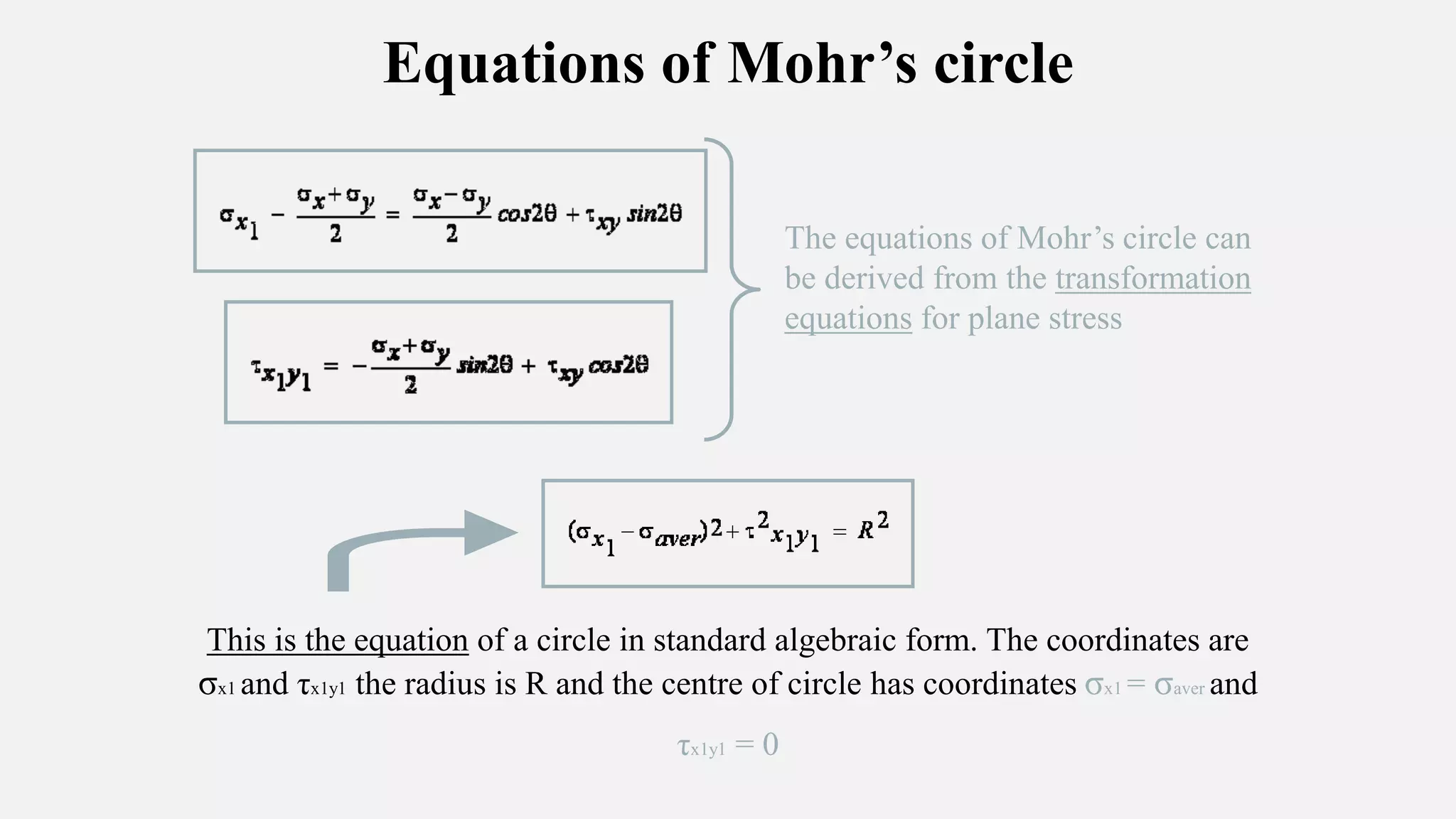
The equations of Mohr’s circle can
be derived from the transformation
equations for plane stress
This is the equation of a circle in standard algebraic form. The coordinates are
σx1 and τx1y1 the radius is R and the centre of circle has coordinates σx1 = σaver and
τx1y1 = 0
Copyright 2005 by Nelson, a division of Thomson Canada Limited
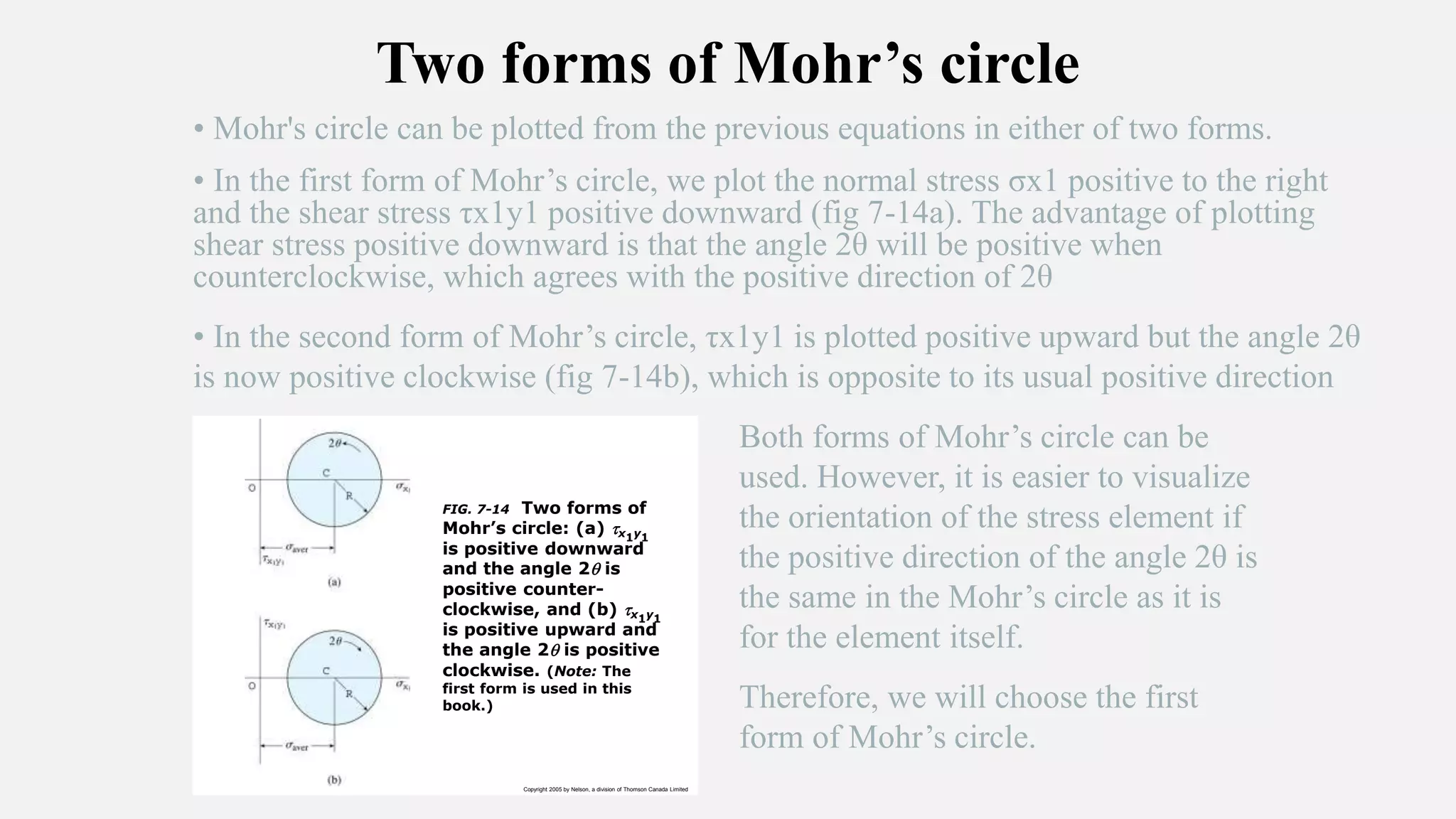
FIG. 7-14 Two forms of
Mohr’s circle: (a) tx1y1
is positive downward
and the angle 2q is
positive counter-
clockwise, and (b) tx1y1
is positive upward and
the angle 2q is positive
clockwise. (Note: The
first form is used in this
book.)
Two forms of Mohr’s circle
• Mohr's circle can be plotted from the previous equations in either of two forms.
• In the first form of Mohr’s circle, we plot the normal stress σx1 positive to the right
and the shear stress τx1y1 positive downward (fig 7-14a). The advantage of plotting
shear stress positive downward is that the angle 2θ will be positive when
counterclockwise, which agrees with the positive direction of 2θ
• In the second form of Mohr’s circle, τx1y1 is plotted positive upward but the angle 2θ
is now positive clockwise (fig 7-14b), which is opposite to its usual positive direction
Both forms of Mohr’s circle can be
used. However, it is easier to visualize
the orientation of the stress element if
the positive direction of the angle 2θ is
the same in the Mohr’s circle as it is
for the element itself.
Therefore, we will choose the first
form of Mohr’s circle.
Construction of Mohr’s Circle
• Mohr’s circle can be constructed in a variety
of ways, depending upon which stresses are
known and which are to be found
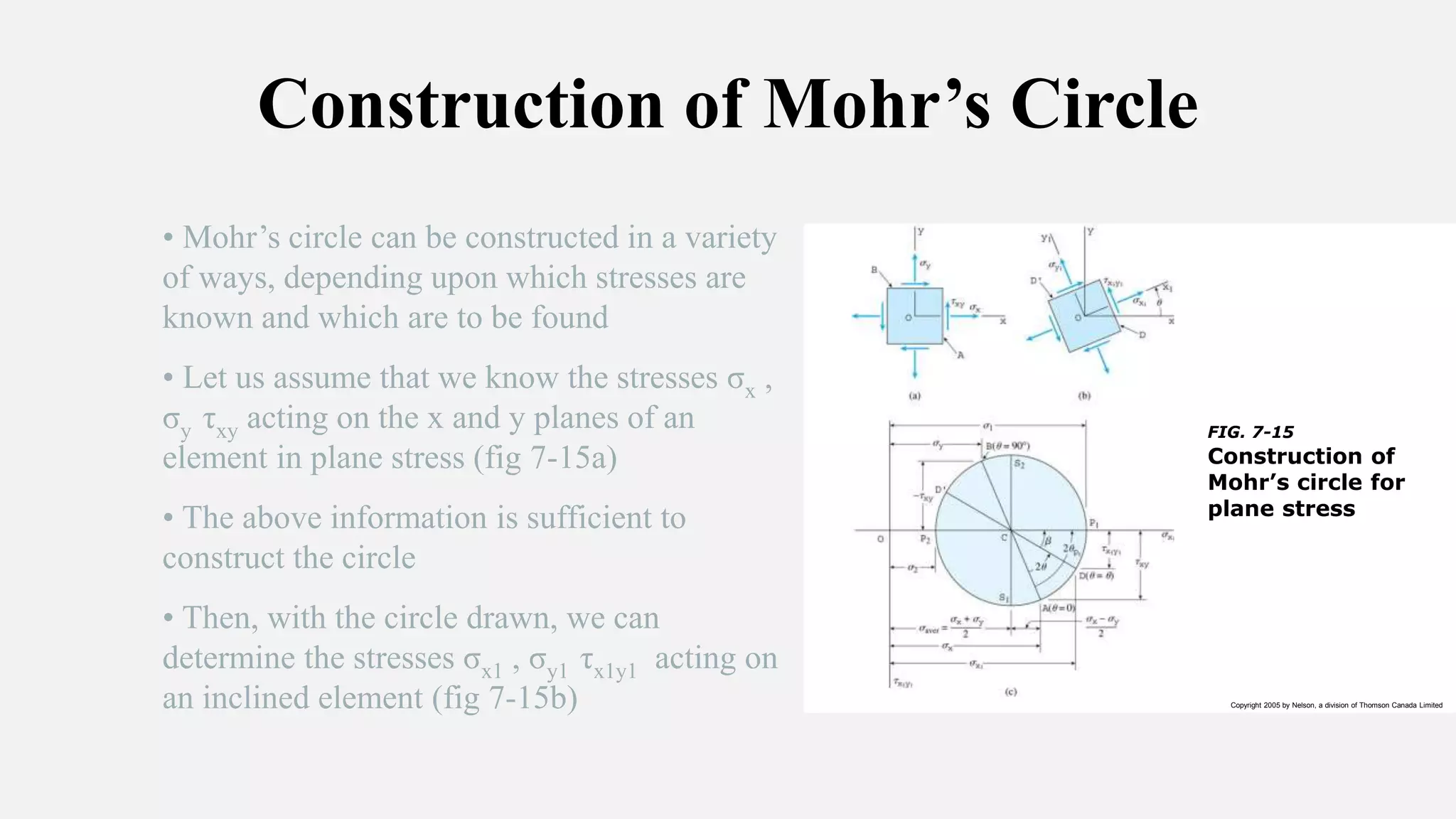
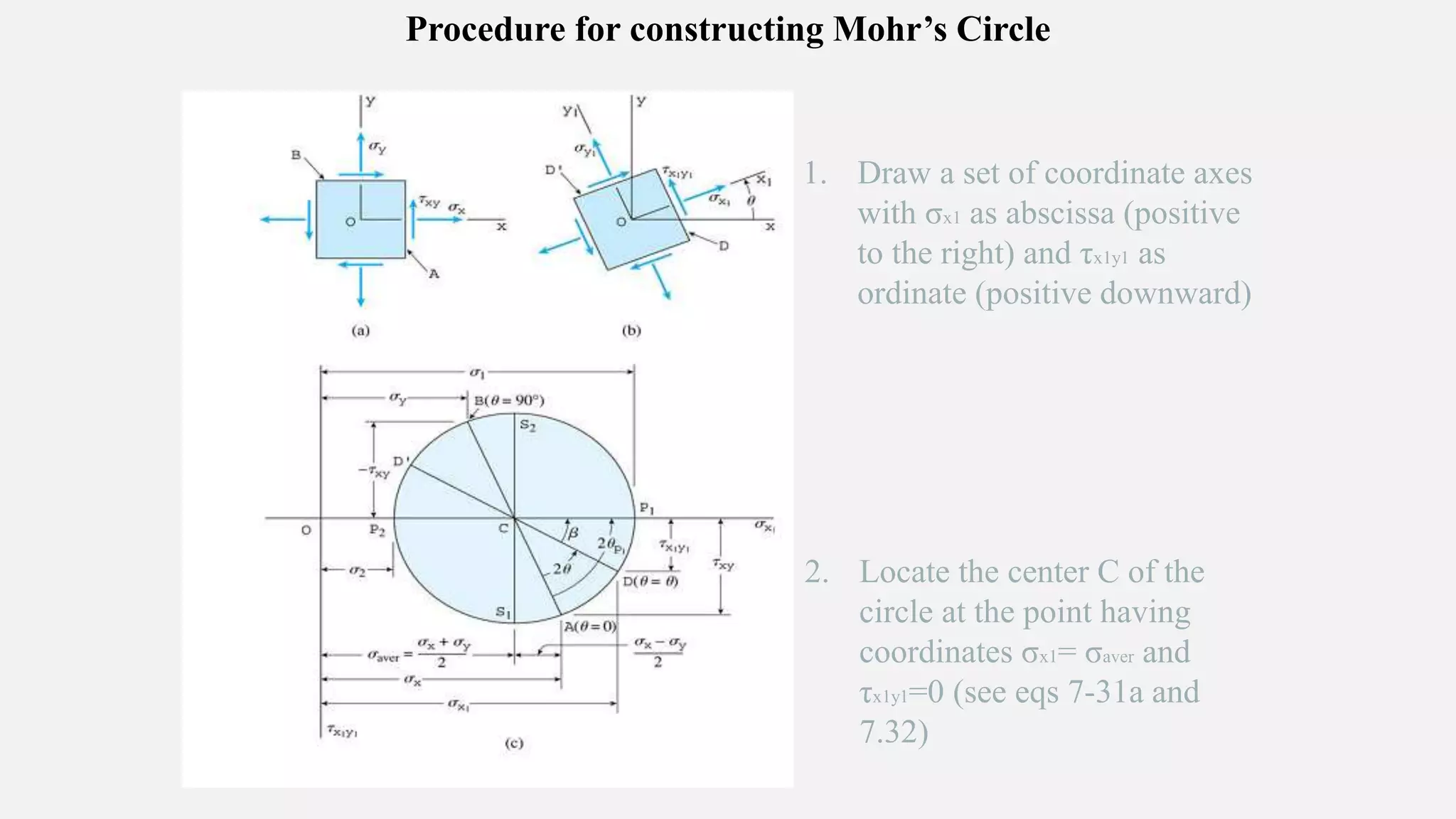
• Let us assume that we know the stresses σx ,
σy τxy acting on the x and y planes of an
element in plane stress (fig 7-15a)
• The above information is sufficient to
construct the circle
• Then, with the circle drawn, we can
determine the stresses σx1 , σy1 τx1y1 acting on
an inclined element (fig 7-15b) Copyright 2005 by Nelson, a division of Thomson Canada Limited
FIG. 7-15
Construction of
Mohr’s circle for
plane stress
Procedure for constructing Mohr’s Circle
1. Draw a set of coordinate axes
with σx1 as abscissa (positive
to the right) and τx1y1 as
ordinate (positive downward)
2. Locate the center C of the
circle at the point having
coordinates σx1= σaver and
τx1y1=0 (see eqs 7-31a and
7.32)
Procedure for constructing Mohr’s Circle
3. Locate point A, representing
the stress conditions on the x
face of the element shown in
fig 7-15a, by plotting its
coordinates σx1=σx and
τx1y1=τxy. Note that point A on
the circle corresponds to θ=0.
Also, note that the x face of
the element (fig 7-15a) is
labeled ‘A’ to show its
correspondence with point A
on the circle
Procedure for constructing Mohr’s Circle
4. Locate point B, representing
the stress conditions on the y
face of the element shown in
fig 7-15a, by plotting its
coordinates σx1=σy and
τx1y1=-τxy. Note that point B on
the circle corresponds to
θ =90. In addition, the y face
of the element (fig 7-15a) is
labeled ‘B’ to show its
correspondence with point B
on the circle
Procedure for constructing Mohr’s Circle
5. Draw a line from point A to
point B. This line is a
diameter of the circle and
passes through the center C.
Points A and B, representing
the stresses on planes at 90 to
each other (fig 7-15a), are at
opposite ends of the diameter
and therefore are 180 apart on
the circle
Procedure for constructing Mohr’s Circle
6. Using point C as the center,
draw Mohr’s circle through
points A and B. The circle
drawn in this manner has
radius R (eq. 7-31b).
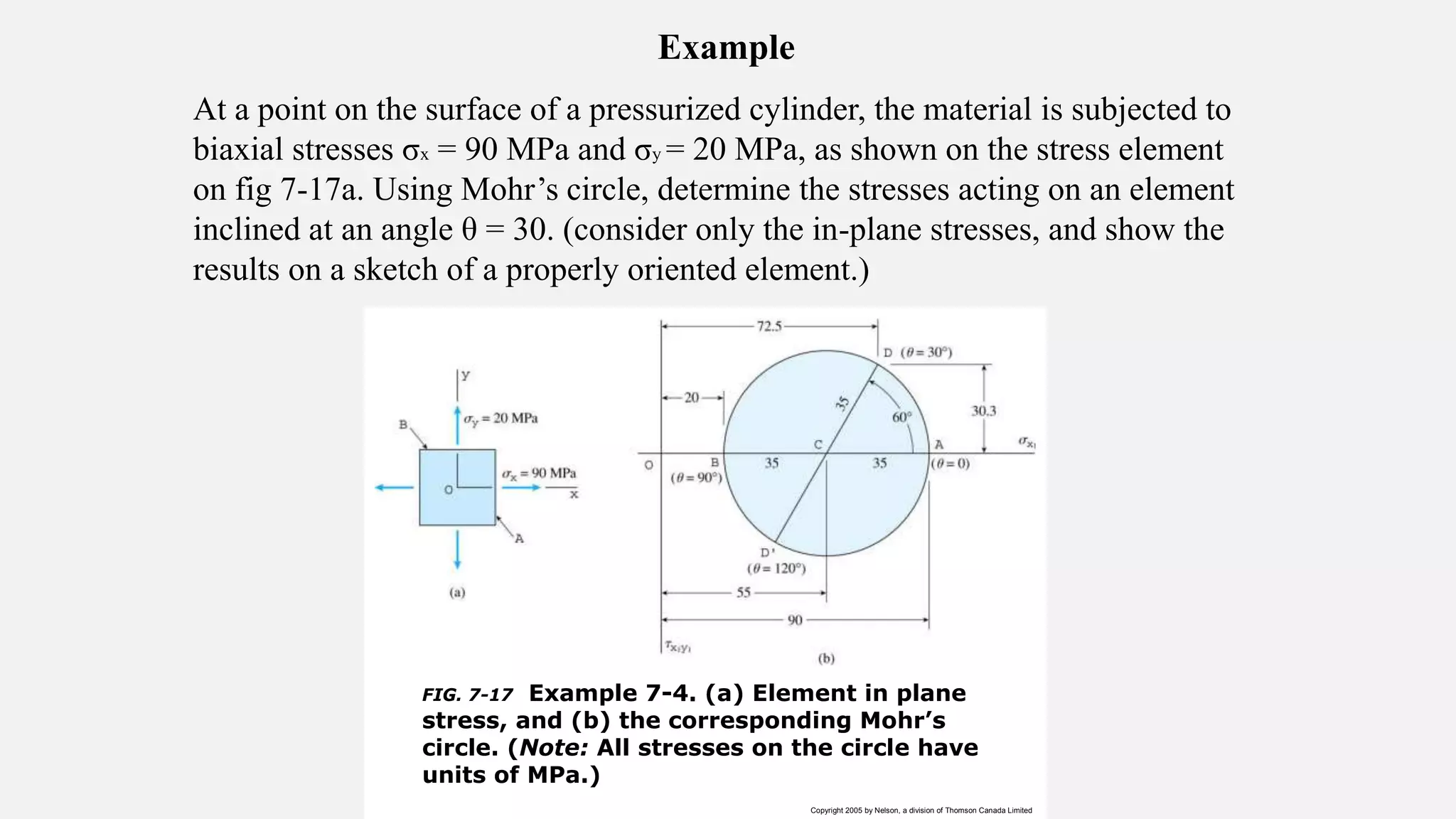
Example
At a point on the surface of a pressurized cylinder, the material is subjected to
biaxial stresses σx = 90 MPa and σy = 20 MPa, as shown on the stress element
on fig 7-17a. Using Mohr’s circle, determine the stresses acting on an element
inclined at an angle θ = 30. (consider only the in-plane stresses, and show the
results on a sketch of a properly oriented element.)
Copyright 2005 by Nelson, a division of Thomson Canada Limited
FIG. 7-17 Example 7-4. (a) Element in plane
stress, and (b) the corresponding Mohr’s
circle. (Note: All stresses on the circle have
units of MPa.)
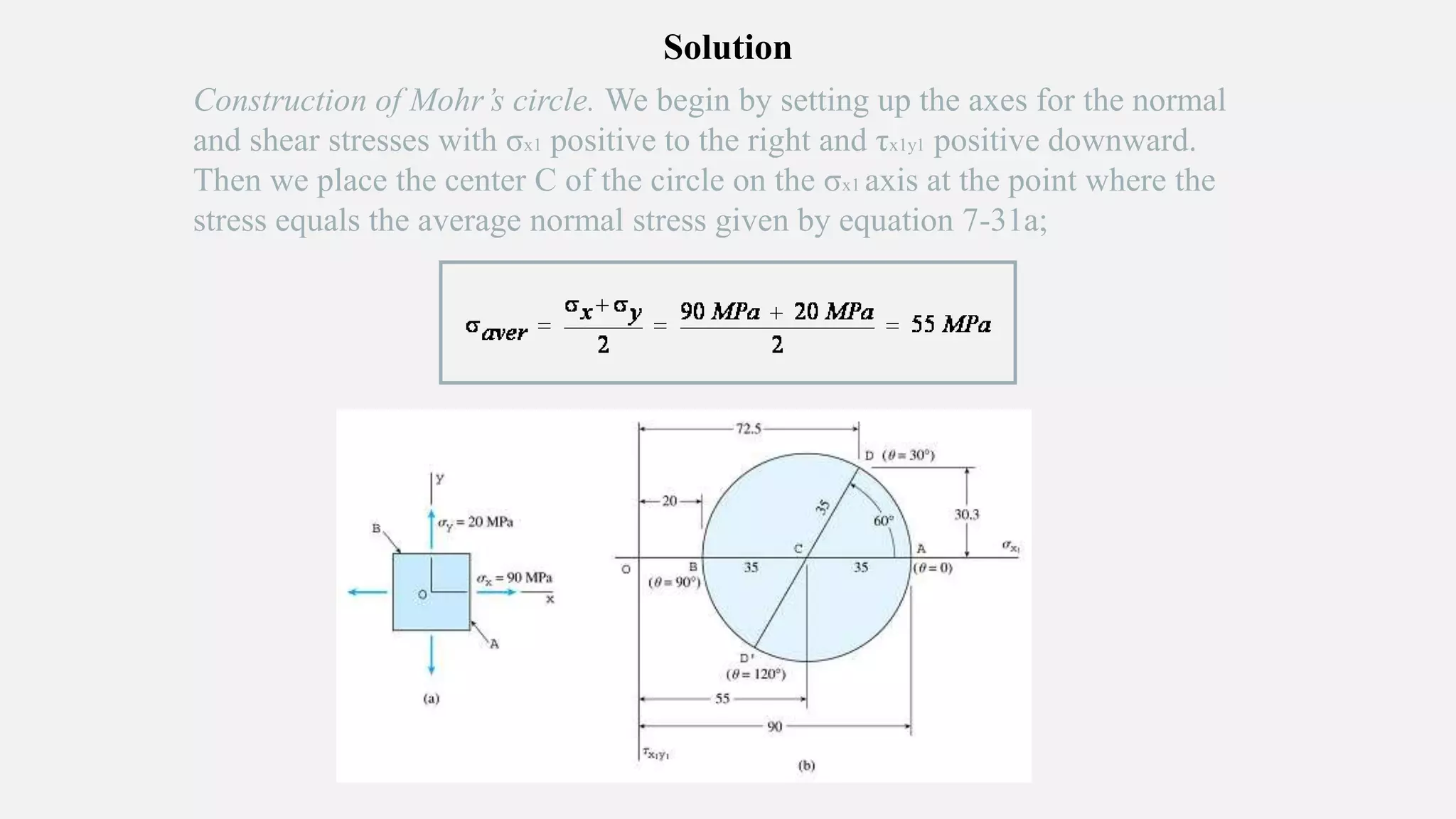
Solution
Construction of Mohr’s circle. We begin by setting up the axes for the normal
and shear stresses with σx1 positive to the right and τx1y1 positive downward.
Then we place the center C of the circle on the σx1 axis at the point where the
stress equals the average normal stress given by equation 7-31a;
Solution
Point A, representing the stresses on the x face of the element (θ=0), has
coordinates; σx1 = 90 MPa and τx1y1 = 0
Similarly, the coordinates of point B, representing the stresses on the y face
(θ=90), are; σx1 = 20 MPa and τx1y1 = 0
Solution
Now we can draw the circle through points A and B with center at C and radius
R (using eq. 7-31b) equal to;
Solution
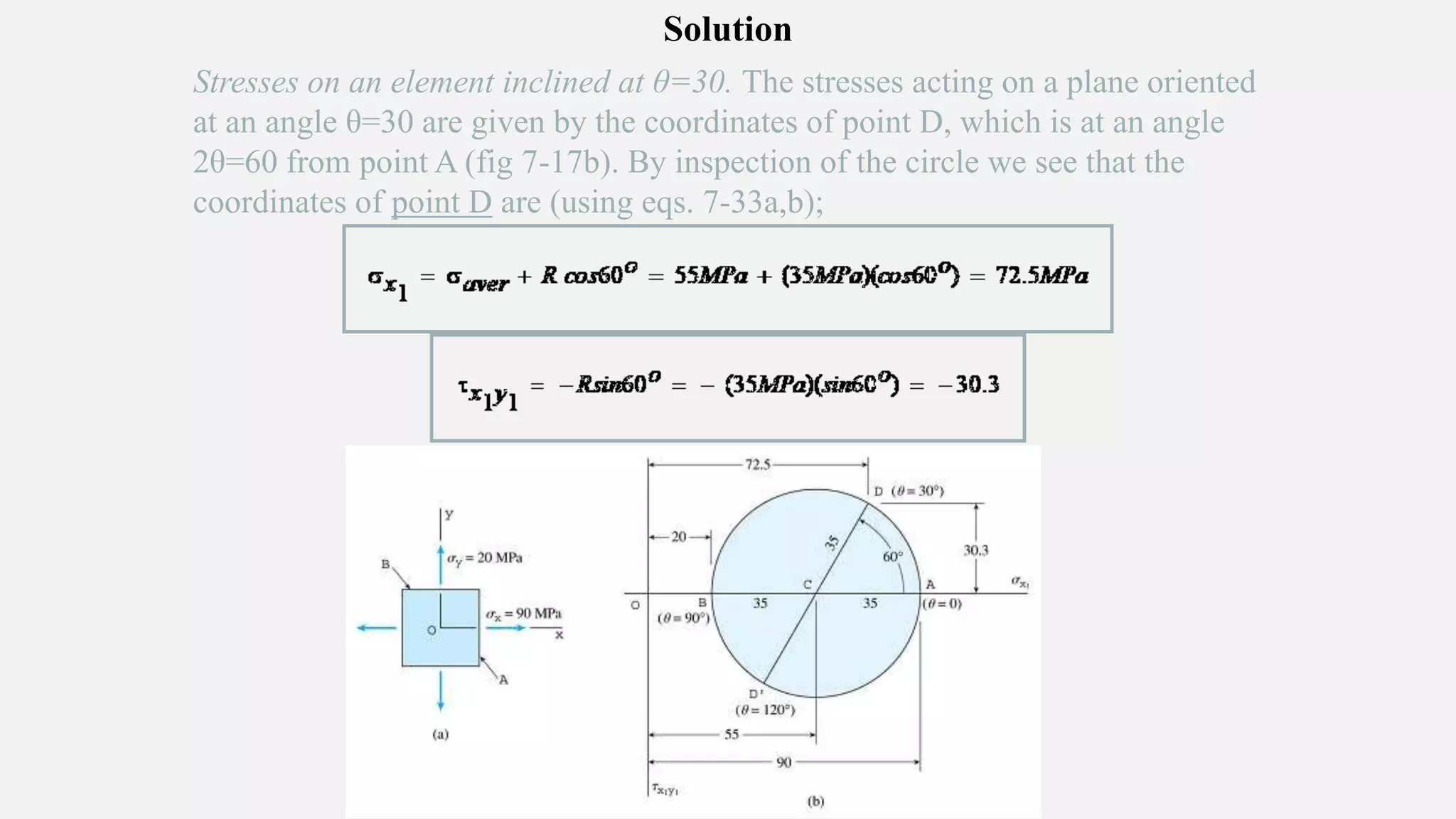
Stresses on an element inclined at θ=30. The stresses acting on a plane oriented
at an angle θ=30 are given by the coordinates of point D, which is at an angle
2θ=60 from point A (fig 7-17b). By inspection of the circle we see that the
coordinates of point D are (using eqs. 7-33a,b);
Solution
In a similar manner, we can find the stresses represented by point D’, which
corresponds to an angle θ = 120 (or 2θ = 240);
Point D’ (using eqs. 7-33a,b);
Solution
Copyright 2005 by Nelson, a division of Thomson Canada Limited
FIG. 7-18 Example 7-4 (continued). Stresses
acting on an element oriented at an angle
q = 30°
These results are shown in the figure below on a sketch of an element oriented
at an angle θ = 30, with all stresses shown in their true directions. Note that the
sum of the normal stresses on the inclined element is equal to σx + σy = (90+20)
MPa = 110 MPa

Principal Planes and Principal Stresses, Mohr's Circle Method

  • 1.
    STRENGTH OF MATERIALSLAB Topic- Principal Planes and Principal Stresses, Mohr's Circle Method Name: Amit Dayeshwar Tuljapurkar PRN: 21110025 Batch: C2
  • 2.
    Mohr’s circle forplane stress • The transformation equations for plane stress can be represented in graphical form by a plot known as Mohr’s circle • This graphical representation is extremely useful because it enables you to visualize the relationships between the normal and shear stresses acting on various inclined planes at a point in a stressed body • Using Mohr’s circle you can also calculate principal stresses, maximum shear stresses and stresses on inclined planes • Mohr’s circle is also valid for strains and moments of inertia •Mohr’s circle is named after the famous German civil engineer Otto Christian Mohr (1835-1918), who developed the circle in 1882
  • 3.
    Equations of Mohr’scircle The equations of Mohr’s circle can be derived from the transformation equations for plane stress This is the equation of a circle in standard algebraic form. The coordinates are σx1 and τx1y1 the radius is R and the centre of circle has coordinates σx1 = σaver and τx1y1 = 0
  • 4.
    Copyright 2005 byNelson, a division of Thomson Canada Limited FIG. 7-14 Two forms of Mohr’s circle: (a) tx1y1 is positive downward and the angle 2q is positive counter- clockwise, and (b) tx1y1 is positive upward and the angle 2q is positive clockwise. (Note: The first form is used in this book.) Two forms of Mohr’s circle • Mohr's circle can be plotted from the previous equations in either of two forms. • In the first form of Mohr’s circle, we plot the normal stress σx1 positive to the right and the shear stress τx1y1 positive downward (fig 7-14a). The advantage of plotting shear stress positive downward is that the angle 2θ will be positive when counterclockwise, which agrees with the positive direction of 2θ • In the second form of Mohr’s circle, τx1y1 is plotted positive upward but the angle 2θ is now positive clockwise (fig 7-14b), which is opposite to its usual positive direction Both forms of Mohr’s circle can be used. However, it is easier to visualize the orientation of the stress element if the positive direction of the angle 2θ is the same in the Mohr’s circle as it is for the element itself. Therefore, we will choose the first form of Mohr’s circle.
  • 5.
    Construction of Mohr’sCircle • Mohr’s circle can be constructed in a variety of ways, depending upon which stresses are known and which are to be found • Let us assume that we know the stresses σx , σy τxy acting on the x and y planes of an element in plane stress (fig 7-15a) • The above information is sufficient to construct the circle • Then, with the circle drawn, we can determine the stresses σx1 , σy1 τx1y1 acting on an inclined element (fig 7-15b) Copyright 2005 by Nelson, a division of Thomson Canada Limited FIG. 7-15 Construction of Mohr’s circle for plane stress
  • 6.
    Procedure for constructingMohr’s Circle 1. Draw a set of coordinate axes with σx1 as abscissa (positive to the right) and τx1y1 as ordinate (positive downward) 2. Locate the center C of the circle at the point having coordinates σx1= σaver and τx1y1=0 (see eqs 7-31a and 7.32)
  • 7.
    Procedure for constructingMohr’s Circle 3. Locate point A, representing the stress conditions on the x face of the element shown in fig 7-15a, by plotting its coordinates σx1=σx and τx1y1=τxy. Note that point A on the circle corresponds to θ=0. Also, note that the x face of the element (fig 7-15a) is labeled ‘A’ to show its correspondence with point A on the circle
  • 8.
    Procedure for constructingMohr’s Circle 4. Locate point B, representing the stress conditions on the y face of the element shown in fig 7-15a, by plotting its coordinates σx1=σy and τx1y1=-τxy. Note that point B on the circle corresponds to θ =90. In addition, the y face of the element (fig 7-15a) is labeled ‘B’ to show its correspondence with point B on the circle
  • 9.
    Procedure for constructingMohr’s Circle 5. Draw a line from point A to point B. This line is a diameter of the circle and passes through the center C. Points A and B, representing the stresses on planes at 90 to each other (fig 7-15a), are at opposite ends of the diameter and therefore are 180 apart on the circle
  • 10.
    Procedure for constructingMohr’s Circle 6. Using point C as the center, draw Mohr’s circle through points A and B. The circle drawn in this manner has radius R (eq. 7-31b).
  • 11.
    Example At a pointon the surface of a pressurized cylinder, the material is subjected to biaxial stresses σx = 90 MPa and σy = 20 MPa, as shown on the stress element on fig 7-17a. Using Mohr’s circle, determine the stresses acting on an element inclined at an angle θ = 30. (consider only the in-plane stresses, and show the results on a sketch of a properly oriented element.) Copyright 2005 by Nelson, a division of Thomson Canada Limited FIG. 7-17 Example 7-4. (a) Element in plane stress, and (b) the corresponding Mohr’s circle. (Note: All stresses on the circle have units of MPa.)
  • 12.
    Solution Construction of Mohr’scircle. We begin by setting up the axes for the normal and shear stresses with σx1 positive to the right and τx1y1 positive downward. Then we place the center C of the circle on the σx1 axis at the point where the stress equals the average normal stress given by equation 7-31a;
  • 13.
    Solution Point A, representingthe stresses on the x face of the element (θ=0), has coordinates; σx1 = 90 MPa and τx1y1 = 0 Similarly, the coordinates of point B, representing the stresses on the y face (θ=90), are; σx1 = 20 MPa and τx1y1 = 0
  • 14.
    Solution Now we candraw the circle through points A and B with center at C and radius R (using eq. 7-31b) equal to;
  • 15.
    Solution Stresses on anelement inclined at θ=30. The stresses acting on a plane oriented at an angle θ=30 are given by the coordinates of point D, which is at an angle 2θ=60 from point A (fig 7-17b). By inspection of the circle we see that the coordinates of point D are (using eqs. 7-33a,b);
  • 16.
    Solution In a similarmanner, we can find the stresses represented by point D’, which corresponds to an angle θ = 120 (or 2θ = 240); Point D’ (using eqs. 7-33a,b);
  • 17.
    Solution Copyright 2005 byNelson, a division of Thomson Canada Limited FIG. 7-18 Example 7-4 (continued). Stresses acting on an element oriented at an angle q = 30° These results are shown in the figure below on a sketch of an element oriented at an angle θ = 30, with all stresses shown in their true directions. Note that the sum of the normal stresses on the inclined element is equal to σx + σy = (90+20) MPa = 110 MPa