TOPIC: MMT FOR KNEE
PRESENTED TO: DR. ASIF WATTOO
PRESENTED BY: AMBREEN SADAF
BSOT02153303
The University Of Lahore
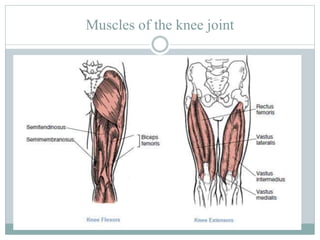
Muscles of the knee joint
Contents:
 Knee Flexion
 Knee Extension
Learning Objectives
 Range of motion
 Muscles
 Origin
 Insertion
 Nerve supply
 Action
 Procedure for MMT
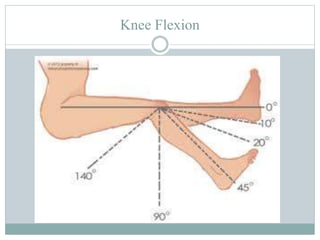
Knee Flexion
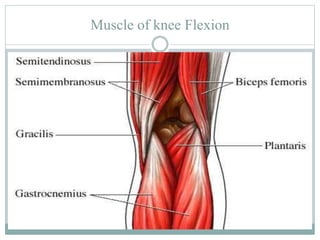
Muscle of knee Flexion
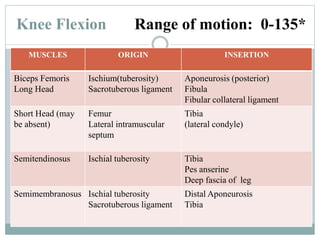
Knee Flexion Range of motion: 0-135*
MUSCLES ORIGIN INSERTION
Biceps Femoris
Long Head
Ischium(tuberosity)
Sacrotuberous ligament
Aponeurosis (posterior)
Fibula
Fibular collateral ligament
Short Head (may
be absent)
Femur
Lateral intramuscular
septum
Tibia
(lateral condyle)
Semitendinosus Ischial tuberosity Tibia
Pes anserine
Deep fascia of leg
Semimembranosus Ischial tuberosity
Sacrotuberous ligament
Distal Aponeurosis
Tibia
Cont..
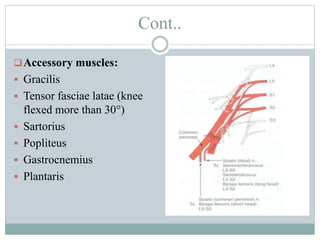
Accessory muscles:
 Gracilis
 Tensor fasciae latae (knee
flexed more than 30°)
 Sartorius
 Popliteus
 Gastrocnemius
 Plantaris
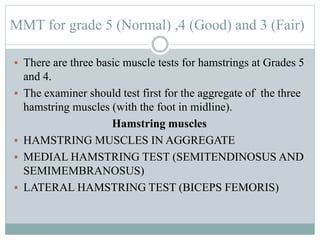
MMT for grade 5 (Normal) ,4 (Good) and 3 (Fair)
 There are three basic muscle tests for hamstrings at Grades 5
and 4.
 The examiner should test first for the aggregate of the three
hamstring muscles (with the foot in midline).
Hamstring muscles
 HAMSTRING MUSCLES IN AGGREGATE
 MEDIAL HAMSTRING TEST (SEMITENDINOSUS AND
SEMIMEMBRANOSUS)
 LATERAL HAMSTRING TEST (BICEPS FEMORIS)
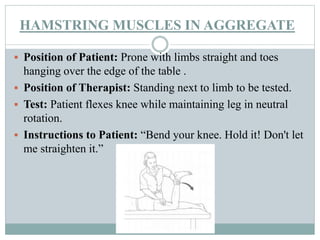
HAMSTRING MUSCLES IN AGGREGATE
 Position of Patient: Prone with limbs straight and toes
hanging over the edge of the table .
 Position of Therapist: Standing next to limb to be tested.
 Test: Patient flexes knee while maintaining leg in neutral
rotation.
 Instructions to Patient: “Bend your knee. Hold it! Don't let
me straighten it.”
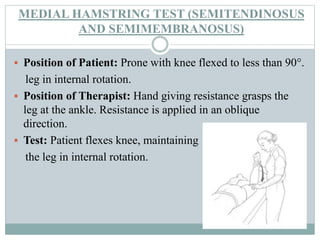
MEDIAL HAMSTRING TEST (SEMITENDINOSUS
AND SEMIMEMBRANOSUS)
 Position of Patient: Prone with knee flexed to less than 90°.
leg in internal rotation.
 Position of Therapist: Hand giving resistance grasps the
leg at the ankle. Resistance is applied in an oblique
direction.
 Test: Patient flexes knee, maintaining
the leg in internal rotation.
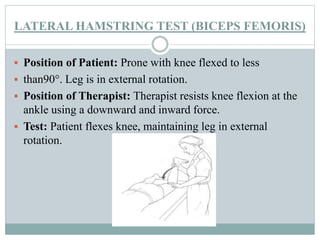
LATERAL HAMSTRING TEST (BICEPS FEMORIS)
 Position of Patient: Prone with knee flexed to less
 than90°. Leg is in external rotation.
 Position of Therapist: Therapist resists knee flexion at the
ankle using a downward and inward force.
 Test: Patient flexes knee, maintaining leg in external
rotation.
Grading the Hamstring Muscles (Grades 5 to 3 )
Grade 5 (Normal) for All Three Tests:
 Resistance will be maximal, and the end knee flexion
position (approximately 90°) cannot be broken.
Grade 4 (Good) for All Three Tests:
 End knee flexion position is held against strong to moderate
resistance.
Grade 3 (Fair) for All Three Tests:
 Holds end range position but tolerates no resistance
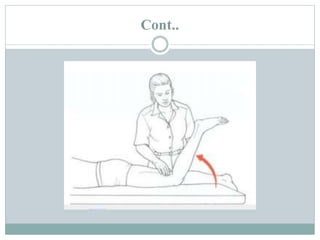
Cont..
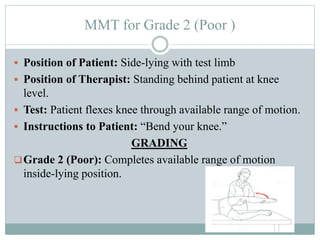
MMT for Grade 2 (Poor )
 Position of Patient: Side-lying with test limb
 Position of Therapist: Standing behind patient at knee
level.
 Test: Patient flexes knee through available range of motion.
 Instructions to Patient: “Bend your knee.”
GRADING
Grade 2 (Poor): Completes available range of motion
inside-lying position.
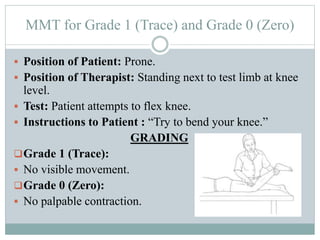
MMT for Grade 1 (Trace) and Grade 0 (Zero)
 Position of Patient: Prone.
 Position of Therapist: Standing next to test limb at knee
level.
 Test: Patient attempts to flex knee.
 Instructions to Patient : “Try to bend your knee.”
GRADING
Grade 1 (Trace):
 No visible movement.
Grade 0 (Zero):
 No palpable contraction.
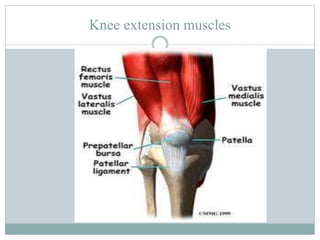
Knee Extension
Knee extension muscles
Knee Extension Range of motion: 135*-0*
MUSCLES ORIGIN INSERTION
Rectus Femoris Ilium (anterior
inferior iliac spine).
Acetabulum
(groove above)
Capsule of hip joint
Aponeurosis
(anterior)
Aponeurosis (posterior)
Patella (base via quadriceps tendon)
Tibial tuberosity via ligamentum
Patellae
Vastus intermedius Femur (shaft, upper
2/3 lateral and
anterior surfaces)
Intermuscular
septum (lateral)
Aponeurosis
Patella
Tibia
Tibial tuberosity via ligamentum patellae
Vastus lateralis Femur
Lateral
Intermuscular
septum
Aponeurosis
Patella
Lateral expansion to capsule of knee joint
and Lliotibial tract.
Knee Extension Range of motion: 135*-0*
MUSCLES ORIGIN INSERTION
Vastus medialis
Longus
Femur linea aspera,
medial lip,
Intertrochanteric
line
Tendon of adductor
Magnus
Aponeurosis (deep)
Patella (medial border)
Tibial tuberosity via ligamentum
patellae
Vastus medialis
Oblique
Femur: Linea
aspera (distal),
supracondylar line.
Intramuscular
septum
Aponeurosis to capsule of knee joint
Patella (medial aspect)
Quadriceps tendon (medial)
Tibial tuberosity via ligamentum
Patellae.
Accessory muscles: Tensor fasciae latae
Cont..
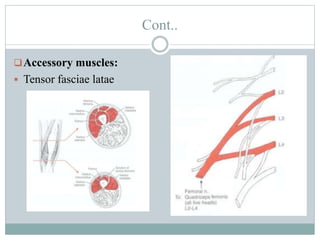
Accessory muscles:
 Tensor fasciae latae
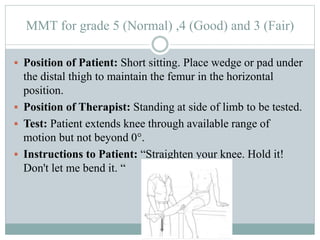
MMT for grade 5 (Normal) ,4 (Good) and 3 (Fair)
 Position of Patient: Short sitting. Place wedge or pad under
the distal thigh to maintain the femur in the horizontal
position.
 Position of Therapist: Standing at side of limb to be tested.
 Test: Patient extends knee through available range of
motion but not beyond 0°.
 Instructions to Patient: “Straighten your knee. Hold it!
Don't let me bend it. “
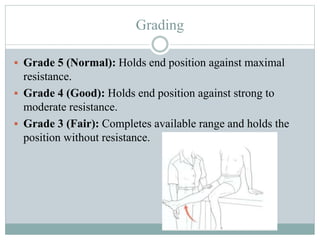
Grading
 Grade 5 (Normal): Holds end position against maximal
resistance.
 Grade 4 (Good): Holds end position against strong to
moderate resistance.
 Grade 3 (Fair): Completes available range and holds the
position without resistance.
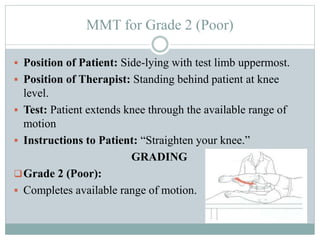
MMT for Grade 2 (Poor)
 Position of Patient: Side-lying with test limb uppermost.
 Position of Therapist: Standing behind patient at knee
level.
 Test: Patient extends knee through the available range of
motion
 Instructions to Patient: “Straighten your knee.”
GRADING
Grade 2 (Poor):
 Completes available range of motion.
MMT for Grade 1 (Trace) and Grade 0 (Zero)
 Position of Patient: Supine.
 Position of Therapist: Standing next to limb to be tested at
knee level.
 Test: Patient attempts to extend knee.
 Instructions to Patient: “Push the back of your knee down in
to the table.”
 OR
 “Tighten your knee cap.”
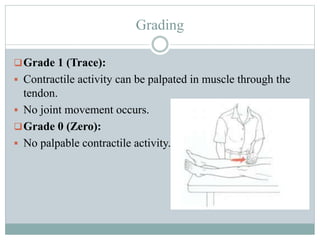
Grading
Grade 1 (Trace):
 Contractile activity can be palpated in muscle through the
tendon.
 No joint movement occurs.
Grade 0 (Zero):
 No palpable contractile activity.
References
 MMT by Daniels and Worthinghams.
 Atlas of human body by Frank H Netter.
MMT for knee

MMT for knee

  • 1.
    TOPIC: MMT FORKNEE PRESENTED TO: DR. ASIF WATTOO PRESENTED BY: AMBREEN SADAF BSOT02153303 The University Of Lahore
  • 2.
    Muscles of theknee joint
  • 3.
    Contents:  Knee Flexion Knee Extension Learning Objectives  Range of motion  Muscles  Origin  Insertion  Nerve supply  Action  Procedure for MMT
  • 4.
  • 5.
  • 6.
    Knee Flexion Rangeof motion: 0-135* MUSCLES ORIGIN INSERTION Biceps Femoris Long Head Ischium(tuberosity) Sacrotuberous ligament Aponeurosis (posterior) Fibula Fibular collateral ligament Short Head (may be absent) Femur Lateral intramuscular septum Tibia (lateral condyle) Semitendinosus Ischial tuberosity Tibia Pes anserine Deep fascia of leg Semimembranosus Ischial tuberosity Sacrotuberous ligament Distal Aponeurosis Tibia
  • 7.
    Cont.. Accessory muscles:  Gracilis Tensor fasciae latae (knee flexed more than 30°)  Sartorius  Popliteus  Gastrocnemius  Plantaris
  • 8.
    MMT for grade5 (Normal) ,4 (Good) and 3 (Fair)  There are three basic muscle tests for hamstrings at Grades 5 and 4.  The examiner should test first for the aggregate of the three hamstring muscles (with the foot in midline). Hamstring muscles  HAMSTRING MUSCLES IN AGGREGATE  MEDIAL HAMSTRING TEST (SEMITENDINOSUS AND SEMIMEMBRANOSUS)  LATERAL HAMSTRING TEST (BICEPS FEMORIS)
  • 9.
    HAMSTRING MUSCLES INAGGREGATE  Position of Patient: Prone with limbs straight and toes hanging over the edge of the table .  Position of Therapist: Standing next to limb to be tested.  Test: Patient flexes knee while maintaining leg in neutral rotation.  Instructions to Patient: “Bend your knee. Hold it! Don't let me straighten it.”
  • 10.
    MEDIAL HAMSTRING TEST(SEMITENDINOSUS AND SEMIMEMBRANOSUS)  Position of Patient: Prone with knee flexed to less than 90°. leg in internal rotation.  Position of Therapist: Hand giving resistance grasps the leg at the ankle. Resistance is applied in an oblique direction.  Test: Patient flexes knee, maintaining the leg in internal rotation.
  • 11.
    LATERAL HAMSTRING TEST(BICEPS FEMORIS)  Position of Patient: Prone with knee flexed to less  than90°. Leg is in external rotation.  Position of Therapist: Therapist resists knee flexion at the ankle using a downward and inward force.  Test: Patient flexes knee, maintaining leg in external rotation.
  • 12.
    Grading the HamstringMuscles (Grades 5 to 3 ) Grade 5 (Normal) for All Three Tests:  Resistance will be maximal, and the end knee flexion position (approximately 90°) cannot be broken. Grade 4 (Good) for All Three Tests:  End knee flexion position is held against strong to moderate resistance. Grade 3 (Fair) for All Three Tests:  Holds end range position but tolerates no resistance
  • 13.
  • 14.
    MMT for Grade2 (Poor )  Position of Patient: Side-lying with test limb  Position of Therapist: Standing behind patient at knee level.  Test: Patient flexes knee through available range of motion.  Instructions to Patient: “Bend your knee.” GRADING Grade 2 (Poor): Completes available range of motion inside-lying position.
  • 15.
    MMT for Grade1 (Trace) and Grade 0 (Zero)  Position of Patient: Prone.  Position of Therapist: Standing next to test limb at knee level.  Test: Patient attempts to flex knee.  Instructions to Patient : “Try to bend your knee.” GRADING Grade 1 (Trace):  No visible movement. Grade 0 (Zero):  No palpable contraction.
  • 17.
  • 18.
  • 19.
    Knee Extension Rangeof motion: 135*-0* MUSCLES ORIGIN INSERTION Rectus Femoris Ilium (anterior inferior iliac spine). Acetabulum (groove above) Capsule of hip joint Aponeurosis (anterior) Aponeurosis (posterior) Patella (base via quadriceps tendon) Tibial tuberosity via ligamentum Patellae Vastus intermedius Femur (shaft, upper 2/3 lateral and anterior surfaces) Intermuscular septum (lateral) Aponeurosis Patella Tibia Tibial tuberosity via ligamentum patellae Vastus lateralis Femur Lateral Intermuscular septum Aponeurosis Patella Lateral expansion to capsule of knee joint and Lliotibial tract.
  • 20.
    Knee Extension Rangeof motion: 135*-0* MUSCLES ORIGIN INSERTION Vastus medialis Longus Femur linea aspera, medial lip, Intertrochanteric line Tendon of adductor Magnus Aponeurosis (deep) Patella (medial border) Tibial tuberosity via ligamentum patellae Vastus medialis Oblique Femur: Linea aspera (distal), supracondylar line. Intramuscular septum Aponeurosis to capsule of knee joint Patella (medial aspect) Quadriceps tendon (medial) Tibial tuberosity via ligamentum Patellae. Accessory muscles: Tensor fasciae latae
  • 21.
  • 22.
    MMT for grade5 (Normal) ,4 (Good) and 3 (Fair)  Position of Patient: Short sitting. Place wedge or pad under the distal thigh to maintain the femur in the horizontal position.  Position of Therapist: Standing at side of limb to be tested.  Test: Patient extends knee through available range of motion but not beyond 0°.  Instructions to Patient: “Straighten your knee. Hold it! Don't let me bend it. “
  • 23.
    Grading  Grade 5(Normal): Holds end position against maximal resistance.  Grade 4 (Good): Holds end position against strong to moderate resistance.  Grade 3 (Fair): Completes available range and holds the position without resistance.
  • 24.
    MMT for Grade2 (Poor)  Position of Patient: Side-lying with test limb uppermost.  Position of Therapist: Standing behind patient at knee level.  Test: Patient extends knee through the available range of motion  Instructions to Patient: “Straighten your knee.” GRADING Grade 2 (Poor):  Completes available range of motion.
  • 25.
    MMT for Grade1 (Trace) and Grade 0 (Zero)  Position of Patient: Supine.  Position of Therapist: Standing next to limb to be tested at knee level.  Test: Patient attempts to extend knee.  Instructions to Patient: “Push the back of your knee down in to the table.”  OR  “Tighten your knee cap.”
  • 26.
    Grading Grade 1 (Trace): Contractile activity can be palpated in muscle through the tendon.  No joint movement occurs. Grade 0 (Zero):  No palpable contractile activity.
  • 27.
    References  MMT byDaniels and Worthinghams.  Atlas of human body by Frank H Netter.