Present tenses

Grammar points
Present
tenses
1. Present simple
2. Present continuous
3. Present perfect: it is not present. it
serves us to talk about the past with
a result in the present!
Present simple
We use it to talk about routines, habits
or things that are true in general.
DO NOT FORGET to add the "s" or
"es" if it´s the 3rd person of the
singular:
I walk
She walks
Present simple:
affirmative
In affirmative, we write the subject + a
verb:
!

I work as a doctor in that hospital.
She walks to school every day.
We like comics and poetry so we read them
whenever we have time.
My dog runs very fun because he is still
young.
Present simple:
negative sentences
For the negative form we use the
auxiliary verb do + NOT: don't or
doesn't.
Examples:
I don't like burgers, I prefer salad.
She doesn't play tennis very well.
We don't study French at school.
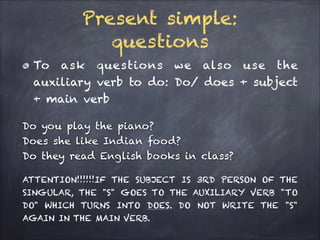
Present simple:
questions
To ask questions we also use the
auxiliary verb to do: Do/ does + subject
+ main verb
Do you play the piano?
Does she like Indian food?
Do they read English books in class?
ATTENTION!!!!!!IF THE SUBJECT IS 3RD PERSON OF THE
SINGULAR, THE "S" GOES TO THE AUXILIARY VERB "TO
DO" WHICH TURNS INTO DOES. DO NOT WRITE THE "S"
AGAIN IN THE MAIN VERB.
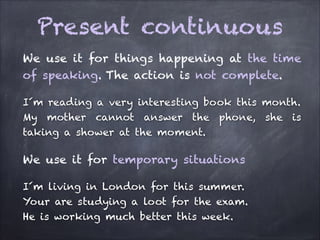
Present continuous
We use it for things happening at the time
of speaking. The action is not complete.
I´m reading a very interesting book this month.
My mother cannot answer the phone, she is
taking a shower at the moment.

We use it for temporary situations
I´m living in London for this summer.
Your are studying a loot for the exam.
He is working much better this week.
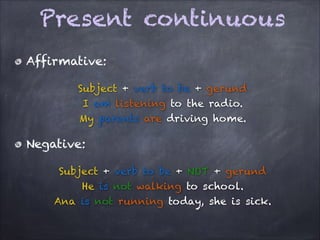
Present continuous
Affirmative:
Subject + verb to be + gerund
I am listening to the radio.
My parents are driving home.

Negative:
Subject + verb to be + NOT + gerund
He is not walking to school.
Ana is not running today, she is sick.
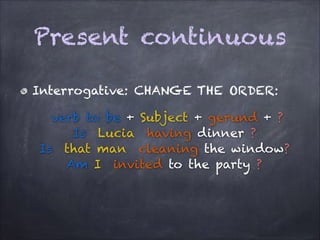
Present continuous
Interrogative: CHANGE THE ORDER:
verb to be + Subject + gerund + ?
Is Lucia having dinner ?
Is that man cleaning the window?
Am I invited to the party ?
Present perfect
We use the present perfect for
an action that started in the
past and has a result now. IT
IS NOT PRESENT. IT IS PAST
WITH A RESULT IN THE PRESENT.
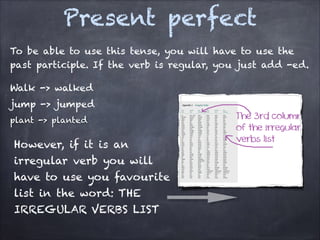
Present perfect
To be able to use this tense, you will have to use the
past participle. If the verb is regular, you just add -ed.
Walk -> walked
jump -> jumped
plant -> planted

However, if it is an
irregular verb you will
have to use you favourite
list in the word: THE
IRREGULAR VERBS LIST
Present perfect
Affirmative : Subject + have/has + past
participle
I have ridden horses since I was 7.
She has studied English for a year.
He has cleaned his shoes.
They are not here. They have gone out.
Present perfect
Negative: Subject + have / has + not +
past participle.
I haven´t finished the book.
He hasn´t arrived yet.
I haven´t lost the keys. They are here!
Lucia hasn´t worn the new dress yet.
Present perfect
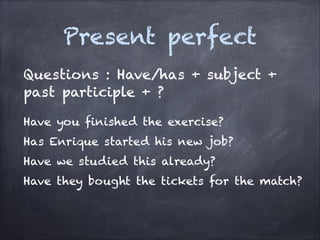
Questions : Have/has + subject +
past participle + ?
Have you finished the exercise?
Has Enrique started his new job?
Have we studied this already?
Have they bought the tickets for the match?
Present perfect
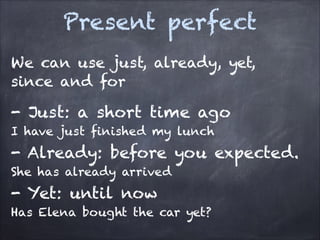
We can use just, already, yet,
since and for

- Just: a short time ago
I have just finished my lunch

- Already: before you expected.
She has already arrived

- Yet: until now
Has Elena bought the car yet?
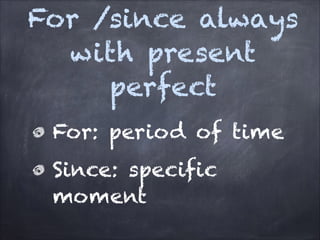
For /since always
with present
perfect
For: period of time
Since: specific
moment
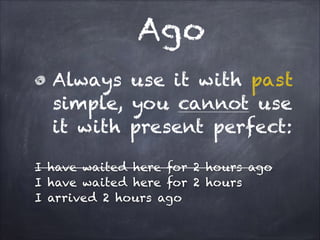
Ago
Always use it with past
simple, you cannot use
it with present perfect:
!

I have waited here for 2 hours ago
I have waited here for 2 hours
I arrived 2 hours ago

Present tenses

  • 1.
  • 2.
    Present tenses 1. Present simple 2.Present continuous 3. Present perfect: it is not present. it serves us to talk about the past with a result in the present!
  • 3.
    Present simple We useit to talk about routines, habits or things that are true in general. DO NOT FORGET to add the "s" or "es" if it´s the 3rd person of the singular: I walk She walks
  • 4.
    Present simple: affirmative In affirmative,we write the subject + a verb: ! I work as a doctor in that hospital. She walks to school every day. We like comics and poetry so we read them whenever we have time. My dog runs very fun because he is still young.
  • 5.
    Present simple: negative sentences Forthe negative form we use the auxiliary verb do + NOT: don't or doesn't. Examples: I don't like burgers, I prefer salad. She doesn't play tennis very well. We don't study French at school.
  • 6.
    Present simple: questions To askquestions we also use the auxiliary verb to do: Do/ does + subject + main verb Do you play the piano? Does she like Indian food? Do they read English books in class? ATTENTION!!!!!!IF THE SUBJECT IS 3RD PERSON OF THE SINGULAR, THE "S" GOES TO THE AUXILIARY VERB "TO DO" WHICH TURNS INTO DOES. DO NOT WRITE THE "S" AGAIN IN THE MAIN VERB.
  • 7.
    Present continuous We useit for things happening at the time of speaking. The action is not complete. I´m reading a very interesting book this month. My mother cannot answer the phone, she is taking a shower at the moment. We use it for temporary situations I´m living in London for this summer. Your are studying a loot for the exam. He is working much better this week.
  • 8.
    Present continuous Affirmative: Subject +verb to be + gerund I am listening to the radio. My parents are driving home. Negative: Subject + verb to be + NOT + gerund He is not walking to school. Ana is not running today, she is sick.
  • 9.
    Present continuous Interrogative: CHANGETHE ORDER: verb to be + Subject + gerund + ? Is Lucia having dinner ? Is that man cleaning the window? Am I invited to the party ?
  • 10.
    Present perfect We usethe present perfect for an action that started in the past and has a result now. IT IS NOT PRESENT. IT IS PAST WITH A RESULT IN THE PRESENT.
  • 11.
    Present perfect To beable to use this tense, you will have to use the past participle. If the verb is regular, you just add -ed. Walk -> walked jump -> jumped plant -> planted However, if it is an irregular verb you will have to use you favourite list in the word: THE IRREGULAR VERBS LIST
  • 12.
    Present perfect Affirmative :Subject + have/has + past participle I have ridden horses since I was 7. She has studied English for a year. He has cleaned his shoes. They are not here. They have gone out.
  • 13.
    Present perfect Negative: Subject+ have / has + not + past participle. I haven´t finished the book. He hasn´t arrived yet. I haven´t lost the keys. They are here! Lucia hasn´t worn the new dress yet.
  • 14.
    Present perfect Questions :Have/has + subject + past participle + ? Have you finished the exercise? Has Enrique started his new job? Have we studied this already? Have they bought the tickets for the match?
  • 15.
    Present perfect We canuse just, already, yet, since and for - Just: a short time ago I have just finished my lunch - Already: before you expected. She has already arrived - Yet: until now Has Elena bought the car yet?
  • 16.
    For /since always withpresent perfect For: period of time Since: specific moment
  • 17.
    Ago Always use itwith past simple, you cannot use it with present perfect: ! I have waited here for 2 hours ago I have waited here for 2 hours I arrived 2 hours ago