
Resourcing and supporting the
Australian Curriculum
Barry McGaw
Vice-Chancellor’s Fellow, University of Melbourne
Chair, Australian Curriculum, Assessment and Reporting Authority
The Curriculum Experience: Connect, Integrate, Lead
Australian School Library Association Biennial Conference
Hobart
September 2013
National view shaped by international context
Simultaneous treatment of disciplines and 21st century skills
Presenting the curriculum electronically
Linking resources to the curriculum for teachers
Outline of presentation
National view shaped by international
context
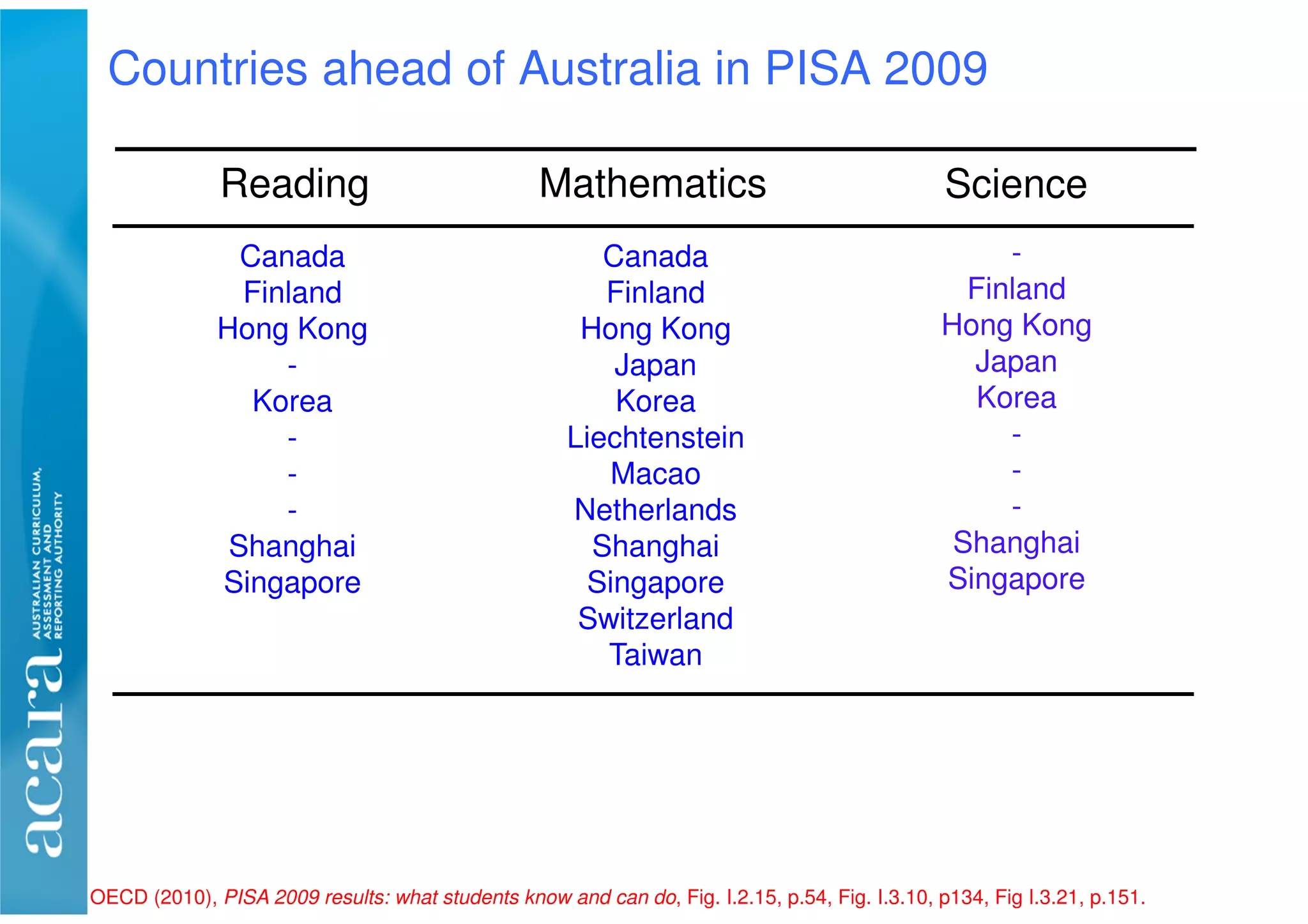
Countries ahead of Australia in PISA 2009
Canada
Finland
Hong Kong
-
Korea
-
-
-
Shanghai
Singapore
Reading Mathematics Science
Canada
Finland
Hong Kong
Japan
Korea
Liechtenstein
Macao
Netherlands
Shanghai
Singapore
Switzerland
Taiwan
-
Finland
Hong Kong
Japan
Korea
-
-
-
Shanghai
Singapore
OECD (2010), PISA 2009 results: what students know and can do, Fig. I.2.15, p.54, Fig. I.3.10, p134, Fig I.3.21, p.151.
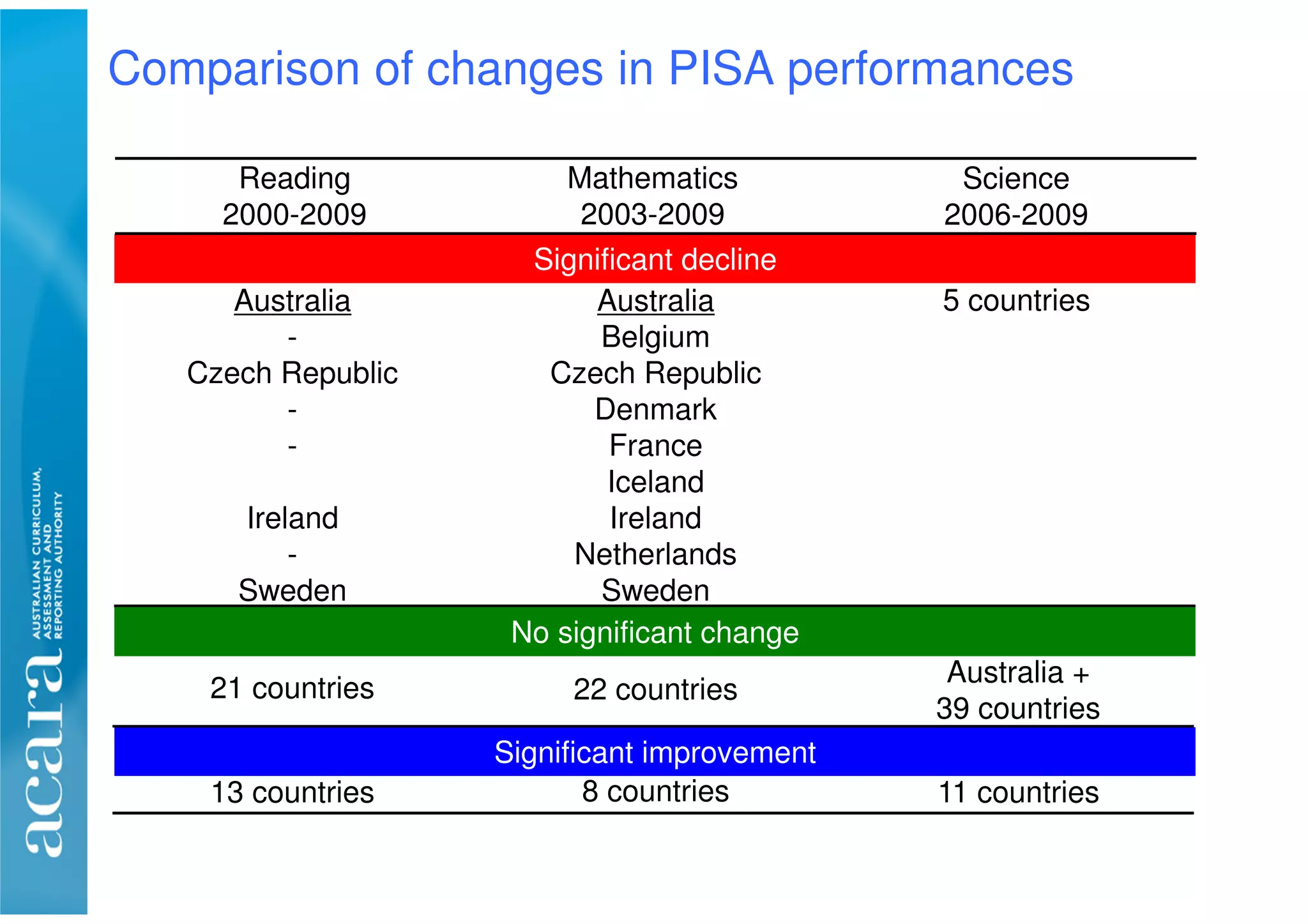
Comparison of changes in PISA performances
Australia
-
Czech Republic
-
-
Ireland
-
Sweden
Australia
Belgium
Czech Republic
Denmark
France
Iceland
Ireland
Netherlands
Sweden
5 countries
Significant decline
Reading
2000-2009
Mathematics
2003-2009
Science
2006-2009
13 countries 8 countries 11 countries
Significant improvement
No significant change
21 countries 22 countries
Australia +
39 countries
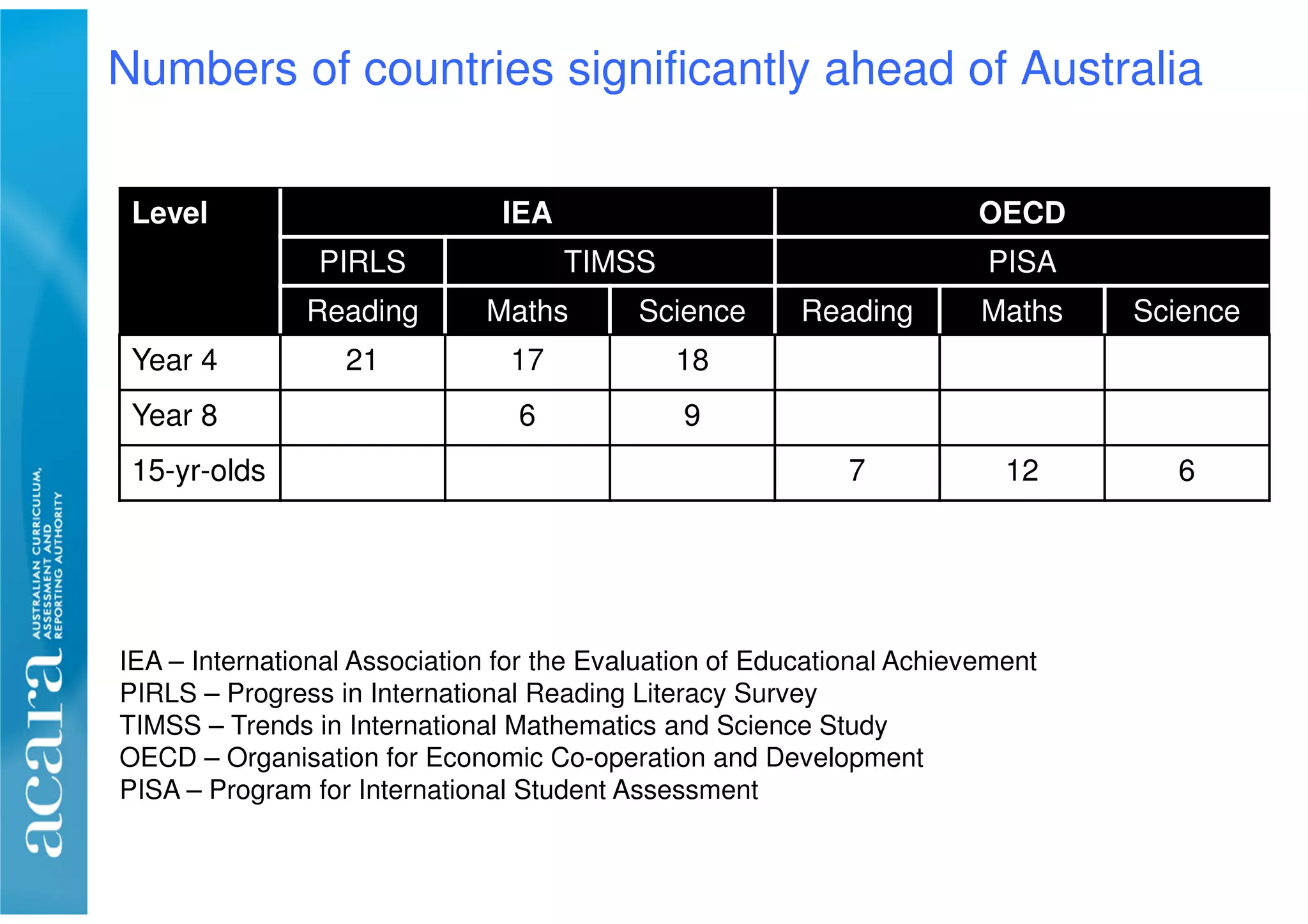
Numbers of countries significantly ahead of Australia
Level IEA OECD
PIRLS TIMSS PISA
Reading Maths Science Reading Maths Science
Year 4 21 17 18
Year 8 6 9
15-yr-olds 7 12 6
IEA – International Association for the Evaluation of Educational Achievement
PIRLS – Progress in International Reading Literacy Survey
TIMSS – Trends in International Mathematics and Science Study
OECD – Organisation for Economic Co-operation and Development
PISA – Program for International Student Assessment
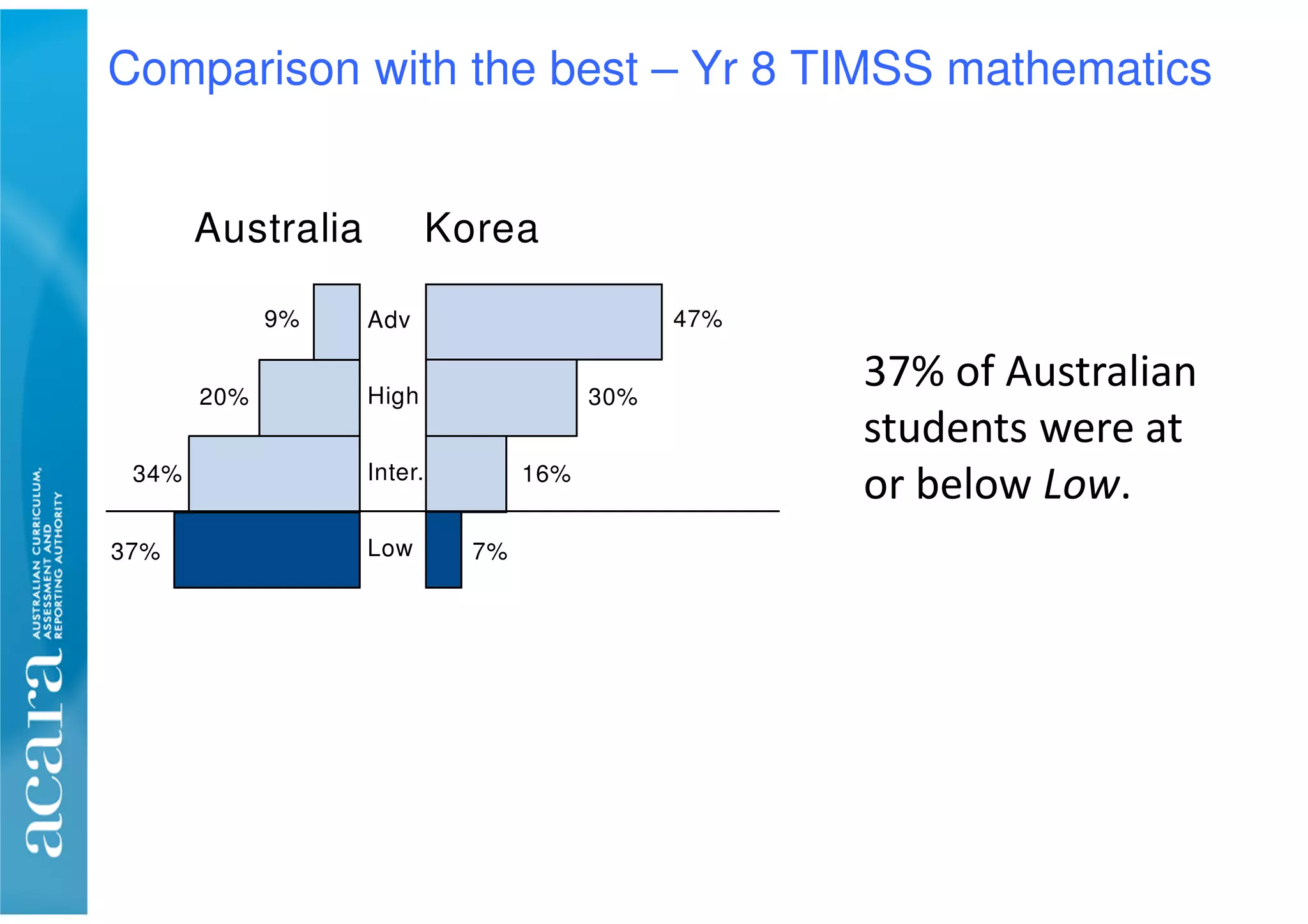
Comparison with the best – Yr 8 TIMSS mathematics
Adv
High
Inter.
Low37%
34%
20%
9%
Australia Korea
7%
16%
30%
47%
37% of Australian
students were at
or below Low.
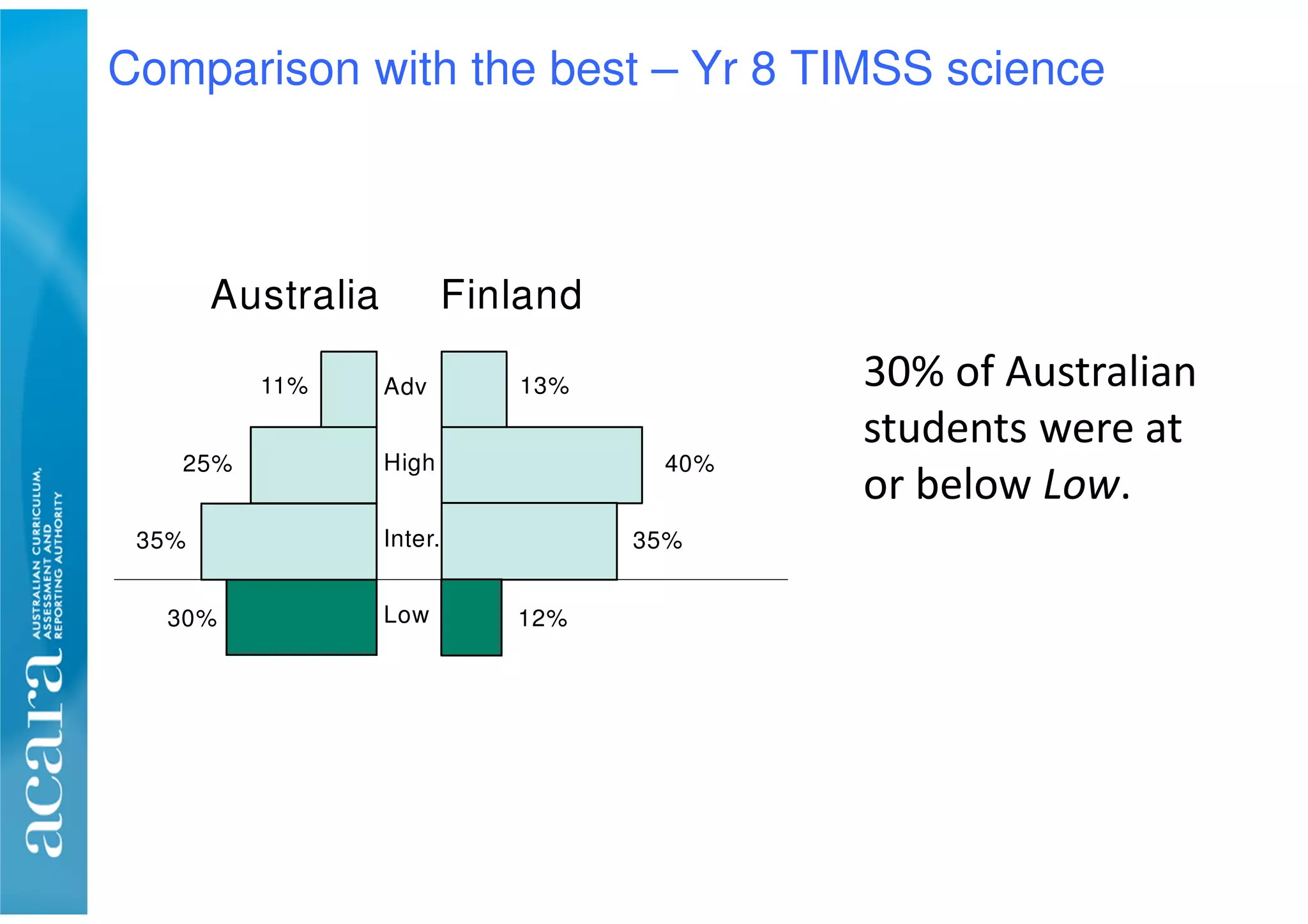
Comparison with the best – Yr 8 TIMSS science
Adv
High
Inter.
Low30%
35%
25%
11%
Australia Finland
12%
35%
40%
13% 30% of Australian
students were at
or below Low.
Australia among high performing countries
High ranking due to high mean
BUT well behind the highest performers
AND evidence of decline, particularly at the top end
We need to raise expectations
In our schools
In our curricula
Conclusion from international comparisons
Simultaneous treatment of disciplines
and 21st century skills
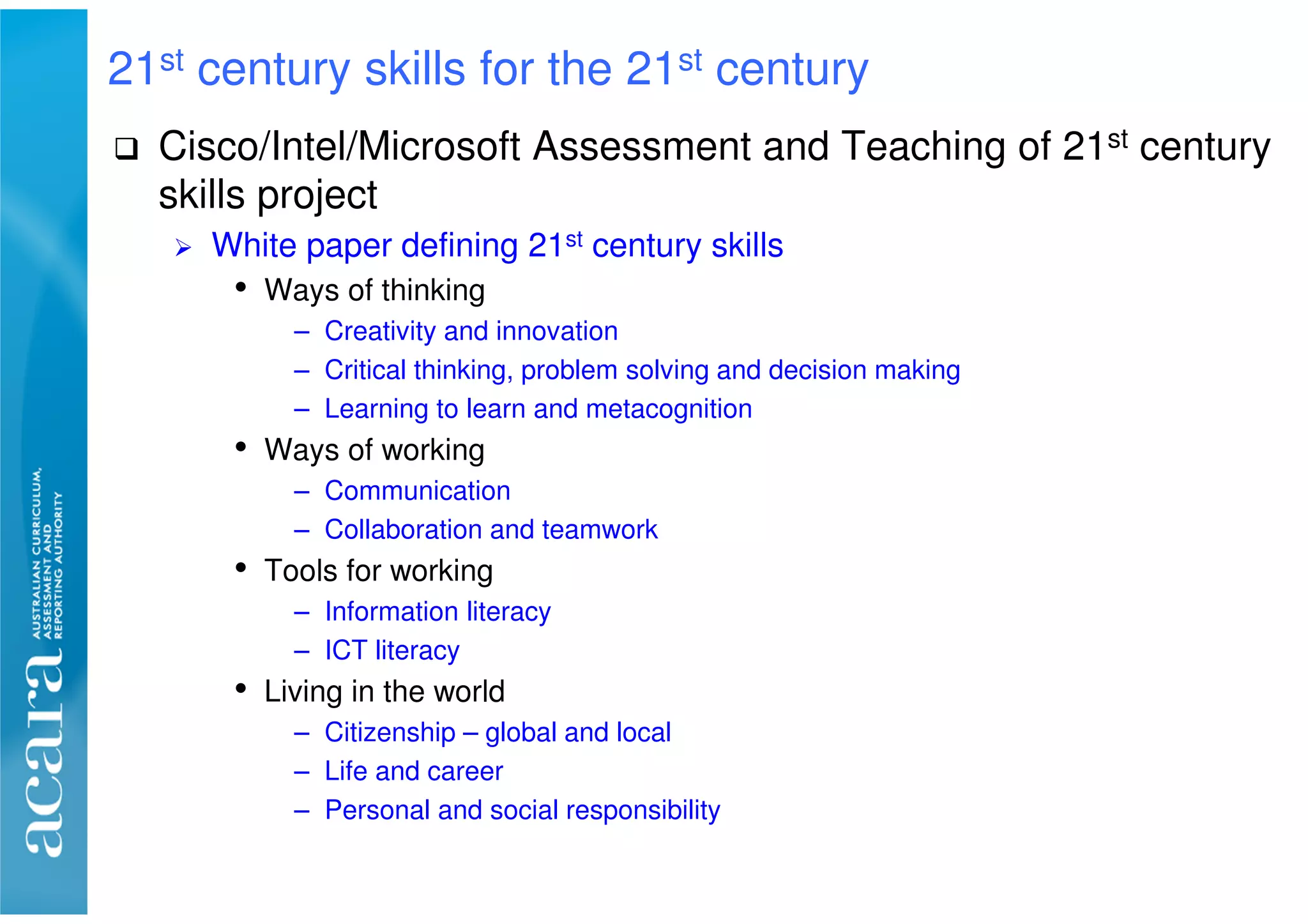
Cisco/Intel/Microsoft Assessment and Teaching of 21st century
skills project
White paper defining 21st century skills
• Ways of thinking
– Creativity and innovation
– Critical thinking, problem solving and decision making
– Learning to learn and metacognition
• Ways of working
– Communication
– Collaboration and teamwork
• Tools for working
– Information literacy
– ICT literacy
• Living in the world
– Citizenship – global and local
– Life and career
– Personal and social responsibility
21st century skills for the 21st century
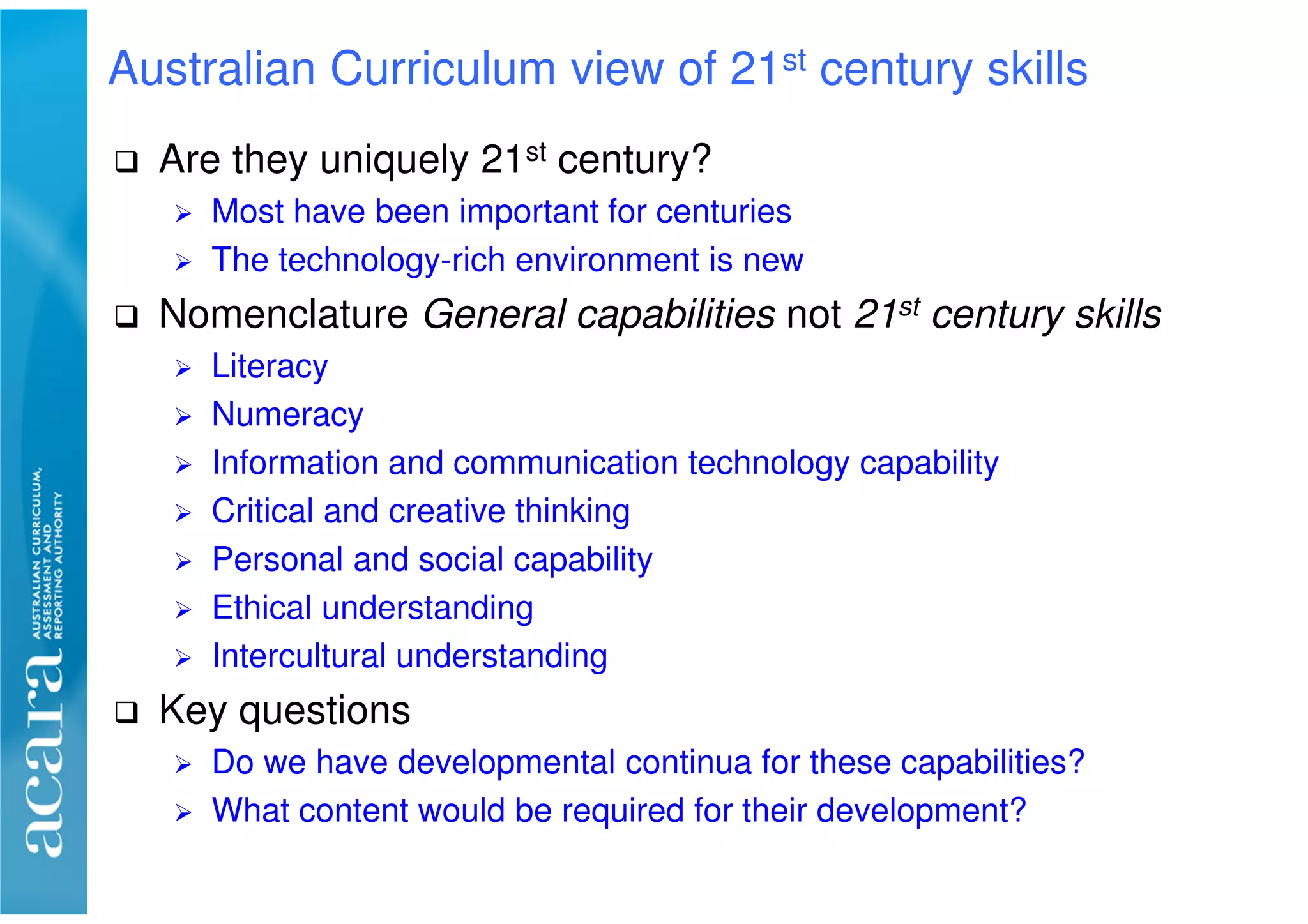
Are they uniquely 21st century?
Most have been important for centuries
The technology-rich environment is new
Nomenclature General capabilities not 21st century skills
Literacy
Numeracy
Information and communication technology capability
Critical and creative thinking
Personal and social capability
Ethical understanding
Intercultural understanding
Key questions
Do we have developmental continua for these capabilities?
What content would be required for their development?
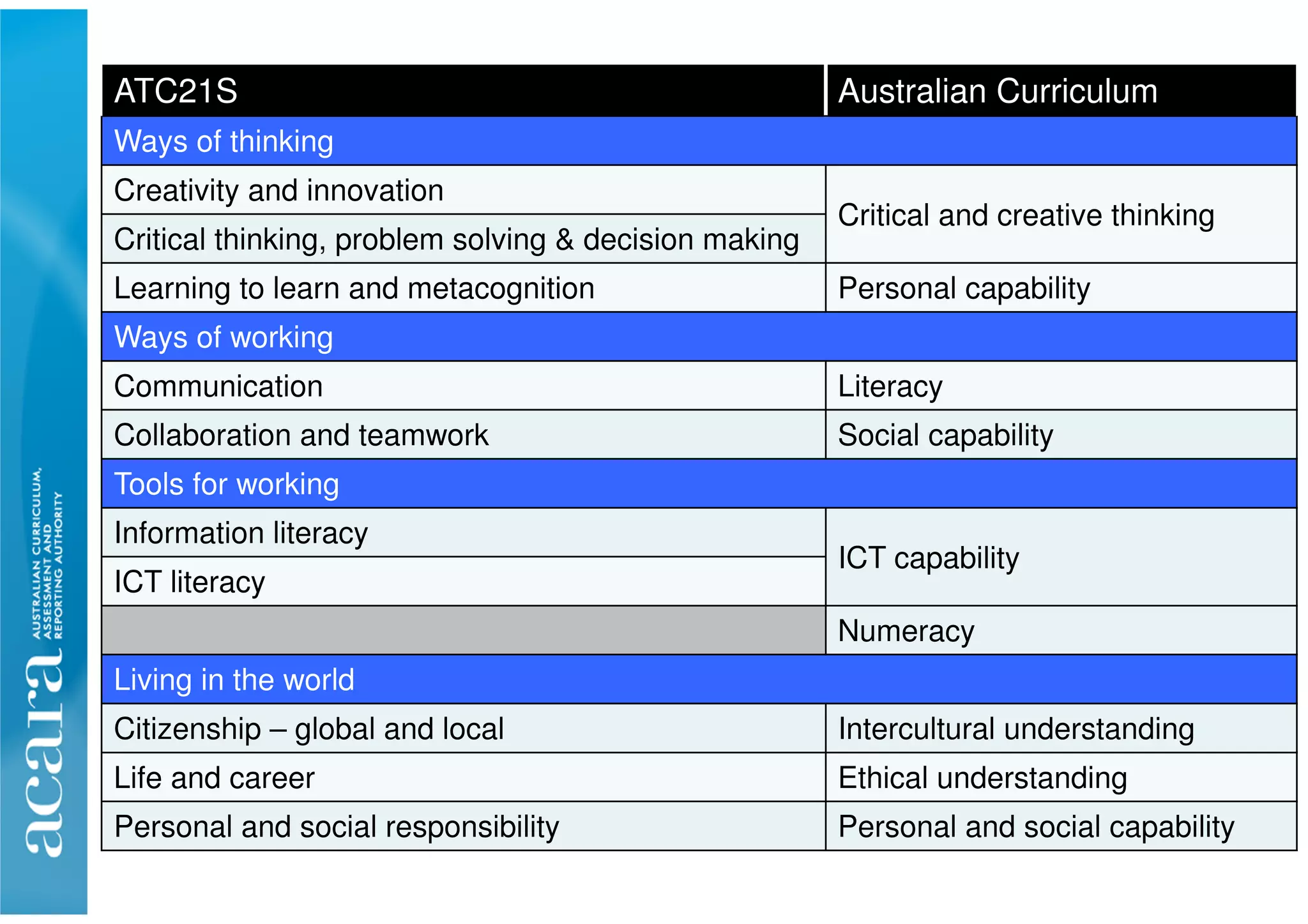
Australian Curriculum view of 21st century skills
ATC21S Australian Curriculum
Ways of thinking
Creativity and innovation
Critical and creative thinking
Critical thinking, problem solving & decision making
Learning to learn and metacognition Personal capability
Ways of working
Communication Literacy
Collaboration and teamwork Social capability
Tools for working
Information literacy
ICT capability
ICT literacy
Numeracy
Living in the world
Citizenship – global and local Intercultural understanding
Life and career Ethical understanding
Personal and social responsibility Personal and social capability
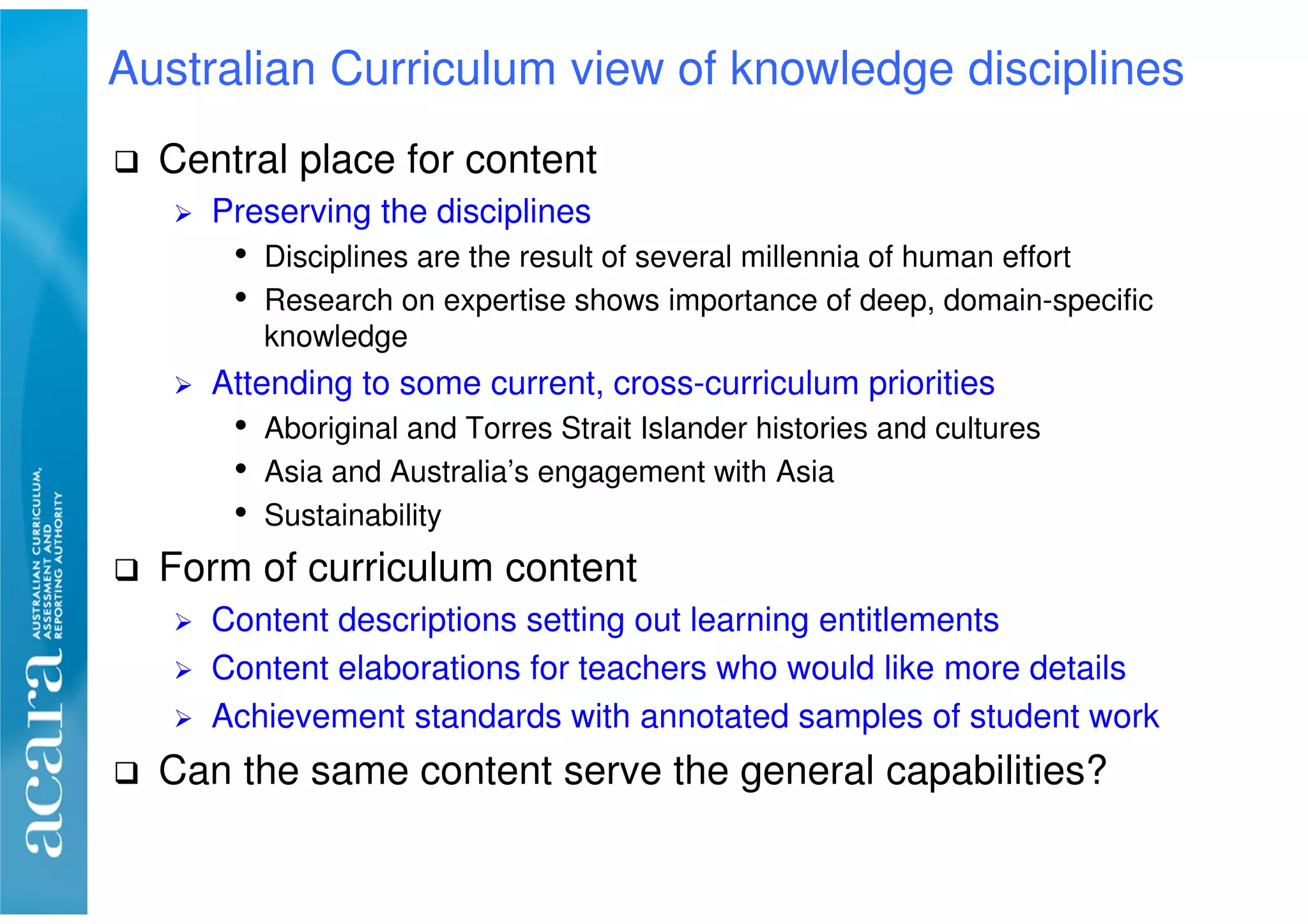
Central place for content
Preserving the disciplines
• Disciplines are the result of several millennia of human effort
• Research on expertise shows importance of deep, domain-specific
knowledge
Attending to some current, cross-curriculum priorities
• Aboriginal and Torres Strait Islander histories and cultures
• Asia and Australia’s engagement with Asia
• Sustainability
Form of curriculum content
Content descriptions setting out learning entitlements
Content elaborations for teachers who would like more details
Achievement standards with annotated samples of student work
Can the same content serve the general capabilities?
Australian Curriculum view of knowledge disciplines
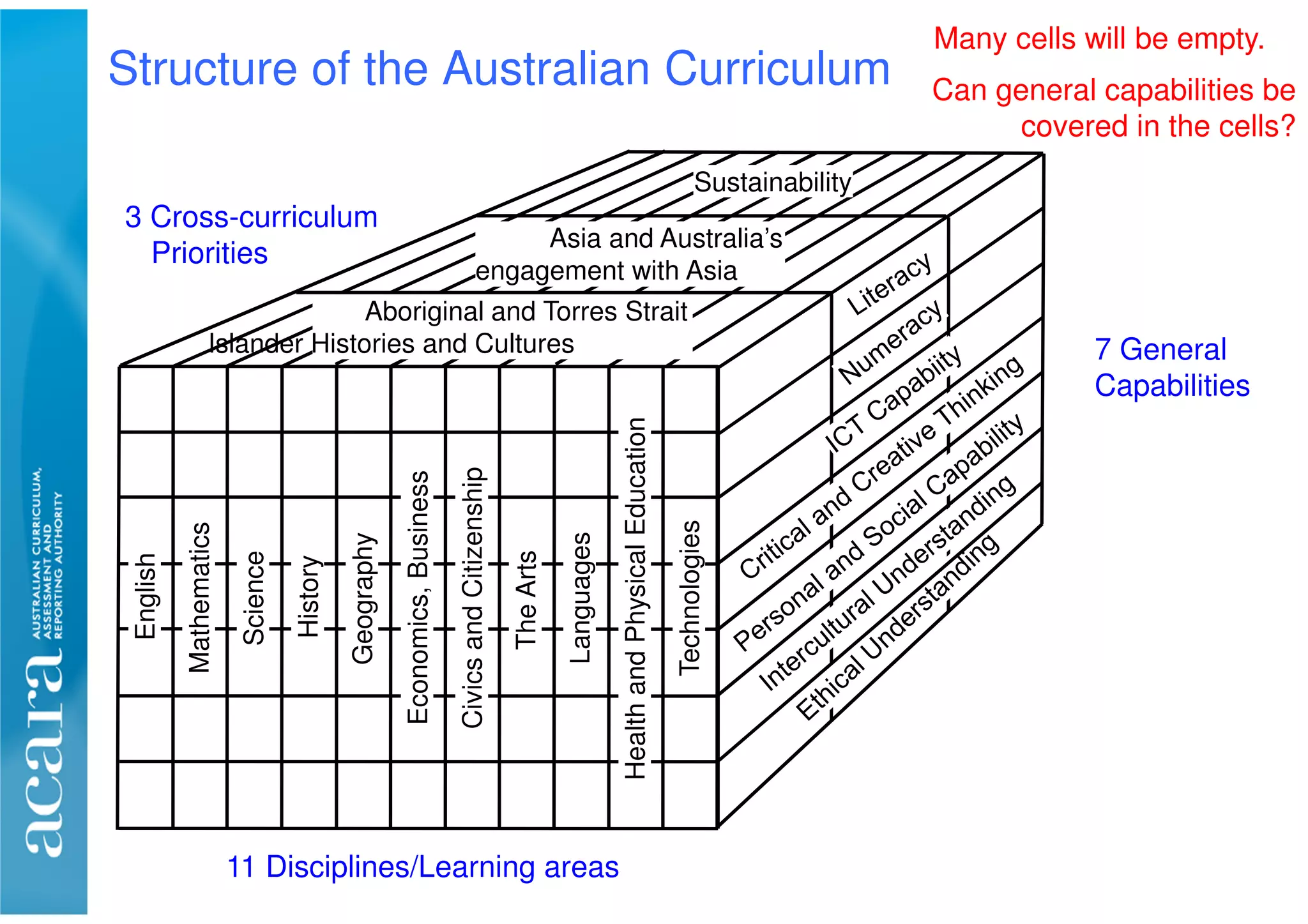
Structure of the Australian Curriculum
7 General
Capabilities
Sustainability
Asia and Australia’s
engagement with Asia
Aboriginal and Torres Strait
Islander Histories and Cultures
3 Cross-curriculum
Priorities
Can general capabilities be
covered in the cells?
Many cells will be empty.
Languages
CivicsandCitizenship
Economics,Business
TheArts
HealthandPhysicalEducation
Technologies
Geography
History
Science
Mathematics
English
11 Disciplines/Learning areas
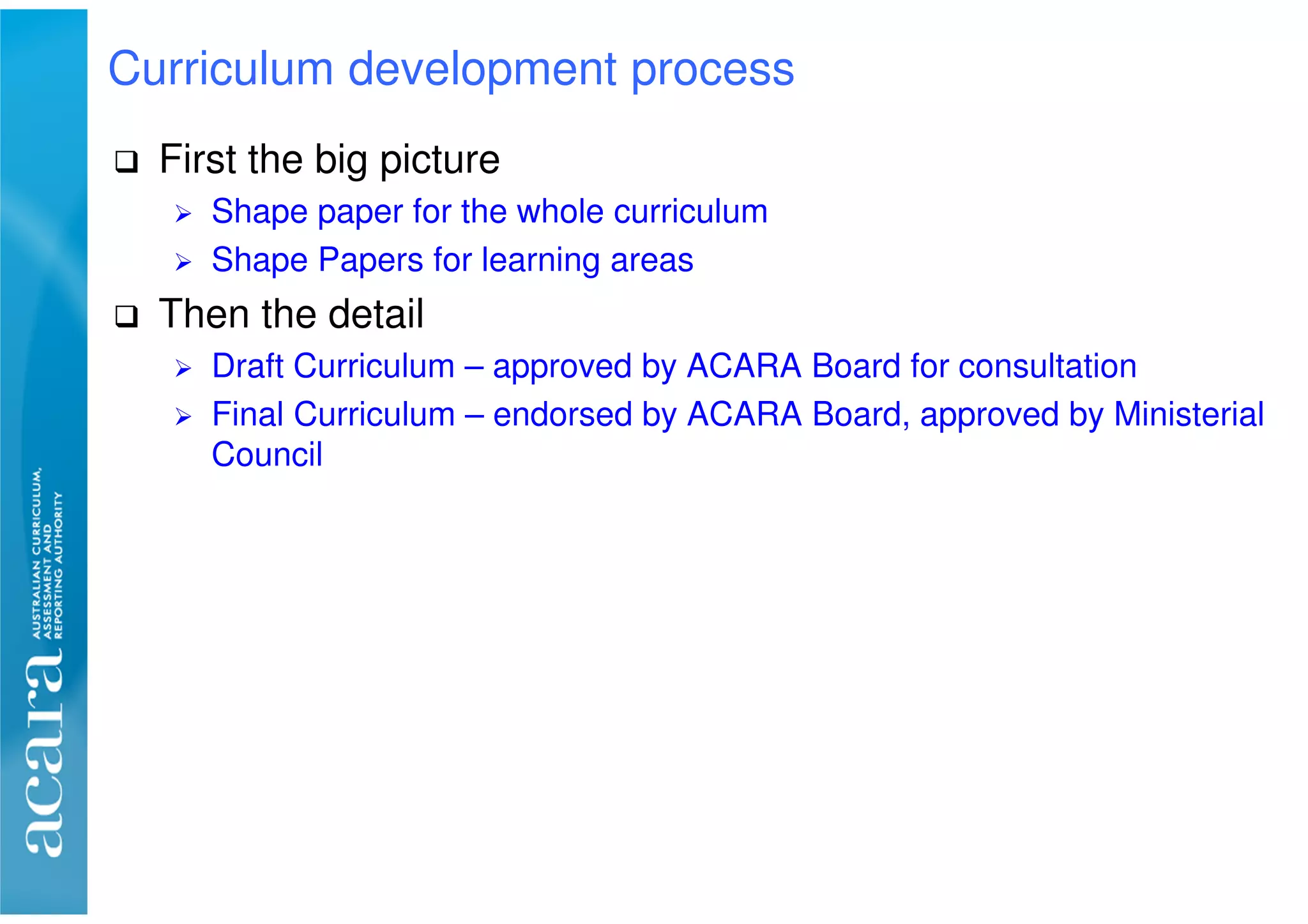
Development process
First the big picture
Shape paper for the whole curriculum
Shape Papers for learning areas
Then the detail
Draft Curriculum – approved by ACARA Board for consultation
Final Curriculum – endorsed by ACARA Board, approved by Ministerial
Council
Curriculum development process
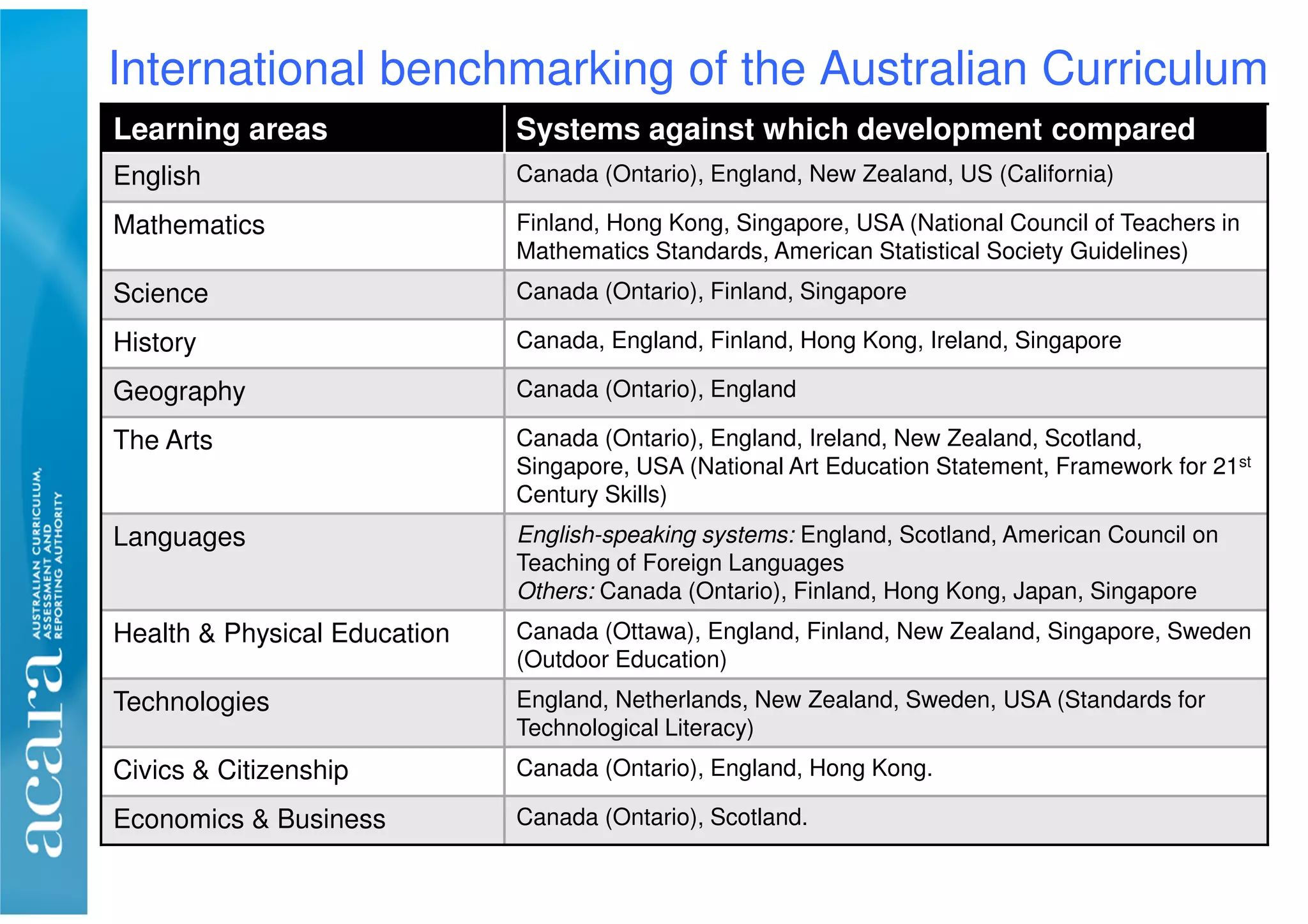
International benchmarking of the Australian Curriculum
Learning areas Systems against which development compared
English Canada (Ontario), England, New Zealand, US (California)
Mathematics Finland, Hong Kong, Singapore, USA (National Council of Teachers in
Mathematics Standards, American Statistical Society Guidelines)
Science Canada (Ontario), Finland, Singapore
History Canada, England, Finland, Hong Kong, Ireland, Singapore
Geography Canada (Ontario), England
The Arts Canada (Ontario), England, Ireland, New Zealand, Scotland,
Singapore, USA (National Art Education Statement, Framework for 21st
Century Skills)
Languages English-speaking systems: England, Scotland, American Council on
Teaching of Foreign Languages
Others: Canada (Ontario), Finland, Hong Kong, Japan, Singapore
Health & Physical Education Canada (Ottawa), England, Finland, New Zealand, Singapore, Sweden
(Outdoor Education)
Technologies England, Netherlands, New Zealand, Sweden, USA (Standards for
Technological Literacy)
Civics & Citizenship Canada (Ontario), England, Hong Kong.
Economics & Business Canada (Ontario), Scotland.
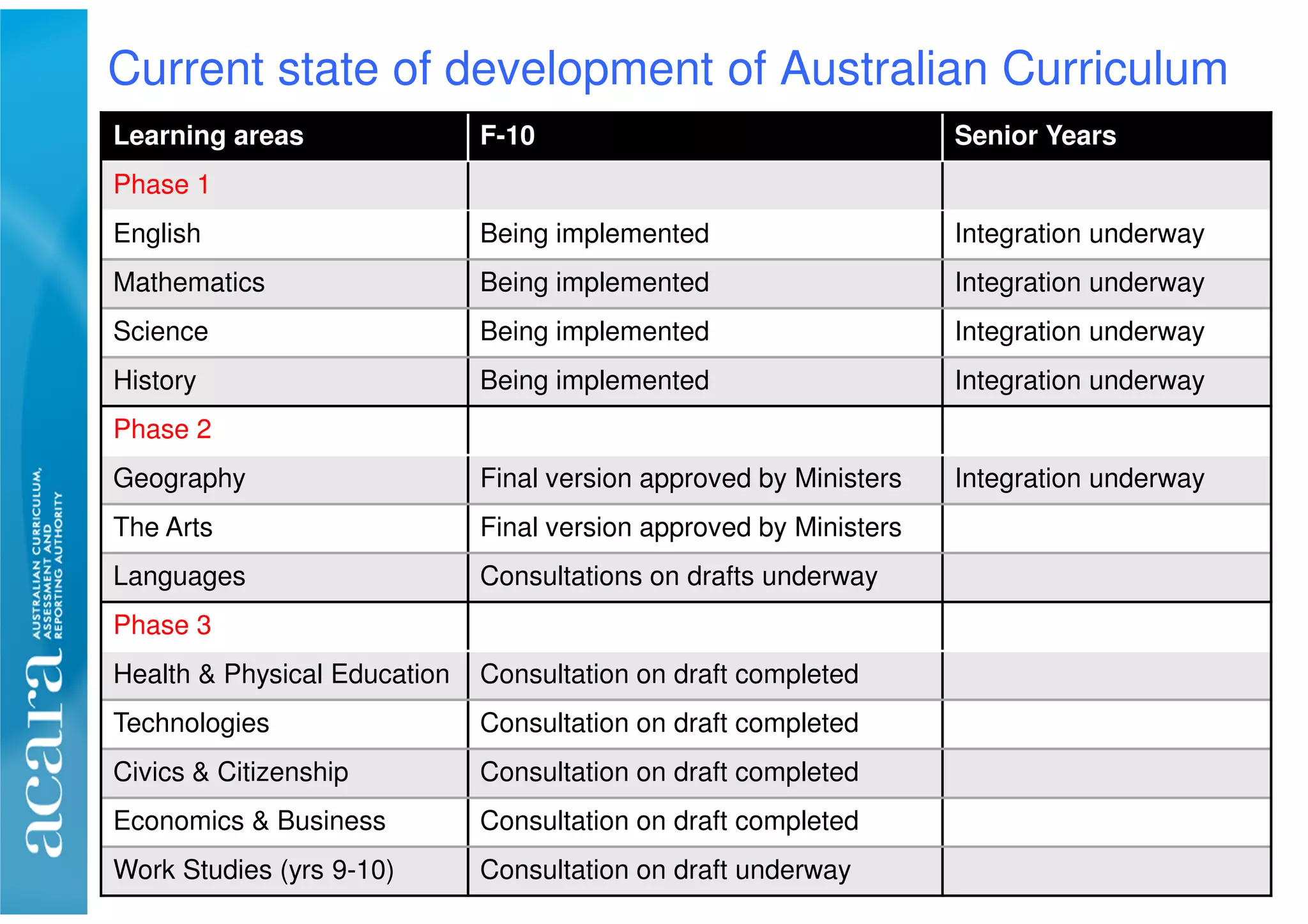
Current state of development of Australian Curriculum
Learning areas F-10 Senior Years
Phase 1
English Being implemented Integration underway
Mathematics Being implemented Integration underway
Science Being implemented Integration underway
History Being implemented Integration underway
Phase 2
Geography Final version approved by Ministers Integration underway
The Arts Final version approved by Ministers
Languages Consultations on drafts underway
Phase 3
Health & Physical Education Consultation on draft completed
Technologies Consultation on draft completed
Civics & Citizenship Consultation on draft completed
Economics & Business Consultation on draft completed
Work Studies (yrs 9-10) Consultation on draft underway
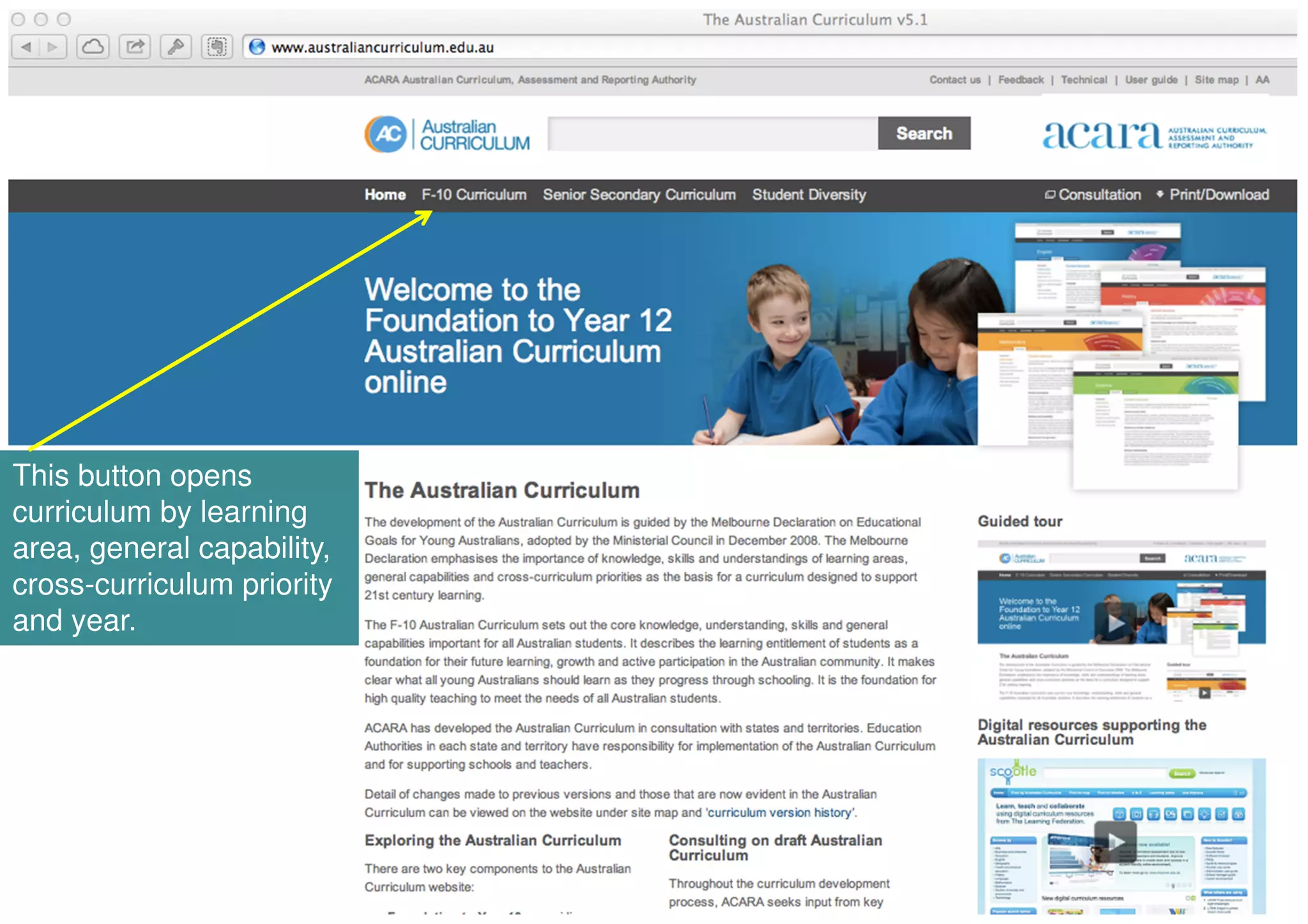
Presenting the curriculum electronically
This button opens
curriculum by learning
area, general capability,
cross-curriculum priority
and year.
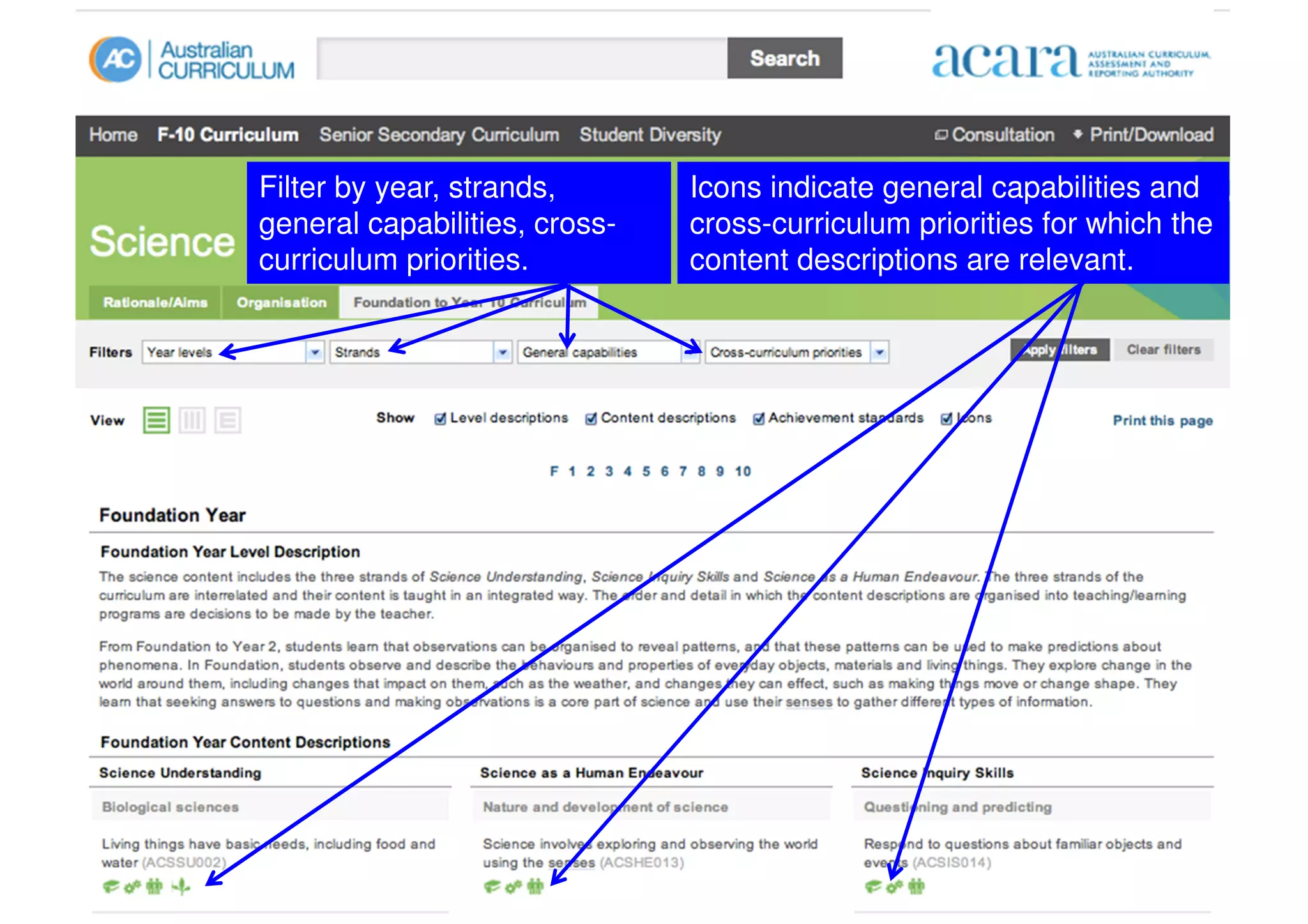
Icons indicate general capabilities and
cross-curriculum priorities for which the
content descriptions are relevant.
Filter by year, strands,
general capabilities, cross-
curriculum priorities.
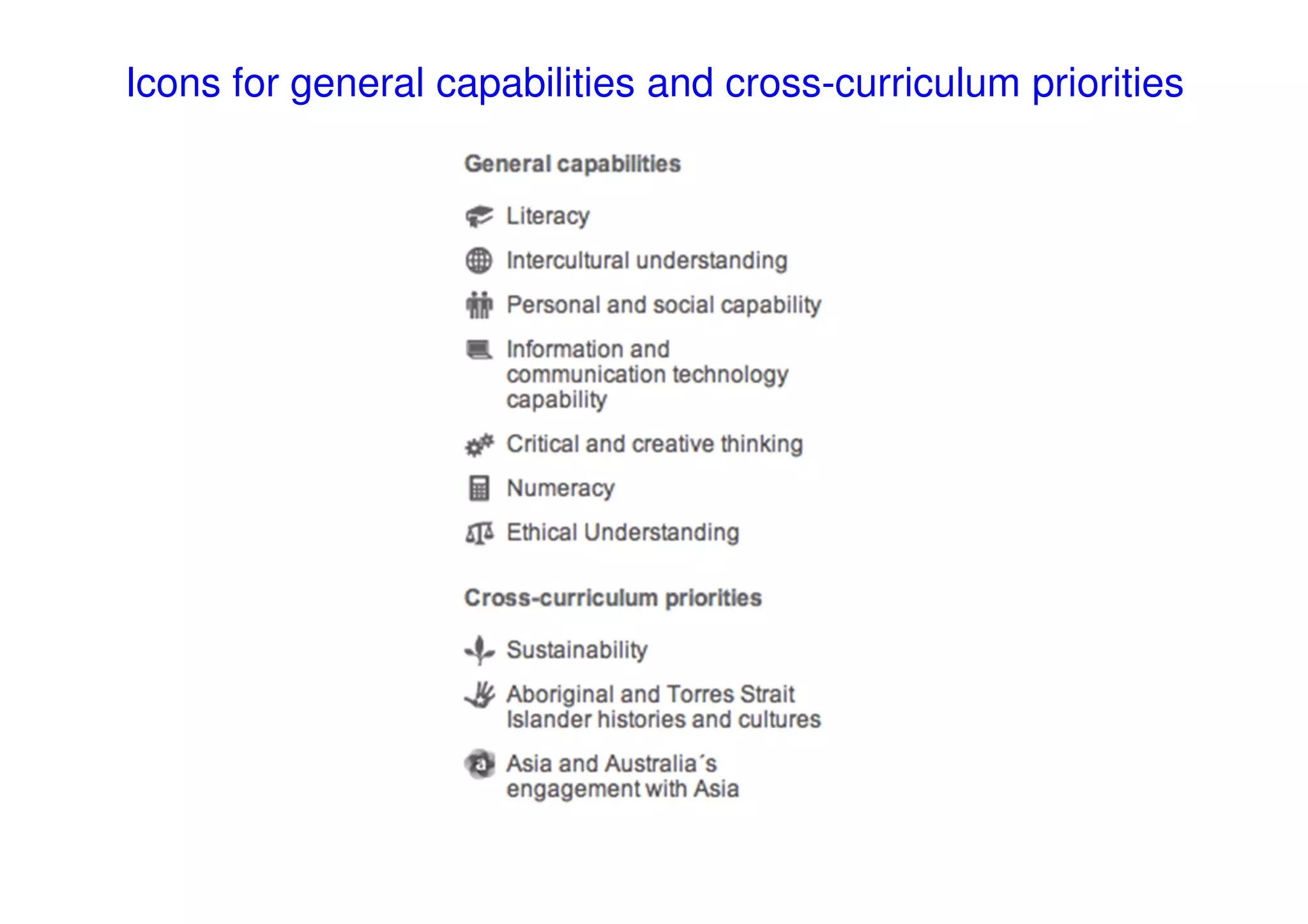
Icons for general capabilities and cross-curriculum priorities
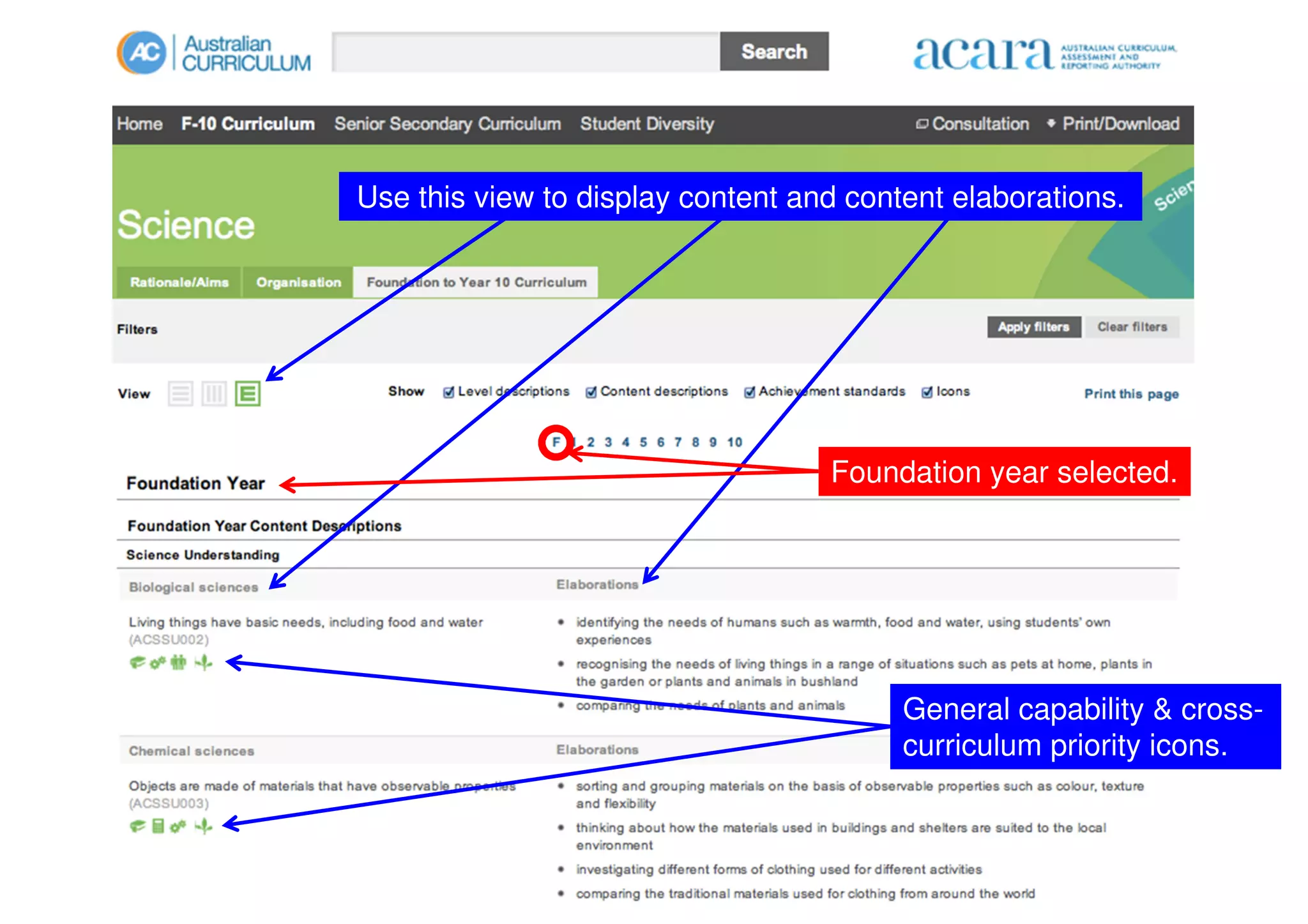
Use this view to display content and content elaborations.
Foundation year selected.
General capability & cross-
curriculum priority icons.
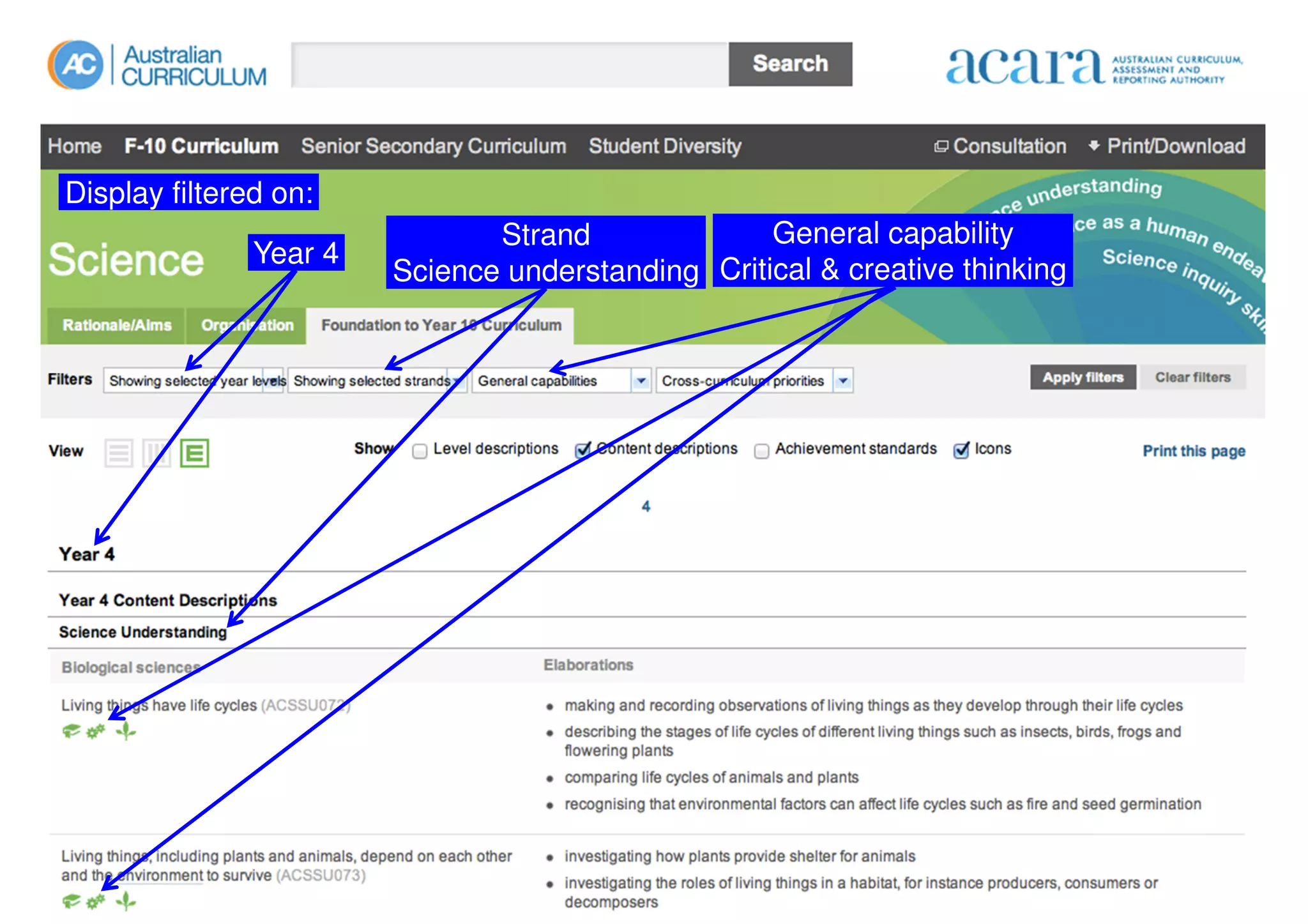
Display filtered on:
Year 4
Strand
Science understanding
General capability
Critical & creative thinking
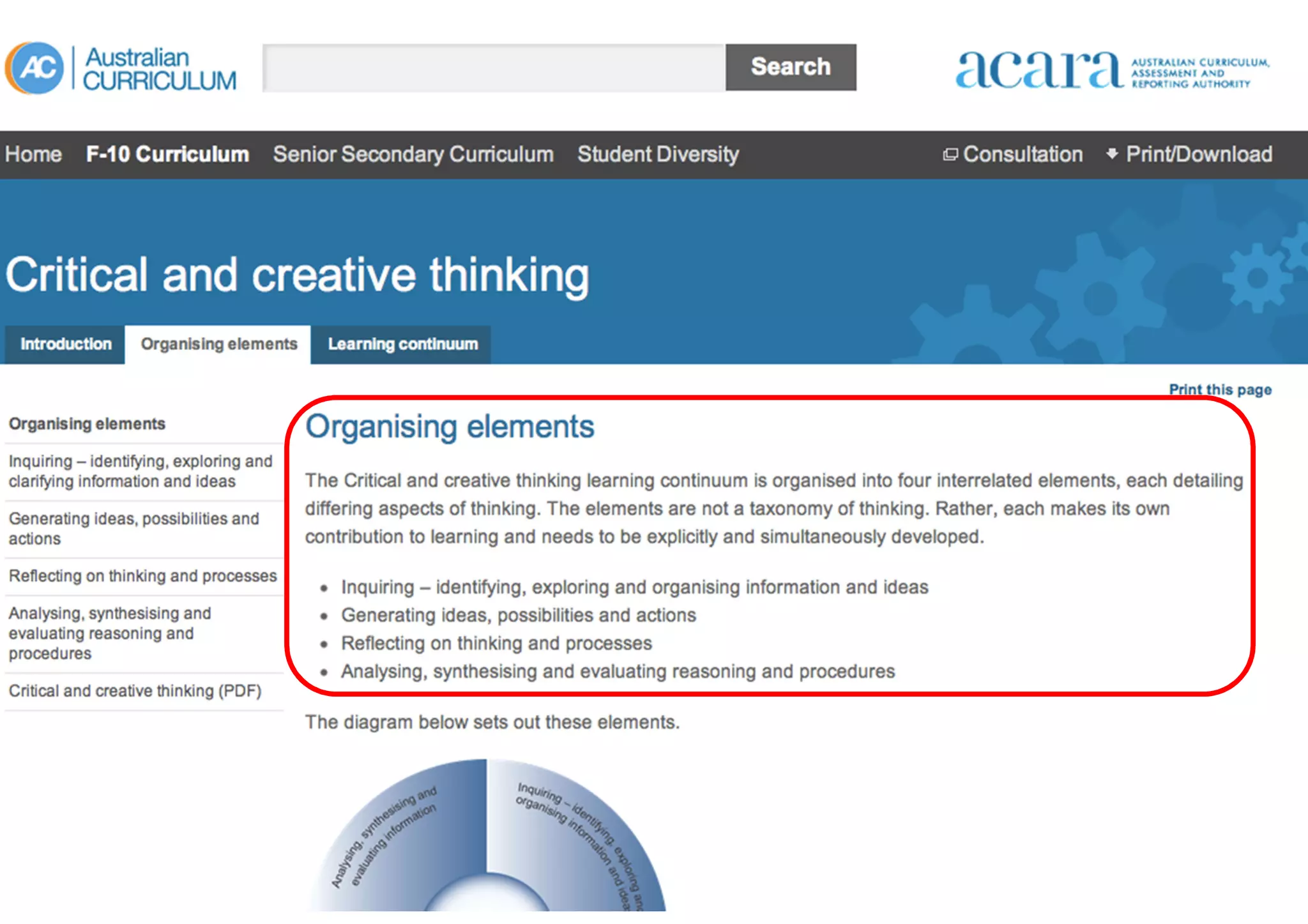
Organising elements
The Critical and creating thinking learning continuum is organised into four
interrelated elements, each detailing differing aspects of thinking. The
elements are not a taxonomy of thinking. Rather, each makes its own
contribution to learning and needs to be explicitly and simultaneously
developed.
Inquiring – identifying, exploring and organising information and ideas
Generating ideas, possibilities and actions
Reflecting on thinking and processes
Analysing, synthesising and evaluating reasoning and procedures.
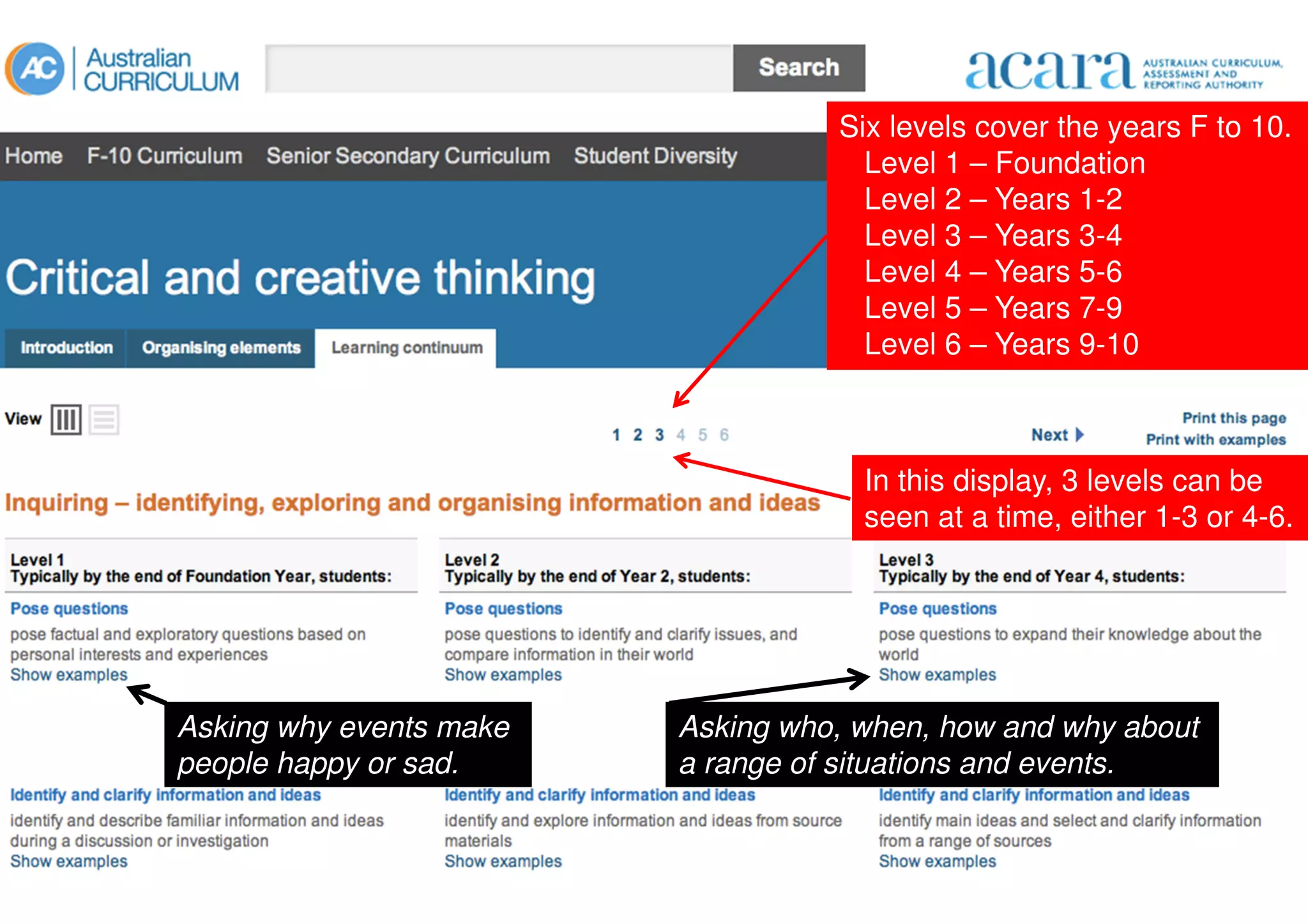
Six levels cover the years F to 10.
Level 1 – Foundation
Level 2 – Years 1-2
Level 3 – Years 3-4
Level 4 – Years 5-6
Level 5 – Years 7-9
Level 6 – Years 9-10
In this display, 3 levels can be
seen at a time, either 1-3 or 4-6.
Asking why events make
people happy or sad.
Asking who, when, how and why about
a range of situations and events.
Linking resources to the curriculum
for teachers
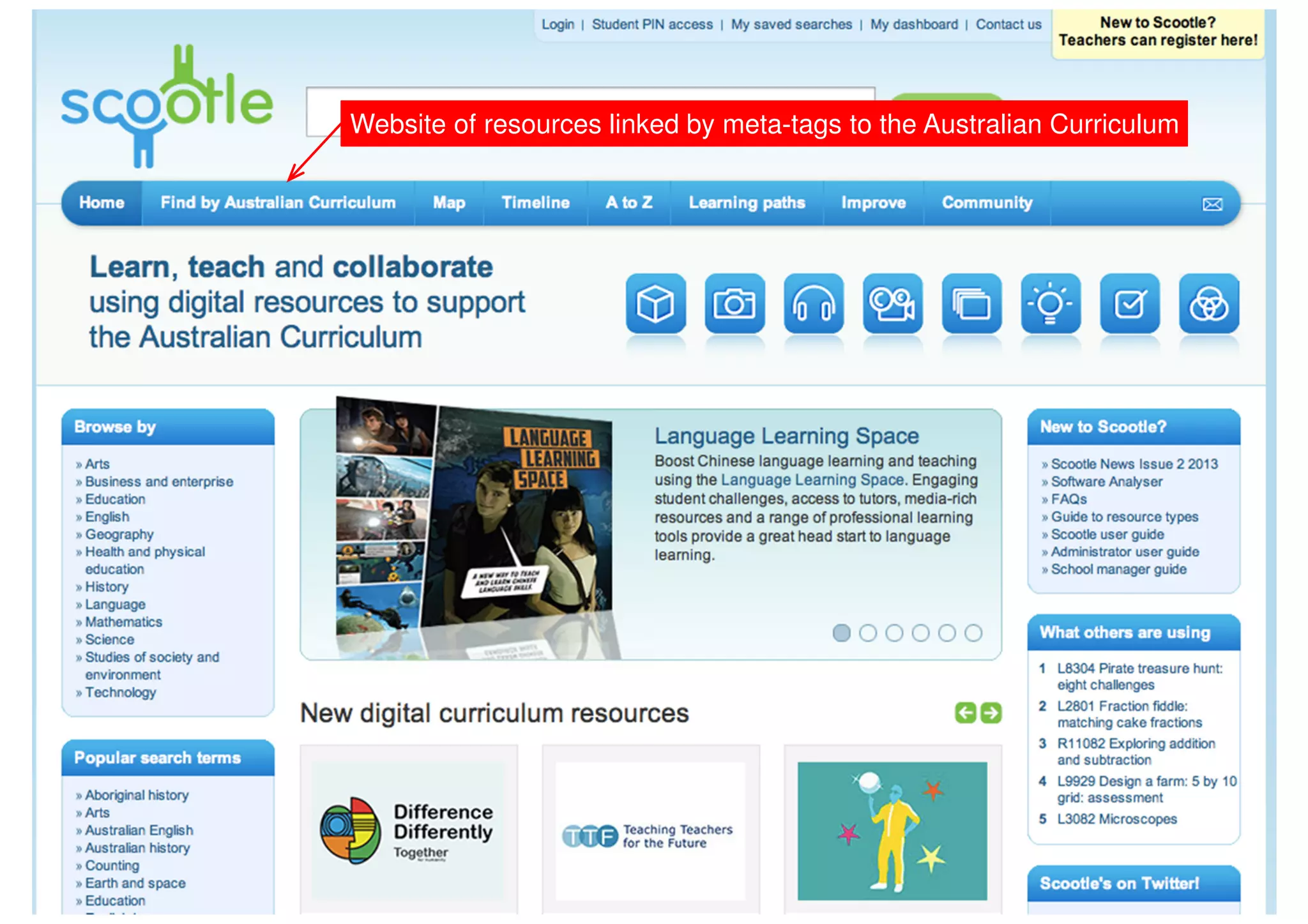
Website of resources linked by meta-tags to the Australian Curriculum
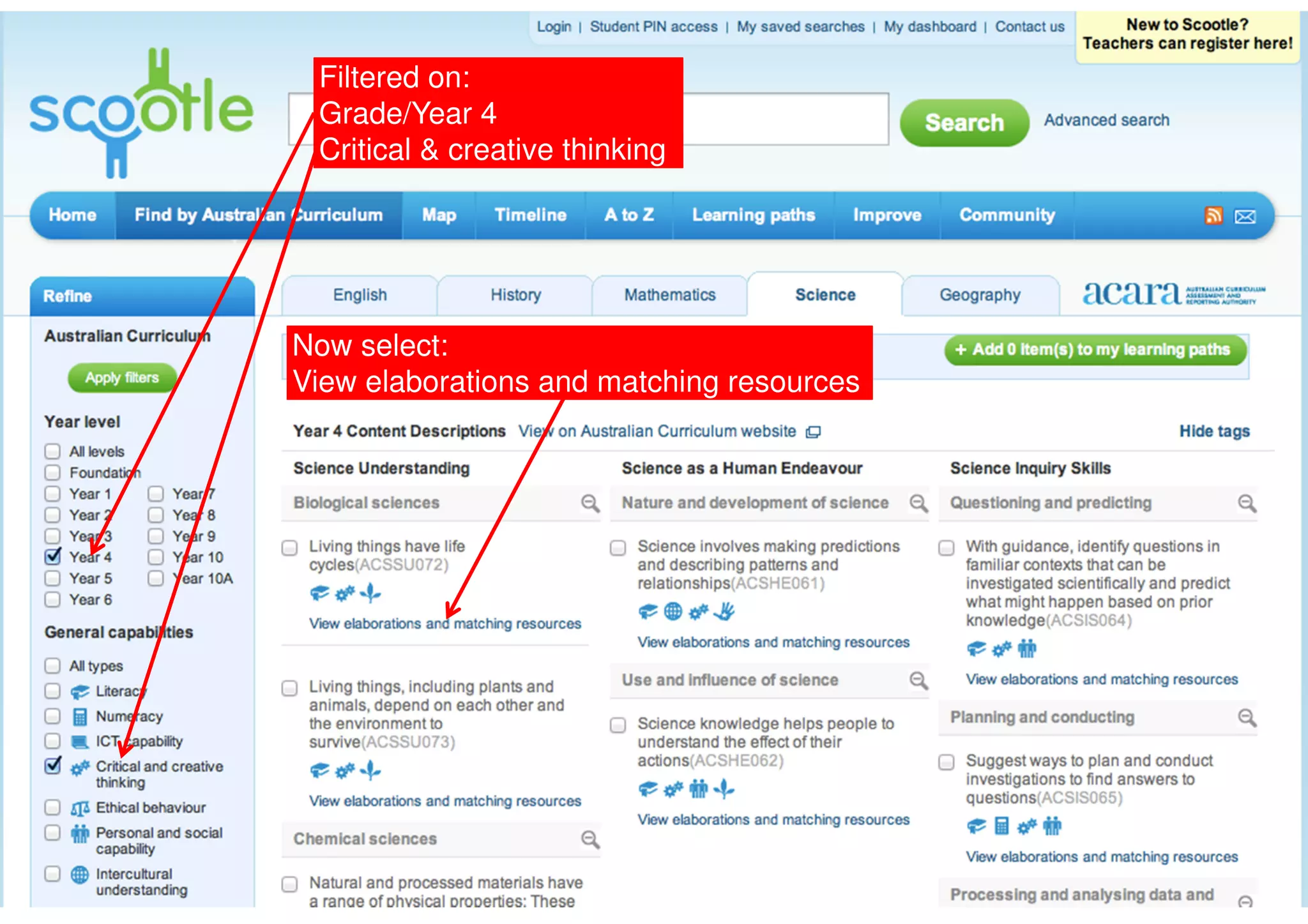
Filtered on:
Grade/Year 4
Critical & creative thinking
Now select:
View elaborations and matching resources
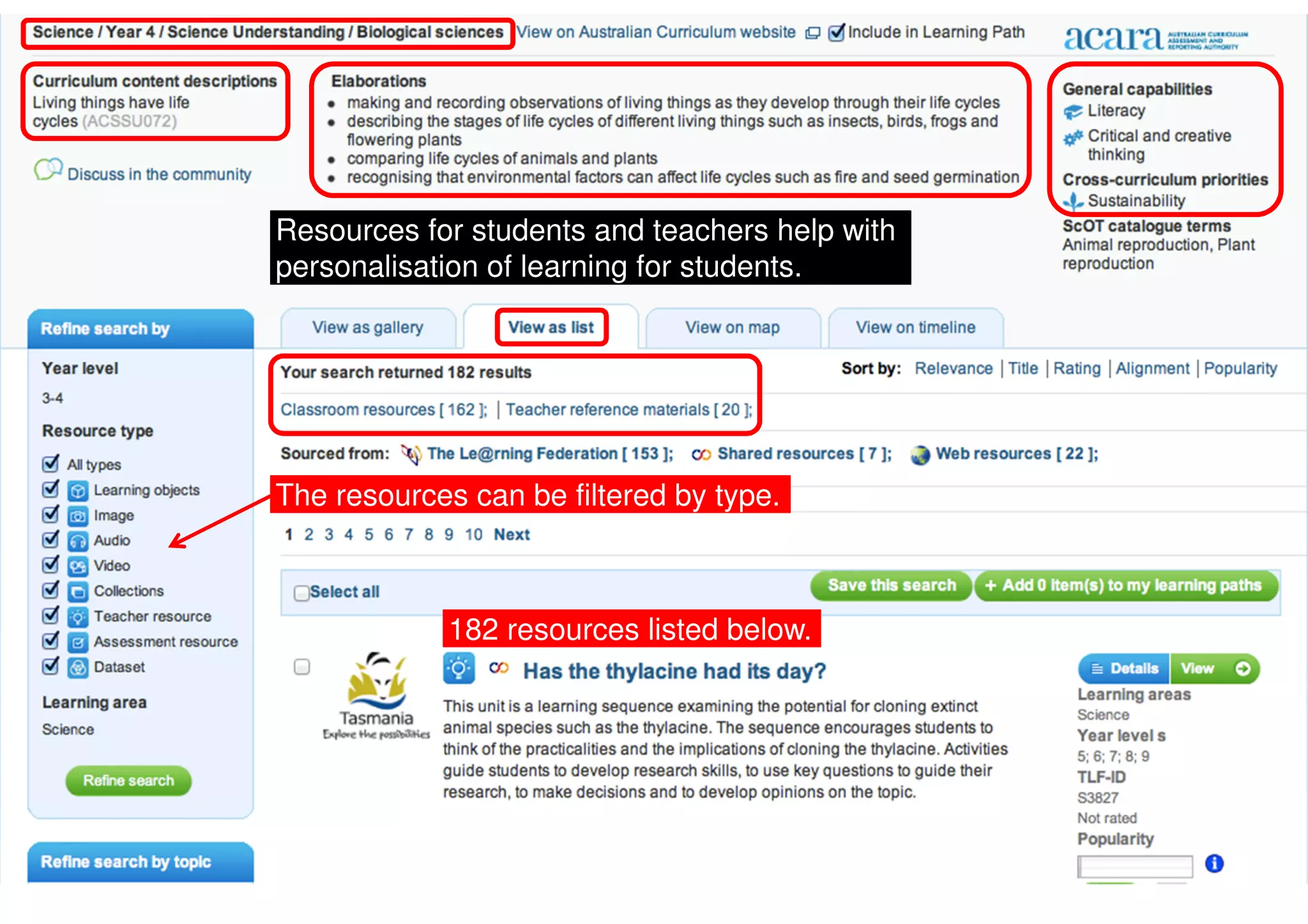
Resources for students and teachers help with
personalisation of learning for students.
The resources can be filtered by type.
182 resources listed below.
Australia’s move to a national perspective
Influenced by needs of students moving between states & territories
Shaped by international context
Australian Curriculum
Includes 21st century skills as general capabilities
Is also, very importantly, organised by disciplines/learning areas.
Provides developmental continua for both
Electronic presentation
Allows users to filter the curriculum in various ways.
Allows ready connection with a database of electronic resources
Powerful confluence of developments that is supporting a
major curriculum change in Australia.
Review and conclusion
Thank you.

Resourcing and supporting the Australian Curriculum

  • 1.
    Resourcing and supportingthe Australian Curriculum Barry McGaw Vice-Chancellor’s Fellow, University of Melbourne Chair, Australian Curriculum, Assessment and Reporting Authority The Curriculum Experience: Connect, Integrate, Lead Australian School Library Association Biennial Conference Hobart September 2013
  • 2.
    National view shapedby international context Simultaneous treatment of disciplines and 21st century skills Presenting the curriculum electronically Linking resources to the curriculum for teachers Outline of presentation
  • 3.
    National view shapedby international context
  • 4.
    Countries ahead ofAustralia in PISA 2009 Canada Finland Hong Kong - Korea - - - Shanghai Singapore Reading Mathematics Science Canada Finland Hong Kong Japan Korea Liechtenstein Macao Netherlands Shanghai Singapore Switzerland Taiwan - Finland Hong Kong Japan Korea - - - Shanghai Singapore OECD (2010), PISA 2009 results: what students know and can do, Fig. I.2.15, p.54, Fig. I.3.10, p134, Fig I.3.21, p.151.
  • 5.
    Comparison of changesin PISA performances Australia - Czech Republic - - Ireland - Sweden Australia Belgium Czech Republic Denmark France Iceland Ireland Netherlands Sweden 5 countries Significant decline Reading 2000-2009 Mathematics 2003-2009 Science 2006-2009 13 countries 8 countries 11 countries Significant improvement No significant change 21 countries 22 countries Australia + 39 countries
  • 6.
    Numbers of countriessignificantly ahead of Australia Level IEA OECD PIRLS TIMSS PISA Reading Maths Science Reading Maths Science Year 4 21 17 18 Year 8 6 9 15-yr-olds 7 12 6 IEA – International Association for the Evaluation of Educational Achievement PIRLS – Progress in International Reading Literacy Survey TIMSS – Trends in International Mathematics and Science Study OECD – Organisation for Economic Co-operation and Development PISA – Program for International Student Assessment
  • 7.
    Comparison with thebest – Yr 8 TIMSS mathematics Adv High Inter. Low37% 34% 20% 9% Australia Korea 7% 16% 30% 47% 37% of Australian students were at or below Low.
  • 8.
    Comparison with thebest – Yr 8 TIMSS science Adv High Inter. Low30% 35% 25% 11% Australia Finland 12% 35% 40% 13% 30% of Australian students were at or below Low.
  • 9.
    Australia among highperforming countries High ranking due to high mean BUT well behind the highest performers AND evidence of decline, particularly at the top end We need to raise expectations In our schools In our curricula Conclusion from international comparisons
  • 10.
    Simultaneous treatment ofdisciplines and 21st century skills
  • 11.
    Cisco/Intel/Microsoft Assessment andTeaching of 21st century skills project White paper defining 21st century skills • Ways of thinking – Creativity and innovation – Critical thinking, problem solving and decision making – Learning to learn and metacognition • Ways of working – Communication – Collaboration and teamwork • Tools for working – Information literacy – ICT literacy • Living in the world – Citizenship – global and local – Life and career – Personal and social responsibility 21st century skills for the 21st century
  • 12.
    Are they uniquely21st century? Most have been important for centuries The technology-rich environment is new Nomenclature General capabilities not 21st century skills Literacy Numeracy Information and communication technology capability Critical and creative thinking Personal and social capability Ethical understanding Intercultural understanding Key questions Do we have developmental continua for these capabilities? What content would be required for their development? Australian Curriculum view of 21st century skills
  • 13.
    ATC21S Australian Curriculum Waysof thinking Creativity and innovation Critical and creative thinking Critical thinking, problem solving & decision making Learning to learn and metacognition Personal capability Ways of working Communication Literacy Collaboration and teamwork Social capability Tools for working Information literacy ICT capability ICT literacy Numeracy Living in the world Citizenship – global and local Intercultural understanding Life and career Ethical understanding Personal and social responsibility Personal and social capability
  • 14.
    Central place forcontent Preserving the disciplines • Disciplines are the result of several millennia of human effort • Research on expertise shows importance of deep, domain-specific knowledge Attending to some current, cross-curriculum priorities • Aboriginal and Torres Strait Islander histories and cultures • Asia and Australia’s engagement with Asia • Sustainability Form of curriculum content Content descriptions setting out learning entitlements Content elaborations for teachers who would like more details Achievement standards with annotated samples of student work Can the same content serve the general capabilities? Australian Curriculum view of knowledge disciplines
  • 15.
    Structure of theAustralian Curriculum 7 General Capabilities Sustainability Asia and Australia’s engagement with Asia Aboriginal and Torres Strait Islander Histories and Cultures 3 Cross-curriculum Priorities Can general capabilities be covered in the cells? Many cells will be empty. Languages CivicsandCitizenship Economics,Business TheArts HealthandPhysicalEducation Technologies Geography History Science Mathematics English 11 Disciplines/Learning areas
  • 16.
  • 17.
    First the bigpicture Shape paper for the whole curriculum Shape Papers for learning areas Then the detail Draft Curriculum – approved by ACARA Board for consultation Final Curriculum – endorsed by ACARA Board, approved by Ministerial Council Curriculum development process
  • 18.
    International benchmarking ofthe Australian Curriculum Learning areas Systems against which development compared English Canada (Ontario), England, New Zealand, US (California) Mathematics Finland, Hong Kong, Singapore, USA (National Council of Teachers in Mathematics Standards, American Statistical Society Guidelines) Science Canada (Ontario), Finland, Singapore History Canada, England, Finland, Hong Kong, Ireland, Singapore Geography Canada (Ontario), England The Arts Canada (Ontario), England, Ireland, New Zealand, Scotland, Singapore, USA (National Art Education Statement, Framework for 21st Century Skills) Languages English-speaking systems: England, Scotland, American Council on Teaching of Foreign Languages Others: Canada (Ontario), Finland, Hong Kong, Japan, Singapore Health & Physical Education Canada (Ottawa), England, Finland, New Zealand, Singapore, Sweden (Outdoor Education) Technologies England, Netherlands, New Zealand, Sweden, USA (Standards for Technological Literacy) Civics & Citizenship Canada (Ontario), England, Hong Kong. Economics & Business Canada (Ontario), Scotland.
  • 19.
    Current state ofdevelopment of Australian Curriculum Learning areas F-10 Senior Years Phase 1 English Being implemented Integration underway Mathematics Being implemented Integration underway Science Being implemented Integration underway History Being implemented Integration underway Phase 2 Geography Final version approved by Ministers Integration underway The Arts Final version approved by Ministers Languages Consultations on drafts underway Phase 3 Health & Physical Education Consultation on draft completed Technologies Consultation on draft completed Civics & Citizenship Consultation on draft completed Economics & Business Consultation on draft completed Work Studies (yrs 9-10) Consultation on draft underway
  • 20.
  • 21.
    This button opens curriculumby learning area, general capability, cross-curriculum priority and year.
  • 22.
    Icons indicate generalcapabilities and cross-curriculum priorities for which the content descriptions are relevant. Filter by year, strands, general capabilities, cross- curriculum priorities.
  • 23.
    Icons for generalcapabilities and cross-curriculum priorities
  • 24.
    Use this viewto display content and content elaborations. Foundation year selected. General capability & cross- curriculum priority icons.
  • 25.
    Display filtered on: Year4 Strand Science understanding General capability Critical & creative thinking
  • 27.
    Organising elements The Criticaland creating thinking learning continuum is organised into four interrelated elements, each detailing differing aspects of thinking. The elements are not a taxonomy of thinking. Rather, each makes its own contribution to learning and needs to be explicitly and simultaneously developed. Inquiring – identifying, exploring and organising information and ideas Generating ideas, possibilities and actions Reflecting on thinking and processes Analysing, synthesising and evaluating reasoning and procedures.
  • 28.
    Six levels coverthe years F to 10. Level 1 – Foundation Level 2 – Years 1-2 Level 3 – Years 3-4 Level 4 – Years 5-6 Level 5 – Years 7-9 Level 6 – Years 9-10 In this display, 3 levels can be seen at a time, either 1-3 or 4-6. Asking why events make people happy or sad. Asking who, when, how and why about a range of situations and events.
  • 29.
    Linking resources tothe curriculum for teachers
  • 30.
    Website of resourceslinked by meta-tags to the Australian Curriculum
  • 31.
    Filtered on: Grade/Year 4 Critical& creative thinking Now select: View elaborations and matching resources
  • 32.
    Resources for studentsand teachers help with personalisation of learning for students. The resources can be filtered by type. 182 resources listed below.
  • 33.
    Australia’s move toa national perspective Influenced by needs of students moving between states & territories Shaped by international context Australian Curriculum Includes 21st century skills as general capabilities Is also, very importantly, organised by disciplines/learning areas. Provides developmental continua for both Electronic presentation Allows users to filter the curriculum in various ways. Allows ready connection with a database of electronic resources Powerful confluence of developments that is supporting a major curriculum change in Australia. Review and conclusion
  • 34.