Team Name - Desh Premi
Team members
Sneha Arolkar
Naveen Phani Krishna
Prashant Takker
Shivam Seth
Aastha Pandey
Brain Gain - Promoting Research & Innovation in India
0
50000
100000
150000
200000
250000 1981
1983
1985
1987
1989
1991
1993
1995
1997
1999
2001
2003
2005
2007
2009
2011
Scientific & Technical Journals
Published
India China United States
0
100
200
300
400
500
600
700
800
900
2009-2010 2010-2011 2011-2012 2012-2013
Patents Filed Patents Granted
0
0.5
1
1.5
2
2.5
3
3.5
1996
1997
1998
1999
2000
2001
2002
2003
2004
2005
2006
2007
2008
2009
2010
2011
R&D expenditure(% of GDP)
India China United States
57346
16985
995742
1951245
80373
93913
17391
192725
3405720
0 500000 1000000 1500000 2000000 2500000 3000000 3500000 4000000
Ph.d
M. Phill
Post Graduate
Under Graduate
PG Diploma
Diploma
Certificate
Integrated
India
Level Wise Enrollment Of Students in
Universities(2010-2011)
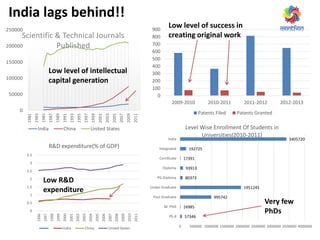
India lags behind!!
Low R&D
expenditure
Low level of intellectual
capital generation
Very few
PhDs
Low level of success in
creating original work
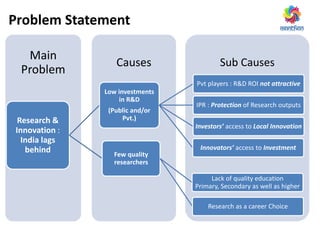
Problem Statement
Sub CausesCauses
Main
Problem
Research &
Innovation :
India lags
behind
Low investments
in R&D
(Public and/or
Pvt.)
Pvt players : R&D ROI not attractive
IPR : Protection of Research outputs
Investors’ access to Local Innovation
Innovators’ access to Investment
Few quality
researchers
Lack of quality education
Primary, Secondary as well as higher
Research as a career Choice
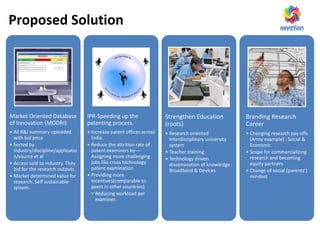
Proposed Solution
Market Oriented Database
of Innovation (MODRI)
• All R&I summary uploaded
with bid price
• Sorted by
industry/discipline/applicatio
n/source et al
• Access sold to industry. They
bid for the research outputs.
• Market determined value for
research. Self sustainable
system.
IPR-Speeding up the
patenting process.
• Increase patent offices across
India.
• Reduce the attrition rate of
patent examiners by----
Assigning more challenging
jobs like cross technology
patent examination
• Providing more
incentives(comparable to
peers in other countries)
• Reducing workload per
examiner.
Strengthen Education
(roots)
• Research oriented
Interdisciplinary university
system
• Teacher training
• Technology driven
dissemination of knowledge :
Broadband & Devices
Branding Research
Career
• Changing research pay offs
(Army example) : Social &
Economic
• Scope for commercializing
research and becoming
equity partners
• Change of social (parents’)
mindset
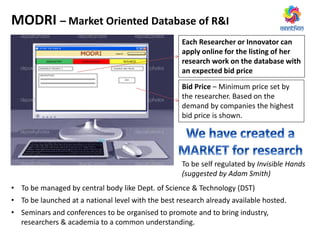
MODRI – Market Oriented Database of R&I
Each Researcher or Innovator can
apply online for the listing of her
research work on the database with
an expected bid price
Bid Price – Minimum price set by
the researcher. Based on the
demand by companies the highest
bid price is shown.
• To be managed by central body like Dept. of Science & Technology (DST)
• To be launched at a national level with the best research already available hosted.
• Seminars and conferences to be organised to promote and to bring industry,
researchers & academia to a common understanding.
To be self regulated by Invisible Hands
(suggested by Adam Smith)
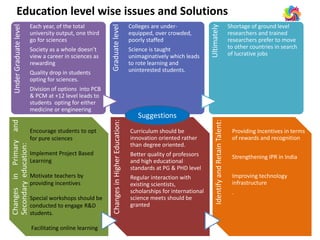
Education level wise issues and SolutionsUnderGraduatelevel
Each year, of the total
university output, one third
go for sciences
Society as a whole doesn’t
view a career in sciences as
rewarding
Quality drop in students
opting for sciences.
Division of options into PCB
& PCM at +12 level leads to
students opting for either
medicine or engineering
Graduatelevel
Colleges are under-
equipped, over crowded,
poorly staffed
Science is taught
unimaginatively which leads
to rote learning and
uninterested students.
Ultimately
Shortage of ground level
researchers and trained
researchers prefer to move
to other countries in search
of lucrative jobs
ChangesinPrimaryand
Secondaryeducation:
ChangesinHigherEducation:
Curriculum should be
innovation oriented rather
than degree oriented.
Better quality of professors
and high educational
standards at PG & PHD level
Regular interaction with
existing scientists,
scholarships for international
science meets should be
granted
IdentifyandRetainTalent:
Providing Incentives in terms
of rewards and recognition
Strengthening IPR in India
Improving technology
infrastructure
.
Encourage students to opt
for pure sciences
Implement Project Based
Learning
Motivate teachers by
providing incentives
Special workshops should be
conducted to engage R&D
students.
Facilitating online learning
Suggestions
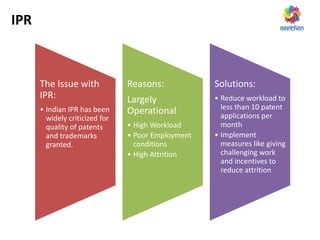
IPR
The Issue with
IPR:
• Indian IPR has been
widely criticized for
quality of patents
and trademarks
granted.
Reasons:
Largely
Operational
• High Workload
• Poor Employment
conditions
• High Attrition
Solutions:
• Reduce workload to
less than 10 patent
applications per
month
• Implement
measures like giving
challenging work
and incentives to
reduce attrition
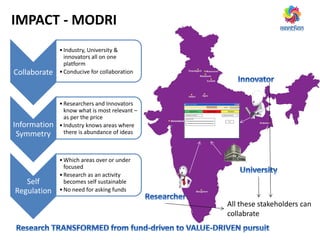
IMPACT - MODRI
All these stakeholders can
collabrate
Collaborate
•Industry, University &
innovators all on one
platform
•Conducive for collaboration
Information
Symmetry
•Researchers and Innovators
know what is most relevant –
as per the price
•Industry knows areas where
there is abundance of ideas
Self
Regulation
•Which areas over or under
focused
•Research as an activity
becomes self sustainable
•No need for asking funds
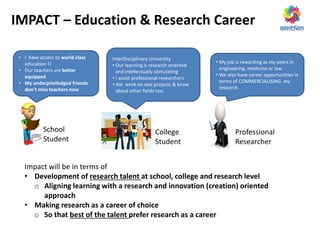
IMPACT – Education & Research Career
• I have access to world class
education !!
• Our teachers are better
equipped
• My underpriviledged friends
don’t miss teachers now
InterDisciplinary University
• Our learning is research oriented
and intellectually stimulating
• I assist professional researchers
• We work on real projects & know
about other fields too.
• My job is rewarding as my peers in
engineering, medicine or law
• We also have career opportunities in
terms of COMMERCIALISING my
research
School
Student
College
Student
Professional
Researcher
Impact will be in terms of
• Development of research talent at school, college and research level
o Aligning learning with a research and innovation (creation) oriented
approach
• Making research as a career of choice
o So that best of the talent prefer research as a career
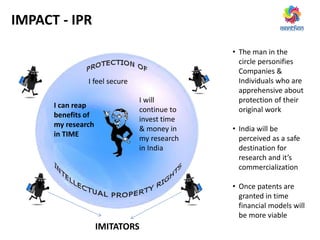
IMPACT - IPR
I feel secure
I can reap
benefits of
my research
in TIME
I will
continue to
invest time
& money in
my research
in India
IMITATORS
• The man in the
circle personifies
Companies &
Individuals who are
apprehensive about
protection of their
original work
• India will be
perceived as a safe
destination for
research and it’s
commercialization
• Once patents are
granted in time
financial models will
be more viable
Key Challenges & Risks
• Making it a credible platform – marketing it
• People in rural areas might not know how to use
it.
• If not implemented transparently would be
rendered ineffective.
REFERENCES
• Research paper by American academy of arts and science
• Paper on science technology and innovation policy by
ministry of science and technology, New Delhi
• Report of University Science Education – Academy of
sciences
• Paper on Intellectual property in nanotechnology
economy- Institute of Nanotechnology
• World Bank Website
• Ministry of Commerce Website
• Article titled “Indian IP examiners have worlds highest
work load and lowest pay” by C.H. Unnikrishnan on
www.livemint.com
Annex 1:Effect of R&D on India’s Revenues
0.00
50,000,000,000.00
100,000,000,000.00
150,000,000,000.00
200,000,000,000.00
250,000,000,000.00
300,000,000,000.00
350,000,000,000.00
400,000,000,000.00
450,000,000,000.00
500,000,000,000.00
1983
1984
1985
1986
1987
1988
1989
1990
1991
1992
1993
1994
1995
1996
1997
1998
1999
2000
2001
2002
2003
2004
2005
2006
2007
2008
2009
2010
2011
High Technology Exports In US$
They are products with high R&D intensity, such as in aerospace, computers,
pharmaceuticals, scientific instruments, and electrical machinery
United States India China

DeshPremi

  • 1.
    Team Name -Desh Premi Team members Sneha Arolkar Naveen Phani Krishna Prashant Takker Shivam Seth Aastha Pandey Brain Gain - Promoting Research & Innovation in India
  • 2.
    0 50000 100000 150000 200000 250000 1981 1983 1985 1987 1989 1991 1993 1995 1997 1999 2001 2003 2005 2007 2009 2011 Scientific &Technical Journals Published India China United States 0 100 200 300 400 500 600 700 800 900 2009-2010 2010-2011 2011-2012 2012-2013 Patents Filed Patents Granted 0 0.5 1 1.5 2 2.5 3 3.5 1996 1997 1998 1999 2000 2001 2002 2003 2004 2005 2006 2007 2008 2009 2010 2011 R&D expenditure(% of GDP) India China United States 57346 16985 995742 1951245 80373 93913 17391 192725 3405720 0 500000 1000000 1500000 2000000 2500000 3000000 3500000 4000000 Ph.d M. Phill Post Graduate Under Graduate PG Diploma Diploma Certificate Integrated India Level Wise Enrollment Of Students in Universities(2010-2011) India lags behind!! Low R&D expenditure Low level of intellectual capital generation Very few PhDs Low level of success in creating original work
  • 3.
    Problem Statement Sub CausesCauses Main Problem Research& Innovation : India lags behind Low investments in R&D (Public and/or Pvt.) Pvt players : R&D ROI not attractive IPR : Protection of Research outputs Investors’ access to Local Innovation Innovators’ access to Investment Few quality researchers Lack of quality education Primary, Secondary as well as higher Research as a career Choice
  • 4.
    Proposed Solution Market OrientedDatabase of Innovation (MODRI) • All R&I summary uploaded with bid price • Sorted by industry/discipline/applicatio n/source et al • Access sold to industry. They bid for the research outputs. • Market determined value for research. Self sustainable system. IPR-Speeding up the patenting process. • Increase patent offices across India. • Reduce the attrition rate of patent examiners by---- Assigning more challenging jobs like cross technology patent examination • Providing more incentives(comparable to peers in other countries) • Reducing workload per examiner. Strengthen Education (roots) • Research oriented Interdisciplinary university system • Teacher training • Technology driven dissemination of knowledge : Broadband & Devices Branding Research Career • Changing research pay offs (Army example) : Social & Economic • Scope for commercializing research and becoming equity partners • Change of social (parents’) mindset
  • 5.
    MODRI – MarketOriented Database of R&I Each Researcher or Innovator can apply online for the listing of her research work on the database with an expected bid price Bid Price – Minimum price set by the researcher. Based on the demand by companies the highest bid price is shown. • To be managed by central body like Dept. of Science & Technology (DST) • To be launched at a national level with the best research already available hosted. • Seminars and conferences to be organised to promote and to bring industry, researchers & academia to a common understanding. To be self regulated by Invisible Hands (suggested by Adam Smith)
  • 6.
    Education level wiseissues and SolutionsUnderGraduatelevel Each year, of the total university output, one third go for sciences Society as a whole doesn’t view a career in sciences as rewarding Quality drop in students opting for sciences. Division of options into PCB & PCM at +12 level leads to students opting for either medicine or engineering Graduatelevel Colleges are under- equipped, over crowded, poorly staffed Science is taught unimaginatively which leads to rote learning and uninterested students. Ultimately Shortage of ground level researchers and trained researchers prefer to move to other countries in search of lucrative jobs ChangesinPrimaryand Secondaryeducation: ChangesinHigherEducation: Curriculum should be innovation oriented rather than degree oriented. Better quality of professors and high educational standards at PG & PHD level Regular interaction with existing scientists, scholarships for international science meets should be granted IdentifyandRetainTalent: Providing Incentives in terms of rewards and recognition Strengthening IPR in India Improving technology infrastructure . Encourage students to opt for pure sciences Implement Project Based Learning Motivate teachers by providing incentives Special workshops should be conducted to engage R&D students. Facilitating online learning Suggestions
  • 7.
    IPR The Issue with IPR: •Indian IPR has been widely criticized for quality of patents and trademarks granted. Reasons: Largely Operational • High Workload • Poor Employment conditions • High Attrition Solutions: • Reduce workload to less than 10 patent applications per month • Implement measures like giving challenging work and incentives to reduce attrition
  • 8.
    IMPACT - MODRI Allthese stakeholders can collabrate Collaborate •Industry, University & innovators all on one platform •Conducive for collaboration Information Symmetry •Researchers and Innovators know what is most relevant – as per the price •Industry knows areas where there is abundance of ideas Self Regulation •Which areas over or under focused •Research as an activity becomes self sustainable •No need for asking funds
  • 9.
    IMPACT – Education& Research Career • I have access to world class education !! • Our teachers are better equipped • My underpriviledged friends don’t miss teachers now InterDisciplinary University • Our learning is research oriented and intellectually stimulating • I assist professional researchers • We work on real projects & know about other fields too. • My job is rewarding as my peers in engineering, medicine or law • We also have career opportunities in terms of COMMERCIALISING my research School Student College Student Professional Researcher Impact will be in terms of • Development of research talent at school, college and research level o Aligning learning with a research and innovation (creation) oriented approach • Making research as a career of choice o So that best of the talent prefer research as a career
  • 10.
    IMPACT - IPR Ifeel secure I can reap benefits of my research in TIME I will continue to invest time & money in my research in India IMITATORS • The man in the circle personifies Companies & Individuals who are apprehensive about protection of their original work • India will be perceived as a safe destination for research and it’s commercialization • Once patents are granted in time financial models will be more viable
  • 11.
    Key Challenges &Risks • Making it a credible platform – marketing it • People in rural areas might not know how to use it. • If not implemented transparently would be rendered ineffective.
  • 12.
    REFERENCES • Research paperby American academy of arts and science • Paper on science technology and innovation policy by ministry of science and technology, New Delhi • Report of University Science Education – Academy of sciences • Paper on Intellectual property in nanotechnology economy- Institute of Nanotechnology • World Bank Website • Ministry of Commerce Website • Article titled “Indian IP examiners have worlds highest work load and lowest pay” by C.H. Unnikrishnan on www.livemint.com
  • 13.
    Annex 1:Effect ofR&D on India’s Revenues 0.00 50,000,000,000.00 100,000,000,000.00 150,000,000,000.00 200,000,000,000.00 250,000,000,000.00 300,000,000,000.00 350,000,000,000.00 400,000,000,000.00 450,000,000,000.00 500,000,000,000.00 1983 1984 1985 1986 1987 1988 1989 1990 1991 1992 1993 1994 1995 1996 1997 1998 1999 2000 2001 2002 2003 2004 2005 2006 2007 2008 2009 2010 2011 High Technology Exports In US$ They are products with high R&D intensity, such as in aerospace, computers, pharmaceuticals, scientific instruments, and electrical machinery United States India China