Technology Learning Center
                                                                             1/20/2012


STEM Education Reform:
Technology Learning Center
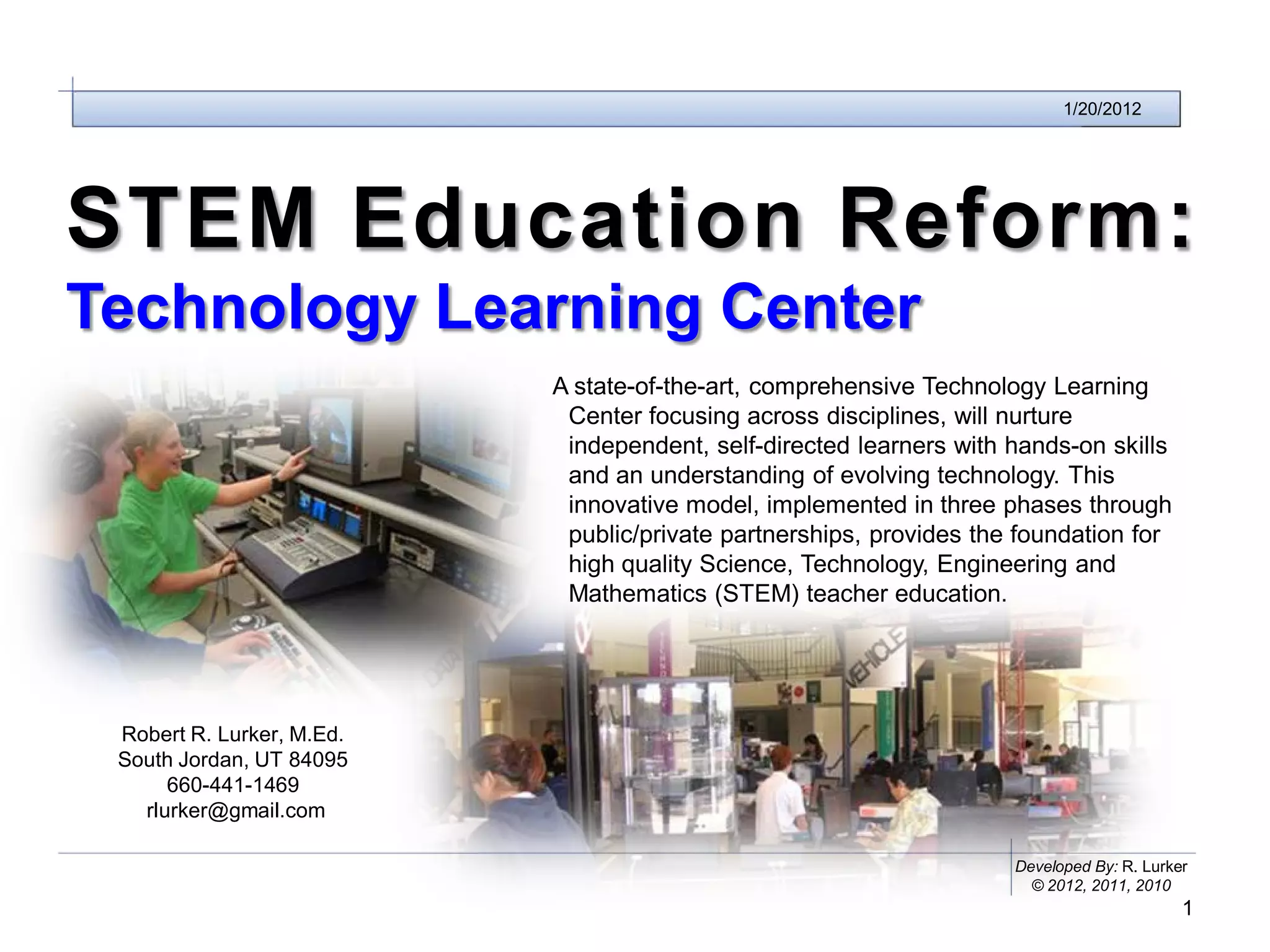
                             A state-of-the-art, comprehensive Technology Learning
                              Center focusing across disciplines, will nurture
                              independent, self-directed learners with hands-on skills
                              and an understanding of evolving technology. This
                              innovative model, implemented in three phases through
                              public/private partnerships, provides the foundation for
                              high quality Science, Technology, Engineering and
                              Mathematics (STEM) teacher education.


  Robert R. Lurker, M.Ed.
  South Jordan, UT 84095
       660-441-1469
    rlurker@gmail.com

                                                                       Developed By: R. Lurker
                                                                         © 2012, 2011, 2010
                                                                                             1
Technology Learning Center
                                                                                                     1/20/2012


                              Presentation Contents
Overview                                   Slide # 1-9     Learning into Practice                      Slide # 27-45
  ● STEM Education Today ● Defining STEM Literacy            Phase I – 21st Century Learning Demonstration
  ● STEM Education Reform ● TLC Project – Improving            ● Demonstration Facilities ● Implementation
  STEM Education ● STEM Education Transformation             Phase II - Design Collaboration and Construction
  ● Project History ● Goals and Objectives
                                                                ● Technology Learning Center Design and
Learning Concepts                          Slide # 10-16        Construction ● Lab Design Concepts/Possibilities
  ● Creative Learning Systems ● Learning Environment            ● Advanced Zone Design Applications
  ● Sample Layout ● Standardized Test Performance               ● Community Design Applications/Interactions
  ● Case Study ● SmartLab™ Student Comments                     ● Building Design Concept Example
                                                             Phase III – 21st Century in Practice
Learning Environment                       Slide # 17-26
                                                               ● Operations ● Opportunities for Involvement
  ● Design Concept ● Building Design Concept                    ● Funding Opportunities ● Budget Estimates –
  ● Central Core ● Example ● Learning Areas                     Technology Learning Center Phases I, II, III and
  ● Educational Applications ● Potential Core Course            STEM Implementation Statewide
  Offerings ● Repeatability ● Outcomes
                                                           Summary                                     Slide # 46

                                                           Selected Bibliography                       Slide # 47- 49

                                                           Contributors                                Slide # 50- 58

                                                           Appendices                                  Slide # 59- 71

                                                                                               Developed By: R. Lurker
                                                                                                 © 2012, 2011, 2010
                                                                                                                       2
Technology Learning Center
                                                                              1/20/2012


STEM Education Today
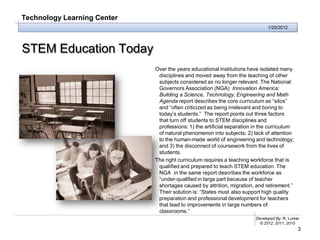
                             Over the years educational institutions have isolated many
                              disciplines and moved away from the teaching of other
                              subjects considered as no longer relevant. The National
                              Governors Association (NGA) Innovation America:
                              Building a Science, Technology, Engineering and Math
                              Agenda report describes the core curriculum as “silos”
                              and “often criticized as being irrelevant and boring to
                              today’s students.” The report points out three factors
                              that turn off students to STEM disciplines and
                              professions: 1) the artificial separation in the curriculum
                              of natural phenomenon into subjects; 2) lack of attention
                              to the human-made world of engineering and technology;
                              and 3) the disconnect of coursework from the lives of
                              students.
                             The right curriculum requires a teaching workforce that is
                              qualified and prepared to teach STEM education. The
                              NGA in the same report describes the workforce as
                              “under-qualified in large part because of teacher
                              shortages caused by attrition, migration, and retirement.”
                              Their solution is: “States must also support high quality
                              preparation and professional development for teachers
                              that lead to improvements in large numbers of
                              classrooms.”
                                                                        Developed By: R. Lurker
                                                                          © 2012, 2011, 2010
                                                                                              3
Technology Learning Center
                                                                                                          1/20/2012


Defining STEM Literacy

The National Governors Association (NGA) Innovation             • Engineering literacy is the understanding of how
America: Building a Science, Technology, Engineering              technologies are developed via the engineering
and Math Agenda report provides definitions of STEM               design process; … Engineering design is the
literacy developed by the Organisation for Economic               systematic and creative application of scientific
Co-operation and Development and the International                and mathematic principles to practical ends such
Technology Education Association                                  as the design, manufacture, and operation of
                                                                  efficient and economical structures, machines,
“STEM literacy refers to an individual’s ability to apply         processes, and systems.
his or her understanding of how the world works within          • Mathematical literacy means the ability of students
and across four interrelated domains.                             to analyze, reason, and communicate ideas
    • Scientific literacy is the ability to use scientific        effectively as they pose, formulate, solve, and
      knowledge … (in three main areas — science in               interpret solutions to mathematical problems in a
      life and health, science in Earth and environment,          variety of situations.“
      and science in technology).
    • Technological literacy means the ability to use,       “Consequently, a STEM classroom shifts students away
      manage, understand, and assess technology. …           from learning discrete bits and pieces of phenomenon
      Technology is the innovation, change, or               and rote procedures and toward having investigating
      modification of the natural environment to satisfy     and questioning the interrelated facets of the world.”
      perceived human needs and wants.                       (Morrison, 2006)


                                                                                                    Developed By: R. Lurker
                                                                                                      © 2012, 2011, 2010
                                                                                                                          4
Technology Learning Center
                                                                                                             1/20/2012


                               STEM Education Reform
              Key Challenges                                                   Opportunities
•    U.S. students of all ages are at a comparative           •   Build learning environments that address the 21st
     disadvantage internationally in terms of science,            Century and prepare students and teachers for a
     technology, engineering and mathematics (STEM)               global economy.
     education as shown by lower math test scores among       •   Apply innovative, existing methods developed by
     others.                                                      Creative Learning Systems (CLS) for their learning
                                                                  labs. CLS has provided positive outcomes that
•    Poor high school graduation rates contribute to higher       suggest this approach is a candidate for identification
     unemployment and crime rates among young adults.             as a "best practice".
                                                              •   Apply a comprehensive approach to the University
•    Inadequate, lecture-based methods of pre-service             level for pre- and in-service STEM teacher education
     and in-service teachers for early childhood,                 and provide broad access and technology resources
     elementary, middle/junior high secondary and post-           for general education and capstone courses.
     secondary levels result in ill-equipped teachers and     •   Address community needs for post professional
     unacceptable turnover rates.                                 technology education for business, industry, law
                                                                  enforcement and the military.
•    STEM education reform is required to address 21st        •   Apply the “three-dimensional textbook” approach
     Century technological needs for the U.S. to succeed          (Taylor, 2009) creating holistic, sustainable learning
     in a global economy.                                         environments, that apply green technology in the
                                                                  design and ongoing operational philosophy.
                                                                                                       Developed By: R. Lurker
                                                                                                         © 2012, 2011, 2010
                                                                                                                             5
Technology Learning Center
                                                                                1/20/2012


TLC Project – Improving STEM Education
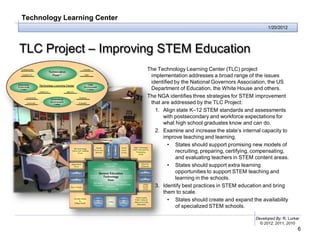
                             The Technology Learning Center (TLC) project
                              implementation addresses a broad range of the issues
                              identified by the National Governors Association, the US
                              Department of Education, the White House and others.
                             The NGA identifies three strategies for STEM improvement
                              that are addressed by the TLC Project:
                                1. Align state K–12 STEM standards and assessments
                                    with postsecondary and workforce expectations for
                                    what high school graduates know and can do.
                                2. Examine and increase the state’s internal capacity to
                                    improve teaching and learning.
                                      • States should support promising new models of
                                         recruiting, preparing, certifying, compensating,
                                         and evaluating teachers in STEM content areas.
                                      • States should support extra learning
                                         opportunities to support STEM teaching and
                                         learning in the schools.
                                3. Identify best practices in STEM education and bring
                                    them to scale.
                                      • States should create and expand the availability
                                         of specialized STEM schools.

                                                                          Developed By: R. Lurker
                                                                            © 2012, 2011, 2010
                                                                                                6
Technology Learning Center
                                                                                         1/20/2012


TLC Project - STEM Education Transformation
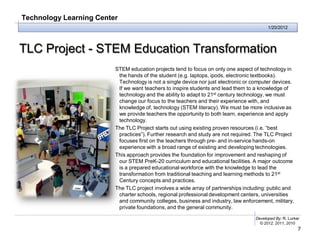
                         STEM education projects tend to focus on only one aspect of technology in
                          the hands of the student (e.g. laptops, ipods, electronic textbooks).
                          Technology is not a single device nor just electronic or computer devices.
                          If we want teachers to inspire students and lead them to a knowledge of
                          technology and the ability to adapt to 21st century technology, we must
                          change our focus to the teachers and their experience with, and
                          knowledge of, technology (STEM literacy). We must be more inclusive as
                          we provide teachers the opportunity to both learn, experience and apply
                          technology.
                         The TLC Project starts out using existing proven resources (i.e. “best
                          practices”). Further research and study are not required. The TLC Project
                          focuses first on the teachers through pre- and in-service hands-on
                          experience with a broad range of existing and developing technologies.
                         This approach provides the foundation for improvement and reshaping of
                          our STEM PreK-20 curriculum and educational facilities. A major outcome
                          is a prepared educational workforce with the knowledge to lead the
                          transformation from traditional teaching and learning methods to 21st
                          Century concepts and practices.
                         The TLC project involves a wide array of partnerships including: public and
                          charter schools, regional professional development centers, universities
                          and community colleges, business and industry, law enforcement, military,
                          private foundations, and the general community.

                                                                                   Developed By: R. Lurker
                                                                                     © 2012, 2011, 2010
                                                                                                         7
Technology Learning Center
                                                                                                             1/20/2012


                                      TLC Project History
•    Conception 2003 – Southeast Missouri State                     –    Rural branch campus application to a “learning
     University                                                          park” with TLC as campus core
        –   1st Meeting – Nashville TN, International         •   Project Phase Development – 2009-2011
            Technology Education Association (ITEA) with            –   Developed a 3-phase approach to implementation
            Creative Learning Systems (CLS)                             including budget, staffing and revenue source
        –   Basic concept utilizing the CLS Lab for teacher             generation
            education                                         •   Selected Publications and Presentations
•    Project Development – University of Central                    –    Lurker, R., Downing, J., & Wilson, D. (2009). The
     Missouri 2003-2007                                                  Technology Learning Center. In Taylor, Anne P.,
        –   Transformed from lab-based application to                    Linking Architecture and Education: Sustainable
            holistic learning concept                                    Design for Learning Environments (pp. 176-177).
               • Basic lab to advanced lab environment for               Everbest Printing Company, Ltd., University of
                    teacher education, University General                New Mexico Press
                    Education and Capstone courses                  –    Advanced Facilitator Development Conference,
        –   Site visits – Kansas, New Mexico, Utah,                      Greeley, CO, 2006
            Colorado, California, Hawaii                            –    International Technology Education Association,
        –   Building concept “Technology Education” ages 2               Kansas City, MO, 2005
            weeks through Adult Learners                            –    The International Association of Science,
                                                                         Technology and Society, Baltimore, 2005
•    Community College Development – Pahrump,
     Nevada 2007-2008                                         •   Awards
        –   Development for shared High School/College              –    William E. Warner Professional Practice Award.
            facility with dual credit                                    Epsilon Pi Tau, 2011

                                                                                                       Developed By: R. Lurker
                                                                                                         © 2012, 2011, 2010
                                                                                                                             8
Technology Learning Center
                                                                                                        1/20/2012


                 TLC Project - Goals and Objectives
Goals:    1.   Develop a state-of-the-art, comprehensive Technology Learning Center that will prepare
               independent, self-directed learners and incorporate cutting-edge technology.
          2. The Center will nurture and develop skills that include individual goal setting, problem solving,
               communication and collaboration, innovation, self-evaluation and an understanding of evolving
               technology.
          Applications include: pre- and in-service teacher education, general education and capstone courses with
          a focus on Science, Technology, Engineering and Mathematics (STEM) teacher education.

Education Objectives                                       General Objectives
    Provide all education majors with hands-on                Create a technology focal point (“Green”
     experience with a broad range of technology.               building) that is accessible, visible, and hands-on
    Provide in-service training for PreK-16 teachers,          for all students on campus. (General Education
     locally and statewide, including teachers from             Classes)
     underperforming schools.                                  Support teacher education at all levels (teachers,
    Establish partnerships with public and charter             counselors and administrators) PreK-20.
     schools, to expand their course offerings and             Provide access to technology and training
     access to advanced technology.                             opportunities for students and parents in public
    Provide curriculum development opportunities               and charter schools, business and industry, law
     to integrate technologies and methods into existing        enforcement, military and the general community.
     classes both at the University level and in PreK-16       Immerse students and teachers in a 21st Century
     schools.                                                   learning environment, while preparing them for a
                                                                global economy.
                                                                                                  Developed By: R. Lurker
                                                                                                    © 2012, 2011, 2010
                                                                                                                        9
Technology Learning Center
                                                              1/20/2012


Learning Concepts
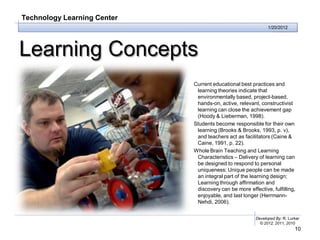
                             Current educational best practices and
                              learning theories indicate that
                              environmentally based, project-based,
                              hands-on, active, relevant, constructivist
                              learning can close the achievement gap
                              (Hoody & Lieberman, 1998).
                             Students become responsible for their own
                              learning (Brooks & Brooks, 1993, p. v),
                              and teachers act as facilitators (Caine &
                              Caine, 1991, p. 22).
                             Whole Brain Teaching and Learning
                              Characteristics – Delivery of learning can
                              be designed to respond to personal
                              uniqueness; Unique people can be made
                              an integral part of the learning design;
                              Learning through affirmation and
                              discovery can be more effective, fulfilling,
                              enjoyable, and last longer (Herrmann-
                              Nehdi, 2006).


                                                        Developed By: R. Lurker
                                                          © 2012, 2011, 2010
                                                                            10
Technology Learning Center
                                                                                                     1/20/2012


“21st Century Learning Labs                            cornerstone of this project. The concepts, facilities and
 for Students of all Abilities                         track record of designing and installing over 700
                                                       installations since 1987 represent elements of multiple
    Creative Learning Systems engages learners with    "best practices". Examples include: The ePortfolio
fully-integrated classroom systems focused on          system™ supports authentic assessment. Improved
technology exploration, alternative energy             test scores have been documented. CLS applies
education and media production. In a Creative          leading edge technology to core, academically-linked,
Learning Systems SmartLab™, students develop 21st      hands-on projects. Integration of multiple technologies
century skills such as critical thinking and problem   is encouraged. They approach technology as a tool to
solving, collaboration, communication, project-        be applied to workflow rather than as an isolated set of
management and self-direction. They apply leading-     skills.
edge technology to academically linked, hands-on           Because of their uniqueness, there is currently no
projects. It's a learning experience that engages,     equivalent, competing product. The TLC project applies
challenges and motivates like no other.”               and expands the model to the university/college level
www.creativelearningsystems.com                        and targets pre- and in-service teachers and students
                                                       completing general education requirements. The TLC
                                                       project also provides technological resources to
STEM Education Reform: Technology
                                                       business, industry, military and other aspects of the
Learning Center (TLC)                                  general community.
   Creative Learning Systems SmartLab™ is the
                                                                                               Developed By: R. Lurker
                                                                                                 © 2012, 2011, 2010
                                                                                                                   11
Technology Learning Center
                                                                                       1/20/2012


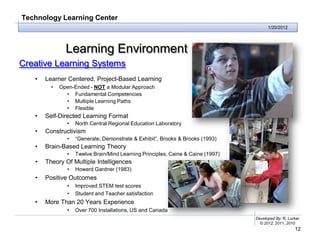
               Learning Environment
Creative Learning Systems
   •   Learner Centered, Project-Based Learning
         •   Open-Ended - NOT a Modular Approach
               • Fundamental Competencies
               • Multiple Learning Paths
               • Flexible
   •   Self-Directed Learning Format
               •   North Central Regional Education Laboratory
   •   Constructivism
               •   “Generate, Demonstrate & Exhibit”, Brooks & Brooks (1993)
   •   Brain-Based Learning Theory
               •   Twelve Brain/Mind Learning Principles, Caine & Caine (1997)
   •   Theory Of Multiple Intelligences
               •   Howard Gardner (1983)
   •   Positive Outcomes
               •   Improved STEM test scores
               •   Student and Teacher satisfaction
   •   More Than 20 Years Experience
               •   Over 700 Installations, US and Canada
                                                                                 Developed By: R. Lurker
                                                                                   © 2012, 2011, 2010
                                                                                                     12
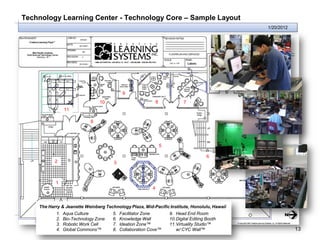
Technology Learning Center - Technology Core – Sample Layout
                                                                                                       1/20/2012


                                                Capacity

                                            9
                                10                            8              7
                11

                            6


                                                                  5

                                                                                         6
           2                          3


           1
                                                          4


    The Harry & Jeanette Weinberg Technology Plaza, Mid-Pacific Institute, Honolulu, Hawaii
           1.   Aqua Culture          5.   Facilitator Zone           9. Head End Room
           2.   Bio-Technology Zone   6.   Knowledge Wall             10.Digital Editing Booth   Developed By: R. Lurker
           3.   Robotic Work Cell     7.   Ideation Zone™             11.Virtuality Studio™        © 2012, 2011, 2010
           4.   Global Commons™       8.   Collaboration Cove™           w/ CYC Wall™                                13
Technology Learning Center - Outcomes
                                                                                                1/20/2012


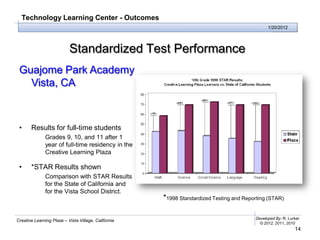
                           Standardized Test Performance
 Guajome Park Academy
   Vista, CA


 •     Results for full-time students
               Grades 9, 10, and 11 after 1
               year of full-time residency in the
               Creative Learning Plaza

 •     *STAR Results shown
               Comparison with STAR Results
               for the State of California and
               for the Vista School District.
                                                      *1998 Standardized Testing and Reporting (STAR)

                                                                                          Developed By: R. Lurker
Creative Learning Plaza – Vista Village, California
                                                                                            © 2012, 2011, 2010
                                                                                                              14
Technology Learning Center - Outcomes
                                                                              1/20/2012


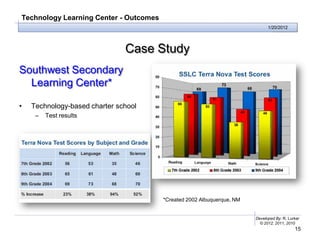
                               Case Study
Southwest Secondary
  Learning Center*

•   Technology-based charter school
     –   Test results


                                        *Created 2002 Albuquerque, NM


                                                                        Developed By: R. Lurker
                                                                          © 2012, 2011, 2010
                                                                                            15
Technology Learning Center - Outcomes
                                                                                                                1/20/2012


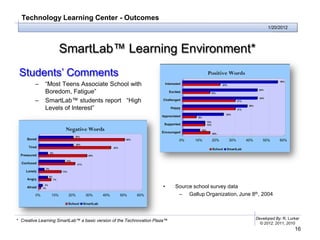
                    SmartLab™ Learning Environment*
 Students’ Comments
        –    “Most Teens Associate School with
             Boredom, Fatigue”
        –    SmartLab™ students report “High
             Levels of Interest”


                                                                     •     Source school survey data
                                                                            – Gallup Organization, June 8th, 2004


                                                                                                          Developed By: R. Lurker
* Creative Learning SmartLab™ a basic version of the Technovation Plaza™
                                                                                                            © 2012, 2011, 2010
                                                                                                                              16
Technology Learning Center
                                                                        1/20/2012


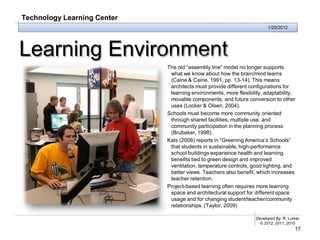
Learning Environment
                             The old “assembly line” model no longer supports
                              what we know about how the brain/mind learns
                              (Caine & Caine, 1991, pp. 13-14). This means
                              architects must provide different configurations for
                              learning environments, more flexibility, adaptability,
                              movable components, and future conversion to other
                              uses (Locker & Olsen, 2004).
                             Schools must become more community oriented
                              through shared facilities, multiple use, and
                              community participation in the planning process
                              (Brubaker, 1998).
                             Kats (2006) reports in “Greening America’s Schools”
                              that students in sustainable, high-performance
                              school buildings experience health and learning
                              benefits tied to green design and improved
                              ventilation, temperature controls, good lighting, and
                              better views. Teachers also benefit, which increases
                              teacher retention.
                             Project-based learning often requires more learning
                              space and architectural support for different space
                              usage and for changing student/teacher/community
                              relationships. (Taylor, 2009)

                                                                  Developed By: R. Lurker
                                                                    © 2012, 2011, 2010
                                                                                      17
Technology Learning Center - Design Concept
                                                                                                      1/20/2012


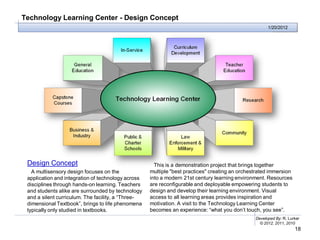
 Design Concept                                       This is a demonstration project that brings together
   A multisensory design focuses on the             multiple "best practices" creating an orchestrated immersion
 application and integration of technology across   into a modern 21st century learning environment. Resources
 disciplines through hands-on learning. Teachers    are reconfigurable and deployable empowering students to
 and students alike are surrounded by technology    design and develop their learning environment. Visual
 and a silent curriculum. The facility, a “Three-   access to all learning areas provides inspiration and
 dimensional Textbook”, brings to life phenomena    motivation. A visit to the Technology Learning Center
 typically only studied in textbooks.               becomes an experience: “what you don’t touch, you see”.
                                                                                                Developed By: R. Lurker
                                                                                                  © 2012, 2011, 2010
                                                                                                                    18
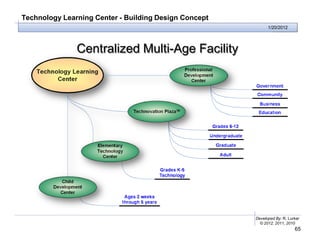
Technology Learning Center - Building Design Concept
                                                                                         1/20/2012


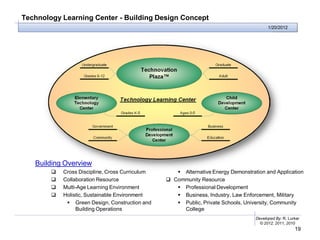
   Building Overview
           Cross Discipline, Cross Curriculum       Alternative Energy Demonstration and Application
           Collaboration Resource                Community Resource
           Multi-Age Learning Environment           Professional Development
           Holistic, Sustainable Environment        Business, Industry, Law Enforcement, Military
              Green Design, Construction and        Public, Private Schools, University, Community
                 Building Operations                  College
                                                                                   Developed By: R. Lurker
                                                                                     © 2012, 2011, 2010
                                                                                                       19
Technology Learning Center - Building Design Concept
                                                                             1/20/2012


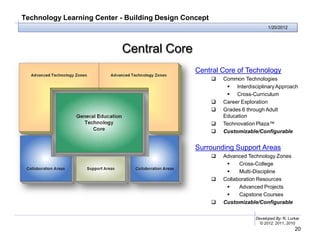
                           Central Core
                                                Central Core of Technology
                                                          Common Technologies
                                                             Interdisciplinary Approach
                                                             Cross-Curriculum
                                                          Career Exploration
                                                          Grades 6 through Adult
                                                           Education
                                                          Technovation Plaza™
                                                          Customizable/Configurable


                                                Surrounding Support Areas
                                                          Advanced Technology Zones
                                                                Cross-College
                                                                Multi-Discipline
                                                          Collaboration Resources
                                                                Advanced Projects
                                                                Capstone Courses
                                                          Customizable/Configurable

                                                                       Developed By: R. Lurker
                                                                         © 2012, 2011, 2010
                                                                                           20
Technology Learning Center - Building Design Concept
                                                                                   1/20/2012


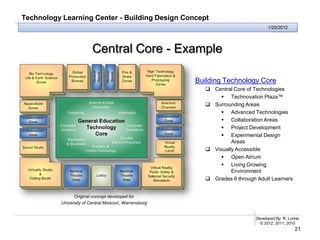
                         Central Core - Example

                                                        Building Technology Core
                                                           Central Core of Technologies
                                                                Technovation Plaza™
                                                           Surrounding Areas
                                                                Advanced Technologies
                                                                Collaboration Areas
                                                                Project Development
                                                                Experimental Design
                                                                   Areas
                                                           Visually Accessible
                                                                Open Atrium
                                                                Living Growing
                                                                   Environment
                                                           Grades 6 through Adult Learners


                Original concept developed for
          University of Central Missouri, Warrensburg


                                                                             Developed By: R. Lurker
                                                                               © 2012, 2011, 2010
                                                                                                 21
Technology Learning Center
                                                                                                     1/20/2012


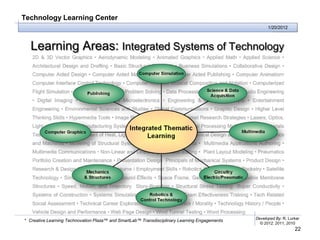
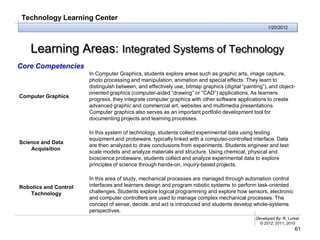
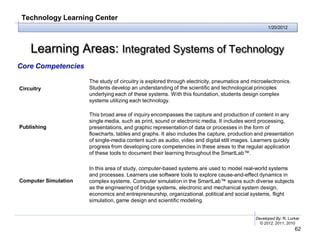
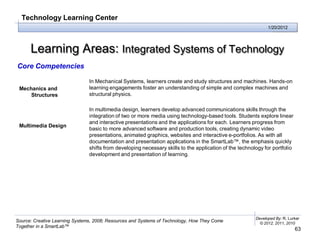
  Learning Areas: Integrated Systems of Technology


                                                                                               Developed By: R. Lurker
* Creative Learning Technovation Plaza™ and SmartLab™ Transdisciplinary Learning Engagements
                                                                                                 © 2012, 2011, 2010
                                                                                                                   22
Technology Learning Center
                                                   1/20/2012


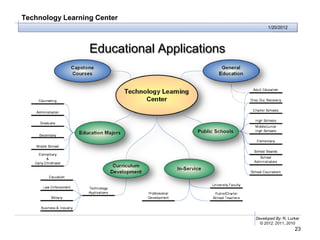
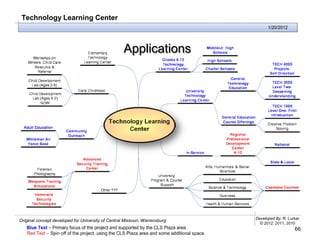
                  Educational Applications


                                             Developed By: R. Lurker
                                               © 2012, 2011, 2010
                                                                 23
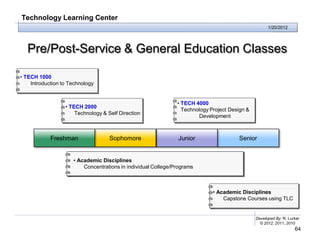
Technology Learning Center
                                                                                                1/20/2012


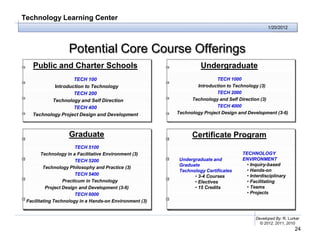
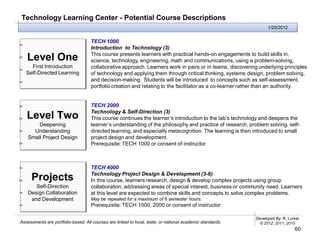
                   Potential Core Course Offerings
   Public and Charter Schools                                      Undergraduate
                   TECH 100                                               TECH 1000
           Introduction to Technology                            Introduction to Technology (3)
                   TECH 200                                               TECH 2000
          Technology and Self Direction                        Technology and Self Direction (3)
                   TECH 400                                               TECH 4000
   Technology Project Design and Development             Technology Project Design and Development (3-6)


                   Graduate                                    Certificate Program
                         TECH 5100
        Technology in a Facilitative Environment (3)                                TECHNOLOGY
                         TECH 5200                        Undergraduate and         ENVIRONMENT
                                                          Graduate                    • Inquiry-based
         Technology Philosophy and Practice (3)
                                                          Technology Certificates     • Hands-on
                         TECH 5400                              • 3-4 Courses         • Interdisciplinary
                   Practicum in Technology                      • Electives           • Facilitating
           Project Design and Development (3-6)                 • 15 Credits          • Teams
                         TECH 6000                                                    • Projects
 Facilitating Technology in a Hands-on Environment (3)


                                                                                          Developed By: R. Lurker
                                                                                            © 2012, 2011, 2010
                                                                                                              24
Technology Learning Center
                                                                      1/20/2012


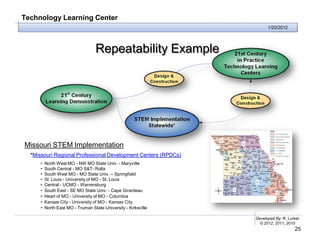
                                  Repeatability Example


Missouri STEM Implementation
  *Missouri Regional Professional Development Centers (RPDCs)
     •   North West MO - NW MO State Univ. - Maryville
     •   South Central - MO S&T- Rolla
     •   South West MO - MO State Univ. – Springfield
     •   St. Louis - University of MO - St. Louis
     •   Central - UCMO - Warrensburg
     •   South East - SE MO State Univ. - Cape Girardeau
     •   Heart of MO - University of MO - Columbia
     •   Kansas City - University of MO - Kansas City
     •   North East MO - Truman State University - Kirksville

                                                                Developed By: R. Lurker
                                                                  © 2012, 2011, 2010
                                                                                    25
Technology Learning Center
                                              1/20/2012


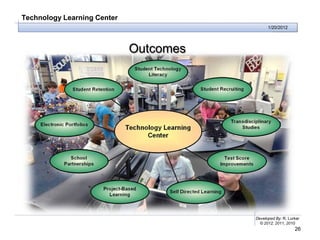
                             Outcomes


                                        Developed By: R. Lurker
                                          © 2012, 2011, 2010
                                                            26
Technology Learning Center
                                                                                     1/20/2012


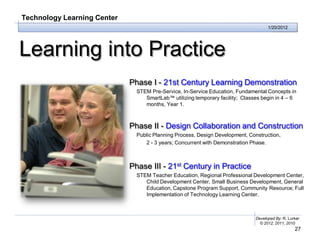
Learning into Practice
                             Phase I - 21st Century Learning Demonstration
                               STEM Pre-Service, In-Service Education, Fundamental Concepts in
                                  SmartLab™ utilizing temporary facility; Classes begin in 4 – 6
                                  months, Year 1.


                             Phase II - Design Collaboration and Construction
                               Public Planning Process, Design Development, Construction,
                                  2 - 3 years; Concurrent with Demonstration Phase.


                             Phase III - 21st Century in Practice
                               STEM Teacher Education, Regional Professional Development Center,
                                  Child Development Center, Small Business Development, General
                                  Education, Capstone Program Support, Community Resource; Full
                                  Implementation of Technology Learning Center.


                                                                               Developed By: R. Lurker
                                                                                 © 2012, 2011, 2010
                                                                                                   27
Technology Learning Center
                                                                        1/20/2012


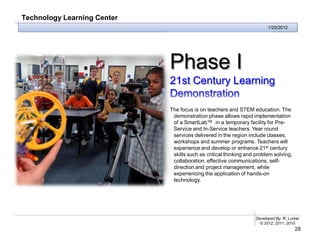
                             Phase I
                             21st Century Learning
                             Demonstration
                             The focus is on teachers and STEM education. The
                              demonstration phase allows rapid implementation
                              of a SmartLab™ in a temporary facility for Pre-
                              Service and In-Service teachers. Year round
                              services delivered in the region include classes,
                              workshops and summer programs. Teachers will
                              experience and develop or enhance 21st century
                              skills such as critical thinking and problem solving,
                              collaboration, effective communications, self-
                              direction and project management, while
                              experiencing the application of hands-on
                              technology.


                                                                  Developed By: R. Lurker
                                                                    © 2012, 2011, 2010
                                                                                      28
Technology Learning Center - Implementation
                                                                                              1/20/2012


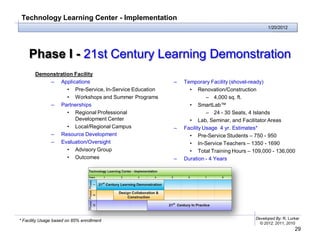
    Phase I - 21st Century Learning Demonstration
       Demonstration Facility
           – Applications                               –   Temporary Facility (shovel-ready)
                  • Pre-Service, In-Service Education         • Renovation/Construction
                  • Workshops and Summer Programs                     – 4,000 sq. ft.
           – Partnerships                                     • SmartLab™
                  • Regional Professional                             – 24 - 30 Seats, 4 Islands
                     Development Center                       • Lab, Seminar, and Facilitator Areas
                  • Local/Regional Campus               –   Facility Usage 4 yr. Estimates*
           – Resource Development                             • Pre-Service Students – 750 - 950
           – Evaluation/Oversight                             • In-Service Teachers – 1350 - 1690
                  • Advisory Group                            • Total Training Hours – 109,000 - 136,000
                  • Outcomes                            –   Duration - 4 Years


                                                                                        Developed By: R. Lurker
* Facility Usage based on 85% enrollment
                                                                                          © 2012, 2011, 2010
                                                                                                            29
Technology Learning Center - Implementation
                                                                                                       1/20/2012


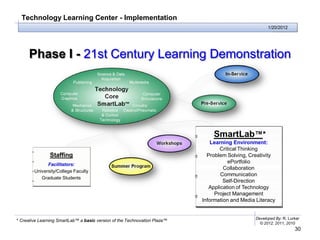
     Phase I - 21st Century Learning Demonstration


                                                                               SmartLab™*
                                                                               Learning Environment:
                                                                                  Critical Thinking
               Staffing                                                      Problem Solving, Creativity
              Facilitators:
                                                                                      ePortfolio
                                                                                    Collaboration
        University/College Faculty
                                                                                   Communication
           Graduate Students
                                                                                    Self-Direction
                                                                              Application of Technology
                                                                                Project Management
                                                                           Information and Media Literacy


                                                                                                 Developed By: R. Lurker
* Creative Learning SmartLab™ a basic version of the Technovation Plaza™
                                                                                                   © 2012, 2011, 2010
                                                                                                                     30
Technology Learning Center
                                                                                     1/20/2012


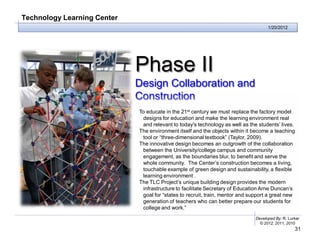
                             Phase II
                             Design Collaboration and
                             Construction
                             To educate in the 21st century we must replace the factory model
                              designs for education and make the learning environment real
                              and relevant to today's technology as well as the students’ lives.
                             The environment itself and the objects within it become a teaching
                              tool or “three-dimensional textbook” (Taylor, 2009).
                             The innovative design becomes an outgrowth of the collaboration
                              between the University/college campus and community
                              engagement, as the boundaries blur, to benefit and serve the
                              whole community. The Center’s construction becomes a living,
                              touchable example of green design and sustainability, a flexible
                              learning environment .
                             The TLC Project’s unique building design provides the modern
                              infrastructure to facilitate Secretary of Education Arne Duncan’s
                              goal for “states to recruit, train, mentor and support a great new
                              generation of teachers who can better prepare our students for
                              college and work.”
                                                                               Developed By: R. Lurker
                                                                                 © 2012, 2011, 2010
                                                                                                   31
Technology Learning Center - Implementation
                                                                                            1/20/2012


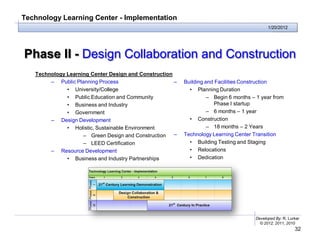
Phase II - Design Collaboration and Construction
   Technology Learning Center Design and Construction
        – Public Planning Process                     –   Building and Facilities Construction
              • University/College                          • Planning Duration
              • Public Education and Community                      – Begin 6 months – 1 year from
              • Business and Industry                                  Phase I startup
              • Government                                          – 6 months – 1 year
        – Design Development                                • Construction
              • Holistic, Sustainable Environment                   – 18 months – 2 Years
                    – Green Design and Construction   –   Technology Learning Center Transition
                    – LEED Certification                    • Building Testing and Staging
        – Resource Development                              • Relocations
              • Business and Industry Partnerships          • Dedication


                                                                                      Developed By: R. Lurker
                                                                                        © 2012, 2011, 2010
                                                                                                          32
Technology Learning Center
                                                     1/20/2012


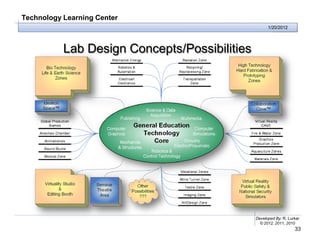
           Lab Design Concepts/Possibilities


                                               Developed By: R. Lurker
                                                 © 2012, 2011, 2010
                                                                   33
Technology Learning Center
                                                                1/20/2012


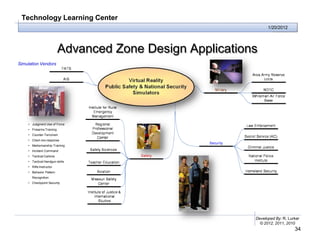
                          Advanced Zone Design Applications
Simulation Vendors


    • Judgment Use of Force
    • Firearms Training
    • Counter-Terrorism
    • Chem-bio response
    • Marksmanship Training
    • Incident Command
    • Tactical Carbine
    • Tactical Handgun skills
    • Rifle Instructor
    • Behavior Pattern
      Recognition
    • Checkpoint Security


                                                          Developed By: R. Lurker
                                                            © 2012, 2011, 2010
                                                                              34
Technology Learning Center
                                                 1/20/2012


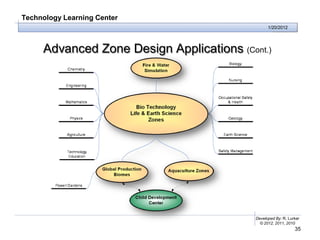
     Advanced Zone Design Applications (Cont.)


                                           Developed By: R. Lurker
                                             © 2012, 2011, 2010
                                                               35
Technology Learning Center
                                               1/20/2012


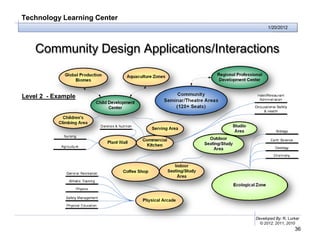
    Community Design Applications/Interactions


Level 2 - Example


                                         Developed By: R. Lurker
                                           © 2012, 2011, 2010
                                                             36
Technology Learning Center
                                                   1/20/2012


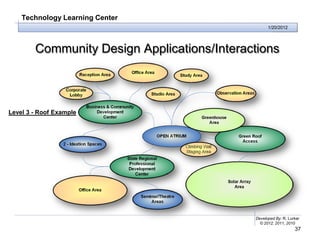
        Community Design Applications/Interactions


Level 3 - Roof Example


                                             Developed By: R. Lurker
                                               © 2012, 2011, 2010
                                                                 37
Technology Learning Center
                                                                                   1/20/2012


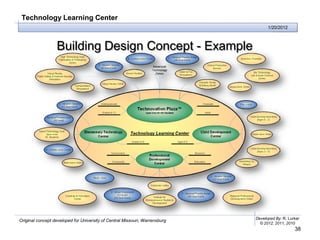
                  Building Design Concept - Example


                                                                             Developed By: R. Lurker
Original concept developed for University of Central Missouri, Warrensburg
                                                                               © 2012, 2011, 2010
                                                                                                 38
Technology Learning Center
                                                                      1/20/2012


                             Phase III
                             21st Century In Practice
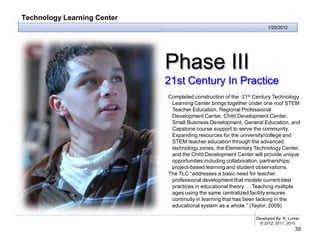
                             Completed construction of the 21st Century Technology
                              Learning Center brings together under one roof STEM
                              Teacher Education, Regional Professional
                              Development Center, Child Development Center,
                              Small Business Development, General Education, and
                              Capstone course support to serve the community.
                              Expanding resources for the university/college and
                              STEM teacher education through the advanced
                              technology zones, the Elementary Technology Center,
                              and the Child Development Center will provide unique
                              opportunities including collaboration, partnerships,
                              project-based learning and student observations.
                             The TLC “addresses a basic need for teacher
                              professional development that models current best
                              practices in educational theory. …Teaching multiple
                              ages using the same centralized facility ensures
                              continuity in learning that has been lacking in the
                              educational system as a whole.” (Taylor, 2009)

                                                                Developed By: R. Lurker
                                                                  © 2012, 2011, 2010
                                                                                    39
Technology Learning Center - Implementation
                                                                                      1/20/2012


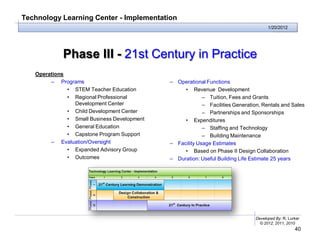
            Phase III - 21st Century in Practice
   Operations
        – Programs                           – Operational Functions
              • STEM Teacher Education            • Revenue Development
              • Regional Professional                     – Tuition, Fees and Grants
                Development Center                        – Facilities Generation, Rentals and Sales
              • Child Development Center                  – Partnerships and Sponsorships
              • Small Business Development        • Expenditures
              • General Education                         – Staffing and Technology
              • Capstone Program Support                  – Building Maintenance
        – Evaluation/Oversight               – Facility Usage Estimates
              • Expanded Advisory Group           • Based on Phase II Design Collaboration
              • Outcomes                     – Duration: Useful Building Life Estimate 25 years


                                                                                Developed By: R. Lurker
                                                                                  © 2012, 2011, 2010
                                                                                                    40
Technology Learning Center - Stakeholders
                                                                                     1/20/2012


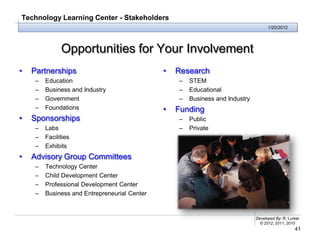
               Opportunities for Your Involvement
•   Partnerships                               •   Research
     –   Education                                 –   STEM
     –   Business and Industry                     –   Educational
     –   Government                                –   Business and Industry
     –   Foundations                           •   Funding
•   Sponsorships                                   –   Public
     –   Labs                                      –   Private
     –   Facilities
     –   Exhibits
•   Advisory Group Committees
     –   Technology Center
     –   Child Development Center
     –   Professional Development Center
     –   Business and Entrepreneurial Center


                                                                               Developed By: R. Lurker
                                                                                 © 2012, 2011, 2010
                                                                                                   41
Technology Learning Center - Funding Opportunities
                                                           1/20/2012


                                                     Developed By: R. Lurker
                                                       © 2012, 2011, 2010
                                                                         42
Technology Learning Center - Budget Estimates
                                                                                                  1/20/2012


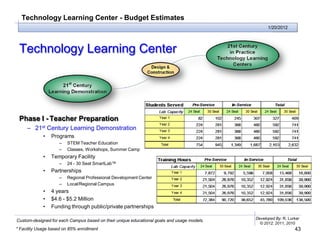
 Technology Learning Center


 Phase I - Teacher Preparation
     – 21st Century Learning Demonstration
             •   Programs
                     –   STEM Teacher Education
                     –   Classes, Workshops, Summer Camp
             •   Temporary Facility
                     –   24 - 30 Seat SmartLab™
             •   Partnerships
                     –   Regional Professional Development Center
                     –   Local/Regional Campus
             •   4 years
             •   $4.6 - $5.2 Million
             •   Funding through public/private partnerships

                                                                                            Developed By: R. Lurker
Custom-designed for each Campus based on their unique educational goals and usage models.
                                                                                              © 2012, 2011, 2010
* Facility Usage based on 85% enrollment                                                                        43
Technology Learning Center - Budget Estimates
                                                                                                                        1/20/2012


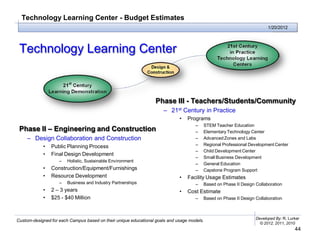
 Technology Learning Center


                                                                  Phase III - Teachers/Students/Community
                                                                     – 21st Century in Practice
                                                                             •   Programs
                                                                                     –   STEM Teacher Education
 Phase II – Engineering and Construction                                             –   Elementary Technology Center
     – Design Collaboration and Construction                                         –   Advanced Zones and Labs
            •   Public Planning Process                                              –   Regional Professional Development Center
                                                                                     –   Child Development Center
            •   Final Design Development
                                                                                     –   Small Business Development
                    –   Holistic, Sustainable Environment
                                                                                     –   General Education
            •   Construction/Equipment/Furnishings                                   –   Capstone Program Support
            •   Resource Development                                         •   Facility Usage Estimates
                    –   Business and Industry Partnerships                           –   Based on Phase II Design Collaboration
            •   2 – 3 years                                                  •   Cost Estimate
            •   $25 - $40 Million                                                    –   Based on Phase II Design Collaboration


                                                                                                                  Developed By: R. Lurker
Custom-designed for each Campus based on their unique educational goals and usage models.
                                                                                                                    © 2012, 2011, 2010
                                                                                                                                      44
Technology Learning Center - Budget Estimates
                                                                                                                  1/20/2012


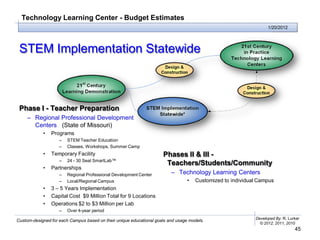
 STEM Implementation Statewide


 Phase I - Teacher Preparation
     – Regional Professional Development
       Centers (State of Missouri)
            •   Programs
                    –   STEM Teacher Education
                    –   Classes, Workshops, Summer Camp
            •   Temporary Facility                                   Phases II & III -
                    –   24 - 30 Seat SmartLab™
                                                                      Teachers/Students/Community
            •   Partnerships
                    –   Regional Professional Development Center         – Technology Learning Centers
                    –   Local/Regional Campus                                    •   Customized to individual Campus
            •   3 – 5 Years Implementation
            •   Capital Cost $9 Million Total for 9 Locations
            •   Operations $2 to $3 Million per Lab
                    –   Over 4-year period
                                                                                                            Developed By: R. Lurker
Custom-designed for each Campus based on their unique educational goals and usage models.
                                                                                                              © 2012, 2011, 2010
                                                                                                                                45
Technology Learning Center - Summary
                                                                                                           1/20/2012


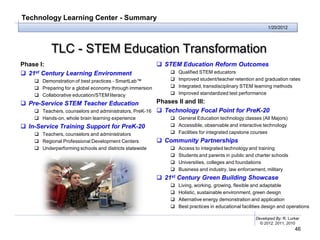
           TLC - STEM Education Transformation
Phase I:                                                  STEM Education Reform Outcomes
 21st Century Learning Environment                             Qualified STEM educators
     Demonstration of best practices - SmartLab™               Improved student/teacher retention and graduation rates
     Preparing for a global economy through immersion          Integrated, transdisciplinary STEM learning methods
     Collaborative education/STEM literacy                     Improved standardized test performance

 Pre-Service STEM Teacher Education                     Phases II and III:
     Teachers, counselors and administrators, PreK-16    Technology Focal Point for PreK-20
     Hands-on, whole brain learning experience               General Education technology classes (All Majors)
 In-Service Training Support for PreK-20                     Accessible, observable and interactive technology
     Teachers, counselors and administrators                 Facilities for integrated capstone courses
     Regional Professional Development Centers           Community Partnerships
     Underperforming schools and districts statewide           Access to integrated technology and training
                                                                Students and parents in public and charter schools
                                                                Universities, colleges and foundations
                                                                Business and industry, law enforcement, military
                                                          21st Century Green Building Showcase
                                                                Living, working, growing, flexible and adaptable
                                                                Holistic, sustainable environment, green design
                                                                Alternative energy demonstration and application
                                                                Best practices in educational facilities design and operations

                                                                                                     Developed By: R. Lurker
                                                                                                       © 2012, 2011, 2010
                                                                                                                         46
Technology Learning Center
                                                                                                                              1/20/2012


                                       Selected Bibliography
•    Abramson, P. (2005). 10th Annual School Construction Report.     •   Creative Learning Systems. (1994). Creative Learning Plaza:
     Dayton: School Planning & Management.                                The Ultimate Environment for Authentic Learning . San Diego,
•    Abramson, P. (2005, February). 2005 College Construction             CA: Creative Learning Systems, Inc.
     Report. College Planning & Management .                          •   Creative Learning Systems. (2004). Self-Directed Learning,
•    American Architectural Foundation & KnowlwdgeWorks                   Curriculum Design and The Creative Learning Environment .
     Foundation. (2005). National Summit on School Design.                San Diego, CA: Creative Learning Systems.
     Washington, DC: American Architectural Foundation &              •   Creative Learning Systems. (2004). The SmartLab. Longmont,
     KnowlwdgeWorks Foundation.                                           CO: Creative Learning Systems.
•    American Architectural Foundation. (2006). Designed For          •   Dando, A. (2004). Standardized Test Performance In a Creative
     Learning Forum, School Design and Student Learning in the            Learning Environment. San Diego: Creative Learning Systems.
     21st Century. Washington, DC: American Architectural             •   Disney Institute. (2001). Perfecting the art of customer service.
     Foundation.                                                          New York: Disney Editions.
•    Anstrand, D. E., & Kirkbirde, E. E. (2009). The Education        •   Duncan, A. (2009, November 23). Duncan Endorses Efforts to
     Environment Program. DesignShare.                                    Improve STEM Education. Retrieved 2009, from ED.gov:
•    Brooks, J. G., & Brooks, M. G. (1993). In search of                  www.ed.gov
     understanding: The case for constructivist classrooms.           •   Duncan, A. (2009, February 9). Secretary Arne Duncan Speaks
     Alexandria, VA: Association of Supervision and Curriculum            at the 91st Annual Meeting of the American Council on
     Development.                                                         Education. Retrieved 2009, from ED.gov: www.ed.gov
•    Brubaker, C. W. (1997). Planning and Designing Schools. New      •   Duncan, A. (2009, March 12). Secretary Arne Duncan Testifies
     York: McGraw-Hill.                                                   Before the House Budget Committee on the Fiscal Year 2010
•    Caine, R. N., & Caine, G. (1991). Making Connections: Teaching       Budget Request. Retrieved 2009, from ED.gov: www.ed.gov
     and the Human Brain. Alexandria, VA: Association for             •   Garcia, A. G. (n.d.). Designing Early College High Schools: What
     Supervision and Curriculum Development.                              does it take? Texas High School Project.
•    Cibulka, J. G. (2009). Meeting Urgent National Needs in P-12     •   Herrmann, N. (2006). Making Partnerships and Alliances Really
     Education: Improving Relevance, Evidence, and Performance in         Work. Lake Lure, NC: The Ned Herrmann Group.
     Teacher Preparation. Washington: National Council for
     Accreditation of Teacher Education (NCATE).
                                                                                                                       Developed By: R. Lurker
                                                                                                                         © 2012, 2011, 2010
                                                                                                                                              47
Technology Learning Center - Bibliography
                                                                                                                               1/20/2012


•    Herrmann, N. (1994). The Creative Brain. Kingsport: Brain          •   Kats, G. (2006). Greening America's Schools: Costs and
     Books.                                                                 Benefits. Washington: The U.S. Green Building Council.
•    Herrmann, N. (1996). The Whole Brain Business Book. Ney            •   Lemke, C. (2003). Standards for a Modern World: Preparing
     York: McGraw-Hill.                                                     Students for the Future. Learning & Leading with Technology ,
•    Herrmann-Nehdi, A. (1998, January). Training With The Brain In         31 (1).
     Mind: The Application Of Brain Dominance Technology To             •   Locker, F. M., & Olsen, S. (2004). Design Share The
     Teaching And Learning. Lake Lure, NC, USA: Herrmann                    International Forum for Innovative Schools. Retrieved 2010, from
     International.                                                         Flexible School Facilities:
•    Hoody, L., & Lieberman, G. (1998). Closing the achievement             designshare.com/Research/Locker/FlexibleSchools.asp
     gap: Using the environment as an integrating context for           •   Machi, E. (2009). Improving U.S. Competitiveness with K12
     learning. State Education and Environment Roundtable.                  STEM Education and Training. Washington: The Heritage
•    International Technology Association. (2003). Advancing                Foundation.
     Excellence in Technological Literacy: Student Assessment,          •   Morrison, J. S. (2006). Attributes of STEM Education: The
     Professional Development, and Program Standards. Reston, VA:           Students, The Academy, The Classroom. TIES STEM
     International Technology Education Association.                        Monograph Series.
•    International Technology Association. (2000). Standards for        •   Nair, P. (2009). Don't Just Rebuild Schools-Reinvent Them.
     Technological Literacy: Content for the Study of Technology.           Education Week , 28 (28), 24-25.
     Reston, VA: International Technology Education Association and     •   National Alliance For Pre-Engineering Programs. (2002). Project
     its Technology for All Americans Project.                              Lead The Way. Project Lead The Way . Clifton Park, New York:
•    ISTE International Society for Technology in Education.                Project Lead The Way.
     Maximizing the Impact: The pivotal role of technology in a 21st    •   National Governors Association Center for Best Practices,
     century education system. Eugene, OR : ISTE International              National Conference of State Legislatures, National Association
     Society for Technology in Education.                                   of State Boards of Education, Council of Chief State School
•    Katehi, L., Pearson, G., & Feder, M. (2009). Engineering in K-12       Officers. (2008). Accelerating the Agenda: Actions to Improve
     Education: Understanding The Status and Improving The                  America's High Schools. Washington, DC: National Governors
     Prospects. National Academy of Engineering and National                Association.
     Research Council of the National Academies, Committee on K-        •   National Governors Association Center for Best Practices.
     12 Engineering Education. Washington: The National Academies           (2008). Promoting STEM Education: A Communications Toolkit.
     Press.                                                                 Washington: National Governors Association Center for Best
                                                                            Practices.

                                                                                                                         Developed By: R. Lurker
                                                                                                                           © 2012, 2011, 2010
                                                                                                                                               48
Technology Learning Center - Bibliography
                                                                                                                            1/20/2012


•    National Governors Association. (2007). Innovation America:            House of Representatives' STEM Hearing. Retrieved 2009, from
     Building a Science, Technology, Engineering and Math Agenda.           Tech & Learning: www.techlearning.com
     Washington, DC: National Governors Association.                    •   The Conference Board, Corporate Voices for Working Families,
•    National Institute of Building Sciences. (2010, January 25).           The Partnership for 21st Century Skills, and the Society for
     McGraw-Hill Construction Monthly, Historical, and Forecast             Human Resource Management. (2006). Are They Really Ready
     Data. Retrieved 2010, from National Clearinghouse for                  To Work? Employers' Perspectives on the Basic Knowledge and
     Educational Facilities - Data & Statistics: www.edfacilities.org       Applied Skills of New Entrants to the 21st Century U.S.
•    Pullias, D. (1997, April). The Future is ... Beyond Modular. The       Workforce. The Conference Board, Inc.
     Technology Teacher.                                                •   The White House. (2009, November 29). Educate to Innovate.
•    Pullias, D. (1992, January). What is Technology Education? The         Retrieved 2009, from The White House: www.whitehouse.gov
     Technology Teacher.                                                •   The White House Office of the Press Secretary. (2009,
•    Reed Business Information . (2009, May 11). RSMeans.                   November 23). President Obama Launches "Educate to
     Retrieved 2009, from Quick Cost Estimator: www.rsmeans.com             Innovate" Campaign for Excellence in Science, Technology,
•    Reynard, R. (2008). 21st Century Teaching and Learning:                Engineering & Math (STEM) Education. Retrieved 2009, from
     Assessing New Knowledge. THE Journal.                                  The White House: www.whitehouse.gov
•    Schneider, J. W. (2006). Designing and Building for the Class of   •   Thode, B. (1989, November). Applying Higher Level Thinking
     2020. Building Design and Construction.                                Skills. The Technology Teacher.
•    Snyder, M., & Causey, D. (2006). Alaska's Smart Science            •   U.S. Green Building Council. (2003). Building Momentum:
     Through Technology (AKS2T2). Anchorage, AK, USA: College               National Trends and Prospects for High-Performance Green
     of Education, University of Alaska Anchorage.                          Buildings. Washington, DC: U.S. Green Building Council.
•    Taylor, A. P. (2009). Linking Architecture and Education:          •   Wright, M. (2000). From The Editor: What does an Elementary
     Sustainable Design for Learning Environments. Albuquerque:             School Technology Education Classroom Look Like?
     University of New Mexico Press.                                        Technology and Children, 5 (2), 2-4.
•    Teach For America. (2008). 2008 Annual Report: Priorities and
     Results. New York, NY: Teach For America.
•    Technology & Learning. (2009, March 29). Survey says students
     don't think their schools' tech is current. Retrieved 2009, from
     Technology & Learning: www.techlearning.com
•    Technology & Learning. (2009, March 5). Testimony from [U.S.]

                                                                                                                      Developed By: R. Lurker
                                                                                                                        © 2012, 2011, 2010
                                                                                                                                           49
Technology Learning Center
                                                                                                                               1/20/2012


                                                     Contributors
From the initial conceptual “seeds” to the development of this           Thomas R. Atkinson, Jr., Ph.D., Associate Professor of Educational
  Technology Learning Center proposal, a wide array of individuals           Technology, University of Central Missouri, Warrensburg, MO
  have contributed their expertise, experience and visions for STEM      David Baird, Ph.D., Associate Professor of Industrial & Engineering
  education reform. They participated in interviews via e-mails, phone       Technology and Middle & Secondary Education, Cape
  calls or in person; facilitated and/or hosted numerous site visits;        Girardeau, MO
  provided reference data, information, and analyses; and reviewed       Rochelle R. Barabas, M.S., Assistant Professor of Graphic Imaging
  drafts. Inclusion as a contributor is not meant to imply formal            and Design Technology, University of Central Missouri,
  endorsement of this draft proposal by an individual and/or                 Warrensburg, MO
  organization; it is a recognition of their assistance to the author.
                                                                         Dr. Chris Belcher, Assistant Superintendent, Warrensburg R-VI
                                                                             School District, Warrensburg, MO
                                                                         Julie J. Blaine, M.S., Interim Director of the Central Regional
  Dr. Jerry Ackins, Superintendent, Crest Ridge R-VII School District,       Professional Development Center, University of Central
      Centerview, MO                                                         Missouri, Warrensburg, MO
  Bob Ahring, Director, Public Safety, University of Central Missouri,   Zinna L. Bland, Ph.D., Associate Professor of Business Education,
      Warrensburg, MO                                                        University of Central Missouri, Warrensburg, MO
  Martha L. Albin, Ed.D., Interim Vice President, Finance and            George W. Boddy, Ph.D., Director of Extended Campus and
      Administration, University of Central Missouri, Warrensburg,           Distance Learning, University of Central Missouri,
      MO                                                                     Warrensburg, MO
  Jennifer E. Aldrich, Ed.D., Associate Professor of Early Childhood     Steven R. Boone, Ph.D., Associate Dean of the College of Arts and
      Education, University of Central Missouri, Warrensburg, MO             Sciences and Professor of Chemistry, University of Central
  Pat Anderson, Director, Safety and Security, Great Basin College,          Missouri, Warrensburg, MO
      Elko, NV                                                           Butch Borasky, Board of County Commissioners, Nye County,
  Patricia A. Antrim, Ph.D., Chair of the Department of Educational          Pahrump, NV
      Leadership and Human Development and Associate Professor           Richard D. Bruce, Ph.D., LEED AP, Assistant Professor,
      of Library Science and Information Services, University of             Department of Technology and Construction Management.
      Central Missouri, Warrensburg, MO                                      Missouri State University, Springfield, MO

                                                                                                                         Developed By: R. Lurker
                                                                                                                           © 2012, 2011, 2010
                                                                                                                                               50
Technology Learning Center - Contributors
                                                                                                                            1/20/2012


Ruth S. Burkett, Ph.D., Assistant Professor of Science Education,     E. Samuel Cox, Ph.D., Interim Chair of the Department of
    University of Central Missouri, Warrensburg, MO                       Communications and Professor of Speech Communications,
Julie Burner, Director of Technology, Holden R-III School District,       University of Central Missouri, Warrensburg, MO
    Holden, MO                                                        Shawn Cripe, Projects Administrator, Office of Sponsored
Kim Butler, Facilitator Support Specialist, Creative Learning             Programs, University of Central Missouri, Warrensburg, MO
    Systems, Inc., Longmont, CO; Formerly Instructor, Technology      Angla Dando, Ph.D., Education System Analyst, International
    Education, Roosevelt High School, Johnstown, CO; and                  Relations, Creative Learning Systems, Inc., Longmont, CO
    Facilitator, Aims Community College, Greeley, CO                  Edward W. Davenport, Ph.D., Chair of the Department of
Kathryn A. Callahan, Ph.D., Professor of Fashion and Apparel              Mathematics and Computer Science and Professor of
    Merchandising, School of Technology, University of Central            Mathematics, University of Central Missouri, Warrensburg, MO
    Missouri, Warrensburg, MO                                         Dr. Jim Davis, Principal, Warrensburg Middle School, Warrensburg
Pricilla L. Callison, Ph.D., Director of Pedagogy & Research,             R-VI School District, Warrensburg, MO
    Regional Professional Development Center, University of           Pauline Denning, Technology Coordinator, Thomas R-2J School
    Central Missouri, Warrensburg, MO                                     District, Loveland, CO
Glenn A. Carriker, Ed.S., Interim Director, Missouri Safety Center,   Matt Dickstein, Chief Executive Officer, Creative Learning Systems,
    University of Central Missouri, Warrensburg, MO                       Inc., Longmont, CO
Bryan W. Carter, Ph.D., Associate Professor of English, University    Mollie M. Dinwiddie, Ed.S., Interim Dean, Library Services and
    of Central Missouri, Warrensburg, MO                                  Professor of Library Services, University of Central Missouri,
Kyle R. Carter, Ph.D., Provost and Vice President for Academic            Warrensburg, MO
    Affairs and Professor of Psychology, University of Central        Linda Dooling, Director, Professional Development, Missouri
    Missouri, Warrensburg, MO                                             Department of Elementary & Secondary Education, Jefferson
Gary Clark, Whiteman Training and Education Center, Whiteman              City, MO
    Air Force Base, Knob Noster, MO                                   Joyce A. Downing, Ph.D., Associate Dean of the College of
Julie A. Clawson, Ph.D., Chair of the Department of Nursing and           Education and Associate Professor of Special Education,
    Professor of Nursing, University of Central Missouri,                 University of Central Missouri, Warrensburg, MO
    Warrensburg, MO                                                   Boyd K. Earl, Kindergarten Teacher, Nibley Park Elementary
Renee S. Cole, Ph.D., Associate Professor of Chemistry, University        School, Salt Lake City School District, Salt Lake City, UT
    of Central Missouri, Warrensburg, MO


                                                                                                                      Developed By: R. Lurker
                                                                                                                        © 2012, 2011, 2010
                                                                                                                                            51
Technology Learning Center - Contributors
                                                                                                                               1/20/2012


Paula J. Elefante, Executive Director, EDEN, Inc. Economic            John W. D. Gole, Ph.D., Chair of the Department of Biology and
    Development Authority Nye County, Pahrump, NV                          Earth Science and Associate Professor of Biology, University of
Paul H. Engelmann, Ph.D., Professor of Economics, University of            Central Missouri, Warrensburg, MO
    Central Missouri, Warrensburg, MO                                 Dr. Dan Gordon, Principal, Warrensburg High School, Warrensburg
Terri Fayle, Assistant to the Director and Program Administrator,          R-VI School District, Warrensburg, MO
    Office of Sponsored Programs, University of Central Missouri,     Doug Graham, Educational Consultant/CEO, School Technologies
    Warrensburg, MO                                                        Inc., Albuquerque, NM
Larry G. Ficken, Superintendent, Knob Noster R-VIII School            Alice L. Greife, Ph.D., Dean of the College of Science and
    District, Knob Noster, MO                                              Technology and Professor of Industrial Hygiene, University of
Steve Fotenos, U.S. Secret Service, Kansas City, MO                        Central Missouri, Warrensburg, MO
Tom Frayer, SmartLab Facilitator, Mountain View High School,          Carl J. Grigsby, Ed.D., Associate Professor of Secondary/Middle
    Thomas R-2J School District, Loveland, CO                              School Education, University of Central Missouri,
Richard A. Frazier, Ph.D., Associate Professor of Science                  Warrensburg, MO
    Education, University of Central Missouri, Warrensburg, MO        Lt. Ed Gulic, Public Affairs, Whiteman Air Force Base, Knob Noster,
Karen B. French, Assistant Director Community Engagement,                  MO
    Union Station, Central Missouri State University, Kansas City,    Carolyn Harris, Consultant, Health Systems Planning, Policy and
    MO                                                                     Program Planning, Administration, Evaluation, Research and
Gary S. Frey, Ed.D., Professor of Industrial Technology, University        Grant Writing, Riverside, CA
    of Montana Western, Dillon, MT                                    Dr. Lindell L. Harrison, Superintendent, Holden R-III School District,
Eric D. Fudge, M.S., Director, Instructional Technology and Design,        Holden, MO
    Center for Teaching and Learning, Central Missouri State          M. Gene Heaton, Enterprise GIS Project Supervisor, City of San
    University, Warrensburg, MO                                            Antonio, San Antonio, TX
Dorothy S. Gallagher, Board of Regents, Nevada System of Higher       Janet Herdon, North Kansas City School District, Kansas City, MO
    Education, Elko, NV                                               Patricia Herrmann, Client Relationship Manager, Herrmann
Ted R. Garten, Ph.D., Development Officer, College of Education            International, Lake Lure, NC
    and Human Services, University of Central Missouri,               Jerry Hill, Ed.S., Assistant Superintendent for Student
    Warrensburg, MO                                                        Achievement, Nye County School District, Pahrump, NV


                                                                                                                        Developed By: R. Lurker
                                                                                                                          © 2012, 2011, 2010
                                                                                                                                               52
Technology Learning Center - Contributors
                                                                                                                         1/20/2012


Mark Hines, Technology Coordinator, Mid-Pacific Institute,          Andrew K. King, Ph.D., Assistant Professor of Elementary
    Honolulu, HI                                                        Education and Technology, University of Central Missouri,
Karen Holley, Grant Writer, Nye County School District, Pahrump,        Warrensburg, MO
    NV                                                              Darrell Lacy, Director, Nye County Nuclear Waste Repository,
Eric C. Honour, Jr., D.Mus., Director of Music Technology and           Pahrump, NV
    Assistant Professor of Music, University of Central Missouri,   Sharon L. Lamson, Ph.D., Chair Curriculum and Instruction and
    Warrensburg, MO                                                     Professor of Elementary Education, University of Central
Delores Hudson, Board of Governors, University of Central               Missouri, Warrensburg, MO
    Missouri, Warrensburg, MO                                       Tammy Long, Executive Director, Greater Warrensburg Area
C. Wilson Hurst, M.S., Assistant Professor of Graphic Arts              Chamber of Commerce and Visitors Center, Warrensburg, MO
    Technology Management and Photography, University of            LTC William R. Lynn, M.B.A., Chair of the Department of Military
    Central Missouri, Warrensburg, MO                                   Science and Leadership and Professor of Military Science,
Patricia Jannuzzi, Principal, Academic Lafayette Charter School,        University of Central Missouri, Warrensburg, MO
    Kansas City, MO                                                 James R. Machell, Jr., Ph.D., Chair of the Department of
Michael Jinks, Ph.D., Superintendent, Warrensburg R-VI School           Educational Leadership and Human Development and
    District, Warrensburg, MO                                           Professor of Educational Leadership, University of Central
Odin L. Jurkowski, Ed.D., Chair of the Department of Career and         Missouri, Warrensburg, MO
    Technology Education and Associate Professor of Instructional   Bob MacIntosh, Associate Director of Technology, Mid-Pacific
    Technology, University of Central Missouri, Warrensburg, MO         Institute, Honolulu, HI; formerly Creative Learning Systems,
Richard C. Kahoe, Ed.S., Associate Professor of Career and              Inc., Longmont, CO
    Technology Education, University of Central Missouri,           James R. Marble, Ph.D., Habitat Restoration Biologist, Las Vegas,
    Warrensburg, MO                                                     NV; formerly, Director of Natural Resources Office Nye County,
Dr. Larry Keisker, Director, Clinical SVCS, University of Central       NV
    Missouri, Warrensburg, MO                                       Barbara J. Mayfield, J.D., Director of Accessibility Services,
Joseph Kelly, AIA, Project Architect, Sprotte+Watson Architecture       ADA/504 Coordinator, University of Central Missouri,
    & Planning, Inc., Vista, CA                                         Warrensburg, MO
Gregory E. Kennedy, Ph.D., Professor of Child and Family            Christopher M. Meehan, M.S., Assistant Professor of Computer
    Development, University of Central Missouri, Warrensburg, MO        Aided Drafting and Design, University of Central Missouri,
                                                                        Warrensburg, MO


                                                                                                                   Developed By: R. Lurker
                                                                                                                     © 2012, 2011, 2010
                                                                                                                                         53
Technology Learning Center - Contributors
                                                                                                                        1/20/2012


Matthew A. Melvin, Ed.D., Assistant Provost for Enrollment        Paul A. Page, Ph.D., Vice President for University Advancement,
    Management, University of Central Missouri, Warrensburg, MO       University of Central Missouri, Warrensburg, MO
Dean Meyers, President, Inventive Technology Inc., Westminster,   Kyle W. Palmer, Ph.D., – Program Coordinator and Professor of
    CO                                                                Computer Aided Drafting and Design Technology, University of
Larry K. Michaelsen, Ph.D., Professor of Management, University       Central Missouri, Warrensburg, MO
    of Central Missouri, Warrensburg, MO                          Bobby R. Patton, Ph.D., President and Professor of Speech
Carol A. Mihalevich, Ph.D., Professor of Reading, University of       Communication, University of Central Missouri, Warrensburg,
    Central Missouri, Warrensburg, MO                                 MO
Dr. Doug Miller, Coordinator of Professional Development,         Ann M. Pearce, B.S., Associate to the President, University of
    Leadership Academy, Missouri Department of Elementary and         Central Missouri, Warrensburg, MO
    Secondary Education, Jefferson City, MO                       Novella Perrin, Ph.D., Dean of The Graduate School and Assistant
W. Douglas Miller, Supervisor of Technology Education,                Provost for Research, University of Central Missouri,
    Department of Elementary and Secondary Education, State of        Warrensburg, MO
    Missouri, Jefferson City, MO                                  Aaron M. Podolefsky, Ph.D., President and Professor of History and
Julie Milner, Charter School Technology Coordinator, Academic         Anthropology, University of Central Missouri, Warrensburg, MO
    Lafayette Charter School, Kansas City, MO                     Pamela Raffurty, Director, Workshop on Wheels Child Care
Joy Mockelmann, Ph.D., Supervisor, State System of Support,           Resource & Referral, University of Central Missouri,
    Wyoming Department of Education, Cheyenne, WY                     Warrensburg, MO
Thomas M. Moore, Ph.D., Associate Professor of Agriculture,       Jim Ramos, Regional Manager, Advanced Interactive Systems,
    University of Central Missouri, Warrensburg, MO                   AIS, Seattle, WA
Gary Nelson, President, Creative Learning Systems, Inc.,          Dan Ramseier, President, High Country Technology Consultants
    Longmont, CO                                                      Inc., Greeley, CO
Lareesa Nelson, Business Manager, Urban Community Leadership      Larry Ray, Contracts and Capital Development Manager, University
    Academy (UCLA), Kansas City, MO                                   of Central Missouri, Warrensburg, MO
Robert J. Ohrenberg, Ed.D., Professor of Manufacturing            C. David Rice, Ph.D., Assistant Provost for Information Technology
    Management, University of Central Missouri, Warrensburg, MO       and Instruction and Professor of History, University of Central
Carolyn P. O’Keefe, M.S., Director of Lee’s Summit Facility,          Missouri, Warrensburg, MO
    University of Central Missouri, Warrensburg, MO               Joe C. Rice, President and CEO, Mid-Pacific Institute, Honolulu, HI


                                                                                                                  Developed By: R. Lurker
                                                                                                                    © 2012, 2011, 2010
                                                                                                                                        54
Technology Learning Center - Contributors
                                                                                                                           1/20/2012


Diana Ringen, Librarian, Whiteman AFB Elementary, Knob Noster         Richard D. Sluder, Ph.D., Dean of the College of Health and
    R-VIII School District, Knob Noster, MO                               Human Services, and Professor of Criminal Justice. Formerly
Betty Roberts, Ph.D., Vice President of Administration and Finance,       Interim Dean of the College of Education and Human Services,
    University of Central Missouri, Warrensburg, MO                       University of Central Missouri, Warrensburg, MO
Kent Roberts, Principal, Pahrump Valley High School, Nye County       Stan Smith, Instructional Technology Coordinator, Warrensburg R-
    School District, Pahrump, NV                                          VI School District, Warrensburg, MO
Dr. William E. Roberts, Superintendent of Nye County School           Mary L. Snyder, Ph.D., Dean, College of Education and Professor
    District; Lieutenant Colonel, U.S. Army (Retired), Pahrump, NV        of Education, University of Alaska Anchorage, AK
Beth C. Rutt, M.S., Director of Campus Activities, Central Missouri   Margaret E. Stone, Ph.D., Interim Director of Sponsored Research
    State University, Warrensburg, MO                                     and Projects, University of Central Missouri, Warrensburg, MO
Wesley A. Savage, P.E., M.B.A., Director, Institute for               Marcus L. Stucker, Director Aux. Services, Holden R-III School
    Entrepreneurial Studies and Development, University of Central        District, Holden, MO
    Missouri, Warrensburg, MO                                         Sue E. Sundberg, Ph.D., Professor of Mathematics Education,
Joseph A. Scarcella, Ph.D., Program Coordinator                           University of Central Missouri, Warrensburg, MO
    Adult/Vocational/Technology Teacher Education and Assistant       Deborah Sutton, Director, Instructional Technology, Missouri
    Professor, California State University, San Bernardino, CA            Department of Elementary & Secondary Education, Jefferson
Suzanne Schelp, Copyright Permissions Coordinator, Library                City, MO
    Services, James C Kirkpatrick Library, University of Central      John R. Sutton, Ph.D., Chair of the School of Technology and
    Missouri, Warrensburg, MO                                             Professor of Technology, University of Central Missouri,
Dan L. Sevier, Assistant Superintendent, Knob Noster R-VIII School        Warrensburg, MO
    District, Knob Noster, MO                                         Bob Swadell, Developer, Lieutenant Colonel, U.S. Army (Retired),
Y.T. Shah, Sc.D., Provost and Vice President for Academic Affairs,        Pahrump, NV
    University of Central Missouri, Warrensburg, MO                   Anne Taylor, Ph.D., Hon, AIA, ACSA Distinguished Professor,
Judith Penrod Siminoe, J.D., General Counsel, University of               School of Architecture and Planning, University of New Mexico,
    Central Missouri, Warrensburg, MO                                     Albuquerque, NM
Claire A. Sinclair, Public Affairs Specialist, U.S. Department of     Windy Thill, Director, Career & Technical Education, Shawnee
    Energy, Office of External Affairs, Pahrump, NV                       Mission Public Schools, Shawnee Mission, KS


                                                                                                                     Developed By: R. Lurker
                                                                                                                       © 2012, 2011, 2010
                                                                                                                                           55
Technology Learning Center - Contributors
                                                                                                                            1/20/2012


Douglas D. Thomas, Ed.D., Director, Midwest Center for Charter       Michael E. Wiggins, Ph.D., Director National Police Institute and
    Schools and Urban Education, and Professor of Education              Professor of Criminal Justice, University of Central Missouri,
    Administration, University of Central Missouri, Warrensburg,         Warrensburg, MO
    MO                                                               Ruthann Williams, M.S., Assistant Professor of Business
Frank Tussing, Executive Director, Nevada Alliance for Defense,          Education, University of Central Missouri, Warrensburg, MO
    Energy & Business, Las Vegas, NV                                 Kurt Williamson, Vice President of Learning Environments, Creative
Jeffrey M. Ulmer, M.S., Assistant Professor of Industrial                Learning Systems, Inc., Longmont, CO
    Technology, University of Central Missouri, Warrensburg, MO      Diane C. Wilson, Ph.D., Associate Professor of Instructional
Gene A. Vinson, Ed.S., Director of the Central Regional                  Technology, University of Central Missouri, Warrensburg, MO
    Professional Development Center, University of Central           George W. Wilson, Ph.D., Interim Provost and Vice President for
    Missouri, Warrensburg, MO                                            Academic Affairs and Professor of Economics, University of
Peter L. Viscusi, Ph.D., Assistant Provost for Undergraduate             Central Missouri, Warrensburg, MO
    Studies and Dean of The Honors College and Professor of          Frederick D. Worman, Ph.D., Chair of the Department of Agriculture
    History, University of Central Missouri, Warrensburg, MO             and Professor of Agriculture, University of Central Missouri,
Victoria S. Voland, B.S.E., Director of the Foster/Knox Child Care       Warrensburg, MO
    Center, University of Central Missouri, Warrensburg, MO          Michael D. Wright, Ed.D., Dean of Education and Professor of
Troy E. Wade, Chairman, Nevada Alliance for Defense, Energy &            Career and Technology Education, University of Central
    Business, Las Vegas, NV                                              Missouri, Warrensburg, MO
Barton A. Washer, Ph.D., Assistant V Professor of Occupational       Benny K. Yates, M.A., Assistant Professor of Technology
    Education, University of Central Missouri, Warrensburg, MO           Education, University of Central Missouri, Warrensburg, MO
Russell A. Watson, M.S., AIA, Principal, Sprotte+Watson              John R. Zelazek, Ph.D., Professor of Secondary Education,
    Architecture & Planning, Inc., Vista, CA                             University of Central Missouri, Warrensburg, MO
E. Lee Weir, Ed.D., Professor of Graphic Imaging and Design          John N. Zey, M.S., Associate Professor of Industrial Hygiene,
    Technology, University of Central Missouri, Warrensburg, MO          University of Central Missouri, Warrensburg, MO
Bernard Westley, Urban Community Leadership Academy (UCLA),
    Kansas City, MO                                                  Note: University of Central Missouri; formerly Central Missouri
Virginia E. Wheeless, Ph.D, Dean of the College of Arts and             State University
    Sciences and Professor of Communications, University of
    Central Missouri, Warrensburg, MO

                                                                                                                      Developed By: R. Lurker
                                                                                                                        © 2012, 2011, 2010
                                                                                                                                          56
Technology Learning Center - Contributors
                                                                            1/20/2012


                           Site Visits

The Harold S. Winograd Center for Innovative Learning, Aims
    Community College, Aims College Corporate Education Center,
    Greeley, CO
Guajome Park Academy, Vista Unified School District, Vista, CA
Mid-Pacific Institute, The Harry and Jeanette Weinberg Technology
    Plaza and the Dennis S. L. Chew Technology Center, Honolulu,
    HI
Mountain View High School, Tech Lab, Thompson R-2J School
    District, Loveland, CO
Nibley Park Elementary School, Salt Lake City School District, Salt
    Lake City, UT
Roosevelt High School, Weld RE5J School District, Johnstown, CO
Shawnee Mission North High School, Shawnee Mission Public
    Schools, Shawnee Mission, KS
Shawnee Mission South High School, Shawnee Mission Public
    Schools, Shawnee Mission, KS
Southwest Secondary Learning Center, Southwest Learning
    Centers, Albuquerque, NM
Wood River Middle School, Blaine County School District, Hailey,
    ID
Yucca Mountain, Nuclear Waste Repository, U.S. Department of
    Energy, Nye County, NV


                                                                      Developed By: R. Lurker
                                                                        © 2012, 2011, 2010
                                                                                          57
Technology Learning Center
                                                                                       1/20/2012


STEM Education Refor m:
Technology Learning Center
  “In the realm of technology, the educational
  community is playing catch-up. Industry is far
    ahead of education. And tech-savvy high
   school students often are far ahead of their
                    teachers.”                           To learn how you can become
                                                             involved, please contact:
      “Public schools that do not adapt to the
   technology needs of students risk becoming
     increasingly irrelevant. Students will seek             Robert R. Lurker, M.Ed.
                    other options.”                            11392 Skylux Ave.
                                                             South Jordan, UT 84095
  “Reforms within the system will require strong                  660-441-1469
    leadership and a willingness to restructure
                                                               rlurker@gmail.com
     the learning environment in fundamental
                       ways.”
       ~ Conclusions, National Technology Plan, 2005 ~


                                                                                Developed By: R. Lurker
                                                                                  © 2012, 2011, 2010
                                                                                                    58
Technology Learning Center
                                                                      1/20/2012


                                 Appendices


      Potential Course Descriptions                      Slide # 60
      Learning Areas: Integrated Systems of Technology   Slide # 61- 63
      Pre-Service & General Education Classes            Slide # 64
      Building Design Concept                            Slide # 65
      Applications                                       Slide # 66
      Extended Campus                                    Slide # 67
      Potential Revenue Source Generation                Slide #68-69
      High School Repurposing Model                      Slide # 70
      P-20 Planning Considerations                       Slide # 71
                                                                Developed By: R. Lurker
                                                                  © 2012, 2011, 2010
                                                                                    59
Technology Learning Center - Potential Course Descriptions
                                                                                                                 1/20/2012


                                    TECH 1000
                                    Introduction to Technology (3)

   Level One                        This course presents learners with practical hands-on engagements to build skills in,
                                    science, technology, engineering, math and communications, using a problem-solving,
     First Introduction             collaborative approach. Learners work in pairs or in teams, discovering underlying principles
   Self-Directed Learning           of technology and applying them through critical thinking, systems design, problem solving,
                                    and decision-making. Students will be introduced to concepts such as self-assessment,
                                    portfolio creation and relating to the facilitator as a co-learner rather than an authority.


                                    TECH 2000

   Level Two                        Technology & Self-Direction (3)
                                    This course continues the learner’s introduction to the lab’s technology and deepens the
        Deepening                   learner’s understanding of the philosophy and practice of research, problem solving, self-
      Understanding                 directed learning, and especially metacognition. The learning is then introduced to small
    Small Project Design            project design and development.
                                    Prerequisite: TECH 1000 or consent of instructor


                                    TECH 4000

      Projects                      Technology Project Design & Development (3-6)
                                    In this course, learners research, design & develop complex projects using group
       Self-Direction               collaboration, addressing areas of special interest, business or community need. Learners
    Design Collaboration            at this level are expected to combine skills and concepts to solve complex problems.
     and Development                May be repeated for a maximum of 6 semester hours.
                                    Prerequisite: TECH 1000, 2000 or consent of instructor

                                                                                                           Developed By: R. Lurker
Assessments are portfolio-based. All courses are linked to local, state, or national academic standards.     © 2012, 2011, 2010
                                                                                                                               60
Technology Learning Center
                                                                                                      1/20/2012


    Learning Areas: Integrated Systems of Technology
Core Competencies
                       In Computer Graphics, students explore areas such as graphic arts, image capture,
                       photo processing and manipulation, animation and special effects. They learn to
                       distinguish between, and effectively use, bitmap graphics (digital “painting”), and object-
                       oriented graphics (computer-aided “drawing” or “CAD”) applications. As learners
Computer Graphics
                       progress, they integrate computer graphics with other software applications to create
                       advanced graphic and commercial art, websites and multimedia presentations.
                       Computer graphics also serves as an important portfolio development tool for
                       documenting projects and learning processes.

                       In this system of technology, students collect experimental data using testing
                       equipment and probeware, typically linked with a computer-controlled interface. Data
Science and Data
                       are then analyzed to draw conclusions from experiments. Students engineer and test
    Acquisition
                       scale models and analyze materials and structure. Using chemical, physical and
                       bioscience probeware, students collect and analyze experimental data to explore
                       principles of science through hands-on, inquiry-based projects.

                       In this area of study, mechanical processes are managed through automation control
Robotics and Control   interfaces and learners design and program robotic systems to perform task-oriented
   Technology          challenges. Students explore logical programming and explore how sensors, electronic
                       and computer controllers are used to manage complex mechanical processes. The
                       concept of sense, decide, and act is introduced and students develop whole-systems
                       perspectives.
                                                                                                Developed By: R. Lurker
                                                                                                  © 2012, 2011, 2010
                                                                                                                    61
Technology Learning Center
                                                                                                    1/20/2012


    Learning Areas: Integrated Systems of Technology
Core Competencies

                      The study of circuitry is explored through electricity, pneumatics and microelectronics.
Circuitry             Students develop an understanding of the scientific and technological principles
                      underlying each of these systems. With this foundation, students design complex
                      systems utilizing each technology.

                      This broad area of inquiry encompasses the capture and production of content in any
                      single media, such as print, sound or electronic media. It includes word processing,
Publishing            presentations, and graphic representation of data or processes in the form of
                      flowcharts, tables and graphs. It also includes the capture, production and presentation
                      of single-media content such as audio, video and digital still images. Learners quickly
                      progress from developing core competencies in these areas to the regular application
                      of these tools to document their learning throughout the SmartLab™.

                      In this area of study, computer-based systems are used to model real-world systems
                      and processes. Learners use software tools to explore cause-and-effect dynamics in
Computer Simulation   complex systems. Computer simulation in the SmartLab™ spans such diverse subjects
                      as the engineering of bridge systems, electronic and mechanical system design,
                      economics and entrepreneurship, organizational, political and social systems, flight
                      simulation, game design and scientific modeling.


                                                                                              Developed By: R. Lurker
                                                                                                © 2012, 2011, 2010
                                                                                                                  62
Technology Learning Center
                                                                                                               1/20/2012


      Learning Areas: Integrated Systems of Technology
Core Competencies

                                In Mechanical Systems, learners create and study structures and machines. Hands-on
 Mechanics and                  learning engagements foster an understanding of simple and complex machines and
     Structures                 structural physics.

                                In multimedia design, learners develop advanced communications skills through the
                                integration of two or more media using technology-based tools. Students explore linear
                                and interactive presentations and the applications for each. Learners progress from
 Multimedia Design
                                basic to more advanced software and production tools, creating dynamic video
                                presentations, animated graphics, websites and interactive e-portfolios. As with all
                                documentation and presentation applications in the SmartLab™, the emphasis quickly
                                shifts from developing necessary skills to the application of the technology for portfolio
                                development and presentation of learning.


                                                                                                         Developed By: R. Lurker
Source: Creative Learning Systems, 2008; Resources and Systems of Technology, How They Come                © 2012, 2011, 2010
Together in a SmartLab™
                                                                                                                             63
Technology Learning Center
                                                                                                     1/20/2012


  Pre/Post-Service & General Education Classes

• TECH 1000
    Introduction to Technology


                                                               • TECH 4000
                  • TECH 2000
                                                                 Technology Project Design &
                      Technology & Self Direction
                                                                       Development


            Freshman                Sophomore                  Junior                  Senior


                     • Academic Disciplines
                         Concentrations in individual College/Programs


                                                                             • Academic Disciplines
                                                                                 Capstone Courses using TLC


                                                                                               Developed By: R. Lurker
                                                                                                 © 2012, 2011, 2010
                                                                                                                   64
Technology Learning Center - Building Design Concept
                                                             1/20/2012


               Centralized Multi-Age Facility


                                                       Developed By: R. Lurker
                                                         © 2012, 2011, 2010
                                                                           65
Technology Learning Center
                                                                                   1/20/2012


                                                    Applications


                                                                             Developed By: R. Lurker
Original concept developed for University of Central Missouri, Warrensburg
                                                                               © 2012, 2011, 2010
                                                                                                 66
Technology Learning Center
                                                                                   1/20/2012


                                           Extended Campus


                                                                             Developed By: R. Lurker
Original concept developed for University of Central Missouri, Warrensburg
                                                                               © 2012, 2011, 2010
                                                                                                 67
Technology Learning Center
                                                                                                        1/20/2012


               Potential Revenue Source Generation
   Service Partnership Opportunities                        Community Resources
    •   University/College                                   • Energy generation
          – Tuition and fees                                        – Wind
          – General access lab usage fees                           – Solar
    •   Public schools                                              – Other
          – Regional Professional Development Center
                                                             • Recycling center/processing
    •   Charter schools
                                                             • Food service/Coffee Shop
    •   Community Education classes
                                                                    – Student program management
    •   Businesses
          – Product development/prototyping                  • Physical Arcade
          – Food sales to local restaurants, campus food     • Climbing Wall
              services
          – Workshops                                        Global Production Biomes
          – Space/facilities rentals
                                                              •   Food production sales
          – Equipment rental/usage
                                                              •   Plant sales
    •   Summer Camp/Summer workshops
                                                              •   Aquaculture production
          – Campus housing
          – Food services
                                                              •   Year-round indoor community gardens
          – Facilities                                        •   Summer garden spaces


                                                                                                  Developed By: R. Lurker
                                                                                                    © 2012, 2011, 2010
                                                                                                                      68
Technology Learning Center
                                                                                                          1/20/2012


          Potential Revenue Source Generation (Cont.)
   Advanced Technology Zones                              Elementary Technology Center
    •   Collaboration Coves and Ideation Spaces             •   Classes and programs for children
          – Global business project                               – After-school classes
              collaboration/meetings
                                                                  – Evening classes
    •   Business & Research Rentals
                                                                  – Summer programs/classes
          – Anechoic Chamber
          – Virtual Reality Public Safety & National
              Security Simulators                          Child Development Center
                 • Military including Reserves              •   Day-time childcare
                 • Security, Safety
                                                            •   Evening childcare
                 • Local Law Enforcement, Secret Service,
                                                            •   Community workshops
                     FBI, Homeland Security
          – Virtual Reality CAVE                                  – Parents, Childcare workers
          – Virtuality Studio & Editing Booths
          – Sound Studios
          – Hard Fabrication and Prototyping Zone
          – Fire & Water Zones
                 • Burn lab
                 • Water testing pool
          – Bio Technology Zones

                                                                                                    Developed By: R. Lurker
                                                                                                      © 2012, 2011, 2010
                                                                                                                        69
Technology Learning Center
                                                                                                                           1/20/2012


                   High School: Repurposing Model                                                             v1.0


                                                                                                                     Developed By: R. Lurker
High School Science and Technology areas repurposed to address the proposed 21st Century Science Standards.
                                                                                                                       © 2012, 2011, 2010
                                                                                                                                         70
Technology Learning Center
                                                   1/20/2012


              P-20 Planning Considerations


                                             Developed By: R. Lurker
                                               © 2012, 2011, 2010
                                                                 71

STEM Education Reform: Technology Learning Center v5.3a

  • 1.
    Technology Learning Center 1/20/2012 STEM Education Reform: Technology Learning Center A state-of-the-art, comprehensive Technology Learning Center focusing across disciplines, will nurture independent, self-directed learners with hands-on skills and an understanding of evolving technology. This innovative model, implemented in three phases through public/private partnerships, provides the foundation for high quality Science, Technology, Engineering and Mathematics (STEM) teacher education. Robert R. Lurker, M.Ed. South Jordan, UT 84095 660-441-1469 rlurker@gmail.com Developed By: R. Lurker © 2012, 2011, 2010 1
  • 2.
    Technology Learning Center 1/20/2012 Presentation Contents Overview Slide # 1-9 Learning into Practice Slide # 27-45 ● STEM Education Today ● Defining STEM Literacy Phase I – 21st Century Learning Demonstration ● STEM Education Reform ● TLC Project – Improving ● Demonstration Facilities ● Implementation STEM Education ● STEM Education Transformation Phase II - Design Collaboration and Construction ● Project History ● Goals and Objectives ● Technology Learning Center Design and Learning Concepts Slide # 10-16 Construction ● Lab Design Concepts/Possibilities ● Creative Learning Systems ● Learning Environment ● Advanced Zone Design Applications ● Sample Layout ● Standardized Test Performance ● Community Design Applications/Interactions ● Case Study ● SmartLab™ Student Comments ● Building Design Concept Example Phase III – 21st Century in Practice Learning Environment Slide # 17-26 ● Operations ● Opportunities for Involvement ● Design Concept ● Building Design Concept ● Funding Opportunities ● Budget Estimates – ● Central Core ● Example ● Learning Areas Technology Learning Center Phases I, II, III and ● Educational Applications ● Potential Core Course STEM Implementation Statewide Offerings ● Repeatability ● Outcomes Summary Slide # 46 Selected Bibliography Slide # 47- 49 Contributors Slide # 50- 58 Appendices Slide # 59- 71 Developed By: R. Lurker © 2012, 2011, 2010 2
  • 3.
    Technology Learning Center 1/20/2012 STEM Education Today Over the years educational institutions have isolated many disciplines and moved away from the teaching of other subjects considered as no longer relevant. The National Governors Association (NGA) Innovation America: Building a Science, Technology, Engineering and Math Agenda report describes the core curriculum as “silos” and “often criticized as being irrelevant and boring to today’s students.” The report points out three factors that turn off students to STEM disciplines and professions: 1) the artificial separation in the curriculum of natural phenomenon into subjects; 2) lack of attention to the human-made world of engineering and technology; and 3) the disconnect of coursework from the lives of students. The right curriculum requires a teaching workforce that is qualified and prepared to teach STEM education. The NGA in the same report describes the workforce as “under-qualified in large part because of teacher shortages caused by attrition, migration, and retirement.” Their solution is: “States must also support high quality preparation and professional development for teachers that lead to improvements in large numbers of classrooms.” Developed By: R. Lurker © 2012, 2011, 2010 3
  • 4.
    Technology Learning Center 1/20/2012 Defining STEM Literacy The National Governors Association (NGA) Innovation • Engineering literacy is the understanding of how America: Building a Science, Technology, Engineering technologies are developed via the engineering and Math Agenda report provides definitions of STEM design process; … Engineering design is the literacy developed by the Organisation for Economic systematic and creative application of scientific Co-operation and Development and the International and mathematic principles to practical ends such Technology Education Association as the design, manufacture, and operation of efficient and economical structures, machines, “STEM literacy refers to an individual’s ability to apply processes, and systems. his or her understanding of how the world works within • Mathematical literacy means the ability of students and across four interrelated domains. to analyze, reason, and communicate ideas • Scientific literacy is the ability to use scientific effectively as they pose, formulate, solve, and knowledge … (in three main areas — science in interpret solutions to mathematical problems in a life and health, science in Earth and environment, variety of situations.“ and science in technology). • Technological literacy means the ability to use, “Consequently, a STEM classroom shifts students away manage, understand, and assess technology. … from learning discrete bits and pieces of phenomenon Technology is the innovation, change, or and rote procedures and toward having investigating modification of the natural environment to satisfy and questioning the interrelated facets of the world.” perceived human needs and wants. (Morrison, 2006) Developed By: R. Lurker © 2012, 2011, 2010 4
  • 5.
    Technology Learning Center 1/20/2012 STEM Education Reform Key Challenges Opportunities • U.S. students of all ages are at a comparative • Build learning environments that address the 21st disadvantage internationally in terms of science, Century and prepare students and teachers for a technology, engineering and mathematics (STEM) global economy. education as shown by lower math test scores among • Apply innovative, existing methods developed by others. Creative Learning Systems (CLS) for their learning labs. CLS has provided positive outcomes that • Poor high school graduation rates contribute to higher suggest this approach is a candidate for identification unemployment and crime rates among young adults. as a "best practice". • Apply a comprehensive approach to the University • Inadequate, lecture-based methods of pre-service level for pre- and in-service STEM teacher education and in-service teachers for early childhood, and provide broad access and technology resources elementary, middle/junior high secondary and post- for general education and capstone courses. secondary levels result in ill-equipped teachers and • Address community needs for post professional unacceptable turnover rates. technology education for business, industry, law enforcement and the military. • STEM education reform is required to address 21st • Apply the “three-dimensional textbook” approach Century technological needs for the U.S. to succeed (Taylor, 2009) creating holistic, sustainable learning in a global economy. environments, that apply green technology in the design and ongoing operational philosophy. Developed By: R. Lurker © 2012, 2011, 2010 5
  • 6.
    Technology Learning Center 1/20/2012 TLC Project – Improving STEM Education The Technology Learning Center (TLC) project implementation addresses a broad range of the issues identified by the National Governors Association, the US Department of Education, the White House and others. The NGA identifies three strategies for STEM improvement that are addressed by the TLC Project: 1. Align state K–12 STEM standards and assessments with postsecondary and workforce expectations for what high school graduates know and can do. 2. Examine and increase the state’s internal capacity to improve teaching and learning. • States should support promising new models of recruiting, preparing, certifying, compensating, and evaluating teachers in STEM content areas. • States should support extra learning opportunities to support STEM teaching and learning in the schools. 3. Identify best practices in STEM education and bring them to scale. • States should create and expand the availability of specialized STEM schools. Developed By: R. Lurker © 2012, 2011, 2010 6
  • 7.
    Technology Learning Center 1/20/2012 TLC Project - STEM Education Transformation STEM education projects tend to focus on only one aspect of technology in the hands of the student (e.g. laptops, ipods, electronic textbooks). Technology is not a single device nor just electronic or computer devices. If we want teachers to inspire students and lead them to a knowledge of technology and the ability to adapt to 21st century technology, we must change our focus to the teachers and their experience with, and knowledge of, technology (STEM literacy). We must be more inclusive as we provide teachers the opportunity to both learn, experience and apply technology. The TLC Project starts out using existing proven resources (i.e. “best practices”). Further research and study are not required. The TLC Project focuses first on the teachers through pre- and in-service hands-on experience with a broad range of existing and developing technologies. This approach provides the foundation for improvement and reshaping of our STEM PreK-20 curriculum and educational facilities. A major outcome is a prepared educational workforce with the knowledge to lead the transformation from traditional teaching and learning methods to 21st Century concepts and practices. The TLC project involves a wide array of partnerships including: public and charter schools, regional professional development centers, universities and community colleges, business and industry, law enforcement, military, private foundations, and the general community. Developed By: R. Lurker © 2012, 2011, 2010 7
  • 8.
    Technology Learning Center 1/20/2012 TLC Project History • Conception 2003 – Southeast Missouri State – Rural branch campus application to a “learning University park” with TLC as campus core – 1st Meeting – Nashville TN, International • Project Phase Development – 2009-2011 Technology Education Association (ITEA) with – Developed a 3-phase approach to implementation Creative Learning Systems (CLS) including budget, staffing and revenue source – Basic concept utilizing the CLS Lab for teacher generation education • Selected Publications and Presentations • Project Development – University of Central – Lurker, R., Downing, J., & Wilson, D. (2009). The Missouri 2003-2007 Technology Learning Center. In Taylor, Anne P., – Transformed from lab-based application to Linking Architecture and Education: Sustainable holistic learning concept Design for Learning Environments (pp. 176-177). • Basic lab to advanced lab environment for Everbest Printing Company, Ltd., University of teacher education, University General New Mexico Press Education and Capstone courses – Advanced Facilitator Development Conference, – Site visits – Kansas, New Mexico, Utah, Greeley, CO, 2006 Colorado, California, Hawaii – International Technology Education Association, – Building concept “Technology Education” ages 2 Kansas City, MO, 2005 weeks through Adult Learners – The International Association of Science, Technology and Society, Baltimore, 2005 • Community College Development – Pahrump, Nevada 2007-2008 • Awards – Development for shared High School/College – William E. Warner Professional Practice Award. facility with dual credit Epsilon Pi Tau, 2011 Developed By: R. Lurker © 2012, 2011, 2010 8
  • 9.
    Technology Learning Center 1/20/2012 TLC Project - Goals and Objectives Goals: 1. Develop a state-of-the-art, comprehensive Technology Learning Center that will prepare independent, self-directed learners and incorporate cutting-edge technology. 2. The Center will nurture and develop skills that include individual goal setting, problem solving, communication and collaboration, innovation, self-evaluation and an understanding of evolving technology. Applications include: pre- and in-service teacher education, general education and capstone courses with a focus on Science, Technology, Engineering and Mathematics (STEM) teacher education. Education Objectives General Objectives  Provide all education majors with hands-on  Create a technology focal point (“Green” experience with a broad range of technology. building) that is accessible, visible, and hands-on  Provide in-service training for PreK-16 teachers, for all students on campus. (General Education locally and statewide, including teachers from Classes) underperforming schools.  Support teacher education at all levels (teachers,  Establish partnerships with public and charter counselors and administrators) PreK-20. schools, to expand their course offerings and  Provide access to technology and training access to advanced technology. opportunities for students and parents in public  Provide curriculum development opportunities and charter schools, business and industry, law to integrate technologies and methods into existing enforcement, military and the general community. classes both at the University level and in PreK-16  Immerse students and teachers in a 21st Century schools. learning environment, while preparing them for a global economy. Developed By: R. Lurker © 2012, 2011, 2010 9
  • 10.
    Technology Learning Center 1/20/2012 Learning Concepts Current educational best practices and learning theories indicate that environmentally based, project-based, hands-on, active, relevant, constructivist learning can close the achievement gap (Hoody & Lieberman, 1998). Students become responsible for their own learning (Brooks & Brooks, 1993, p. v), and teachers act as facilitators (Caine & Caine, 1991, p. 22). Whole Brain Teaching and Learning Characteristics – Delivery of learning can be designed to respond to personal uniqueness; Unique people can be made an integral part of the learning design; Learning through affirmation and discovery can be more effective, fulfilling, enjoyable, and last longer (Herrmann- Nehdi, 2006). Developed By: R. Lurker © 2012, 2011, 2010 10
  • 11.
    Technology Learning Center 1/20/2012 “21st Century Learning Labs cornerstone of this project. The concepts, facilities and for Students of all Abilities track record of designing and installing over 700 installations since 1987 represent elements of multiple Creative Learning Systems engages learners with "best practices". Examples include: The ePortfolio fully-integrated classroom systems focused on system™ supports authentic assessment. Improved technology exploration, alternative energy test scores have been documented. CLS applies education and media production. In a Creative leading edge technology to core, academically-linked, Learning Systems SmartLab™, students develop 21st hands-on projects. Integration of multiple technologies century skills such as critical thinking and problem is encouraged. They approach technology as a tool to solving, collaboration, communication, project- be applied to workflow rather than as an isolated set of management and self-direction. They apply leading- skills. edge technology to academically linked, hands-on Because of their uniqueness, there is currently no projects. It's a learning experience that engages, equivalent, competing product. The TLC project applies challenges and motivates like no other.” and expands the model to the university/college level www.creativelearningsystems.com and targets pre- and in-service teachers and students completing general education requirements. The TLC project also provides technological resources to STEM Education Reform: Technology business, industry, military and other aspects of the Learning Center (TLC) general community. Creative Learning Systems SmartLab™ is the Developed By: R. Lurker © 2012, 2011, 2010 11
  • 12.
    Technology Learning Center 1/20/2012 Learning Environment Creative Learning Systems • Learner Centered, Project-Based Learning • Open-Ended - NOT a Modular Approach • Fundamental Competencies • Multiple Learning Paths • Flexible • Self-Directed Learning Format • North Central Regional Education Laboratory • Constructivism • “Generate, Demonstrate & Exhibit”, Brooks & Brooks (1993) • Brain-Based Learning Theory • Twelve Brain/Mind Learning Principles, Caine & Caine (1997) • Theory Of Multiple Intelligences • Howard Gardner (1983) • Positive Outcomes • Improved STEM test scores • Student and Teacher satisfaction • More Than 20 Years Experience • Over 700 Installations, US and Canada Developed By: R. Lurker © 2012, 2011, 2010 12
  • 13.
    Technology Learning Center- Technology Core – Sample Layout 1/20/2012 Capacity 9 10 8 7 11 6 5 6 2 3 1 4 The Harry & Jeanette Weinberg Technology Plaza, Mid-Pacific Institute, Honolulu, Hawaii 1. Aqua Culture 5. Facilitator Zone 9. Head End Room 2. Bio-Technology Zone 6. Knowledge Wall 10.Digital Editing Booth Developed By: R. Lurker 3. Robotic Work Cell 7. Ideation Zone™ 11.Virtuality Studio™ © 2012, 2011, 2010 4. Global Commons™ 8. Collaboration Cove™ w/ CYC Wall™ 13
  • 14.
    Technology Learning Center- Outcomes 1/20/2012 Standardized Test Performance Guajome Park Academy Vista, CA • Results for full-time students Grades 9, 10, and 11 after 1 year of full-time residency in the Creative Learning Plaza • *STAR Results shown Comparison with STAR Results for the State of California and for the Vista School District. *1998 Standardized Testing and Reporting (STAR) Developed By: R. Lurker Creative Learning Plaza – Vista Village, California © 2012, 2011, 2010 14
  • 15.
    Technology Learning Center- Outcomes 1/20/2012 Case Study Southwest Secondary Learning Center* • Technology-based charter school – Test results *Created 2002 Albuquerque, NM Developed By: R. Lurker © 2012, 2011, 2010 15
  • 16.
    Technology Learning Center- Outcomes 1/20/2012 SmartLab™ Learning Environment* Students’ Comments – “Most Teens Associate School with Boredom, Fatigue” – SmartLab™ students report “High Levels of Interest” • Source school survey data – Gallup Organization, June 8th, 2004 Developed By: R. Lurker * Creative Learning SmartLab™ a basic version of the Technovation Plaza™ © 2012, 2011, 2010 16
  • 17.
    Technology Learning Center 1/20/2012 Learning Environment The old “assembly line” model no longer supports what we know about how the brain/mind learns (Caine & Caine, 1991, pp. 13-14). This means architects must provide different configurations for learning environments, more flexibility, adaptability, movable components, and future conversion to other uses (Locker & Olsen, 2004). Schools must become more community oriented through shared facilities, multiple use, and community participation in the planning process (Brubaker, 1998). Kats (2006) reports in “Greening America’s Schools” that students in sustainable, high-performance school buildings experience health and learning benefits tied to green design and improved ventilation, temperature controls, good lighting, and better views. Teachers also benefit, which increases teacher retention. Project-based learning often requires more learning space and architectural support for different space usage and for changing student/teacher/community relationships. (Taylor, 2009) Developed By: R. Lurker © 2012, 2011, 2010 17
  • 18.
    Technology Learning Center- Design Concept 1/20/2012 Design Concept This is a demonstration project that brings together A multisensory design focuses on the multiple "best practices" creating an orchestrated immersion application and integration of technology across into a modern 21st century learning environment. Resources disciplines through hands-on learning. Teachers are reconfigurable and deployable empowering students to and students alike are surrounded by technology design and develop their learning environment. Visual and a silent curriculum. The facility, a “Three- access to all learning areas provides inspiration and dimensional Textbook”, brings to life phenomena motivation. A visit to the Technology Learning Center typically only studied in textbooks. becomes an experience: “what you don’t touch, you see”. Developed By: R. Lurker © 2012, 2011, 2010 18
  • 19.
    Technology Learning Center- Building Design Concept 1/20/2012 Building Overview  Cross Discipline, Cross Curriculum  Alternative Energy Demonstration and Application  Collaboration Resource  Community Resource  Multi-Age Learning Environment  Professional Development  Holistic, Sustainable Environment  Business, Industry, Law Enforcement, Military  Green Design, Construction and  Public, Private Schools, University, Community Building Operations College Developed By: R. Lurker © 2012, 2011, 2010 19
  • 20.
    Technology Learning Center- Building Design Concept 1/20/2012 Central Core Central Core of Technology  Common Technologies  Interdisciplinary Approach  Cross-Curriculum  Career Exploration  Grades 6 through Adult Education  Technovation Plaza™  Customizable/Configurable Surrounding Support Areas  Advanced Technology Zones  Cross-College  Multi-Discipline  Collaboration Resources  Advanced Projects  Capstone Courses  Customizable/Configurable Developed By: R. Lurker © 2012, 2011, 2010 20
  • 21.
    Technology Learning Center- Building Design Concept 1/20/2012 Central Core - Example Building Technology Core  Central Core of Technologies  Technovation Plaza™  Surrounding Areas  Advanced Technologies  Collaboration Areas  Project Development  Experimental Design Areas  Visually Accessible  Open Atrium  Living Growing Environment  Grades 6 through Adult Learners Original concept developed for University of Central Missouri, Warrensburg Developed By: R. Lurker © 2012, 2011, 2010 21
  • 22.
    Technology Learning Center 1/20/2012 Learning Areas: Integrated Systems of Technology Developed By: R. Lurker * Creative Learning Technovation Plaza™ and SmartLab™ Transdisciplinary Learning Engagements © 2012, 2011, 2010 22
  • 23.
    Technology Learning Center 1/20/2012 Educational Applications Developed By: R. Lurker © 2012, 2011, 2010 23
  • 24.
    Technology Learning Center 1/20/2012 Potential Core Course Offerings Public and Charter Schools Undergraduate TECH 100 TECH 1000 Introduction to Technology Introduction to Technology (3) TECH 200 TECH 2000 Technology and Self Direction Technology and Self Direction (3) TECH 400 TECH 4000 Technology Project Design and Development Technology Project Design and Development (3-6) Graduate Certificate Program TECH 5100 Technology in a Facilitative Environment (3) TECHNOLOGY TECH 5200 Undergraduate and ENVIRONMENT Graduate • Inquiry-based Technology Philosophy and Practice (3) Technology Certificates • Hands-on TECH 5400 • 3-4 Courses • Interdisciplinary Practicum in Technology • Electives • Facilitating Project Design and Development (3-6) • 15 Credits • Teams TECH 6000 • Projects Facilitating Technology in a Hands-on Environment (3) Developed By: R. Lurker © 2012, 2011, 2010 24
  • 25.
    Technology Learning Center 1/20/2012 Repeatability Example Missouri STEM Implementation *Missouri Regional Professional Development Centers (RPDCs) • North West MO - NW MO State Univ. - Maryville • South Central - MO S&T- Rolla • South West MO - MO State Univ. – Springfield • St. Louis - University of MO - St. Louis • Central - UCMO - Warrensburg • South East - SE MO State Univ. - Cape Girardeau • Heart of MO - University of MO - Columbia • Kansas City - University of MO - Kansas City • North East MO - Truman State University - Kirksville Developed By: R. Lurker © 2012, 2011, 2010 25
  • 26.
    Technology Learning Center 1/20/2012 Outcomes Developed By: R. Lurker © 2012, 2011, 2010 26
  • 27.
    Technology Learning Center 1/20/2012 Learning into Practice Phase I - 21st Century Learning Demonstration STEM Pre-Service, In-Service Education, Fundamental Concepts in SmartLab™ utilizing temporary facility; Classes begin in 4 – 6 months, Year 1. Phase II - Design Collaboration and Construction Public Planning Process, Design Development, Construction, 2 - 3 years; Concurrent with Demonstration Phase. Phase III - 21st Century in Practice STEM Teacher Education, Regional Professional Development Center, Child Development Center, Small Business Development, General Education, Capstone Program Support, Community Resource; Full Implementation of Technology Learning Center. Developed By: R. Lurker © 2012, 2011, 2010 27
  • 28.
    Technology Learning Center 1/20/2012 Phase I 21st Century Learning Demonstration The focus is on teachers and STEM education. The demonstration phase allows rapid implementation of a SmartLab™ in a temporary facility for Pre- Service and In-Service teachers. Year round services delivered in the region include classes, workshops and summer programs. Teachers will experience and develop or enhance 21st century skills such as critical thinking and problem solving, collaboration, effective communications, self- direction and project management, while experiencing the application of hands-on technology. Developed By: R. Lurker © 2012, 2011, 2010 28
  • 29.
    Technology Learning Center- Implementation 1/20/2012 Phase I - 21st Century Learning Demonstration Demonstration Facility – Applications – Temporary Facility (shovel-ready) • Pre-Service, In-Service Education • Renovation/Construction • Workshops and Summer Programs – 4,000 sq. ft. – Partnerships • SmartLab™ • Regional Professional – 24 - 30 Seats, 4 Islands Development Center • Lab, Seminar, and Facilitator Areas • Local/Regional Campus – Facility Usage 4 yr. Estimates* – Resource Development • Pre-Service Students – 750 - 950 – Evaluation/Oversight • In-Service Teachers – 1350 - 1690 • Advisory Group • Total Training Hours – 109,000 - 136,000 • Outcomes – Duration - 4 Years Developed By: R. Lurker * Facility Usage based on 85% enrollment © 2012, 2011, 2010 29
  • 30.
    Technology Learning Center- Implementation 1/20/2012 Phase I - 21st Century Learning Demonstration SmartLab™* Learning Environment: Critical Thinking Staffing Problem Solving, Creativity Facilitators: ePortfolio Collaboration University/College Faculty Communication Graduate Students Self-Direction Application of Technology Project Management Information and Media Literacy Developed By: R. Lurker * Creative Learning SmartLab™ a basic version of the Technovation Plaza™ © 2012, 2011, 2010 30
  • 31.
    Technology Learning Center 1/20/2012 Phase II Design Collaboration and Construction To educate in the 21st century we must replace the factory model designs for education and make the learning environment real and relevant to today's technology as well as the students’ lives. The environment itself and the objects within it become a teaching tool or “three-dimensional textbook” (Taylor, 2009). The innovative design becomes an outgrowth of the collaboration between the University/college campus and community engagement, as the boundaries blur, to benefit and serve the whole community. The Center’s construction becomes a living, touchable example of green design and sustainability, a flexible learning environment . The TLC Project’s unique building design provides the modern infrastructure to facilitate Secretary of Education Arne Duncan’s goal for “states to recruit, train, mentor and support a great new generation of teachers who can better prepare our students for college and work.” Developed By: R. Lurker © 2012, 2011, 2010 31
  • 32.
    Technology Learning Center- Implementation 1/20/2012 Phase II - Design Collaboration and Construction Technology Learning Center Design and Construction – Public Planning Process – Building and Facilities Construction • University/College • Planning Duration • Public Education and Community – Begin 6 months – 1 year from • Business and Industry Phase I startup • Government – 6 months – 1 year – Design Development • Construction • Holistic, Sustainable Environment – 18 months – 2 Years – Green Design and Construction – Technology Learning Center Transition – LEED Certification • Building Testing and Staging – Resource Development • Relocations • Business and Industry Partnerships • Dedication Developed By: R. Lurker © 2012, 2011, 2010 32
  • 33.
    Technology Learning Center 1/20/2012 Lab Design Concepts/Possibilities Developed By: R. Lurker © 2012, 2011, 2010 33
  • 34.
    Technology Learning Center 1/20/2012 Advanced Zone Design Applications Simulation Vendors • Judgment Use of Force • Firearms Training • Counter-Terrorism • Chem-bio response • Marksmanship Training • Incident Command • Tactical Carbine • Tactical Handgun skills • Rifle Instructor • Behavior Pattern Recognition • Checkpoint Security Developed By: R. Lurker © 2012, 2011, 2010 34
  • 35.
    Technology Learning Center 1/20/2012 Advanced Zone Design Applications (Cont.) Developed By: R. Lurker © 2012, 2011, 2010 35
  • 36.
    Technology Learning Center 1/20/2012 Community Design Applications/Interactions Level 2 - Example Developed By: R. Lurker © 2012, 2011, 2010 36
  • 37.
    Technology Learning Center 1/20/2012 Community Design Applications/Interactions Level 3 - Roof Example Developed By: R. Lurker © 2012, 2011, 2010 37
  • 38.
    Technology Learning Center 1/20/2012 Building Design Concept - Example Developed By: R. Lurker Original concept developed for University of Central Missouri, Warrensburg © 2012, 2011, 2010 38
  • 39.
    Technology Learning Center 1/20/2012 Phase III 21st Century In Practice Completed construction of the 21st Century Technology Learning Center brings together under one roof STEM Teacher Education, Regional Professional Development Center, Child Development Center, Small Business Development, General Education, and Capstone course support to serve the community. Expanding resources for the university/college and STEM teacher education through the advanced technology zones, the Elementary Technology Center, and the Child Development Center will provide unique opportunities including collaboration, partnerships, project-based learning and student observations. The TLC “addresses a basic need for teacher professional development that models current best practices in educational theory. …Teaching multiple ages using the same centralized facility ensures continuity in learning that has been lacking in the educational system as a whole.” (Taylor, 2009) Developed By: R. Lurker © 2012, 2011, 2010 39
  • 40.
    Technology Learning Center- Implementation 1/20/2012 Phase III - 21st Century in Practice Operations – Programs – Operational Functions • STEM Teacher Education • Revenue Development • Regional Professional – Tuition, Fees and Grants Development Center – Facilities Generation, Rentals and Sales • Child Development Center – Partnerships and Sponsorships • Small Business Development • Expenditures • General Education – Staffing and Technology • Capstone Program Support – Building Maintenance – Evaluation/Oversight – Facility Usage Estimates • Expanded Advisory Group • Based on Phase II Design Collaboration • Outcomes – Duration: Useful Building Life Estimate 25 years Developed By: R. Lurker © 2012, 2011, 2010 40
  • 41.
    Technology Learning Center- Stakeholders 1/20/2012 Opportunities for Your Involvement • Partnerships • Research – Education – STEM – Business and Industry – Educational – Government – Business and Industry – Foundations • Funding • Sponsorships – Public – Labs – Private – Facilities – Exhibits • Advisory Group Committees – Technology Center – Child Development Center – Professional Development Center – Business and Entrepreneurial Center Developed By: R. Lurker © 2012, 2011, 2010 41
  • 42.
    Technology Learning Center- Funding Opportunities 1/20/2012 Developed By: R. Lurker © 2012, 2011, 2010 42
  • 43.
    Technology Learning Center- Budget Estimates 1/20/2012 Technology Learning Center Phase I - Teacher Preparation – 21st Century Learning Demonstration • Programs – STEM Teacher Education – Classes, Workshops, Summer Camp • Temporary Facility – 24 - 30 Seat SmartLab™ • Partnerships – Regional Professional Development Center – Local/Regional Campus • 4 years • $4.6 - $5.2 Million • Funding through public/private partnerships Developed By: R. Lurker Custom-designed for each Campus based on their unique educational goals and usage models. © 2012, 2011, 2010 * Facility Usage based on 85% enrollment 43
  • 44.
    Technology Learning Center- Budget Estimates 1/20/2012 Technology Learning Center Phase III - Teachers/Students/Community – 21st Century in Practice • Programs – STEM Teacher Education Phase II – Engineering and Construction – Elementary Technology Center – Design Collaboration and Construction – Advanced Zones and Labs • Public Planning Process – Regional Professional Development Center – Child Development Center • Final Design Development – Small Business Development – Holistic, Sustainable Environment – General Education • Construction/Equipment/Furnishings – Capstone Program Support • Resource Development • Facility Usage Estimates – Business and Industry Partnerships – Based on Phase II Design Collaboration • 2 – 3 years • Cost Estimate • $25 - $40 Million – Based on Phase II Design Collaboration Developed By: R. Lurker Custom-designed for each Campus based on their unique educational goals and usage models. © 2012, 2011, 2010 44
  • 45.
    Technology Learning Center- Budget Estimates 1/20/2012 STEM Implementation Statewide Phase I - Teacher Preparation – Regional Professional Development Centers (State of Missouri) • Programs – STEM Teacher Education – Classes, Workshops, Summer Camp • Temporary Facility Phases II & III - – 24 - 30 Seat SmartLab™ Teachers/Students/Community • Partnerships – Regional Professional Development Center – Technology Learning Centers – Local/Regional Campus • Customized to individual Campus • 3 – 5 Years Implementation • Capital Cost $9 Million Total for 9 Locations • Operations $2 to $3 Million per Lab – Over 4-year period Developed By: R. Lurker Custom-designed for each Campus based on their unique educational goals and usage models. © 2012, 2011, 2010 45
  • 46.
    Technology Learning Center- Summary 1/20/2012 TLC - STEM Education Transformation Phase I:  STEM Education Reform Outcomes  21st Century Learning Environment  Qualified STEM educators  Demonstration of best practices - SmartLab™  Improved student/teacher retention and graduation rates  Preparing for a global economy through immersion  Integrated, transdisciplinary STEM learning methods  Collaborative education/STEM literacy  Improved standardized test performance  Pre-Service STEM Teacher Education Phases II and III:  Teachers, counselors and administrators, PreK-16  Technology Focal Point for PreK-20  Hands-on, whole brain learning experience  General Education technology classes (All Majors)  In-Service Training Support for PreK-20  Accessible, observable and interactive technology  Teachers, counselors and administrators  Facilities for integrated capstone courses  Regional Professional Development Centers  Community Partnerships  Underperforming schools and districts statewide  Access to integrated technology and training  Students and parents in public and charter schools  Universities, colleges and foundations  Business and industry, law enforcement, military  21st Century Green Building Showcase  Living, working, growing, flexible and adaptable  Holistic, sustainable environment, green design  Alternative energy demonstration and application  Best practices in educational facilities design and operations Developed By: R. Lurker © 2012, 2011, 2010 46
  • 47.
    Technology Learning Center 1/20/2012 Selected Bibliography • Abramson, P. (2005). 10th Annual School Construction Report. • Creative Learning Systems. (1994). Creative Learning Plaza: Dayton: School Planning & Management. The Ultimate Environment for Authentic Learning . San Diego, • Abramson, P. (2005, February). 2005 College Construction CA: Creative Learning Systems, Inc. Report. College Planning & Management . • Creative Learning Systems. (2004). Self-Directed Learning, • American Architectural Foundation & KnowlwdgeWorks Curriculum Design and The Creative Learning Environment . Foundation. (2005). National Summit on School Design. San Diego, CA: Creative Learning Systems. Washington, DC: American Architectural Foundation & • Creative Learning Systems. (2004). The SmartLab. Longmont, KnowlwdgeWorks Foundation. CO: Creative Learning Systems. • American Architectural Foundation. (2006). Designed For • Dando, A. (2004). Standardized Test Performance In a Creative Learning Forum, School Design and Student Learning in the Learning Environment. San Diego: Creative Learning Systems. 21st Century. Washington, DC: American Architectural • Disney Institute. (2001). Perfecting the art of customer service. Foundation. New York: Disney Editions. • Anstrand, D. E., & Kirkbirde, E. E. (2009). The Education • Duncan, A. (2009, November 23). Duncan Endorses Efforts to Environment Program. DesignShare. Improve STEM Education. Retrieved 2009, from ED.gov: • Brooks, J. G., & Brooks, M. G. (1993). In search of www.ed.gov understanding: The case for constructivist classrooms. • Duncan, A. (2009, February 9). Secretary Arne Duncan Speaks Alexandria, VA: Association of Supervision and Curriculum at the 91st Annual Meeting of the American Council on Development. Education. Retrieved 2009, from ED.gov: www.ed.gov • Brubaker, C. W. (1997). Planning and Designing Schools. New • Duncan, A. (2009, March 12). Secretary Arne Duncan Testifies York: McGraw-Hill. Before the House Budget Committee on the Fiscal Year 2010 • Caine, R. N., & Caine, G. (1991). Making Connections: Teaching Budget Request. Retrieved 2009, from ED.gov: www.ed.gov and the Human Brain. Alexandria, VA: Association for • Garcia, A. G. (n.d.). Designing Early College High Schools: What Supervision and Curriculum Development. does it take? Texas High School Project. • Cibulka, J. G. (2009). Meeting Urgent National Needs in P-12 • Herrmann, N. (2006). Making Partnerships and Alliances Really Education: Improving Relevance, Evidence, and Performance in Work. Lake Lure, NC: The Ned Herrmann Group. Teacher Preparation. Washington: National Council for Accreditation of Teacher Education (NCATE). Developed By: R. Lurker © 2012, 2011, 2010 47
  • 48.
    Technology Learning Center- Bibliography 1/20/2012 • Herrmann, N. (1994). The Creative Brain. Kingsport: Brain • Kats, G. (2006). Greening America's Schools: Costs and Books. Benefits. Washington: The U.S. Green Building Council. • Herrmann, N. (1996). The Whole Brain Business Book. Ney • Lemke, C. (2003). Standards for a Modern World: Preparing York: McGraw-Hill. Students for the Future. Learning & Leading with Technology , • Herrmann-Nehdi, A. (1998, January). Training With The Brain In 31 (1). Mind: The Application Of Brain Dominance Technology To • Locker, F. M., & Olsen, S. (2004). Design Share The Teaching And Learning. Lake Lure, NC, USA: Herrmann International Forum for Innovative Schools. Retrieved 2010, from International. Flexible School Facilities: • Hoody, L., & Lieberman, G. (1998). Closing the achievement designshare.com/Research/Locker/FlexibleSchools.asp gap: Using the environment as an integrating context for • Machi, E. (2009). Improving U.S. Competitiveness with K12 learning. State Education and Environment Roundtable. STEM Education and Training. Washington: The Heritage • International Technology Association. (2003). Advancing Foundation. Excellence in Technological Literacy: Student Assessment, • Morrison, J. S. (2006). Attributes of STEM Education: The Professional Development, and Program Standards. Reston, VA: Students, The Academy, The Classroom. TIES STEM International Technology Education Association. Monograph Series. • International Technology Association. (2000). Standards for • Nair, P. (2009). Don't Just Rebuild Schools-Reinvent Them. Technological Literacy: Content for the Study of Technology. Education Week , 28 (28), 24-25. Reston, VA: International Technology Education Association and • National Alliance For Pre-Engineering Programs. (2002). Project its Technology for All Americans Project. Lead The Way. Project Lead The Way . Clifton Park, New York: • ISTE International Society for Technology in Education. Project Lead The Way. Maximizing the Impact: The pivotal role of technology in a 21st • National Governors Association Center for Best Practices, century education system. Eugene, OR : ISTE International National Conference of State Legislatures, National Association Society for Technology in Education. of State Boards of Education, Council of Chief State School • Katehi, L., Pearson, G., & Feder, M. (2009). Engineering in K-12 Officers. (2008). Accelerating the Agenda: Actions to Improve Education: Understanding The Status and Improving The America's High Schools. Washington, DC: National Governors Prospects. National Academy of Engineering and National Association. Research Council of the National Academies, Committee on K- • National Governors Association Center for Best Practices. 12 Engineering Education. Washington: The National Academies (2008). Promoting STEM Education: A Communications Toolkit. Press. Washington: National Governors Association Center for Best Practices. Developed By: R. Lurker © 2012, 2011, 2010 48
  • 49.
    Technology Learning Center- Bibliography 1/20/2012 • National Governors Association. (2007). Innovation America: House of Representatives' STEM Hearing. Retrieved 2009, from Building a Science, Technology, Engineering and Math Agenda. Tech & Learning: www.techlearning.com Washington, DC: National Governors Association. • The Conference Board, Corporate Voices for Working Families, • National Institute of Building Sciences. (2010, January 25). The Partnership for 21st Century Skills, and the Society for McGraw-Hill Construction Monthly, Historical, and Forecast Human Resource Management. (2006). Are They Really Ready Data. Retrieved 2010, from National Clearinghouse for To Work? Employers' Perspectives on the Basic Knowledge and Educational Facilities - Data & Statistics: www.edfacilities.org Applied Skills of New Entrants to the 21st Century U.S. • Pullias, D. (1997, April). The Future is ... Beyond Modular. The Workforce. The Conference Board, Inc. Technology Teacher. • The White House. (2009, November 29). Educate to Innovate. • Pullias, D. (1992, January). What is Technology Education? The Retrieved 2009, from The White House: www.whitehouse.gov Technology Teacher. • The White House Office of the Press Secretary. (2009, • Reed Business Information . (2009, May 11). RSMeans. November 23). President Obama Launches "Educate to Retrieved 2009, from Quick Cost Estimator: www.rsmeans.com Innovate" Campaign for Excellence in Science, Technology, • Reynard, R. (2008). 21st Century Teaching and Learning: Engineering & Math (STEM) Education. Retrieved 2009, from Assessing New Knowledge. THE Journal. The White House: www.whitehouse.gov • Schneider, J. W. (2006). Designing and Building for the Class of • Thode, B. (1989, November). Applying Higher Level Thinking 2020. Building Design and Construction. Skills. The Technology Teacher. • Snyder, M., & Causey, D. (2006). Alaska's Smart Science • U.S. Green Building Council. (2003). Building Momentum: Through Technology (AKS2T2). Anchorage, AK, USA: College National Trends and Prospects for High-Performance Green of Education, University of Alaska Anchorage. Buildings. Washington, DC: U.S. Green Building Council. • Taylor, A. P. (2009). Linking Architecture and Education: • Wright, M. (2000). From The Editor: What does an Elementary Sustainable Design for Learning Environments. Albuquerque: School Technology Education Classroom Look Like? University of New Mexico Press. Technology and Children, 5 (2), 2-4. • Teach For America. (2008). 2008 Annual Report: Priorities and Results. New York, NY: Teach For America. • Technology & Learning. (2009, March 29). Survey says students don't think their schools' tech is current. Retrieved 2009, from Technology & Learning: www.techlearning.com • Technology & Learning. (2009, March 5). Testimony from [U.S.] Developed By: R. Lurker © 2012, 2011, 2010 49
  • 50.
    Technology Learning Center 1/20/2012 Contributors From the initial conceptual “seeds” to the development of this Thomas R. Atkinson, Jr., Ph.D., Associate Professor of Educational Technology Learning Center proposal, a wide array of individuals Technology, University of Central Missouri, Warrensburg, MO have contributed their expertise, experience and visions for STEM David Baird, Ph.D., Associate Professor of Industrial & Engineering education reform. They participated in interviews via e-mails, phone Technology and Middle & Secondary Education, Cape calls or in person; facilitated and/or hosted numerous site visits; Girardeau, MO provided reference data, information, and analyses; and reviewed Rochelle R. Barabas, M.S., Assistant Professor of Graphic Imaging drafts. Inclusion as a contributor is not meant to imply formal and Design Technology, University of Central Missouri, endorsement of this draft proposal by an individual and/or Warrensburg, MO organization; it is a recognition of their assistance to the author. Dr. Chris Belcher, Assistant Superintendent, Warrensburg R-VI School District, Warrensburg, MO Julie J. Blaine, M.S., Interim Director of the Central Regional Dr. Jerry Ackins, Superintendent, Crest Ridge R-VII School District, Professional Development Center, University of Central Centerview, MO Missouri, Warrensburg, MO Bob Ahring, Director, Public Safety, University of Central Missouri, Zinna L. Bland, Ph.D., Associate Professor of Business Education, Warrensburg, MO University of Central Missouri, Warrensburg, MO Martha L. Albin, Ed.D., Interim Vice President, Finance and George W. Boddy, Ph.D., Director of Extended Campus and Administration, University of Central Missouri, Warrensburg, Distance Learning, University of Central Missouri, MO Warrensburg, MO Jennifer E. Aldrich, Ed.D., Associate Professor of Early Childhood Steven R. Boone, Ph.D., Associate Dean of the College of Arts and Education, University of Central Missouri, Warrensburg, MO Sciences and Professor of Chemistry, University of Central Pat Anderson, Director, Safety and Security, Great Basin College, Missouri, Warrensburg, MO Elko, NV Butch Borasky, Board of County Commissioners, Nye County, Patricia A. Antrim, Ph.D., Chair of the Department of Educational Pahrump, NV Leadership and Human Development and Associate Professor Richard D. Bruce, Ph.D., LEED AP, Assistant Professor, of Library Science and Information Services, University of Department of Technology and Construction Management. Central Missouri, Warrensburg, MO Missouri State University, Springfield, MO Developed By: R. Lurker © 2012, 2011, 2010 50
  • 51.
    Technology Learning Center- Contributors 1/20/2012 Ruth S. Burkett, Ph.D., Assistant Professor of Science Education, E. Samuel Cox, Ph.D., Interim Chair of the Department of University of Central Missouri, Warrensburg, MO Communications and Professor of Speech Communications, Julie Burner, Director of Technology, Holden R-III School District, University of Central Missouri, Warrensburg, MO Holden, MO Shawn Cripe, Projects Administrator, Office of Sponsored Kim Butler, Facilitator Support Specialist, Creative Learning Programs, University of Central Missouri, Warrensburg, MO Systems, Inc., Longmont, CO; Formerly Instructor, Technology Angla Dando, Ph.D., Education System Analyst, International Education, Roosevelt High School, Johnstown, CO; and Relations, Creative Learning Systems, Inc., Longmont, CO Facilitator, Aims Community College, Greeley, CO Edward W. Davenport, Ph.D., Chair of the Department of Kathryn A. Callahan, Ph.D., Professor of Fashion and Apparel Mathematics and Computer Science and Professor of Merchandising, School of Technology, University of Central Mathematics, University of Central Missouri, Warrensburg, MO Missouri, Warrensburg, MO Dr. Jim Davis, Principal, Warrensburg Middle School, Warrensburg Pricilla L. Callison, Ph.D., Director of Pedagogy & Research, R-VI School District, Warrensburg, MO Regional Professional Development Center, University of Pauline Denning, Technology Coordinator, Thomas R-2J School Central Missouri, Warrensburg, MO District, Loveland, CO Glenn A. Carriker, Ed.S., Interim Director, Missouri Safety Center, Matt Dickstein, Chief Executive Officer, Creative Learning Systems, University of Central Missouri, Warrensburg, MO Inc., Longmont, CO Bryan W. Carter, Ph.D., Associate Professor of English, University Mollie M. Dinwiddie, Ed.S., Interim Dean, Library Services and of Central Missouri, Warrensburg, MO Professor of Library Services, University of Central Missouri, Kyle R. Carter, Ph.D., Provost and Vice President for Academic Warrensburg, MO Affairs and Professor of Psychology, University of Central Linda Dooling, Director, Professional Development, Missouri Missouri, Warrensburg, MO Department of Elementary & Secondary Education, Jefferson Gary Clark, Whiteman Training and Education Center, Whiteman City, MO Air Force Base, Knob Noster, MO Joyce A. Downing, Ph.D., Associate Dean of the College of Julie A. Clawson, Ph.D., Chair of the Department of Nursing and Education and Associate Professor of Special Education, Professor of Nursing, University of Central Missouri, University of Central Missouri, Warrensburg, MO Warrensburg, MO Boyd K. Earl, Kindergarten Teacher, Nibley Park Elementary Renee S. Cole, Ph.D., Associate Professor of Chemistry, University School, Salt Lake City School District, Salt Lake City, UT of Central Missouri, Warrensburg, MO Developed By: R. Lurker © 2012, 2011, 2010 51
  • 52.
    Technology Learning Center- Contributors 1/20/2012 Paula J. Elefante, Executive Director, EDEN, Inc. Economic John W. D. Gole, Ph.D., Chair of the Department of Biology and Development Authority Nye County, Pahrump, NV Earth Science and Associate Professor of Biology, University of Paul H. Engelmann, Ph.D., Professor of Economics, University of Central Missouri, Warrensburg, MO Central Missouri, Warrensburg, MO Dr. Dan Gordon, Principal, Warrensburg High School, Warrensburg Terri Fayle, Assistant to the Director and Program Administrator, R-VI School District, Warrensburg, MO Office of Sponsored Programs, University of Central Missouri, Doug Graham, Educational Consultant/CEO, School Technologies Warrensburg, MO Inc., Albuquerque, NM Larry G. Ficken, Superintendent, Knob Noster R-VIII School Alice L. Greife, Ph.D., Dean of the College of Science and District, Knob Noster, MO Technology and Professor of Industrial Hygiene, University of Steve Fotenos, U.S. Secret Service, Kansas City, MO Central Missouri, Warrensburg, MO Tom Frayer, SmartLab Facilitator, Mountain View High School, Carl J. Grigsby, Ed.D., Associate Professor of Secondary/Middle Thomas R-2J School District, Loveland, CO School Education, University of Central Missouri, Richard A. Frazier, Ph.D., Associate Professor of Science Warrensburg, MO Education, University of Central Missouri, Warrensburg, MO Lt. Ed Gulic, Public Affairs, Whiteman Air Force Base, Knob Noster, Karen B. French, Assistant Director Community Engagement, MO Union Station, Central Missouri State University, Kansas City, Carolyn Harris, Consultant, Health Systems Planning, Policy and MO Program Planning, Administration, Evaluation, Research and Gary S. Frey, Ed.D., Professor of Industrial Technology, University Grant Writing, Riverside, CA of Montana Western, Dillon, MT Dr. Lindell L. Harrison, Superintendent, Holden R-III School District, Eric D. Fudge, M.S., Director, Instructional Technology and Design, Holden, MO Center for Teaching and Learning, Central Missouri State M. Gene Heaton, Enterprise GIS Project Supervisor, City of San University, Warrensburg, MO Antonio, San Antonio, TX Dorothy S. Gallagher, Board of Regents, Nevada System of Higher Janet Herdon, North Kansas City School District, Kansas City, MO Education, Elko, NV Patricia Herrmann, Client Relationship Manager, Herrmann Ted R. Garten, Ph.D., Development Officer, College of Education International, Lake Lure, NC and Human Services, University of Central Missouri, Jerry Hill, Ed.S., Assistant Superintendent for Student Warrensburg, MO Achievement, Nye County School District, Pahrump, NV Developed By: R. Lurker © 2012, 2011, 2010 52
  • 53.
    Technology Learning Center- Contributors 1/20/2012 Mark Hines, Technology Coordinator, Mid-Pacific Institute, Andrew K. King, Ph.D., Assistant Professor of Elementary Honolulu, HI Education and Technology, University of Central Missouri, Karen Holley, Grant Writer, Nye County School District, Pahrump, Warrensburg, MO NV Darrell Lacy, Director, Nye County Nuclear Waste Repository, Eric C. Honour, Jr., D.Mus., Director of Music Technology and Pahrump, NV Assistant Professor of Music, University of Central Missouri, Sharon L. Lamson, Ph.D., Chair Curriculum and Instruction and Warrensburg, MO Professor of Elementary Education, University of Central Delores Hudson, Board of Governors, University of Central Missouri, Warrensburg, MO Missouri, Warrensburg, MO Tammy Long, Executive Director, Greater Warrensburg Area C. Wilson Hurst, M.S., Assistant Professor of Graphic Arts Chamber of Commerce and Visitors Center, Warrensburg, MO Technology Management and Photography, University of LTC William R. Lynn, M.B.A., Chair of the Department of Military Central Missouri, Warrensburg, MO Science and Leadership and Professor of Military Science, Patricia Jannuzzi, Principal, Academic Lafayette Charter School, University of Central Missouri, Warrensburg, MO Kansas City, MO James R. Machell, Jr., Ph.D., Chair of the Department of Michael Jinks, Ph.D., Superintendent, Warrensburg R-VI School Educational Leadership and Human Development and District, Warrensburg, MO Professor of Educational Leadership, University of Central Odin L. Jurkowski, Ed.D., Chair of the Department of Career and Missouri, Warrensburg, MO Technology Education and Associate Professor of Instructional Bob MacIntosh, Associate Director of Technology, Mid-Pacific Technology, University of Central Missouri, Warrensburg, MO Institute, Honolulu, HI; formerly Creative Learning Systems, Richard C. Kahoe, Ed.S., Associate Professor of Career and Inc., Longmont, CO Technology Education, University of Central Missouri, James R. Marble, Ph.D., Habitat Restoration Biologist, Las Vegas, Warrensburg, MO NV; formerly, Director of Natural Resources Office Nye County, Dr. Larry Keisker, Director, Clinical SVCS, University of Central NV Missouri, Warrensburg, MO Barbara J. Mayfield, J.D., Director of Accessibility Services, Joseph Kelly, AIA, Project Architect, Sprotte+Watson Architecture ADA/504 Coordinator, University of Central Missouri, & Planning, Inc., Vista, CA Warrensburg, MO Gregory E. Kennedy, Ph.D., Professor of Child and Family Christopher M. Meehan, M.S., Assistant Professor of Computer Development, University of Central Missouri, Warrensburg, MO Aided Drafting and Design, University of Central Missouri, Warrensburg, MO Developed By: R. Lurker © 2012, 2011, 2010 53
  • 54.
    Technology Learning Center- Contributors 1/20/2012 Matthew A. Melvin, Ed.D., Assistant Provost for Enrollment Paul A. Page, Ph.D., Vice President for University Advancement, Management, University of Central Missouri, Warrensburg, MO University of Central Missouri, Warrensburg, MO Dean Meyers, President, Inventive Technology Inc., Westminster, Kyle W. Palmer, Ph.D., – Program Coordinator and Professor of CO Computer Aided Drafting and Design Technology, University of Larry K. Michaelsen, Ph.D., Professor of Management, University Central Missouri, Warrensburg, MO of Central Missouri, Warrensburg, MO Bobby R. Patton, Ph.D., President and Professor of Speech Carol A. Mihalevich, Ph.D., Professor of Reading, University of Communication, University of Central Missouri, Warrensburg, Central Missouri, Warrensburg, MO MO Dr. Doug Miller, Coordinator of Professional Development, Ann M. Pearce, B.S., Associate to the President, University of Leadership Academy, Missouri Department of Elementary and Central Missouri, Warrensburg, MO Secondary Education, Jefferson City, MO Novella Perrin, Ph.D., Dean of The Graduate School and Assistant W. Douglas Miller, Supervisor of Technology Education, Provost for Research, University of Central Missouri, Department of Elementary and Secondary Education, State of Warrensburg, MO Missouri, Jefferson City, MO Aaron M. Podolefsky, Ph.D., President and Professor of History and Julie Milner, Charter School Technology Coordinator, Academic Anthropology, University of Central Missouri, Warrensburg, MO Lafayette Charter School, Kansas City, MO Pamela Raffurty, Director, Workshop on Wheels Child Care Joy Mockelmann, Ph.D., Supervisor, State System of Support, Resource & Referral, University of Central Missouri, Wyoming Department of Education, Cheyenne, WY Warrensburg, MO Thomas M. Moore, Ph.D., Associate Professor of Agriculture, Jim Ramos, Regional Manager, Advanced Interactive Systems, University of Central Missouri, Warrensburg, MO AIS, Seattle, WA Gary Nelson, President, Creative Learning Systems, Inc., Dan Ramseier, President, High Country Technology Consultants Longmont, CO Inc., Greeley, CO Lareesa Nelson, Business Manager, Urban Community Leadership Larry Ray, Contracts and Capital Development Manager, University Academy (UCLA), Kansas City, MO of Central Missouri, Warrensburg, MO Robert J. Ohrenberg, Ed.D., Professor of Manufacturing C. David Rice, Ph.D., Assistant Provost for Information Technology Management, University of Central Missouri, Warrensburg, MO and Instruction and Professor of History, University of Central Carolyn P. O’Keefe, M.S., Director of Lee’s Summit Facility, Missouri, Warrensburg, MO University of Central Missouri, Warrensburg, MO Joe C. Rice, President and CEO, Mid-Pacific Institute, Honolulu, HI Developed By: R. Lurker © 2012, 2011, 2010 54
  • 55.
    Technology Learning Center- Contributors 1/20/2012 Diana Ringen, Librarian, Whiteman AFB Elementary, Knob Noster Richard D. Sluder, Ph.D., Dean of the College of Health and R-VIII School District, Knob Noster, MO Human Services, and Professor of Criminal Justice. Formerly Betty Roberts, Ph.D., Vice President of Administration and Finance, Interim Dean of the College of Education and Human Services, University of Central Missouri, Warrensburg, MO University of Central Missouri, Warrensburg, MO Kent Roberts, Principal, Pahrump Valley High School, Nye County Stan Smith, Instructional Technology Coordinator, Warrensburg R- School District, Pahrump, NV VI School District, Warrensburg, MO Dr. William E. Roberts, Superintendent of Nye County School Mary L. Snyder, Ph.D., Dean, College of Education and Professor District; Lieutenant Colonel, U.S. Army (Retired), Pahrump, NV of Education, University of Alaska Anchorage, AK Beth C. Rutt, M.S., Director of Campus Activities, Central Missouri Margaret E. Stone, Ph.D., Interim Director of Sponsored Research State University, Warrensburg, MO and Projects, University of Central Missouri, Warrensburg, MO Wesley A. Savage, P.E., M.B.A., Director, Institute for Marcus L. Stucker, Director Aux. Services, Holden R-III School Entrepreneurial Studies and Development, University of Central District, Holden, MO Missouri, Warrensburg, MO Sue E. Sundberg, Ph.D., Professor of Mathematics Education, Joseph A. Scarcella, Ph.D., Program Coordinator University of Central Missouri, Warrensburg, MO Adult/Vocational/Technology Teacher Education and Assistant Deborah Sutton, Director, Instructional Technology, Missouri Professor, California State University, San Bernardino, CA Department of Elementary & Secondary Education, Jefferson Suzanne Schelp, Copyright Permissions Coordinator, Library City, MO Services, James C Kirkpatrick Library, University of Central John R. Sutton, Ph.D., Chair of the School of Technology and Missouri, Warrensburg, MO Professor of Technology, University of Central Missouri, Dan L. Sevier, Assistant Superintendent, Knob Noster R-VIII School Warrensburg, MO District, Knob Noster, MO Bob Swadell, Developer, Lieutenant Colonel, U.S. Army (Retired), Y.T. Shah, Sc.D., Provost and Vice President for Academic Affairs, Pahrump, NV University of Central Missouri, Warrensburg, MO Anne Taylor, Ph.D., Hon, AIA, ACSA Distinguished Professor, Judith Penrod Siminoe, J.D., General Counsel, University of School of Architecture and Planning, University of New Mexico, Central Missouri, Warrensburg, MO Albuquerque, NM Claire A. Sinclair, Public Affairs Specialist, U.S. Department of Windy Thill, Director, Career & Technical Education, Shawnee Energy, Office of External Affairs, Pahrump, NV Mission Public Schools, Shawnee Mission, KS Developed By: R. Lurker © 2012, 2011, 2010 55
  • 56.
    Technology Learning Center- Contributors 1/20/2012 Douglas D. Thomas, Ed.D., Director, Midwest Center for Charter Michael E. Wiggins, Ph.D., Director National Police Institute and Schools and Urban Education, and Professor of Education Professor of Criminal Justice, University of Central Missouri, Administration, University of Central Missouri, Warrensburg, Warrensburg, MO MO Ruthann Williams, M.S., Assistant Professor of Business Frank Tussing, Executive Director, Nevada Alliance for Defense, Education, University of Central Missouri, Warrensburg, MO Energy & Business, Las Vegas, NV Kurt Williamson, Vice President of Learning Environments, Creative Jeffrey M. Ulmer, M.S., Assistant Professor of Industrial Learning Systems, Inc., Longmont, CO Technology, University of Central Missouri, Warrensburg, MO Diane C. Wilson, Ph.D., Associate Professor of Instructional Gene A. Vinson, Ed.S., Director of the Central Regional Technology, University of Central Missouri, Warrensburg, MO Professional Development Center, University of Central George W. Wilson, Ph.D., Interim Provost and Vice President for Missouri, Warrensburg, MO Academic Affairs and Professor of Economics, University of Peter L. Viscusi, Ph.D., Assistant Provost for Undergraduate Central Missouri, Warrensburg, MO Studies and Dean of The Honors College and Professor of Frederick D. Worman, Ph.D., Chair of the Department of Agriculture History, University of Central Missouri, Warrensburg, MO and Professor of Agriculture, University of Central Missouri, Victoria S. Voland, B.S.E., Director of the Foster/Knox Child Care Warrensburg, MO Center, University of Central Missouri, Warrensburg, MO Michael D. Wright, Ed.D., Dean of Education and Professor of Troy E. Wade, Chairman, Nevada Alliance for Defense, Energy & Career and Technology Education, University of Central Business, Las Vegas, NV Missouri, Warrensburg, MO Barton A. Washer, Ph.D., Assistant V Professor of Occupational Benny K. Yates, M.A., Assistant Professor of Technology Education, University of Central Missouri, Warrensburg, MO Education, University of Central Missouri, Warrensburg, MO Russell A. Watson, M.S., AIA, Principal, Sprotte+Watson John R. Zelazek, Ph.D., Professor of Secondary Education, Architecture & Planning, Inc., Vista, CA University of Central Missouri, Warrensburg, MO E. Lee Weir, Ed.D., Professor of Graphic Imaging and Design John N. Zey, M.S., Associate Professor of Industrial Hygiene, Technology, University of Central Missouri, Warrensburg, MO University of Central Missouri, Warrensburg, MO Bernard Westley, Urban Community Leadership Academy (UCLA), Kansas City, MO Note: University of Central Missouri; formerly Central Missouri Virginia E. Wheeless, Ph.D, Dean of the College of Arts and State University Sciences and Professor of Communications, University of Central Missouri, Warrensburg, MO Developed By: R. Lurker © 2012, 2011, 2010 56
  • 57.
    Technology Learning Center- Contributors 1/20/2012 Site Visits The Harold S. Winograd Center for Innovative Learning, Aims Community College, Aims College Corporate Education Center, Greeley, CO Guajome Park Academy, Vista Unified School District, Vista, CA Mid-Pacific Institute, The Harry and Jeanette Weinberg Technology Plaza and the Dennis S. L. Chew Technology Center, Honolulu, HI Mountain View High School, Tech Lab, Thompson R-2J School District, Loveland, CO Nibley Park Elementary School, Salt Lake City School District, Salt Lake City, UT Roosevelt High School, Weld RE5J School District, Johnstown, CO Shawnee Mission North High School, Shawnee Mission Public Schools, Shawnee Mission, KS Shawnee Mission South High School, Shawnee Mission Public Schools, Shawnee Mission, KS Southwest Secondary Learning Center, Southwest Learning Centers, Albuquerque, NM Wood River Middle School, Blaine County School District, Hailey, ID Yucca Mountain, Nuclear Waste Repository, U.S. Department of Energy, Nye County, NV Developed By: R. Lurker © 2012, 2011, 2010 57
  • 58.
    Technology Learning Center 1/20/2012 STEM Education Refor m: Technology Learning Center “In the realm of technology, the educational community is playing catch-up. Industry is far ahead of education. And tech-savvy high school students often are far ahead of their teachers.” To learn how you can become involved, please contact: “Public schools that do not adapt to the technology needs of students risk becoming increasingly irrelevant. Students will seek Robert R. Lurker, M.Ed. other options.” 11392 Skylux Ave. South Jordan, UT 84095 “Reforms within the system will require strong 660-441-1469 leadership and a willingness to restructure rlurker@gmail.com the learning environment in fundamental ways.” ~ Conclusions, National Technology Plan, 2005 ~ Developed By: R. Lurker © 2012, 2011, 2010 58
  • 59.
    Technology Learning Center 1/20/2012 Appendices Potential Course Descriptions Slide # 60 Learning Areas: Integrated Systems of Technology Slide # 61- 63 Pre-Service & General Education Classes Slide # 64 Building Design Concept Slide # 65 Applications Slide # 66 Extended Campus Slide # 67 Potential Revenue Source Generation Slide #68-69 High School Repurposing Model Slide # 70 P-20 Planning Considerations Slide # 71 Developed By: R. Lurker © 2012, 2011, 2010 59
  • 60.
    Technology Learning Center- Potential Course Descriptions 1/20/2012 TECH 1000 Introduction to Technology (3) Level One This course presents learners with practical hands-on engagements to build skills in, science, technology, engineering, math and communications, using a problem-solving, First Introduction collaborative approach. Learners work in pairs or in teams, discovering underlying principles Self-Directed Learning of technology and applying them through critical thinking, systems design, problem solving, and decision-making. Students will be introduced to concepts such as self-assessment, portfolio creation and relating to the facilitator as a co-learner rather than an authority. TECH 2000 Level Two Technology & Self-Direction (3) This course continues the learner’s introduction to the lab’s technology and deepens the Deepening learner’s understanding of the philosophy and practice of research, problem solving, self- Understanding directed learning, and especially metacognition. The learning is then introduced to small Small Project Design project design and development. Prerequisite: TECH 1000 or consent of instructor TECH 4000 Projects Technology Project Design & Development (3-6) In this course, learners research, design & develop complex projects using group Self-Direction collaboration, addressing areas of special interest, business or community need. Learners Design Collaboration at this level are expected to combine skills and concepts to solve complex problems. and Development May be repeated for a maximum of 6 semester hours. Prerequisite: TECH 1000, 2000 or consent of instructor Developed By: R. Lurker Assessments are portfolio-based. All courses are linked to local, state, or national academic standards. © 2012, 2011, 2010 60
  • 61.
    Technology Learning Center 1/20/2012 Learning Areas: Integrated Systems of Technology Core Competencies In Computer Graphics, students explore areas such as graphic arts, image capture, photo processing and manipulation, animation and special effects. They learn to distinguish between, and effectively use, bitmap graphics (digital “painting”), and object- oriented graphics (computer-aided “drawing” or “CAD”) applications. As learners Computer Graphics progress, they integrate computer graphics with other software applications to create advanced graphic and commercial art, websites and multimedia presentations. Computer graphics also serves as an important portfolio development tool for documenting projects and learning processes. In this system of technology, students collect experimental data using testing equipment and probeware, typically linked with a computer-controlled interface. Data Science and Data are then analyzed to draw conclusions from experiments. Students engineer and test Acquisition scale models and analyze materials and structure. Using chemical, physical and bioscience probeware, students collect and analyze experimental data to explore principles of science through hands-on, inquiry-based projects. In this area of study, mechanical processes are managed through automation control Robotics and Control interfaces and learners design and program robotic systems to perform task-oriented Technology challenges. Students explore logical programming and explore how sensors, electronic and computer controllers are used to manage complex mechanical processes. The concept of sense, decide, and act is introduced and students develop whole-systems perspectives. Developed By: R. Lurker © 2012, 2011, 2010 61
  • 62.
    Technology Learning Center 1/20/2012 Learning Areas: Integrated Systems of Technology Core Competencies The study of circuitry is explored through electricity, pneumatics and microelectronics. Circuitry Students develop an understanding of the scientific and technological principles underlying each of these systems. With this foundation, students design complex systems utilizing each technology. This broad area of inquiry encompasses the capture and production of content in any single media, such as print, sound or electronic media. It includes word processing, Publishing presentations, and graphic representation of data or processes in the form of flowcharts, tables and graphs. It also includes the capture, production and presentation of single-media content such as audio, video and digital still images. Learners quickly progress from developing core competencies in these areas to the regular application of these tools to document their learning throughout the SmartLab™. In this area of study, computer-based systems are used to model real-world systems and processes. Learners use software tools to explore cause-and-effect dynamics in Computer Simulation complex systems. Computer simulation in the SmartLab™ spans such diverse subjects as the engineering of bridge systems, electronic and mechanical system design, economics and entrepreneurship, organizational, political and social systems, flight simulation, game design and scientific modeling. Developed By: R. Lurker © 2012, 2011, 2010 62
  • 63.
    Technology Learning Center 1/20/2012 Learning Areas: Integrated Systems of Technology Core Competencies In Mechanical Systems, learners create and study structures and machines. Hands-on Mechanics and learning engagements foster an understanding of simple and complex machines and Structures structural physics. In multimedia design, learners develop advanced communications skills through the integration of two or more media using technology-based tools. Students explore linear and interactive presentations and the applications for each. Learners progress from Multimedia Design basic to more advanced software and production tools, creating dynamic video presentations, animated graphics, websites and interactive e-portfolios. As with all documentation and presentation applications in the SmartLab™, the emphasis quickly shifts from developing necessary skills to the application of the technology for portfolio development and presentation of learning. Developed By: R. Lurker Source: Creative Learning Systems, 2008; Resources and Systems of Technology, How They Come © 2012, 2011, 2010 Together in a SmartLab™ 63
  • 64.
    Technology Learning Center 1/20/2012 Pre/Post-Service & General Education Classes • TECH 1000 Introduction to Technology • TECH 4000 • TECH 2000 Technology Project Design & Technology & Self Direction Development Freshman Sophomore Junior Senior • Academic Disciplines Concentrations in individual College/Programs • Academic Disciplines Capstone Courses using TLC Developed By: R. Lurker © 2012, 2011, 2010 64
  • 65.
    Technology Learning Center- Building Design Concept 1/20/2012 Centralized Multi-Age Facility Developed By: R. Lurker © 2012, 2011, 2010 65
  • 66.
    Technology Learning Center 1/20/2012 Applications Developed By: R. Lurker Original concept developed for University of Central Missouri, Warrensburg © 2012, 2011, 2010 66
  • 67.
    Technology Learning Center 1/20/2012 Extended Campus Developed By: R. Lurker Original concept developed for University of Central Missouri, Warrensburg © 2012, 2011, 2010 67
  • 68.
    Technology Learning Center 1/20/2012 Potential Revenue Source Generation  Service Partnership Opportunities  Community Resources • University/College • Energy generation – Tuition and fees – Wind – General access lab usage fees – Solar • Public schools – Other – Regional Professional Development Center • Recycling center/processing • Charter schools • Food service/Coffee Shop • Community Education classes – Student program management • Businesses – Product development/prototyping • Physical Arcade – Food sales to local restaurants, campus food • Climbing Wall services – Workshops  Global Production Biomes – Space/facilities rentals • Food production sales – Equipment rental/usage • Plant sales • Summer Camp/Summer workshops • Aquaculture production – Campus housing – Food services • Year-round indoor community gardens – Facilities • Summer garden spaces Developed By: R. Lurker © 2012, 2011, 2010 68
  • 69.
    Technology Learning Center 1/20/2012 Potential Revenue Source Generation (Cont.)  Advanced Technology Zones  Elementary Technology Center • Collaboration Coves and Ideation Spaces • Classes and programs for children – Global business project – After-school classes collaboration/meetings – Evening classes • Business & Research Rentals – Summer programs/classes – Anechoic Chamber – Virtual Reality Public Safety & National Security Simulators  Child Development Center • Military including Reserves • Day-time childcare • Security, Safety • Evening childcare • Local Law Enforcement, Secret Service, • Community workshops FBI, Homeland Security – Virtual Reality CAVE – Parents, Childcare workers – Virtuality Studio & Editing Booths – Sound Studios – Hard Fabrication and Prototyping Zone – Fire & Water Zones • Burn lab • Water testing pool – Bio Technology Zones Developed By: R. Lurker © 2012, 2011, 2010 69
  • 70.
    Technology Learning Center 1/20/2012 High School: Repurposing Model v1.0 Developed By: R. Lurker High School Science and Technology areas repurposed to address the proposed 21st Century Science Standards. © 2012, 2011, 2010 70
  • 71.
    Technology Learning Center 1/20/2012 P-20 Planning Considerations Developed By: R. Lurker © 2012, 2011, 2010 71