ANGAN KARMAKAR
(JUNIOR RESIDENT)
CHAIRPERSON: PROF. R.N.SARKAR
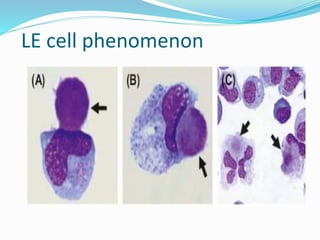
LE cell phenomenon
Anti nuclear antibodies
 (auto)antibodies reactive with antigens in nucleoplasm
 POSITIVE when titre above normal level
 Most ANAs – directed against nucleic acid or
associated proteins
 First demonstration- in 1957 by Holborow et al using
indirect immunofluoroscence
 In SLE- predominant antigen is nucleosome
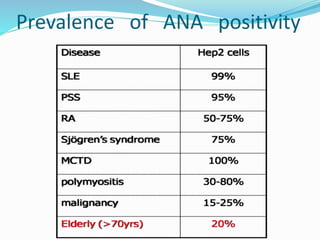
Prevalence of ANA positivity
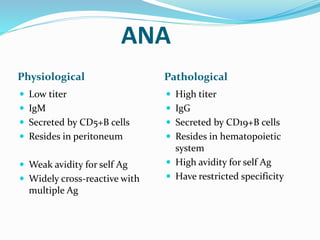
ANA
Physiological
 Low titer
 IgM
 Secreted by CD5+B cells
 Resides in peritoneum
 Weak avidity for self Ag
 Widely cross-reactive with
multiple Ag
Pathological
 High titer
 IgG
 Secreted by CD19+B cells
 Resides in hematopoietic
system
 High avidity for self Ag
 Have restricted specificity
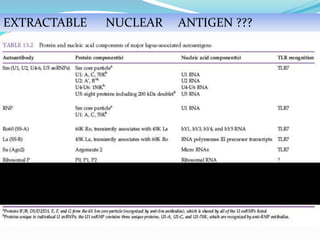
ANANUCLEAR LINE ANTIGEN ???EXTRACTABLE NUCLEAR ANTIGEN ???
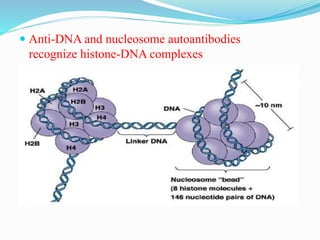
 Anti-DNA and nucleosome autoantibodies
recognize histone-DNA complexes
 Autoantibodies against chromatin and nucleosomes in
SLE are diverse, recognizing the H2A-H2B-DNA
complex, as well as individual histones, ssDNA, and
dsDNA
 About 70% of SLE patients have anti-dsDNA
antibodies at some time in their disease course
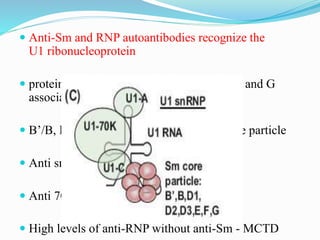
 Anti-Sm and RNP autoantibodies recognize the
U1 ribonucleoprotein
 proteins U1-70K, A, B’/B, C, D1/2/3, E, F, and G
associated with U1 sn RNA
 B’/B, D, E, F, and G assemble into Sm core particle
 Anti sm- SLE
 Anti 70K, A, C – PM, Scleroderma, SLE
 High levels of anti-RNP without anti-Sm - MCTD
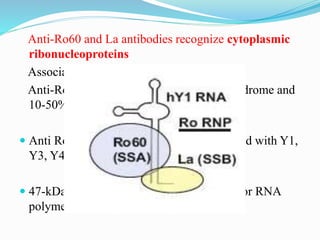
Anti-Ro60 and La antibodies recognize cytoplasmic
ribonucleoproteins
Associated with sicca syndrome
Anti-Ro60:60-80% of primary Sjogren syndrome and
10-50% SLE patients
 Anti Ro60 bind to 60-kDa protein associated with Y1,
Y3, Y4, or Y5 RNA.
 47-kDa La antigen is a termination factor for RNA
polymerase III
Development of autoimmunity
 defects in the Fas-Fas ligand (FasL) pathway
 defects in endosomal DNA degradation
 defects in degradation of misfolded RNA
 defects in the clearance of apoptotic cells by
phagocytes
 over-expression of TLRs
MECHANISM OF SLE
Autoantigenesis
Mechanisms:
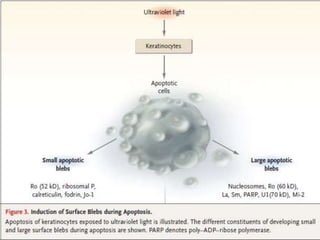
 Defective apoptosis
 Impaired removal of apoptotic cells
 Mutation
 Genetic polymorphisms
 Alternate splicing
 Post translational modification
 Molecular mimicry
 Defective sensing and uptake of autoAg
How does auto-Ag produce
auto-antibody
 Induction of effector T cells
 Reduced activation of suppressor cells
 Activation of TLRs
Others-
 Acting as chemoattractants
 Altered recognition of auto-antigens
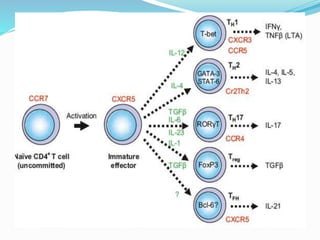
Role of T cells
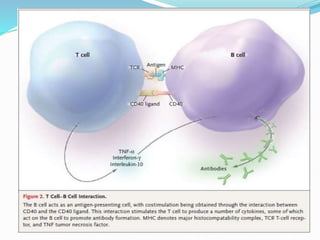
 T-cell-independent response-rapid antibody
production by short-lived plasma cells that
develop extrafollicularly and produce low-affinity
IgM antibodies
 T-cell-dependent response– in secondary
lymphoid organs e.g. spleen or lymph nodes,
which provide an optimal milieu for interactions
between T cells, B cells, and APCs
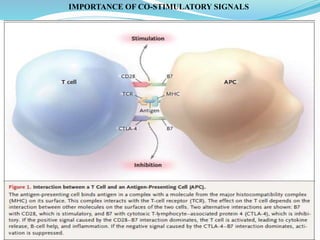
IMPORTANCE OF CO-STIMULATORY SIGNALS
 IFN-1 rescues autoraective T cells from apoptosis
 Newer therapy directed at co-stimulation:
CTLA4-Ig: potent inhibitor of co-stimulation and thus
T-cell activation
Role of B cells
 B1- IgM-high, IgD-low, CD23-neg
T cell independent
produces low affinity Ab
 B2 (conventional)-IgM-low,IgD-high, CD23-high,CD5- neg
requires CD 4+ T cells
high affinity Ab production
 Deletion (apoptosis), anergy, receptor editing, and
immunological ignorance -determines whether B cells
become activated or are tolerized
 High-affinity B cells tend to develop into short-
lived plasma cells, whereas lower-affinity B cells
enter germinal centers and are more likely to become
long-lived plasma cells and memory cells.
 Maintenance of long-lived plasma cells requires
continuous expression of Blimp-1 ,IL-6 and BAFF
produced by stromal cells
Extra follicular generation of
autoantibodies
 anti-DNA and rheumatoid factors, can develop
extrafollicularly without T cells
 T-cell independent
 exhibit significant somatic hyper mutation and class
switching
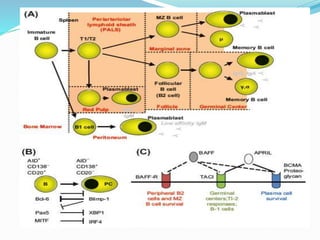
Role of BAFF/APRIL
 interact differentially with three receptors: BAFF-R ,TACI,
and BCMA.
 BAFF/BAFF-R interactions regulate the differentiation and
survival of B-2 and MZ B cells
 APRIL regulates CD40-independent class-switching and
plasma cell survival
 TACI regulates TI-2 responses.
CD40-CD40 ligand signalling
 CD40-CD40L interactions are important for generating
high-affinity autoantibodies.
 Newer therapeutic options:
1. human monoclonal anti-BAFF antibody : BELIMUMAB
2.anti-CD40L reduces anti-dsDNA antibodies
Basic mechanism of ANA production
Breakdown of tolerance
Transformation of autoreactive B cells
into long lived plasma cell & memory B
cells
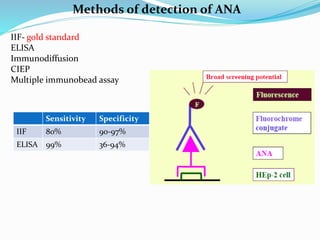
Sensitivity Specificity
IIF 80% 90-97%
ELISA 99% 36-94%
IIF- gold standard
ELISA
Immunodiffusion
CIEP
Multiple immunobead assay
Methods of detection of ANA
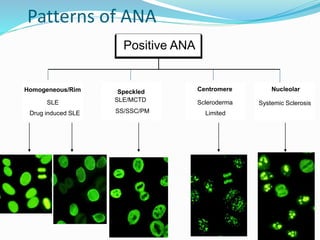
Patterns of ANA
Homogeneous/Rim
SLE
Drug induced SLE
Positive ANA
Speckled
SS/SSC/PM
SLE/MCTD
Centromere
Scleroderma
Limited
Nucleolar
Systemic Sclerosis
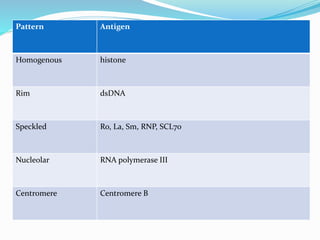
Pattern Antigen
Homogenous histone
Rim dsDNA
Speckled Ro, La, Sm, RNP, SCL70
Nucleolar RNA polymerase III
Centromere Centromere B
anti nuclear antibody

anti nuclear antibody

  • 1.
  • 2.
  • 3.
    Anti nuclear antibodies (auto)antibodies reactive with antigens in nucleoplasm  POSITIVE when titre above normal level  Most ANAs – directed against nucleic acid or associated proteins  First demonstration- in 1957 by Holborow et al using indirect immunofluoroscence  In SLE- predominant antigen is nucleosome
  • 4.
  • 5.
    ANA Physiological  Low titer IgM  Secreted by CD5+B cells  Resides in peritoneum  Weak avidity for self Ag  Widely cross-reactive with multiple Ag Pathological  High titer  IgG  Secreted by CD19+B cells  Resides in hematopoietic system  High avidity for self Ag  Have restricted specificity
  • 6.
    ANANUCLEAR LINE ANTIGEN???EXTRACTABLE NUCLEAR ANTIGEN ???
  • 7.
     Anti-DNA andnucleosome autoantibodies recognize histone-DNA complexes  Autoantibodies against chromatin and nucleosomes in SLE are diverse, recognizing the H2A-H2B-DNA complex, as well as individual histones, ssDNA, and dsDNA  About 70% of SLE patients have anti-dsDNA antibodies at some time in their disease course
  • 8.
     Anti-Sm andRNP autoantibodies recognize the U1 ribonucleoprotein  proteins U1-70K, A, B’/B, C, D1/2/3, E, F, and G associated with U1 sn RNA  B’/B, D, E, F, and G assemble into Sm core particle  Anti sm- SLE  Anti 70K, A, C – PM, Scleroderma, SLE  High levels of anti-RNP without anti-Sm - MCTD
  • 9.
    Anti-Ro60 and Laantibodies recognize cytoplasmic ribonucleoproteins Associated with sicca syndrome Anti-Ro60:60-80% of primary Sjogren syndrome and 10-50% SLE patients  Anti Ro60 bind to 60-kDa protein associated with Y1, Y3, Y4, or Y5 RNA.  47-kDa La antigen is a termination factor for RNA polymerase III
  • 11.
    Development of autoimmunity defects in the Fas-Fas ligand (FasL) pathway  defects in endosomal DNA degradation  defects in degradation of misfolded RNA  defects in the clearance of apoptotic cells by phagocytes  over-expression of TLRs MECHANISM OF SLE
  • 12.
    Autoantigenesis Mechanisms:  Defective apoptosis Impaired removal of apoptotic cells  Mutation  Genetic polymorphisms  Alternate splicing  Post translational modification  Molecular mimicry  Defective sensing and uptake of autoAg
  • 13.
    How does auto-Agproduce auto-antibody  Induction of effector T cells  Reduced activation of suppressor cells  Activation of TLRs Others-  Acting as chemoattractants  Altered recognition of auto-antigens
  • 14.
    Role of Tcells  T-cell-independent response-rapid antibody production by short-lived plasma cells that develop extrafollicularly and produce low-affinity IgM antibodies  T-cell-dependent response– in secondary lymphoid organs e.g. spleen or lymph nodes, which provide an optimal milieu for interactions between T cells, B cells, and APCs
  • 16.
  • 17.
     IFN-1 rescuesautoraective T cells from apoptosis  Newer therapy directed at co-stimulation: CTLA4-Ig: potent inhibitor of co-stimulation and thus T-cell activation
  • 18.
    Role of Bcells  B1- IgM-high, IgD-low, CD23-neg T cell independent produces low affinity Ab  B2 (conventional)-IgM-low,IgD-high, CD23-high,CD5- neg requires CD 4+ T cells high affinity Ab production  Deletion (apoptosis), anergy, receptor editing, and immunological ignorance -determines whether B cells become activated or are tolerized
  • 20.
     High-affinity Bcells tend to develop into short- lived plasma cells, whereas lower-affinity B cells enter germinal centers and are more likely to become long-lived plasma cells and memory cells.  Maintenance of long-lived plasma cells requires continuous expression of Blimp-1 ,IL-6 and BAFF produced by stromal cells
  • 21.
    Extra follicular generationof autoantibodies  anti-DNA and rheumatoid factors, can develop extrafollicularly without T cells  T-cell independent  exhibit significant somatic hyper mutation and class switching
  • 22.
    Role of BAFF/APRIL interact differentially with three receptors: BAFF-R ,TACI, and BCMA.  BAFF/BAFF-R interactions regulate the differentiation and survival of B-2 and MZ B cells  APRIL regulates CD40-independent class-switching and plasma cell survival  TACI regulates TI-2 responses.
  • 23.
    CD40-CD40 ligand signalling CD40-CD40L interactions are important for generating high-affinity autoantibodies.  Newer therapeutic options: 1. human monoclonal anti-BAFF antibody : BELIMUMAB 2.anti-CD40L reduces anti-dsDNA antibodies
  • 25.
    Basic mechanism ofANA production Breakdown of tolerance Transformation of autoreactive B cells into long lived plasma cell & memory B cells
  • 27.
    Sensitivity Specificity IIF 80%90-97% ELISA 99% 36-94% IIF- gold standard ELISA Immunodiffusion CIEP Multiple immunobead assay Methods of detection of ANA
  • 28.
    Patterns of ANA Homogeneous/Rim SLE Druginduced SLE Positive ANA Speckled SS/SSC/PM SLE/MCTD Centromere Scleroderma Limited Nucleolar Systemic Sclerosis
  • 29.
    Pattern Antigen Homogenous histone RimdsDNA Speckled Ro, La, Sm, RNP, SCL70 Nucleolar RNA polymerase III Centromere Centromere B