How Industries Use Direct-to-Public
Persuasion in Policy Conflicts:
Asymmetries in Public Voting
Responses
From: Seiders, Flynn, and Nenkov (2021)
Direct-to-Public Persuasion
A strategy used by industry
and activist groups to
convince the public that the
marketer’s stance is the
objectively correct choice.
Persuasion is meant to lead
to voter support for the issue
on state ballot initiatives.
From: Seiders, Flynn, and Nenkov (2021)
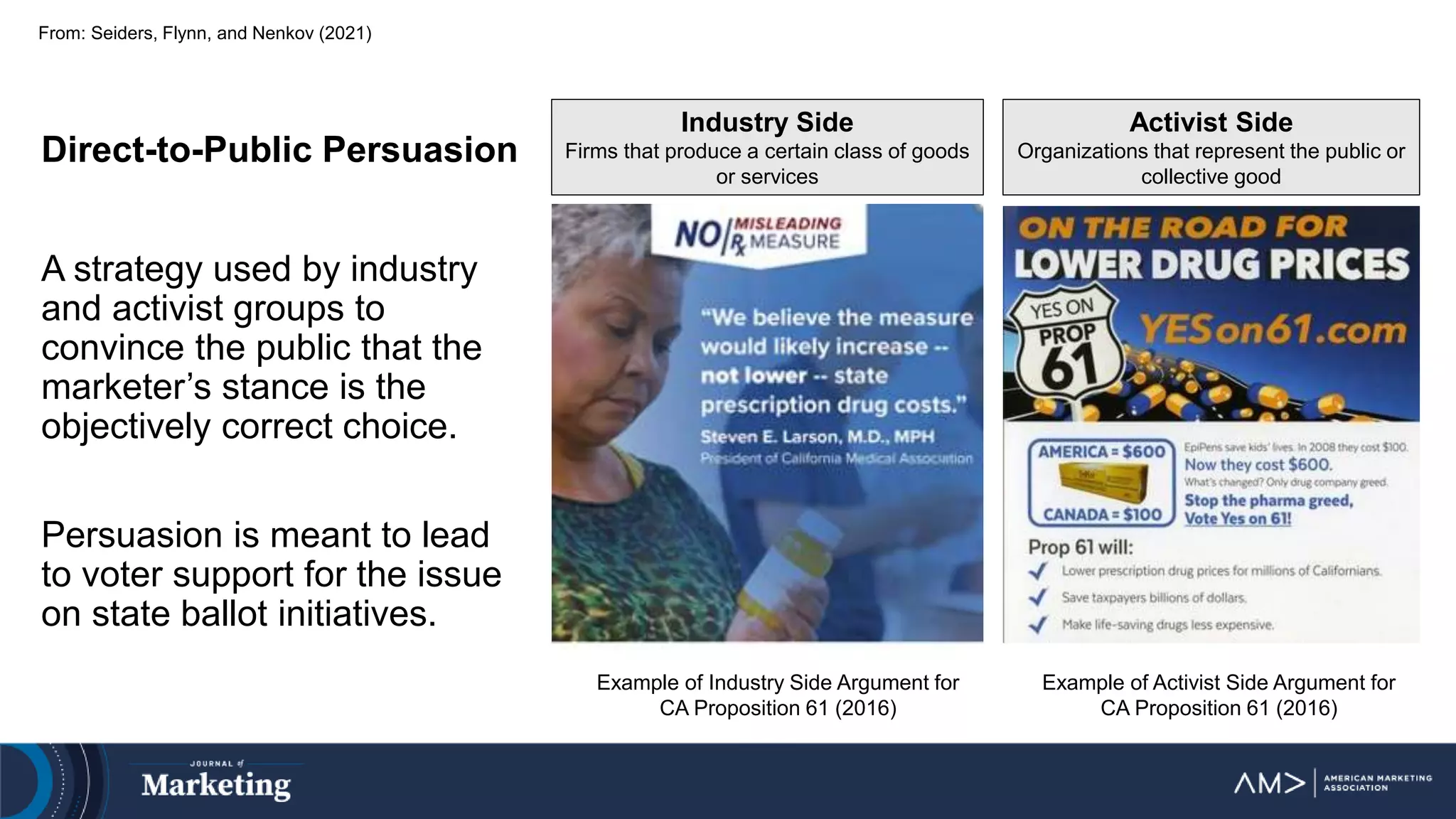
Example of Industry Side Argument for
CA Proposition 61 (2016)
Example of Activist Side Argument for
CA Proposition 61 (2016)
Industry Side
Firms that produce a certain class of goods
or services
Activist Side
Organizations that represent the public or
collective good
Strength & Suspicion
The authors study 2 important dimensions of policy arguments,
argument strength and argument suspicion.
Argument Strength: perception that an argument is persuasive.
Argument Suspicion: perception that an argument is
implausible or has a hidden intent.
From: Seiders, Flynn, and Nenkov (2021)
Financial vs. Societal Arguments
Industry and activist groups can choose between making financial or societal
arguments to voters
Financial Argument: A financial argument emphasizes how the proposed
policy will impose or reduce financial benefits or costs.
Industry side example: “Proposition 25 will hurt people in our state financially
because it would increase the prices of other needed medicines.”
Societal Argument: A societal argument emphasizes how the proposed policy
will inhibit or promote shared societal goals or values.
Activist side example: “Proposition 25 will save patients’ lives because it would
provide better access to life saving drugs.”
From: Seiders, Flynn, and Nenkov (2021)
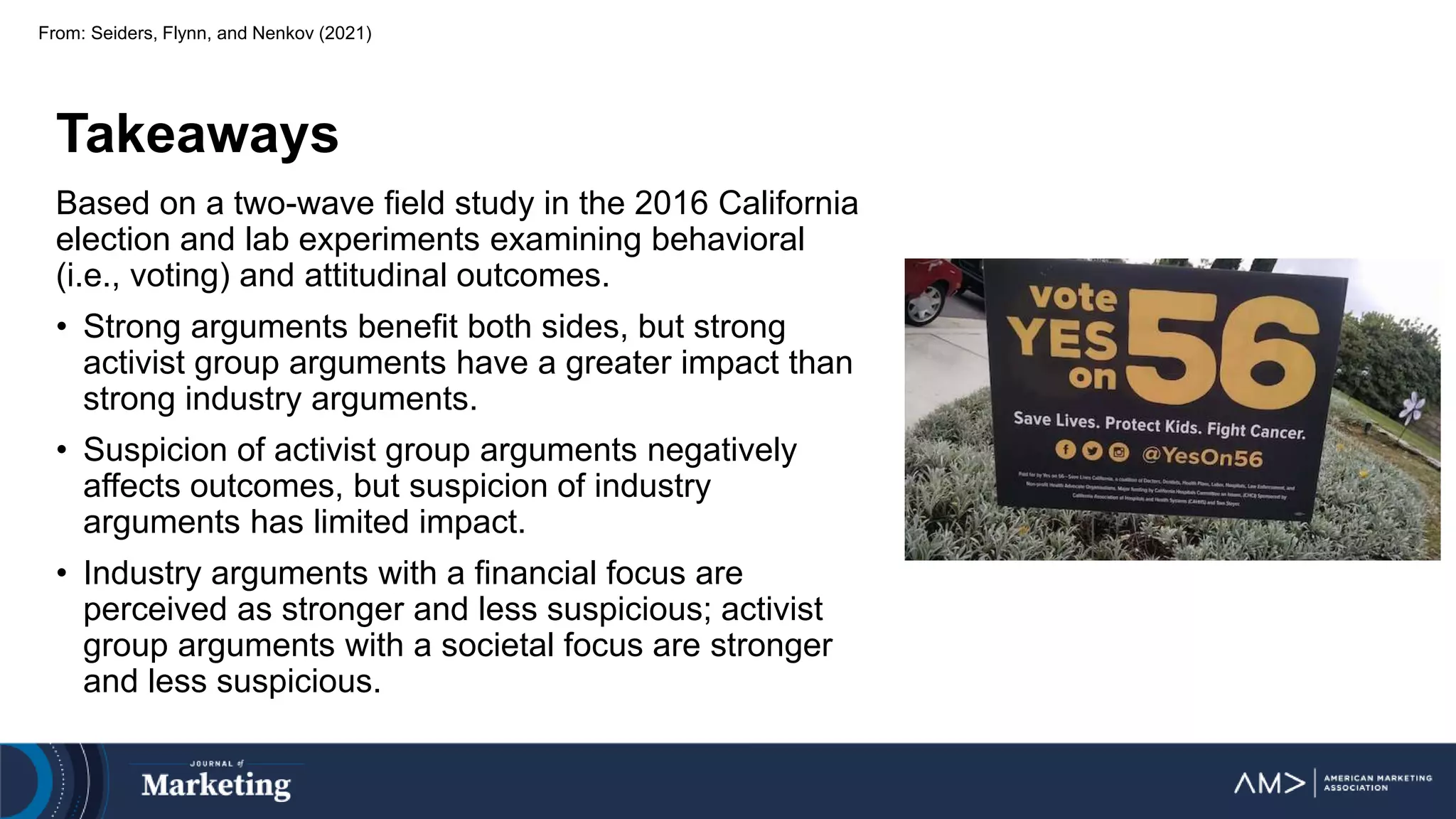
Based on a two-wave field study in the 2016 California
election and lab experiments examining behavioral
(i.e., voting) and attitudinal outcomes.
• Strong arguments benefit both sides, but strong
activist group arguments have a greater impact than
strong industry arguments.
• Suspicion of activist group arguments negatively
affects outcomes, but suspicion of industry
arguments has limited impact.
• Industry arguments with a financial focus are
perceived as stronger and less suspicious; activist
group arguments with a societal focus are stronger
and less suspicious.
Takeaways
From: Seiders, Flynn, and Nenkov (2021)
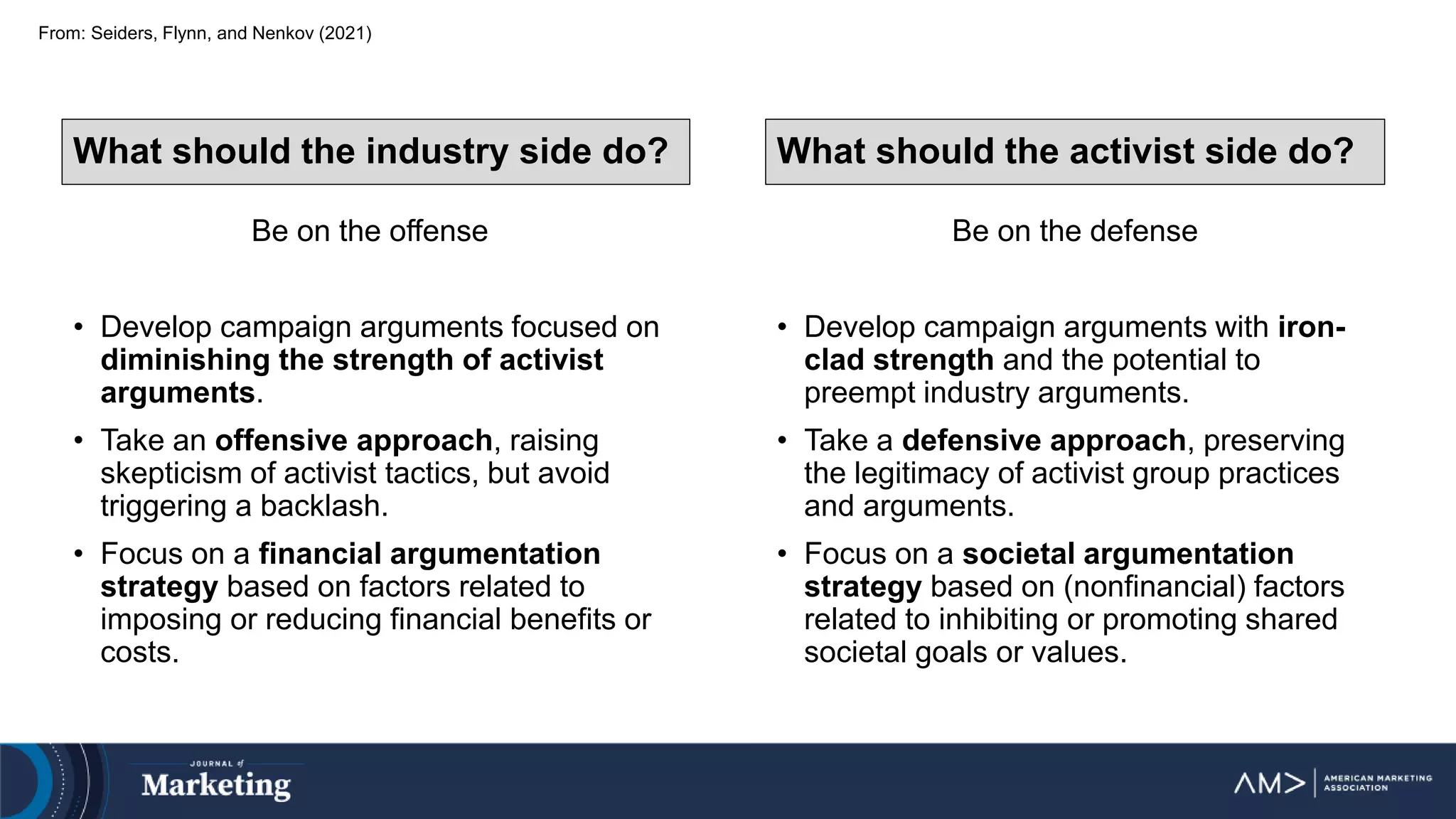
What should the industry side do?
Be on the offense
• Develop campaign arguments focused on
diminishing the strength of activist
arguments.
• Take an offensive approach, raising
skepticism of activist tactics, but avoid
triggering a backlash.
• Focus on a financial argumentation
strategy based on factors related to
imposing or reducing financial benefits or
costs.
What should the activist side do?
Be on the defense
• Develop campaign arguments with iron-
clad strength and the potential to
preempt industry arguments.
• Take a defensive approach, preserving
the legitimacy of activist group practices
and arguments.
• Focus on a societal argumentation
strategy based on (nonfinancial) factors
related to inhibiting or promoting shared
societal goals or values.
From: Seiders, Flynn, and Nenkov (2021)

How Industries Use Direct-to-Public Persuasion in Policy Conflicts: Asymmetries in Public Voting Responses

  • 1.
    How Industries UseDirect-to-Public Persuasion in Policy Conflicts: Asymmetries in Public Voting Responses From: Seiders, Flynn, and Nenkov (2021)
  • 2.
    Direct-to-Public Persuasion A strategyused by industry and activist groups to convince the public that the marketer’s stance is the objectively correct choice. Persuasion is meant to lead to voter support for the issue on state ballot initiatives. From: Seiders, Flynn, and Nenkov (2021) Example of Industry Side Argument for CA Proposition 61 (2016) Example of Activist Side Argument for CA Proposition 61 (2016) Industry Side Firms that produce a certain class of goods or services Activist Side Organizations that represent the public or collective good
  • 3.
    Strength & Suspicion Theauthors study 2 important dimensions of policy arguments, argument strength and argument suspicion. Argument Strength: perception that an argument is persuasive. Argument Suspicion: perception that an argument is implausible or has a hidden intent. From: Seiders, Flynn, and Nenkov (2021)
  • 4.
    Financial vs. SocietalArguments Industry and activist groups can choose between making financial or societal arguments to voters Financial Argument: A financial argument emphasizes how the proposed policy will impose or reduce financial benefits or costs. Industry side example: “Proposition 25 will hurt people in our state financially because it would increase the prices of other needed medicines.” Societal Argument: A societal argument emphasizes how the proposed policy will inhibit or promote shared societal goals or values. Activist side example: “Proposition 25 will save patients’ lives because it would provide better access to life saving drugs.” From: Seiders, Flynn, and Nenkov (2021)
  • 5.
    Based on atwo-wave field study in the 2016 California election and lab experiments examining behavioral (i.e., voting) and attitudinal outcomes. • Strong arguments benefit both sides, but strong activist group arguments have a greater impact than strong industry arguments. • Suspicion of activist group arguments negatively affects outcomes, but suspicion of industry arguments has limited impact. • Industry arguments with a financial focus are perceived as stronger and less suspicious; activist group arguments with a societal focus are stronger and less suspicious. Takeaways From: Seiders, Flynn, and Nenkov (2021)
  • 6.
    What should theindustry side do? Be on the offense • Develop campaign arguments focused on diminishing the strength of activist arguments. • Take an offensive approach, raising skepticism of activist tactics, but avoid triggering a backlash. • Focus on a financial argumentation strategy based on factors related to imposing or reducing financial benefits or costs. What should the activist side do? Be on the defense • Develop campaign arguments with iron- clad strength and the potential to preempt industry arguments. • Take a defensive approach, preserving the legitimacy of activist group practices and arguments. • Focus on a societal argumentation strategy based on (nonfinancial) factors related to inhibiting or promoting shared societal goals or values. From: Seiders, Flynn, and Nenkov (2021)