Onboarding Salespeople:
Socialization Approaches
Wiseman, Ahearne, Hall, and Tirunillai (2021)
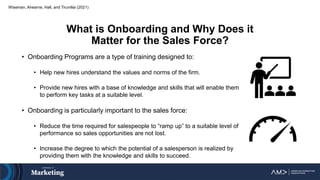
What is Onboarding and Why Does it
Matter for the Sales Force?
• Onboarding Programs are a type of training designed to:
• Help new hires understand the values and norms of the firm.
• Provide new hires with a base of knowledge and skills that will enable them
to perform key tasks at a suitable level.
• Onboarding is particularly important to the sales force:
• Reduce the time required for salespeople to “ramp up” to a suitable level of
performance so sales opportunities are not lost.
• Increase the degree to which the potential of a salesperson is realized by
providing them with the knowledge and skills to succeed.
Wiseman, Ahearne, Hall, and Tirunillai (2021)
Salesperson Onboarding:
Centralized and Decentralized Programs
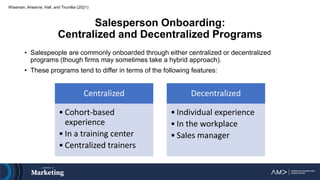
• Salespeople are commonly onboarded through either centralized or decentralized
programs (though firms may sometimes take a hybrid approach).
• These programs tend to differ in terms of the following features:
Wiseman, Ahearne, Hall, and Tirunillai (2021)
Centralized
• Cohort-based
experience
• In a training center
• Centralized trainers
Decentralized
• Individual experience
• In the workplace
• Sales manager
Why Decentralized Onboarding Benefits
the Sales Force
• Like centralized programs, Decentralized programs
provide a degree of structure that new hires appreciate.
• Decentralized programs also encourage new hires to take
a more innovative and adaptive approach to aspects of
their job.
- Through features (e.g., those listed in the prior slide) that
put less pressure on a new hire to follow the firm’s way of
doing things, allowing them to adapt how they approach the
job to fit their strengths.
Wiseman, Ahearne, Hall, and Tirunillai (2021)
Why Decentralized Onboarding Benefits
the Sales Force
• Why encouraging a more innovative and adaptive approach to
some aspects of a job can be especially beneficial in sales.
• General sales strategies prescribed by a firm to their salespeople may
be effective on average but miss out on nuances in how customers
prefer to be engaged, process information, etc.
• Incorporating insights from a new hire’s past work experiences can
lead to positive adaptations in their new sales role.
• Local differences in geographic areas may require changes in how a
salesperson engages with different customers.
Wiseman, Ahearne, Hall, and Tirunillai (2021)
Main Takeaways
• Decentralized onboarding can lead to higher performing
salespeople (compared to centralized onboarding).
Particularly when:
• Sales managers have the bandwidth (e.g., fewer salespeople
reporting to them) to develop and coach their salespeople.
• May enable sales managers to direct a salesperson’s efforts at
taking a more innovative approach to aspects of their job
towards those efforts that are likely to be beneficial.
• New hires have prior work experience (e.g., are coming from
another job as opposed to coming from school).
• Decentralized onboarding may encourage newly hired
salespeople to seek ways to positively incorporate knowledge
and skills from their old job into their new job.
Wiseman, Ahearne, Hall, and Tirunillai (2021)

Wiseman et al. (2022).pptx

  • 1.
  • 2.
    What is Onboardingand Why Does it Matter for the Sales Force? • Onboarding Programs are a type of training designed to: • Help new hires understand the values and norms of the firm. • Provide new hires with a base of knowledge and skills that will enable them to perform key tasks at a suitable level. • Onboarding is particularly important to the sales force: • Reduce the time required for salespeople to “ramp up” to a suitable level of performance so sales opportunities are not lost. • Increase the degree to which the potential of a salesperson is realized by providing them with the knowledge and skills to succeed. Wiseman, Ahearne, Hall, and Tirunillai (2021)
  • 3.
    Salesperson Onboarding: Centralized andDecentralized Programs • Salespeople are commonly onboarded through either centralized or decentralized programs (though firms may sometimes take a hybrid approach). • These programs tend to differ in terms of the following features: Wiseman, Ahearne, Hall, and Tirunillai (2021) Centralized • Cohort-based experience • In a training center • Centralized trainers Decentralized • Individual experience • In the workplace • Sales manager
  • 4.
    Why Decentralized OnboardingBenefits the Sales Force • Like centralized programs, Decentralized programs provide a degree of structure that new hires appreciate. • Decentralized programs also encourage new hires to take a more innovative and adaptive approach to aspects of their job. - Through features (e.g., those listed in the prior slide) that put less pressure on a new hire to follow the firm’s way of doing things, allowing them to adapt how they approach the job to fit their strengths. Wiseman, Ahearne, Hall, and Tirunillai (2021)
  • 5.
    Why Decentralized OnboardingBenefits the Sales Force • Why encouraging a more innovative and adaptive approach to some aspects of a job can be especially beneficial in sales. • General sales strategies prescribed by a firm to their salespeople may be effective on average but miss out on nuances in how customers prefer to be engaged, process information, etc. • Incorporating insights from a new hire’s past work experiences can lead to positive adaptations in their new sales role. • Local differences in geographic areas may require changes in how a salesperson engages with different customers. Wiseman, Ahearne, Hall, and Tirunillai (2021)
  • 6.
    Main Takeaways • Decentralizedonboarding can lead to higher performing salespeople (compared to centralized onboarding). Particularly when: • Sales managers have the bandwidth (e.g., fewer salespeople reporting to them) to develop and coach their salespeople. • May enable sales managers to direct a salesperson’s efforts at taking a more innovative approach to aspects of their job towards those efforts that are likely to be beneficial. • New hires have prior work experience (e.g., are coming from another job as opposed to coming from school). • Decentralized onboarding may encourage newly hired salespeople to seek ways to positively incorporate knowledge and skills from their old job into their new job. Wiseman, Ahearne, Hall, and Tirunillai (2021)