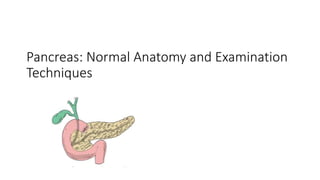
Pancreas: Normal Anatomy and Examination
Techniques
Embryology
• Develops from endoderm of primitive duodenum.
• Develops in two parts –dorsal part and ventral part
• Dorsal part/anlage forms whole body, neck and tail of gland, together
with part of head.
• ventral anlage develops as two separate buds from hepatic diverticulum.
• The left ventral bud atrophies, and right ventral bud persist to form head
and uncinate process
Normal anatomy
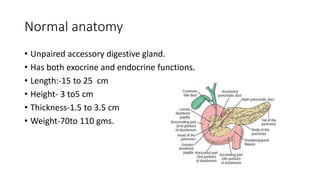
• Unpaired accessory digestive gland.
• Has both exocrine and endocrine functions.
• Length:-15 to 25 cm
• Height- 3 to5 cm
• Thickness-1.5 to 3.5 cm
• Weight-70to 110 gms.
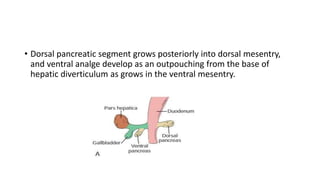
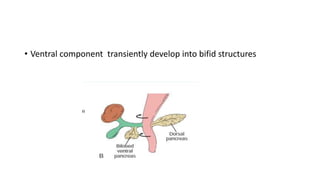
• Dorsal pancreatic segment grows posteriorly into dorsal mesentry,
and ventral analge develop as an outpouching from the base of
hepatic diverticulum as grows in the ventral mesentry.
• Ventral component transiently develop into bifid structures
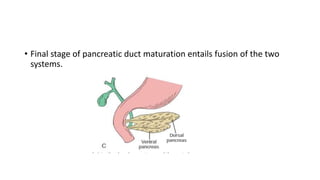
• Final stage of pancreatic duct maturation entails fusion of the two
systems.
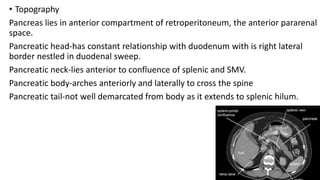
• Topography
Pancreas lies in anterior compartment of retroperitoneum, the anterior pararenal
space.
Pancreatic head-has constant relationship with duodenum with is right lateral
border nestled in duodenal sweep.
Pancreatic neck-lies anterior to confluence of splenic and SMV.
Pancreatic body-arches anteriorly and laterally to cross the spine
Pancreatic tail-not well demarcated from body as it extends to splenic hilum.
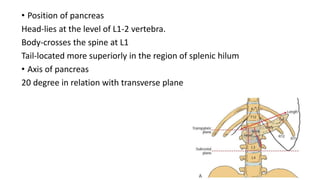
• Position of pancreas
Head-lies at the level of L1-2 vertebra.
Body-crosses the spine at L1
Tail-located more superiorly in the region of splenic hilum
• Axis of pancreas
20 degree in relation with transverse plane
Relations of pancreas
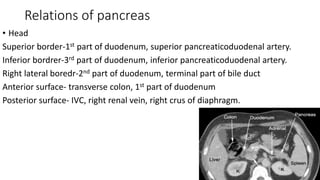
• Head
Superior border-1st part of duodenum, superior pancreaticoduodenal artery.
Inferior bordrer-3rd part of duodenum, inferior pancreaticoduodenal artery.
Right lateral boredr-2nd part of duodenum, terminal part of bile duct
Anterior surface- transverse colon, 1st part of duodenum
Posterior surface- IVC, right renal vein, right crus of diaphragm.
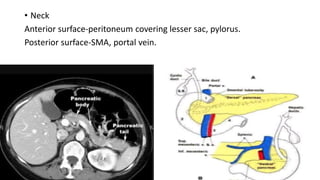
• Neck
Anterior surface-peritoneum covering lesser sac, pylorus.
Posterior surface-SMA, portal vein.
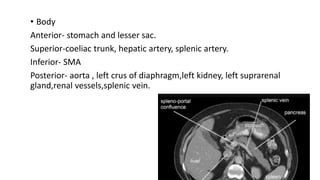
• Body
Anterior- stomach and lesser sac.
Superior-coeliac trunk, hepatic artery, splenic artery.
Inferior- SMA
Posterior- aorta , left crus of diaphragm,left kidney, left suprarenal
gland,renal vessels,splenic vein.
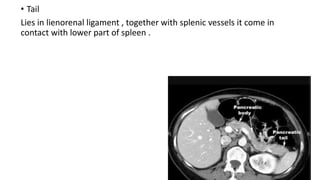
• Tail
Lies in lienorenal ligament , together with splenic vessels it come in
contact with lower part of spleen .
Pancreatic duct
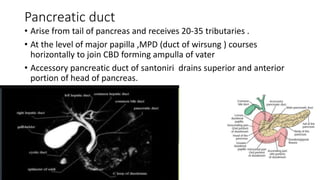
• Arise from tail of pancreas and receives 20-35 tributaries .
• At the level of major papilla ,MPD (duct of wirsung ) courses
horizontally to join CBD forming ampulla of vater
• Accessory pancreatic duct of santoniri drains superior and anterior
portion of head of pancreas.
Arterial supply
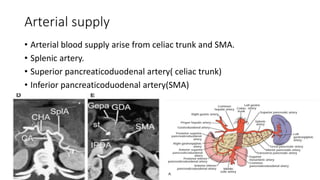
• Arterial blood supply arise from celiac trunk and SMA.
• Splenic artery.
• Superior pancreaticoduodenal artery( celiac trunk)
• Inferior pancreaticoduodenal artery(SMA)
Venous drainage
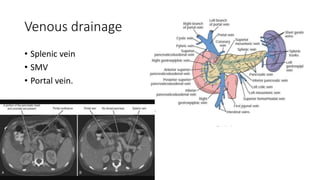
• Splenic vein
• SMV
• Portal vein.
Lymphatics
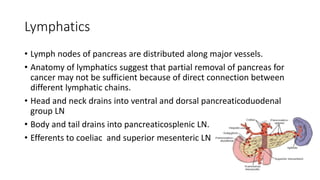
• Lymph nodes of pancreas are distributed along major vessels.
• Anatomy of lymphatics suggest that partial removal of pancreas for
cancer may not be sufficient because of direct connection between
different lymphatic chains.
• Head and neck drains into ventral and dorsal pancreaticoduodenal
group LN
• Body and tail drains into pancreaticosplenic LN.
• Efferents to coeliac and superior mesenteric LN.
Radiological techniques
• Plain radiographs
Plain radiographs obtained on the patients with suspected pancreatic
disease to exclude other conditions such as obstruction or perforated
duodenal ulcers that may stimulate pancreatitis.
Oblique view helpful in patients with chronic pancreatitis to detect
calcifications that may be obscured by spine in AP view.
Contrast study
• The posterior gastric wall , distal duodenum, duodenojejunal junction
can be abnormal with the lesions of pancreatic body and tail.
• Greater curvature, medial aspect of descending duodenum provide
clue for lesions arising from pancreatic head and neck.
• Ba enema examination may reveal abnormalities of colon caused by
disease spread via transverse mesocolon.
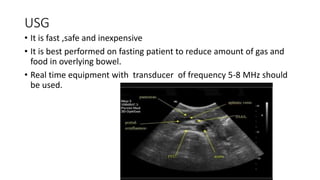
USG
• It is fast ,safe and inexpensive
• It is best performed on fasting patient to reduce amount of gas and
food in overlying bowel.
• Real time equipment with transducer of frequency 5-8 MHz should
be used.
• Examination techniques.
Scan of pancreas should first be performed with patient supine and
transducer turned into modified transverse plane angled cephalad
towards spleen.
Long axis of pancreas seen anterior to splenic vein and confluence of
SMV and splenic vein.
• Parasagittal scan should be begin where the portal vein merges with
longitudinally oriented SMV.
• The neck of pancreas is seen anterior to this confluence.
• Uncinate process lies posterior SMV
• Having the patient drink four 6-oz degassed water can provide
sonographic window for improved visualization of body and tail
• Deep inspiration causes liver to move inferiorly over pancreas ,
caudally displacing gas filled bowels.
• IV glucagon 0.3 mg stop peristalsis and improve water retention in
stomach and pancreas.
• Scanning patient in erect position is also helpful as it as it allow the
liver to descend over the pancreas, displacing the bowel loops
inferiorly. It also cause gas in stomach and duodenum to raise above
the level of pancreas.
Normal findings on USG
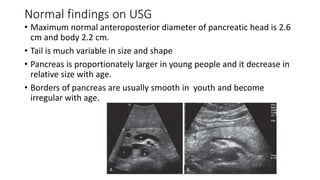
• Maximum normal anteroposterior diameter of pancreatic head is 2.6
cm and body 2.2 cm.
• Tail is much variable in size and shape
• Pancreas is proportionately larger in young people and it decrease in
relative size with age.
• Borders of pancreas are usually smooth in youth and become
irregular with age.
• Echogenicity of pancreas
Echogenicity is high throughout its substance
Pancreatic tissue echotexture is usually coarse, more inhomogeneous,
more echogenic than that of liver.
• MPD
It is identified sonographically in 2/3rd of patients as an anechoic space
surrounded by hypoechoic lines resembling trolley tracks.
The maximal inner diameter is 2 mm; when it is larger, an obstructing
mass, stricture or stone must be suspected.
Intraoperative ultrasound
• Accurate means of localizing small islet cell tumor
• It can also used to guide open biopsy and aspiration.
CT
• Best single noninvasive technique for imaging of pancreas.
• It is unaffected by bowel gas or large body habitus is widely available
and relatively easily performed.
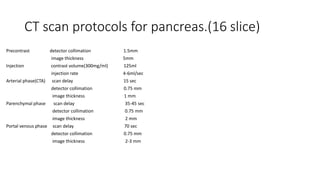
CT scan protocols for pancreas.(16 slice)
Precontrast detector collimation 1.5mm
image thickness 5mm
Injection contrast volume(300mg/ml) 125ml
injection rate 4-6ml/sec
Arterial phase(CTA) scan delay 15 sec
detector collimation 0.75 mm
image thickness 1 mm
Parenchymal phase scan delay 35-45 sec
detector collimation 0.75 mm
image thickness 2 mm
Portal venous phase scan delay 70 sec
detector collimation 0.75 mm
image thickness 2-3 mm
• Precontrast phase-pancreatic calcification, CBD calcification
• CTA -surgical planning.
• Parenchymal phase-maximal enhancement of pancreas, helps in
identifying hyper vascular neuroendocrine tumor hypo vascular
adenocarcinoma
• Portal phase - focal lesions and assessment of portal venous
structure, liver for metastasis.
• Water or low density oral contrast medium given 30 min prior to
scanning
• Negative contrast medium will not obscure CBD stones and helps in
assessing bowel wall involvement
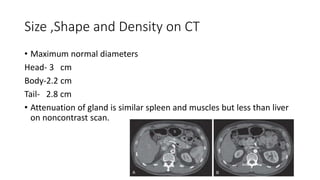
Size ,Shape and Density on CT
• Maximum normal diameters
Head- 3 cm
Body-2.2 cm
Tail- 2.8 cm
• Attenuation of gland is similar spleen and muscles but less than liver
on noncontrast scan.
MRI
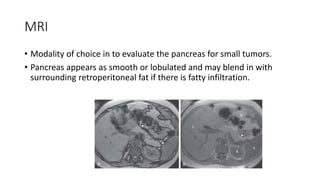
• Modality of choice in to evaluate the pancreas for small tumors.
• Pancreas appears as smooth or lobulated and may blend in with
surrounding retroperitoneal fat if there is fatty infiltration.
MRCP
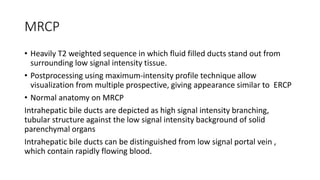
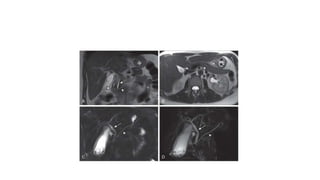
• Heavily T2 weighted sequence in which fluid filled ducts stand out from
surrounding low signal intensity tissue.
• Postprocessing using maximum-intensity profile technique allow
visualization from multiple prospective, giving appearance similar to ERCP
• Normal anatomy on MRCP
Intrahepatic bile ducts are depicted as high signal intensity branching,
tubular structure against the low signal intensity background of solid
parenchymal organs
Intrahepatic bile ducts can be distinguished from low signal portal vein ,
which contain rapidly flowing blood.
Congenital anomalies.
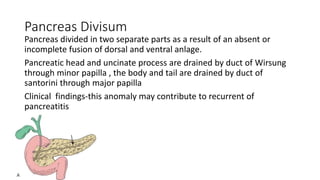
Pancreas Divisum
Pancreas divided in two separate parts as a result of an absent or
incomplete fusion of dorsal and ventral anlage.
Pancreatic head and uncinate process are drained by duct of Wirsung
through minor papilla , the body and tail are drained by duct of
santorini through major papilla
Clinical findings-this anomaly may contribute to recurrent of
pancreatitis
• Radiological findings
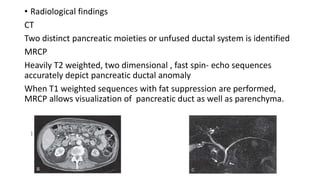
CT
Two distinct pancreatic moieties or unfused ductal system is identified
MRCP
Heavily T2 weighted, two dimensional , fast spin- echo sequences
accurately depict pancreatic ductal anomaly
When T1 weighted sequences with fat suppression are performed,
MRCP allows visualization of pancreatic duct as well as parenchyma.
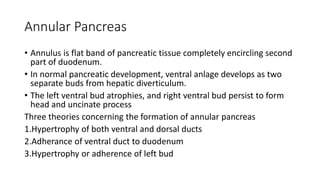
Annular Pancreas
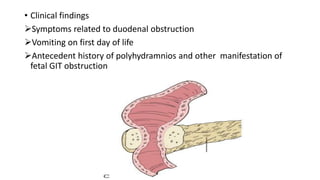
• Annulus is flat band of pancreatic tissue completely encircling second
part of duodenum.
• In normal pancreatic development, ventral anlage develops as two
separate buds from hepatic diverticulum.
• The left ventral bud atrophies, and right ventral bud persist to form
head and uncinate process
Three theories concerning the formation of annular pancreas
1.Hypertrophy of both ventral and dorsal ducts
2.Adherance of ventral duct to duodenum
3.Hypertrophy or adherence of left bud
• Clinical findings
Symptoms related to duodenal obstruction
Vomiting on first day of life
Antecedent history of polyhydramnios and other manifestation of
fetal GIT obstruction
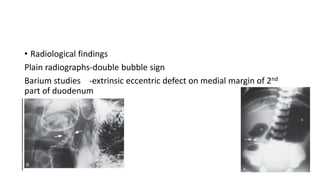
• Radiological findings
Plain radiographs-double bubble sign
Barium studies -extrinsic eccentric defect on medial margin of 2nd
part of duodenum
• USG- non specific enlargement of pancreatic head.
• CT-shows enlargement of pancreatic head that has central region of
high attenuation representing contrast material within narrowed
duodenal segment.
• MRI- T1 –weighted sequence shows normal pancreatic tissue
encircling the duodenum.
Ectopic pancreatic Tissue
• Heteroplastic differentiation of part of embryonic ectoderm that do
not normally produce pancreatic tissue.
• Ectopic rest of pancreatic tissue occurs in gastric antrum, proximal
Portion of duodenum
Majority of cases are asymptomatic and found incidentally.
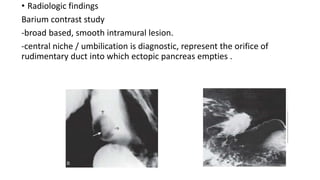
• Radiologic findings
Barium contrast study
-broad based, smooth intramural lesion.
-central niche / umbilication is diagnostic, represent the orifice of
rudimentary duct into which ectopic pancreas empties .
Thank you

Pancreas RADIOLOGY

  • 1.
    Pancreas: Normal Anatomyand Examination Techniques
  • 2.
    Embryology • Develops fromendoderm of primitive duodenum. • Develops in two parts –dorsal part and ventral part • Dorsal part/anlage forms whole body, neck and tail of gland, together with part of head. • ventral anlage develops as two separate buds from hepatic diverticulum. • The left ventral bud atrophies, and right ventral bud persist to form head and uncinate process
  • 3.
    Normal anatomy • Unpairedaccessory digestive gland. • Has both exocrine and endocrine functions. • Length:-15 to 25 cm • Height- 3 to5 cm • Thickness-1.5 to 3.5 cm • Weight-70to 110 gms.
  • 4.
    • Dorsal pancreaticsegment grows posteriorly into dorsal mesentry, and ventral analge develop as an outpouching from the base of hepatic diverticulum as grows in the ventral mesentry.
  • 5.
    • Ventral componenttransiently develop into bifid structures
  • 6.
    • Final stageof pancreatic duct maturation entails fusion of the two systems.
  • 7.
    • Topography Pancreas liesin anterior compartment of retroperitoneum, the anterior pararenal space. Pancreatic head-has constant relationship with duodenum with is right lateral border nestled in duodenal sweep. Pancreatic neck-lies anterior to confluence of splenic and SMV. Pancreatic body-arches anteriorly and laterally to cross the spine Pancreatic tail-not well demarcated from body as it extends to splenic hilum.
  • 8.
    • Position ofpancreas Head-lies at the level of L1-2 vertebra. Body-crosses the spine at L1 Tail-located more superiorly in the region of splenic hilum • Axis of pancreas 20 degree in relation with transverse plane
  • 9.
    Relations of pancreas •Head Superior border-1st part of duodenum, superior pancreaticoduodenal artery. Inferior bordrer-3rd part of duodenum, inferior pancreaticoduodenal artery. Right lateral boredr-2nd part of duodenum, terminal part of bile duct Anterior surface- transverse colon, 1st part of duodenum Posterior surface- IVC, right renal vein, right crus of diaphragm.
  • 10.
    • Neck Anterior surface-peritoneumcovering lesser sac, pylorus. Posterior surface-SMA, portal vein.
  • 11.
    • Body Anterior- stomachand lesser sac. Superior-coeliac trunk, hepatic artery, splenic artery. Inferior- SMA Posterior- aorta , left crus of diaphragm,left kidney, left suprarenal gland,renal vessels,splenic vein.
  • 12.
    • Tail Lies inlienorenal ligament , together with splenic vessels it come in contact with lower part of spleen .
  • 13.
    Pancreatic duct • Arisefrom tail of pancreas and receives 20-35 tributaries . • At the level of major papilla ,MPD (duct of wirsung ) courses horizontally to join CBD forming ampulla of vater • Accessory pancreatic duct of santoniri drains superior and anterior portion of head of pancreas.
  • 14.
    Arterial supply • Arterialblood supply arise from celiac trunk and SMA. • Splenic artery. • Superior pancreaticoduodenal artery( celiac trunk) • Inferior pancreaticoduodenal artery(SMA)
  • 15.
    Venous drainage • Splenicvein • SMV • Portal vein.
  • 16.
    Lymphatics • Lymph nodesof pancreas are distributed along major vessels. • Anatomy of lymphatics suggest that partial removal of pancreas for cancer may not be sufficient because of direct connection between different lymphatic chains. • Head and neck drains into ventral and dorsal pancreaticoduodenal group LN • Body and tail drains into pancreaticosplenic LN. • Efferents to coeliac and superior mesenteric LN.
  • 17.
    Radiological techniques • Plainradiographs Plain radiographs obtained on the patients with suspected pancreatic disease to exclude other conditions such as obstruction or perforated duodenal ulcers that may stimulate pancreatitis. Oblique view helpful in patients with chronic pancreatitis to detect calcifications that may be obscured by spine in AP view.
  • 18.
    Contrast study • Theposterior gastric wall , distal duodenum, duodenojejunal junction can be abnormal with the lesions of pancreatic body and tail. • Greater curvature, medial aspect of descending duodenum provide clue for lesions arising from pancreatic head and neck. • Ba enema examination may reveal abnormalities of colon caused by disease spread via transverse mesocolon.
  • 19.
    USG • It isfast ,safe and inexpensive • It is best performed on fasting patient to reduce amount of gas and food in overlying bowel. • Real time equipment with transducer of frequency 5-8 MHz should be used.
  • 20.
    • Examination techniques. Scanof pancreas should first be performed with patient supine and transducer turned into modified transverse plane angled cephalad towards spleen. Long axis of pancreas seen anterior to splenic vein and confluence of SMV and splenic vein.
  • 21.
    • Parasagittal scanshould be begin where the portal vein merges with longitudinally oriented SMV. • The neck of pancreas is seen anterior to this confluence. • Uncinate process lies posterior SMV
  • 22.
    • Having thepatient drink four 6-oz degassed water can provide sonographic window for improved visualization of body and tail • Deep inspiration causes liver to move inferiorly over pancreas , caudally displacing gas filled bowels. • IV glucagon 0.3 mg stop peristalsis and improve water retention in stomach and pancreas. • Scanning patient in erect position is also helpful as it as it allow the liver to descend over the pancreas, displacing the bowel loops inferiorly. It also cause gas in stomach and duodenum to raise above the level of pancreas.
  • 23.
    Normal findings onUSG • Maximum normal anteroposterior diameter of pancreatic head is 2.6 cm and body 2.2 cm. • Tail is much variable in size and shape • Pancreas is proportionately larger in young people and it decrease in relative size with age. • Borders of pancreas are usually smooth in youth and become irregular with age.
  • 24.
    • Echogenicity ofpancreas Echogenicity is high throughout its substance Pancreatic tissue echotexture is usually coarse, more inhomogeneous, more echogenic than that of liver.
  • 25.
    • MPD It isidentified sonographically in 2/3rd of patients as an anechoic space surrounded by hypoechoic lines resembling trolley tracks. The maximal inner diameter is 2 mm; when it is larger, an obstructing mass, stricture or stone must be suspected.
  • 26.
    Intraoperative ultrasound • Accuratemeans of localizing small islet cell tumor • It can also used to guide open biopsy and aspiration.
  • 27.
    CT • Best singlenoninvasive technique for imaging of pancreas. • It is unaffected by bowel gas or large body habitus is widely available and relatively easily performed.
  • 28.
    CT scan protocolsfor pancreas.(16 slice) Precontrast detector collimation 1.5mm image thickness 5mm Injection contrast volume(300mg/ml) 125ml injection rate 4-6ml/sec Arterial phase(CTA) scan delay 15 sec detector collimation 0.75 mm image thickness 1 mm Parenchymal phase scan delay 35-45 sec detector collimation 0.75 mm image thickness 2 mm Portal venous phase scan delay 70 sec detector collimation 0.75 mm image thickness 2-3 mm
  • 29.
    • Precontrast phase-pancreaticcalcification, CBD calcification • CTA -surgical planning. • Parenchymal phase-maximal enhancement of pancreas, helps in identifying hyper vascular neuroendocrine tumor hypo vascular adenocarcinoma • Portal phase - focal lesions and assessment of portal venous structure, liver for metastasis.
  • 30.
    • Water orlow density oral contrast medium given 30 min prior to scanning • Negative contrast medium will not obscure CBD stones and helps in assessing bowel wall involvement
  • 31.
    Size ,Shape andDensity on CT • Maximum normal diameters Head- 3 cm Body-2.2 cm Tail- 2.8 cm • Attenuation of gland is similar spleen and muscles but less than liver on noncontrast scan.
  • 32.
    MRI • Modality ofchoice in to evaluate the pancreas for small tumors. • Pancreas appears as smooth or lobulated and may blend in with surrounding retroperitoneal fat if there is fatty infiltration.
  • 33.
    MRCP • Heavily T2weighted sequence in which fluid filled ducts stand out from surrounding low signal intensity tissue. • Postprocessing using maximum-intensity profile technique allow visualization from multiple prospective, giving appearance similar to ERCP • Normal anatomy on MRCP Intrahepatic bile ducts are depicted as high signal intensity branching, tubular structure against the low signal intensity background of solid parenchymal organs Intrahepatic bile ducts can be distinguished from low signal portal vein , which contain rapidly flowing blood.
  • 35.
  • 36.
    Pancreas Divisum Pancreas dividedin two separate parts as a result of an absent or incomplete fusion of dorsal and ventral anlage. Pancreatic head and uncinate process are drained by duct of Wirsung through minor papilla , the body and tail are drained by duct of santorini through major papilla Clinical findings-this anomaly may contribute to recurrent of pancreatitis
  • 37.
    • Radiological findings CT Twodistinct pancreatic moieties or unfused ductal system is identified MRCP Heavily T2 weighted, two dimensional , fast spin- echo sequences accurately depict pancreatic ductal anomaly When T1 weighted sequences with fat suppression are performed, MRCP allows visualization of pancreatic duct as well as parenchyma.
  • 38.
    Annular Pancreas • Annulusis flat band of pancreatic tissue completely encircling second part of duodenum. • In normal pancreatic development, ventral anlage develops as two separate buds from hepatic diverticulum. • The left ventral bud atrophies, and right ventral bud persist to form head and uncinate process Three theories concerning the formation of annular pancreas 1.Hypertrophy of both ventral and dorsal ducts 2.Adherance of ventral duct to duodenum 3.Hypertrophy or adherence of left bud
  • 39.
    • Clinical findings Symptomsrelated to duodenal obstruction Vomiting on first day of life Antecedent history of polyhydramnios and other manifestation of fetal GIT obstruction
  • 40.
    • Radiological findings Plainradiographs-double bubble sign Barium studies -extrinsic eccentric defect on medial margin of 2nd part of duodenum
  • 41.
    • USG- nonspecific enlargement of pancreatic head. • CT-shows enlargement of pancreatic head that has central region of high attenuation representing contrast material within narrowed duodenal segment. • MRI- T1 –weighted sequence shows normal pancreatic tissue encircling the duodenum.
  • 42.
    Ectopic pancreatic Tissue •Heteroplastic differentiation of part of embryonic ectoderm that do not normally produce pancreatic tissue. • Ectopic rest of pancreatic tissue occurs in gastric antrum, proximal Portion of duodenum Majority of cases are asymptomatic and found incidentally.
  • 43.
    • Radiologic findings Bariumcontrast study -broad based, smooth intramural lesion. -central niche / umbilication is diagnostic, represent the orifice of rudimentary duct into which ectopic pancreas empties .
  • 44.