By
Abhay L
1. Thermodynamics and heat transfer
2. Heat conduction equation in Cartesian
coordinates
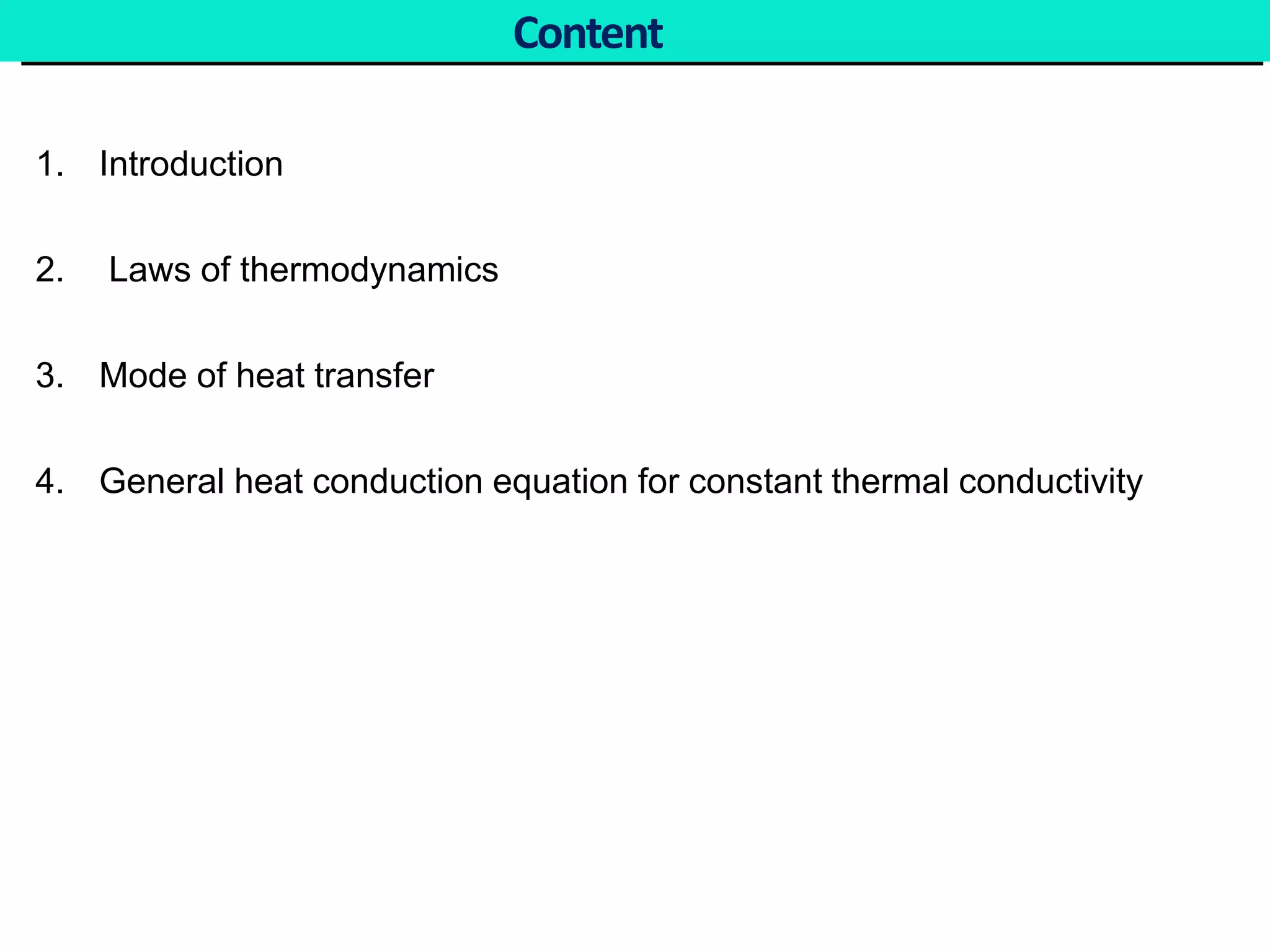
Content
1. Introduction
2. Laws of thermodynamics
3. Mode of heat transfer
4. General heat conduction equation for constant thermal conductivity
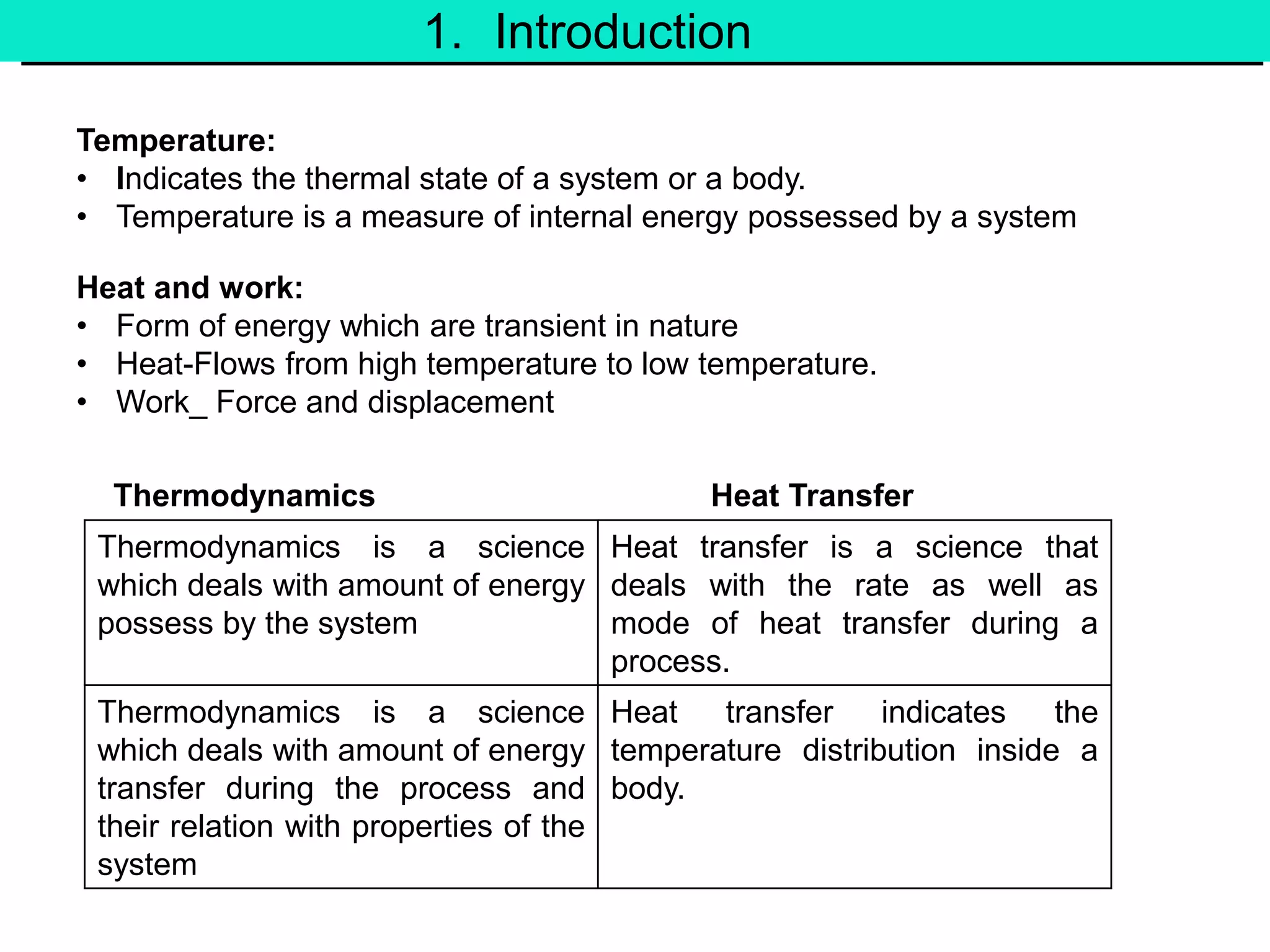
1. Introduction
Temperature:
• Indicates the thermal state of a system or a body.
• Temperature is a measure of internal energy possessed by a system
Heat and work:
• Form of energy which are transient in nature
• Heat-Flows from high temperature to low temperature.
• Work_ Force and displacement
Thermodynamics Heat Transfer
Thermodynamics is a science
which deals with amount of energy
possess by the system
Heat transfer is a science that
deals with the rate as well as
mode of heat transfer during a
process.
Thermodynamics is a science
which deals with amount of energy
transfer during the process and
their relation with properties of the
system
Heat transfer indicates the
temperature distribution inside a
body.
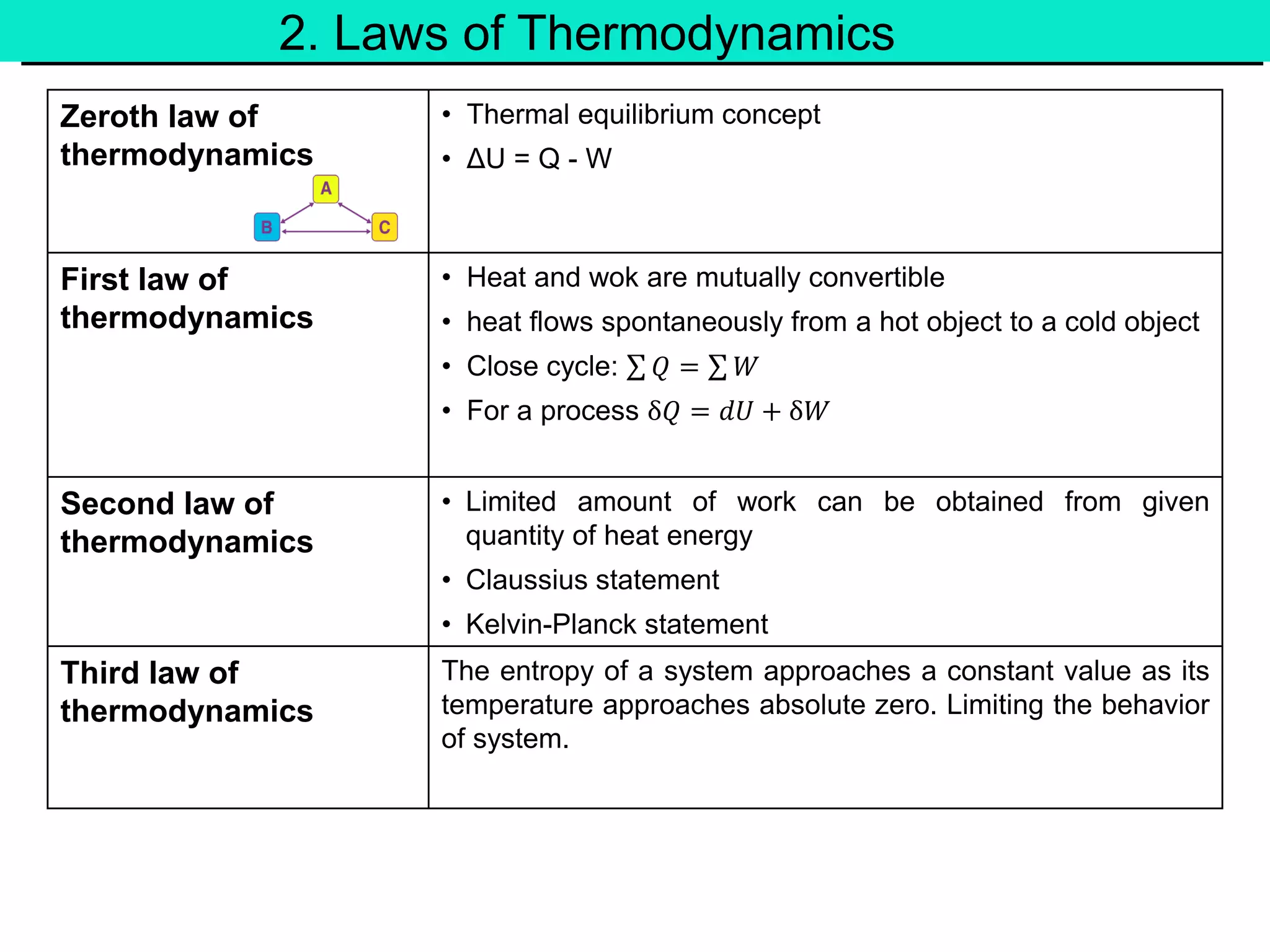
2. Laws of Thermodynamics
Zeroth law of
thermodynamics
• Thermal equilibrium concept
• ΔU = Q - W
First law of
thermodynamics
• Heat and wok are mutually convertible
• heat flows spontaneously from a hot object to a cold object
• Close cycle: σ 𝑄 = σ 𝑊
• For a process δ𝑄 = 𝑑𝑈 + δ𝑊
Second law of
thermodynamics
• Limited amount of work can be obtained from given
quantity of heat energy
• Claussius statement
• Kelvin-Planck statement
Third law of
thermodynamics
The entropy of a system approaches a constant value as its
temperature approaches absolute zero. Limiting the behavior
of system.
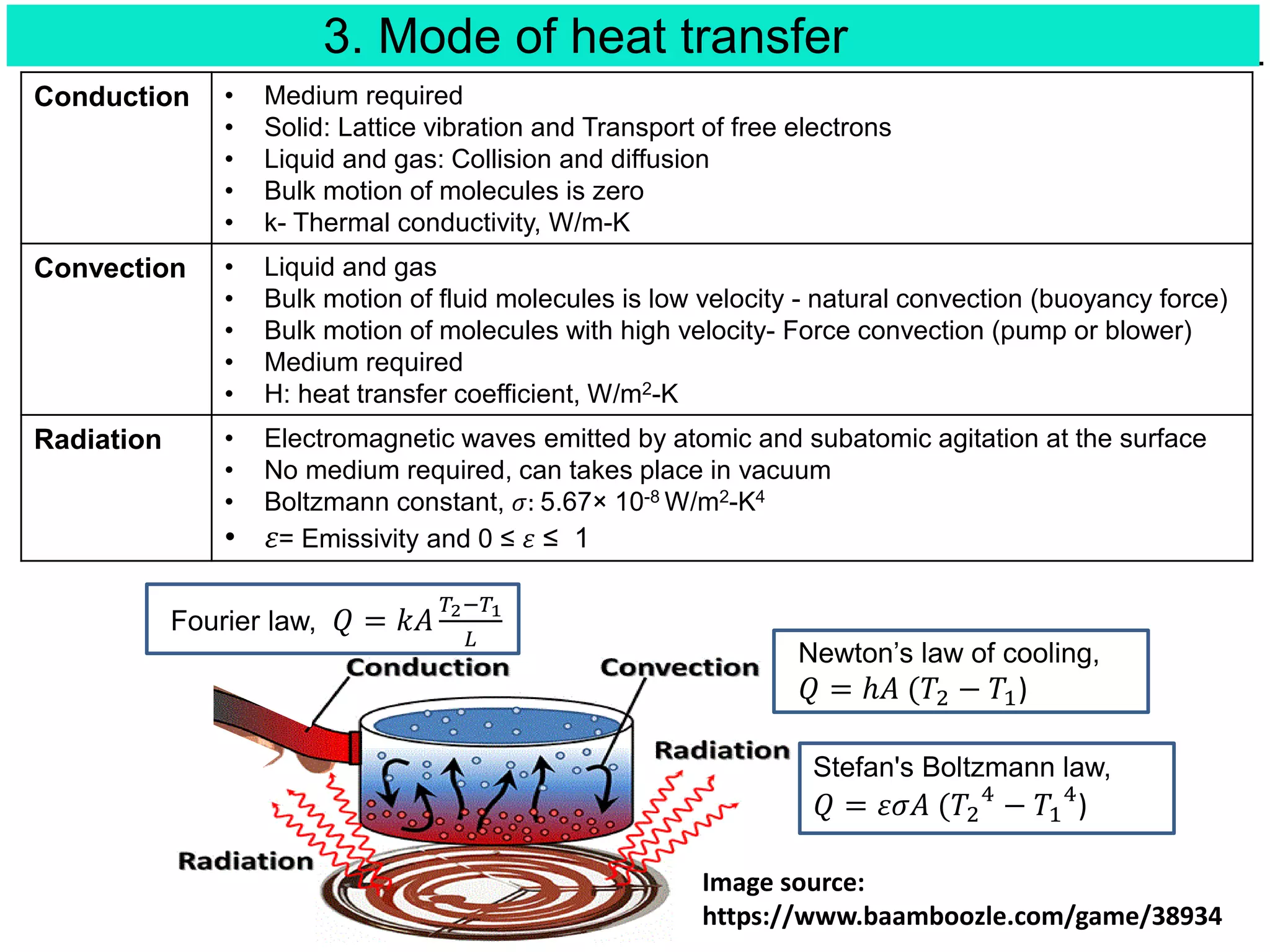
3. Mode of heat transfer
Conduction • Medium required
• Solid: Lattice vibration and Transport of free electrons
• Liquid and gas: Collision and diffusion
• Bulk motion of molecules is zero
• k- Thermal conductivity, W/m-K
Convection • Liquid and gas
• Bulk motion of fluid molecules is low velocity - natural convection (buoyancy force)
• Bulk motion of molecules with high velocity- Force convection (pump or blower)
• Medium required
• H: heat transfer coefficient, W/m2-K
Radiation • Electromagnetic waves emitted by atomic and subatomic agitation at the surface
• No medium required, can takes place in vacuum
• Boltzmann constant, 𝜎: 5.67× 10⁻⁸ W/m2-K4
• 𝜀= Emissivity and 0 ≤ 𝜀 ≤ 1
Newton’s law of cooling,
𝑄 = ℎ𝐴 (𝑇2 − 𝑇1)
Stefan's Boltzmann law,
𝑄 = 𝜀𝜎𝐴 (𝑇2
4
− 𝑇1
4
)
Image source:
https://www.baamboozle.com/game/38934
Fourier law, 𝑄 = 𝑘𝐴
𝑇2−𝑇1
𝐿
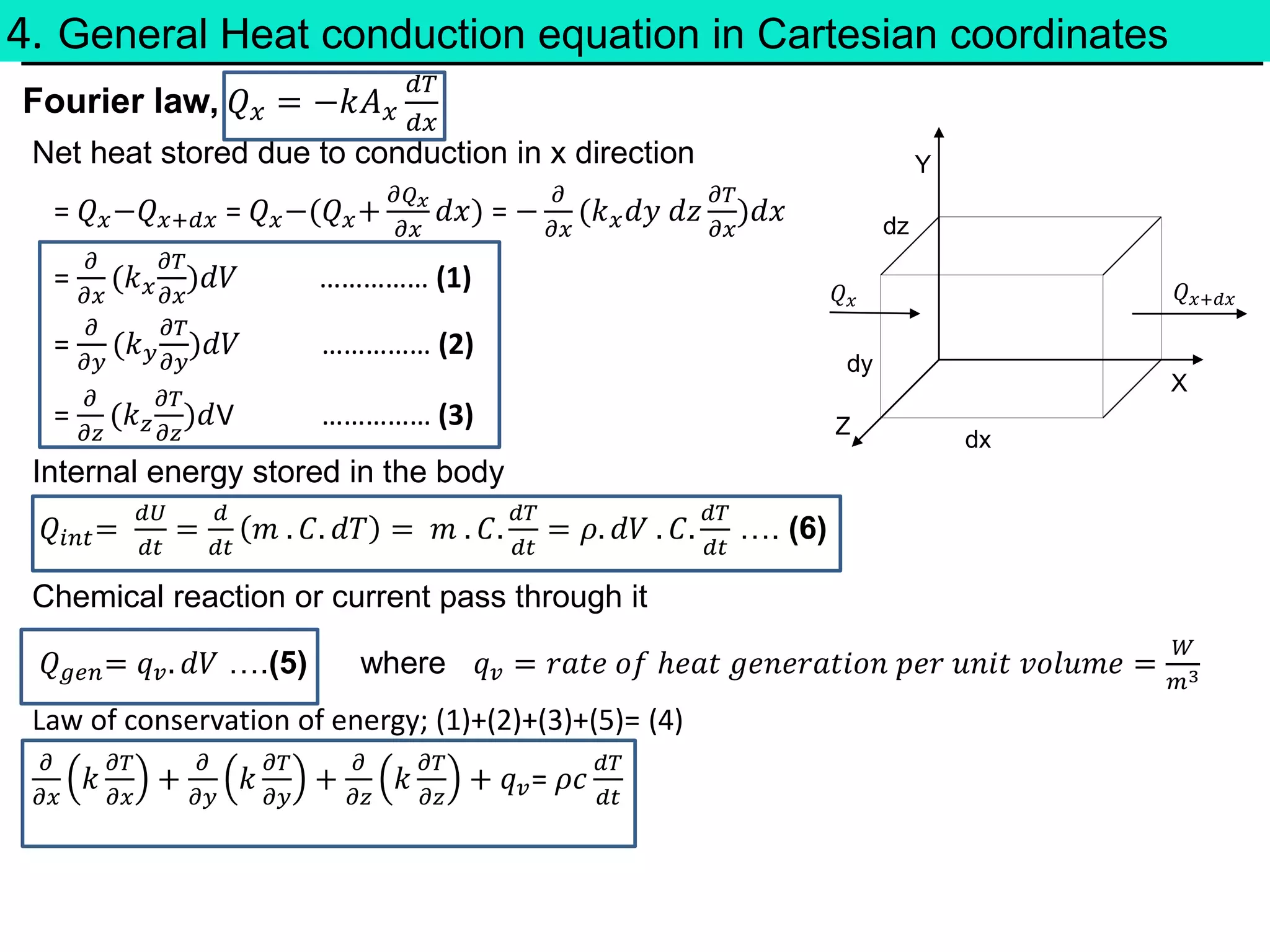
4. General Heat conduction equation in Cartesian coordinates
Fourier law, 𝑄𝑥 = −𝑘𝐴𝑥
𝑑𝑇
𝑑𝑥
𝑄𝑥+𝑑𝑥
Y
X
Z
𝑄𝑥
dx
dz
dy
Net heat stored due to conduction in x direction
= 𝑄𝑥−𝑄𝑥+𝑑𝑥 = 𝑄𝑥−(𝑄𝑥+
𝜕𝑄𝑥
𝜕𝑥
𝑑𝑥) = −
𝜕
𝜕𝑥
(𝑘𝑥𝑑𝑦 𝑑𝑧
𝜕𝑇
𝜕𝑥
)𝑑𝑥
=
𝜕
𝜕𝑥
(𝑘𝑥
𝜕𝑇
𝜕𝑥
)𝑑𝑉 …………… (1)
=
𝜕
𝜕𝑦
(𝑘𝑦
𝜕𝑇
𝜕𝑦
)𝑑𝑉 …………… (2)
=
𝜕
𝜕𝑧
(𝑘𝑧
𝜕𝑇
𝜕𝑧
)𝑑V …………… (3)
Internal energy stored in the body
𝑄𝑖𝑛𝑡=
𝑑𝑈
𝑑𝑡
=
𝑑
𝑑𝑡
𝑚 . 𝐶. 𝑑𝑇 = 𝑚 . 𝐶.
𝑑𝑇
𝑑𝑡
= 𝜌. 𝑑𝑉 . 𝐶.
𝑑𝑇
𝑑𝑡
…. (6)
Chemical reaction or current pass through it
𝑄𝑔𝑒𝑛= 𝑞𝑣. 𝑑𝑉 ….(5) where 𝑞𝑣 = 𝑟𝑎𝑡𝑒 𝑜𝑓 ℎ𝑒𝑎𝑡 𝑔𝑒𝑛𝑒𝑟𝑎𝑡𝑖𝑜𝑛 𝑝𝑒𝑟 𝑢𝑛𝑖𝑡 𝑣𝑜𝑙𝑢𝑚𝑒 =
𝑊
𝑚3
Law of conservation of energy; (1)+(2)+(3)+(5)= (4)
𝜕
𝜕𝑥
𝑘
𝜕𝑇
𝜕𝑥
+
𝜕
𝜕𝑦
𝑘
𝜕𝑇
𝜕𝑦
+
𝜕
𝜕𝑧
𝑘
𝜕𝑇
𝜕𝑧
+ 𝑞𝑣= 𝜌𝑐
𝑑𝑇
𝑑𝑡
5. General Heat conduction equation for constant
thermal conductivity
Fourier-Biot Equation
𝜕
𝜕𝑥
𝑘
𝜕𝑇
𝜕𝑥
+
𝜕
𝜕𝑦
𝑘
𝜕𝑇
𝜕𝑦
+
𝜕
𝜕𝑧
𝑘
𝜕𝑇
𝜕𝑧
+ 𝑞𝑣= 𝜌𝑐
𝑑𝑇
𝑑𝑡
For isotropic material: 𝑘𝑥 = 𝑘𝑦 = 𝑘𝑧 = 𝑘
𝑘
𝜕𝑇2
𝜕𝑥2 +
𝜕𝑇2
𝜕𝑦2 +
𝜕𝑇2
𝜕𝑧2 + 𝑞𝑣= 𝜌𝑐
𝑑𝑇
𝑑𝑡
In vector form
𝑘 𝛻. 𝛻𝑇 + 𝑞𝑣= 𝜌𝑐
𝑑𝑇
𝑑𝑡
𝛻2𝑇 +
𝑞𝑣
𝑘
=
𝜌.𝑐
𝑘
.
𝑑𝑇
𝑑𝑡
𝜗 =
𝜇
𝜌
𝑚2
𝑠
𝑘𝑖𝑛𝑒𝑚𝑎𝑡𝑖𝑐 𝑣𝑖𝑠𝑐𝑜𝑐𝑖𝑡𝑦 − 𝑖𝑛 𝑓𝑙𝑢𝑖𝑑
𝛼 =
𝑘
𝜌.𝑐
---
𝑊
𝑚.𝐾
∗
𝑚3
𝑘𝑔
∗
𝑘𝑔.𝐾
𝐽
=
𝑚2
𝑠
𝛼 = 𝑇ℎ𝑒𝑟𝑚𝑎𝑙 𝑑𝑖𝑓𝑖𝑠𝑖𝑣𝑖𝑡𝑦 − 𝑖𝑛 ℎ𝑒𝑎𝑡 𝑡𝑟𝑎𝑛𝑠𝑓𝑒𝑟
1
𝑟𝑛
𝜕
𝜕𝑟
𝑟𝑛 𝜕𝑇
𝜕𝑟
+
𝑞𝑣
𝑘
=
1
𝛼
.
𝑑𝑇
𝑑𝑡
One dimension heat conduction equation
Slab, n=0
Cylinder, n=1
Sphere, n=2
4. General Heat conduction equation
No internal heat generation (Diffusion equation)
𝜕
𝜕𝑥
𝑘
𝜕𝑇
𝜕𝑥
+
𝜕
𝜕𝑦
𝑘
𝜕𝑇
𝜕𝑦
+
𝜕
𝜕𝑧
𝑘
𝜕𝑇
𝜕𝑧
= 𝜌𝑐𝑝
𝜕𝑇
𝜕𝑡
𝜕
𝜕𝑥
𝑘
𝜕𝑇
𝜕𝑥
+
𝜕
𝜕𝑦
𝑘
𝜕𝑇
𝜕𝑦
+
𝜕
𝜕𝑧
𝑘
𝜕𝑇
𝜕𝑧
= 0
Steady state and no heat generation (Laplace equation)
𝜕
𝜕𝑥
𝑘
𝜕𝑇
𝜕𝑥
+
𝜕
𝜕𝑦
𝑘
𝜕𝑇
𝜕𝑦
+
𝜕
𝜕𝑧
𝑘
𝜕𝑇
𝜕𝑧
+ 𝑞𝑣= 0
Steady state (Poisson’s equation)
One dimension without heat generation and steady state
𝜕𝑇2
𝜕𝑥2 = 0 ;
𝜕𝑇
𝜕𝑥
= 𝑐1; 𝑇 = 𝑐1𝑥 + 𝑐2
𝑇1
𝑇2
𝑄
𝑥0 𝑥𝐿
𝑥 = 0; 𝑇1 = 𝑐2
𝑥 = 𝐿; 𝑇2 = 𝑐1. 𝐿 + 𝑇1 ; 𝑐1 =
𝑇2−𝑇1
𝐿
𝑇 =
𝑇2−𝑇1
𝐿
𝑥 + 𝑇1
Thank you
9

Thermodynamics, heat transfer, conduction equation

  • 1.
    By Abhay L 1. Thermodynamicsand heat transfer 2. Heat conduction equation in Cartesian coordinates
  • 2.
    Content 1. Introduction 2. Lawsof thermodynamics 3. Mode of heat transfer 4. General heat conduction equation for constant thermal conductivity
  • 3.
    1. Introduction Temperature: • Indicatesthe thermal state of a system or a body. • Temperature is a measure of internal energy possessed by a system Heat and work: • Form of energy which are transient in nature • Heat-Flows from high temperature to low temperature. • Work_ Force and displacement Thermodynamics Heat Transfer Thermodynamics is a science which deals with amount of energy possess by the system Heat transfer is a science that deals with the rate as well as mode of heat transfer during a process. Thermodynamics is a science which deals with amount of energy transfer during the process and their relation with properties of the system Heat transfer indicates the temperature distribution inside a body.
  • 4.
    2. Laws ofThermodynamics Zeroth law of thermodynamics • Thermal equilibrium concept • ΔU = Q - W First law of thermodynamics • Heat and wok are mutually convertible • heat flows spontaneously from a hot object to a cold object • Close cycle: σ 𝑄 = σ 𝑊 • For a process δ𝑄 = 𝑑𝑈 + δ𝑊 Second law of thermodynamics • Limited amount of work can be obtained from given quantity of heat energy • Claussius statement • Kelvin-Planck statement Third law of thermodynamics The entropy of a system approaches a constant value as its temperature approaches absolute zero. Limiting the behavior of system.
  • 5.
    3. Mode ofheat transfer Conduction • Medium required • Solid: Lattice vibration and Transport of free electrons • Liquid and gas: Collision and diffusion • Bulk motion of molecules is zero • k- Thermal conductivity, W/m-K Convection • Liquid and gas • Bulk motion of fluid molecules is low velocity - natural convection (buoyancy force) • Bulk motion of molecules with high velocity- Force convection (pump or blower) • Medium required • H: heat transfer coefficient, W/m2-K Radiation • Electromagnetic waves emitted by atomic and subatomic agitation at the surface • No medium required, can takes place in vacuum • Boltzmann constant, 𝜎: 5.67× 10⁻⁸ W/m2-K4 • 𝜀= Emissivity and 0 ≤ 𝜀 ≤ 1 Newton’s law of cooling, 𝑄 = ℎ𝐴 (𝑇2 − 𝑇1) Stefan's Boltzmann law, 𝑄 = 𝜀𝜎𝐴 (𝑇2 4 − 𝑇1 4 ) Image source: https://www.baamboozle.com/game/38934 Fourier law, 𝑄 = 𝑘𝐴 𝑇2−𝑇1 𝐿
  • 6.
    4. General Heatconduction equation in Cartesian coordinates Fourier law, 𝑄𝑥 = −𝑘𝐴𝑥 𝑑𝑇 𝑑𝑥 𝑄𝑥+𝑑𝑥 Y X Z 𝑄𝑥 dx dz dy Net heat stored due to conduction in x direction = 𝑄𝑥−𝑄𝑥+𝑑𝑥 = 𝑄𝑥−(𝑄𝑥+ 𝜕𝑄𝑥 𝜕𝑥 𝑑𝑥) = − 𝜕 𝜕𝑥 (𝑘𝑥𝑑𝑦 𝑑𝑧 𝜕𝑇 𝜕𝑥 )𝑑𝑥 = 𝜕 𝜕𝑥 (𝑘𝑥 𝜕𝑇 𝜕𝑥 )𝑑𝑉 …………… (1) = 𝜕 𝜕𝑦 (𝑘𝑦 𝜕𝑇 𝜕𝑦 )𝑑𝑉 …………… (2) = 𝜕 𝜕𝑧 (𝑘𝑧 𝜕𝑇 𝜕𝑧 )𝑑V …………… (3) Internal energy stored in the body 𝑄𝑖𝑛𝑡= 𝑑𝑈 𝑑𝑡 = 𝑑 𝑑𝑡 𝑚 . 𝐶. 𝑑𝑇 = 𝑚 . 𝐶. 𝑑𝑇 𝑑𝑡 = 𝜌. 𝑑𝑉 . 𝐶. 𝑑𝑇 𝑑𝑡 …. (6) Chemical reaction or current pass through it 𝑄𝑔𝑒𝑛= 𝑞𝑣. 𝑑𝑉 ….(5) where 𝑞𝑣 = 𝑟𝑎𝑡𝑒 𝑜𝑓 ℎ𝑒𝑎𝑡 𝑔𝑒𝑛𝑒𝑟𝑎𝑡𝑖𝑜𝑛 𝑝𝑒𝑟 𝑢𝑛𝑖𝑡 𝑣𝑜𝑙𝑢𝑚𝑒 = 𝑊 𝑚3 Law of conservation of energy; (1)+(2)+(3)+(5)= (4) 𝜕 𝜕𝑥 𝑘 𝜕𝑇 𝜕𝑥 + 𝜕 𝜕𝑦 𝑘 𝜕𝑇 𝜕𝑦 + 𝜕 𝜕𝑧 𝑘 𝜕𝑇 𝜕𝑧 + 𝑞𝑣= 𝜌𝑐 𝑑𝑇 𝑑𝑡
  • 7.
    5. General Heatconduction equation for constant thermal conductivity Fourier-Biot Equation 𝜕 𝜕𝑥 𝑘 𝜕𝑇 𝜕𝑥 + 𝜕 𝜕𝑦 𝑘 𝜕𝑇 𝜕𝑦 + 𝜕 𝜕𝑧 𝑘 𝜕𝑇 𝜕𝑧 + 𝑞𝑣= 𝜌𝑐 𝑑𝑇 𝑑𝑡 For isotropic material: 𝑘𝑥 = 𝑘𝑦 = 𝑘𝑧 = 𝑘 𝑘 𝜕𝑇2 𝜕𝑥2 + 𝜕𝑇2 𝜕𝑦2 + 𝜕𝑇2 𝜕𝑧2 + 𝑞𝑣= 𝜌𝑐 𝑑𝑇 𝑑𝑡 In vector form 𝑘 𝛻. 𝛻𝑇 + 𝑞𝑣= 𝜌𝑐 𝑑𝑇 𝑑𝑡 𝛻2𝑇 + 𝑞𝑣 𝑘 = 𝜌.𝑐 𝑘 . 𝑑𝑇 𝑑𝑡 𝜗 = 𝜇 𝜌 𝑚2 𝑠 𝑘𝑖𝑛𝑒𝑚𝑎𝑡𝑖𝑐 𝑣𝑖𝑠𝑐𝑜𝑐𝑖𝑡𝑦 − 𝑖𝑛 𝑓𝑙𝑢𝑖𝑑 𝛼 = 𝑘 𝜌.𝑐 --- 𝑊 𝑚.𝐾 ∗ 𝑚3 𝑘𝑔 ∗ 𝑘𝑔.𝐾 𝐽 = 𝑚2 𝑠 𝛼 = 𝑇ℎ𝑒𝑟𝑚𝑎𝑙 𝑑𝑖𝑓𝑖𝑠𝑖𝑣𝑖𝑡𝑦 − 𝑖𝑛 ℎ𝑒𝑎𝑡 𝑡𝑟𝑎𝑛𝑠𝑓𝑒𝑟 1 𝑟𝑛 𝜕 𝜕𝑟 𝑟𝑛 𝜕𝑇 𝜕𝑟 + 𝑞𝑣 𝑘 = 1 𝛼 . 𝑑𝑇 𝑑𝑡 One dimension heat conduction equation Slab, n=0 Cylinder, n=1 Sphere, n=2
  • 8.
    4. General Heatconduction equation No internal heat generation (Diffusion equation) 𝜕 𝜕𝑥 𝑘 𝜕𝑇 𝜕𝑥 + 𝜕 𝜕𝑦 𝑘 𝜕𝑇 𝜕𝑦 + 𝜕 𝜕𝑧 𝑘 𝜕𝑇 𝜕𝑧 = 𝜌𝑐𝑝 𝜕𝑇 𝜕𝑡 𝜕 𝜕𝑥 𝑘 𝜕𝑇 𝜕𝑥 + 𝜕 𝜕𝑦 𝑘 𝜕𝑇 𝜕𝑦 + 𝜕 𝜕𝑧 𝑘 𝜕𝑇 𝜕𝑧 = 0 Steady state and no heat generation (Laplace equation) 𝜕 𝜕𝑥 𝑘 𝜕𝑇 𝜕𝑥 + 𝜕 𝜕𝑦 𝑘 𝜕𝑇 𝜕𝑦 + 𝜕 𝜕𝑧 𝑘 𝜕𝑇 𝜕𝑧 + 𝑞𝑣= 0 Steady state (Poisson’s equation) One dimension without heat generation and steady state 𝜕𝑇2 𝜕𝑥2 = 0 ; 𝜕𝑇 𝜕𝑥 = 𝑐1; 𝑇 = 𝑐1𝑥 + 𝑐2 𝑇1 𝑇2 𝑄 𝑥0 𝑥𝐿 𝑥 = 0; 𝑇1 = 𝑐2 𝑥 = 𝐿; 𝑇2 = 𝑐1. 𝐿 + 𝑇1 ; 𝑐1 = 𝑇2−𝑇1 𝐿 𝑇 = 𝑇2−𝑇1 𝐿 𝑥 + 𝑇1
  • 9.