1
Subject: Web engineering
University of Education Okara Campus
Inam Ul Haq
Inam.bth@gmail.com
3-Tier Architecture
3-Tier Architecture
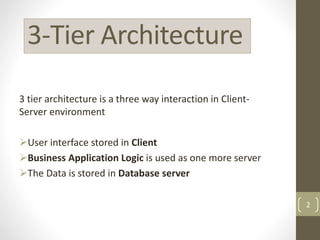
3 tier architecture is a three way interaction in Client-
Server environment
User interface stored in Client
Business Application Logic is used as one more server
The Data is stored in Database server
2
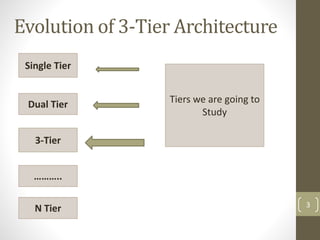
Evolution of 3-Tier Architecture
Single Tier
Dual Tier
3-Tier
………..
N Tier
Tiers we are going to
Study
3
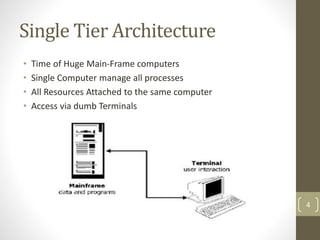
Single Tier Architecture
• Time of Huge Main-Frame computers
• Single Computer manage all processes
• All Resources Attached to the same computer
• Access via dumb Terminals
4
Advantages and Disadvantages
Advantage
• Simple
• Efficient
• Uncomplicated
Disadvantages
• Very Expensive
5
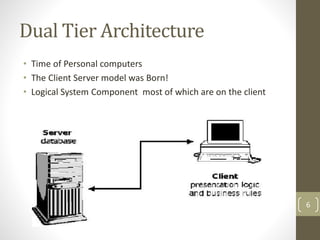
Dual Tier Architecture
• Time of Personal computers
• The Client Server model was Born!
• Logical System Component most of which are on the client
6
Advantages and Disadvantages
Advantages
• Less expensive then Main-Frame
Disadvantages
• The connection to the database server are very expensive
• One user can connect to the user of server at a time
• Server need more time to respond existing connections
• Cost-ineffective: many users can use their connection 2-
3% of time
7
3-Tier Architectures
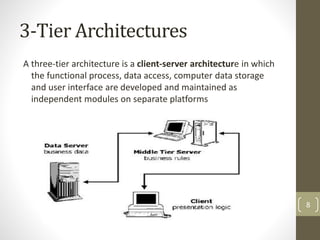
A three-tier architecture is a client-server architecture in which
the functional process, data access, computer data storage
and user interface are developed and maintained as
independent modules on separate platforms
8
3-Tier Architectures(Cont…)
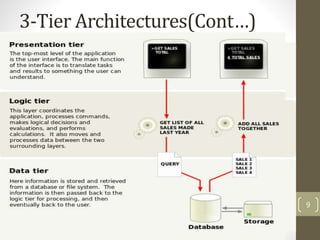
•Presentation Tier:
displays information related to services
available on a website.
•Application Tier:
this tier is pulled from the presentation
tier. It controls application functionality
by performing detailed processing.
•Data Tier:
Houses database servers where
information is stored and retrieved.
9
Scalability
• The application server can be deployed on many machines
• Database no longer require connection from every client
Data Integrity
• Middle tier can ensure that only valid data is allowed to be
updated in the database
Improved security
• Because client does not have direct access to the database
therefore data is more secure
Advantages
10
Reduced distribution
• Updating is only need for application server and no need for
distributed on client
Maintainability
• Changes to the components in one layer have no effect on any
others layers
Reliability
• A 3-Tier architecture, if deployed on multiple servers, makes it
easier to increase reliability of a system by implementing
multiple levels of redundancy.
Advantages (Cont...)
11
Disadvantages
Increased complexity / efforts
• 3-tier architecture is more complex to build compared to 2-
tier architecture
12
Why 3-Tier Architecture ?
Needs of new world’s applications(Web Apps)
 Business will increasingly compete being the first to
market with new electronic goods and services
 Companies will create virtual corporations through
alliances with a shifting set of partners
 Roles and relationships btw. enterprises will shift
frequently
13
Use of artificial
intelligence
Why 3-Tier Architecture ? (Cont..)
 Meets the requirements of large-scale internet and
intranet client/server applications
 Is easier to manage and deploy on the network
 Provides better security
14
Web Applications
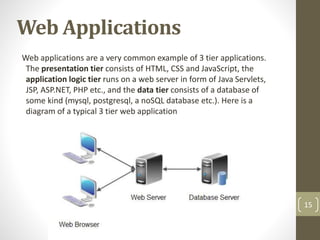
Web applications are a very common example of 3 tier applications.
The presentation tier consists of HTML, CSS and JavaScript, the
application logic tier runs on a web server in form of Java Servlets,
JSP, ASP.NET, PHP etc., and the data tier consists of a database of
some kind (mysql, postgresql, a noSQL database etc.). Here is a
diagram of a typical 3 tier web application
15
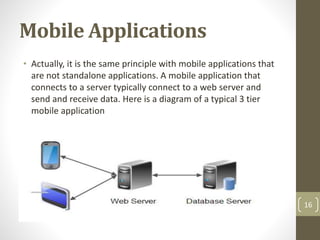
Mobile Applications
• Actually, it is the same principle with mobile applications that
are not standalone applications. A mobile application that
connects to a server typically connect to a web server and
send and receive data. Here is a diagram of a typical 3 tier
mobile application
16
Another 3-Tier Model
• You could also think of this as a 4-tier architecture:
• The database management system (DBMS)
• A persistence manager ( primary interface for application
components.)
• The main application software
• A GUI
17
• The purpose of N tier architecture is to insulate the different
layers of the application from each other. The GUI client
doesn't know how the server is working internally, and the
server doesn't know how the database server works internally
etc. They just communicate via standard interfaces.
Another 3-Tier Model (cont..)
18

3 tier architecture

  • 1.
    1 Subject: Web engineering Universityof Education Okara Campus Inam Ul Haq Inam.bth@gmail.com 3-Tier Architecture
  • 2.
    3-Tier Architecture 3 tierarchitecture is a three way interaction in Client- Server environment User interface stored in Client Business Application Logic is used as one more server The Data is stored in Database server 2
  • 3.
    Evolution of 3-TierArchitecture Single Tier Dual Tier 3-Tier ……….. N Tier Tiers we are going to Study 3
  • 4.
    Single Tier Architecture •Time of Huge Main-Frame computers • Single Computer manage all processes • All Resources Attached to the same computer • Access via dumb Terminals 4
  • 5.
    Advantages and Disadvantages Advantage •Simple • Efficient • Uncomplicated Disadvantages • Very Expensive 5
  • 6.
    Dual Tier Architecture •Time of Personal computers • The Client Server model was Born! • Logical System Component most of which are on the client 6
  • 7.
    Advantages and Disadvantages Advantages •Less expensive then Main-Frame Disadvantages • The connection to the database server are very expensive • One user can connect to the user of server at a time • Server need more time to respond existing connections • Cost-ineffective: many users can use their connection 2- 3% of time 7
  • 8.
    3-Tier Architectures A three-tierarchitecture is a client-server architecture in which the functional process, data access, computer data storage and user interface are developed and maintained as independent modules on separate platforms 8
  • 9.
    3-Tier Architectures(Cont…) •Presentation Tier: displaysinformation related to services available on a website. •Application Tier: this tier is pulled from the presentation tier. It controls application functionality by performing detailed processing. •Data Tier: Houses database servers where information is stored and retrieved. 9
  • 10.
    Scalability • The applicationserver can be deployed on many machines • Database no longer require connection from every client Data Integrity • Middle tier can ensure that only valid data is allowed to be updated in the database Improved security • Because client does not have direct access to the database therefore data is more secure Advantages 10
  • 11.
    Reduced distribution • Updatingis only need for application server and no need for distributed on client Maintainability • Changes to the components in one layer have no effect on any others layers Reliability • A 3-Tier architecture, if deployed on multiple servers, makes it easier to increase reliability of a system by implementing multiple levels of redundancy. Advantages (Cont...) 11
  • 12.
    Disadvantages Increased complexity /efforts • 3-tier architecture is more complex to build compared to 2- tier architecture 12
  • 13.
    Why 3-Tier Architecture? Needs of new world’s applications(Web Apps)  Business will increasingly compete being the first to market with new electronic goods and services  Companies will create virtual corporations through alliances with a shifting set of partners  Roles and relationships btw. enterprises will shift frequently 13 Use of artificial intelligence
  • 14.
    Why 3-Tier Architecture? (Cont..)  Meets the requirements of large-scale internet and intranet client/server applications  Is easier to manage and deploy on the network  Provides better security 14
  • 15.
    Web Applications Web applicationsare a very common example of 3 tier applications. The presentation tier consists of HTML, CSS and JavaScript, the application logic tier runs on a web server in form of Java Servlets, JSP, ASP.NET, PHP etc., and the data tier consists of a database of some kind (mysql, postgresql, a noSQL database etc.). Here is a diagram of a typical 3 tier web application 15
  • 16.
    Mobile Applications • Actually,it is the same principle with mobile applications that are not standalone applications. A mobile application that connects to a server typically connect to a web server and send and receive data. Here is a diagram of a typical 3 tier mobile application 16
  • 17.
    Another 3-Tier Model •You could also think of this as a 4-tier architecture: • The database management system (DBMS) • A persistence manager ( primary interface for application components.) • The main application software • A GUI 17
  • 18.
    • The purposeof N tier architecture is to insulate the different layers of the application from each other. The GUI client doesn't know how the server is working internally, and the server doesn't know how the database server works internally etc. They just communicate via standard interfaces. Another 3-Tier Model (cont..) 18