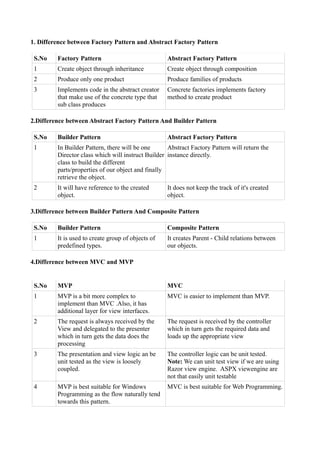
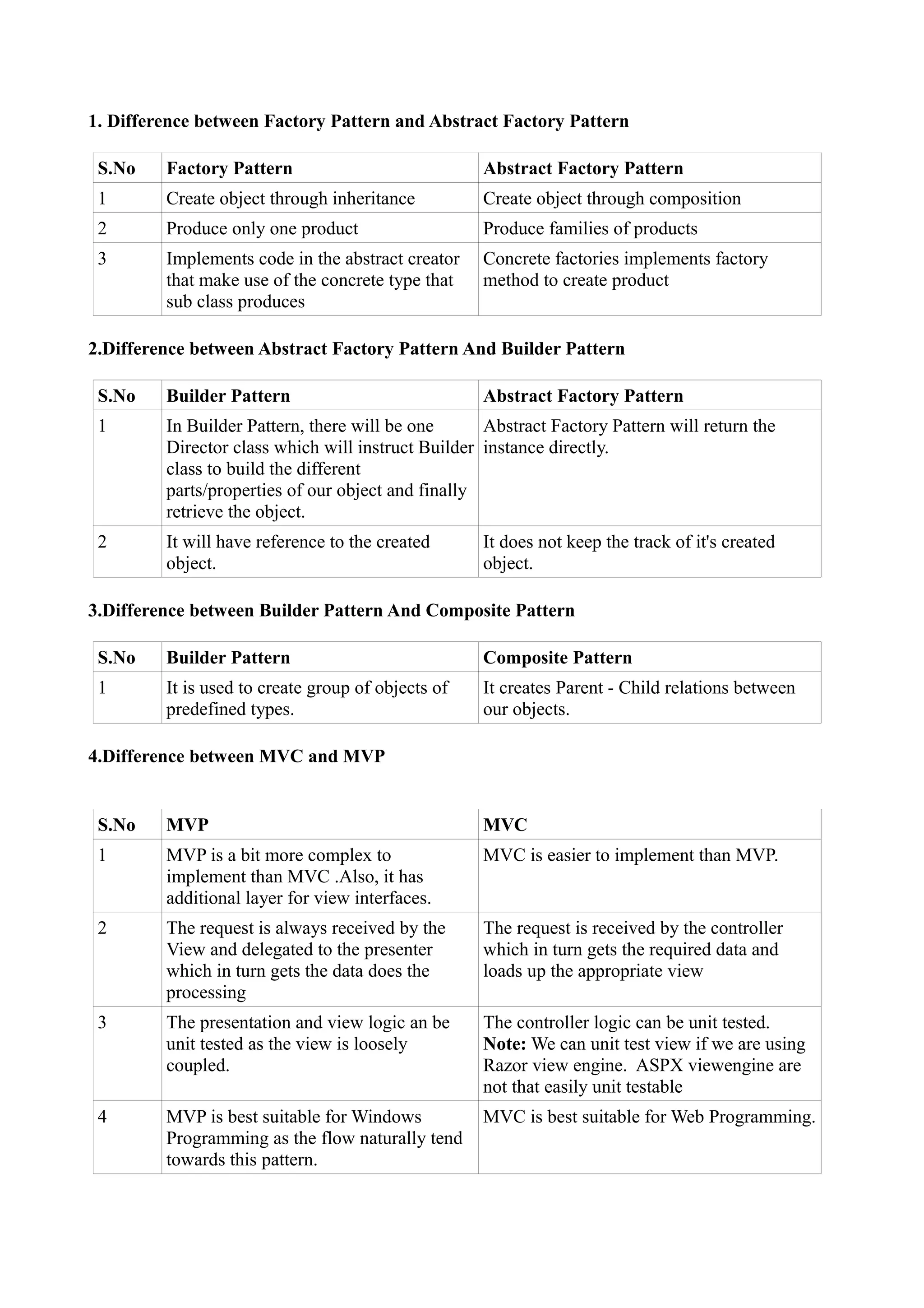
1. Difference between Factory Pattern and Abstract Factory Pattern

 S.No    Factory Pattern                            Abstract Factory Pattern
 1       Create object through inheritance          Create object through composition
 2       Produce only one product                   Produce families of products
 3       Implements code in the abstract creator    Concrete factories implements factory
         that make use of the concrete type that    method to create product
         sub class produces

2.Difference between Abstract Factory Pattern And Builder Pattern

 S.No    Builder Pattern                            Abstract Factory Pattern
 1       In Builder Pattern, there will be one      Abstract Factory Pattern will return the
         Director class which will instruct Builder instance directly.
         class to build the different
         parts/properties of our object and finally
         retrieve the object.
 2       It will have reference to the created      It does not keep the track of it's created
         object.                                    object.

3.Difference between Builder Pattern And Composite Pattern

 S.No    Builder Pattern                            Composite Pattern
 1       It is used to create group of objects of   It creates Parent - Child relations between
         predefined types.                          our objects.

4.Difference between MVC and MVP


 S.No    MVP                                        MVC
 1       MVP is a bit more complex to               MVC is easier to implement than MVP.
         implement than MVC .Also, it has
         additional layer for view interfaces.
 2       The request is always received by the      The request is received by the controller
         View and delegated to the presenter        which in turn gets the required data and
         which in turn gets the data does the       loads up the appropriate view
         processing
 3       The presentation and view logic an be      The controller logic can be unit tested.
         unit tested as the view is loosely         Note: We can unit test view if we are using
         coupled.                                   Razor view engine. ASPX viewengine are
                                                    not that easily unit testable
 4       MVP is best suitable for Windows           MVC is best suitable for Web Programming.
         Programming as the flow naturally tend
         towards this pattern.
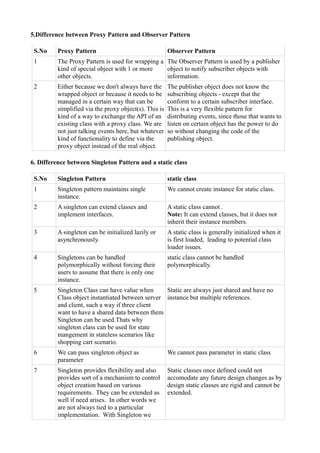
5.Difference between Proxy Pattern and Observer Pattern

 S.No     Proxy Pattern                                 Observer Pattern
 1        The Proxy Pattern is used for wrapping a The Observer Pattern is used by a publisher
          kind of special object with 1 or more    object to notify subscriber objects with
          other objects.                           information.
 2        Either because we don't always have the       The publisher object does not know the
          wrapped object or because it needs to be      subscribing objects - except that the
          managed in a certain way that can be          conform to a certain subscriber interface.
          simplified via the proxy object(s). This is   This is a very flexible pattern for
          kind of a way to exchange the API of an       distributing events, since those that wants to
          existing class with a proxy class. We are     listen on certain object has the power to do
          not just talking events here, but whatever    so without changing the code of the
          kind of functionality to define via the       publishing object.
          proxy object instead of the real object.

6. Difference between Singleton Pattern and a static class

 S.No     Singleton Pattern                             static class
 1        Singleton pattern maintains single            We cannot create instance for static class.
          instance.
 2        A singleton can extend classes and            A static class cannot .
          implement interfaces.                         Note: It can extend classes, but it does not
                                                        inherit their instance members.
 3        A singleton can be initialized lazily or      A static class is generally initialized when it
          asynchronously.                               is first loaded, leading to potential class
                                                        loader issues.
 4        Singletons can be handled                     static class cannot be handled
          polymorphically without forcing their         polymorphically.
          users to assume that there is only one
          instance.
 5        Singleton Class can have value when      Static are always just shared and have no
          Class object instantiated between server instance but multiple references.
          and client, such a way if three client
          want to have a shared data between them
          Singleton can be used.Thats why
          singleton class can be used for state
          mangement in stateless scenarios like
          shopping cart scenario.
 6        We can pass singleton object as               We cannot pass parameter in static class
          parameter
 7        Singleton provides flexibility and also       Static classes once defined could not
          provides sort of a mechanism to control       accomodate any future design changes as by
          object creation based on various              design static classes are rigid and cannot be
          requirements. They can be extended as         extended.
          well if need arises. In other words we
          are not always tied to a particular
          implementation. With Singleton we
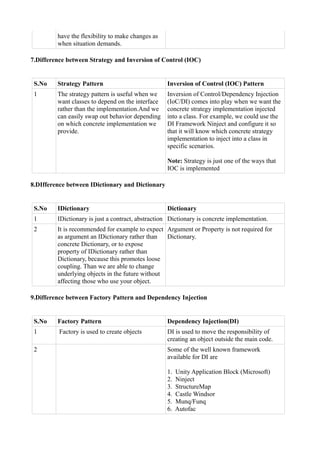
have the flexibility to make changes as
         when situation demands.

7.Difference between Strategy and Inversion of Control (IOC)


 S.No    Strategy Pattern                          Inversion of Control (IOC) Pattern
 1       The strategy pattern is useful when we    Inversion of Control/Dependency Injection
         want classes to depend on the interface   (IoC/DI) comes into play when we want the
         rather than the implementation.And we     concrete strategy implementation injected
         can easily swap out behavior depending    into a class. For example, we could use the
         on which concrete implementation we       DI Framework Ninject and configure it so
         provide.                                  that it will know which concrete strategy
                                                   implementation to inject into a class in
                                                   specific scenarios.

                                                   Note: Strategy is just one of the ways that
                                                   IOC is implemented

8.DIfference between IDictionary and Dictionary


 S.No    IDictionary                               Dictionary
 1       IDictionary is just a contract, abstraction Dictionary is concrete implementation.
 2       It is recommended for example to expect Argument or Property is not required for
         as argument an IDictionary rather than   Dictionary.
         concrete Dictionary, or to expose
         property of IDictionary rather than
         Dictionary, because this promotes loose
         coupling. Than we are able to change
         underlying objects in the future without
         affecting those who use your object.

9.Difference between Factory Pattern and Dependency Injection


 S.No    Factory Pattern                           Dependency Injection(DI)
 1        Factory is used to create objects        DI is used to move the responsibility of
                                                   creating an object outside the main code.
 2                                                 Some of the well known framework
                                                   available for DI are

                                                   1.   Unity Application Block (Microsoft)
                                                   2.   Ninject
                                                   3.   StructureMap
                                                   4.   Castle Windsor
                                                   5.   Munq/Funq
                                                   6.   Autofac
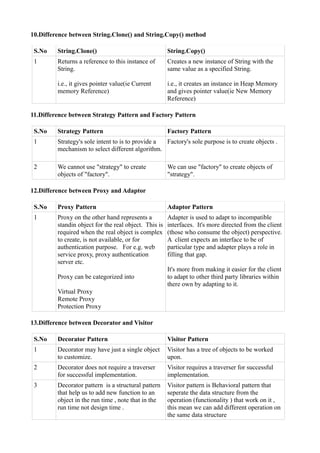
10.Difference between String.Clone() and String.Copy() method

 S.No    String.Clone()                                String.Copy()
 1       Returns a reference to this instance of       Creates a new instance of String with the
         String.                                       same value as a specified String.

         i.e., it gives pointer value(ie Current       i.e., it creates an instance in Heap Memory
         memory Reference)                             and gives pointer value(ie New Memory
                                                       Reference)

11.Difference between Strategy Pattern and Factory Pattern

 S.No    Strategy Pattern                              Factory Pattern
 1       Strategy's sole intent to is to provide a Factory's sole purpose is to create objects .
         mechanism to select different algorithm.

 2       We cannot use "strategy" to create            We can use "factory" to create objects of
         objects of "factory".                         "strategy".

12.Difference between Proxy and Adaptor

 S.No    Proxy Pattern                                 Adaptor Pattern
 1       Proxy on the other hand represents a          Adapter is used to adapt to incompatible
         standin object for the real object. This is   interfaces. It's more directed from the client
         required when the real object is complex      (those who consume the object) perspective.
         to create, is not available, or for           A client expects an interface to be of
         authentication purpose. For e.g. web          particular type and adapter plays a role in
         service proxy, proxy authentication           filling that gap.
         server etc.
                                                       It's more from making it easier for the client
         Proxy can be categorized into                 to adapt to other third party libraries within
                                                       there own by adapting to it.
         Virtual Proxy
         Remote Proxy
         Protection Proxy

13.Difference between Decorator and Visitor

 S.No    Decorator Pattern                             Visitor Pattern
 1       Decorator may have just a single object       Visitor has a tree of objects to be worked
         to customize.                                 upon.
 2       Decorator does not require a traverser        Visitor requires a traverser for successful
         for successful implementation.                implementation.
 3       Decorator pattern is a structural pattern     Visitor pattern is Behavioral pattern that
         that help us to add new function to an        seperate the data structure from the
         object in the run time , note that in the     operation (functionality ) that work on it ,
         run time not design time .                    this mean we can add different operation on
                                                       the same data structure
Design patterns   difference between interview questions

Design patterns difference between interview questions

  • 1.
    1. Difference betweenFactory Pattern and Abstract Factory Pattern S.No Factory Pattern Abstract Factory Pattern 1 Create object through inheritance Create object through composition 2 Produce only one product Produce families of products 3 Implements code in the abstract creator Concrete factories implements factory that make use of the concrete type that method to create product sub class produces 2.Difference between Abstract Factory Pattern And Builder Pattern S.No Builder Pattern Abstract Factory Pattern 1 In Builder Pattern, there will be one Abstract Factory Pattern will return the Director class which will instruct Builder instance directly. class to build the different parts/properties of our object and finally retrieve the object. 2 It will have reference to the created It does not keep the track of it's created object. object. 3.Difference between Builder Pattern And Composite Pattern S.No Builder Pattern Composite Pattern 1 It is used to create group of objects of It creates Parent - Child relations between predefined types. our objects. 4.Difference between MVC and MVP S.No MVP MVC 1 MVP is a bit more complex to MVC is easier to implement than MVP. implement than MVC .Also, it has additional layer for view interfaces. 2 The request is always received by the The request is received by the controller View and delegated to the presenter which in turn gets the required data and which in turn gets the data does the loads up the appropriate view processing 3 The presentation and view logic an be The controller logic can be unit tested. unit tested as the view is loosely Note: We can unit test view if we are using coupled. Razor view engine. ASPX viewengine are not that easily unit testable 4 MVP is best suitable for Windows MVC is best suitable for Web Programming. Programming as the flow naturally tend towards this pattern.
  • 2.
    5.Difference between ProxyPattern and Observer Pattern S.No Proxy Pattern Observer Pattern 1 The Proxy Pattern is used for wrapping a The Observer Pattern is used by a publisher kind of special object with 1 or more object to notify subscriber objects with other objects. information. 2 Either because we don't always have the The publisher object does not know the wrapped object or because it needs to be subscribing objects - except that the managed in a certain way that can be conform to a certain subscriber interface. simplified via the proxy object(s). This is This is a very flexible pattern for kind of a way to exchange the API of an distributing events, since those that wants to existing class with a proxy class. We are listen on certain object has the power to do not just talking events here, but whatever so without changing the code of the kind of functionality to define via the publishing object. proxy object instead of the real object. 6. Difference between Singleton Pattern and a static class S.No Singleton Pattern static class 1 Singleton pattern maintains single We cannot create instance for static class. instance. 2 A singleton can extend classes and A static class cannot . implement interfaces. Note: It can extend classes, but it does not inherit their instance members. 3 A singleton can be initialized lazily or A static class is generally initialized when it asynchronously. is first loaded, leading to potential class loader issues. 4 Singletons can be handled static class cannot be handled polymorphically without forcing their polymorphically. users to assume that there is only one instance. 5 Singleton Class can have value when Static are always just shared and have no Class object instantiated between server instance but multiple references. and client, such a way if three client want to have a shared data between them Singleton can be used.Thats why singleton class can be used for state mangement in stateless scenarios like shopping cart scenario. 6 We can pass singleton object as We cannot pass parameter in static class parameter 7 Singleton provides flexibility and also Static classes once defined could not provides sort of a mechanism to control accomodate any future design changes as by object creation based on various design static classes are rigid and cannot be requirements. They can be extended as extended. well if need arises. In other words we are not always tied to a particular implementation. With Singleton we
  • 3.
    have the flexibilityto make changes as when situation demands. 7.Difference between Strategy and Inversion of Control (IOC) S.No Strategy Pattern Inversion of Control (IOC) Pattern 1 The strategy pattern is useful when we Inversion of Control/Dependency Injection want classes to depend on the interface (IoC/DI) comes into play when we want the rather than the implementation.And we concrete strategy implementation injected can easily swap out behavior depending into a class. For example, we could use the on which concrete implementation we DI Framework Ninject and configure it so provide. that it will know which concrete strategy implementation to inject into a class in specific scenarios. Note: Strategy is just one of the ways that IOC is implemented 8.DIfference between IDictionary and Dictionary S.No IDictionary Dictionary 1 IDictionary is just a contract, abstraction Dictionary is concrete implementation. 2 It is recommended for example to expect Argument or Property is not required for as argument an IDictionary rather than Dictionary. concrete Dictionary, or to expose property of IDictionary rather than Dictionary, because this promotes loose coupling. Than we are able to change underlying objects in the future without affecting those who use your object. 9.Difference between Factory Pattern and Dependency Injection S.No Factory Pattern Dependency Injection(DI) 1 Factory is used to create objects DI is used to move the responsibility of creating an object outside the main code. 2 Some of the well known framework available for DI are 1. Unity Application Block (Microsoft) 2. Ninject 3. StructureMap 4. Castle Windsor 5. Munq/Funq 6. Autofac
  • 4.
    10.Difference between String.Clone()and String.Copy() method S.No String.Clone() String.Copy() 1 Returns a reference to this instance of Creates a new instance of String with the String. same value as a specified String. i.e., it gives pointer value(ie Current i.e., it creates an instance in Heap Memory memory Reference) and gives pointer value(ie New Memory Reference) 11.Difference between Strategy Pattern and Factory Pattern S.No Strategy Pattern Factory Pattern 1 Strategy's sole intent to is to provide a Factory's sole purpose is to create objects . mechanism to select different algorithm. 2 We cannot use "strategy" to create We can use "factory" to create objects of objects of "factory". "strategy". 12.Difference between Proxy and Adaptor S.No Proxy Pattern Adaptor Pattern 1 Proxy on the other hand represents a Adapter is used to adapt to incompatible standin object for the real object. This is interfaces. It's more directed from the client required when the real object is complex (those who consume the object) perspective. to create, is not available, or for A client expects an interface to be of authentication purpose. For e.g. web particular type and adapter plays a role in service proxy, proxy authentication filling that gap. server etc. It's more from making it easier for the client Proxy can be categorized into to adapt to other third party libraries within there own by adapting to it. Virtual Proxy Remote Proxy Protection Proxy 13.Difference between Decorator and Visitor S.No Decorator Pattern Visitor Pattern 1 Decorator may have just a single object Visitor has a tree of objects to be worked to customize. upon. 2 Decorator does not require a traverser Visitor requires a traverser for successful for successful implementation. implementation. 3 Decorator pattern is a structural pattern Visitor pattern is Behavioral pattern that that help us to add new function to an seperate the data structure from the object in the run time , note that in the operation (functionality ) that work on it , run time not design time . this mean we can add different operation on the same data structure