NoSQL, no security?
Will Urbanski
Vulnerability Management, Dell SecureWorks
What we will cover today

§ Why look at NoSQL security?


§ Relational Database attack vectors


§ NoSQL attack vectors


§ Securing NoSQL deployments


2        10/27/12
Why look at
    NoSQL security?


3        10/27/12
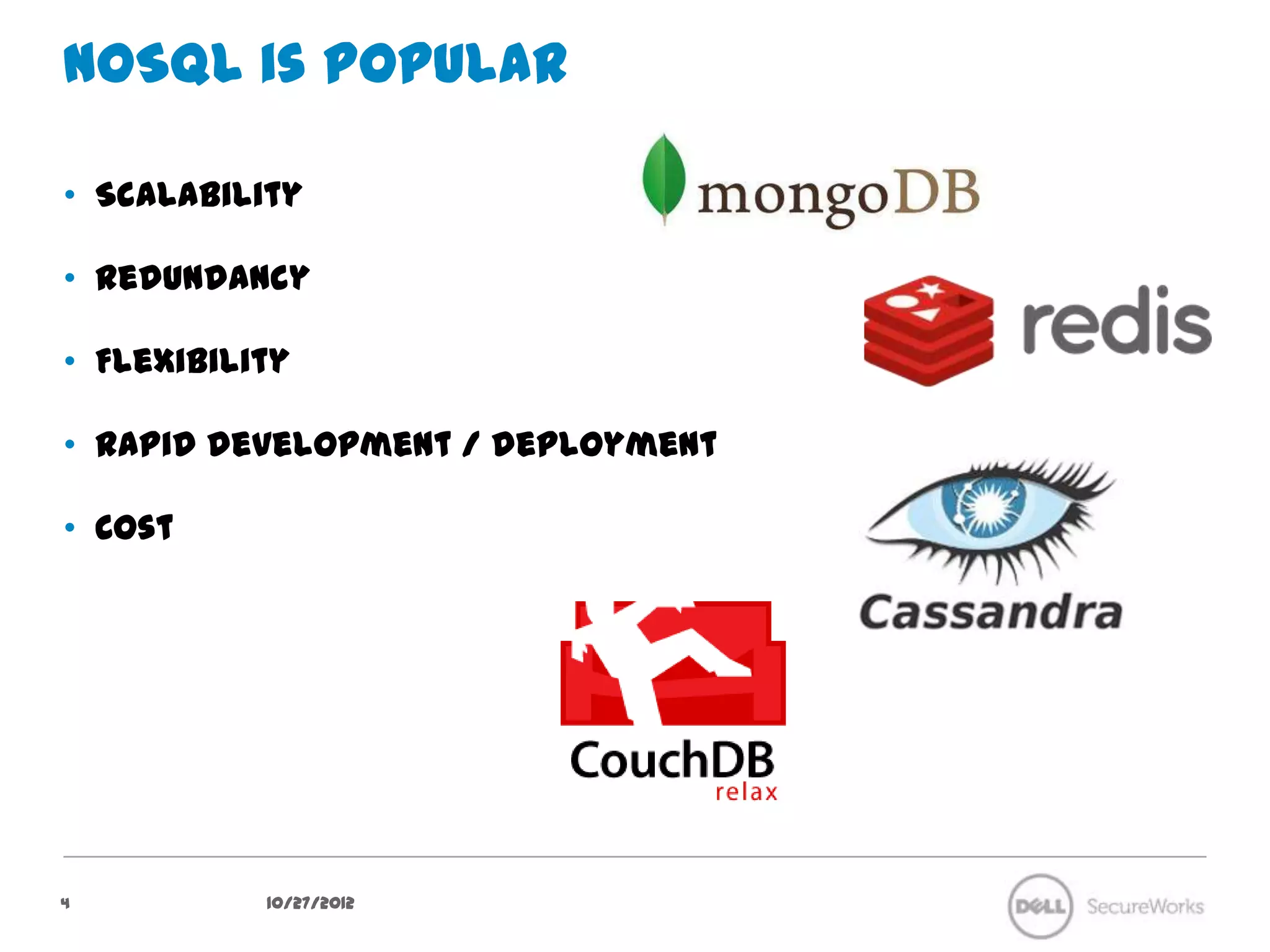
NoSQL is popular

•  Scalability

•  Redundancy

•  Flexibility

•  Rapid development / deployment

•  Cost


4                10/27/12
“Redis is designed to be accessed by trusted clients inside trusted
environments. This means that usually it is not a good idea to expose
the Redis instance directly to the internet or, in general, to an
environment where untrusted clients can directly access the Redis TCP
port or UNIX socket.” [redis.io]


5           10/27/12
“The most effective way to reduce risk for MongoDB deployments is to
run your entire MongoDB deployment, including all MongoDB
components in a trusted environment” [mongodb.org]


6           10/27/12
“When you start out fresh, CouchDB allows any request to be made by
anyone. [..] it should be obvious that putting a default installation into
the wild is adventurous. Any rogue client could come along and delete
a database.” [guide.couchdb.org]


7            10/27/12
8   Confidential   10/27/12
9   Confidential   10/27/12
Relational Databases (RDBMS)

•  Relative Feature Parity


•  Integrated Security Features

     –  Authorization

     –  Authentication

     –  Confidentiality


10               10/27/12
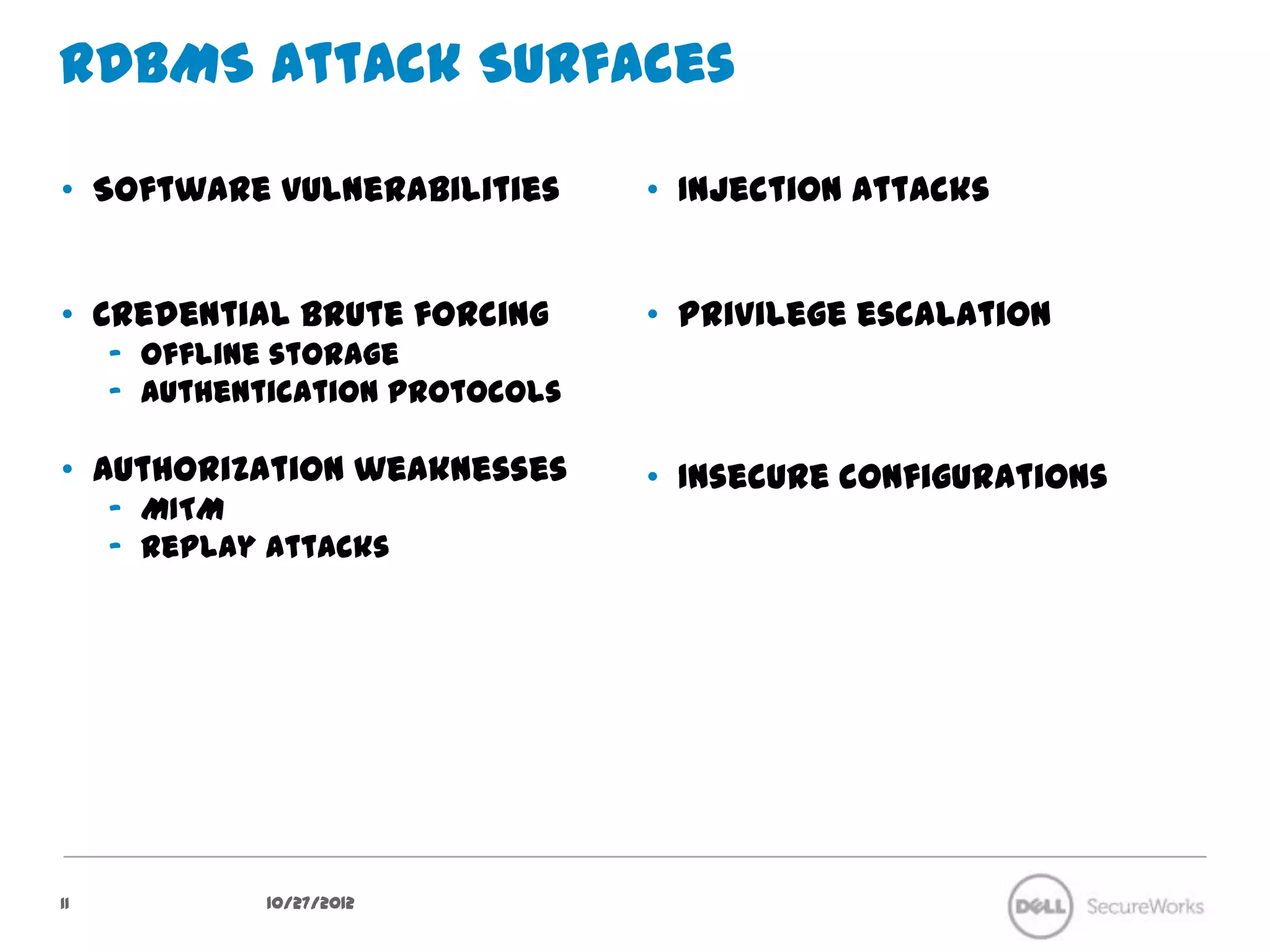
RDBMS Attack Surfaces

•  Software vulnerabilities        •  Injection Attacks


•  Credential brute forcing        •  Privilege escalation
     –  Offline storage
     –  Authentication protocols

•  Authorization weaknesses        •  Insecure configurations
     –  MITM
     –  Replay attacks


11              10/27/12
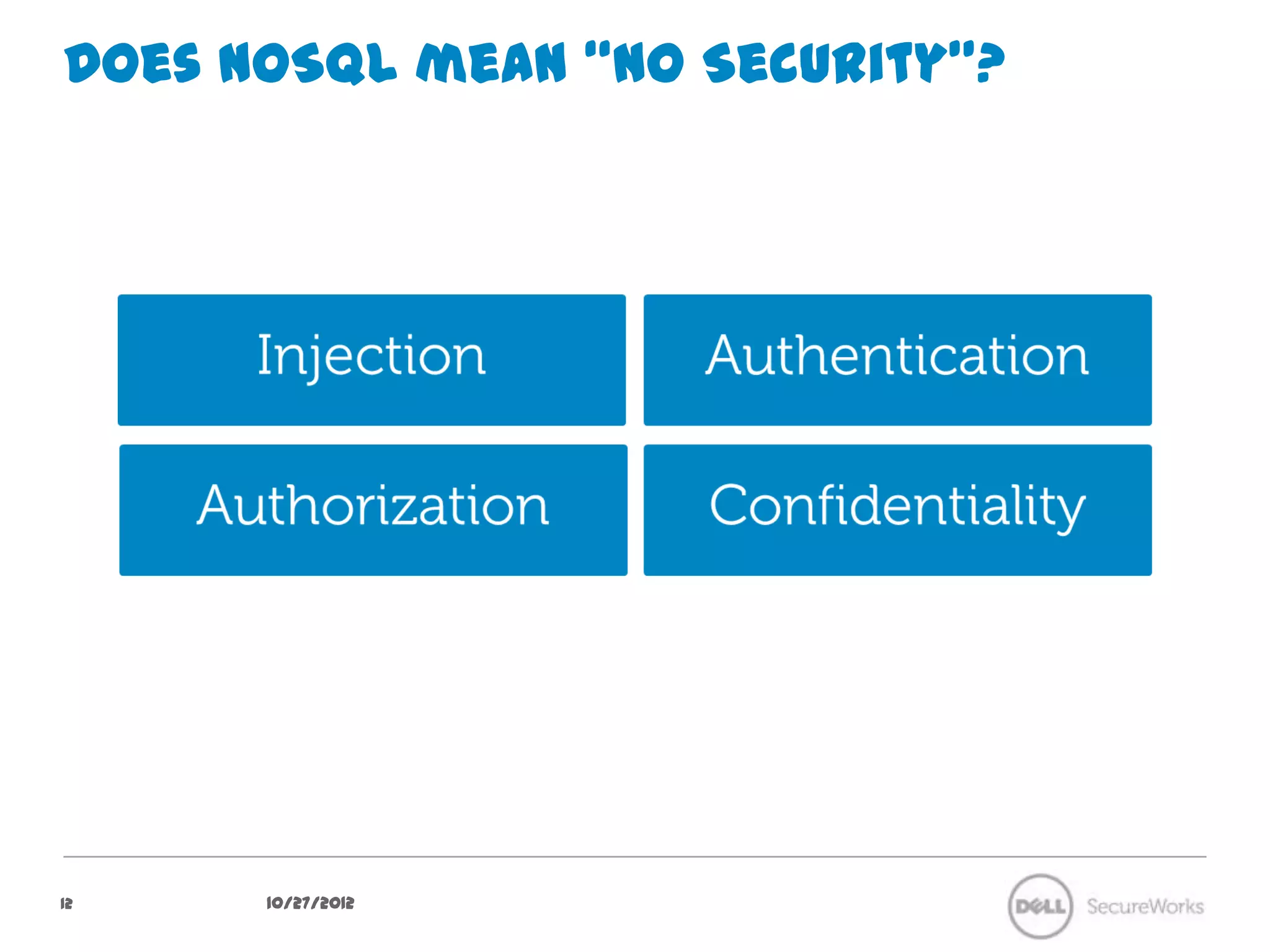
Does NoSQL mean “No Security”?


12     10/27/12
Injection


13          10/27/12
Injection Attacks

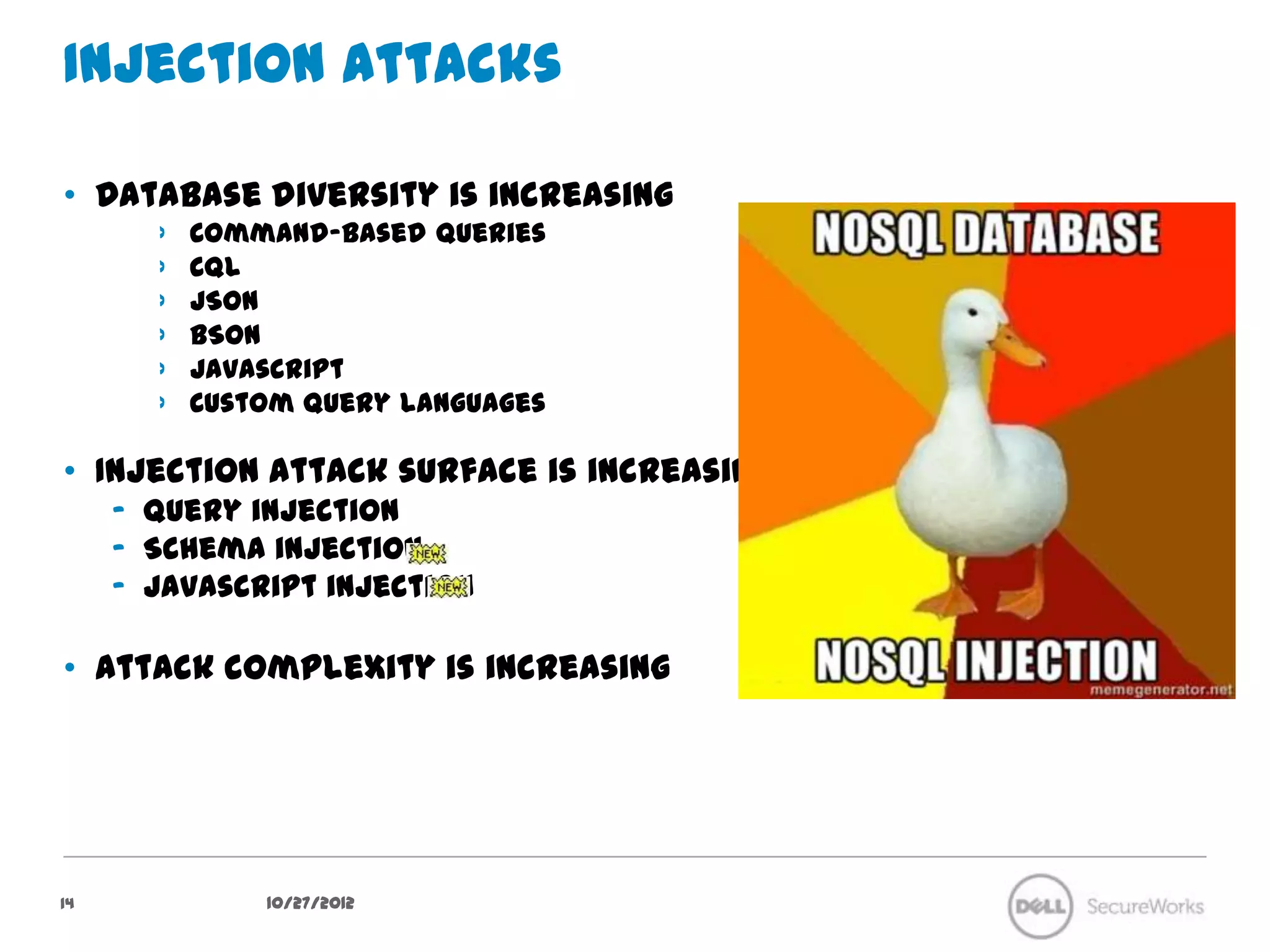
•  Database diversity is increasing
        ›    Command-based queries
        ›    CQL
        ›    JSON
        ›    BSON
        ›    Javascript
        ›    Custom query languages

•  Injection attack surface is increasing
     –  Query injection
     –  Schema injection
     –  Javascript injection

•  Attack complexity is increasing


14                10/27/12
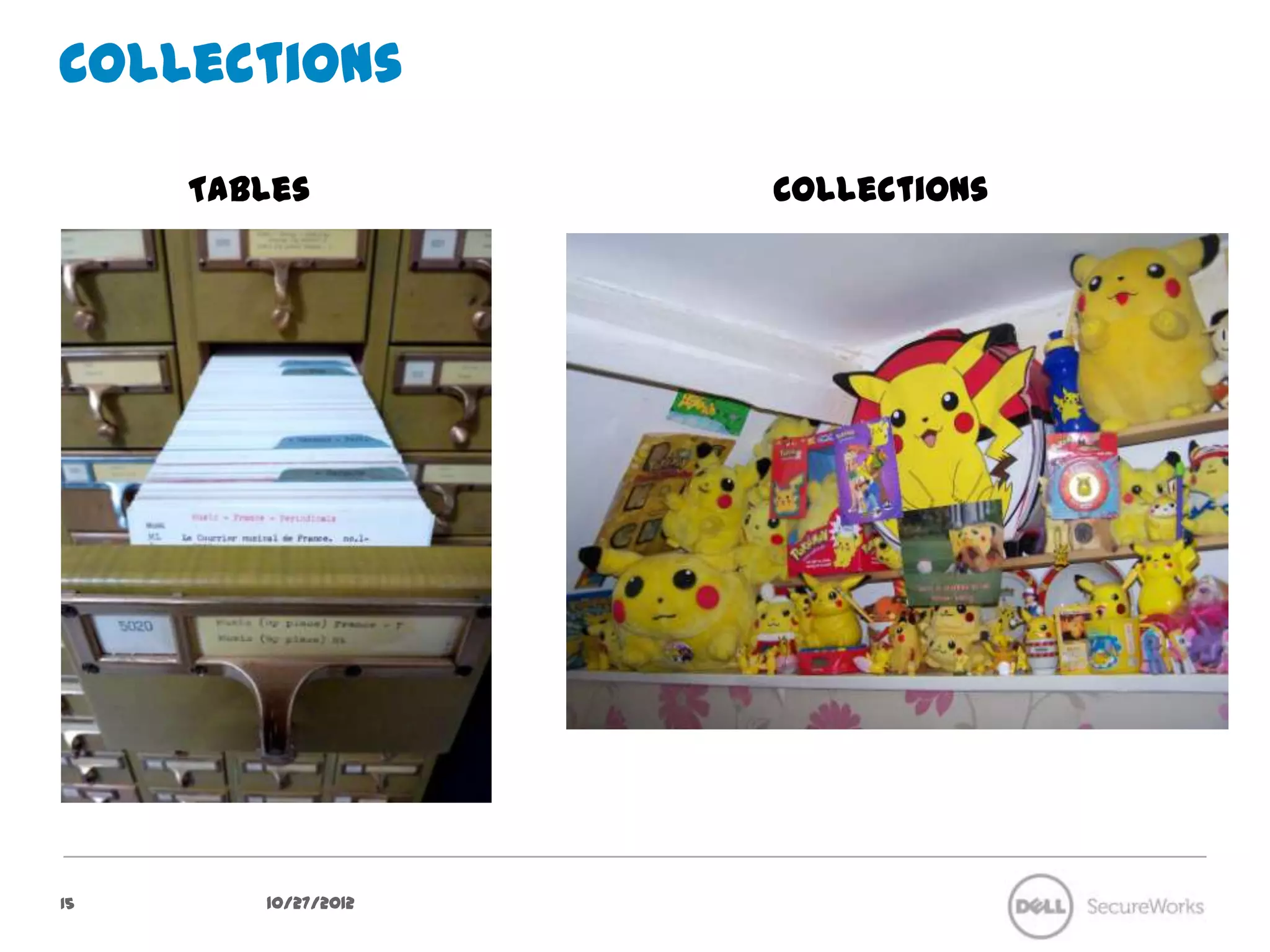
Collections

     Tables         Collections


15       10/27/12
Schema Injection

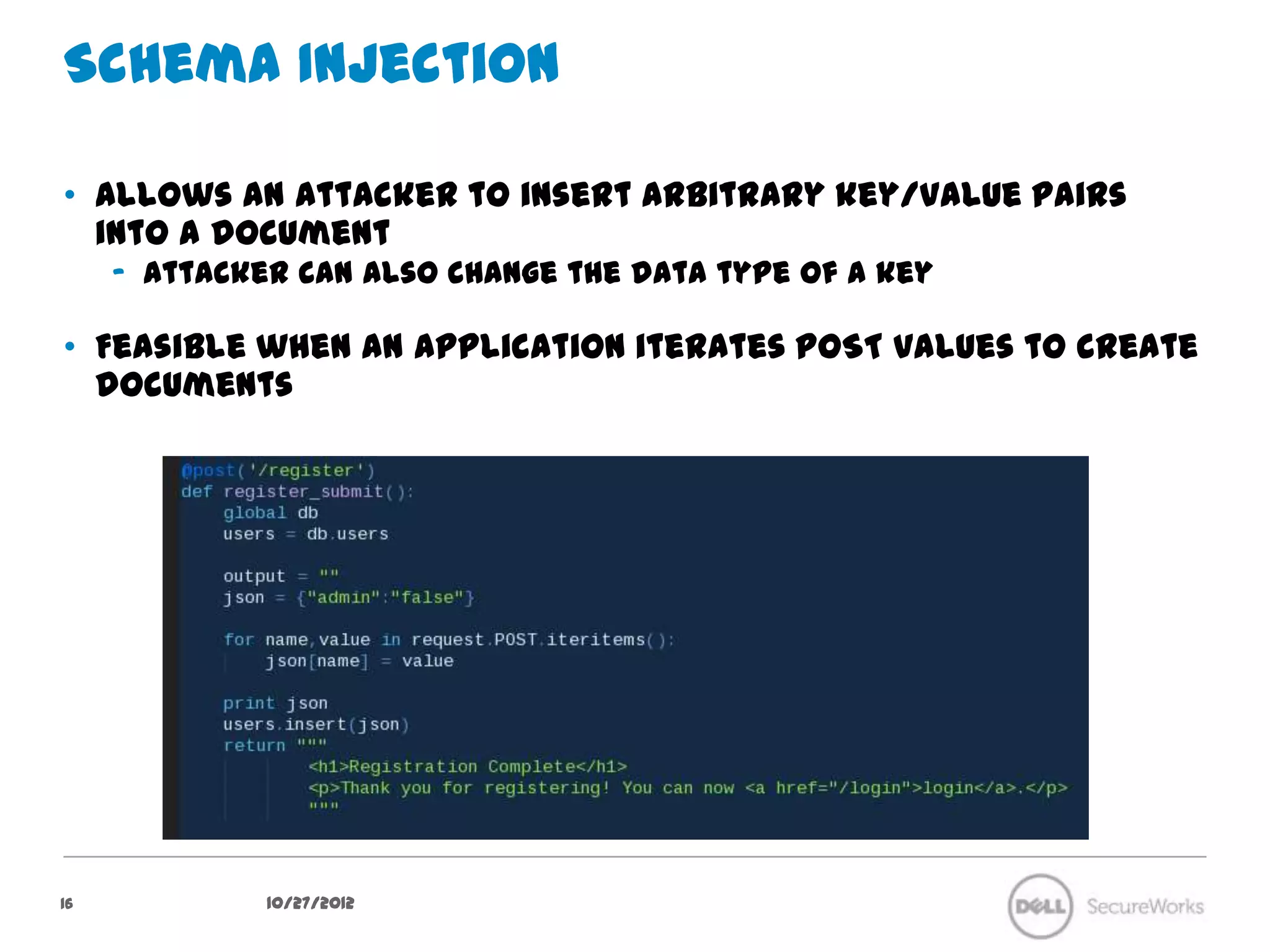
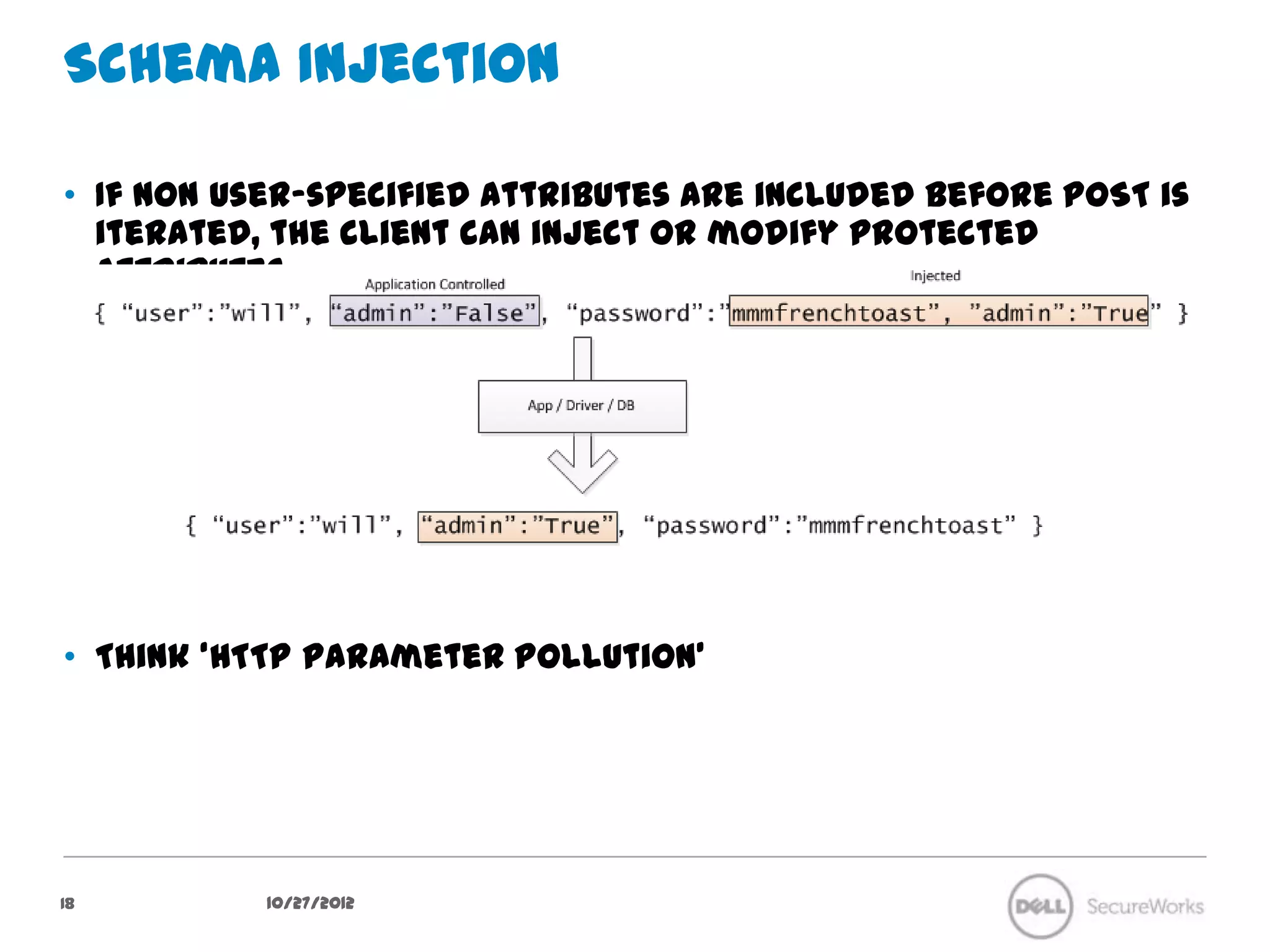
•  Allows an attacker to insert arbitrary key/value pairs into a document
     –  Attacker can also change the data type of a key

•  Feasible when an application iterates POST values to create
   documents


16              10/27/12
Schema Injection

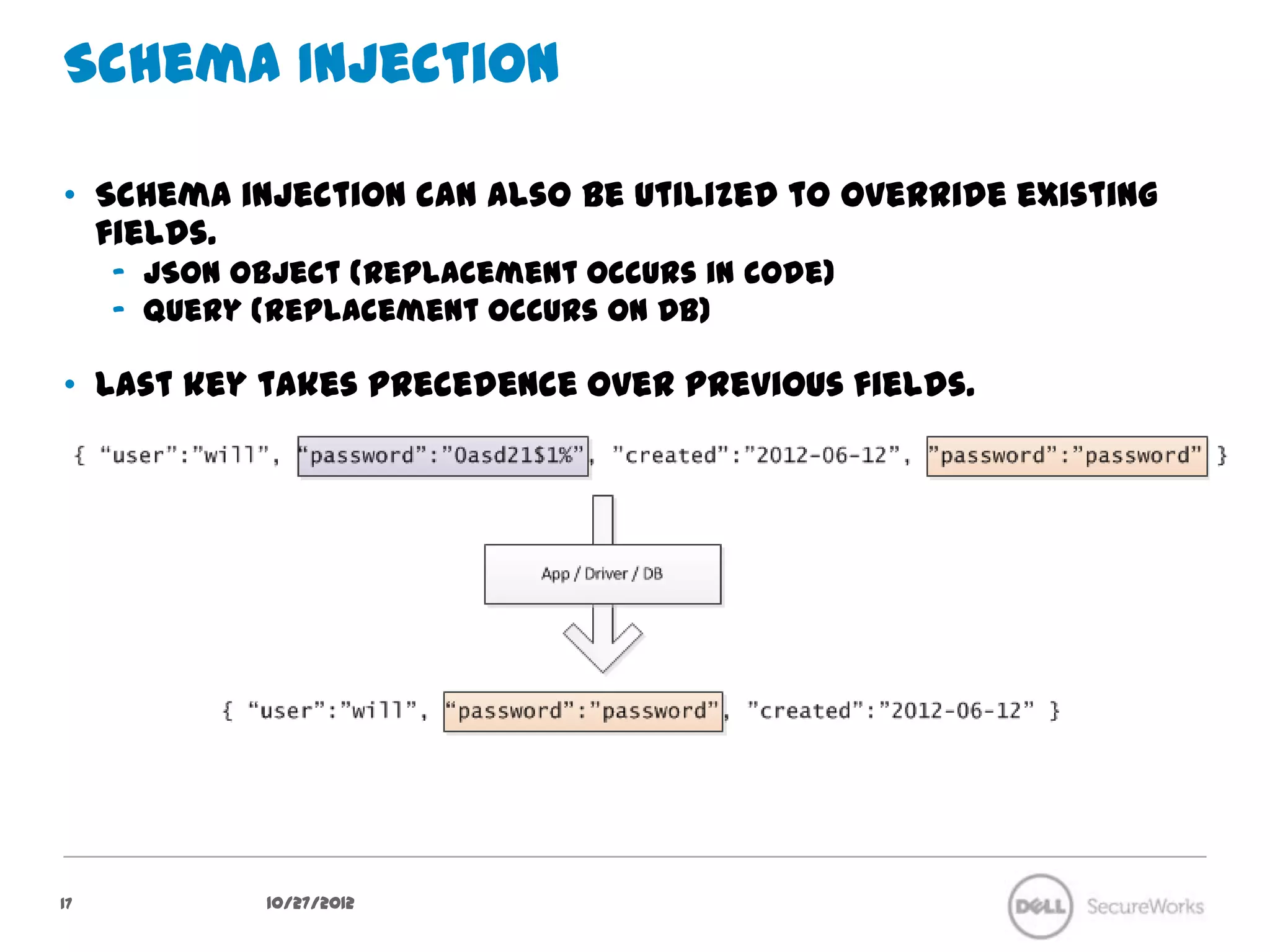
•  Schema injection can also be utilized to override existing fields.
     –  JSON object (replacement occurs in code)
     –  Query (replacement occurs on DB)

•  Last key takes precedence over previous fields.


17             10/27/12
Schema Injection

•  If non user-specified attributes are included before POST is iterated,
   the client can inject or modify protected attributes.


•  Think ‘HTTP Parameter Pollution’


18           10/27/12
Schema Injection Mitigation

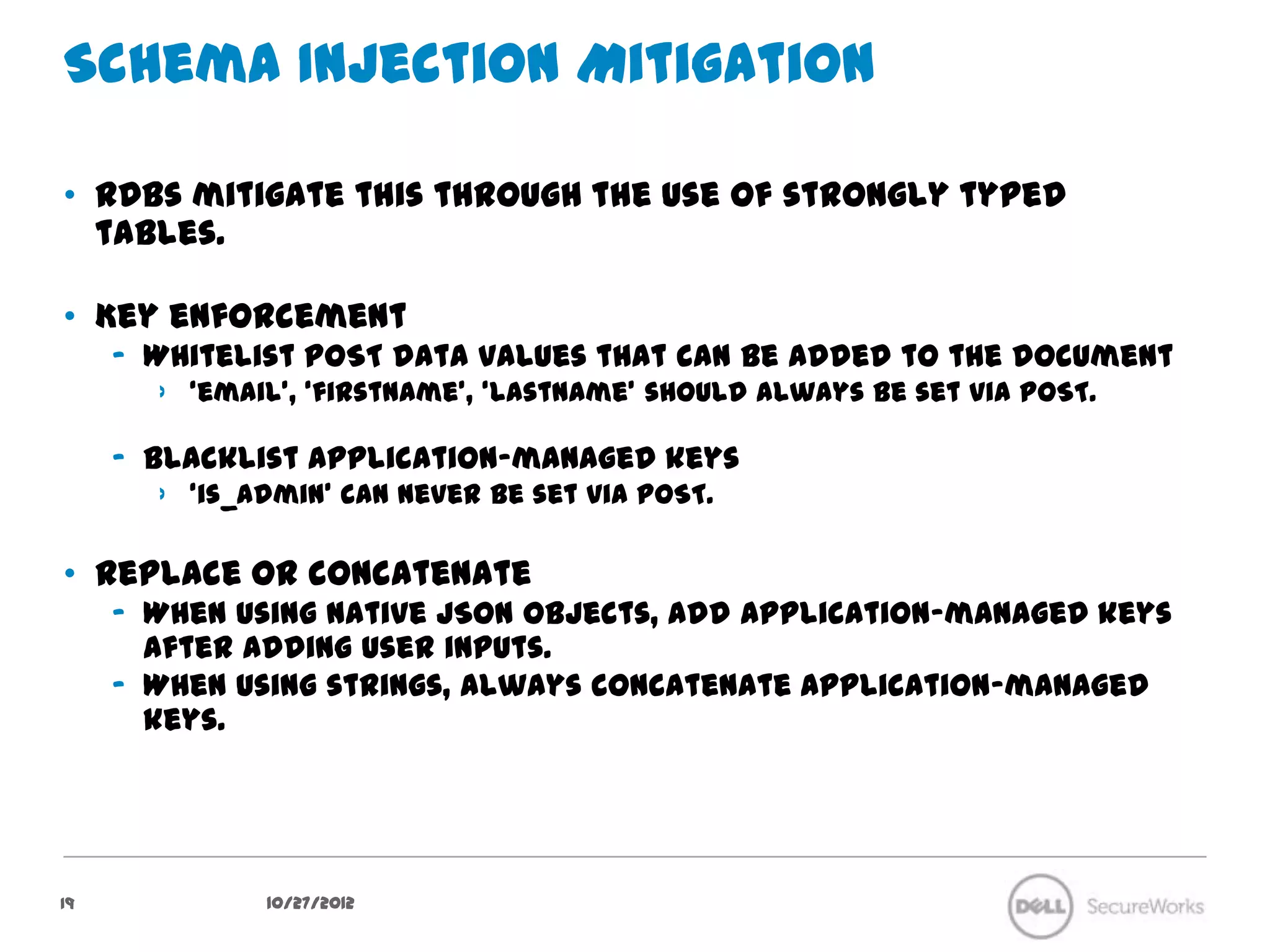
•  RDBs mitigate this through the use of strongly typed tables.

•  Key enforcement
     –  Whitelist POST data values that can be added to the document
        ›  ‘email’, ‘firstName’, ‘lastName’ should always be set via POST.

     –  Blacklist application-managed keys
        ›  ‘is_admin’ can never be set via POST.

•  Replace or concatenate
     –  When using native JSON objects, add application-managed keys after
        adding user inputs.
     –  When using strings, always concatenate application-managed keys.


19              10/27/12
Query Injection

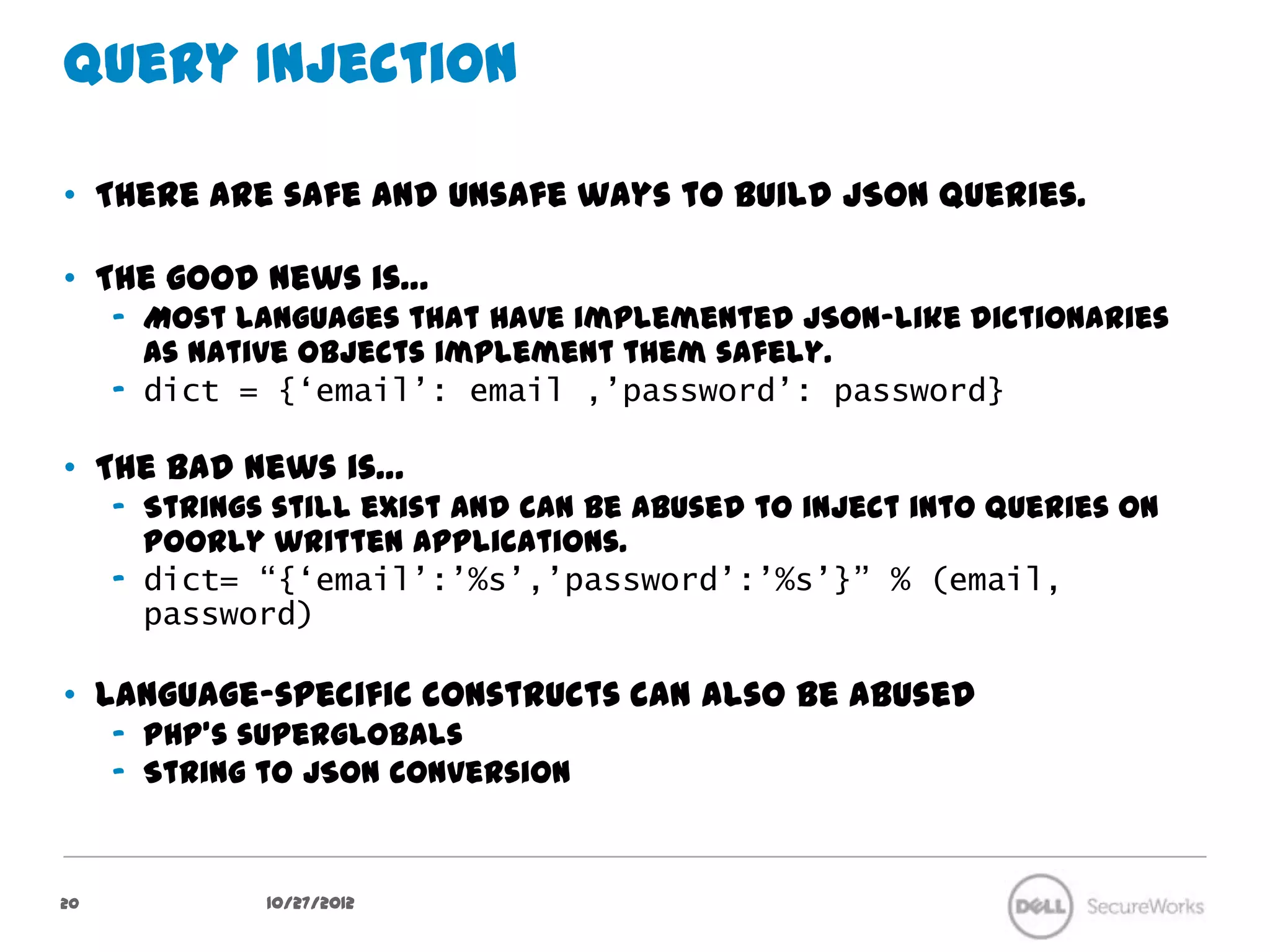
•  There are safe and unsafe ways to build JSON queries.

•  The good news is…
     –  Most languages that have implemented JSON-like dictionaries as native
        objects implement them safely.
     –  dict = {‘email’: email ,’password’: password}

•  The bad news is…
     –  Strings still exist and can be abused to inject into queries on poorly written
        applications.
     –  dict= “{‘email’:’%s’,’password’:’%s’}” % (email,
        password)

•  Language-specific constructs can also be abused
     –  PHP’s superglobals
     –  String to JSON conversion


20              10/27/12
PHP’s Superglobals

•  PHP automatically converts superglobal values to multidimensional
   arrays
     –  $_POST – for working with HTTP POST data
     –  $_GET – for working with HTTP GET data

•  This is very handy when working with web forms
     –  <input type=“text” name=“person[name]” value=“”>
     –  Can be referenced via $_POST[‘person’][‘name’]

•  PHP also uses arrays to represent MongoDB documents
     –  $user = array(
           ‘email' => ‘will@localhost',
           ‘password' => ‘mmmfrenchtoast',
           ‘date_created' => ‘2012-06-15’
        );


21             10/27/12
PHP’s Superglobals

•  Adversaries can weaponize superglobals by inserting MongoDB
   comparison operations in HTTP GET or POST keys
      –  forgot_password.php?
         email=will@localhost&security_question[$ne]=1

      –  Array (
            “email” => “will@localhost”,
            “security_question” => array(“$ne” => 1)
         );

•  Kudos to Bryan Sullivan @ Adobe for identifying and reporting this
     http://blogs.adobe.com/asset/files/2011/04/NoSQL-But-Even-Less-Security.pdf


22                      10/27/12
Javascript Injection (SSJI)

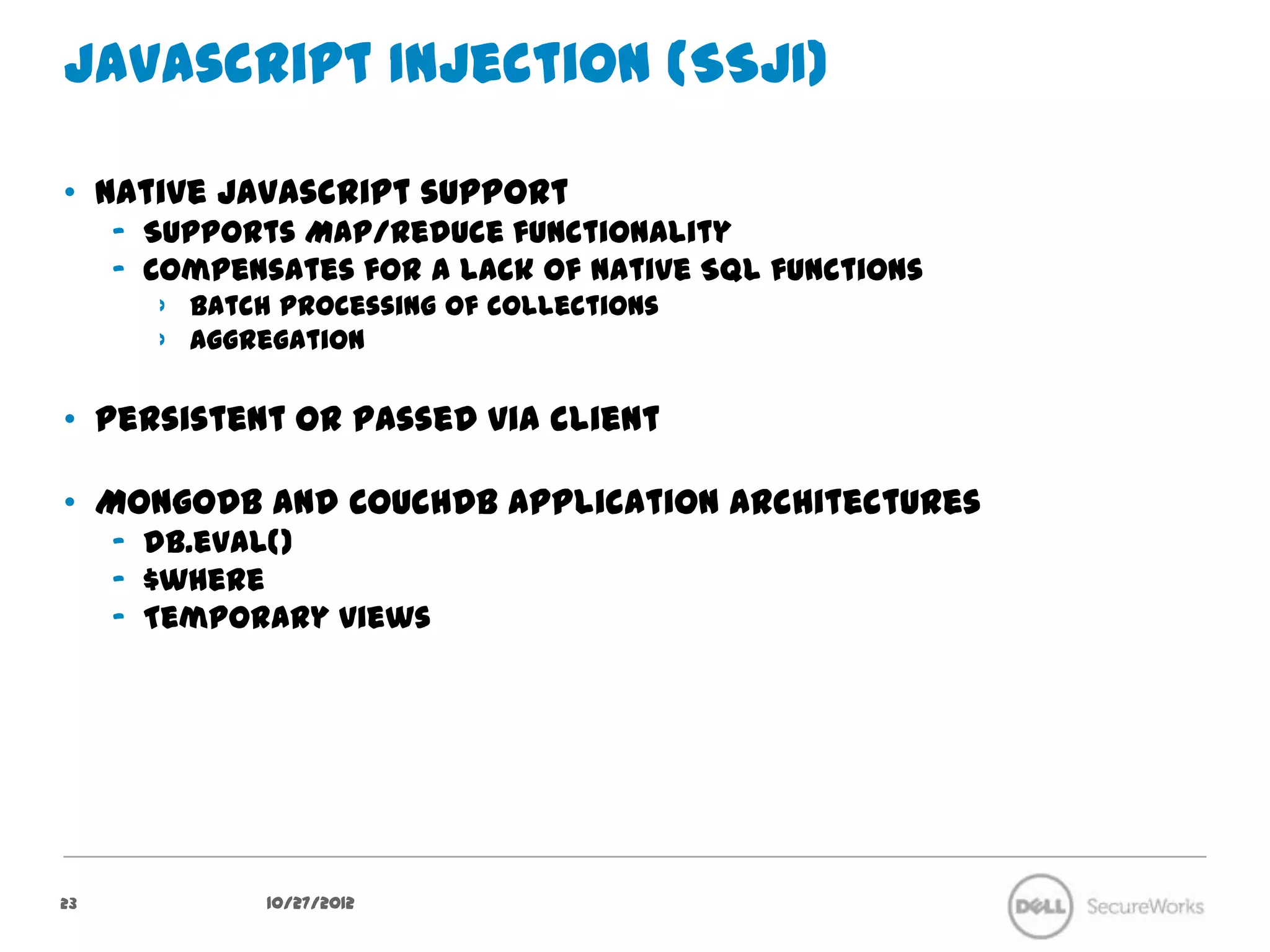
•  Native Javascript support
     –  Supports Map/Reduce functionality
     –  Compensates for a lack of native SQL functions
        ›  Batch processing of collections
        ›  Aggregation

•  Persistent or passed via client

•  MongoDB and CouchDB application architectures
     –  db.eval()
     –  $where
     –  Temporary views


23              10/27/12
Mitigating Injection Attacks

•  Use safe string / JSON operations
     –  Escape input
     –  Avoid string concatenation when building queries
     –  Use native JSON-like objects when available

•  Be careful when utilizing GET and POST variables
     –  Check for use of $operators
     –  Validate strings do not contain JSON

•  Validate document schemas before writing to the database

•  Identify and sanitize Javascript in application inputs
     –  Check for server-side Javascript injection on IPS/WAF, if applicable

•  Ensure your defense in depth strategy is looking for these attacks


24              10/27/12
Authentication


25         10/27/12
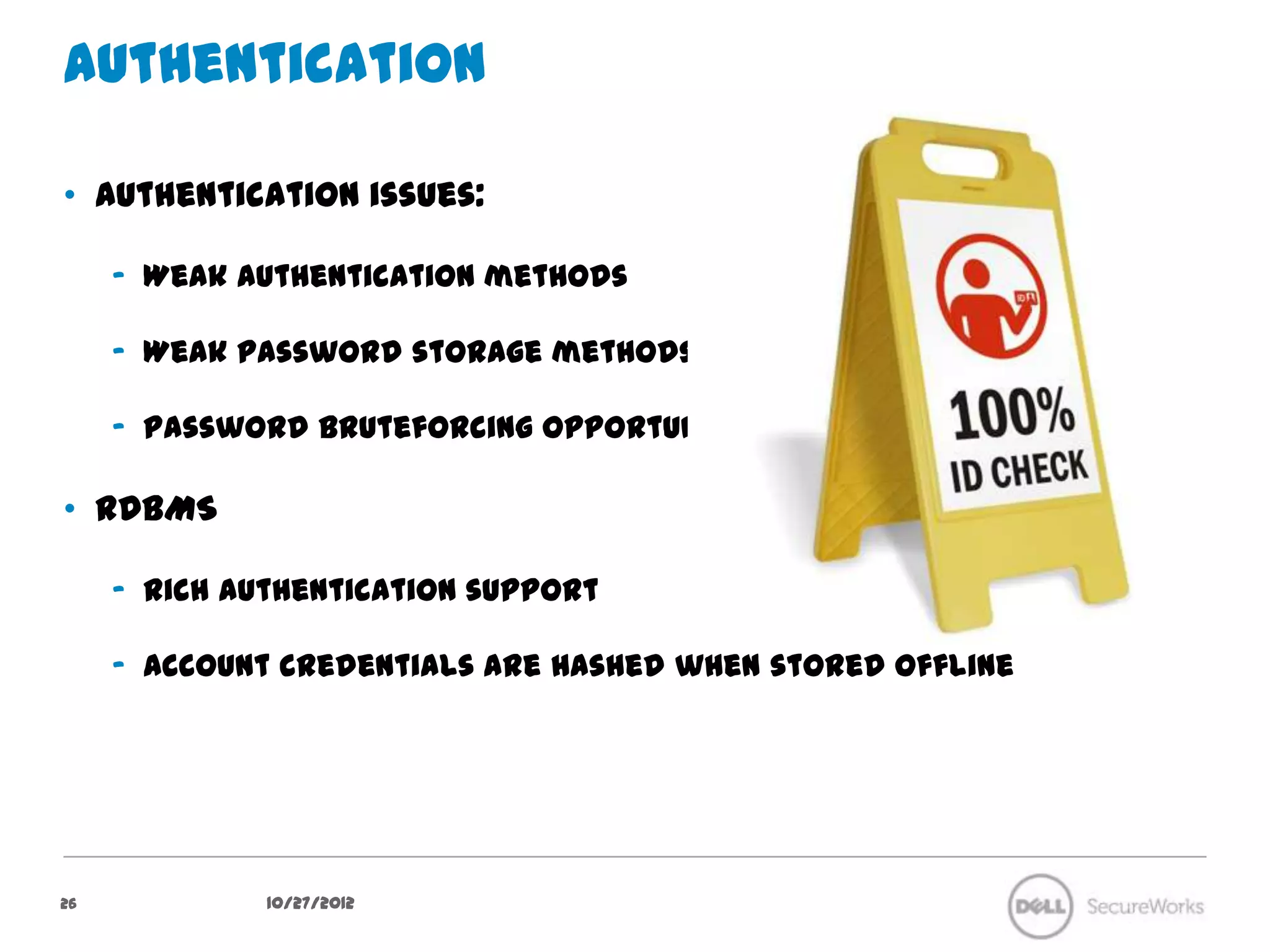
Authentication

•  Authentication issues:

     –  Weak authentication methods

     –  Weak password storage methods

     –  Password bruteforcing opportunities

•  RDBMS

     –  Rich authentication support

     –  Account credentials are hashed when stored offline


26              10/27/12
Local-only security model

•  “When you start out fresh, CouchDB allows any request to be made
   by anyone. [..] Everybody has privileges to do anything.
   Neat.” [guide.couchdb.org]

•  “If there are no admin users, one may access the database from the
   localhost interface without authenticating.” [mongodb.org]

•  Limited security by default
     •  Localhost only
     •  Rapid development
     •  Ease of use

•  Growing pains
     •  Authentication methods don’t always effectively scale beyond localhost


27               10/27/12
Weak authentication methods

1.  HTTP/RESTful authentication

2.  Non-HTTP/RESTful authentication


28      10/27/12
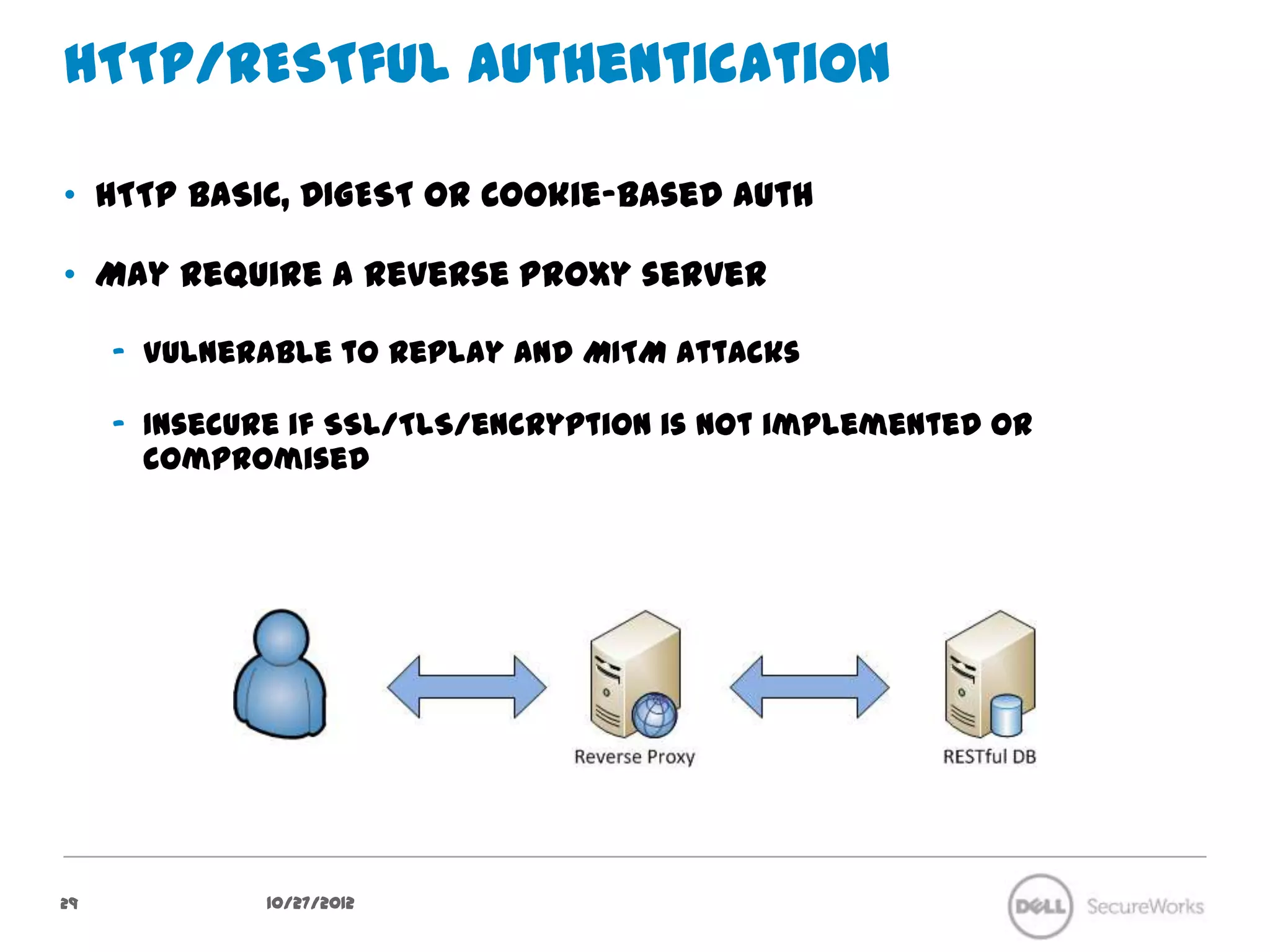
HTTP/RESTful authentication

•  HTTP BASIC, DIGEST or Cookie-based auth

•  May require a reverse proxy server

     –  Vulnerable to replay and MITM attacks

     –  Insecure if SSL/TLS/encryption is not implemented or compromised


29             10/27/12
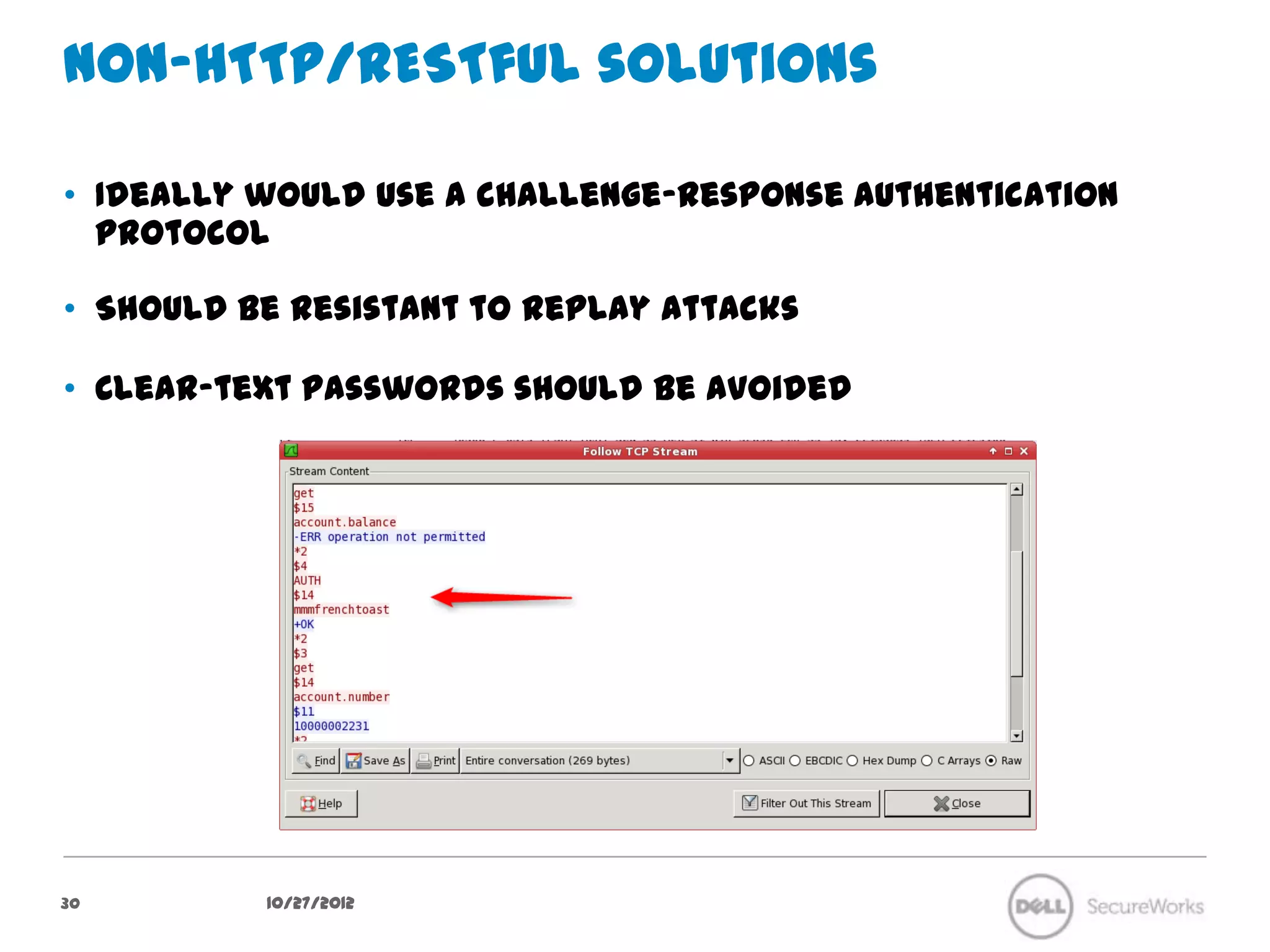
Non-HTTP/RESTful solutions

•  Ideally would use a challenge-response authentication protocol

•  Should be resistant to replay attacks

•  Clear-text passwords should be avoided


30           10/27/12
Weak password storage methods

•  Passwords should never be stored in the clear
     –  Redis, CouchDB (some cases)

•  Passwords should be hashed or encrypted
     –  Preferably with a secure hashing algorithm

     –  MongoDB
        ›  MD5(username + “:mongo:” + password)

     –  CouchDB
        ›  Salt is a randomly generated 128-bit UUID
        ›  PW = “-hashed-” + SHA1(password + salt) + “,” + salt

•  Access to password storage should be limited


31              10/27/12
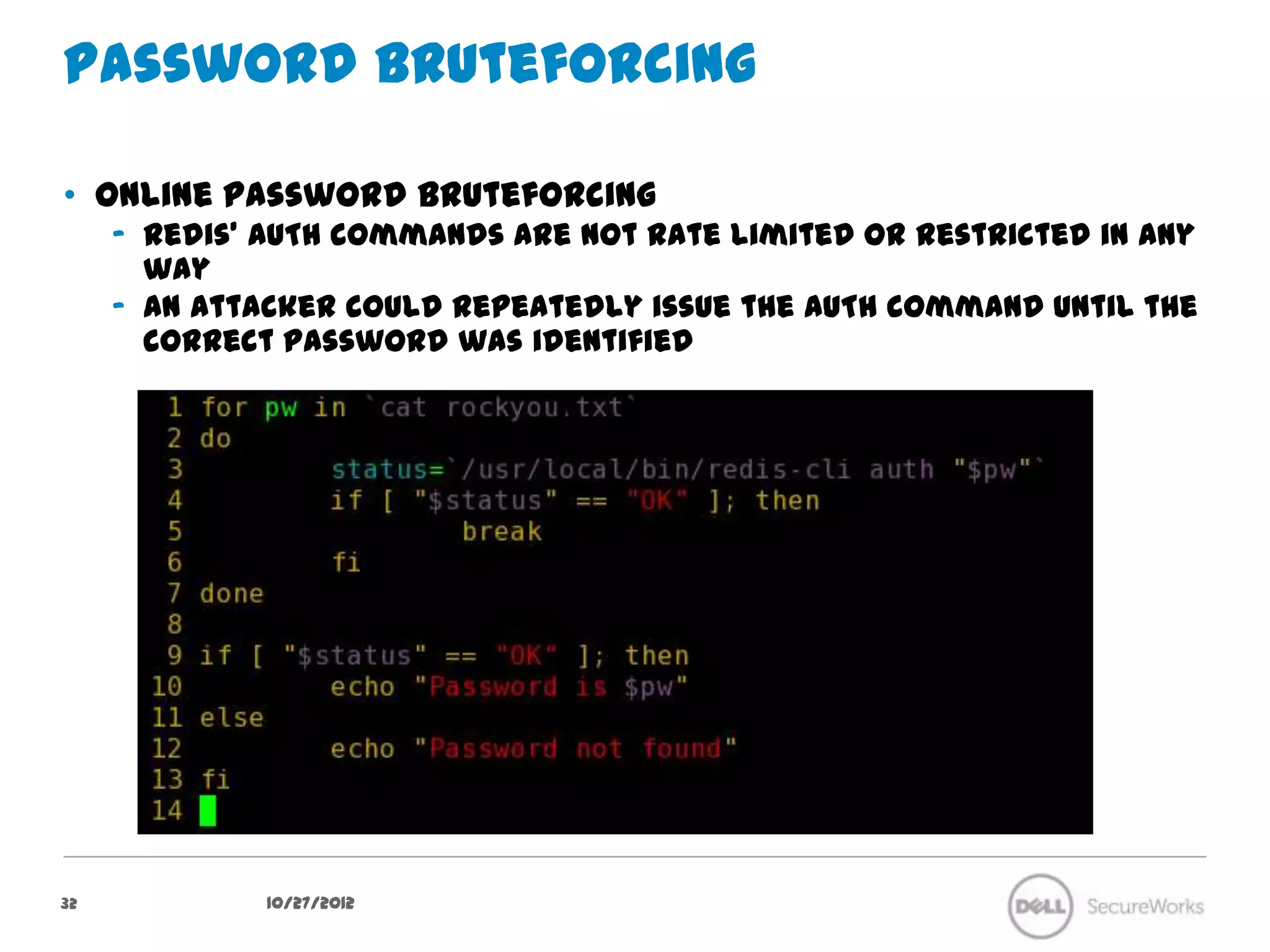
Password bruteforcing

•  Online password bruteforcing
     –  Redis’ AUTH commands are not rate limited or restricted in any way
     –  An attacker could repeatedly issue the AUTH command until the correct
        password was identified


32             10/27/12
Authentication

•  Authentication schemes vary widely depending on the NoSQL
   database being used

•  Native authentication schemes are relatively weak
     –  Replay attacks
     –  Password bruteforcing
     –  Information leakage


•  Pluggable authentication is generally not supported


33             10/27/12
Authorization


34         10/27/12
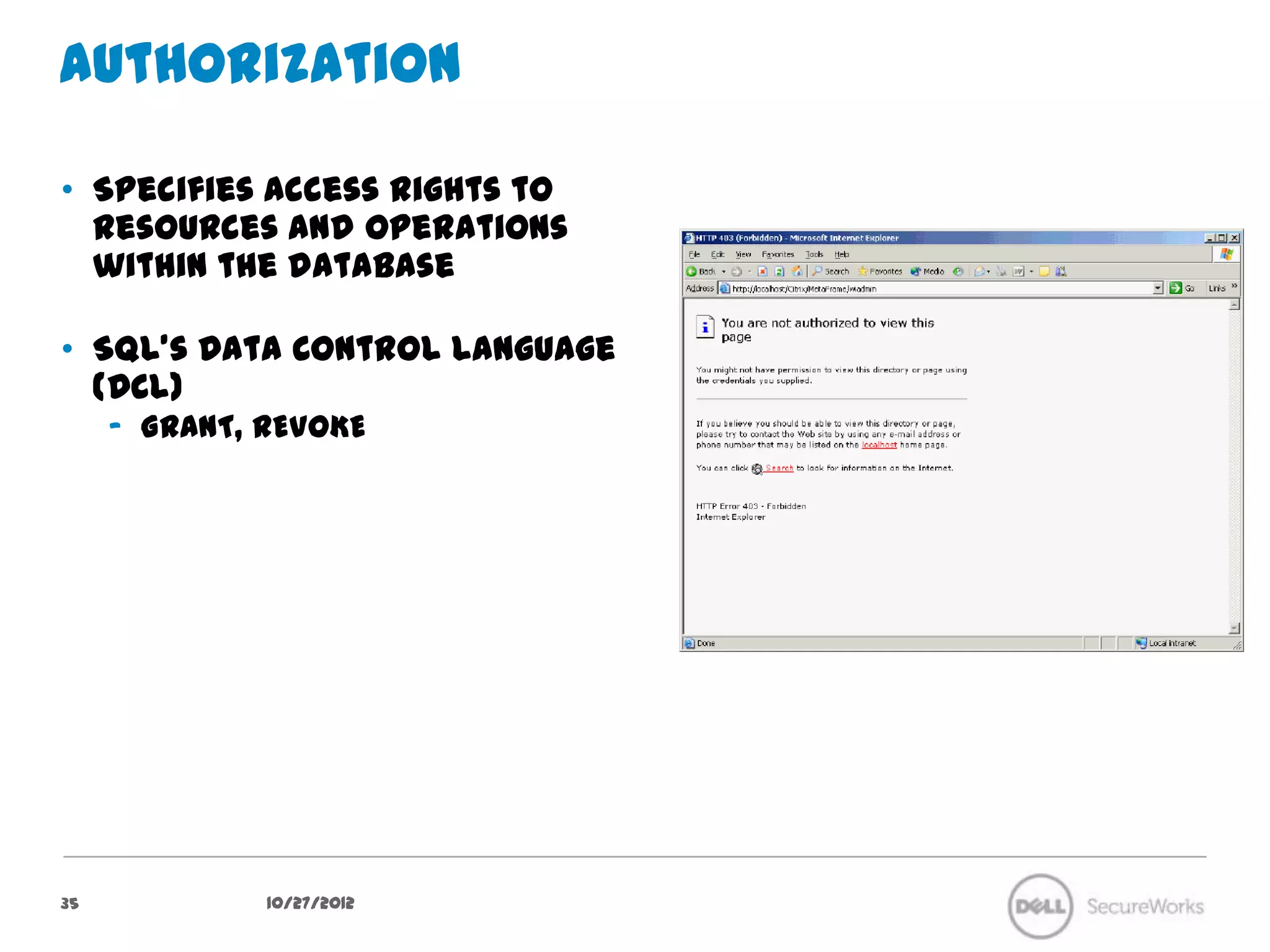
Authorization

•  Specifies access rights to
   resources and operations within
   the database

•  SQL’s Data Control Language
   (DCL)
     –  GRANT, REVOKE


35           10/27/12
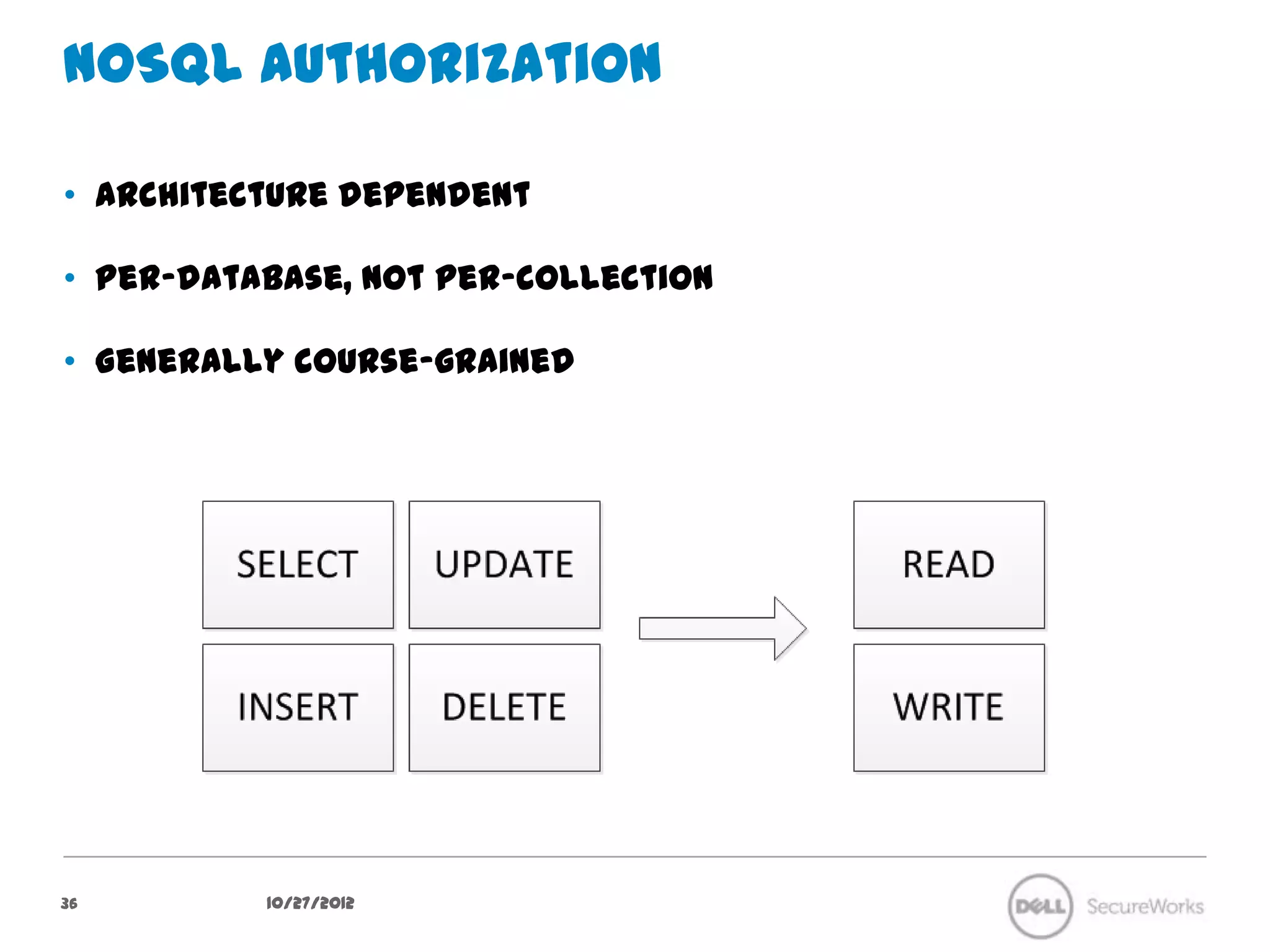
NoSQL Authorization

•  Architecture dependent

•  Per-database, not per-collection

•  Generally course-grained


36           10/27/12
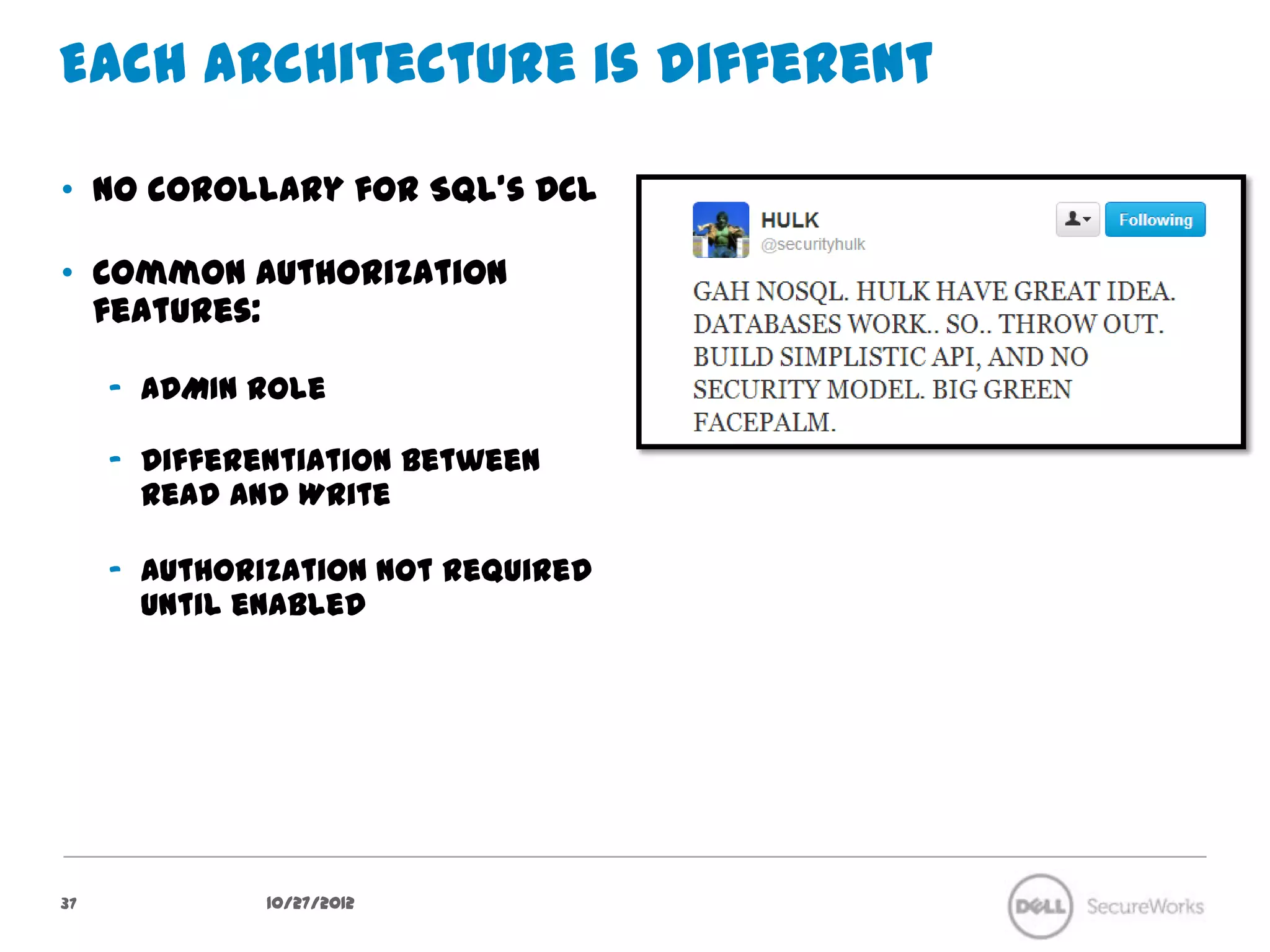
Each architecture is different

•  No corollary for SQL’s DCL

•  Common authorization features:

     –  ADMIN role

     –  Differentiation between Read and
        Write

     –  Authorization not required until
        enabled


37              10/27/12
Inventive Solutions

•  Validation Functions

•  Role-based Access Control
     –  User roles
     –  Security groups

•  Command Renaming
     –  Authorization through obscurity


38              10/27/12
Confidentiality


39          10/27/12
Confidentiality

•  Protect data at rest and in transit

•  Confidentiality in transit
     –  SSL/TLS
     –  Mutually verifiable (key exchange)

•  Confidentiality at rest
     –  Integrated cryptographic functionality
     –  Ability to encrypt data in the database
     –  Easy access to hashing functions


40              10/27/12
NoSQL Confidentiality

•  In transit
     –  Some SSL support

     –  HTTP/REST-based solutions generally recommend use of HTTPS reverse
        proxies

     –  Non-REST based solutions recommend the use of stunnel, VPNs, or a
        transport-layer encryption technology

•  At rest

•  Third party applications exist to provide advanced authorization and
   confidentiality functionality to existing databases


41              10/27/12
Securing NoSQL


42        10/27/12
Securing NoSQL

•  Trusted operating environment
     –  Scoping
     –  Identifying ingress and egress

•  Compliance Issues
     –  PCI

•  Compensating Controls
     –  Architecture limitations


43               10/27/12
#1 Understand your solution

•  No two NoSQL solutions are the
   same
     –  Read the manual!

•  Understand the environment
     –  Define “trusted environment”
     –  Understand ingress/egress

•  Architecture
     –  Software
     –  Capabilities
     –  Controls

•  Defense in Depth


44               10/27/12
#2 Beware architecture creep

•  Additional architecture may be
   required

•  Increased TCO, deployment
   times

•  Identify these needs during
   development


45           10/27/12
#3 Always Validate

•  The NoSQL injection attack surface is diverse
     –  Schema, query, and javascript injection attacks affect architectures
        differently.

•  Understand how these attacks can affect your application and NoSQL
   environment

•  Continue to validate for traditional (SQLi, XSS) and non-traditional
   injection (NoSQLi, SSJI) attacks.


46              10/27/12
#4 Work with Vendors

•  Dynamic projects; quick release cycles

•  If your NoSQL solution doesn't support the features you need, ask for
   them.

•  Several of the shortcomings we have discussed today are “on the
   roadmap”


47           10/27/12
Thank you!

     I value your
     feedback


                      Twitter: @willurbanski


48         10/27/12
Picture Credits

•    14 – Red Bull
•    15 – Flickr.com / ActiveGuy98
•    22 – Flickr.com / John Kannenberg
•    22 – Flickr.com / Angelberries
•    34 – mysecuritysign.com
•    54 – Flickr.com / James Pullen


49             10/27/12

NoSQL, no security?

  • 1.
    NoSQL, no security? WillUrbanski Vulnerability Management, Dell SecureWorks
  • 2.
    What we willcover today § Why look at NoSQL security? § Relational Database attack vectors § NoSQL attack vectors § Securing NoSQL deployments 2 10/27/12
  • 3.
    Why look at NoSQL security? 3 10/27/12
  • 4.
    NoSQL is popular • Scalability •  Redundancy •  Flexibility •  Rapid development / deployment •  Cost 4 10/27/12
  • 5.
    “Redis is designedto be accessed by trusted clients inside trusted environments. This means that usually it is not a good idea to expose the Redis instance directly to the internet or, in general, to an environment where untrusted clients can directly access the Redis TCP port or UNIX socket.” [redis.io] 5 10/27/12
  • 6.
    “The most effectiveway to reduce risk for MongoDB deployments is to run your entire MongoDB deployment, including all MongoDB components in a trusted environment” [mongodb.org] 6 10/27/12
  • 7.
    “When you startout fresh, CouchDB allows any request to be made by anyone. [..] it should be obvious that putting a default installation into the wild is adventurous. Any rogue client could come along and delete a database.” [guide.couchdb.org] 7 10/27/12
  • 8.
    8 Confidential 10/27/12
  • 9.
    9 Confidential 10/27/12
  • 10.
    Relational Databases (RDBMS) • Relative Feature Parity •  Integrated Security Features –  Authorization –  Authentication –  Confidentiality 10 10/27/12
  • 11.
    RDBMS Attack Surfaces • Software vulnerabilities •  Injection Attacks •  Credential brute forcing •  Privilege escalation –  Offline storage –  Authentication protocols •  Authorization weaknesses •  Insecure configurations –  MITM –  Replay attacks 11 10/27/12
  • 12.
    Does NoSQL mean“No Security”? 12 10/27/12
  • 13.
    Injection 13 10/27/12
  • 14.
    Injection Attacks •  Databasediversity is increasing ›  Command-based queries ›  CQL ›  JSON ›  BSON ›  Javascript ›  Custom query languages •  Injection attack surface is increasing –  Query injection –  Schema injection –  Javascript injection •  Attack complexity is increasing 14 10/27/12
  • 15.
    Collections Tables Collections 15 10/27/12
  • 16.
    Schema Injection •  Allowsan attacker to insert arbitrary key/value pairs into a document –  Attacker can also change the data type of a key •  Feasible when an application iterates POST values to create documents 16 10/27/12
  • 17.
    Schema Injection •  Schemainjection can also be utilized to override existing fields. –  JSON object (replacement occurs in code) –  Query (replacement occurs on DB) •  Last key takes precedence over previous fields. 17 10/27/12
  • 18.
    Schema Injection •  Ifnon user-specified attributes are included before POST is iterated, the client can inject or modify protected attributes. •  Think ‘HTTP Parameter Pollution’ 18 10/27/12
  • 19.
    Schema Injection Mitigation • RDBs mitigate this through the use of strongly typed tables. •  Key enforcement –  Whitelist POST data values that can be added to the document ›  ‘email’, ‘firstName’, ‘lastName’ should always be set via POST. –  Blacklist application-managed keys ›  ‘is_admin’ can never be set via POST. •  Replace or concatenate –  When using native JSON objects, add application-managed keys after adding user inputs. –  When using strings, always concatenate application-managed keys. 19 10/27/12
  • 20.
    Query Injection •  Thereare safe and unsafe ways to build JSON queries. •  The good news is… –  Most languages that have implemented JSON-like dictionaries as native objects implement them safely. –  dict = {‘email’: email ,’password’: password} •  The bad news is… –  Strings still exist and can be abused to inject into queries on poorly written applications. –  dict= “{‘email’:’%s’,’password’:’%s’}” % (email, password) •  Language-specific constructs can also be abused –  PHP’s superglobals –  String to JSON conversion 20 10/27/12
  • 21.
    PHP’s Superglobals •  PHPautomatically converts superglobal values to multidimensional arrays –  $_POST – for working with HTTP POST data –  $_GET – for working with HTTP GET data •  This is very handy when working with web forms –  <input type=“text” name=“person[name]” value=“”> –  Can be referenced via $_POST[‘person’][‘name’] •  PHP also uses arrays to represent MongoDB documents –  $user = array( ‘email' => ‘will@localhost', ‘password' => ‘mmmfrenchtoast', ‘date_created' => ‘2012-06-15’ ); 21 10/27/12
  • 22.
    PHP’s Superglobals •  Adversariescan weaponize superglobals by inserting MongoDB comparison operations in HTTP GET or POST keys –  forgot_password.php? email=will@localhost&security_question[$ne]=1 –  Array ( “email” => “will@localhost”, “security_question” => array(“$ne” => 1) ); •  Kudos to Bryan Sullivan @ Adobe for identifying and reporting this http://blogs.adobe.com/asset/files/2011/04/NoSQL-But-Even-Less-Security.pdf 22 10/27/12
  • 23.
    Javascript Injection (SSJI) • Native Javascript support –  Supports Map/Reduce functionality –  Compensates for a lack of native SQL functions ›  Batch processing of collections ›  Aggregation •  Persistent or passed via client •  MongoDB and CouchDB application architectures –  db.eval() –  $where –  Temporary views 23 10/27/12
  • 24.
    Mitigating Injection Attacks • Use safe string / JSON operations –  Escape input –  Avoid string concatenation when building queries –  Use native JSON-like objects when available •  Be careful when utilizing GET and POST variables –  Check for use of $operators –  Validate strings do not contain JSON •  Validate document schemas before writing to the database •  Identify and sanitize Javascript in application inputs –  Check for server-side Javascript injection on IPS/WAF, if applicable •  Ensure your defense in depth strategy is looking for these attacks 24 10/27/12
  • 25.
  • 26.
    Authentication •  Authentication issues: –  Weak authentication methods –  Weak password storage methods –  Password bruteforcing opportunities •  RDBMS –  Rich authentication support –  Account credentials are hashed when stored offline 26 10/27/12
  • 27.
    Local-only security model • “When you start out fresh, CouchDB allows any request to be made by anyone. [..] Everybody has privileges to do anything. Neat.” [guide.couchdb.org] •  “If there are no admin users, one may access the database from the localhost interface without authenticating.” [mongodb.org] •  Limited security by default •  Localhost only •  Rapid development •  Ease of use •  Growing pains •  Authentication methods don’t always effectively scale beyond localhost 27 10/27/12
  • 28.
    Weak authentication methods 1. HTTP/RESTful authentication 2.  Non-HTTP/RESTful authentication 28 10/27/12
  • 29.
    HTTP/RESTful authentication •  HTTPBASIC, DIGEST or Cookie-based auth •  May require a reverse proxy server –  Vulnerable to replay and MITM attacks –  Insecure if SSL/TLS/encryption is not implemented or compromised 29 10/27/12
  • 30.
    Non-HTTP/RESTful solutions •  Ideallywould use a challenge-response authentication protocol •  Should be resistant to replay attacks •  Clear-text passwords should be avoided 30 10/27/12
  • 31.
    Weak password storagemethods •  Passwords should never be stored in the clear –  Redis, CouchDB (some cases) •  Passwords should be hashed or encrypted –  Preferably with a secure hashing algorithm –  MongoDB ›  MD5(username + “:mongo:” + password) –  CouchDB ›  Salt is a randomly generated 128-bit UUID ›  PW = “-hashed-” + SHA1(password + salt) + “,” + salt •  Access to password storage should be limited 31 10/27/12
  • 32.
    Password bruteforcing •  Onlinepassword bruteforcing –  Redis’ AUTH commands are not rate limited or restricted in any way –  An attacker could repeatedly issue the AUTH command until the correct password was identified 32 10/27/12
  • 33.
    Authentication •  Authentication schemesvary widely depending on the NoSQL database being used •  Native authentication schemes are relatively weak –  Replay attacks –  Password bruteforcing –  Information leakage •  Pluggable authentication is generally not supported 33 10/27/12
  • 34.
  • 35.
    Authorization •  Specifies accessrights to resources and operations within the database •  SQL’s Data Control Language (DCL) –  GRANT, REVOKE 35 10/27/12
  • 36.
    NoSQL Authorization •  Architecturedependent •  Per-database, not per-collection •  Generally course-grained 36 10/27/12
  • 37.
    Each architecture isdifferent •  No corollary for SQL’s DCL •  Common authorization features: –  ADMIN role –  Differentiation between Read and Write –  Authorization not required until enabled 37 10/27/12
  • 38.
    Inventive Solutions •  ValidationFunctions •  Role-based Access Control –  User roles –  Security groups •  Command Renaming –  Authorization through obscurity 38 10/27/12
  • 39.
  • 40.
    Confidentiality •  Protect dataat rest and in transit •  Confidentiality in transit –  SSL/TLS –  Mutually verifiable (key exchange) •  Confidentiality at rest –  Integrated cryptographic functionality –  Ability to encrypt data in the database –  Easy access to hashing functions 40 10/27/12
  • 41.
    NoSQL Confidentiality •  Intransit –  Some SSL support –  HTTP/REST-based solutions generally recommend use of HTTPS reverse proxies –  Non-REST based solutions recommend the use of stunnel, VPNs, or a transport-layer encryption technology •  At rest •  Third party applications exist to provide advanced authorization and confidentiality functionality to existing databases 41 10/27/12
  • 42.
  • 43.
    Securing NoSQL •  Trustedoperating environment –  Scoping –  Identifying ingress and egress •  Compliance Issues –  PCI •  Compensating Controls –  Architecture limitations 43 10/27/12
  • 44.
    #1 Understand yoursolution •  No two NoSQL solutions are the same –  Read the manual! •  Understand the environment –  Define “trusted environment” –  Understand ingress/egress •  Architecture –  Software –  Capabilities –  Controls •  Defense in Depth 44 10/27/12
  • 45.
    #2 Beware architecturecreep •  Additional architecture may be required •  Increased TCO, deployment times •  Identify these needs during development 45 10/27/12
  • 46.
    #3 Always Validate • The NoSQL injection attack surface is diverse –  Schema, query, and javascript injection attacks affect architectures differently. •  Understand how these attacks can affect your application and NoSQL environment •  Continue to validate for traditional (SQLi, XSS) and non-traditional injection (NoSQLi, SSJI) attacks. 46 10/27/12
  • 47.
    #4 Work withVendors •  Dynamic projects; quick release cycles •  If your NoSQL solution doesn't support the features you need, ask for them. •  Several of the shortcomings we have discussed today are “on the roadmap” 47 10/27/12
  • 48.
    Thank you! I value your feedback Twitter: @willurbanski 48 10/27/12
  • 49.
    Picture Credits •  14 – Red Bull •  15 – Flickr.com / ActiveGuy98 •  22 – Flickr.com / John Kannenberg •  22 – Flickr.com / Angelberries •  34 – mysecuritysign.com •  54 – Flickr.com / James Pullen 49 10/27/12

Editor's Notes

  • #20 So what are the implications of Schema injection? Well for starters, there can be performance implications for the database. We can also do fun things like apply different data types to different keys in different rows. So our password in document #1 can be a string, while our password in document #2 could be an integer. Again, normally these constraints would be enforced by an application, but since they aren’t an attacker may be able to use this to their advantage, perhaps to bypass a login mechanism.To mitigate these attacks in a NoSQL environment we need to ensure that only valid keys are explicitly allowed into the database. Additional, unnecessary keys should be blocked or dropped. This is not an issue in the SQL world because the strongly typed table environment prevents any additional schemas from being added, and what benefit could you gain from creating extra, unused tables?And here’s the scary part, a lot of frameworks are already advocating or implementing code that simpy iterates over the post data. This is a Bad Idea™. From a penetration testers perspective, this is a gold mine.
  • #33 10k passwords on a VM, in about 30 seconds.~ 1,000,000 passwords in a little under an hour