“What’s in a Name?: Information Literacy,
            Metaliteracy, or Transliteracy”

Trudi E. Jacobson, M.L.S., M.A.                     Tom Mackey, Ph.D.
    Distinguished Librarian                                 Dean
      University Libraries                      Center for Distance Learning
      University at Albany                         Empire State College
             SUNY                                          SUNY
                             #acrlname
                      ACRL 2013 Imagine Innovate Inspire                   1
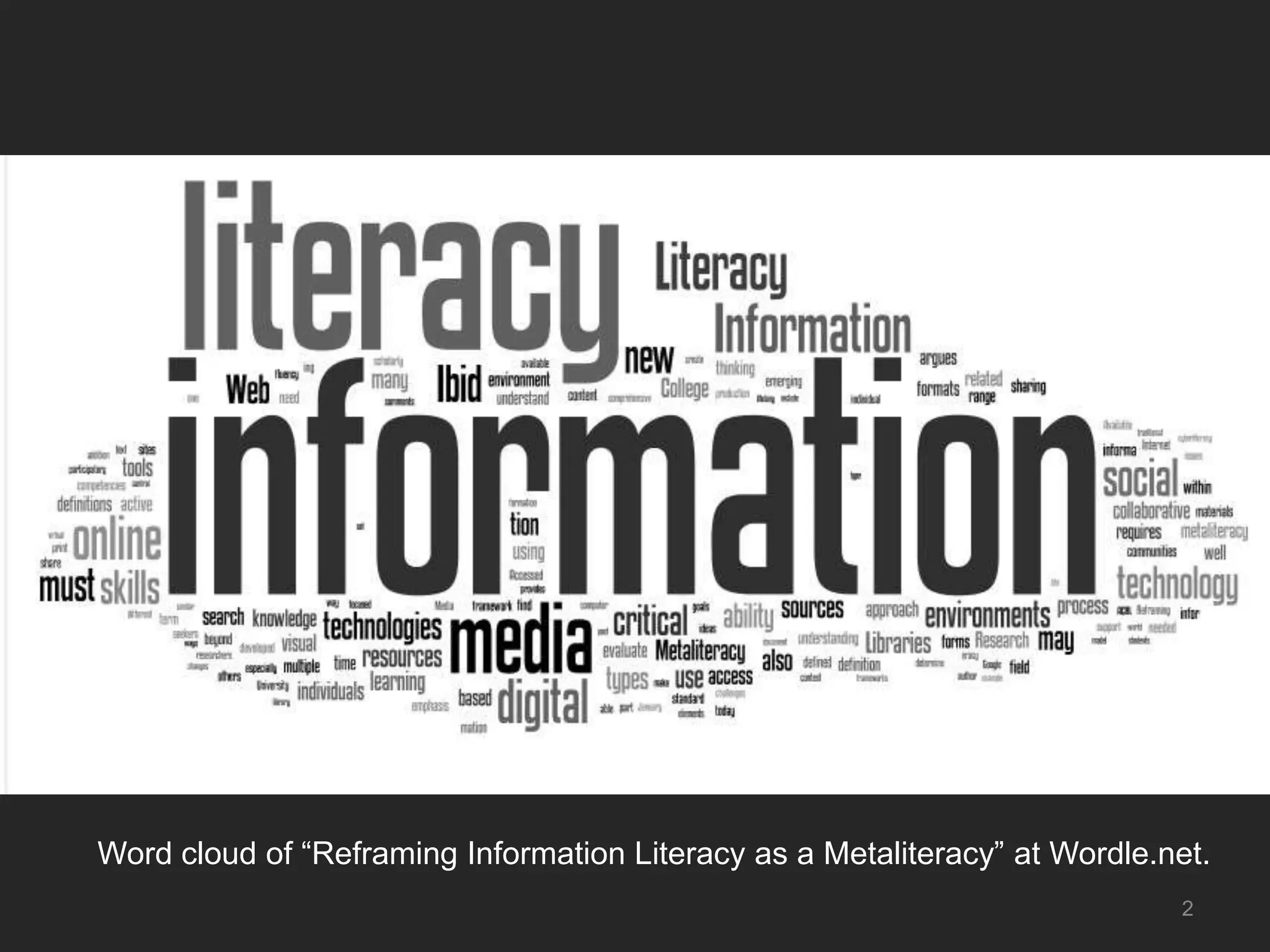
Word cloud of “Reframing Information Literacy as a Metaliteracy” at Wordle.net.
                                                                            2
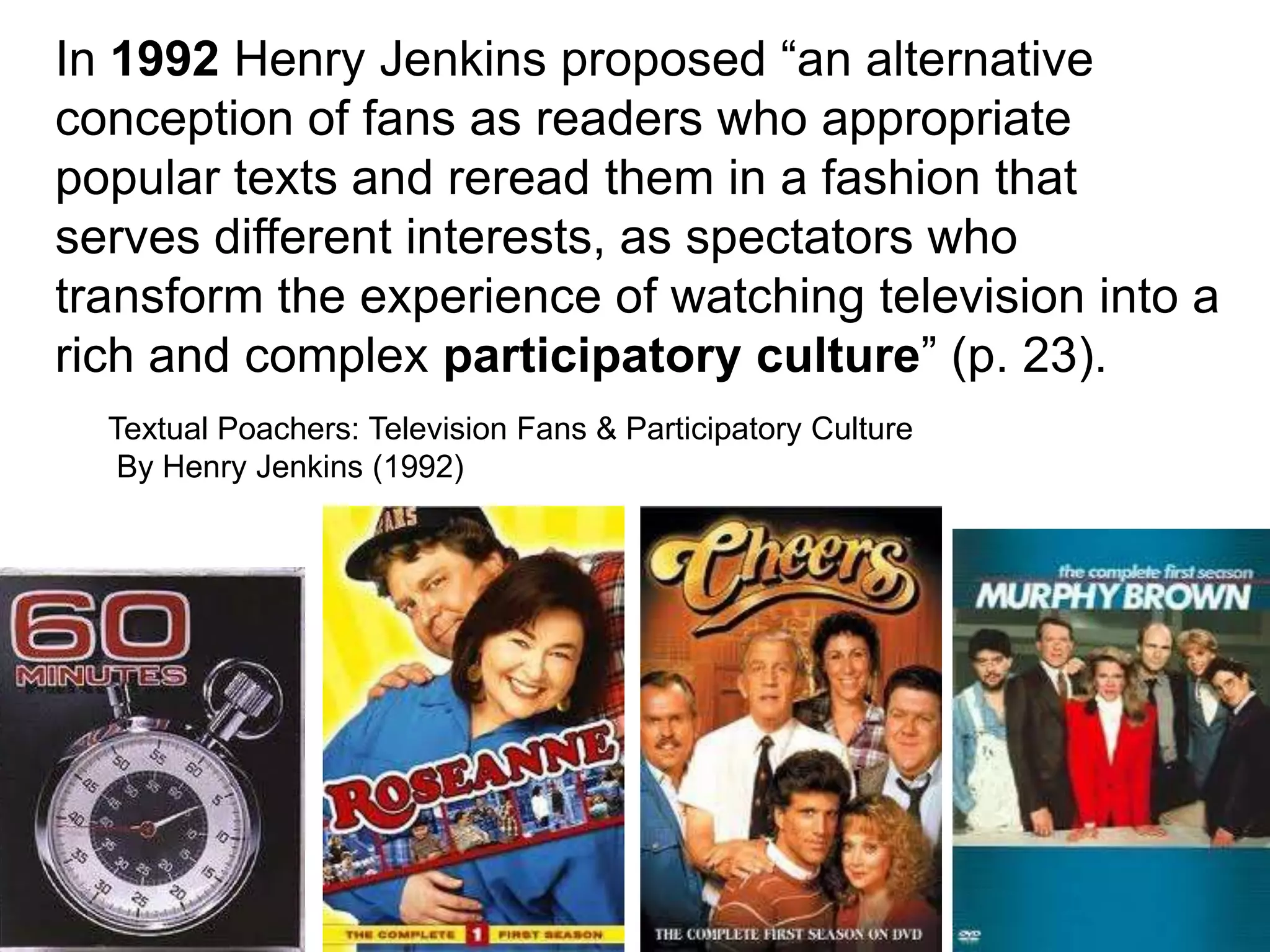
In 1992 Henry Jenkins proposed “an alternative
conception of fans as readers who appropriate
popular texts and reread them in a fashion that
serves different interests, as spectators who
transform the experience of watching television into a
rich and complex participatory culture” (p. 23).
  Textual Poachers: Television Fans & Participatory Culture
   By Henry Jenkins (1992)


                                                              3
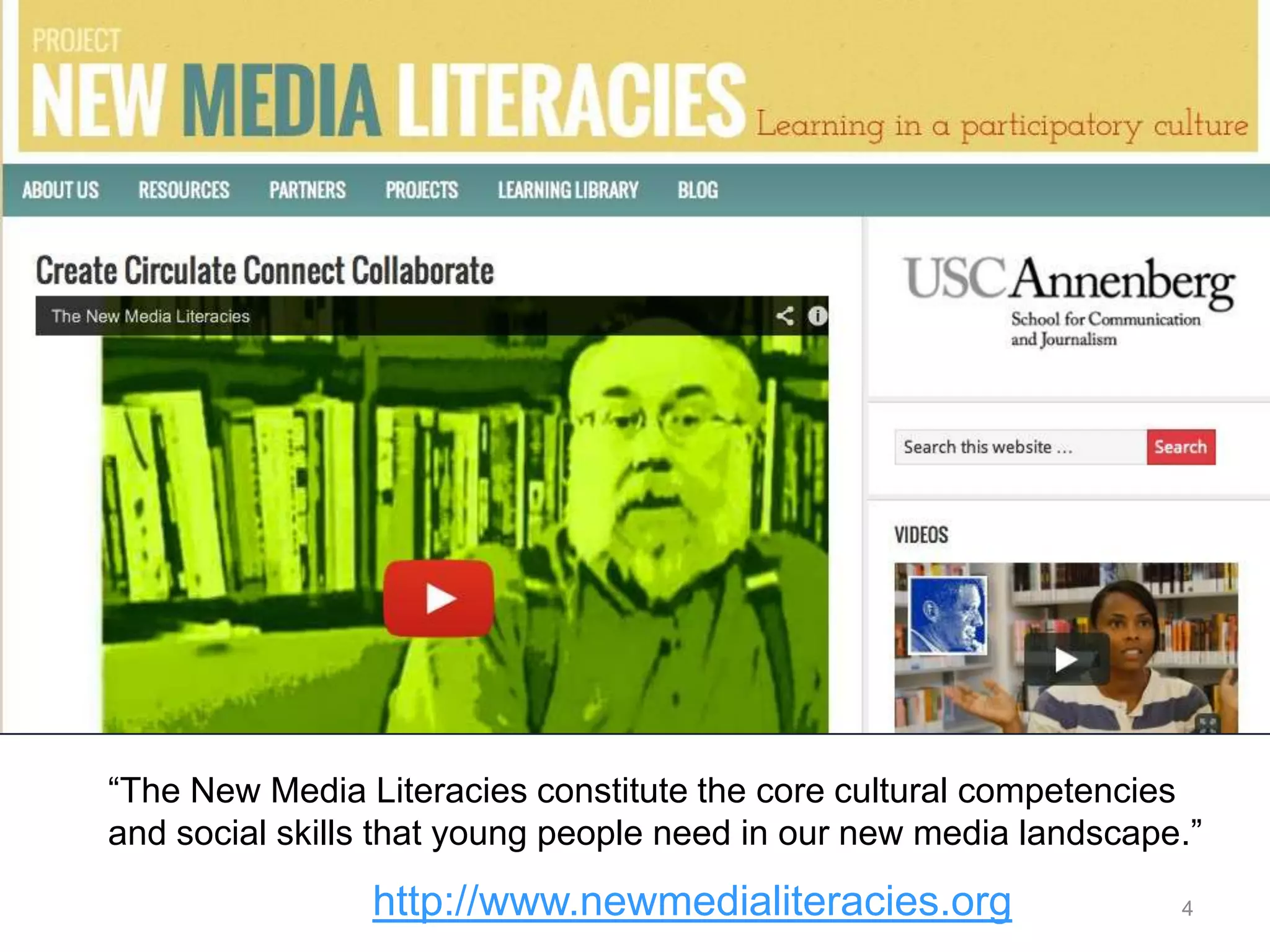
“The New Media Literacies constitute the core cultural competencies
and social skills that young people need in our new media landscape.”
                http://www.newmedialiteracies.org                  4
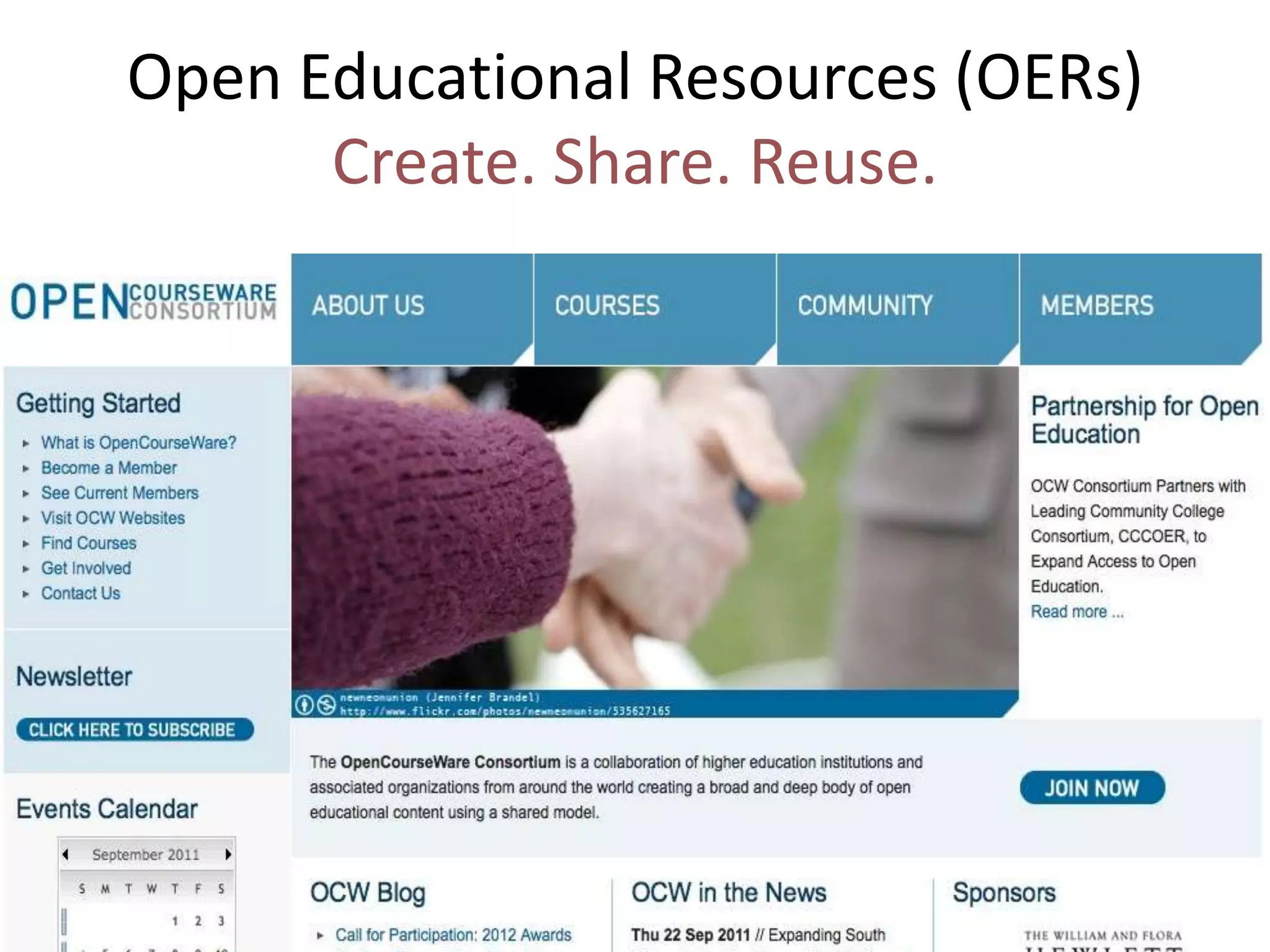
Open Educational Resources (OERs)
      Create. Share. Reuse.
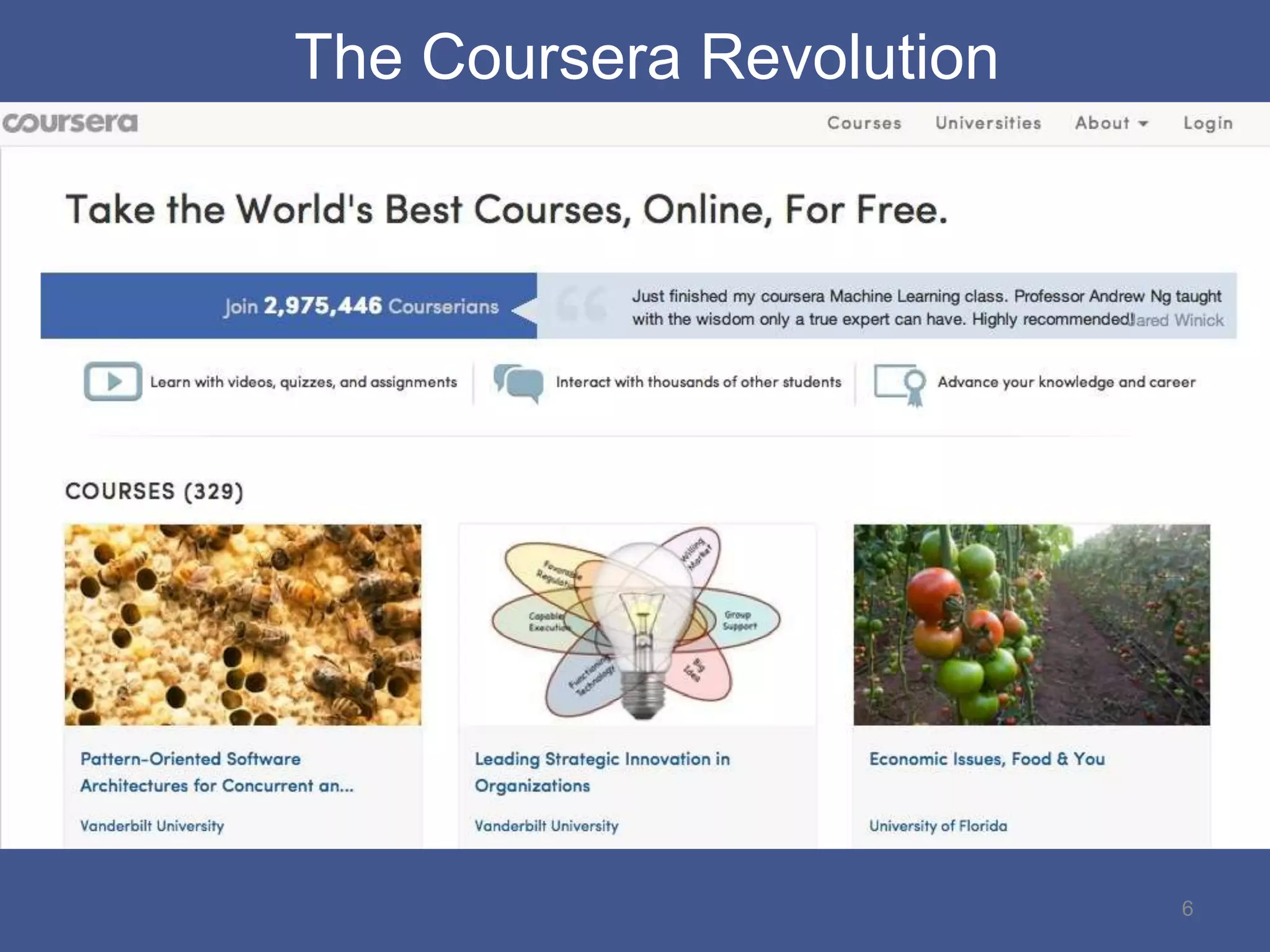
The Coursera Revolution


                          6
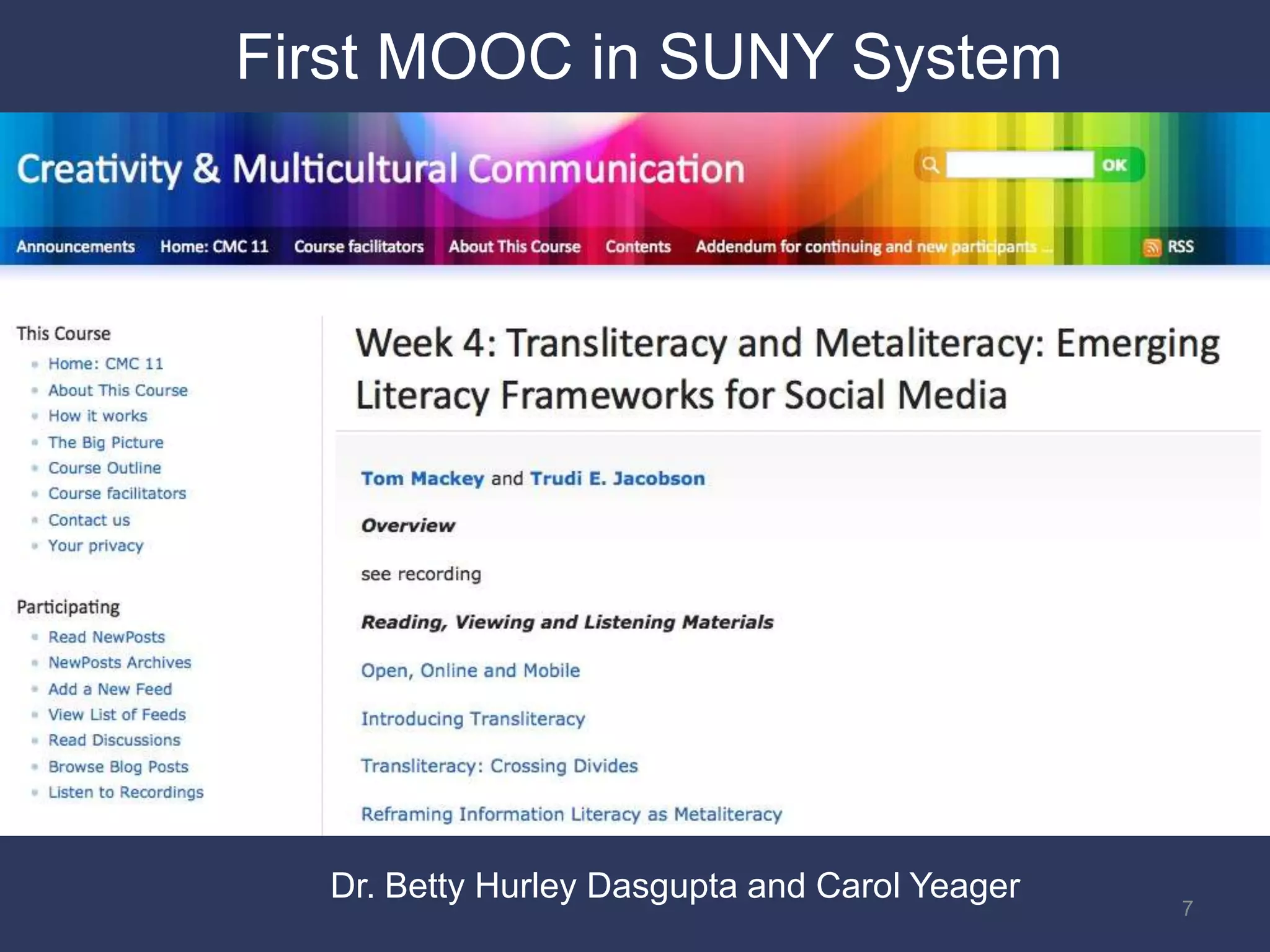
First MOOC in SUNY System


  Dr. Betty Hurley Dasgupta and Carol Yeager
                                               7
What is participatory learning?
•   Active           •   Social
•   Interactive      •   Convergent
•   Networked        •   Emergent
•   Connected        •   Adaptable
•   Collaborative    •   Evolving
•   Community        •   Transformative
•   Global           •   Multi-modal


                                          8
ACRL Standard Definition of
             Information Literacy (1989)
  • Determine the extent of information needed
  • Access the needed information effectively and
    efficiently
  • Evaluate information and its sources critically
  • Incorporate selected information into one’s knowledge
    base
  • Use information effectively to accomplish a specific
    purpose
  • Understand the economic, legal, and social issues
    surrounding the use of information, and access and use
    information ethically and legally

http://www.ala.org/ala/mgrps/divs/acrl/standards/informationliteracycompetency.cfm
                                                                               9
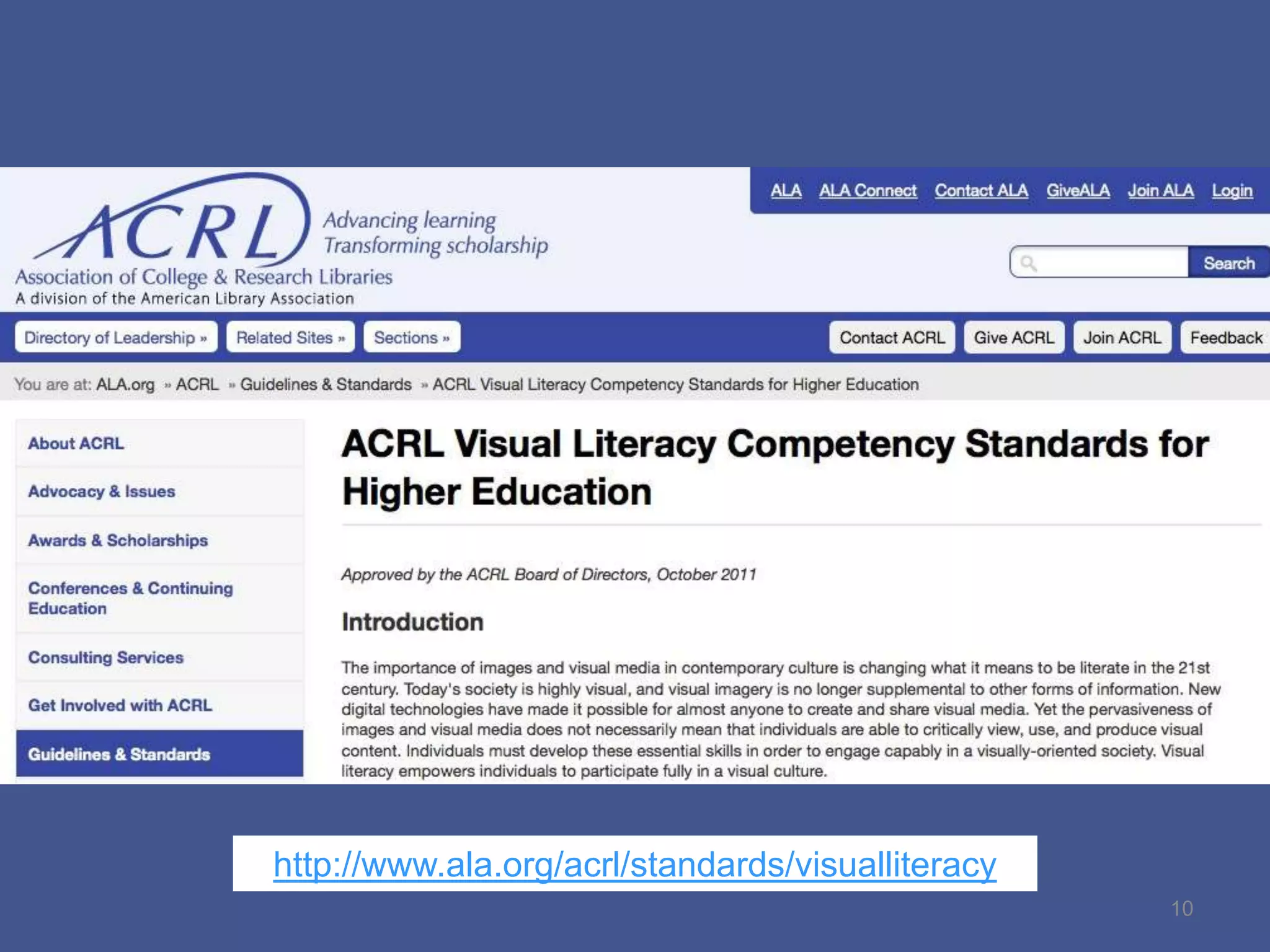
http://www.ala.org/acrl/standards/visualliteracy
                                                   10
TRANSLITERACY
 “is concerned with mapping
 meaning across different media and
 not with developing particular
 literacies about various media.”
        “Introducing transliteracy
        What does it mean to academic libraries?”
        Tom Ipri
        College & Research Libraries
         http://crln.acrl.org/content/71/10/532.full


                                                       11
TRANSLITERACY
 “It is not about learning text literacy
 and visual literacy and digital literacy
 in isolation from one another but
 about the interaction among all
 these literacies.”
  “Introducing transliteracy
  What does it mean to academic libraries?”
  Tom Ipri
  College & Research Libraries
  http://crln.acrl.org/content/71/10/532.full   12
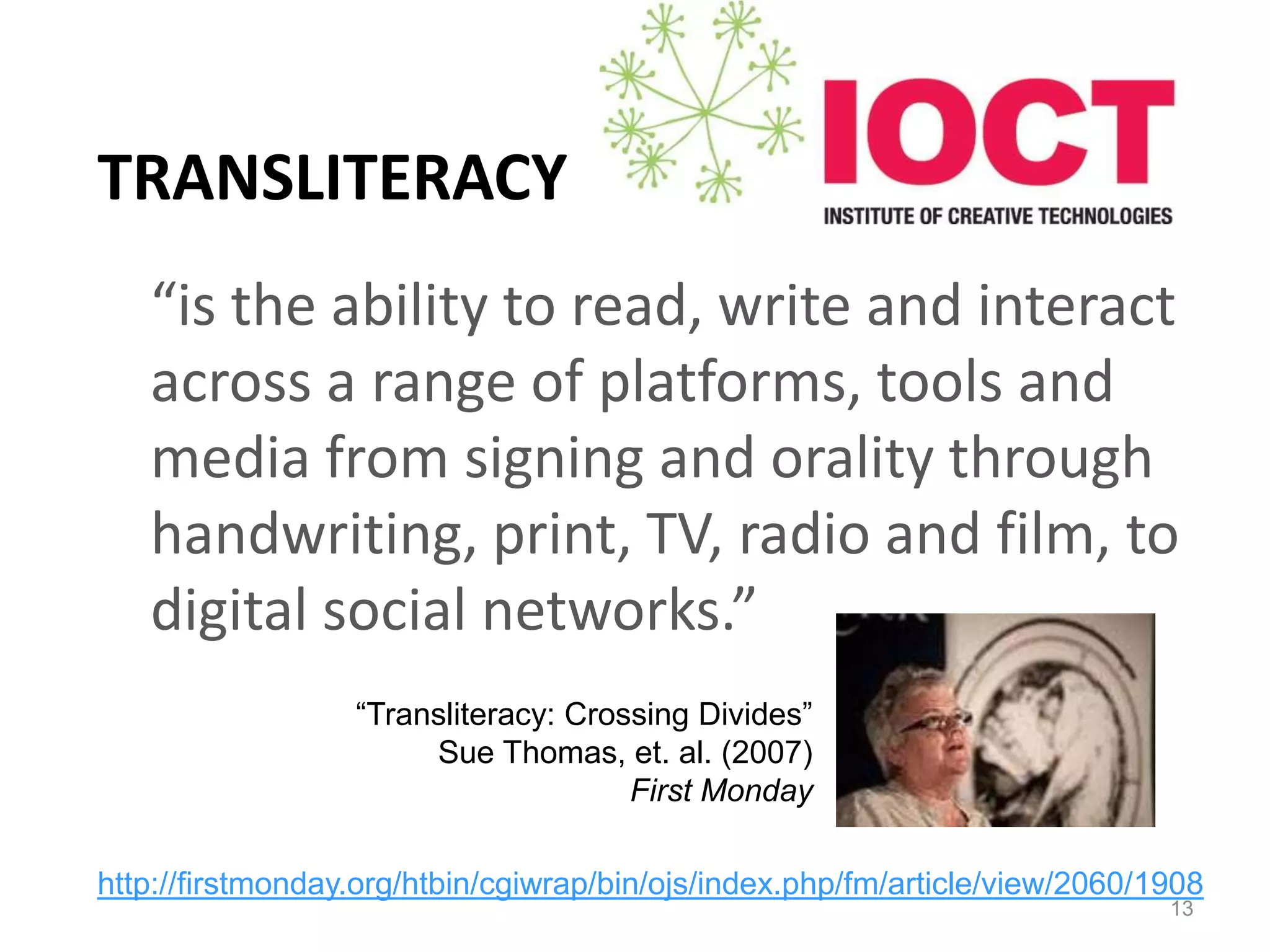
TRANSLITERACY
   “is the ability to read, write and interact
   across a range of platforms, tools and
   media from signing and orality through
   handwriting, print, TV, radio and film, to
   digital social networks.”
                  “Transliteracy: Crossing Divides”
                       Sue Thomas, et. al. (2007)
                                      First Monday

http://firstmonday.org/htbin/cgiwrap/bin/ojs/index.php/fm/article/view/2060/1908
                                                                             13
Media and Information Literacy (MIL)
“Information and media literacy enables
people to interpret and make informed
judgments as users of information and
media, as well as to become skillful
creators and producers of information
and media messages in their own right.”
http://portal.unesco.org/ci/en/ev.php-URL_ID=15886&URL_DO=DO_TOPIC&URL_SECTION=201.html


                                                                                          14
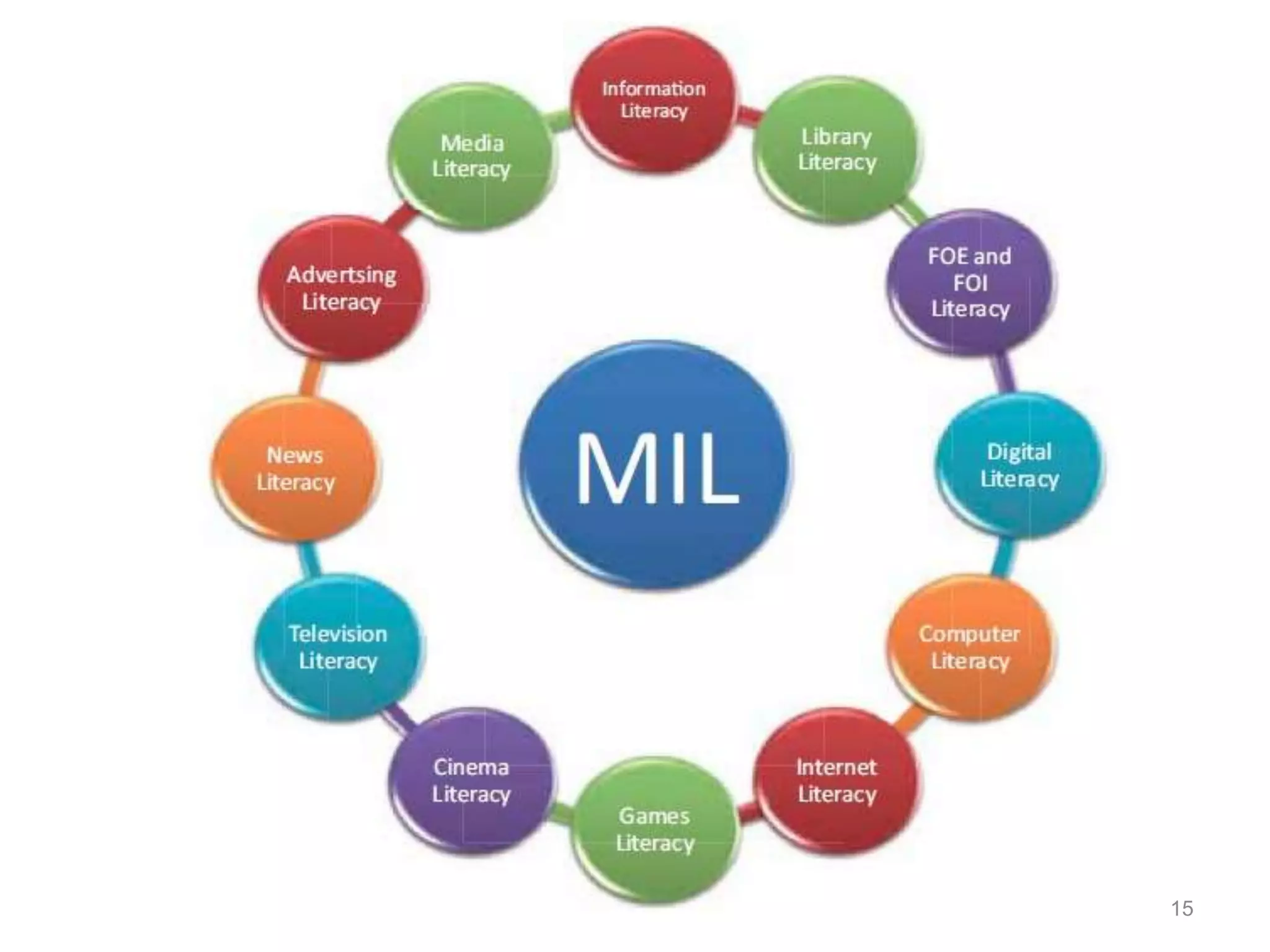
15
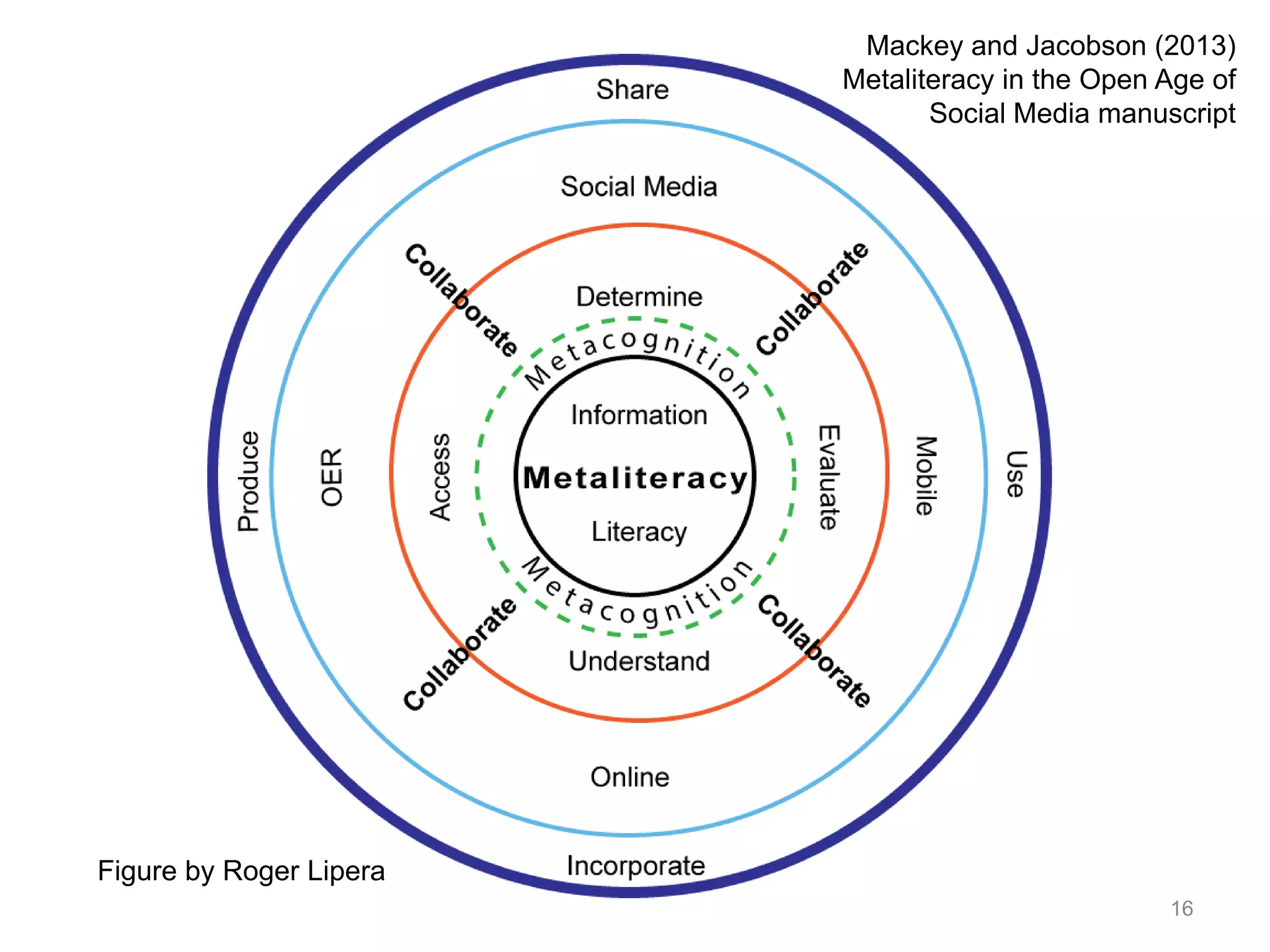
Mackey and Jacobson (2013)
                         Metaliteracy in the Open Age of
                                Social Media manuscript


Figure by Roger Lipera
                                                  16
“Metaliteracy promotes critical
     thinking and collaboration in a digital
     age, providing a comprehensive
     framework to effectively participate in
     social media and online communities.”

Thomas P. Mackey and Trudi E. Jacobson “Reframing Information Literacy as a
Metaliteracy” College & Research Libraries. January 2011 72:62-78.
http://crl.acrl.org/content/72/1/62.full.pdf
                                                                              17
“It is a unified construct that supports
     the acquisition, production, and
     sharing of knowledge in collaborative
     online communities.”


Thomas P. Mackey and Trudi E. Jacobson “Reframing Information Literacy as a
Metaliteracy” College & Research Libraries. January 2011 72:62-78.
http://crl.acrl.org/content/72/1/62.full.pdf
                                                                              18
“Information literacy is central to this
    redefinition because information takes
    many forms online and is produced and
    communicated through multiple
    modalities. ”

Thomas P. Mackey and Trudi E. Jacobson “Reframing Information Literacy as a
Metaliteracy” College & Research Libraries. January 2011 72:62-78.
http://crl.acrl.org/content/72/1/62.full.pdf
                                                                              19
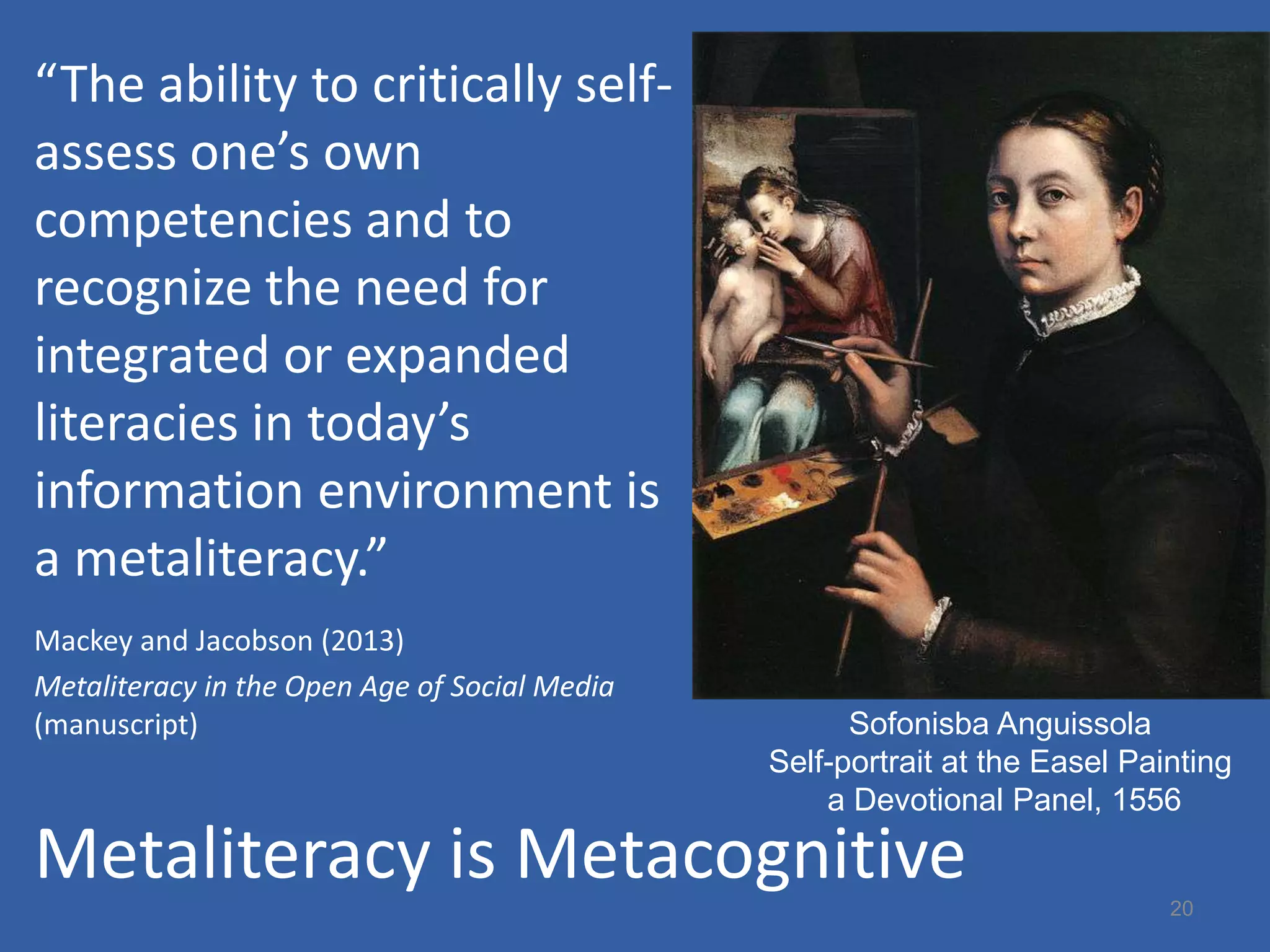
“The ability to critically self-
assess one’s own
competencies and to
recognize the need for
integrated or expanded
literacies in today’s
information environment is
a metaliteracy.”
Mackey and Jacobson (2013)
Metaliteracy in the Open Age of Social Media
(manuscript)                                         Sofonisba Anguissola
                                               Self-portrait at the Easel Painting
                                                   a Devotional Panel, 1556

Metaliteracy is Metacognitive                                                20
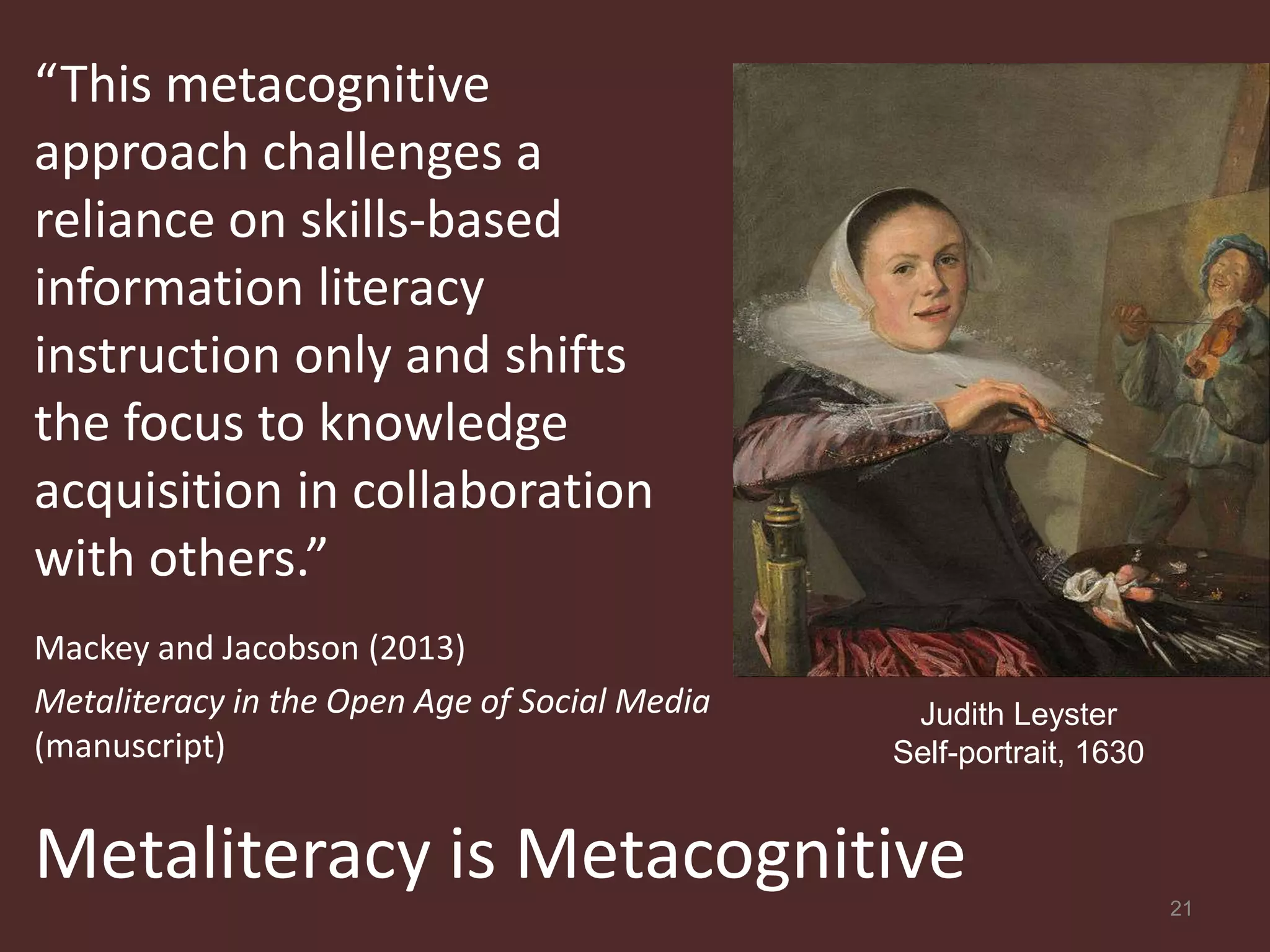
“This metacognitive
approach challenges a
reliance on skills-based
information literacy
instruction only and shifts
the focus to knowledge
acquisition in collaboration
with others.”
Mackey and Jacobson (2013)
Metaliteracy in the Open Age of Social Media    Judith Leyster
(manuscript)                                   Self-portrait, 1630


Metaliteracy is Metacognitive                                        21
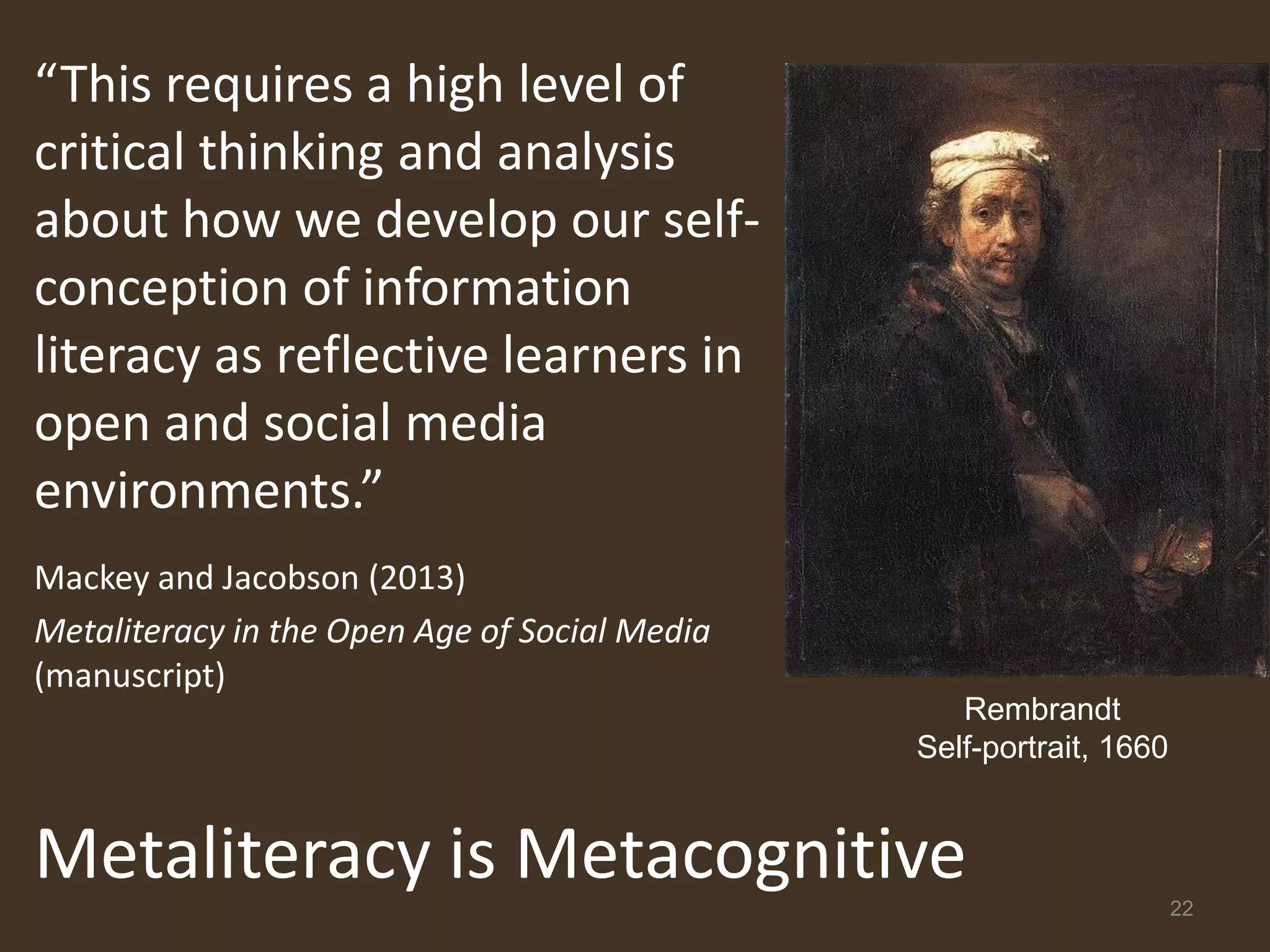
“This requires a high level of
critical thinking and analysis
about how we develop our self-
conception of information
literacy as reflective learners in
open and social media
environments.”
Mackey and Jacobson (2013)
Metaliteracy in the Open Age of Social Media
(manuscript)
                                                  Rembrandt
                                               Self-portrait, 1660


Metaliteracy is Metacognitive                                        22
“Both metaliteracy and transliteracy
challenge traditional skills-based concepts
of information literacy by recognizing the
role of emerging technologies, suggesting
that information technology is a central
component of students’ learning.”


        “Connectivism: Learning Theory and Pedagogical
        Practice for Networked Information Landscapes”
        Michelle Kathleen Dunaway
        Reference Services Review Vol. 39 Iss: 4
                                                         23
“Metaliteracy and transliteracy are
frameworks for understanding information
literacy that emphasize the importance of
communities, connections, information
networks, and information technologies”


       “Connectivism: Learning Theory and Pedagogical
       Practice for Networked Information Landscapes”
       Michelle Kathleen Dunaway
       Reference Services Review Vol. 39 Iss: 4
                                                        24
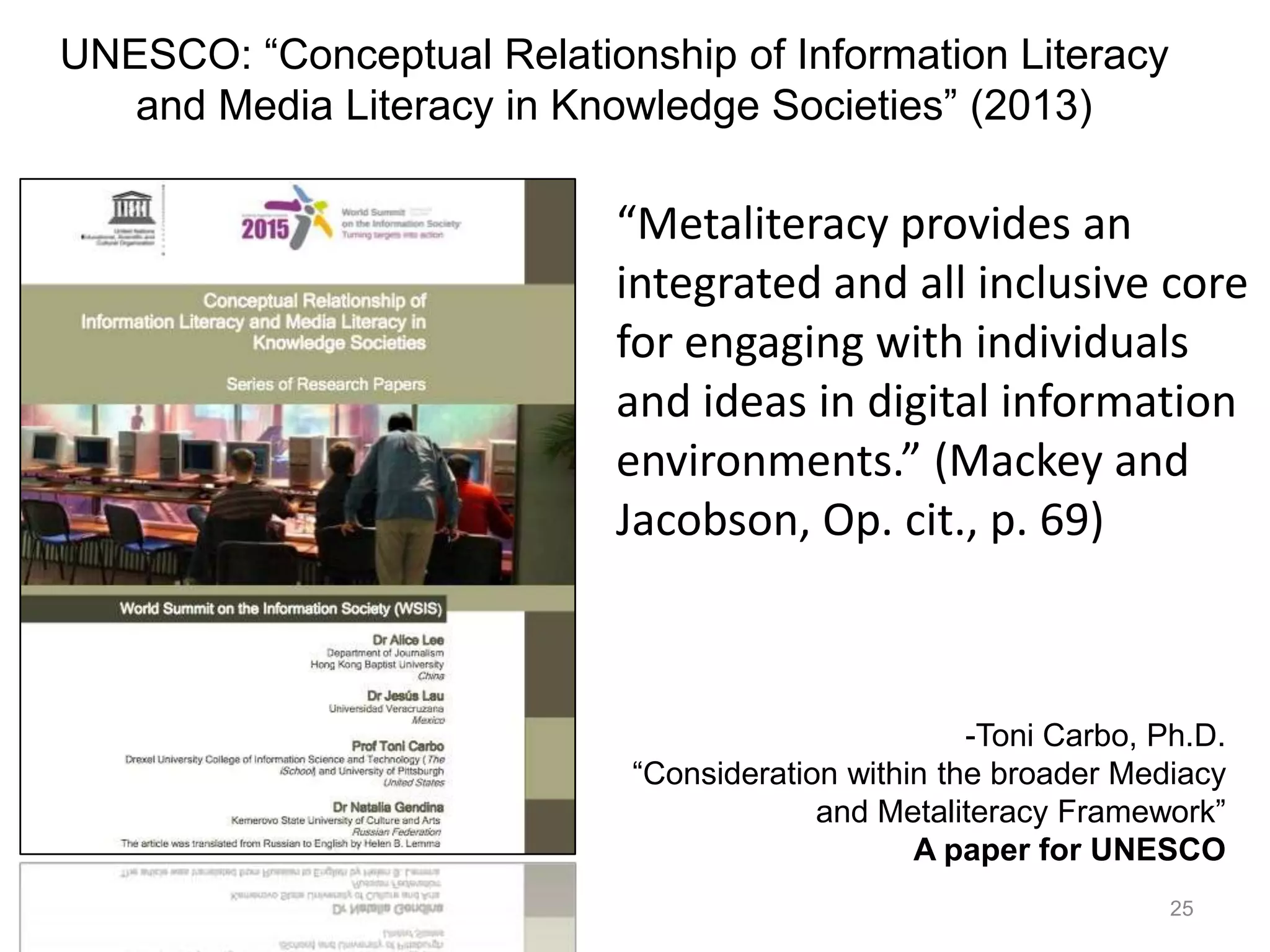
UNESCO: “Conceptual Relationship of Information Literacy
   and Media Literacy in Knowledge Societies” (2013)

                            “Metaliteracy provides an
                            integrated and all inclusive core
                            for engaging with individuals
                            and ideas in digital information
                            environments.” (Mackey and
                            Jacobson, Op. cit., p. 69)


                                                    -Toni Carbo, Ph.D.
                            “Consideration within the broader Mediacy
                                         and Metaliteracy Framework”
                                                A paper for UNESCO
                                                                  25
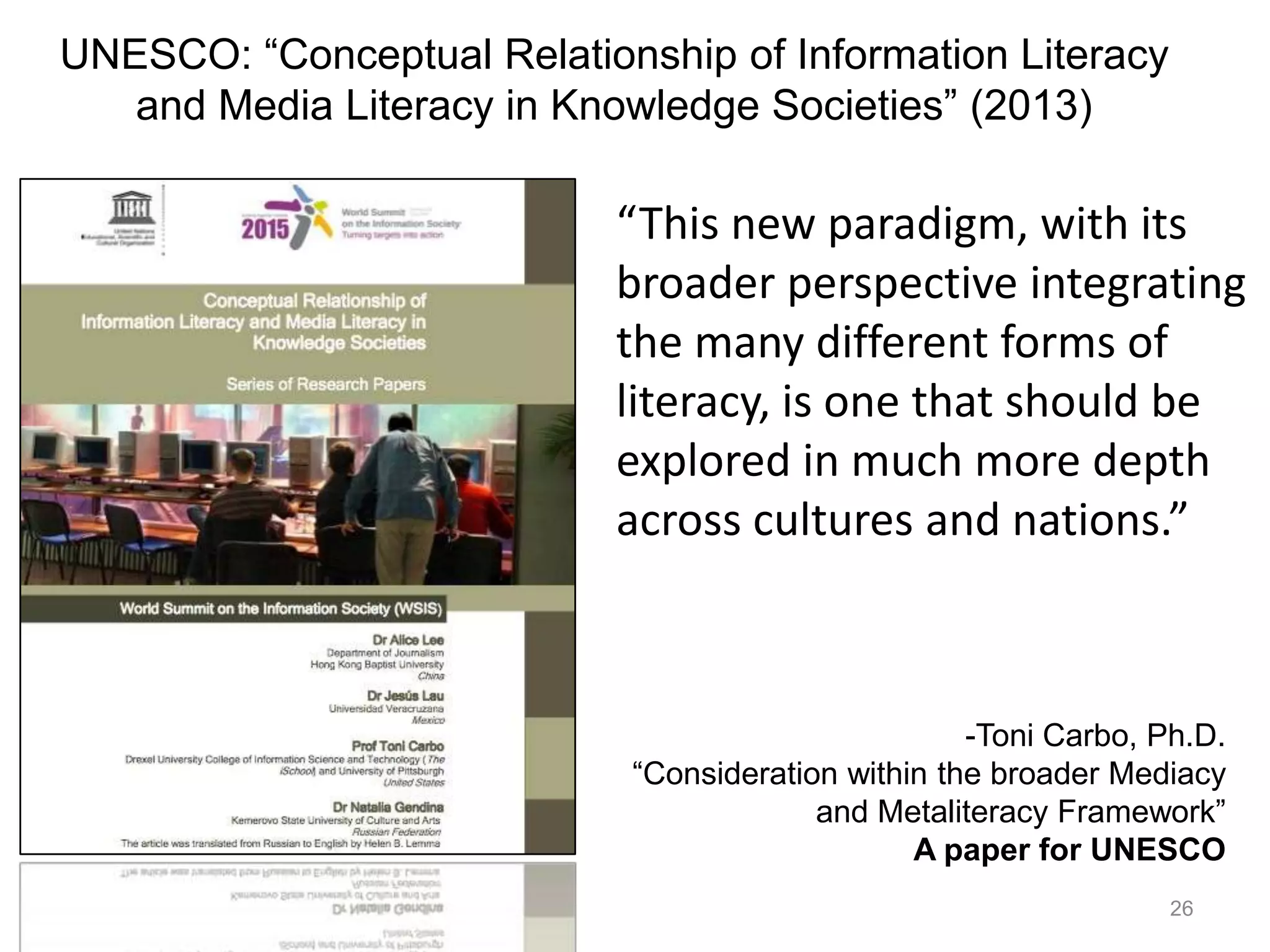
UNESCO: “Conceptual Relationship of Information Literacy
   and Media Literacy in Knowledge Societies” (2013)

                            “This new paradigm, with its
                            broader perspective integrating
                            the many different forms of
                            literacy, is one that should be
                            explored in much more depth
                            across cultures and nations.”


                                                    -Toni Carbo, Ph.D.
                            “Consideration within the broader Mediacy
                                         and Metaliteracy Framework”
                                                A paper for UNESCO
                                                                  26
Survey Instrument
• Survey Monkey
• 26 Questions
• Likert scale
• Some open-ended comments
• Library and Information Science faculty and
  librarians (listservs, LinkedIn groups, colleagues)
• 85.5% librarians
• 551 started survey
• 361 completed survey (65.5%)

                                                        27
Literacy frameworks familiar with


N=413                                28
Literacy frameworks related to
         information literacy


N=419                               29
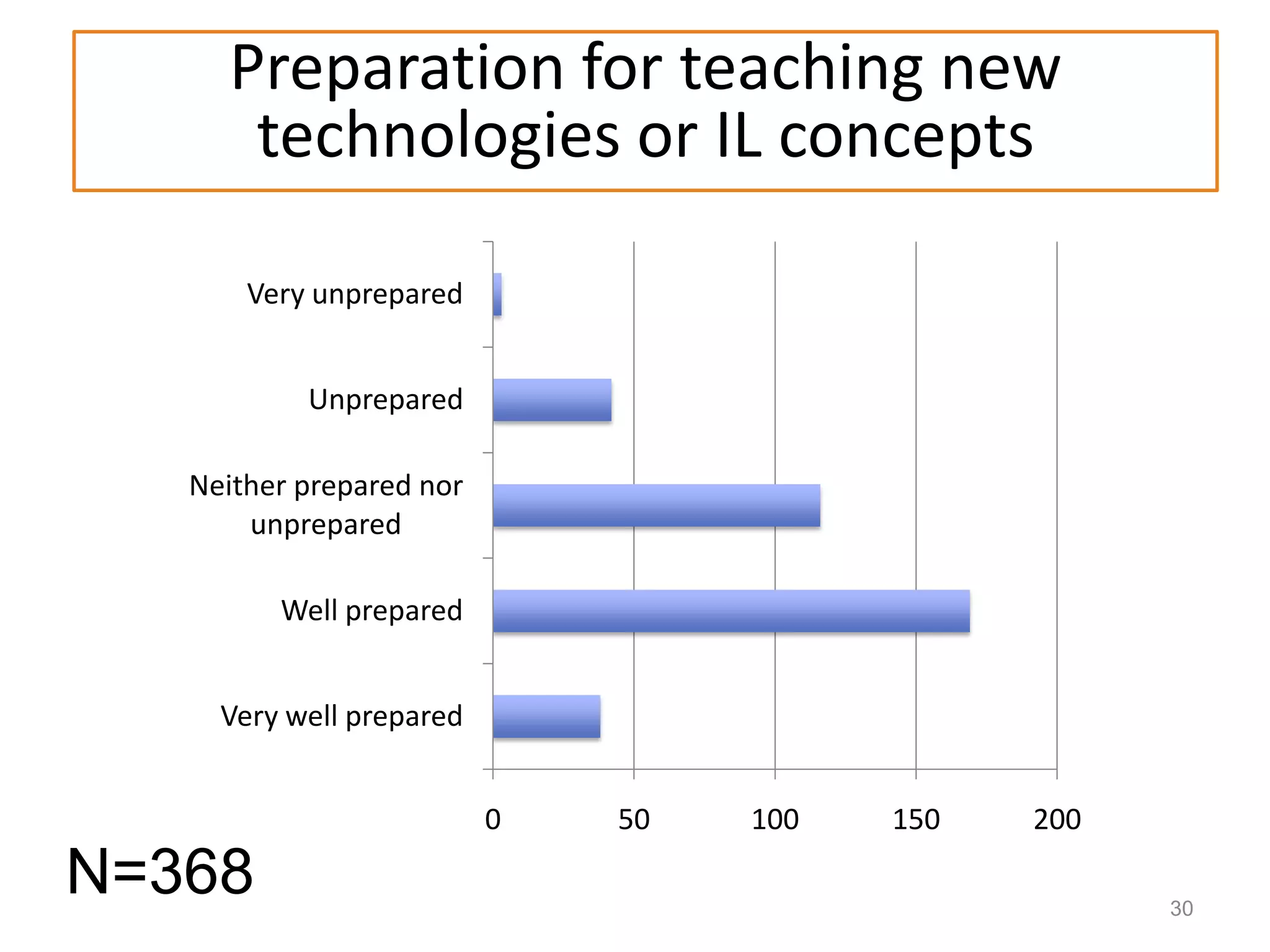
Preparation for teaching new
      technologies or IL concepts

       Very unprepared


           Unprepared

   Neither prepared nor
       unprepared

         Well prepared


     Very well prepared


                          0   50   100   150   200

N=368                                                30
Lack of knowledge or skills hinder
     teaching new components?

    No


    Yes


          0   50   100   150   200   250

N=360                                      31
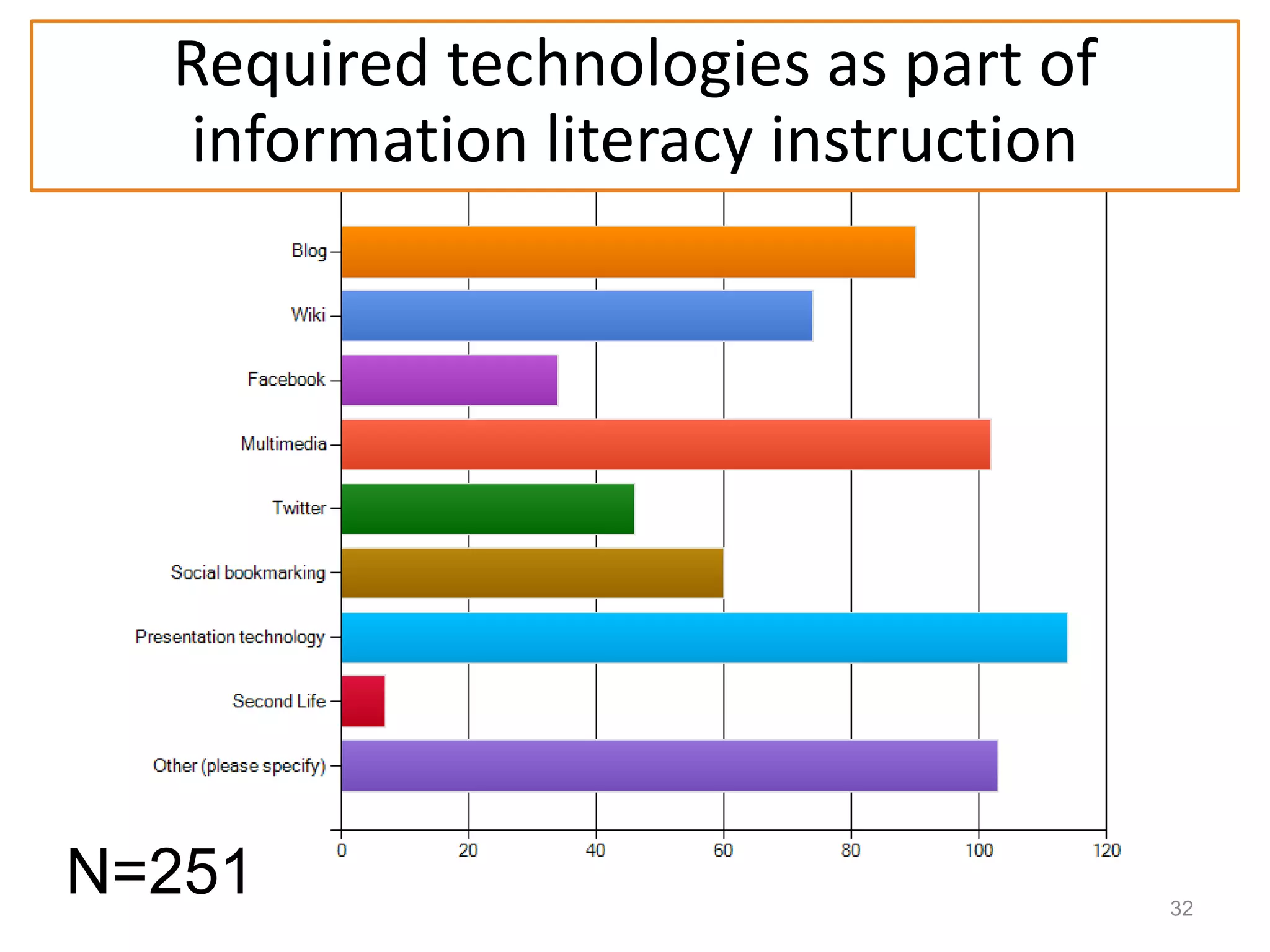
Required technologies as part of
   information literacy instruction


N=251                                 32
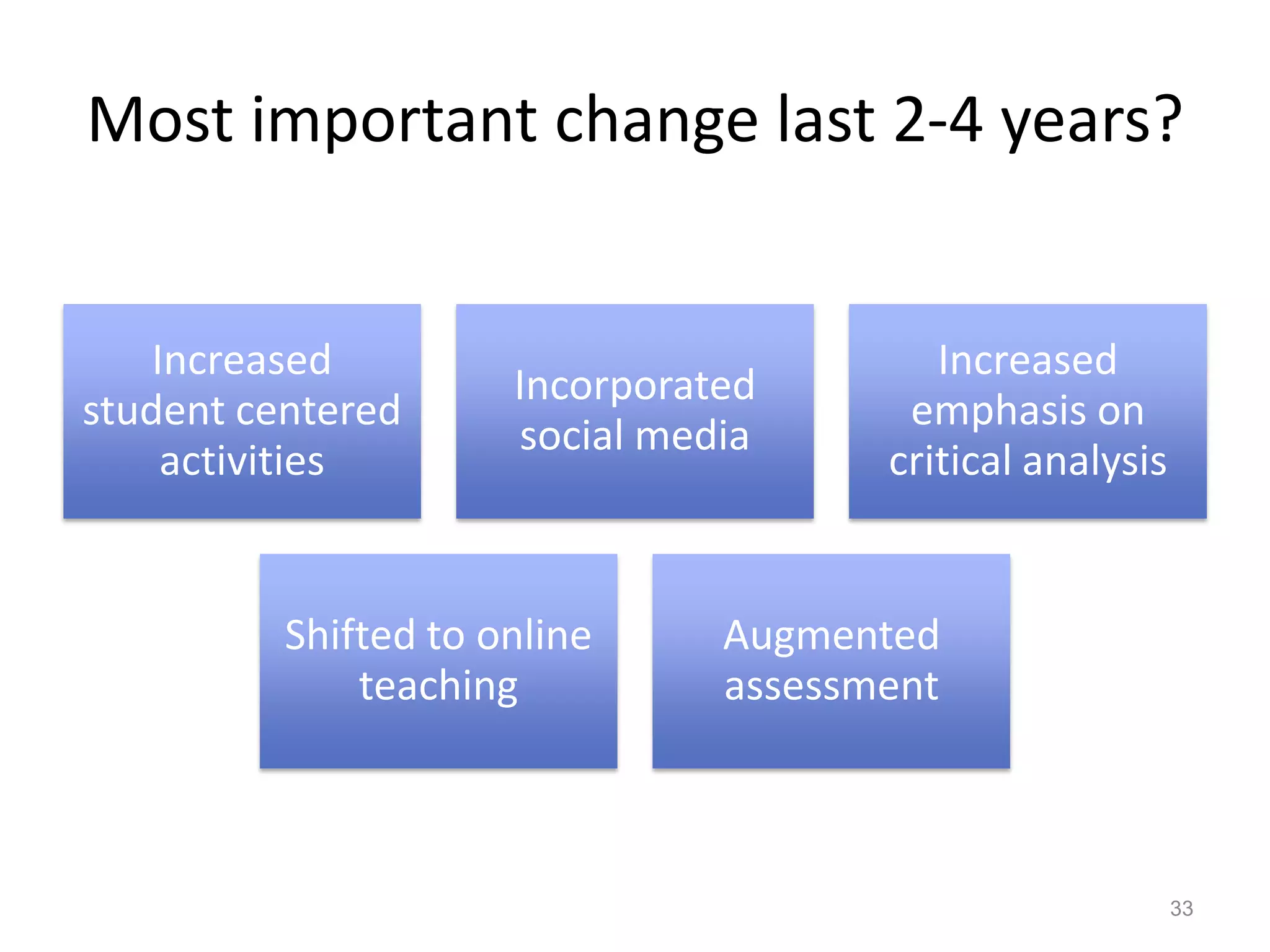
Most important change last 2-4 years?


    Increased                             Increased
                      Incorporated
student centered                        emphasis on
                      social media
     activities                        critical analysis


          Shifted to online     Augmented
              teaching          assessment


                                                           33
Metaliteracy in Practice

TEACHING STUDENTS


                           34
Understand Format Type and Delivery Mode

Evaluate User Feedback as Active Researcher

Create a Context for User-generated Information

Evaluate Dynamic Content Critically
Thomas P. Mackey and Trudi E. Jacobson “Reframing Information Literacy as a Metaliteracy” College &
Research Libraries. January 2011 72:62-78. http://crl.acrl.org/content/72/1/62.full.pdf             35
Produce Original Content in Multiple Media Formats


Understand Personal Privacy, Information Ethics and
Intellectual Property Issues


Share Information in Participatory Environments


Thomas P. Mackey and Trudi E. Jacobson “Reframing Information Literacy as a Metaliteracy” College &
Research Libraries. January 2011 72:62-78. http://crl.acrl.org/content/72/1/62.full.pdf             36
Active Metaliterate Engagement
Basic IL Course:

     • Migration of individual paper-based research guide to
       team-based guide using website
     • Creation of information: “what information would you
       have liked to find but didn’t?”
     • Data visualization/visual literacy component
     • Learn the technology on their own, as a team
     • Sense of pride and accomplishment
     • New skills, altered sense of participation
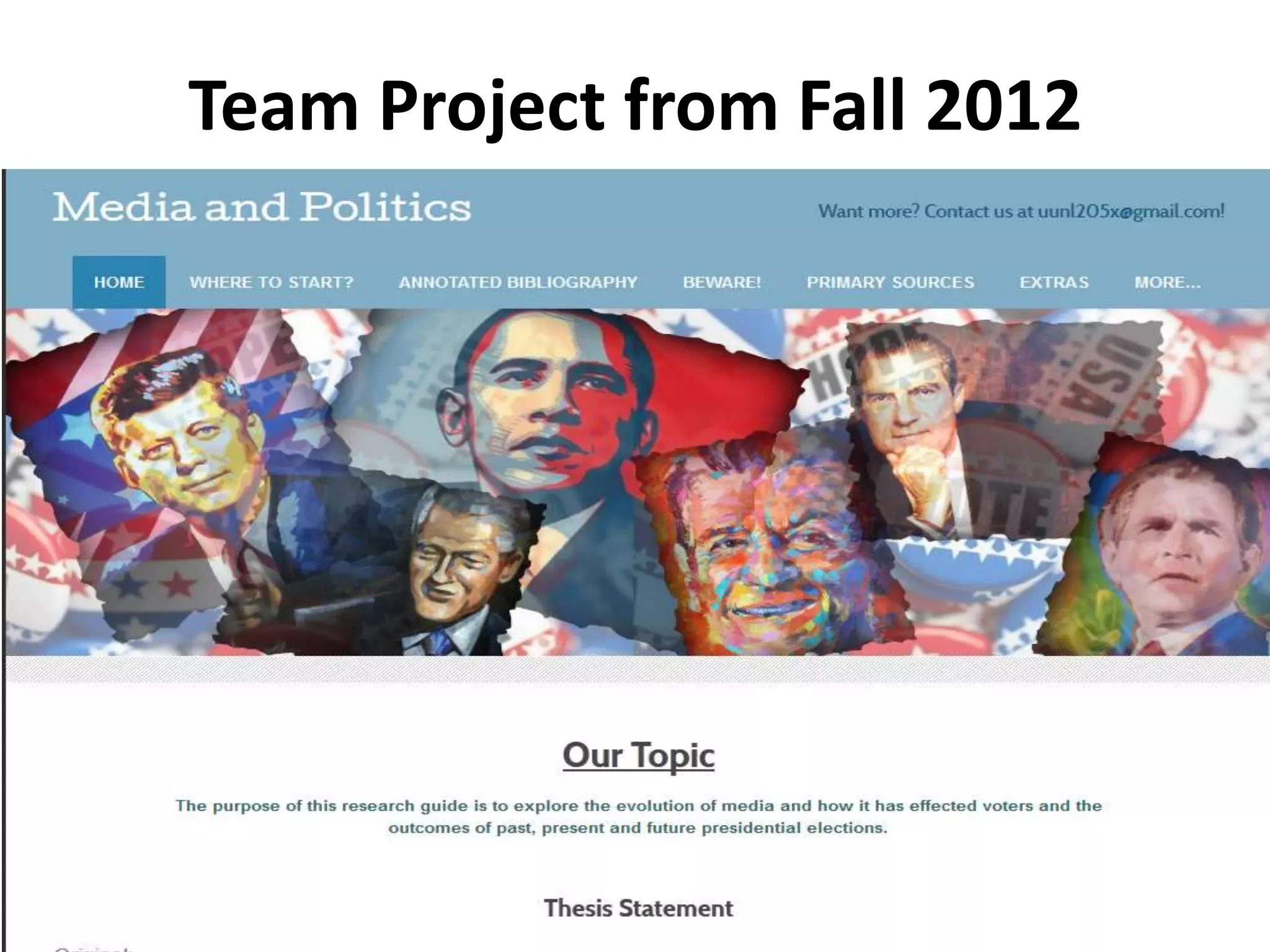
Team Project from Fall 2012
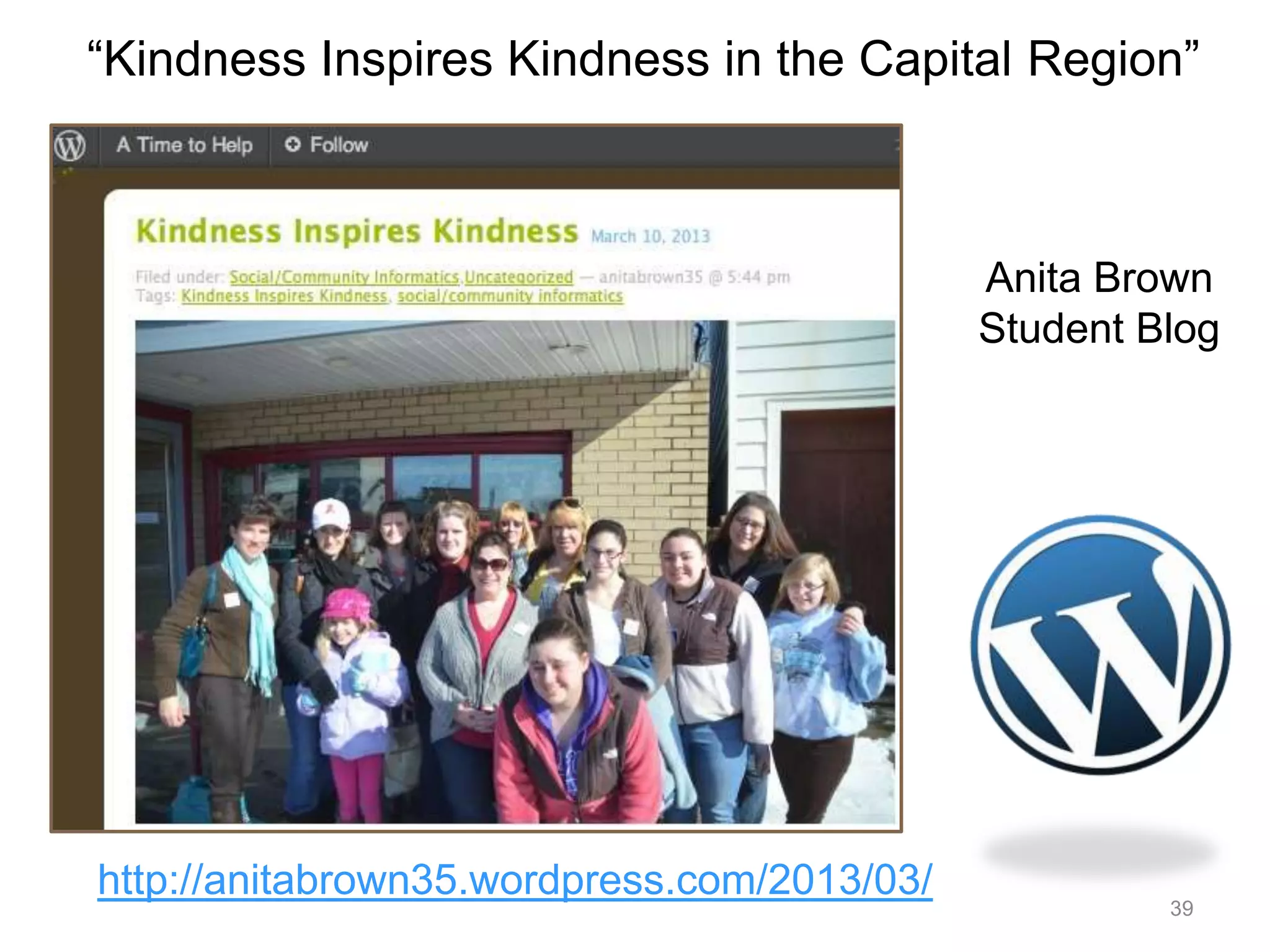
“Kindness Inspires Kindness in the Capital Region”


                                             Anita Brown
                                             Student Blog


http://anitabrown35.wordpress.com/2013/03/
                                                      39
Metacognitive Practice
  – Gain insights about the process of creating
    original information
  – Understand what one needs to know when
    creating and sharing
  – Recognize gaps in knowledge
  – Seek new knowledge to adjust to challenging
    situations
  – Adapt to changing technologies
  – Continuously self-reflect
  – Demonstrate empowerment through
    interaction, communication, and presentation
  – Reflect on production and participation
                                              40
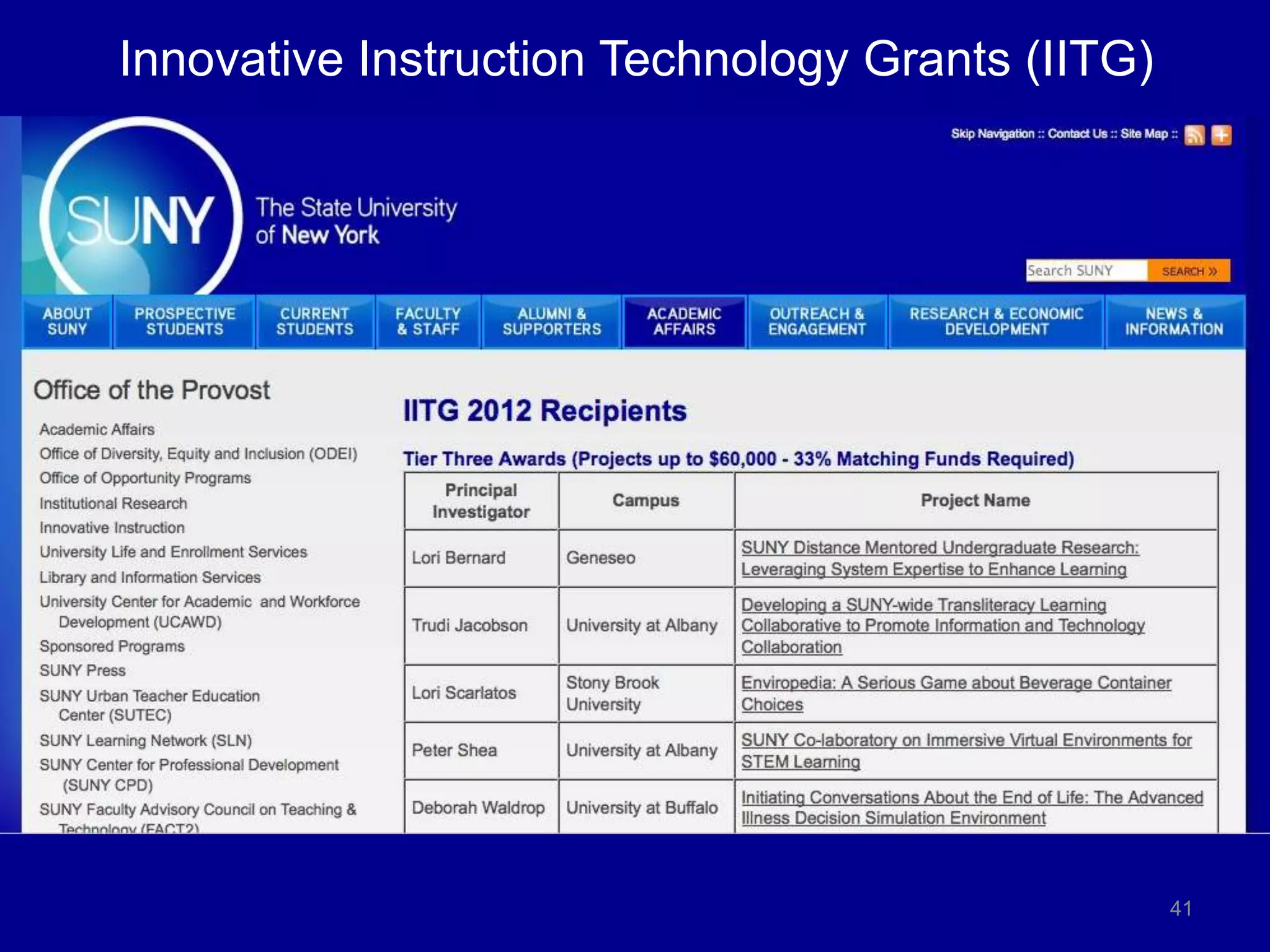
Innovative Instruction Technology Grants (IITG)


                                                  41
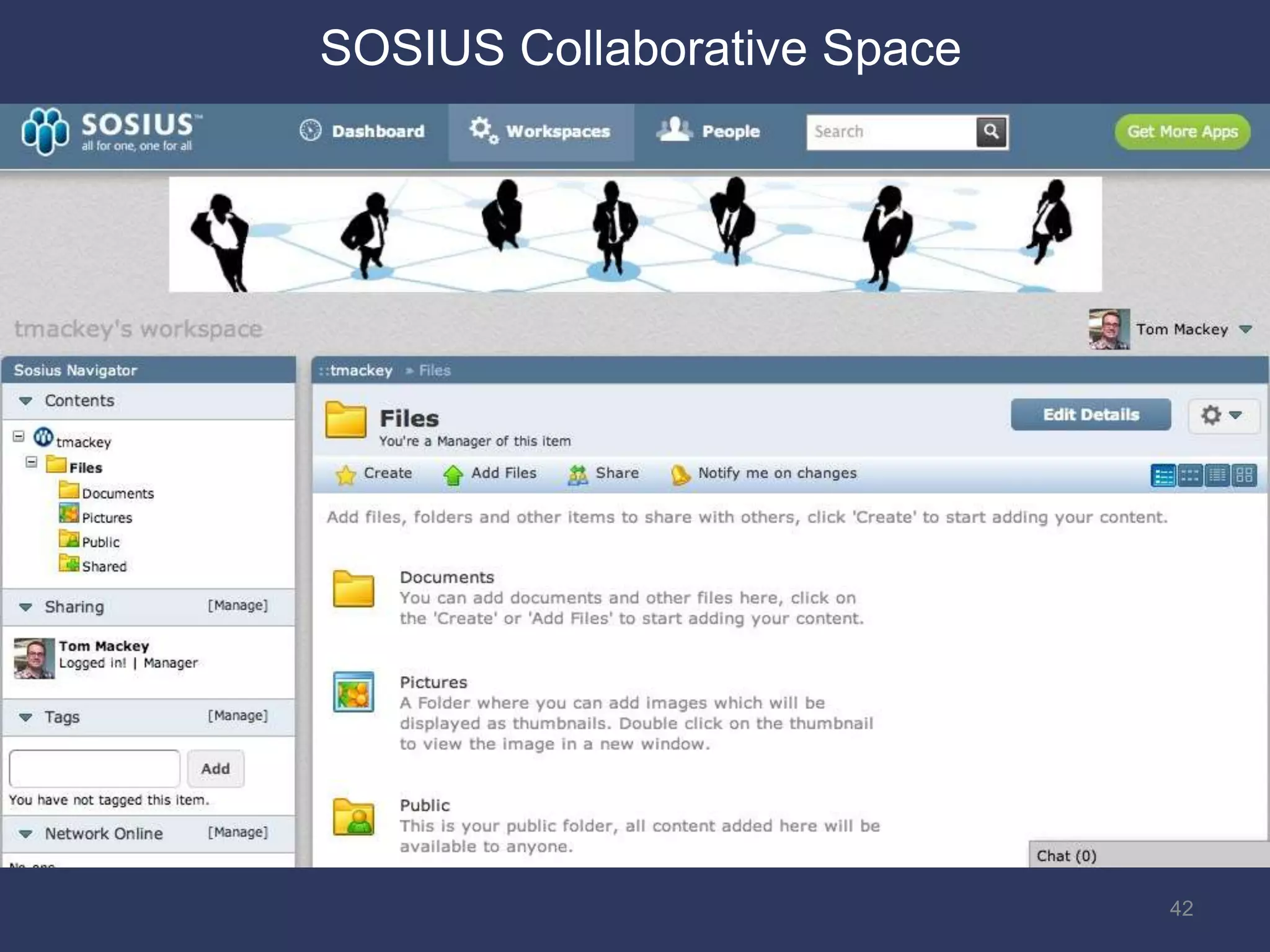
SOSIUS Collaborative Space


                             42
Trans-Metaliteracy Learning Collaborative


                                            43
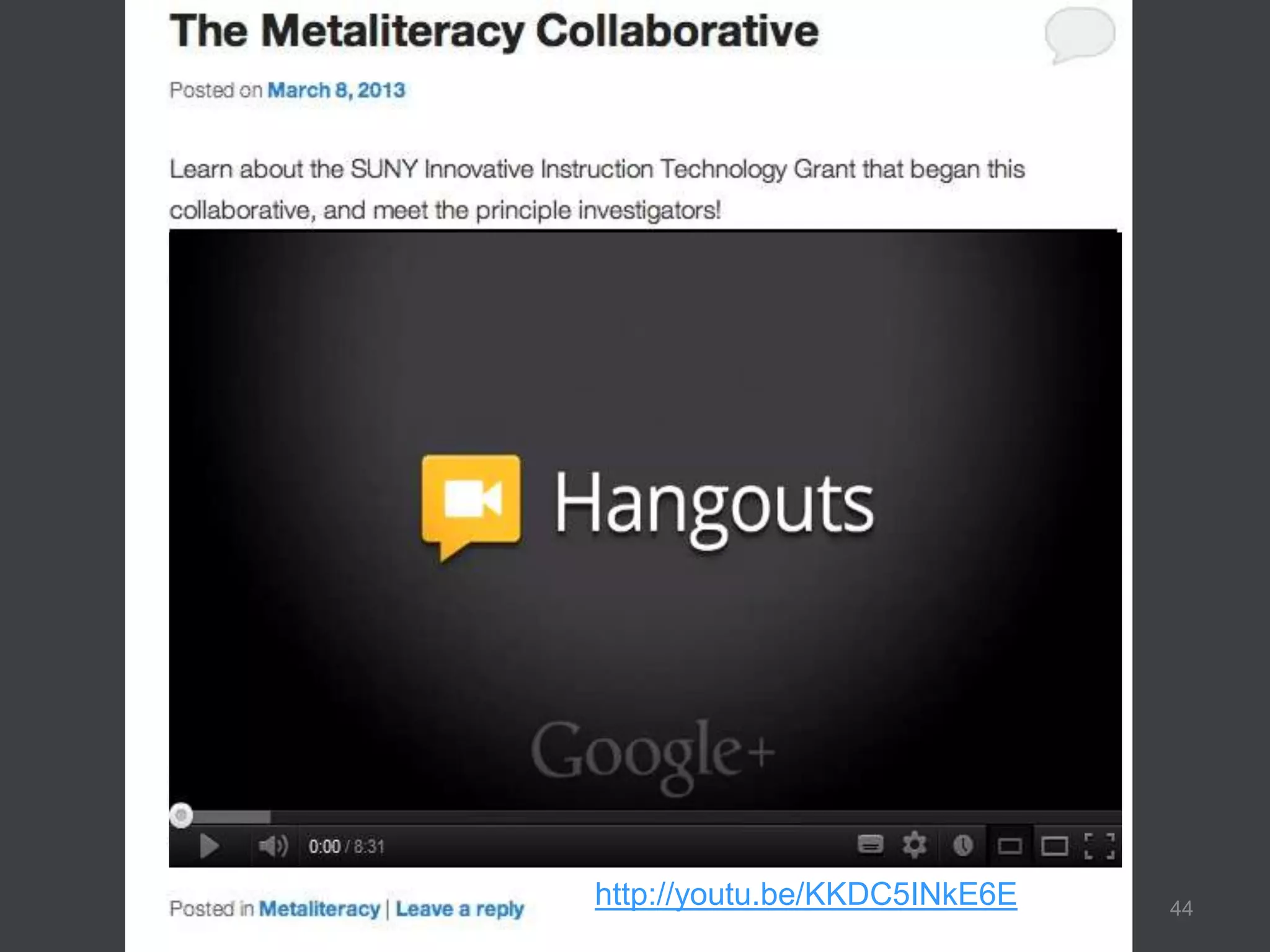
http://youtu.be/KKDC5INkE6E   44
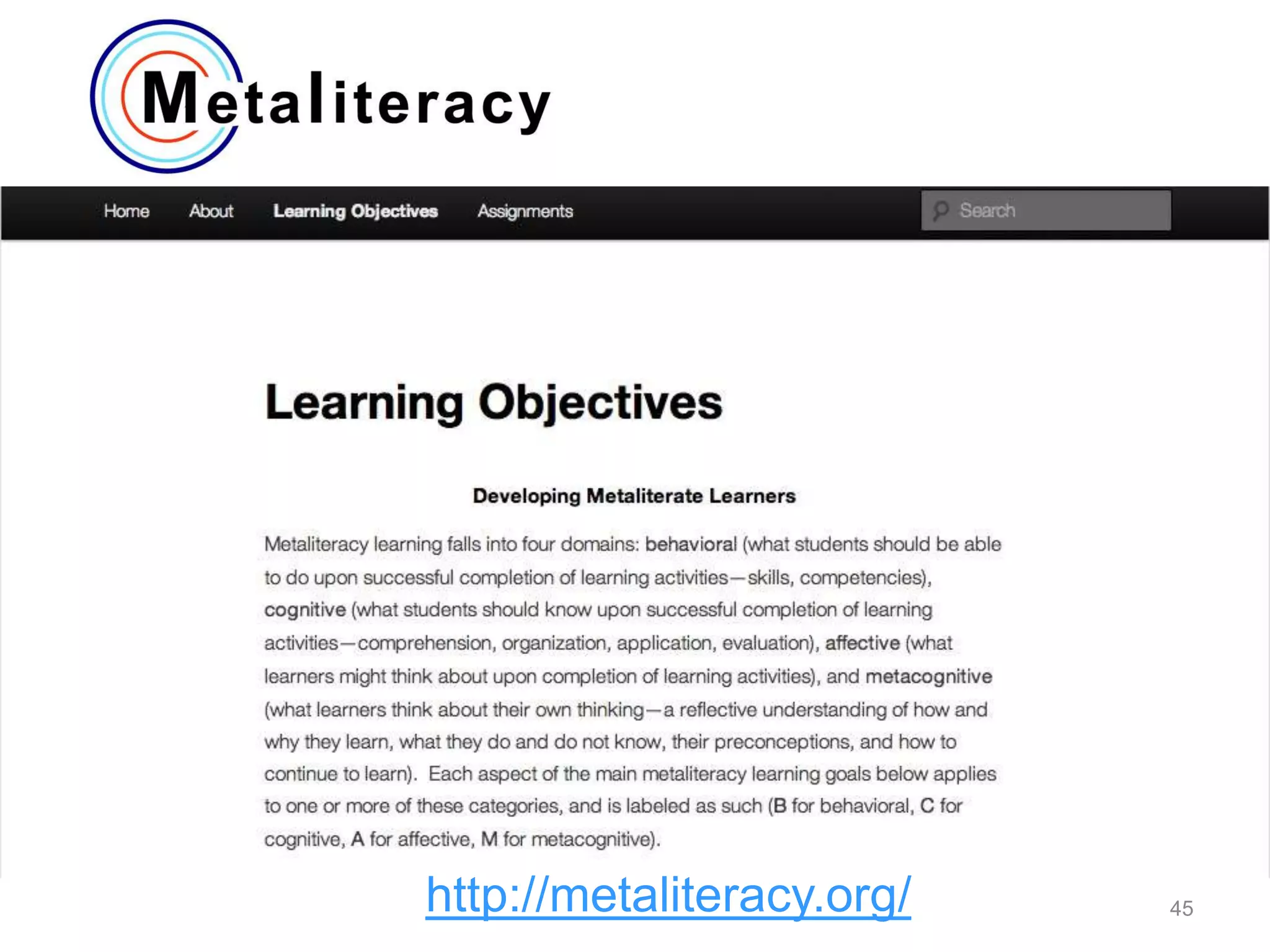
http://metaliteracy.org/   45
Individual Reflection

• Spend 2 minutes thinking about
  how you might design an activity
  or an assignment to meet one of
  the objectives


                                     46
Sharing and Polishing
•   Group with several people near you
•   Share the ideas you each developed
•   Select one to develop further
•   Select a spokesperson
•   Add to metaliteracy.org if time


                                         47
SHARING YOUR IDEAS


                     48
QUESTIONS?


             49
New MOOC for Fall 2013:

             #L4LLL
Literacies for Lifelong Learning
       (a Metaliteracy MOOC)
Trudi E. Jacobson, M.L.S., M.A.
Distinguished Librarian
Head, Information Literacy Department
University Libraries
University at Albany, SUNY


Tom Mackey, Ph.D.
Dean
Center for Distance Learning
Empire State College, SUNY


         Visual representation of “Reframing Information Literacy as a Metaliteracy”
                              from the null_sets site at the University of Tennessee.
                                http://www.flickr.com/photos/nullsets/8587487783/
                                                                                        51

ACRL 2013 Metaliteracy

  • 1.
    “What’s in aName?: Information Literacy, Metaliteracy, or Transliteracy” Trudi E. Jacobson, M.L.S., M.A. Tom Mackey, Ph.D. Distinguished Librarian Dean University Libraries Center for Distance Learning University at Albany Empire State College SUNY SUNY #acrlname ACRL 2013 Imagine Innovate Inspire 1
  • 2.
    Word cloud of“Reframing Information Literacy as a Metaliteracy” at Wordle.net. 2
  • 3.
    In 1992 HenryJenkins proposed “an alternative conception of fans as readers who appropriate popular texts and reread them in a fashion that serves different interests, as spectators who transform the experience of watching television into a rich and complex participatory culture” (p. 23). Textual Poachers: Television Fans & Participatory Culture By Henry Jenkins (1992) 3
  • 4.
    “The New MediaLiteracies constitute the core cultural competencies and social skills that young people need in our new media landscape.” http://www.newmedialiteracies.org 4
  • 5.
    Open Educational Resources(OERs) Create. Share. Reuse.
  • 6.
  • 7.
    First MOOC inSUNY System Dr. Betty Hurley Dasgupta and Carol Yeager 7
  • 8.
    What is participatorylearning? • Active • Social • Interactive • Convergent • Networked • Emergent • Connected • Adaptable • Collaborative • Evolving • Community • Transformative • Global • Multi-modal 8
  • 9.
    ACRL Standard Definitionof Information Literacy (1989) • Determine the extent of information needed • Access the needed information effectively and efficiently • Evaluate information and its sources critically • Incorporate selected information into one’s knowledge base • Use information effectively to accomplish a specific purpose • Understand the economic, legal, and social issues surrounding the use of information, and access and use information ethically and legally http://www.ala.org/ala/mgrps/divs/acrl/standards/informationliteracycompetency.cfm 9
  • 10.
  • 11.
    TRANSLITERACY “is concernedwith mapping meaning across different media and not with developing particular literacies about various media.” “Introducing transliteracy What does it mean to academic libraries?” Tom Ipri College & Research Libraries http://crln.acrl.org/content/71/10/532.full 11
  • 12.
    TRANSLITERACY “It isnot about learning text literacy and visual literacy and digital literacy in isolation from one another but about the interaction among all these literacies.” “Introducing transliteracy What does it mean to academic libraries?” Tom Ipri College & Research Libraries http://crln.acrl.org/content/71/10/532.full 12
  • 13.
    TRANSLITERACY “is the ability to read, write and interact across a range of platforms, tools and media from signing and orality through handwriting, print, TV, radio and film, to digital social networks.” “Transliteracy: Crossing Divides” Sue Thomas, et. al. (2007) First Monday http://firstmonday.org/htbin/cgiwrap/bin/ojs/index.php/fm/article/view/2060/1908 13
  • 14.
    Media and InformationLiteracy (MIL) “Information and media literacy enables people to interpret and make informed judgments as users of information and media, as well as to become skillful creators and producers of information and media messages in their own right.” http://portal.unesco.org/ci/en/ev.php-URL_ID=15886&URL_DO=DO_TOPIC&URL_SECTION=201.html 14
  • 15.
  • 16.
    Mackey and Jacobson(2013) Metaliteracy in the Open Age of Social Media manuscript Figure by Roger Lipera 16
  • 17.
    “Metaliteracy promotes critical thinking and collaboration in a digital age, providing a comprehensive framework to effectively participate in social media and online communities.” Thomas P. Mackey and Trudi E. Jacobson “Reframing Information Literacy as a Metaliteracy” College & Research Libraries. January 2011 72:62-78. http://crl.acrl.org/content/72/1/62.full.pdf 17
  • 18.
    “It is aunified construct that supports the acquisition, production, and sharing of knowledge in collaborative online communities.” Thomas P. Mackey and Trudi E. Jacobson “Reframing Information Literacy as a Metaliteracy” College & Research Libraries. January 2011 72:62-78. http://crl.acrl.org/content/72/1/62.full.pdf 18
  • 19.
    “Information literacy iscentral to this redefinition because information takes many forms online and is produced and communicated through multiple modalities. ” Thomas P. Mackey and Trudi E. Jacobson “Reframing Information Literacy as a Metaliteracy” College & Research Libraries. January 2011 72:62-78. http://crl.acrl.org/content/72/1/62.full.pdf 19
  • 20.
    “The ability tocritically self- assess one’s own competencies and to recognize the need for integrated or expanded literacies in today’s information environment is a metaliteracy.” Mackey and Jacobson (2013) Metaliteracy in the Open Age of Social Media (manuscript) Sofonisba Anguissola Self-portrait at the Easel Painting a Devotional Panel, 1556 Metaliteracy is Metacognitive 20
  • 21.
    “This metacognitive approach challengesa reliance on skills-based information literacy instruction only and shifts the focus to knowledge acquisition in collaboration with others.” Mackey and Jacobson (2013) Metaliteracy in the Open Age of Social Media Judith Leyster (manuscript) Self-portrait, 1630 Metaliteracy is Metacognitive 21
  • 22.
    “This requires ahigh level of critical thinking and analysis about how we develop our self- conception of information literacy as reflective learners in open and social media environments.” Mackey and Jacobson (2013) Metaliteracy in the Open Age of Social Media (manuscript) Rembrandt Self-portrait, 1660 Metaliteracy is Metacognitive 22
  • 23.
    “Both metaliteracy andtransliteracy challenge traditional skills-based concepts of information literacy by recognizing the role of emerging technologies, suggesting that information technology is a central component of students’ learning.” “Connectivism: Learning Theory and Pedagogical Practice for Networked Information Landscapes” Michelle Kathleen Dunaway Reference Services Review Vol. 39 Iss: 4 23
  • 24.
    “Metaliteracy and transliteracyare frameworks for understanding information literacy that emphasize the importance of communities, connections, information networks, and information technologies” “Connectivism: Learning Theory and Pedagogical Practice for Networked Information Landscapes” Michelle Kathleen Dunaway Reference Services Review Vol. 39 Iss: 4 24
  • 25.
    UNESCO: “Conceptual Relationshipof Information Literacy and Media Literacy in Knowledge Societies” (2013) “Metaliteracy provides an integrated and all inclusive core for engaging with individuals and ideas in digital information environments.” (Mackey and Jacobson, Op. cit., p. 69) -Toni Carbo, Ph.D. “Consideration within the broader Mediacy and Metaliteracy Framework” A paper for UNESCO 25
  • 26.
    UNESCO: “Conceptual Relationshipof Information Literacy and Media Literacy in Knowledge Societies” (2013) “This new paradigm, with its broader perspective integrating the many different forms of literacy, is one that should be explored in much more depth across cultures and nations.” -Toni Carbo, Ph.D. “Consideration within the broader Mediacy and Metaliteracy Framework” A paper for UNESCO 26
  • 27.
    Survey Instrument • SurveyMonkey • 26 Questions • Likert scale • Some open-ended comments • Library and Information Science faculty and librarians (listservs, LinkedIn groups, colleagues) • 85.5% librarians • 551 started survey • 361 completed survey (65.5%) 27
  • 28.
  • 29.
    Literacy frameworks relatedto information literacy N=419 29
  • 30.
    Preparation for teachingnew technologies or IL concepts Very unprepared Unprepared Neither prepared nor unprepared Well prepared Very well prepared 0 50 100 150 200 N=368 30
  • 31.
    Lack of knowledgeor skills hinder teaching new components? No Yes 0 50 100 150 200 250 N=360 31
  • 32.
    Required technologies aspart of information literacy instruction N=251 32
  • 33.
    Most important changelast 2-4 years? Increased Increased Incorporated student centered emphasis on social media activities critical analysis Shifted to online Augmented teaching assessment 33
  • 34.
  • 35.
    Understand Format Typeand Delivery Mode Evaluate User Feedback as Active Researcher Create a Context for User-generated Information Evaluate Dynamic Content Critically Thomas P. Mackey and Trudi E. Jacobson “Reframing Information Literacy as a Metaliteracy” College & Research Libraries. January 2011 72:62-78. http://crl.acrl.org/content/72/1/62.full.pdf 35
  • 36.
    Produce Original Contentin Multiple Media Formats Understand Personal Privacy, Information Ethics and Intellectual Property Issues Share Information in Participatory Environments Thomas P. Mackey and Trudi E. Jacobson “Reframing Information Literacy as a Metaliteracy” College & Research Libraries. January 2011 72:62-78. http://crl.acrl.org/content/72/1/62.full.pdf 36
  • 37.
    Active Metaliterate Engagement BasicIL Course: • Migration of individual paper-based research guide to team-based guide using website • Creation of information: “what information would you have liked to find but didn’t?” • Data visualization/visual literacy component • Learn the technology on their own, as a team • Sense of pride and accomplishment • New skills, altered sense of participation
  • 38.
  • 39.
    “Kindness Inspires Kindnessin the Capital Region” Anita Brown Student Blog http://anitabrown35.wordpress.com/2013/03/ 39
  • 40.
    Metacognitive Practice – Gain insights about the process of creating original information – Understand what one needs to know when creating and sharing – Recognize gaps in knowledge – Seek new knowledge to adjust to challenging situations – Adapt to changing technologies – Continuously self-reflect – Demonstrate empowerment through interaction, communication, and presentation – Reflect on production and participation 40
  • 41.
  • 42.
  • 43.
  • 44.
  • 45.
  • 46.
    Individual Reflection • Spend2 minutes thinking about how you might design an activity or an assignment to meet one of the objectives 46
  • 47.
    Sharing and Polishing • Group with several people near you • Share the ideas you each developed • Select one to develop further • Select a spokesperson • Add to metaliteracy.org if time 47
  • 48.
  • 49.
  • 50.
    New MOOC forFall 2013: #L4LLL Literacies for Lifelong Learning (a Metaliteracy MOOC)
  • 51.
    Trudi E. Jacobson,M.L.S., M.A. Distinguished Librarian Head, Information Literacy Department University Libraries University at Albany, SUNY Tom Mackey, Ph.D. Dean Center for Distance Learning Empire State College, SUNY Visual representation of “Reframing Information Literacy as a Metaliteracy” from the null_sets site at the University of Tennessee. http://www.flickr.com/photos/nullsets/8587487783/ 51

Editor's Notes

  • #3 ----- Meeting Notes (4/1/13 16:55) -----Tom
  • #4 Tom
  • #5 Tom
  • #6 Tom
  • #7 Tom
  • #8 Tom
  • #9 Trudi
  • #10 Trudi
  • #11 Trudi
  • #12 Trudi
  • #13 Trudi
  • #14 Trudi
  • #15 Trudi
  • #16 Trudi
  • #17 TomThis is our visual model to explain Metaliteracy (pause)We see this as a flexible, circular model that builds on information literacy with new technologies and competencies (pause)Metaliteracy expands information literacy to include the ability to produce, share, and collaborate in open learning and social media environments (pause)Metaliteracy also includes a central focus on metacognition, or the ability to think about one’s thinking.Today’s learner moves through these spheres from any direction rather than a traditional linear manner
  • #18 Tom
  • #19 Tom
  • #20 Tom
  • #21 TomTo be metaliterate requires one to understand existing literacy strengths and areas for improvement, and to make decisions about one’s learning.
  • #22 Tom
  • #23 Tom
  • #24 TomTransliteracy and metaliteracy have been compared in the literature (pause)In this article Michelle Dunaway argues that both frameworks move beyond traditional skills-based instruction (pause)And that emerging technologies are central to both concepts of literacy (pause)We agree with this point
  • #25 TomDunaway also says that both frameworks focus on the importance of communities, connections, and networks (pause)She compares this to the theory of “connectivism” by George Siemens (pause)Siemens argues that we learn by making connections in networks
  • #26 Tom
  • #27 Tom
  • #28 Trudi
  • #29 Trudi
  • #30 Trudi
  • #31 Trudi
  • #32 Trudi
  • #33 Trudi
  • #34 Trudi
  • #35 Trudi
  • #36 Trudi
  • #37 Trudi
  • #38 Trudi[What I say here will depend on the time available, I will try to at least mention the first two lines below]In the information literacy course that I teach, I try to incorporate the metaliteracy learning objectives in a number of ways (pause)Students, working in teams, create their own information sources, research guides, using a website that they have to learn how to create (pause)Not only do they create the website, which provides citations for and critical annotations of resources on a topic, they each have to create their own information source using a web application (pause)This source is supposed to fill in gaps in the information that they have found, and might take the form of a short movie, or a timeline about their topic, or a Prezi presentation (pause)In this source they have created, they often address the issue of visual literacy, and how that information has a different impact than traditional text
  • #39 TrudiHere is the landing page of one team’s website. This team of 5 students created this entire resource. I should mention that this course is only 14 hours long, and the students do all the work on the website in class (pause)Greg will put the URL in the chat window in case you would like to explore it. http://mediapolitics.weebly.com/index.html
  • #41 Tom
  • #42 Trudi
  • #43 Trudi
  • #44 Trudi
  • #45 Trudi
  • #46 Trudi
  • #47 Trudi
  • #48 Trudi
  • #49 Tom: 10 minutes, or amount of time left minus 5-10 minutes for questions
  • #50 Tom
  • #51 TomThis year Empire State College offered two Massive Open Online Courses or MOOCs (pause)Next fall we will offer a new MOOC on the topic of Literacies for Lifelong Learning (pause)This will be a Metaliteracy MOOC that explores many of today’s emerging literacy frameworks (pause)Our MOOC will be free and open to everyone. We invite you to attend our MOOC next year.