Mechanisms and systems:  causal issues in the social sciences Federica Russo Philosophy, Louvain & Kent
Overview Causal modelling Methodology Presuppositions System analysis Presuppositions Methodology  Causal modelling vs. Systemics A case study Health systems and mortality
Causal modelling Goals Detecting causes of effects Measuring effects of causes Uncovering causal structures Modelling causal mechanisms …  Methods Qualitative/Quantitative Aggregate/Individual/Multilevel … Methodology Hypothetico-deductivism
Causal models are made of Assumptions Statistical Extra-statistical Causal  Key notions Background knowledge Exogeneity Invariance/Stability Closure of the system
Causal assumptions Covariate sufficiency All the variables included in the model are needed to explain the phenomenon No-confounding No variable included in the model screens-off other variables
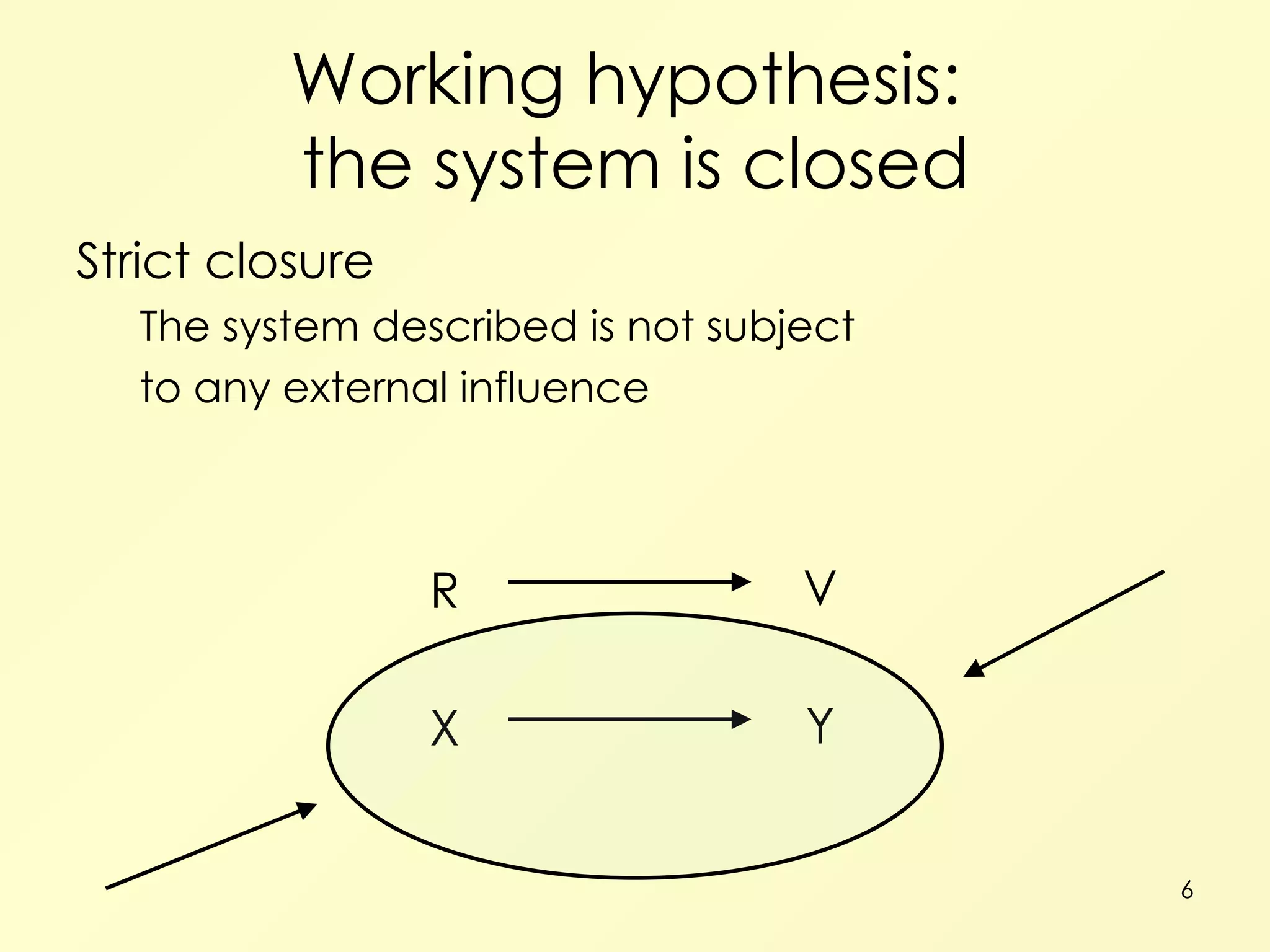
Working hypothesis:  the system is closed Strict closure The system described is not subject  to any external influence X Y R V
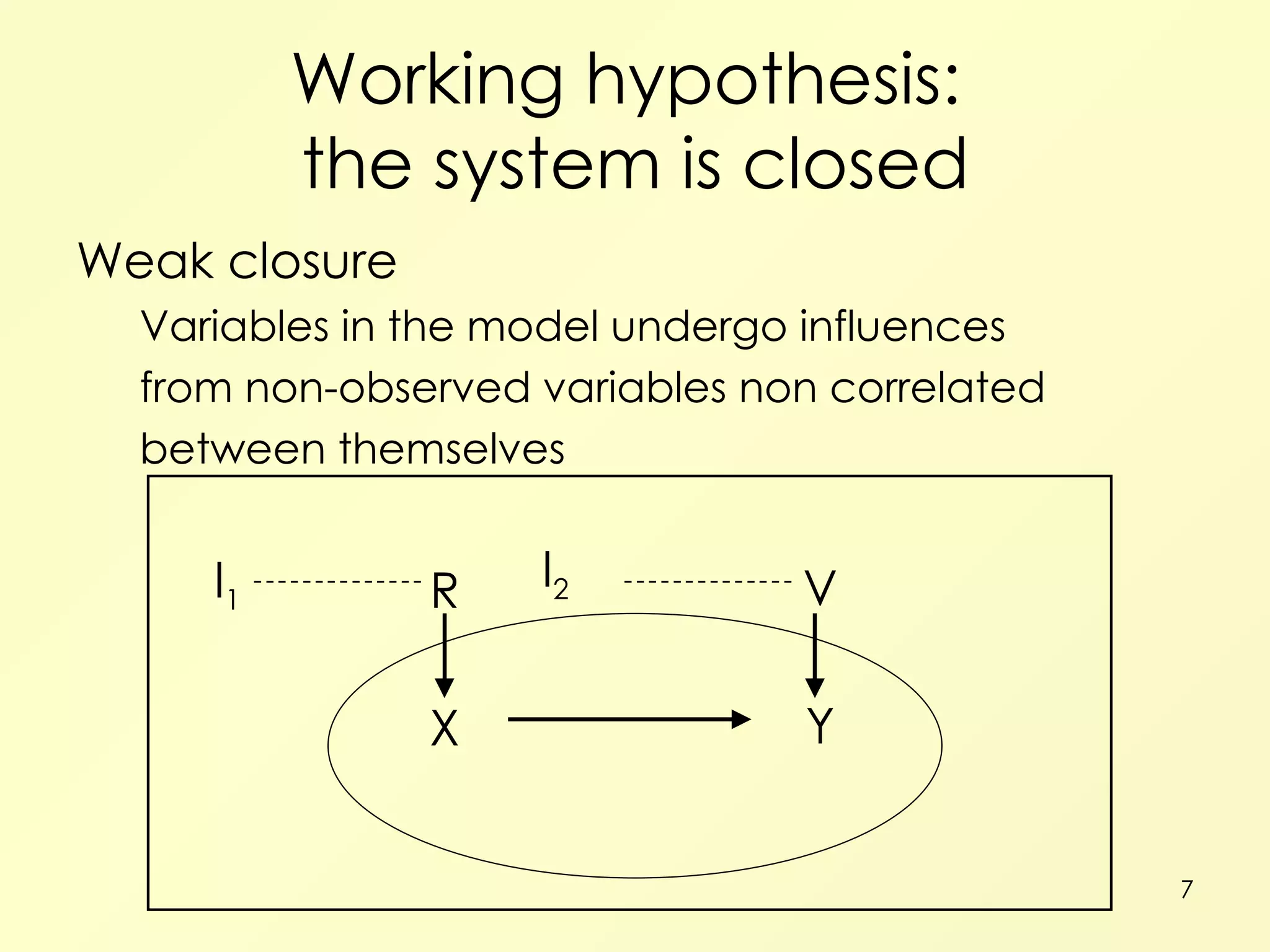
Working hypothesis:  the system is closed Weak closure Variables in the model undergo influences from non-observed variables non correlated between themselves X Y R V I 1 I 2
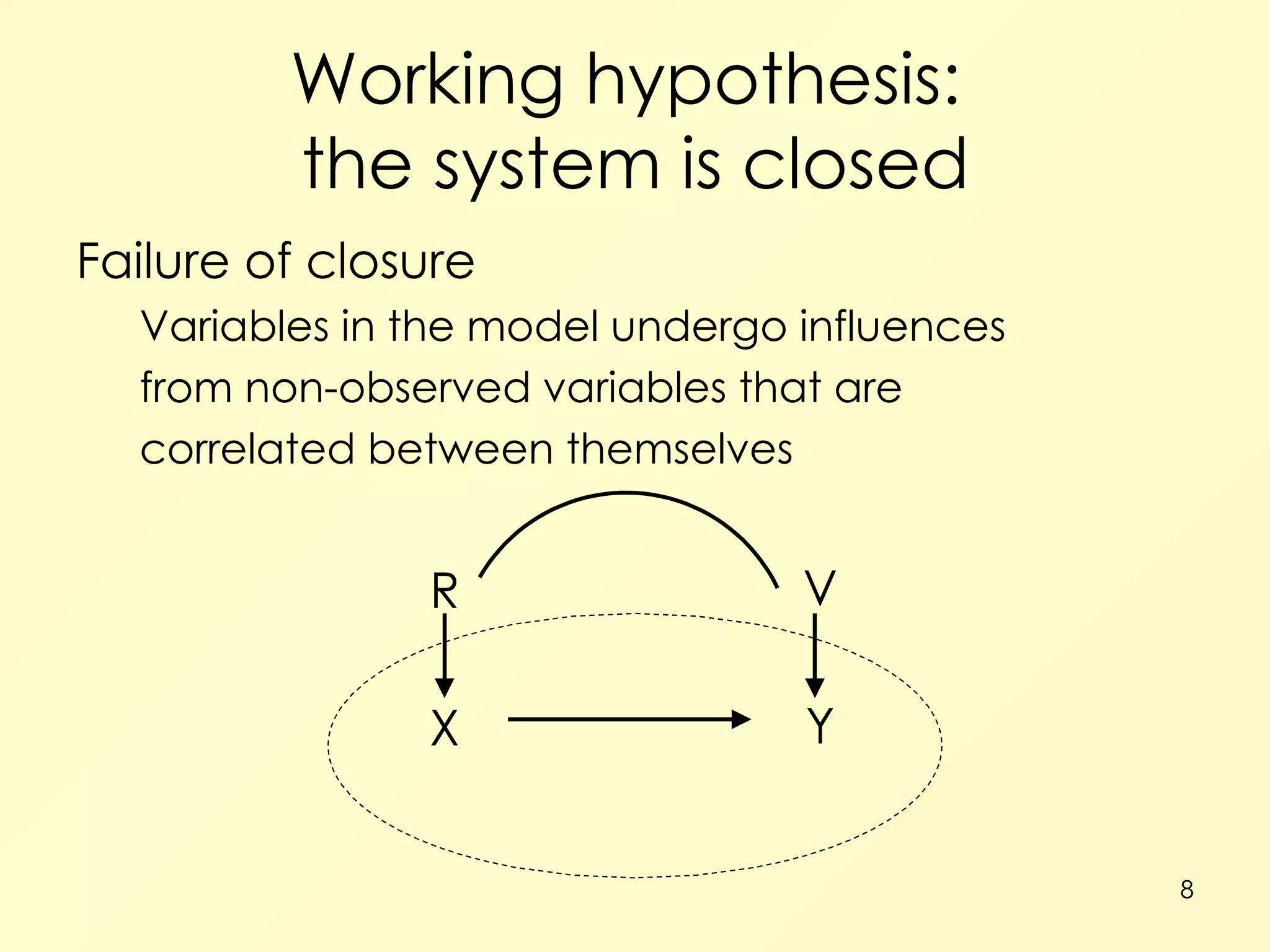
Working hypothesis:  the system is closed Failure of closure Variables in the model undergo influences from non-observed variables that are correlated between themselves X Y R V
Causal models model mechanisms Mechanisms are a scheme of how variables relate to each other Variables play specific (causal) roles Some types of relations are excluded, e.g. loops
Hypothetico-deductivism Hypothesise stage and prior information Causal hypotheses are (dis)confirmed depending on results of tests and on congruence with background knowledge A dynamic process Va et vient between established theories and establishing theories
System analysis: scope and goals System theorists von Bertalanffy (1969), Bunge (1979) A general theory of systems in the various sciences Formulation and derivation of principles valid for all systems Systems are ubiquitous, a general framework is needed
von Bertalanffy: Major aims of a general system theory (1969): 1. there is a general tendency towards the integration in the various sciences, natural and social; 2. such integration seems to be centred in a general system theory; 3. such theory may be an important means of aiming at exact theory in the non-physical fields of science; 4. developing unifying principles running ‘vertically’ through the universe of the individual sciences; 5. this can lead to a much-needed integration in scientific education. General system theory aims to encompass various disciplines.
What is a system? A system is a set of elements standing in reciprocal interrelations Elements,  p , stand in relation,  R , so that the behaviour of an element  p  in  R  is different from its behaviour in another relation,  R’ . If the behaviours in  R  and  R’  are not different, there is no interaction, and the elements behave independently with respect to the relations  R  and  R’ . (von Bertalanffy 1969, p.37) Systems are mathematically defined by certain families of differential equations Systems are not aggregates (= collections of items not held together by bonds and lacking integrity)
Systems and the whole Science of the whole Holism: stresses integrity of systems at the expenses of their components and of mutual actions among them Atomism: the whole is contained in its parts, so the study of parts suffices to understand the whole Neither can properly analyse systems
Systemics methodology (Bunge) First identification of the components of the system Second identification of the environment Third identification of the structure N.B.: no prior hypotheses about the structure
Systemics, a different worldview von Bertalanffy: systemics open a new paradigm System philosophy Against the analytic, mechanistic, one-way causal paradigm of classical science No sharp difference between the object of investigation and the knowing agent
A different worldview von Bertalanffy (1969) Perception is not a reflection of ‘real things’ (whatever their metaphysical status), and knowledge is not a simple approximation to ‘truth’ or ‘reality’. It is an interaction between knower and known, this dependent on a multiplicity of factors of a biological, psychological, cultural, linguistic, etc., nature.
A different worldview Von Bertalanffy (1969) The third part of systems philosophy will be concerned with the relations of man and world or what is termed ‘ values ’ in philosophical parlance. If reality is a hierarchy of organized wholes, the image of man will be different from what it is in a world of physical particles governed by chance events as ultimate and only ‘true’ reality. Rather, the world of symbols, values, social entities and cultures is something very ‘real’; and its embeddedness in a cosmic order of hierarchies is apt to bridge the opposition of C.P. Snow’s ‘Two Cultures’ of science and the humanities, technologies and history, natural and social sciences, or in whatever way the antithesis is formulated.
A different worldview Bunge (1979): There are no stray things Every thing interacts with everything else so that all things cohere in forming systems Every concrete thing is either a system or a component of it Every system is engaged in some process or other Every change in a system is lawful
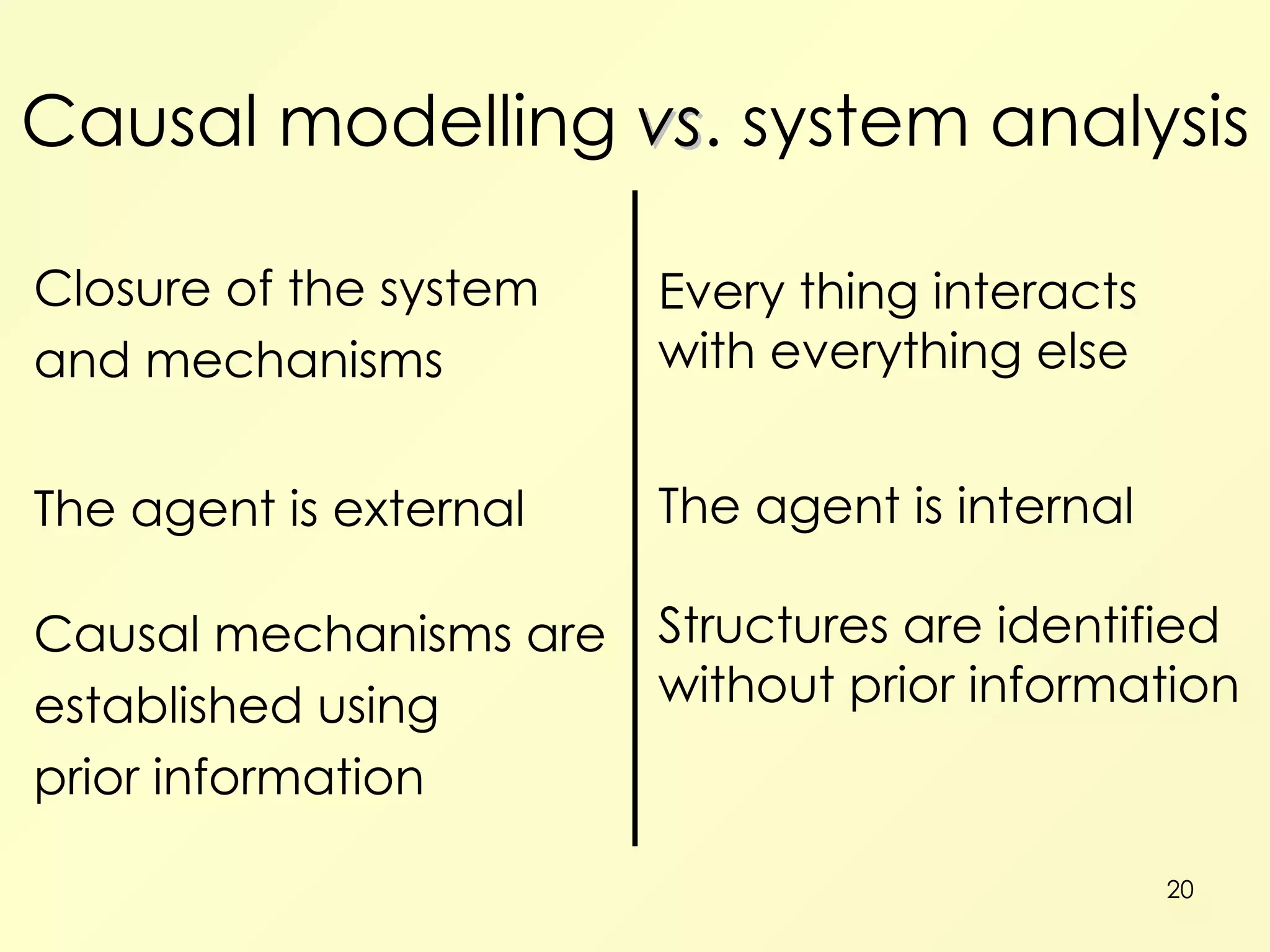
Causal modelling  vs . system analysis Closure of the system and mechanisms The agent is external Causal mechanisms are established using prior information Every thing interacts with everything else The agent is internal Structures are identified without prior information
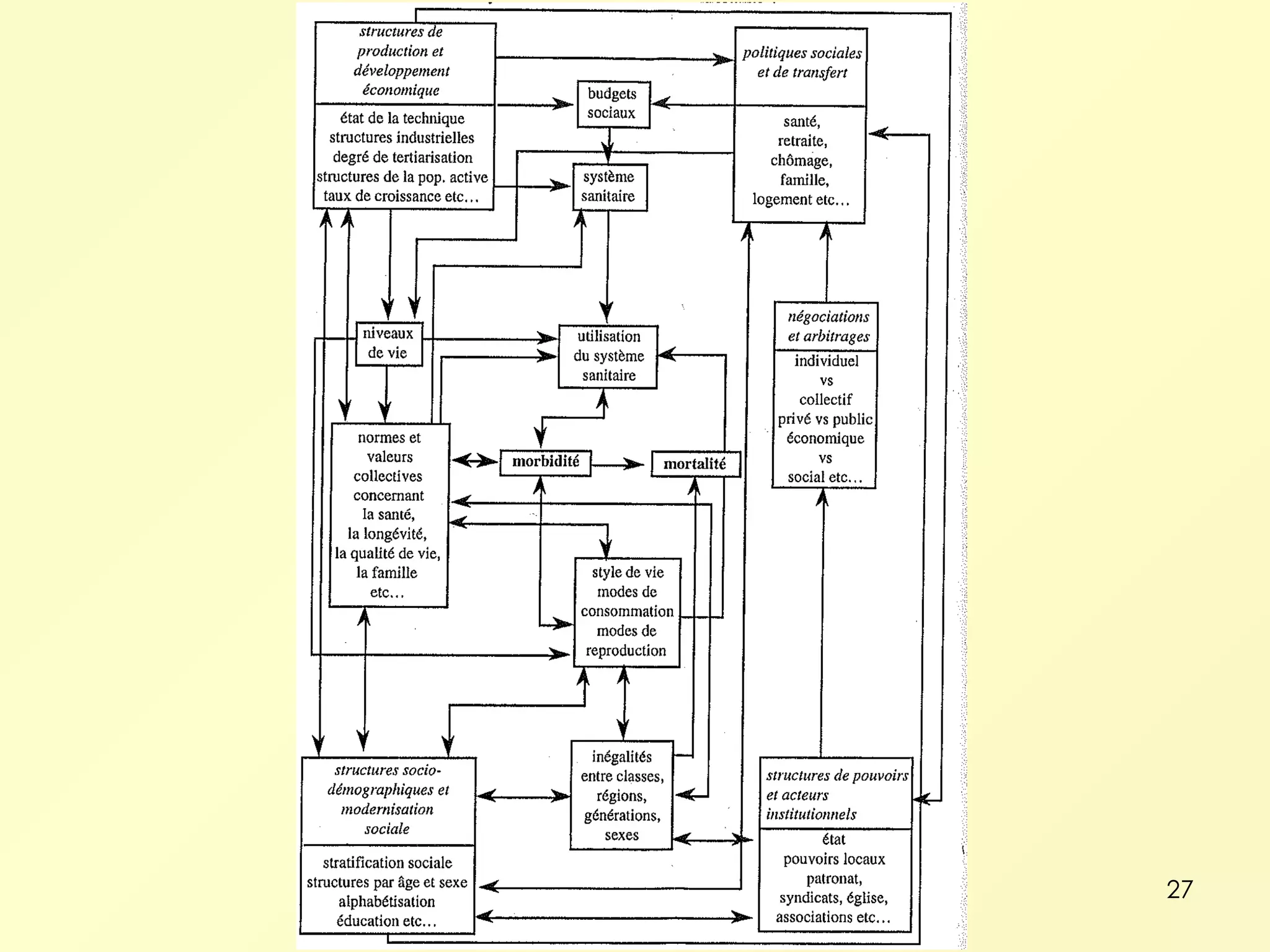
Causal analysis  within  system analysis? Lauriaux (1994) theoretical weaknesses of causal analysis: choice of variables, conceptualisation, closure of the system
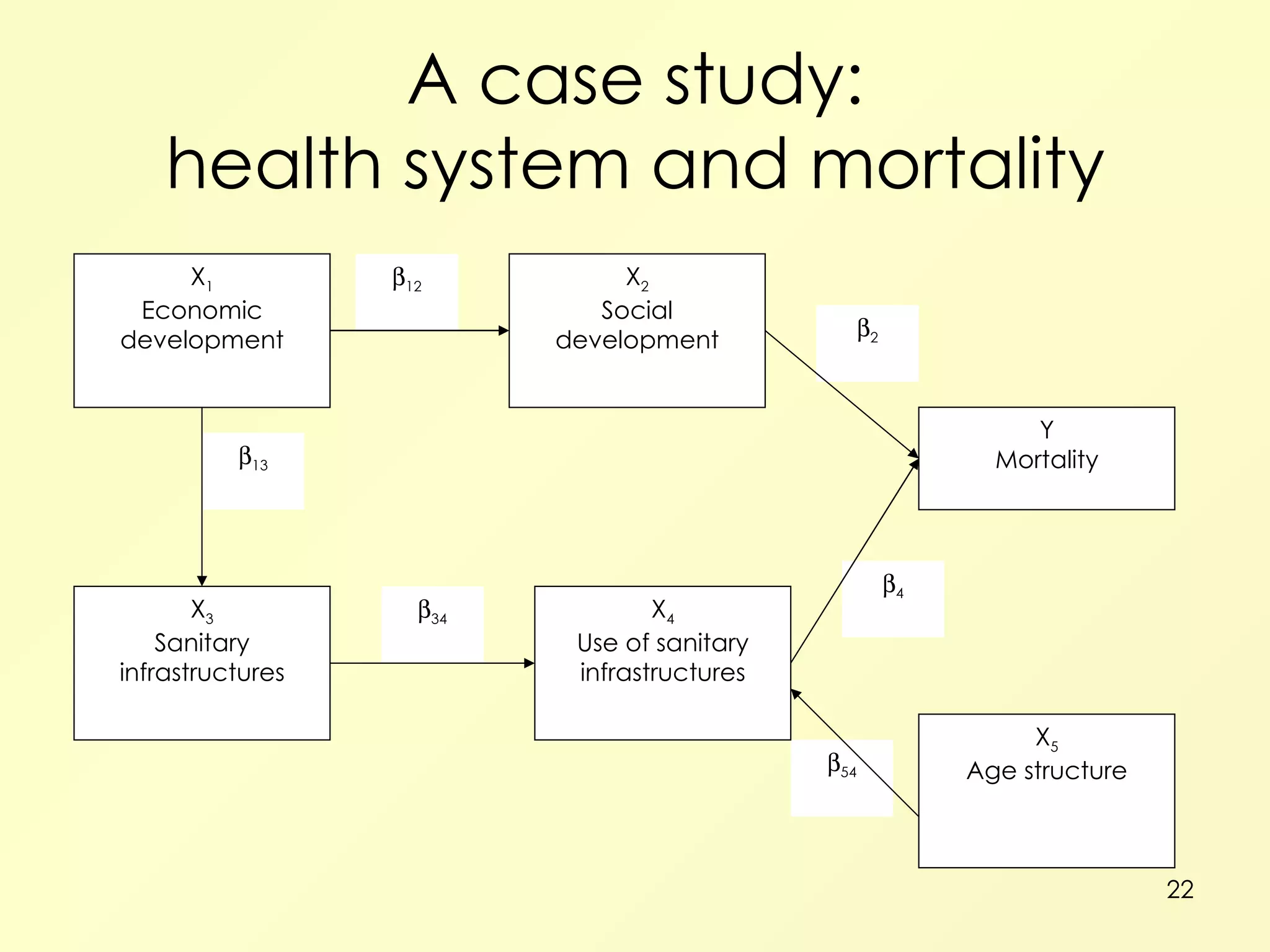
A case study: health system and mortality  54  4  13  34  12  2 X 1 Economic development X 2 Social development X 3 Sanitary infrastructures X 4 Use of sanitary infrastructures X 5 Age structure Y Mortality
Lauriaux’s critique Principal variables are theoretical constructs according to well established economic and sociological theories Assumption: economic development generates social development Problem: counterexamples exist, the arrow might be reversed with serious problems for policy To intervene on an effect which is not an effect won’t deliver the planned results
Causal analysis  within  system analysis? The problem still remains: How to make sense of covariations between variables if we abandon the causal framework? Solution: system analysis
Complementarity of the two approaches? Systems are homeostatic: they keep themselves in a stable state by means of regulatory interdependent mechanisms Changes in the system re-establish the equilibrium in consequence of too strong internal/external influences In the process of balancing, components jointly evolve Those joint evolutions are covariations we call causal
Lauriaux’s systemic story
 
My systemic worries Systems become very easily intractable, of difficult use for policy I haven’t seen precise, concrete methods to analyse data Assumptions clash too much to make the approaches complementary
To sum up I sketched the features Of causal modelling: closure of the system, use of prior information, mechanism Of system analysis: different worldview, reciprocal interrelations of elements I discussed the possibility of a complementarity of the two approaches
A charitable interpretation? A weak notion of ‘system’ Mechanisms are  within  (social) systems Relax postulate that  every  thing interacts with everything else A weak and diversified notion of ‘interaction’ The agent interacts with the system: she interprets but doesn’t modify it Things can have correlational, causal, …, interactions
To conclude Are those approaches compatible? I think not, because of significantly different assumptions Is systemics a viable alternative? I think not, because clear methods are still lacking
Unless … A charitable interpretation of systems and interaction is provided Peculiar import of systemics is perhaps distort Yet causal modelling gains … ?
References  Bunge M. (1979).  A world of systems.  Reidel Publishing Company. Franck R. (1994) (ed).  Faut-il chercher aux causes une raison?  Vrin. Franck R. (2002) (ed).  The Explanatory Power of Models . Springer. Lauriaux M. (1994),   “ Des causes aux syst èmes: la causalité en question”, in Franck (1994). Lopez-Rios O., Mompart A. and Wunsch G. (1992). Système de soins et mortalité régionale: une analyse causale,  European Journal of Population , 8(4), 363-379. Pumain D. (2006) (ed).  Hierarchy in natural and social sciences . Springer. Russo F. (forthcoming),  Measuring variations. Causality and causal modelling in the social sciences.  Springer. von Bertalanffy (1969),  General system theory.  Braziller.

Causalanalysis Systemics Dubrovnik

  • 1.
    Mechanisms and systems: causal issues in the social sciences Federica Russo Philosophy, Louvain & Kent
  • 2.
    Overview Causal modellingMethodology Presuppositions System analysis Presuppositions Methodology Causal modelling vs. Systemics A case study Health systems and mortality
  • 3.
    Causal modelling GoalsDetecting causes of effects Measuring effects of causes Uncovering causal structures Modelling causal mechanisms … Methods Qualitative/Quantitative Aggregate/Individual/Multilevel … Methodology Hypothetico-deductivism
  • 4.
    Causal models aremade of Assumptions Statistical Extra-statistical Causal Key notions Background knowledge Exogeneity Invariance/Stability Closure of the system
  • 5.
    Causal assumptions Covariatesufficiency All the variables included in the model are needed to explain the phenomenon No-confounding No variable included in the model screens-off other variables
  • 6.
    Working hypothesis: the system is closed Strict closure The system described is not subject to any external influence X Y R V
  • 7.
    Working hypothesis: the system is closed Weak closure Variables in the model undergo influences from non-observed variables non correlated between themselves X Y R V I 1 I 2
  • 8.
    Working hypothesis: the system is closed Failure of closure Variables in the model undergo influences from non-observed variables that are correlated between themselves X Y R V
  • 9.
    Causal models modelmechanisms Mechanisms are a scheme of how variables relate to each other Variables play specific (causal) roles Some types of relations are excluded, e.g. loops
  • 10.
    Hypothetico-deductivism Hypothesise stageand prior information Causal hypotheses are (dis)confirmed depending on results of tests and on congruence with background knowledge A dynamic process Va et vient between established theories and establishing theories
  • 11.
    System analysis: scopeand goals System theorists von Bertalanffy (1969), Bunge (1979) A general theory of systems in the various sciences Formulation and derivation of principles valid for all systems Systems are ubiquitous, a general framework is needed
  • 12.
    von Bertalanffy: Majoraims of a general system theory (1969): 1. there is a general tendency towards the integration in the various sciences, natural and social; 2. such integration seems to be centred in a general system theory; 3. such theory may be an important means of aiming at exact theory in the non-physical fields of science; 4. developing unifying principles running ‘vertically’ through the universe of the individual sciences; 5. this can lead to a much-needed integration in scientific education. General system theory aims to encompass various disciplines.
  • 13.
    What is asystem? A system is a set of elements standing in reciprocal interrelations Elements, p , stand in relation, R , so that the behaviour of an element p in R is different from its behaviour in another relation, R’ . If the behaviours in R and R’ are not different, there is no interaction, and the elements behave independently with respect to the relations R and R’ . (von Bertalanffy 1969, p.37) Systems are mathematically defined by certain families of differential equations Systems are not aggregates (= collections of items not held together by bonds and lacking integrity)
  • 14.
    Systems and thewhole Science of the whole Holism: stresses integrity of systems at the expenses of their components and of mutual actions among them Atomism: the whole is contained in its parts, so the study of parts suffices to understand the whole Neither can properly analyse systems
  • 15.
    Systemics methodology (Bunge)First identification of the components of the system Second identification of the environment Third identification of the structure N.B.: no prior hypotheses about the structure
  • 16.
    Systemics, a differentworldview von Bertalanffy: systemics open a new paradigm System philosophy Against the analytic, mechanistic, one-way causal paradigm of classical science No sharp difference between the object of investigation and the knowing agent
  • 17.
    A different worldviewvon Bertalanffy (1969) Perception is not a reflection of ‘real things’ (whatever their metaphysical status), and knowledge is not a simple approximation to ‘truth’ or ‘reality’. It is an interaction between knower and known, this dependent on a multiplicity of factors of a biological, psychological, cultural, linguistic, etc., nature.
  • 18.
    A different worldviewVon Bertalanffy (1969) The third part of systems philosophy will be concerned with the relations of man and world or what is termed ‘ values ’ in philosophical parlance. If reality is a hierarchy of organized wholes, the image of man will be different from what it is in a world of physical particles governed by chance events as ultimate and only ‘true’ reality. Rather, the world of symbols, values, social entities and cultures is something very ‘real’; and its embeddedness in a cosmic order of hierarchies is apt to bridge the opposition of C.P. Snow’s ‘Two Cultures’ of science and the humanities, technologies and history, natural and social sciences, or in whatever way the antithesis is formulated.
  • 19.
    A different worldviewBunge (1979): There are no stray things Every thing interacts with everything else so that all things cohere in forming systems Every concrete thing is either a system or a component of it Every system is engaged in some process or other Every change in a system is lawful
  • 20.
    Causal modelling vs . system analysis Closure of the system and mechanisms The agent is external Causal mechanisms are established using prior information Every thing interacts with everything else The agent is internal Structures are identified without prior information
  • 21.
    Causal analysis within system analysis? Lauriaux (1994) theoretical weaknesses of causal analysis: choice of variables, conceptualisation, closure of the system
  • 22.
    A case study:health system and mortality  54  4  13  34  12  2 X 1 Economic development X 2 Social development X 3 Sanitary infrastructures X 4 Use of sanitary infrastructures X 5 Age structure Y Mortality
  • 23.
    Lauriaux’s critique Principalvariables are theoretical constructs according to well established economic and sociological theories Assumption: economic development generates social development Problem: counterexamples exist, the arrow might be reversed with serious problems for policy To intervene on an effect which is not an effect won’t deliver the planned results
  • 24.
    Causal analysis within system analysis? The problem still remains: How to make sense of covariations between variables if we abandon the causal framework? Solution: system analysis
  • 25.
    Complementarity of thetwo approaches? Systems are homeostatic: they keep themselves in a stable state by means of regulatory interdependent mechanisms Changes in the system re-establish the equilibrium in consequence of too strong internal/external influences In the process of balancing, components jointly evolve Those joint evolutions are covariations we call causal
  • 26.
  • 27.
  • 28.
    My systemic worriesSystems become very easily intractable, of difficult use for policy I haven’t seen precise, concrete methods to analyse data Assumptions clash too much to make the approaches complementary
  • 29.
    To sum upI sketched the features Of causal modelling: closure of the system, use of prior information, mechanism Of system analysis: different worldview, reciprocal interrelations of elements I discussed the possibility of a complementarity of the two approaches
  • 30.
    A charitable interpretation?A weak notion of ‘system’ Mechanisms are within (social) systems Relax postulate that every thing interacts with everything else A weak and diversified notion of ‘interaction’ The agent interacts with the system: she interprets but doesn’t modify it Things can have correlational, causal, …, interactions
  • 31.
    To conclude Arethose approaches compatible? I think not, because of significantly different assumptions Is systemics a viable alternative? I think not, because clear methods are still lacking
  • 32.
    Unless … Acharitable interpretation of systems and interaction is provided Peculiar import of systemics is perhaps distort Yet causal modelling gains … ?
  • 33.
    References BungeM. (1979). A world of systems. Reidel Publishing Company. Franck R. (1994) (ed). Faut-il chercher aux causes une raison? Vrin. Franck R. (2002) (ed). The Explanatory Power of Models . Springer. Lauriaux M. (1994),  “ Des causes aux syst èmes: la causalité en question”, in Franck (1994). Lopez-Rios O., Mompart A. and Wunsch G. (1992). Système de soins et mortalité régionale: une analyse causale, European Journal of Population , 8(4), 363-379. Pumain D. (2006) (ed). Hierarchy in natural and social sciences . Springer. Russo F. (forthcoming), Measuring variations. Causality and causal modelling in the social sciences. Springer. von Bertalanffy (1969), General system theory. Braziller.

Editor's Notes

  • #2 [attention getter] [need] 2 approaches: causal modelling vs. system analysis. ? Radically different, ? Compatible, ? Complementary, ? how do they handle evidence, ? What do they contribute to building theories. Question since my PhD from many quarters (philosophers and scientists) [task] analysis of their foundations and methods  are they compatible/complementary or in opposition? [main message] tentative negative answer: opposition to each other unless a charitable interpretation of systemics is given.
  • #3 [browse on topics]
  • #4 OSS: be very broad, present causal analysis to cover as many causal models as possible (qualitative/quantitative, hierarchical, …) OSS: confine discussion to H-D models. Controversial whether inductive methods (eg TETRAD) deliver reliable results (?can algorithms bootstrap causal relations from rough data without any prior assumption)
  • #5 Stability/invariance correspond to theoretical saturation or informational redundancy in qualitative analysis OSS: closure of the system is a *hypothesis* (the system under analysis is not subject to external influences)  later we’ll see this is one of the main contentious issues Disclaimer: sometimes use system in a loose way – later system will get a specific meaning  other contentious issue
  • #6 Covariate sufficiency and no-confounding also at the basis of mechanism – see later Obviously related to closure of the system
  • #7 Quite unrealistic
  • #8 How weak closure is related to covariate sufficiency and no-confounding
  • #10 In mechanisms: specific causal roles of variables Gear analogy is fine but need not to think of mechanisms as ‘physical’ gears (too restrictive, unsuitable to social domain)
  • #11 Recall stages: Hypothesise Build Confirm/disconfirm Controversial whether causal model be hypothetico-*deductive*, ?misnomer. Won’t go into this debate. However, weaker inferential step: not *deduction* strictu sensu, but ‘drawing consequences from hypothesis’. Data are not *implied* by the hypothesis, but just have to ‘conform to it’ = selected indicators adequately represent conceptual variables Stress role of background knowledge – prior knowledge essential in order to confirm/disconfirm causal structure = mechanism
  • #12 (difficulty in finding founders)
  • #14 !! Systems are not mechanisms of causal models !!
  • #16 NB: couldn’t find more on the general methodology nor on how to write differential equations (choice of variables, kind of relations, meaning of parameters…) Bunge’s steps up in the air: how to identify environment structure components (eg, at what level do we take the components?)
  • #17 OSS: von Bert says new paradigm in Kuhnian terms Not the same thing as saying that any investigation has a subjective component due to eg researchers’ prejudices  the agent interprets reality but does not modify it! (as is the case in systemics)
  • #19 Two cultures of CP Snow: humanities: increasing constructivist worldview, scientific method embedded in language and culture (therefore no objectivity) Sciences: the observer can still have a grip on reality by making objective and non-culturally embedded statements about nature
  • #20 In causal analysis there are stray things, albeit theory-laden Here: not stray because things interact with the agent and change accordingly Systems cannot be closed because the agent interacts with them In causal analysis some changes are just correlational, not lawful nor causal In systemics: if there’s a correlation, there must be a law – why? – because every thing interacts with everything else. This is a postulate of systemics
  • #22 Lauriaux against causal analysis: closure of the system is much more than a hypothesis, it is a postulate Too narrow in scope Overlooks the many interrelations between elements of systems  cannot give the correct dynamic of society
  • #23 knowledge of the causal context is given by knowledge of the political, economic and social situation in Spain over the decades 1970-1980, which led to a low mortality rate at the time of the study. Knowledge of the socio-political context makes clearer the modelling strategy of this study. In fact, previous studies in demography and medical geography examined the incidence of the health system on regional mortality coming to the conclusion that regional differences in mortality could not possibly be explained by regional differences in the health system. However, Spain met deep socio-economic changes in the mid-Seventies, and consequently policy in that period simultaneously tried to intervene on improving the social and economic situation. mortality is influenced by the health system which is in turn influenced by the social and economic development. It is this background that explains the choice of distinguishing the supply and demand of medical care, unlike the majority of similar ecological studies.
  • #28 Problems: Double edges Causal ordering? Measurement of variables (distinction between indicators and observed variables) Methods: qualitative, quantitative? No theoretical justification