2014 | Volume 2
Issue 2 | 04–13
ISSN 2305-6991
BCSSS
Systema: connecting Matter, Life, Culture and Technology
Big Questions Come In Bundles,
Hence They Should Be Tackled
Systemically
Mario Bunge
Department of Philosophy,McGill University, Montreal, Canada;
c/o info.philosophy@mcgill.ca
Editor’s Note: This article is the keynote address presented to the European Meetings on Cybernetics
and Systems Research (EMCSR) in 2014, on the occasion of Mario Bunge receiving the Bertalanffy
Award in Complexity Thinking, awarded by the Bertalanffy Centre for the Study of Systems Science
(BCSSS).
Abstract: Problems come in all kinds and sizes. Small problems call for the use of known tools found in
circumscribed fields, whereas big problems call for further research, which may require breaching
disciplinary walls. This is because every small problem concerns some separable system whose
components are so weakly linked with one another, that it may be reduced to an aggregate, at least to a
first approximation. I submit that (a) every problem concerns some system, and (b) analysis works only
provided the system components are so loosely linked, that they can be treated as if they were isolated
items. These methodological assumptions are key principles of systemism, the philosophy first
expounded by d’Holbach in the 18th century, and rescued by Bertalanffy and his companions in the
general systems movement in the last century. Systems and systemism are so little known in the
philosophical community, that the vast majority of philosophical dictionaries have ignored them. By
contrast, all scientists and technologists have practiced systemism – except when they failed for having
adopted either of the alternatives to systemism, namely atomism and holism. A number of examples
taken from contemporary science and technology are analyzed, from the entanglement typical of
quantum physics to the design of social policies. Along the way we define the concept of a system, and
note that (a) analysis is the dual of synthesis rather than its opposite; (b) systemism should not be
mistaken for holism, because the former recommends combining the bottom-up with the top-down
strategies; (c) systemism encourages the convergence or fusion of disciplines rather than reductionism.
The recent replacement of GDP with more complex social indicators as the measure of social progress
is regarded as a victory of the systemic view of society. Finally, I argue that systemism is no less than a
component of the philosophical matrix of scientific and technological research, along with
epistemological realism, ontological materialism, scientism, and humanism. I also argue in favor of
Anatol Rapoport’s view, that systems theory is not a theory proper but a viewpoint or approach that
helps pose problems and place them in their context.
Keywords: Big Questions; Systemism; Systemics; General Systems Theory
5
Systema: connecting Matter, Life, Culture and Technology | 2014 | Volume 2 | Issue 2
This article is available from http://www.systema-journal.org
© the author(s), publisher and licensee
Bertalanffy Center for the Study of Systems Science http://www.bcsss.org
This is an open access article licensed under the Attribution-NonCommercial-NoDerivatives 4.0
International License.
6
Systema: connecting Matter, Life, Culture and Technology | 2014 | Volume 2 | Issue 2
It is well known that problems come in all kinds and sizes. There are cognitive and moral
problems, individual and social issues, scientific and technological conundrums, and so on.
Then again, problems can be either local or systemic, and they may be tackled by individual
experts or by multidisciplinary teams.
Small problems call for the use of known tools found in circumscribed fields, whereas
big problems call for further research, which may require breaching disciplinary walls. For
example, whereas a fractured bone may be set by an expert, maintaining the population of a
whole town in good health requires a city- wide health system, which in turn calls for the
intervention of regional health, educational, and tax authorities goaded by groups of
educated citizens.
All of the preceding is well known. What is less well known is why some issues come
in bunches rather than in isolation from others, and this is a philosophical problem, because
it transcends disciplinary boundaries. The individualist thinker, who focuses on isolated
items, has no answer, hence he will ignore the question, or he will offer Descartes’ well-
known recipe: Analyze the given problem into its components, and tackle these one by one.
But this procedure works only when the problem concerns a separable system, that is, one
whose components are so weakly linked with one another, that it can be reduced to an
aggregate, or treated to a first approximation as if it were one.
Notice that we have stealthily moved from epistemology to ontology. Indeed, we have
asserted that (a) every problem concerns some system, and (b) analysis works provided the
system components are so loosely linked, that they can be treated as if they were isolated
items. Both assumptions are rather strong, and therefore debatable. Indeed, they are key
principles of systemism, a philosophy so little known in the philosophical community, that the
vast majority of philosophical dictionaries have ignored it.
The point of the present paper is to argue that, while most philosophers have ignored
all the systems other than the philosophical ones, all scientists and technologists have
practised systemism – except when they failed for having adopted either of the alternatives
to systemism, namely atomism and holism.
1 Systemism: the alternative to atomism and
holism
Ancient Greek philosophy produced two great ontologies or worldviews: Democritus’
atomism and Aristotle’s holism. The corresponding methodologies were the bottom-up
(elements whole) and the top-down (whole elements) strategies. The builder
assembles: he constructs houses out of from stones and other units; likewise, the
draughtsman combines lines to build pictures By contrast, the butcher and the dissector
start with the whole animal, to obtain or study its components.
Each of the two strategies, analysis and synthesis, is the dual rather than the opposite
of the other – as suggested by the fact that the concepts of part and whole are defined
together. (Indeed, one defines the part-whole relation, namely thus: “x is a part of y = the
physical addition of x and y equals y.”). Consequently, the statements “The part precedes
the whole” and “The whole precedes the part” make sense with reference to material
processes of clumping and disintegration, but not logically.
In other words, analysis and synthesis are mutually complementary rather than
mutually exclusive. For example, building a house may require demolishing a pre-existing
building, and anatomy flourishes only when supplemented with physiology. Likewise
7
Systema: connecting Matter, Life, Culture and Technology | 2014 | Volume 2 | Issue 2
synthetic chemistry, the artificial construction of molecules such as pharmaceutical drugs,
presupposes analytical chemistry, or the analysis of lumps of matter into their chemical
components.
In other words, atomism (or individualism) is the dual of holism, and each of them tells
us only a part of the truth. The full truth is told by systemism, the philosophical view
according to which the physical universe is the system of all material systems–physical,
chemical, living, and social. Euclid was perhaps the first to construct a conceptual system,
his own system of geometric axioms, but the concept of a material system emerged only
about 1600, with Copernicus and Harvey.
Systemism was first explicitly proposed by Thiry d’Holbach in the 1770s, and
reinvented in 1913 by the physiologist and self-taught sociologist Lawrence J. Henderson,
who passed it on to the influential sociologists Talcott Parsons, George Homans, and Robert
Merton. Two decades later, the theoretical biologist Ludwig von Bertalanffy reinvented
systemism independently, and in 1950 he published a paper that attracted the attention of a
number of outstanding scientists and technologists, in particular Russell Ackoff, William R.
Ashby, Kenneth Boulding, C. West Churchman, Ralph Gerard, George Klir, and Anatol
Rapoport. This group set in motion the so-called general systems movement, which was
soon surrounded by a large number of amateurs who thought that they could write about
systems in general without having studied any particular systems.
In my view, a material (or concrete) system can be analyzed into its composition,
environment, structure (or set of bonds), and mechanism (or set of processes that make it
tick). In short, the simplest model of a material system is the quadruple <C, E, S, M>.
Obviously, the fourth component, M, is absent in a model of a conceptual system, such as a
hypothetic-deductive system, and of a semiotic system, such as a poem, a musical score, a
diagram, or a portrait.
The composition and structure of a system come together, like the nodes and lines of
a graph. Yet radical atomists stress composition at the expense of structure, whereas
structuralists pretend that there can be structures without components. For example, it is
often said that Water = H2O, whereas in fact this is the formula for the composition of a
water molecule. To account for a body of liquid water, even as small as a droplet, we must
include the hydrogen bonds that hold the molecules together and explain the global
properties of a watery body, such as fluidity and surface tension. As for the structuralists,
they emphasize structure to the point of disregarding the stuff the system is made of – for
instance, humans in the case of social systems.
8
Systema: connecting Matter, Life, Culture and Technology | 2014 | Volume 2 | Issue 2
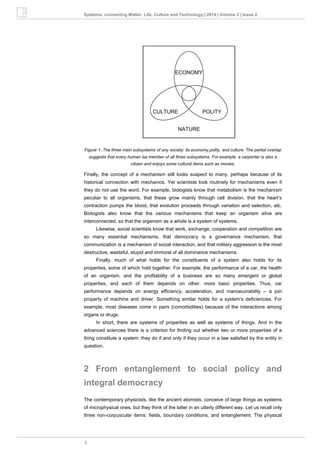
Figure 1: The three main subsystems of any society: its economy,polity, and culture. The partial overlap
suggests that every human isa member of all three subsystems. For example, a carpenter is also a
citizen and enjoys some cultural items such as movies.
Finally, the concept of a mechanism still looks suspect to many, perhaps because of its
historical connection with mechanics. Yet scientists look routinely for mechanisms even if
they do not use the word. For example, biologists know that metabolism is the mechanism
peculiar to all organisms, that these grow mainly through cell division, that the heart’s
contraction pumps the blood, that evolution proceeds through variation and selection, etc.
Biologists also know that the various mechanisms that keep an organism alive are
interconnected, so that the organism as a whole is a system of systems.
Likewise, social scientists know that work, exchange, cooperation and competition are
so many essential mechanisms, that democracy is a governance mechanism, that
communication is a mechanism of social interaction, and that military aggression is the most
destructive, wasteful, stupid and immoral of all dominance mechanisms.
Finally, much of what holds for the constituents of a system also holds for its
properties, some of which hold together. For example, the performance of a car, the health
of an organism, and the profitability of a business are so many emergent or global
properties, and each of them depends on other, more basic properties. Thus, car
performance depends on energy efficiency, acceleration, and manoeuvrability – a join
property of machine and driver. Something similar holds for a system’s deficiencies. For
example, most diseases come in pairs (comorbidities) because of the interactions among
organs or drugs.
In short, there are systems of properties as well as systems of things. And in the
advanced sciences there is a criterion for finding out whether two or more properties of a
thing constitute a system: they do if and only if they occur in a law satisfied by the entity in
question.
2 From entanglement to social policy and
integral democracy
The contemporary physicists, like the ancient atomists, conceive of large things as systems
of microphysical ones, but they think of the latter in an utterly different way. Let us recall only
three non-corpuscular items: fields, boundary conditions, and entanglement. The physical
9
Systema: connecting Matter, Life, Culture and Technology | 2014 | Volume 2 | Issue 2
fields constitute not only the cement joining particles or bodies together into systems: the
elementary particles are the quanta of fields.
And to calculate the energy levels of even the hydrogen atom, the smallest system of
all, one must think of it as embedded in a macrophysical environment, represented
schematically by the boundary conditions. Indeed, energy quantization, the earliest
accomplishment of quantum physics, does not occur unless the state function of the atom
vanishes at the boundary. (Classical analog: the fixed borders of a vibrating string or drum.)
Entanglement, first noted by Schrödinger eight decades ago and dismissed by
Einstein as ghostly, but experimentally confirmed several decades later, is perhaps the most
counter-intuitive (or non-classical) feature of the quantum theory. One of its various
manifestations is the correlation that persists among items that used to be together in a
system that has disintegrated. It would seem that particles look more like caltrops than like
smooth marbles; and that, once a system, always a system.
Let us now jump from microphysics to macrosociology, in particular social policy and
political organization. It is well known that one-sided or sectoral social policies yield at best
modest results. For instance, separately from one another, housing, public health and public
education do not do much for the jobless. In particular, the scholastic achievement of
undernourished children in poor health and living in crime-ridden slums, is bound to be low.
This is why the UNESCO original slogan, “Start by educating people,” is unrealistic.
Only systemic social policies, tackling simultaneously all of the basic social problems – or
else their equivalent, namely radical income inequality – can work, and this for a simple
reason: because humans are not one-dimensional. We are thinking and social animals.
Finally, how about politics? A good starting point is the most famous political formula in
history: Liberty, equality, fraternity. This is a system, not a mere juxtaposition of rights or
ideals. Indeed, liberty is only possible among equals willing to help one another. Likewise,
fraternity is impossible in a caste society. In short, radical Libertarians, radical Egalitarians
and Communitarians preach either utopias or unjust societies. The French revolutionaries of
1789 had it right: only the combination of the three ideals in question constitutes a stable
tripod. A fourth leg, namely competence, would make it even more stable.
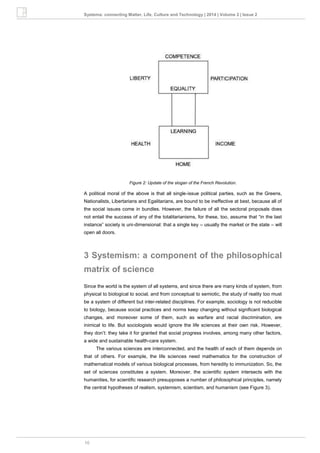
However, that political tripod is not free-standing: it will not be stable unless it stands
on the material square made of work, home, health, and learning. If in doubt, just think that a
group of unemployed homeless without skills and in ill- health can at best work as a band of
thieves. In short, a just and sustainable society can only be built by combining and realizing
two systems of values: those of welfare and democracy (see Figure 2).
10
Systema: connecting Matter, Life, Culture and Technology | 2014 | Volume 2 | Issue 2
Figure 2: Update of the slogan of the French Revolution.
A political moral of the above is that all single-issue political parties, such as the Greens,
Nationalists, Libertarians and Egalitarians, are bound to be ineffective at best, because all of
the social issues come in bundles. However, the failure of all the sectoral proposals does
not entail the success of any of the totalitarianisms, for these, too, assume that “in the last
instance” society is uni-dimensional: that a single key – usually the market or the state – will
open all doors.
3 Systemism: a component of the philosophical
matrix of science
Since the world is the system of all systems, and since there are many kinds of system, from
physical to biological to social, and from conceptual to semiotic, the study of reality too must
be a system of different but inter-related disciplines. For example, sociology is not reducible
to biology, because social practices and norms keep changing without significant biological
changes, and moreover some of them, such as warfare and racial discrimination, are
inimical to life. But sociologists would ignore the life sciences at their own risk. However,
they don’t: they take it for granted that social progress involves, among many other factors,
a wide and sustainable health-care system.
The various sciences are interconnected, and the health of each of them depends on
that of others. For example, the life sciences need mathematics for the construction of
mathematical models of various biological processes, from heredity to immunization. So, the
set of sciences constitutes a system. Moreover, the scientific system intersects with the
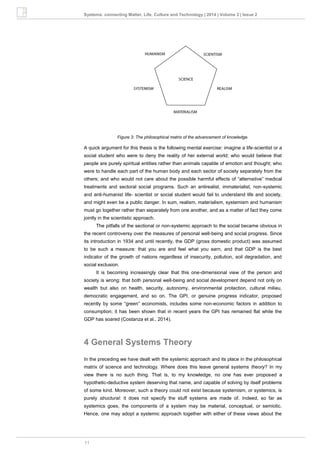
humanities, for scientific research presupposes a number of philosophical principles, namely
the central hypotheses of realism, systemism, scientism, and humanism (see Figure 3).
11
Systema: connecting Matter, Life, Culture and Technology | 2014 | Volume 2 | Issue 2
Figure 3: The philosophical matrix of the advancement of knowledge.
A quick argument for this thesis is the following mental exercise: imagine a life-scientist or a
social student who were to deny the reality of her external world; who would believe that
people are purely spiritual entities rather than animals capable of emotion and thought; who
were to handle each part of the human body and each sector of society separately from the
others; and who would not care about the possible harmful effects of “alternative” medical
treatments and sectoral social programs. Such an antirealist, immaterialist, non-systemic
and anti-humanist life- scientist or social student would fail to understand life and society,
and might even be a public danger. In sum, realism, materialism, systemism and humanism
must go together rather than separately from one another, and as a matter of fact they come
jointly in the scientistic approach.
The pitfalls of the sectional or non-systemic approach to the social became obvious in
the recent controversy over the measures of personal well-being and social progress. Since
its introduction in 1934 and until recently, the GDP (gross domestic product) was assumed
to be such a measure: that you are and feel what you earn, and that GDP is the best
indicator of the growth of nations regardless of insecurity, pollution, soil degradation, and
social exclusion.
It is becoming increasingly clear that this one-dimensional view of the person and
society is wrong: that both personal well-being and social development depend not only on
wealth but also on health, security, autonomy, environmental protection, cultural milieu,
democratic engagement, and so on. The GPI, or genuine progress indicator, proposed
recently by some “green” economists, includes some non-economic factors in addition to
consumption; it has been shown that in recent years the GPI has remained flat while the
GDP has soared (Costanza et al., 2014).
4 General Systems Theory
In the preceding we have dealt with the systemic approach and its place in the philosophical
matrix of science and technology. Where does this leave general systems theory? In my
view there is no such thing. That is, to my knowledge, no one has ever proposed a
hypothetic-deductive system deserving that name, and capable of solving by itself problems
of some kind. Moreover, such a theory could not exist because systemism, or systemics, is
purely structural: it does not specify the stuff systems are made of. Indeed, so far as
systemics goes, the components of a system may be material, conceptual, or semiotic.
Hence, one may adopt a systemic approach together with either of these views about the
12
Systema: connecting Matter, Life, Culture and Technology | 2014 | Volume 2 | Issue 2
composition of the world: that it is “made” exclusively of concrete elements, ideas, or
symbols.
Hence the general systems students cannot search for laws, or universal patterns, true
of systems of all kinds, and enabling one to understand how systems emerge, develop,
combine, and disintegrate. Being purely structural, systemics does not even contain the
most general concepts occurring in all the physical, chemical, biological, and social theories:
those of time and energy. Nor does it involve the typical concepts of mathematical theories:
those of logical consequence and logical consistency.
The practical consequence of the preceding is that general systems theorists are not
equipped to study, design, or control systems of any kind. What they can do is to supply a
point of view or perspective for the analysis and synthesis of systems of any kind. In this
regard, systemism is similar to the remaining sides of the philosophical pentagon within
which scientific theories and practices develop: each of these sides is necessary, but none
of them suffices by itself. Only those who place problems in the said pentagon can detect
and locate them adequately, and perhaps even sketch strategies for tackling them.
True, many a scientist or technologist will be puzzled by my attributing them those
philosophical presuppositions. And the linguistic philosophers, as well as the
hermeneuticians, will reject my assumption on the ground that few if any contemporary
investigators use the words in question. In particular, materialism, and even the word
‘matter’, are unpopular among contemporary scientists. But is it not material or concrete
things what they study? The puzzle vanishes if the old-fashioned equation of ‘matter’ and
‘impenetrable’ is replaced with the definition of ‘material’ as changeable: all and only
material (concrete) things may change.
Under this new definition, photons and neutrinos are material even though they are
neither impenetrable nor conserved. The same applies, a fortiori, to brains and societies:
they are supra-physical, though just as concrete or material as photons. Only
mathematicians deal with immaterial or abstract objects such as numbers – but these are
figments of their imagination, which is a cerebral process.
All of this should interest the systems theorist, for systemism may be combined with
either materialism or spiritualism. And only an examination of the outcomes of research
projects can tell which of the two combinations, systemic materialism and systemic
immaterialism (or structuralism), can best advance learning: whether studying concrete
systems or chasing ghosts.
5 Conclusion
The systemic perspective is neither more nor less than a perspective or viewpoint: the one
that suggests sizing up the problem at hand, placing it in a wide enough context, and
thinking about it as concerning a system or part of one. Systemics does not tell us how to
cure cancer, but it suggests studying cancer types and therapies with the help of all the
relevant disciplines, from molecular biology to social medicine, instead of limiting our
attention to pieces of cancerous tissue at an advanced stage. Likewise, systemics does not
tell us how to eradicate poverty or crime, but it reminds us that these and all the other social
issues come in bundles, whence they cannot be addressed one by one, the way most
politicians and statesmen have been doing, but call for society-wide programs rather than
piles of bills, each addressing a separate issue.
The economist and systems theorist Kenneth Boulding called systemics “the skeleton
of science,” because it tackles structure regardless of stuff, so that it needs fleshing out
13
Systema: connecting Matter, Life, Culture and Technology | 2014 | Volume 2 | Issue 2
before it can do more than helping pose problems. Anatol Rapoport, another pioneer in the
field as well as a mathematician, psychologist and political scientist, cautioned that systems
theory is not a theory proper, but something even more important, namely a fruitful
viewpoint: the one that enjoins us to think out of the box, and to remember that every item is
either a system or a part of one. Systemics will not tell us how a human being lives, but it will
remind us that it is a system of systems, and that it is embedded in a social system that in
turn is a part of a natural system. It is systems wherever we look or act to address big
issues.
References
Bertalanffy, L. v. (1950). An Outline of General Systems Theory. British Journal for the Philosophy of
Science, 1, 139-164.
Bunge, M. (1979). Treatise on Basic Philosophy, vol. 4: A World of Systems. Dordrecht: Reidel.
Costanza, R. et al. Time to leave GDP behind. Nature, 505, 283-85.
About the Author
Mario Bunge
Born in Buenos Aires in 1919, Professor Mario Bunge earned his doctorate in physico-mathematical
sciences from the National University of La Plata in Argentina, and has been a professor of theoretical
physics and of philosophy. He joined McGill University in 1966, was given a named chair, and was
recently made an emeritus professor. He has also been a visiting professor in numerous countries
including the USA, Denmark, Germany, Italy, Mexico, Switzerland, and Australia. Professor Bunge
holds 19 honorary doctorates and four honorary professorships, is a member of four academies and a
Prince of Asturias laureate, and ranks #43 in the AAAS’ Science Hall of Fame. He has authored over
400 papers and more than 80 books on quantum theory, philosophy of science, semantics,
epistemology, ontology, ethics, political philosophy, and science policy.

Big questions come in bundles

  • 1.
    2014 | Volume2 Issue 2 | 04–13 ISSN 2305-6991 BCSSS Systema: connecting Matter, Life, Culture and Technology Big Questions Come In Bundles, Hence They Should Be Tackled Systemically Mario Bunge Department of Philosophy,McGill University, Montreal, Canada; c/o info.philosophy@mcgill.ca Editor’s Note: This article is the keynote address presented to the European Meetings on Cybernetics and Systems Research (EMCSR) in 2014, on the occasion of Mario Bunge receiving the Bertalanffy Award in Complexity Thinking, awarded by the Bertalanffy Centre for the Study of Systems Science (BCSSS). Abstract: Problems come in all kinds and sizes. Small problems call for the use of known tools found in circumscribed fields, whereas big problems call for further research, which may require breaching disciplinary walls. This is because every small problem concerns some separable system whose components are so weakly linked with one another, that it may be reduced to an aggregate, at least to a first approximation. I submit that (a) every problem concerns some system, and (b) analysis works only provided the system components are so loosely linked, that they can be treated as if they were isolated items. These methodological assumptions are key principles of systemism, the philosophy first expounded by d’Holbach in the 18th century, and rescued by Bertalanffy and his companions in the general systems movement in the last century. Systems and systemism are so little known in the philosophical community, that the vast majority of philosophical dictionaries have ignored them. By contrast, all scientists and technologists have practiced systemism – except when they failed for having adopted either of the alternatives to systemism, namely atomism and holism. A number of examples taken from contemporary science and technology are analyzed, from the entanglement typical of quantum physics to the design of social policies. Along the way we define the concept of a system, and note that (a) analysis is the dual of synthesis rather than its opposite; (b) systemism should not be mistaken for holism, because the former recommends combining the bottom-up with the top-down strategies; (c) systemism encourages the convergence or fusion of disciplines rather than reductionism. The recent replacement of GDP with more complex social indicators as the measure of social progress is regarded as a victory of the systemic view of society. Finally, I argue that systemism is no less than a component of the philosophical matrix of scientific and technological research, along with epistemological realism, ontological materialism, scientism, and humanism. I also argue in favor of Anatol Rapoport’s view, that systems theory is not a theory proper but a viewpoint or approach that helps pose problems and place them in their context. Keywords: Big Questions; Systemism; Systemics; General Systems Theory
  • 2.
    5 Systema: connecting Matter,Life, Culture and Technology | 2014 | Volume 2 | Issue 2 This article is available from http://www.systema-journal.org © the author(s), publisher and licensee Bertalanffy Center for the Study of Systems Science http://www.bcsss.org This is an open access article licensed under the Attribution-NonCommercial-NoDerivatives 4.0 International License.
  • 3.
    6 Systema: connecting Matter,Life, Culture and Technology | 2014 | Volume 2 | Issue 2 It is well known that problems come in all kinds and sizes. There are cognitive and moral problems, individual and social issues, scientific and technological conundrums, and so on. Then again, problems can be either local or systemic, and they may be tackled by individual experts or by multidisciplinary teams. Small problems call for the use of known tools found in circumscribed fields, whereas big problems call for further research, which may require breaching disciplinary walls. For example, whereas a fractured bone may be set by an expert, maintaining the population of a whole town in good health requires a city- wide health system, which in turn calls for the intervention of regional health, educational, and tax authorities goaded by groups of educated citizens. All of the preceding is well known. What is less well known is why some issues come in bunches rather than in isolation from others, and this is a philosophical problem, because it transcends disciplinary boundaries. The individualist thinker, who focuses on isolated items, has no answer, hence he will ignore the question, or he will offer Descartes’ well- known recipe: Analyze the given problem into its components, and tackle these one by one. But this procedure works only when the problem concerns a separable system, that is, one whose components are so weakly linked with one another, that it can be reduced to an aggregate, or treated to a first approximation as if it were one. Notice that we have stealthily moved from epistemology to ontology. Indeed, we have asserted that (a) every problem concerns some system, and (b) analysis works provided the system components are so loosely linked, that they can be treated as if they were isolated items. Both assumptions are rather strong, and therefore debatable. Indeed, they are key principles of systemism, a philosophy so little known in the philosophical community, that the vast majority of philosophical dictionaries have ignored it. The point of the present paper is to argue that, while most philosophers have ignored all the systems other than the philosophical ones, all scientists and technologists have practised systemism – except when they failed for having adopted either of the alternatives to systemism, namely atomism and holism. 1 Systemism: the alternative to atomism and holism Ancient Greek philosophy produced two great ontologies or worldviews: Democritus’ atomism and Aristotle’s holism. The corresponding methodologies were the bottom-up (elements whole) and the top-down (whole elements) strategies. The builder assembles: he constructs houses out of from stones and other units; likewise, the draughtsman combines lines to build pictures By contrast, the butcher and the dissector start with the whole animal, to obtain or study its components. Each of the two strategies, analysis and synthesis, is the dual rather than the opposite of the other – as suggested by the fact that the concepts of part and whole are defined together. (Indeed, one defines the part-whole relation, namely thus: “x is a part of y = the physical addition of x and y equals y.”). Consequently, the statements “The part precedes the whole” and “The whole precedes the part” make sense with reference to material processes of clumping and disintegration, but not logically. In other words, analysis and synthesis are mutually complementary rather than mutually exclusive. For example, building a house may require demolishing a pre-existing building, and anatomy flourishes only when supplemented with physiology. Likewise
  • 4.
    7 Systema: connecting Matter,Life, Culture and Technology | 2014 | Volume 2 | Issue 2 synthetic chemistry, the artificial construction of molecules such as pharmaceutical drugs, presupposes analytical chemistry, or the analysis of lumps of matter into their chemical components. In other words, atomism (or individualism) is the dual of holism, and each of them tells us only a part of the truth. The full truth is told by systemism, the philosophical view according to which the physical universe is the system of all material systems–physical, chemical, living, and social. Euclid was perhaps the first to construct a conceptual system, his own system of geometric axioms, but the concept of a material system emerged only about 1600, with Copernicus and Harvey. Systemism was first explicitly proposed by Thiry d’Holbach in the 1770s, and reinvented in 1913 by the physiologist and self-taught sociologist Lawrence J. Henderson, who passed it on to the influential sociologists Talcott Parsons, George Homans, and Robert Merton. Two decades later, the theoretical biologist Ludwig von Bertalanffy reinvented systemism independently, and in 1950 he published a paper that attracted the attention of a number of outstanding scientists and technologists, in particular Russell Ackoff, William R. Ashby, Kenneth Boulding, C. West Churchman, Ralph Gerard, George Klir, and Anatol Rapoport. This group set in motion the so-called general systems movement, which was soon surrounded by a large number of amateurs who thought that they could write about systems in general without having studied any particular systems. In my view, a material (or concrete) system can be analyzed into its composition, environment, structure (or set of bonds), and mechanism (or set of processes that make it tick). In short, the simplest model of a material system is the quadruple <C, E, S, M>. Obviously, the fourth component, M, is absent in a model of a conceptual system, such as a hypothetic-deductive system, and of a semiotic system, such as a poem, a musical score, a diagram, or a portrait. The composition and structure of a system come together, like the nodes and lines of a graph. Yet radical atomists stress composition at the expense of structure, whereas structuralists pretend that there can be structures without components. For example, it is often said that Water = H2O, whereas in fact this is the formula for the composition of a water molecule. To account for a body of liquid water, even as small as a droplet, we must include the hydrogen bonds that hold the molecules together and explain the global properties of a watery body, such as fluidity and surface tension. As for the structuralists, they emphasize structure to the point of disregarding the stuff the system is made of – for instance, humans in the case of social systems.
  • 5.
    8 Systema: connecting Matter,Life, Culture and Technology | 2014 | Volume 2 | Issue 2 Figure 1: The three main subsystems of any society: its economy,polity, and culture. The partial overlap suggests that every human isa member of all three subsystems. For example, a carpenter is also a citizen and enjoys some cultural items such as movies. Finally, the concept of a mechanism still looks suspect to many, perhaps because of its historical connection with mechanics. Yet scientists look routinely for mechanisms even if they do not use the word. For example, biologists know that metabolism is the mechanism peculiar to all organisms, that these grow mainly through cell division, that the heart’s contraction pumps the blood, that evolution proceeds through variation and selection, etc. Biologists also know that the various mechanisms that keep an organism alive are interconnected, so that the organism as a whole is a system of systems. Likewise, social scientists know that work, exchange, cooperation and competition are so many essential mechanisms, that democracy is a governance mechanism, that communication is a mechanism of social interaction, and that military aggression is the most destructive, wasteful, stupid and immoral of all dominance mechanisms. Finally, much of what holds for the constituents of a system also holds for its properties, some of which hold together. For example, the performance of a car, the health of an organism, and the profitability of a business are so many emergent or global properties, and each of them depends on other, more basic properties. Thus, car performance depends on energy efficiency, acceleration, and manoeuvrability – a join property of machine and driver. Something similar holds for a system’s deficiencies. For example, most diseases come in pairs (comorbidities) because of the interactions among organs or drugs. In short, there are systems of properties as well as systems of things. And in the advanced sciences there is a criterion for finding out whether two or more properties of a thing constitute a system: they do if and only if they occur in a law satisfied by the entity in question. 2 From entanglement to social policy and integral democracy The contemporary physicists, like the ancient atomists, conceive of large things as systems of microphysical ones, but they think of the latter in an utterly different way. Let us recall only three non-corpuscular items: fields, boundary conditions, and entanglement. The physical
  • 6.
    9 Systema: connecting Matter,Life, Culture and Technology | 2014 | Volume 2 | Issue 2 fields constitute not only the cement joining particles or bodies together into systems: the elementary particles are the quanta of fields. And to calculate the energy levels of even the hydrogen atom, the smallest system of all, one must think of it as embedded in a macrophysical environment, represented schematically by the boundary conditions. Indeed, energy quantization, the earliest accomplishment of quantum physics, does not occur unless the state function of the atom vanishes at the boundary. (Classical analog: the fixed borders of a vibrating string or drum.) Entanglement, first noted by Schrödinger eight decades ago and dismissed by Einstein as ghostly, but experimentally confirmed several decades later, is perhaps the most counter-intuitive (or non-classical) feature of the quantum theory. One of its various manifestations is the correlation that persists among items that used to be together in a system that has disintegrated. It would seem that particles look more like caltrops than like smooth marbles; and that, once a system, always a system. Let us now jump from microphysics to macrosociology, in particular social policy and political organization. It is well known that one-sided or sectoral social policies yield at best modest results. For instance, separately from one another, housing, public health and public education do not do much for the jobless. In particular, the scholastic achievement of undernourished children in poor health and living in crime-ridden slums, is bound to be low. This is why the UNESCO original slogan, “Start by educating people,” is unrealistic. Only systemic social policies, tackling simultaneously all of the basic social problems – or else their equivalent, namely radical income inequality – can work, and this for a simple reason: because humans are not one-dimensional. We are thinking and social animals. Finally, how about politics? A good starting point is the most famous political formula in history: Liberty, equality, fraternity. This is a system, not a mere juxtaposition of rights or ideals. Indeed, liberty is only possible among equals willing to help one another. Likewise, fraternity is impossible in a caste society. In short, radical Libertarians, radical Egalitarians and Communitarians preach either utopias or unjust societies. The French revolutionaries of 1789 had it right: only the combination of the three ideals in question constitutes a stable tripod. A fourth leg, namely competence, would make it even more stable. However, that political tripod is not free-standing: it will not be stable unless it stands on the material square made of work, home, health, and learning. If in doubt, just think that a group of unemployed homeless without skills and in ill- health can at best work as a band of thieves. In short, a just and sustainable society can only be built by combining and realizing two systems of values: those of welfare and democracy (see Figure 2).
  • 7.
    10 Systema: connecting Matter,Life, Culture and Technology | 2014 | Volume 2 | Issue 2 Figure 2: Update of the slogan of the French Revolution. A political moral of the above is that all single-issue political parties, such as the Greens, Nationalists, Libertarians and Egalitarians, are bound to be ineffective at best, because all of the social issues come in bundles. However, the failure of all the sectoral proposals does not entail the success of any of the totalitarianisms, for these, too, assume that “in the last instance” society is uni-dimensional: that a single key – usually the market or the state – will open all doors. 3 Systemism: a component of the philosophical matrix of science Since the world is the system of all systems, and since there are many kinds of system, from physical to biological to social, and from conceptual to semiotic, the study of reality too must be a system of different but inter-related disciplines. For example, sociology is not reducible to biology, because social practices and norms keep changing without significant biological changes, and moreover some of them, such as warfare and racial discrimination, are inimical to life. But sociologists would ignore the life sciences at their own risk. However, they don’t: they take it for granted that social progress involves, among many other factors, a wide and sustainable health-care system. The various sciences are interconnected, and the health of each of them depends on that of others. For example, the life sciences need mathematics for the construction of mathematical models of various biological processes, from heredity to immunization. So, the set of sciences constitutes a system. Moreover, the scientific system intersects with the humanities, for scientific research presupposes a number of philosophical principles, namely the central hypotheses of realism, systemism, scientism, and humanism (see Figure 3).
  • 8.
    11 Systema: connecting Matter,Life, Culture and Technology | 2014 | Volume 2 | Issue 2 Figure 3: The philosophical matrix of the advancement of knowledge. A quick argument for this thesis is the following mental exercise: imagine a life-scientist or a social student who were to deny the reality of her external world; who would believe that people are purely spiritual entities rather than animals capable of emotion and thought; who were to handle each part of the human body and each sector of society separately from the others; and who would not care about the possible harmful effects of “alternative” medical treatments and sectoral social programs. Such an antirealist, immaterialist, non-systemic and anti-humanist life- scientist or social student would fail to understand life and society, and might even be a public danger. In sum, realism, materialism, systemism and humanism must go together rather than separately from one another, and as a matter of fact they come jointly in the scientistic approach. The pitfalls of the sectional or non-systemic approach to the social became obvious in the recent controversy over the measures of personal well-being and social progress. Since its introduction in 1934 and until recently, the GDP (gross domestic product) was assumed to be such a measure: that you are and feel what you earn, and that GDP is the best indicator of the growth of nations regardless of insecurity, pollution, soil degradation, and social exclusion. It is becoming increasingly clear that this one-dimensional view of the person and society is wrong: that both personal well-being and social development depend not only on wealth but also on health, security, autonomy, environmental protection, cultural milieu, democratic engagement, and so on. The GPI, or genuine progress indicator, proposed recently by some “green” economists, includes some non-economic factors in addition to consumption; it has been shown that in recent years the GPI has remained flat while the GDP has soared (Costanza et al., 2014). 4 General Systems Theory In the preceding we have dealt with the systemic approach and its place in the philosophical matrix of science and technology. Where does this leave general systems theory? In my view there is no such thing. That is, to my knowledge, no one has ever proposed a hypothetic-deductive system deserving that name, and capable of solving by itself problems of some kind. Moreover, such a theory could not exist because systemism, or systemics, is purely structural: it does not specify the stuff systems are made of. Indeed, so far as systemics goes, the components of a system may be material, conceptual, or semiotic. Hence, one may adopt a systemic approach together with either of these views about the
  • 9.
    12 Systema: connecting Matter,Life, Culture and Technology | 2014 | Volume 2 | Issue 2 composition of the world: that it is “made” exclusively of concrete elements, ideas, or symbols. Hence the general systems students cannot search for laws, or universal patterns, true of systems of all kinds, and enabling one to understand how systems emerge, develop, combine, and disintegrate. Being purely structural, systemics does not even contain the most general concepts occurring in all the physical, chemical, biological, and social theories: those of time and energy. Nor does it involve the typical concepts of mathematical theories: those of logical consequence and logical consistency. The practical consequence of the preceding is that general systems theorists are not equipped to study, design, or control systems of any kind. What they can do is to supply a point of view or perspective for the analysis and synthesis of systems of any kind. In this regard, systemism is similar to the remaining sides of the philosophical pentagon within which scientific theories and practices develop: each of these sides is necessary, but none of them suffices by itself. Only those who place problems in the said pentagon can detect and locate them adequately, and perhaps even sketch strategies for tackling them. True, many a scientist or technologist will be puzzled by my attributing them those philosophical presuppositions. And the linguistic philosophers, as well as the hermeneuticians, will reject my assumption on the ground that few if any contemporary investigators use the words in question. In particular, materialism, and even the word ‘matter’, are unpopular among contemporary scientists. But is it not material or concrete things what they study? The puzzle vanishes if the old-fashioned equation of ‘matter’ and ‘impenetrable’ is replaced with the definition of ‘material’ as changeable: all and only material (concrete) things may change. Under this new definition, photons and neutrinos are material even though they are neither impenetrable nor conserved. The same applies, a fortiori, to brains and societies: they are supra-physical, though just as concrete or material as photons. Only mathematicians deal with immaterial or abstract objects such as numbers – but these are figments of their imagination, which is a cerebral process. All of this should interest the systems theorist, for systemism may be combined with either materialism or spiritualism. And only an examination of the outcomes of research projects can tell which of the two combinations, systemic materialism and systemic immaterialism (or structuralism), can best advance learning: whether studying concrete systems or chasing ghosts. 5 Conclusion The systemic perspective is neither more nor less than a perspective or viewpoint: the one that suggests sizing up the problem at hand, placing it in a wide enough context, and thinking about it as concerning a system or part of one. Systemics does not tell us how to cure cancer, but it suggests studying cancer types and therapies with the help of all the relevant disciplines, from molecular biology to social medicine, instead of limiting our attention to pieces of cancerous tissue at an advanced stage. Likewise, systemics does not tell us how to eradicate poverty or crime, but it reminds us that these and all the other social issues come in bundles, whence they cannot be addressed one by one, the way most politicians and statesmen have been doing, but call for society-wide programs rather than piles of bills, each addressing a separate issue. The economist and systems theorist Kenneth Boulding called systemics “the skeleton of science,” because it tackles structure regardless of stuff, so that it needs fleshing out
  • 10.
    13 Systema: connecting Matter,Life, Culture and Technology | 2014 | Volume 2 | Issue 2 before it can do more than helping pose problems. Anatol Rapoport, another pioneer in the field as well as a mathematician, psychologist and political scientist, cautioned that systems theory is not a theory proper, but something even more important, namely a fruitful viewpoint: the one that enjoins us to think out of the box, and to remember that every item is either a system or a part of one. Systemics will not tell us how a human being lives, but it will remind us that it is a system of systems, and that it is embedded in a social system that in turn is a part of a natural system. It is systems wherever we look or act to address big issues. References Bertalanffy, L. v. (1950). An Outline of General Systems Theory. British Journal for the Philosophy of Science, 1, 139-164. Bunge, M. (1979). Treatise on Basic Philosophy, vol. 4: A World of Systems. Dordrecht: Reidel. Costanza, R. et al. Time to leave GDP behind. Nature, 505, 283-85. About the Author Mario Bunge Born in Buenos Aires in 1919, Professor Mario Bunge earned his doctorate in physico-mathematical sciences from the National University of La Plata in Argentina, and has been a professor of theoretical physics and of philosophy. He joined McGill University in 1966, was given a named chair, and was recently made an emeritus professor. He has also been a visiting professor in numerous countries including the USA, Denmark, Germany, Italy, Mexico, Switzerland, and Australia. Professor Bunge holds 19 honorary doctorates and four honorary professorships, is a member of four academies and a Prince of Asturias laureate, and ranks #43 in the AAAS’ Science Hall of Fame. He has authored over 400 papers and more than 80 books on quantum theory, philosophy of science, semantics, epistemology, ontology, ethics, political philosophy, and science policy.