International Journal of Engineering Science Invention
ISSN (Online): 2319 – 6734, ISSN (Print): 2319 – 6726
www.ijesi.org ||Volume 5 Issue 6|| June 2016 || PP.19-25
www.ijesi.org 19 | Page
A Systematic Introduction to Functional Analysis in the Social
Sciences
Dr. S. B. M. Marume1
,
1
BA, Hons BA, MA, MAdmin, MSocSc, PhD
Zimbabwe Open University
Abstract: No study on functional analysis can be successfully concluded without reference to Talcott Parsons
and Robert K. Merton, both world renowned functionalist luminaries in sociology. According to these
sociologists a social system is viewed as being made up of interrelated and interacting parts; the parts having
consequences for the whole system or some other parts of it, and there being a feedback of the consequences of
a part for the system or some other part(s) on that part. Methodologically, functionalism, then, does three
things, namely, that it relates: (a) parts of the system to the whole in terms of their consequences for the total
system; (b) one part of the system to another part in terms of its consequences for another; and (c) the
consequences of a part, back to that part in terms of the way those parts’ consequences for the system or some
other parts react upon it. There are four explicit postulates of functional indispensability, and the distinction
between manifest and latent functions.
Keywords: sociology, system, manifest and latent functions, feedback and problems
1. Learning objectives
To be able to
 Define and describe what functional analysis does.
 List and explain four postulates of functional analysis.
 List Professor R. K. Mertons’ classifications of functions.
 Explain the distinctions between manifest and latent functions in a social system.
 Describe Talcott Parson’s four functional problems.
 Outline some criticism of functional analysis.
 Appreciate the suitability and applicability of functional analysis to social sciences.
2. The purpose of the article
The purpose of this article, which is basically descriptive – analytical – explanatory in nature, is to:
 Show what functional analysis is and does
 outline its four postulates
 Illustrate the concept function and distinction between manifest and latent functions.
 Elaborate the four functional problems of any social system
 Outline some of the limitations of functional analysis
3. A systematic introduction to functional analysis
This topic is of special interest to sociologists of all ages in the first instance and in the second instance also to
other social scientists [political scientists, economists, psychologists, public administration scientists] for variety
of reasons.
3.1 What functional analysis can do
In any discussion on the social system it is noted that a system is seen as being made up of interrelated and
interacting parts; the parts having consequences for the whole system or some other parts of it, and there being a
feed-back of the consequences of a part (for the system or some other part(s)) on that part. Functionalism, then,
does three things, that is, it relates:
a. parts of the system to the whole (in terms of their consequences for the whole)
b. one part of the system to another (in terms of its consequences for another), and
c. the consequences of a part, back to that part (in terms of the way those parts’ consequences for the system
or some other parts) react upon it.
Journal Article 90 A Systematic Introduction To Functional Analysis In The Social Sciences
www.ijesi.org 20 | Page
3.2 Some postulates of functional analysis
Postulates, as you know are assumptions made or accepted, without proof, in order to explain something else.
There are four explicit postulates of functional analysis, namely,
3.2.1 Functional unity
This refers to the assumption that there is some integration and order in societies; that if societies exist there
must be some sense in which each one more or less hangs together. The question of how this is accomplished, or
is not accomplished is a central one for functionalists.
3.2.2 Universal functionalism
This refers to the assumption that each social form has a role in social continuity; (i.e. performs a function or
functions for the system). Kingsley Davis qualifies this by saying that “every social form should be examined
from the standpoint of its possible role in social continuity”.
3.2.3 Functional indispensability
This refers to two assumptions that certain:
a. functions are indispensable for the persistence of a social system and
b. cultural or social forms are indispensible in fulfilling each of these functions for example religion-
integrative.
This second assumption is questioned by some sociologists who think there are functional equivalents (i.e. one
cultural or social form could replace another and perform the same function).
4. The distinction between manifest and latent functions
This refers to the assumption that some functions are intended and recognized (manifest) and some are
unintended and unrecognized (latent).
Most quoted renowned and leading sociologists relevant to the study on functional analysis include: Talcott
Parsons; R.M. Merton; Durkeim; Pareto; Max Weber
Robert. K Merton [1957, 1964] introduced this distinction to eliminate the confusion between the subjective
category of motive (conscious motivation, end-in-view) and the objective category of function (objective
consequences). He says it is a conceptual distinction between the cases in which the subjective aim-in-view
coincides with the objective consequences, i.e. manifest functions; and cases in which the subjective aim-in-
view and the objective consequences diverge, i.e. latent functions.
He defines manifest functions as those objective consequences contributing to the adjustment or adaptation
(persistence and maintenance) of the system, which are intended and recognized by the participant in the
systems which are intended, recognized and fundamental for the system; and latent functions are those
consequences contributing to the adjustment or adaptation (persistence and maintenance) of the system, which
are neither intended nor recognized – they are unintended, unrecognized and functional for the system.
Merton also makes the sociological distinction between manifest dysfunctions intended, recognized and
dysfunctional for the system; and latent dysfunctions- unintended, unrecognized and dysfunctional for the
system.
Functional analysis is to-day associated with Talcott Parsons (1902-79) a renowned American sociologist, and
we will now pay our attention to his thinking on this subject but should note at the outset that the idea of
studying social phenomena in terms of their consequences for other social phenomena and for society as a whole
did not originate with Parsons. Influenced mainly by Durkheim, Pareto and Max Weber, Parsons refined the
thinking of the earlier functionalists. Instead of looking at social phenomena (e.g. institutions) in terms of their
functions for society, that is, in terms of the problems they solve for society, he saw society as a social system
having certain problems that must be solved, if the society is to persist.
A social system is a social interaction process in which a) a task is performed, and b) at, the same time, the
system is maintained.
A social system then,
a. has a goal (or end), that is, it operates for the purpose of realizing some future state. (goal attainment)
b. therefore, requires mechanisms (means) that adapt it to its environment. This is referred to as “external
adaptation” and is a technical matter (adaptive)
c. also requires mechanisms that fit together the activities of its various units, which may be individuals or
groups. This is referred to as “internal adaptation”, and is a managerial matter, (integrative)
d. needs its units pacified: and its newcomers taught the roles and values appropriate to the system, (latency
and tension management).
On the basis of this kind of reasoning, Parsons offered a theory of social systems that specifies:-
i. the problem that must be solved in order for the system to survive (G.A.I.L). These are called variously –
functional imperative functional needs, functional problems, functional requisites, systemic needs.
ii. the social processes and functional subsystems and structural subsystems that meet these problems. Social
processes refer to a set of activities directed towards the solution of one of the functional problems. A
Journal Article 90 A Systematic Introduction To Functional Analysis In The Social Sciences
www.ijesi.org 21 | Page
functional subsystem refers to an abstract term that is given to the social processes that have a bearing on
one of the functional problems. A structural subsystem refers to social structure (in this case a substructure
of the society) that has consequences, primarily for one of the functional problems.
iii. the relationship between the subsystem of the social system
Parsons says that there are four problems which must be solved if a social system is to persist. That is, there are
four functional problems. He calls them goal attainment, the adaptive, the integrative and latency (or tension
management and pattern maintenance) problems.
The goal attainment problem: every social system has one or more goals that can only be attained through
coordinated effort (e.g. national security). The action system must be kept moving steadily towards its goal(s),
which are constantly redefined.
Process: consultation, rational discussion, decision making.
Functional subsystem: the “Polity”.
Structural subsystem: in a complex system, the government.
The adaptive problem: if the social system is to attain its goal (s), the object world must be properly perceived
and rationally manipulated in relation to the goal (s) of the system. This is a technical matter.
Process: the mobilization of the technical means that are required for (a) goal attainment and (b) latency. It
includes the division of labour to exploit the resources and the organization of the means of production and
distribution of goods, services and satisfactions.
Functional subsystem: the “Economy”.
Structural subsystem: business firms, factories, etc.
The integrative problem: if the system is to persist, then some degree of loyalty to it is required and co-
operation units must be held in line. This is a problem of morale and solidarity, which must be created and
maintained in spite of disappointment and frustrations that are generated in the process of goal attainment and in
the manner of sharing the fruits of co-operation. This refers to the units of the system, that is, inter unit
integration.
Process: is achieving and maintain the appropriate emotional and social relations between units of systems, by
providing common ultimate goals, patterns of authority and social control.
Functional subsystem: the integrative subsystem there is no distinctive abstract term for this functional
subsystem.
Structural subsystems: religion, law.
The tension management and pattern maintenance (or latency) problem [TM and PM]: is to make sure
that units of the system have the time and facilities, within a suitable conditioning environment, to constitute and
reconstitute (create and re-create) the capacities needed by the system. This refers to the state of units
themselves that is intra unit. Unit members must be pacified (tension management) and newcomers must be
socialized (pattern maintenance).
Processes: creating, maintaining and restoring the energies motive and values of the co-operating units (that is
within the units) of the system.
Functional subsystem: the latency (TM & PM) subsystem – there is no distinctive abstract term for the
functional subsystem.
Structural subsystem: family.
Any social system can be analysed in terms of the four functional problems that have been discussed. The
functional problems are solved by the functional subsystems. Parsons says the solutions of the functional
problems always proceed in the following order.
A – Adaptive; G – Goal attainment; I – integrative and L – Latency. That is, the system must first adapt to its
environment A – to attain its goals. When the goal is attained (A), then morale and solidarity between units is
restored (I), and the unit members themselves regenerated, (L), before it starts after another system goal (e.g.
task group)
Every social system can be divided (analytically) into its four functional subsystems on the basis of its four
functional needs. Within each functional subsystem, the structural subsystems can also be divided into four
subsystems (or 16 sub-subsystems- they will be called subsystems for convenience).
Talcott Parsons says these subsystems interact with each other- that they touch each other in specific ways,
making interchanges as the points of contact, and for the most part maintaining equilibrium.
Four of these are concerned with values and according to Parsons there is no interchange of values, or f
activities supporting them.
Journal Article 90 A Systematic Introduction To Functional Analysis In The Social Sciences
www.ijesi.org 22 | Page
C. Morse explains that “The interaction of member units, performing latent roles, is not part of the action cycle
of the system to which the latency subsystem belongs. The units are not pursuing system goals; they are merely
restoring themselves and each other to normal functioning states, both as biological and psychic organisms and
as the properly socialized agents -------- of future action cycle.
“The function of the latency subsystem is to contribute stability to the institutionalized norms and internalized
motivational commitments that constitute the basic structural elements of action”. The Latency subsystem
focuses on the unit of the system and not the system itself.
Ideas contained in Parsons’ theory of social system
1. Parsons frame of reference
His frame of reference is a system (a co-operative and more or less rational ends- means process) which
involves:
a. a system goal (s) – that is, the problem (s) to which it is oriented (e.g. survival)
b. an exchange of output (energy, material, personnel) for input (of utilizes, good services, satisfactions).
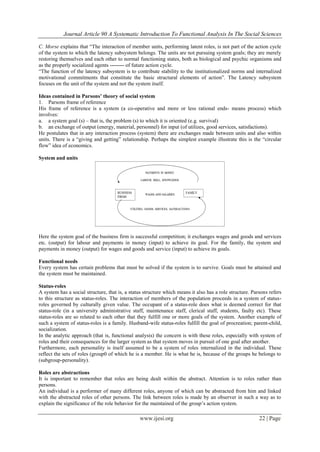
He postulates that in any interaction process (system) there are exchanges made between units and also within
units. There is a “giving and getting” relationship. Perhaps the simplest example illustrate this is the “circular
flow” idea of economics.
System and units
Here the system goal of the business firm is successful competition; it exchanges wages and goods and services
etc. (output) for labour and payments in money (input) to achieve its goal. For the family, the system and
payments in money (output) for wages and goods and service (input) to achieve its goals.
Functional needs
Every system has certain problems that must be solved if the system is to survive. Goals must be attained and
the system must be maintained.
Status-roles
A system has a social structure, that is, a status structure which means it also has a role structure. Parsons refers
to this structure as status-roles. The interaction of members of the population proceeds in a system of status-
roles governed by culturally given value. The occupant of a status-role does what is deemed correct for that
status-role (in a university administrative staff, maintenance staff, clerical staff, students, faulty etc). These
status-roles are so related to each other that they fulfill one or more goals of the system. Another example of
such a system of status-roles is a family. Husband-wife status-roles fulfill the goal of procreation; parent-child,
socialization.
In the analytic approach (that is, functional analysis) the concern is with these roles, especially with system of
roles and their consequences for the larger system as that system moves in pursuit of one goal after another.
Furthermore, each personality is itself assumed to be a system of roles internalized in the individual. These
reflect the sets of roles (group0 of which he is a member. He is what he is, because of the groups he belongs to
(subgroup-personality).
Roles are abstractions
It is important to remember that roles are being dealt within the abstract. Attention is to roles rather than
persons.
An individual is a performer of many different roles, anyone of which can be abstracted from him and linked
with the abstracted roles of other persons. The link between roles is made by an observer in such a way as to
explain the significance of the role behavior for the maintained of the group’s action system.
Journal Article 90 A Systematic Introduction To Functional Analysis In The Social Sciences
www.ijesi.org 23 | Page
The same role of many different persons enables us to account for a large part of the membership of a system,
by simply referring to that common role (students).
The same individual is a member of several sub-systems, but his role differs from one sub-system to another.
Interaction Processes in Terms of Roles and Transactions
The responsibilities of roles fall into two broad categories.
The first specifies how the role occupant must manipulate objects in the interest of goal attainment (i.e. what
people do). It is a technical role behavior and is incidental to interaction. Parsons is not very interested in this
category.
The second category of responsibilities refers to how the role occupant interacts with others- that is, what
performances and sanctions he renders in the interaction.
Talcott Parsons says, “Every concrete act has both a performance and a sanctions aspect”.
Performance- refers to that part of the act that has an effect on the state of the system (function).
Sanctions- refers to that part of the act that has an effect on the actor towards whom it is oriented (and thus only
indirectly, through his probable future action, on the state of the system). This is an analytical distinction.
Transactions are the substance of interaction process; they consist of a reciprocal discharge of role
responsibilities. They require “performance-sanctions” interchange and something that changes hands which is
disposed of and received. The something that change hands is called a social possession.
The social significance of possession arises from, and is embodied in, the fact that they are bundles of rights and
obligations.
Possessions come into being as the result of action processes; they are the “products” of action, and so are
included among the “consequences” of action. In the system, there is a distribution of two types of possessions-
facilities and rewards.
Facilities- refers to items that are to be used to attain some goal, and not as objects of direct gratification, they
assist action, they may be tangible or intangible.
Rewards- refers to items which gratify their recipients in their own rights because they express an evaluation of
a performing or a system of performances. Rewards may be positive or negative, Moser summarized this
discussion on roles and transaction. He says, “If we consider any two related roles, the implied interaction may
be summarized as follows.
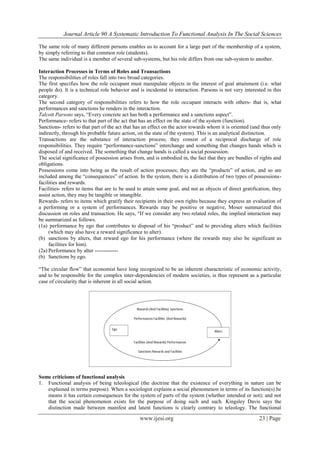
(1a) performance by ego that contributes to disposal of his “product” and to providing alters which facilities
(which may also have a reward significance to alter).
(b) sanctions by alters, that reward ego for his performance (where the rewards may also be significant as
facilities for him).
(2a) Performance by alter -------------
(b) Sanctions by ego.
“The circular flow” that economist have long recognized to be an inherent characteristic of economic activity,
and to be responsible for the complex inter-dependencies of modern societies, is thus represent as a particular
case of circularity that is inherent in all social action.
Some criticisms of functional analysis
1. Functional analysis of being teleological (the doctrine that the existence of everything in nature can be
explained in terms purpose). When a sociologist explains a social phenomenon in terms of its function(s) he
means it has certain consequences for the system of parts of the system (whether intended or not); and not
that the social phenomenon exists for the purpose of doing such and such. Kingsley Davis says the
distinction made between manifest and latent functions is clearly contrary to teleology. The functional
Journal Article 90 A Systematic Introduction To Functional Analysis In The Social Sciences
www.ijesi.org 24 | Page
theory of incest taboos does not hold that these exist because social consequences (functions) are perceived-
i.e. manifest functions. On the contrary, they are latent functions. The purpose the actors have in mind are
part of the mechanism by which the social functions are effected.
2. Functional analysis is accused of being ideological. But, argues Davis, a theory support or non support of a
moral or political bias is independent of its scientific validity.
3. By the postulate of universal functionalism it is assumed that every social phenomenon is functional. But
the question is – functional for what and for whom? What is functional for individual or group may be
dysfunctional for another. For instance, ethnocentrism may be functional for a group in that it increases the
solidarity and loyalty of a group i.e. integrative. At the same time it may be dysfunctional for the larger
society because it weakens the ties of individuals in that group to the larger society, that is, unintegrative.
Also, such things as crime can be shown to be functional.
4. By the postulate of functional unity, it is assumed that all the needs of a system are being met (or else the
system could not survive) and so there is no allowance for social change. But Davis does not think this is a
valid criticism and points out that some of the best analyses of social change have come from people
labeled functionalists. He says functionalism does allow for social change because the postulate of
functional unity does not assume complete functional unity. For instance, a section of the population may
not be sufficiently integrated within the society (e.g. workers). Then it could be expected that a new social
structure (in this case it was labour unions) would emerge to strengthen this integration. This is social
change.
5. Functional analysis is said to offer little by way of verification. Davis says this “is because functionalism is
preeminently social theory, and also tends to be broad and complex. The broader and more general a theory,
the less is the chance of proving or disproving it in its entirety.
6. Probably the greatest amount of, and most valid criticism, has been directed against Parson’s use of
functionalism. He has divided the functional needs of a system into four (A.G.I.L) and says there are
systems of activities (a functional subsystem) to solve each of these problems. These systems of activities
are made up of activities of a number of structural subsystems (i.e. actual groups, roles).
The activities of structural subsystem supposedly have consequences for all four functional subsystems -
A.G.I.L to some degree. The criticism is this: In order to get satisfactory results from Parsons scheme to the real
world, one must be thoroughly familiar with the subsystem being studied, and with Parsons theory. He must
know all the activities of all of the units of the subsystem. Then he must be able to classify the activities of the
subsystem according to the primary of the functions and perform. (A.G.I.L) That is, he must arbitrarily abstract
certain types of activity from among all the different activities of the units, (faculty, students, board members,
deans etc) and classify them as their primacy of function A.G.I.L.
Bibliography
[1]. G. A. Almond and J.S. Coleman: The politics of the developing areas: Princeton University Press, 1960.
[2]. J. J. N. Cloete: Introduction to Public Administration: Pretoria: J. L. van Schaik, 1985.
[3]. S. B. M. Marume: Public Administration: special contemporary problems and challenges; LAP Lambert Academic
Publishing, Berlin, Germany, 2015 [ISBN 978-3-659-75883-6]
[4]. S. B. M. Marume: Normative factors in public administration: LAP Lambert Academic Publishing: Berlin,
Germany 2015 [ISBN 978-3-659-49921-0]
[5]. D. Waldo: Perspectives on Administration: Alabama: Alabama University Press, 1956.
Profile of contributor and photograph
Samson Brown Muchineripi Marume: a former senior civil servant for over 37 years serving in
various capacities of seniority and 10 years as deputy permanent secretary; thirteen years as a large
commercial farmer; well-travelled domestically within Zimbabwe; regionally [SADC countries:
Angola, Botswana, Lesotho, Malawi, Mozambique, Mauritius, Swaziland, South Africa, Namibia,
Tanzania, Zambia and DRC]; and Africa [Kenya, Ethiopia, Sudan, Egypt, Nigeria, Ghana, Libya,
and Uganda]; and internationally [Washington, New York and California in USA; Dublin and Cork
in Irish Republic; England in United Kingdom; Netherlands, Frankfurt in Germany; Lisbon in
Portugal; Spain (Nice), Paris in France, Geneva in Switzerland, Belgrade in former Yugoslavia-;
Rome and Turin in Italy; Nicosia – Cyprus; Athens – Greece; Beijing and Great Walls of China;
Singapore; Hong Kong; Tokyo, Kyoto, Yokohama, and Osaka, in Japan]; fifteen years as
management consultant and part – time lecturer for BA/BSc and MA/MBA degree levels with Christ College- affiliate of
Great Zimbabwe University and National University of Science and Technology; six years as PhD/DPhil research thesis
supervisor, internal and external examiner with Christ University, Bangalore, India [2011 – 2016]; and Zimbabwe Open
University; external examiner of management and administrative sciences at Great Zimbabwe University (2016 – 2019);
currently senior lecturer and acting chairperson of Department of Public Administration in Faculty of Commerce and Law of
Zimbabwe Open University; a negotiator; a prolific writer who has published five books, prepared twenty five modules in
public administration and political science for undergraduate and postgraduate students, and published over sixty referred
journal articles in international journals [IOSR, IJSR, ISCA – IRJSS, IJESR, MJESR, IJESI, IJBMI, IJHSS and Quest
Journal Article 90 A Systematic Introduction To Functional Analysis In The Social Sciences
www.ijesi.org 25 | Page
Journals] on constitutional and administrative law, public administration, political science, philosophy, Africa in
international politics, local government and administration, sociology and community development; vastly experienced
public administrator; and an eminent scholar with specialist qualifications from University of South Africa, and from
California University for Advanced Studies, State of California, United States of America: BA with majors in public
administration and political science and subsidiaries in sociology, constitutional law and English; postgraduate special Hons
BA [Public Administration]; MA [Public Administration]; MAdmin magna cum laude in transport economics as major, and
minors in public management and communications; MSocSc cum laude in international politics as a major and minors in
comparative government and law, war and strategic studies, sociology, and social science research methodologies; and PhD
summa cum laude in Public Administration.

A Systematic Introduction to Functional Analysis in the Social Sciences

  • 1.
    International Journal ofEngineering Science Invention ISSN (Online): 2319 – 6734, ISSN (Print): 2319 – 6726 www.ijesi.org ||Volume 5 Issue 6|| June 2016 || PP.19-25 www.ijesi.org 19 | Page A Systematic Introduction to Functional Analysis in the Social Sciences Dr. S. B. M. Marume1 , 1 BA, Hons BA, MA, MAdmin, MSocSc, PhD Zimbabwe Open University Abstract: No study on functional analysis can be successfully concluded without reference to Talcott Parsons and Robert K. Merton, both world renowned functionalist luminaries in sociology. According to these sociologists a social system is viewed as being made up of interrelated and interacting parts; the parts having consequences for the whole system or some other parts of it, and there being a feedback of the consequences of a part for the system or some other part(s) on that part. Methodologically, functionalism, then, does three things, namely, that it relates: (a) parts of the system to the whole in terms of their consequences for the total system; (b) one part of the system to another part in terms of its consequences for another; and (c) the consequences of a part, back to that part in terms of the way those parts’ consequences for the system or some other parts react upon it. There are four explicit postulates of functional indispensability, and the distinction between manifest and latent functions. Keywords: sociology, system, manifest and latent functions, feedback and problems 1. Learning objectives To be able to  Define and describe what functional analysis does.  List and explain four postulates of functional analysis.  List Professor R. K. Mertons’ classifications of functions.  Explain the distinctions between manifest and latent functions in a social system.  Describe Talcott Parson’s four functional problems.  Outline some criticism of functional analysis.  Appreciate the suitability and applicability of functional analysis to social sciences. 2. The purpose of the article The purpose of this article, which is basically descriptive – analytical – explanatory in nature, is to:  Show what functional analysis is and does  outline its four postulates  Illustrate the concept function and distinction between manifest and latent functions.  Elaborate the four functional problems of any social system  Outline some of the limitations of functional analysis 3. A systematic introduction to functional analysis This topic is of special interest to sociologists of all ages in the first instance and in the second instance also to other social scientists [political scientists, economists, psychologists, public administration scientists] for variety of reasons. 3.1 What functional analysis can do In any discussion on the social system it is noted that a system is seen as being made up of interrelated and interacting parts; the parts having consequences for the whole system or some other parts of it, and there being a feed-back of the consequences of a part (for the system or some other part(s)) on that part. Functionalism, then, does three things, that is, it relates: a. parts of the system to the whole (in terms of their consequences for the whole) b. one part of the system to another (in terms of its consequences for another), and c. the consequences of a part, back to that part (in terms of the way those parts’ consequences for the system or some other parts) react upon it.
  • 2.
    Journal Article 90A Systematic Introduction To Functional Analysis In The Social Sciences www.ijesi.org 20 | Page 3.2 Some postulates of functional analysis Postulates, as you know are assumptions made or accepted, without proof, in order to explain something else. There are four explicit postulates of functional analysis, namely, 3.2.1 Functional unity This refers to the assumption that there is some integration and order in societies; that if societies exist there must be some sense in which each one more or less hangs together. The question of how this is accomplished, or is not accomplished is a central one for functionalists. 3.2.2 Universal functionalism This refers to the assumption that each social form has a role in social continuity; (i.e. performs a function or functions for the system). Kingsley Davis qualifies this by saying that “every social form should be examined from the standpoint of its possible role in social continuity”. 3.2.3 Functional indispensability This refers to two assumptions that certain: a. functions are indispensable for the persistence of a social system and b. cultural or social forms are indispensible in fulfilling each of these functions for example religion- integrative. This second assumption is questioned by some sociologists who think there are functional equivalents (i.e. one cultural or social form could replace another and perform the same function). 4. The distinction between manifest and latent functions This refers to the assumption that some functions are intended and recognized (manifest) and some are unintended and unrecognized (latent). Most quoted renowned and leading sociologists relevant to the study on functional analysis include: Talcott Parsons; R.M. Merton; Durkeim; Pareto; Max Weber Robert. K Merton [1957, 1964] introduced this distinction to eliminate the confusion between the subjective category of motive (conscious motivation, end-in-view) and the objective category of function (objective consequences). He says it is a conceptual distinction between the cases in which the subjective aim-in-view coincides with the objective consequences, i.e. manifest functions; and cases in which the subjective aim-in- view and the objective consequences diverge, i.e. latent functions. He defines manifest functions as those objective consequences contributing to the adjustment or adaptation (persistence and maintenance) of the system, which are intended and recognized by the participant in the systems which are intended, recognized and fundamental for the system; and latent functions are those consequences contributing to the adjustment or adaptation (persistence and maintenance) of the system, which are neither intended nor recognized – they are unintended, unrecognized and functional for the system. Merton also makes the sociological distinction between manifest dysfunctions intended, recognized and dysfunctional for the system; and latent dysfunctions- unintended, unrecognized and dysfunctional for the system. Functional analysis is to-day associated with Talcott Parsons (1902-79) a renowned American sociologist, and we will now pay our attention to his thinking on this subject but should note at the outset that the idea of studying social phenomena in terms of their consequences for other social phenomena and for society as a whole did not originate with Parsons. Influenced mainly by Durkheim, Pareto and Max Weber, Parsons refined the thinking of the earlier functionalists. Instead of looking at social phenomena (e.g. institutions) in terms of their functions for society, that is, in terms of the problems they solve for society, he saw society as a social system having certain problems that must be solved, if the society is to persist. A social system is a social interaction process in which a) a task is performed, and b) at, the same time, the system is maintained. A social system then, a. has a goal (or end), that is, it operates for the purpose of realizing some future state. (goal attainment) b. therefore, requires mechanisms (means) that adapt it to its environment. This is referred to as “external adaptation” and is a technical matter (adaptive) c. also requires mechanisms that fit together the activities of its various units, which may be individuals or groups. This is referred to as “internal adaptation”, and is a managerial matter, (integrative) d. needs its units pacified: and its newcomers taught the roles and values appropriate to the system, (latency and tension management). On the basis of this kind of reasoning, Parsons offered a theory of social systems that specifies:- i. the problem that must be solved in order for the system to survive (G.A.I.L). These are called variously – functional imperative functional needs, functional problems, functional requisites, systemic needs. ii. the social processes and functional subsystems and structural subsystems that meet these problems. Social processes refer to a set of activities directed towards the solution of one of the functional problems. A
  • 3.
    Journal Article 90A Systematic Introduction To Functional Analysis In The Social Sciences www.ijesi.org 21 | Page functional subsystem refers to an abstract term that is given to the social processes that have a bearing on one of the functional problems. A structural subsystem refers to social structure (in this case a substructure of the society) that has consequences, primarily for one of the functional problems. iii. the relationship between the subsystem of the social system Parsons says that there are four problems which must be solved if a social system is to persist. That is, there are four functional problems. He calls them goal attainment, the adaptive, the integrative and latency (or tension management and pattern maintenance) problems. The goal attainment problem: every social system has one or more goals that can only be attained through coordinated effort (e.g. national security). The action system must be kept moving steadily towards its goal(s), which are constantly redefined. Process: consultation, rational discussion, decision making. Functional subsystem: the “Polity”. Structural subsystem: in a complex system, the government. The adaptive problem: if the social system is to attain its goal (s), the object world must be properly perceived and rationally manipulated in relation to the goal (s) of the system. This is a technical matter. Process: the mobilization of the technical means that are required for (a) goal attainment and (b) latency. It includes the division of labour to exploit the resources and the organization of the means of production and distribution of goods, services and satisfactions. Functional subsystem: the “Economy”. Structural subsystem: business firms, factories, etc. The integrative problem: if the system is to persist, then some degree of loyalty to it is required and co- operation units must be held in line. This is a problem of morale and solidarity, which must be created and maintained in spite of disappointment and frustrations that are generated in the process of goal attainment and in the manner of sharing the fruits of co-operation. This refers to the units of the system, that is, inter unit integration. Process: is achieving and maintain the appropriate emotional and social relations between units of systems, by providing common ultimate goals, patterns of authority and social control. Functional subsystem: the integrative subsystem there is no distinctive abstract term for this functional subsystem. Structural subsystems: religion, law. The tension management and pattern maintenance (or latency) problem [TM and PM]: is to make sure that units of the system have the time and facilities, within a suitable conditioning environment, to constitute and reconstitute (create and re-create) the capacities needed by the system. This refers to the state of units themselves that is intra unit. Unit members must be pacified (tension management) and newcomers must be socialized (pattern maintenance). Processes: creating, maintaining and restoring the energies motive and values of the co-operating units (that is within the units) of the system. Functional subsystem: the latency (TM & PM) subsystem – there is no distinctive abstract term for the functional subsystem. Structural subsystem: family. Any social system can be analysed in terms of the four functional problems that have been discussed. The functional problems are solved by the functional subsystems. Parsons says the solutions of the functional problems always proceed in the following order. A – Adaptive; G – Goal attainment; I – integrative and L – Latency. That is, the system must first adapt to its environment A – to attain its goals. When the goal is attained (A), then morale and solidarity between units is restored (I), and the unit members themselves regenerated, (L), before it starts after another system goal (e.g. task group) Every social system can be divided (analytically) into its four functional subsystems on the basis of its four functional needs. Within each functional subsystem, the structural subsystems can also be divided into four subsystems (or 16 sub-subsystems- they will be called subsystems for convenience). Talcott Parsons says these subsystems interact with each other- that they touch each other in specific ways, making interchanges as the points of contact, and for the most part maintaining equilibrium. Four of these are concerned with values and according to Parsons there is no interchange of values, or f activities supporting them.
  • 4.
    Journal Article 90A Systematic Introduction To Functional Analysis In The Social Sciences www.ijesi.org 22 | Page C. Morse explains that “The interaction of member units, performing latent roles, is not part of the action cycle of the system to which the latency subsystem belongs. The units are not pursuing system goals; they are merely restoring themselves and each other to normal functioning states, both as biological and psychic organisms and as the properly socialized agents -------- of future action cycle. “The function of the latency subsystem is to contribute stability to the institutionalized norms and internalized motivational commitments that constitute the basic structural elements of action”. The Latency subsystem focuses on the unit of the system and not the system itself. Ideas contained in Parsons’ theory of social system 1. Parsons frame of reference His frame of reference is a system (a co-operative and more or less rational ends- means process) which involves: a. a system goal (s) – that is, the problem (s) to which it is oriented (e.g. survival) b. an exchange of output (energy, material, personnel) for input (of utilizes, good services, satisfactions). He postulates that in any interaction process (system) there are exchanges made between units and also within units. There is a “giving and getting” relationship. Perhaps the simplest example illustrate this is the “circular flow” idea of economics. System and units Here the system goal of the business firm is successful competition; it exchanges wages and goods and services etc. (output) for labour and payments in money (input) to achieve its goal. For the family, the system and payments in money (output) for wages and goods and service (input) to achieve its goals. Functional needs Every system has certain problems that must be solved if the system is to survive. Goals must be attained and the system must be maintained. Status-roles A system has a social structure, that is, a status structure which means it also has a role structure. Parsons refers to this structure as status-roles. The interaction of members of the population proceeds in a system of status- roles governed by culturally given value. The occupant of a status-role does what is deemed correct for that status-role (in a university administrative staff, maintenance staff, clerical staff, students, faulty etc). These status-roles are so related to each other that they fulfill one or more goals of the system. Another example of such a system of status-roles is a family. Husband-wife status-roles fulfill the goal of procreation; parent-child, socialization. In the analytic approach (that is, functional analysis) the concern is with these roles, especially with system of roles and their consequences for the larger system as that system moves in pursuit of one goal after another. Furthermore, each personality is itself assumed to be a system of roles internalized in the individual. These reflect the sets of roles (group0 of which he is a member. He is what he is, because of the groups he belongs to (subgroup-personality). Roles are abstractions It is important to remember that roles are being dealt within the abstract. Attention is to roles rather than persons. An individual is a performer of many different roles, anyone of which can be abstracted from him and linked with the abstracted roles of other persons. The link between roles is made by an observer in such a way as to explain the significance of the role behavior for the maintained of the group’s action system.
  • 5.
    Journal Article 90A Systematic Introduction To Functional Analysis In The Social Sciences www.ijesi.org 23 | Page The same role of many different persons enables us to account for a large part of the membership of a system, by simply referring to that common role (students). The same individual is a member of several sub-systems, but his role differs from one sub-system to another. Interaction Processes in Terms of Roles and Transactions The responsibilities of roles fall into two broad categories. The first specifies how the role occupant must manipulate objects in the interest of goal attainment (i.e. what people do). It is a technical role behavior and is incidental to interaction. Parsons is not very interested in this category. The second category of responsibilities refers to how the role occupant interacts with others- that is, what performances and sanctions he renders in the interaction. Talcott Parsons says, “Every concrete act has both a performance and a sanctions aspect”. Performance- refers to that part of the act that has an effect on the state of the system (function). Sanctions- refers to that part of the act that has an effect on the actor towards whom it is oriented (and thus only indirectly, through his probable future action, on the state of the system). This is an analytical distinction. Transactions are the substance of interaction process; they consist of a reciprocal discharge of role responsibilities. They require “performance-sanctions” interchange and something that changes hands which is disposed of and received. The something that change hands is called a social possession. The social significance of possession arises from, and is embodied in, the fact that they are bundles of rights and obligations. Possessions come into being as the result of action processes; they are the “products” of action, and so are included among the “consequences” of action. In the system, there is a distribution of two types of possessions- facilities and rewards. Facilities- refers to items that are to be used to attain some goal, and not as objects of direct gratification, they assist action, they may be tangible or intangible. Rewards- refers to items which gratify their recipients in their own rights because they express an evaluation of a performing or a system of performances. Rewards may be positive or negative, Moser summarized this discussion on roles and transaction. He says, “If we consider any two related roles, the implied interaction may be summarized as follows. (1a) performance by ego that contributes to disposal of his “product” and to providing alters which facilities (which may also have a reward significance to alter). (b) sanctions by alters, that reward ego for his performance (where the rewards may also be significant as facilities for him). (2a) Performance by alter ------------- (b) Sanctions by ego. “The circular flow” that economist have long recognized to be an inherent characteristic of economic activity, and to be responsible for the complex inter-dependencies of modern societies, is thus represent as a particular case of circularity that is inherent in all social action. Some criticisms of functional analysis 1. Functional analysis of being teleological (the doctrine that the existence of everything in nature can be explained in terms purpose). When a sociologist explains a social phenomenon in terms of its function(s) he means it has certain consequences for the system of parts of the system (whether intended or not); and not that the social phenomenon exists for the purpose of doing such and such. Kingsley Davis says the distinction made between manifest and latent functions is clearly contrary to teleology. The functional
  • 6.
    Journal Article 90A Systematic Introduction To Functional Analysis In The Social Sciences www.ijesi.org 24 | Page theory of incest taboos does not hold that these exist because social consequences (functions) are perceived- i.e. manifest functions. On the contrary, they are latent functions. The purpose the actors have in mind are part of the mechanism by which the social functions are effected. 2. Functional analysis is accused of being ideological. But, argues Davis, a theory support or non support of a moral or political bias is independent of its scientific validity. 3. By the postulate of universal functionalism it is assumed that every social phenomenon is functional. But the question is – functional for what and for whom? What is functional for individual or group may be dysfunctional for another. For instance, ethnocentrism may be functional for a group in that it increases the solidarity and loyalty of a group i.e. integrative. At the same time it may be dysfunctional for the larger society because it weakens the ties of individuals in that group to the larger society, that is, unintegrative. Also, such things as crime can be shown to be functional. 4. By the postulate of functional unity, it is assumed that all the needs of a system are being met (or else the system could not survive) and so there is no allowance for social change. But Davis does not think this is a valid criticism and points out that some of the best analyses of social change have come from people labeled functionalists. He says functionalism does allow for social change because the postulate of functional unity does not assume complete functional unity. For instance, a section of the population may not be sufficiently integrated within the society (e.g. workers). Then it could be expected that a new social structure (in this case it was labour unions) would emerge to strengthen this integration. This is social change. 5. Functional analysis is said to offer little by way of verification. Davis says this “is because functionalism is preeminently social theory, and also tends to be broad and complex. The broader and more general a theory, the less is the chance of proving or disproving it in its entirety. 6. Probably the greatest amount of, and most valid criticism, has been directed against Parson’s use of functionalism. He has divided the functional needs of a system into four (A.G.I.L) and says there are systems of activities (a functional subsystem) to solve each of these problems. These systems of activities are made up of activities of a number of structural subsystems (i.e. actual groups, roles). The activities of structural subsystem supposedly have consequences for all four functional subsystems - A.G.I.L to some degree. The criticism is this: In order to get satisfactory results from Parsons scheme to the real world, one must be thoroughly familiar with the subsystem being studied, and with Parsons theory. He must know all the activities of all of the units of the subsystem. Then he must be able to classify the activities of the subsystem according to the primary of the functions and perform. (A.G.I.L) That is, he must arbitrarily abstract certain types of activity from among all the different activities of the units, (faculty, students, board members, deans etc) and classify them as their primacy of function A.G.I.L. Bibliography [1]. G. A. Almond and J.S. Coleman: The politics of the developing areas: Princeton University Press, 1960. [2]. J. J. N. Cloete: Introduction to Public Administration: Pretoria: J. L. van Schaik, 1985. [3]. S. B. M. Marume: Public Administration: special contemporary problems and challenges; LAP Lambert Academic Publishing, Berlin, Germany, 2015 [ISBN 978-3-659-75883-6] [4]. S. B. M. Marume: Normative factors in public administration: LAP Lambert Academic Publishing: Berlin, Germany 2015 [ISBN 978-3-659-49921-0] [5]. D. Waldo: Perspectives on Administration: Alabama: Alabama University Press, 1956. Profile of contributor and photograph Samson Brown Muchineripi Marume: a former senior civil servant for over 37 years serving in various capacities of seniority and 10 years as deputy permanent secretary; thirteen years as a large commercial farmer; well-travelled domestically within Zimbabwe; regionally [SADC countries: Angola, Botswana, Lesotho, Malawi, Mozambique, Mauritius, Swaziland, South Africa, Namibia, Tanzania, Zambia and DRC]; and Africa [Kenya, Ethiopia, Sudan, Egypt, Nigeria, Ghana, Libya, and Uganda]; and internationally [Washington, New York and California in USA; Dublin and Cork in Irish Republic; England in United Kingdom; Netherlands, Frankfurt in Germany; Lisbon in Portugal; Spain (Nice), Paris in France, Geneva in Switzerland, Belgrade in former Yugoslavia-; Rome and Turin in Italy; Nicosia – Cyprus; Athens – Greece; Beijing and Great Walls of China; Singapore; Hong Kong; Tokyo, Kyoto, Yokohama, and Osaka, in Japan]; fifteen years as management consultant and part – time lecturer for BA/BSc and MA/MBA degree levels with Christ College- affiliate of Great Zimbabwe University and National University of Science and Technology; six years as PhD/DPhil research thesis supervisor, internal and external examiner with Christ University, Bangalore, India [2011 – 2016]; and Zimbabwe Open University; external examiner of management and administrative sciences at Great Zimbabwe University (2016 – 2019); currently senior lecturer and acting chairperson of Department of Public Administration in Faculty of Commerce and Law of Zimbabwe Open University; a negotiator; a prolific writer who has published five books, prepared twenty five modules in public administration and political science for undergraduate and postgraduate students, and published over sixty referred journal articles in international journals [IOSR, IJSR, ISCA – IRJSS, IJESR, MJESR, IJESI, IJBMI, IJHSS and Quest
  • 7.
    Journal Article 90A Systematic Introduction To Functional Analysis In The Social Sciences www.ijesi.org 25 | Page Journals] on constitutional and administrative law, public administration, political science, philosophy, Africa in international politics, local government and administration, sociology and community development; vastly experienced public administrator; and an eminent scholar with specialist qualifications from University of South Africa, and from California University for Advanced Studies, State of California, United States of America: BA with majors in public administration and political science and subsidiaries in sociology, constitutional law and English; postgraduate special Hons BA [Public Administration]; MA [Public Administration]; MAdmin magna cum laude in transport economics as major, and minors in public management and communications; MSocSc cum laude in international politics as a major and minors in comparative government and law, war and strategic studies, sociology, and social science research methodologies; and PhD summa cum laude in Public Administration.