03/16/12
                                                  Tinniam V Ganesh tvganesh.85@gmail.com
    SIGNALING SYSTEM 7 (SS7)


1

                   Tinniam.V. Ganesh
                  tvganesh.85@gmail.com
                  http://gigadom.wordpress.com/
WHAT IS COMMUNICATION ?


                                                 03/16/12
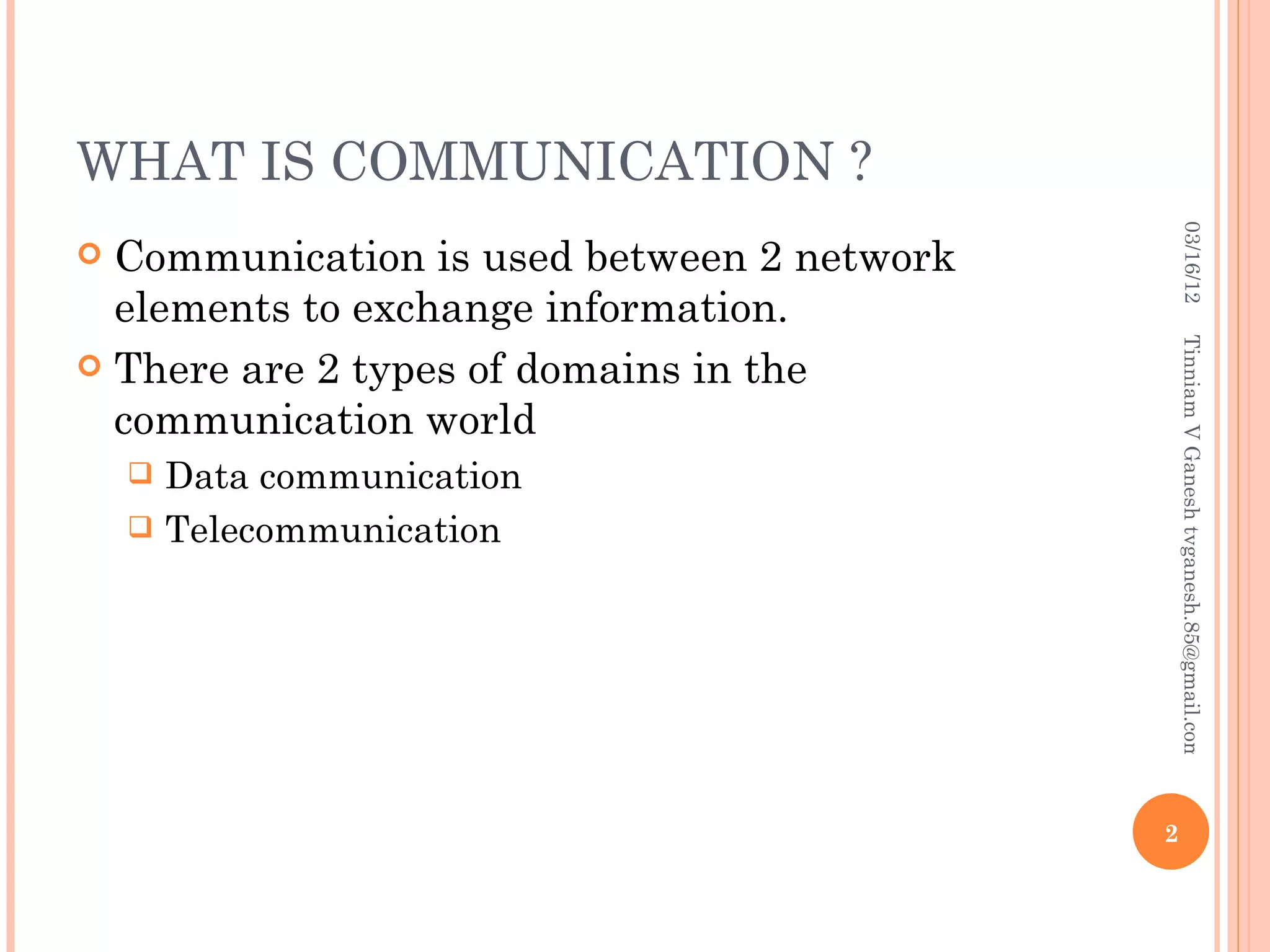
 Communication is used between 2 network
  elements to exchange information.


                                                Tinniam V Ganesh tvganesh.85@gmail.com
 There are 2 types of domains in the
  communication world
     Data communication
     Telecommunication


                                            2
DIFFERENCES BETWEEN TELECOM &
DATACOM


                                                                        03/16/12
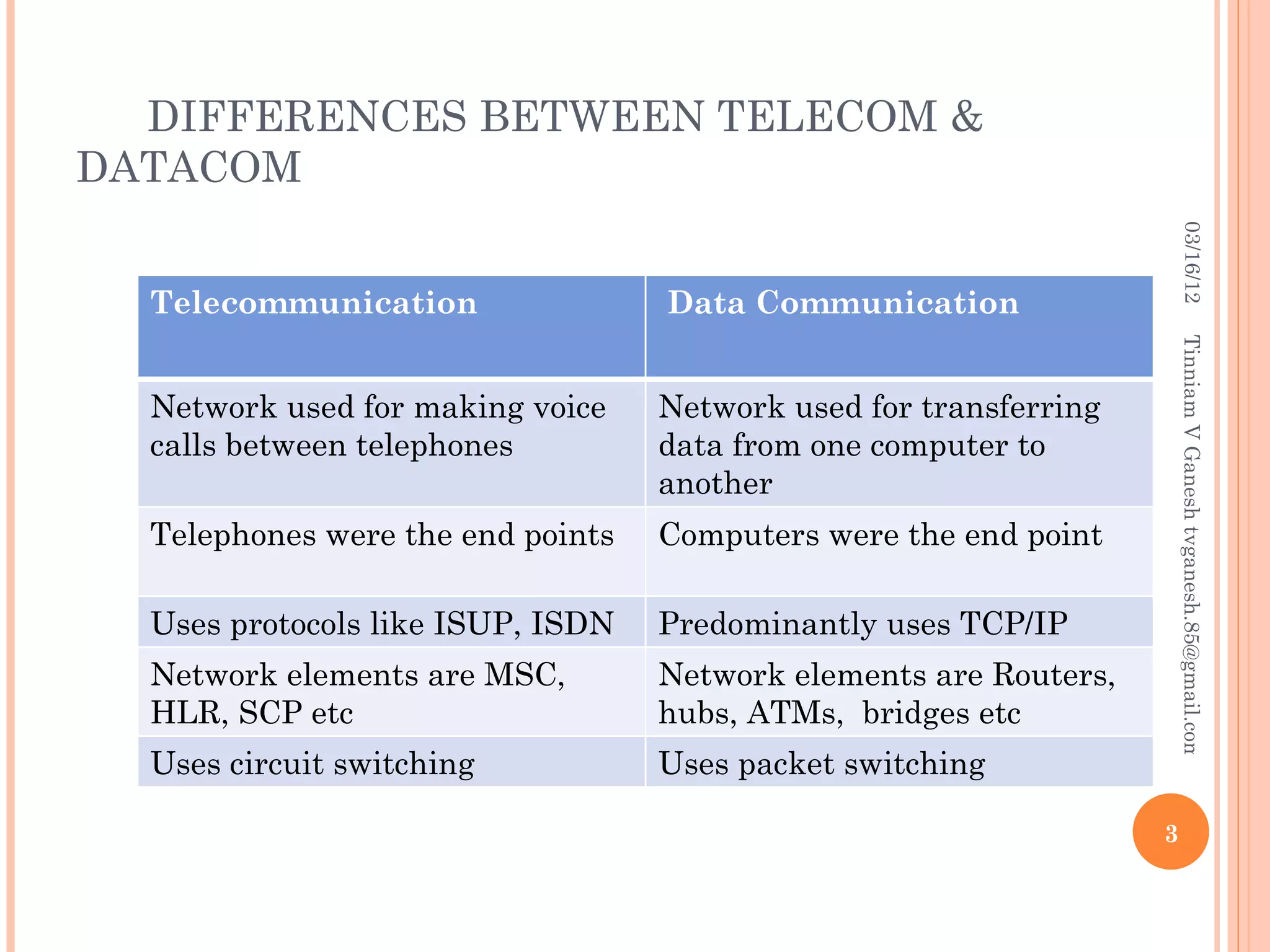
  Telecommunication                Data Communication


                                                                       Tinniam V Ganesh tvganesh.85@gmail.com
  Network used for making voice    Network used for transferring
  calls between telephones         data from one computer to
                                   another
  Telephones were the end points   Computers were the end point

  Uses protocols like ISUP, ISDN   Predominantly uses TCP/IP
  Network elements are MSC,        Network elements are Routers,
  HLR, SCP etc                     hubs, ATMs, bridges etc
  Uses circuit switching           Uses packet switching

                                                                   3
NETWORKS OF TODAY …


                                                         03/16/12
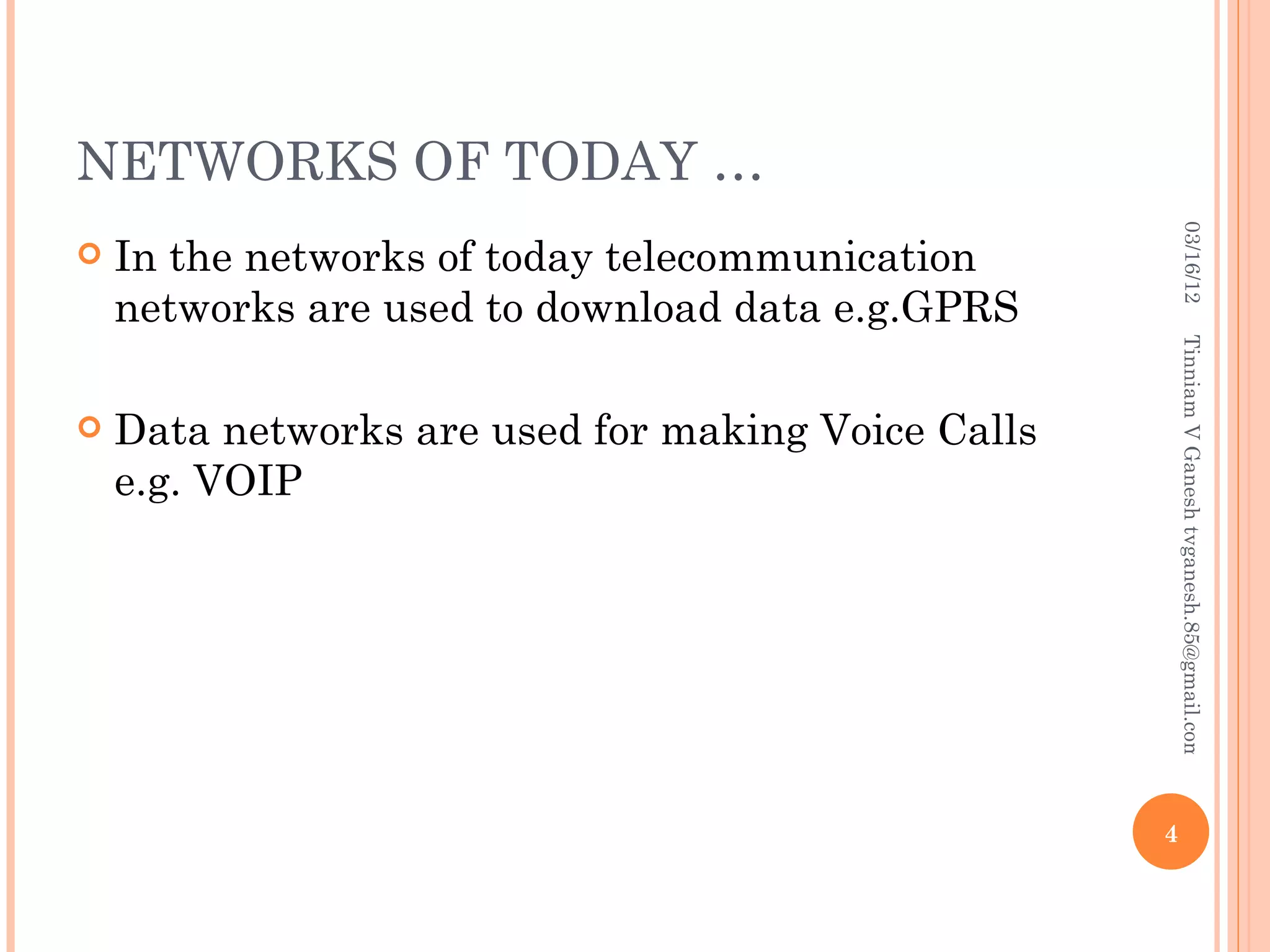
   In the networks of today telecommunication
    networks are used to download data e.g.GPRS


                                                        Tinniam V Ganesh tvganesh.85@gmail.com
   Data networks are used for making Voice Calls
    e.g. VOIP


                                                    4
WHAT IS SIGNALING ?


                                                         03/16/12
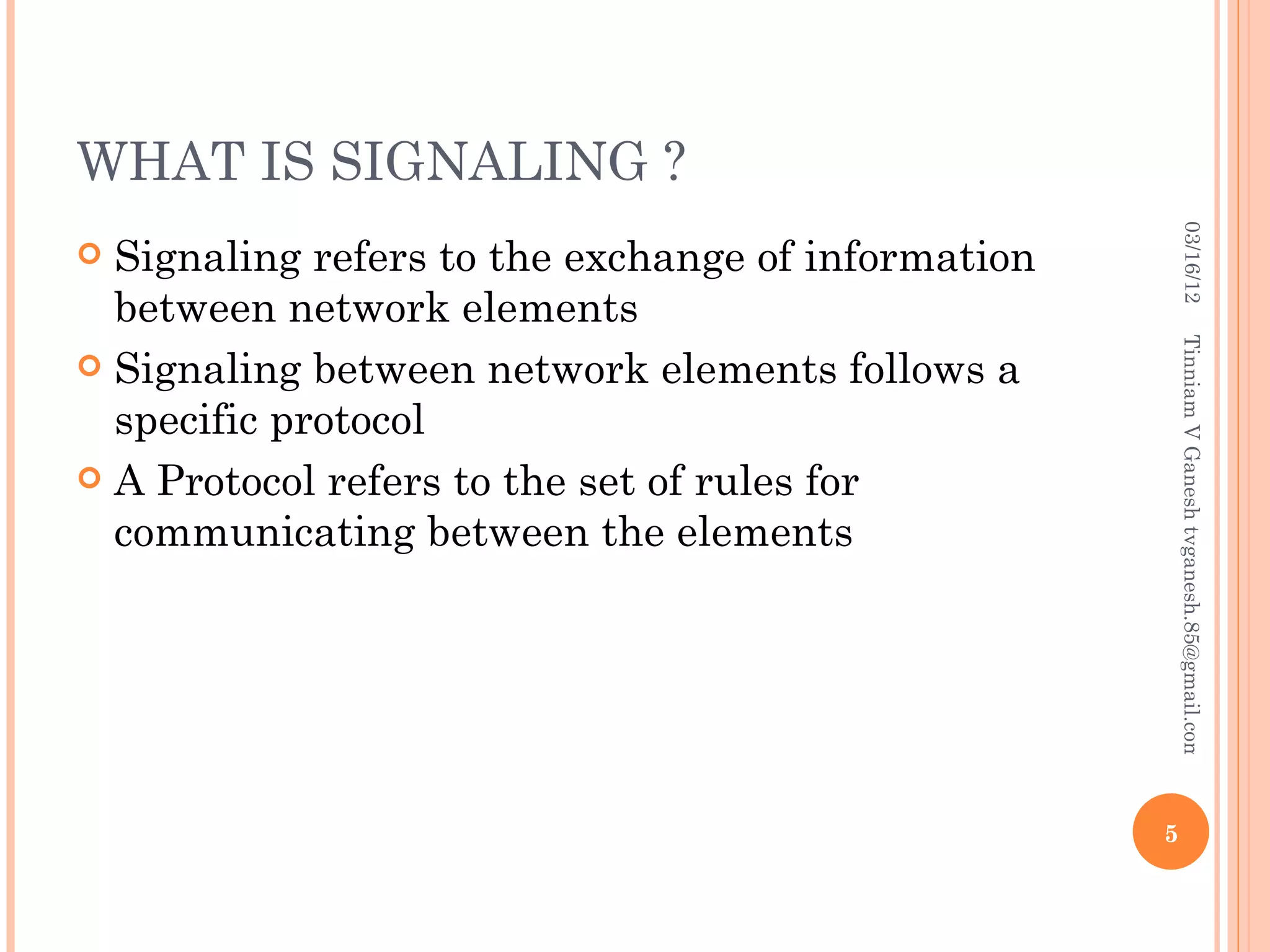
 Signaling refers to the exchange of information
  between network elements


                                                        Tinniam V Ganesh tvganesh.85@gmail.com
 Signaling between network elements follows a
  specific protocol
 A Protocol refers to the set of rules for
  communicating between the elements


                                                    5
WHAT IS SS7 SIGNALING ?


                                                            03/16/12
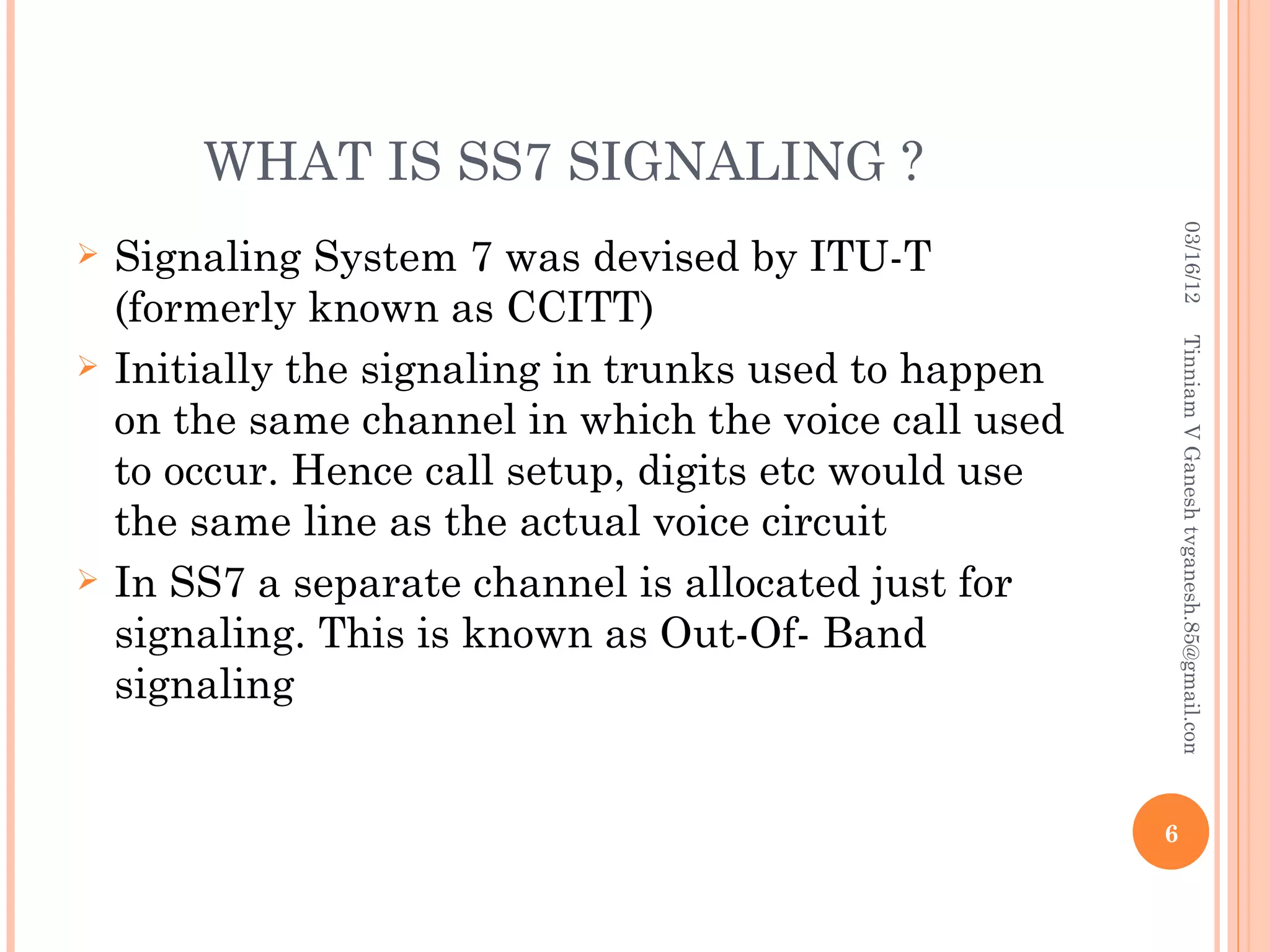
   Signaling System 7 was devised by ITU-T
    (formerly known as CCITT)


                                                           Tinniam V Ganesh tvganesh.85@gmail.com
   Initially the signaling in trunks used to happen
    on the same channel in which the voice call used
    to occur. Hence call setup, digits etc would use
    the same line as the actual voice circuit
   In SS7 a separate channel is allocated just for
    signaling. This is known as Out-Of- Band
    signaling


                                                       6
SS7 SIGNALING


                                                           03/16/12
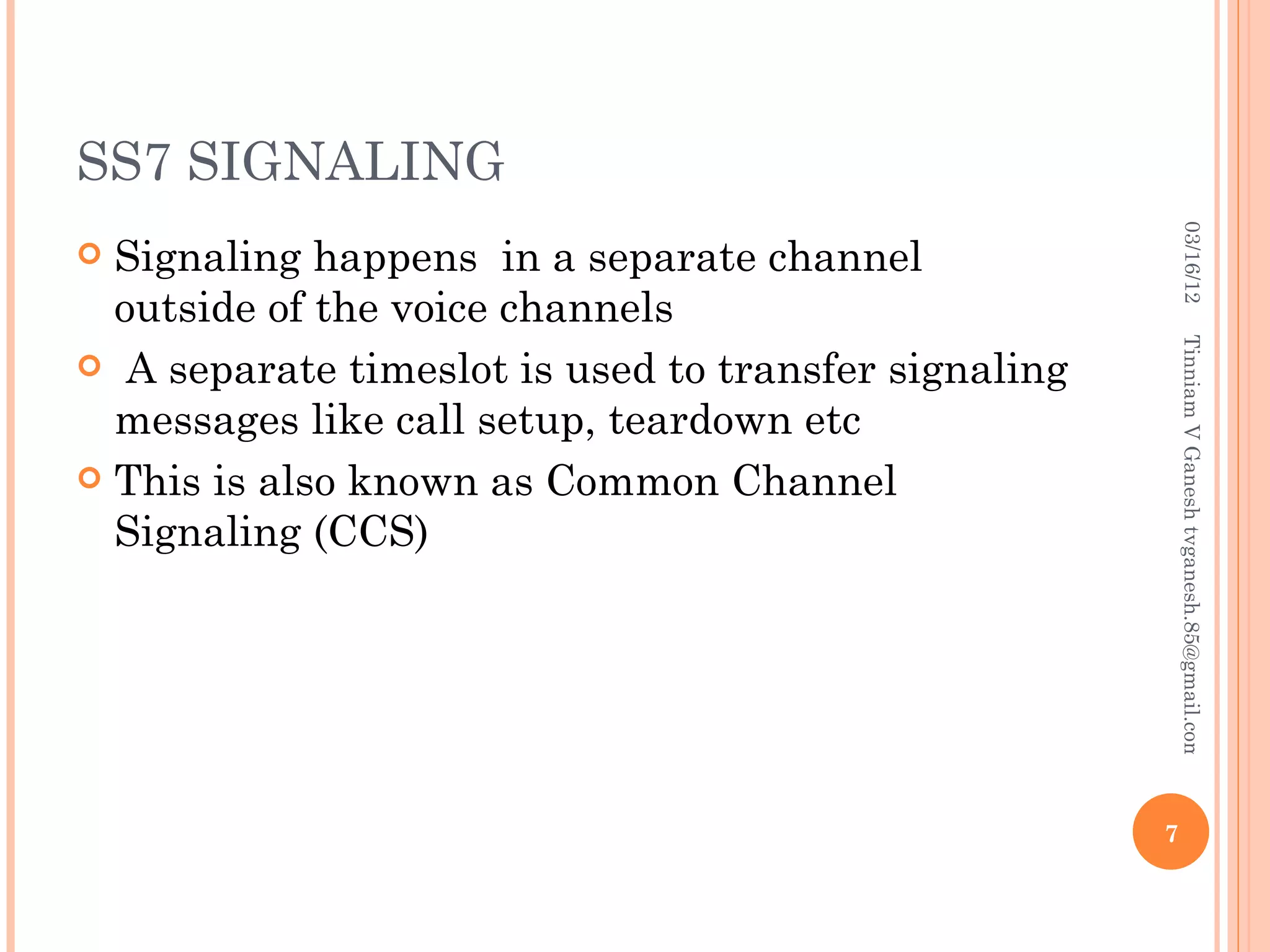
 Signaling happens in a separate channel
  outside of the voice channels


                                                          Tinniam V Ganesh tvganesh.85@gmail.com
 A separate timeslot is used to transfer signaling
  messages like call setup, teardown etc
 This is also known as Common Channel
  Signaling (CCS)


                                                      7
ADVANTAGES OF OUT OF BAND
SIGNALING


                                                       03/16/12
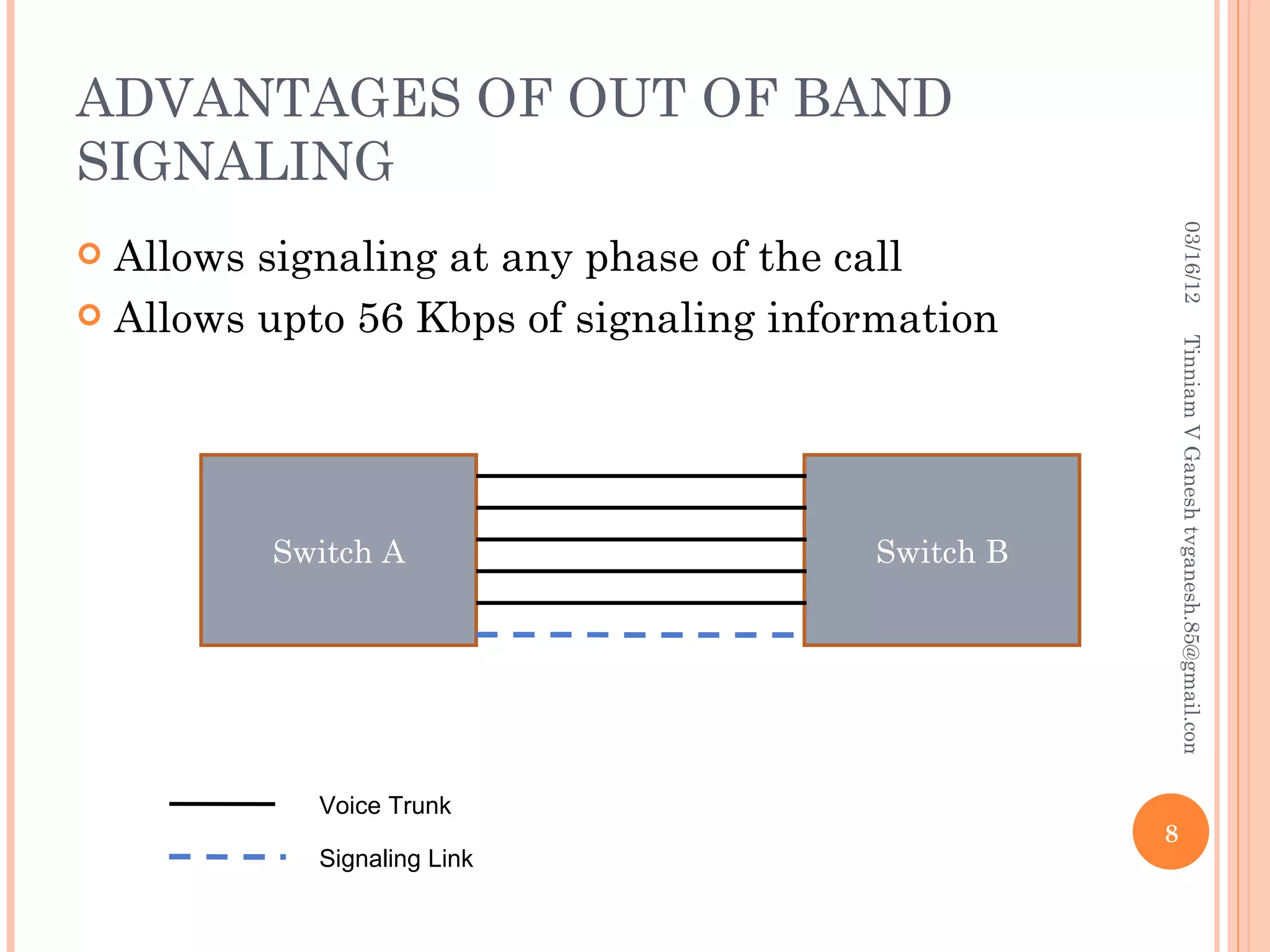
 Allows signaling at any phase of the call
 Allows upto 56 Kbps of signaling information


                                                      Tinniam V Ganesh tvganesh.85@gmail.com
         Switch A                      Switch B


            Voice Trunk
                                                  8
            Signaling Link
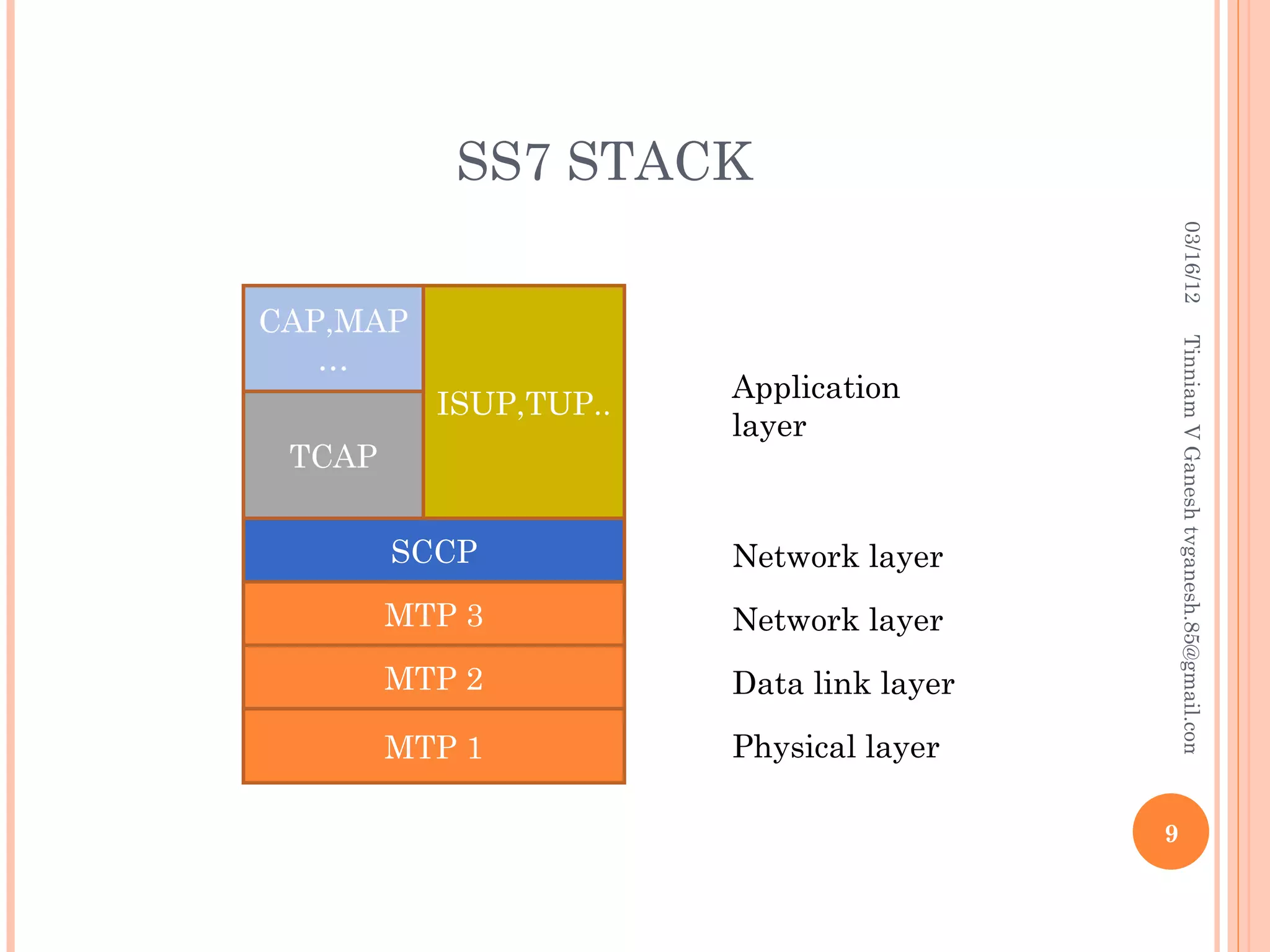
SS7 STACK


                                              03/16/12
CAP,MAP


                                             Tinniam V Ganesh tvganesh.85@gmail.com
   …
                       Application
          ISUP,TUP..
                       layer
 TCAP


        SCCP           Network layer
        MTP 3          Network layer
        MTP 2          Data link layer

        MTP 1          Physical layer

                                         9
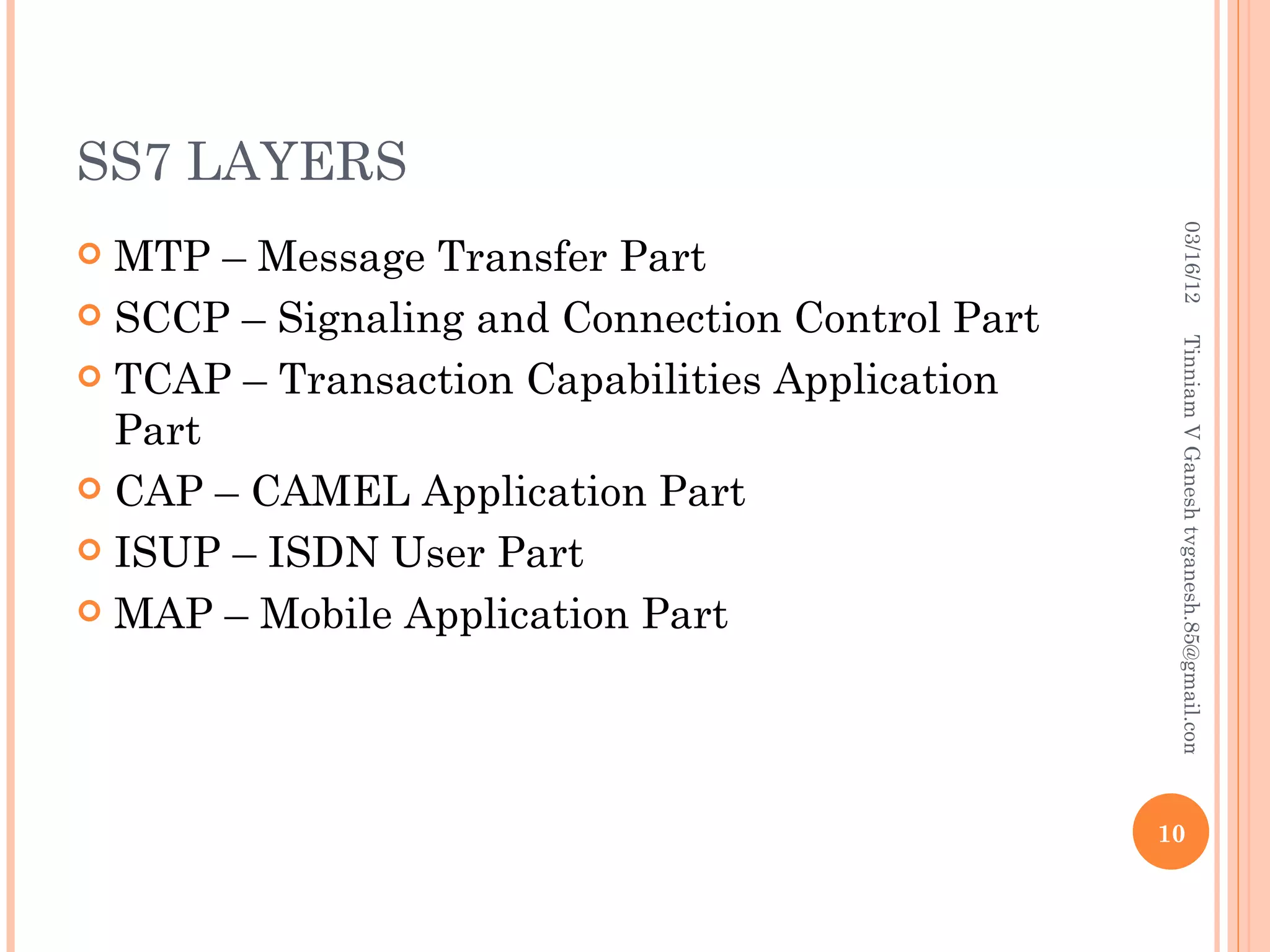
SS7 LAYERS


                                                   03/16/12
 MTP – Message Transfer Part
 SCCP – Signaling and Connection Control Part


                                                  Tinniam V Ganesh tvganesh.85@gmail.com
 TCAP – Transaction Capabilities Application
  Part
 CAP – CAMEL Application Part

 ISUP – ISDN User Part

 MAP – Mobile Application Part


                                                 10
03/16/12   Tinniam V Ganesh tvganesh.85@gmail.com
                                                                       11
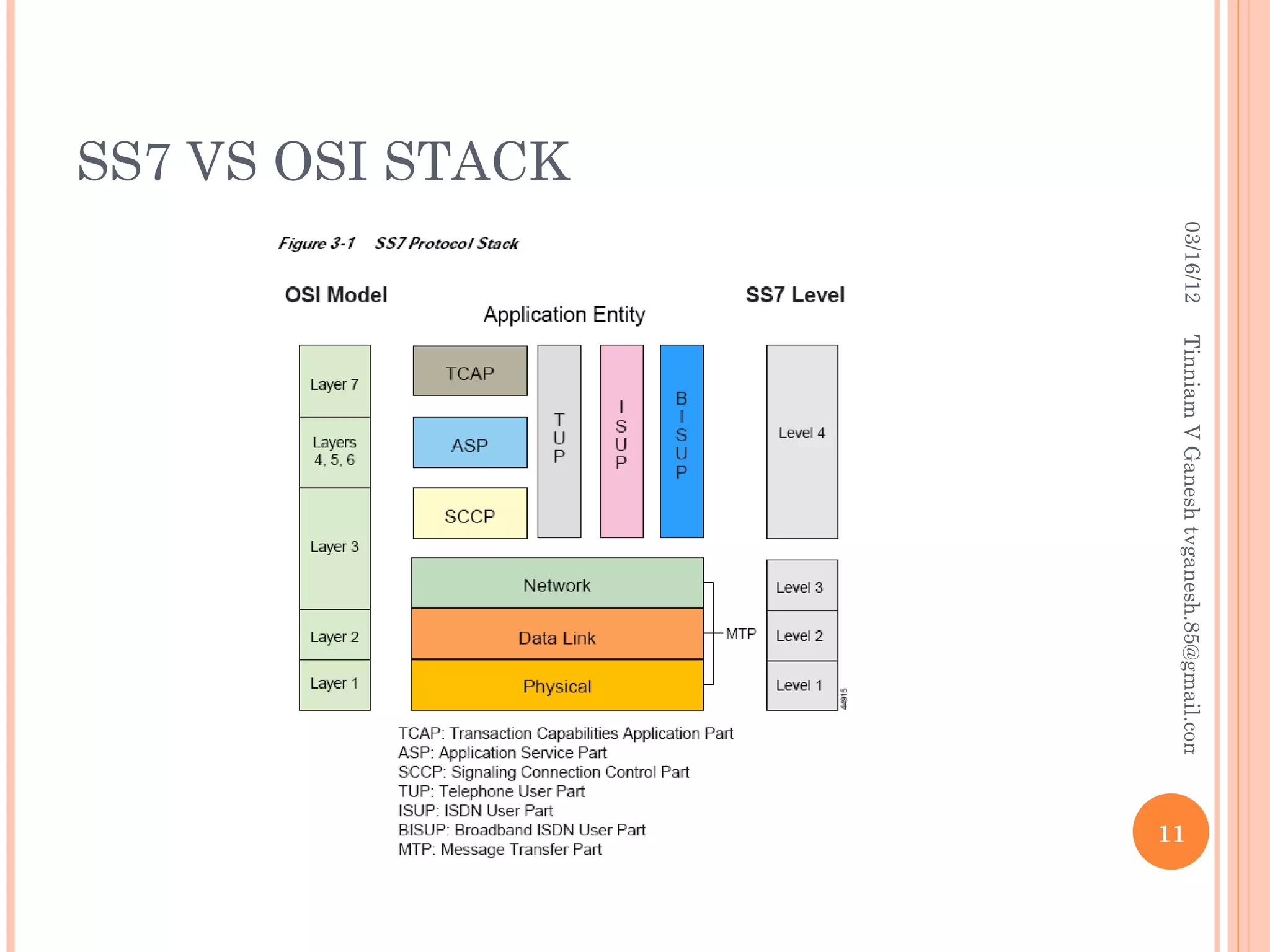
SS7 VS OSI STACK
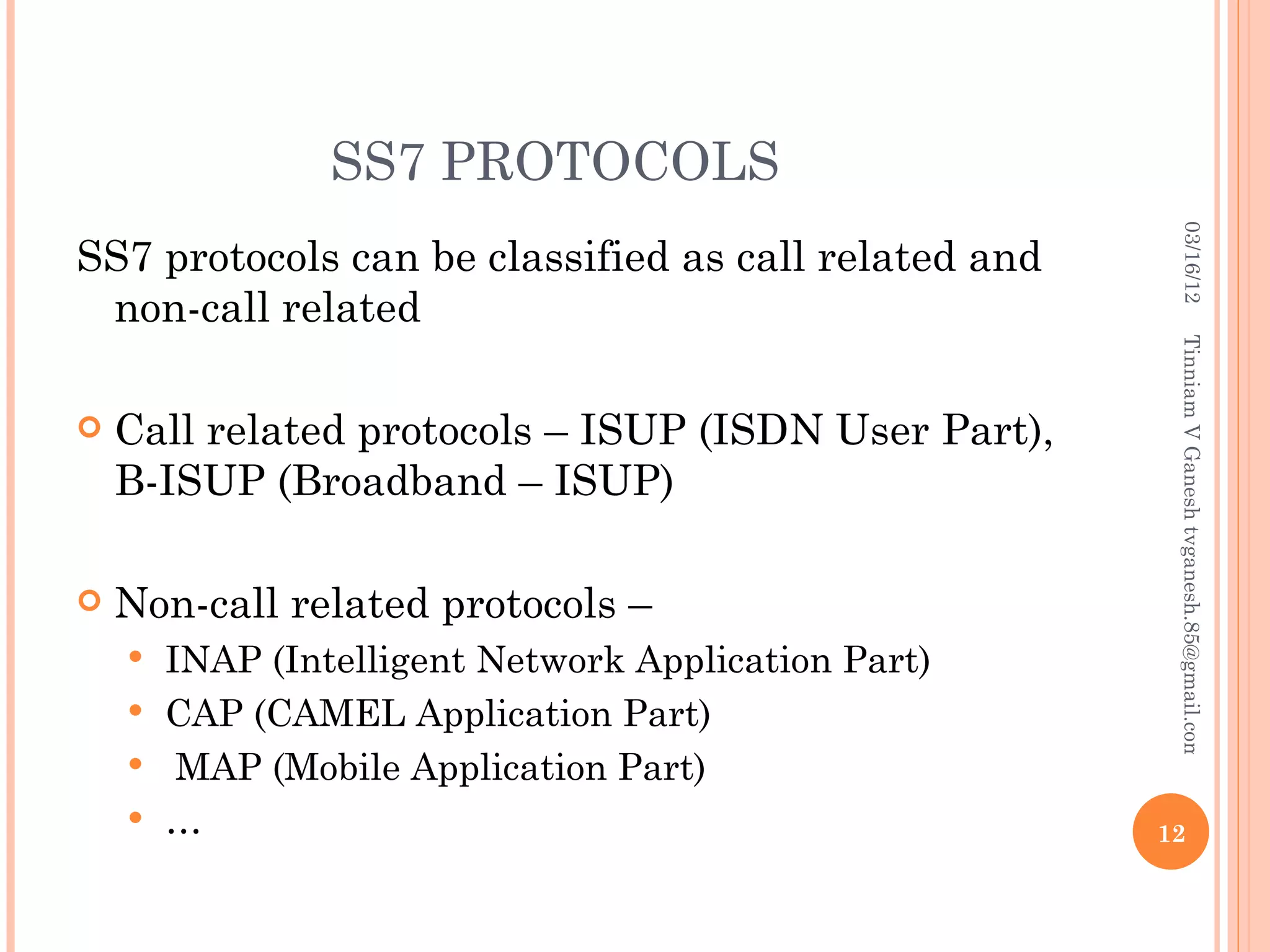
SS7 PROTOCOLS


                                                        03/16/12
SS7 protocols can be classified as call related and
 non-call related


                                                       Tinniam V Ganesh tvganesh.85@gmail.com
   Call related protocols – ISUP (ISDN User Part),
    B-ISUP (Broadband – ISUP)

   Non-call related protocols –
     INAP (Intelligent Network Application Part)
     CAP (CAMEL Application Part)
     MAP (Mobile Application Part)
     …                                               12
SS7 STANDARD BODIES


                                                        03/16/12
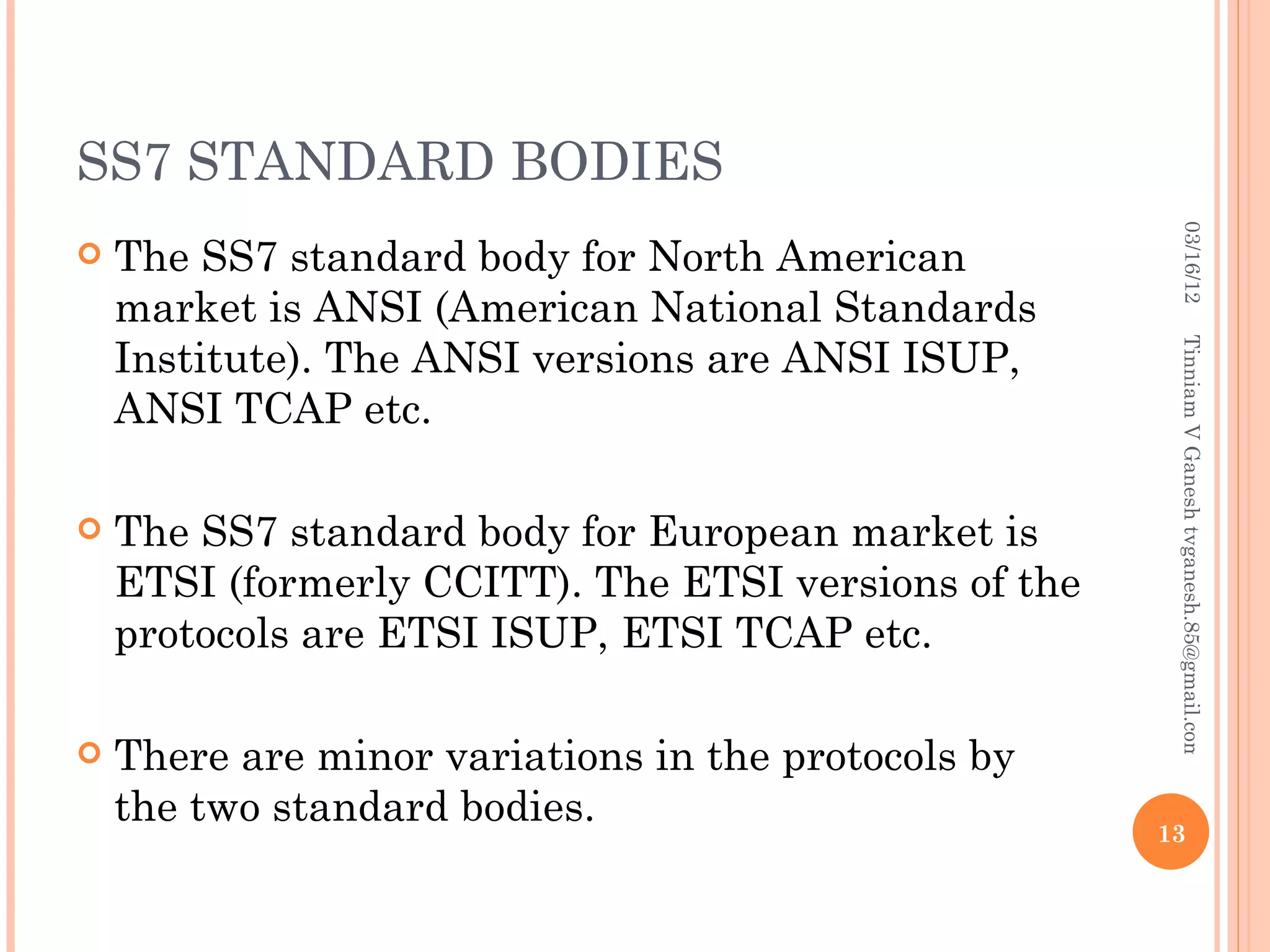
   The SS7 standard body for North American
    market is ANSI (American National Standards
    Institute). The ANSI versions are ANSI ISUP,


                                                       Tinniam V Ganesh tvganesh.85@gmail.com
    ANSI TCAP etc.

   The SS7 standard body for European market is
    ETSI (formerly CCITT). The ETSI versions of the
    protocols are ETSI ISUP, ETSI TCAP etc.

   There are minor variations in the protocols by
    the two standard bodies.
                                                      13
SS7 Link speeds

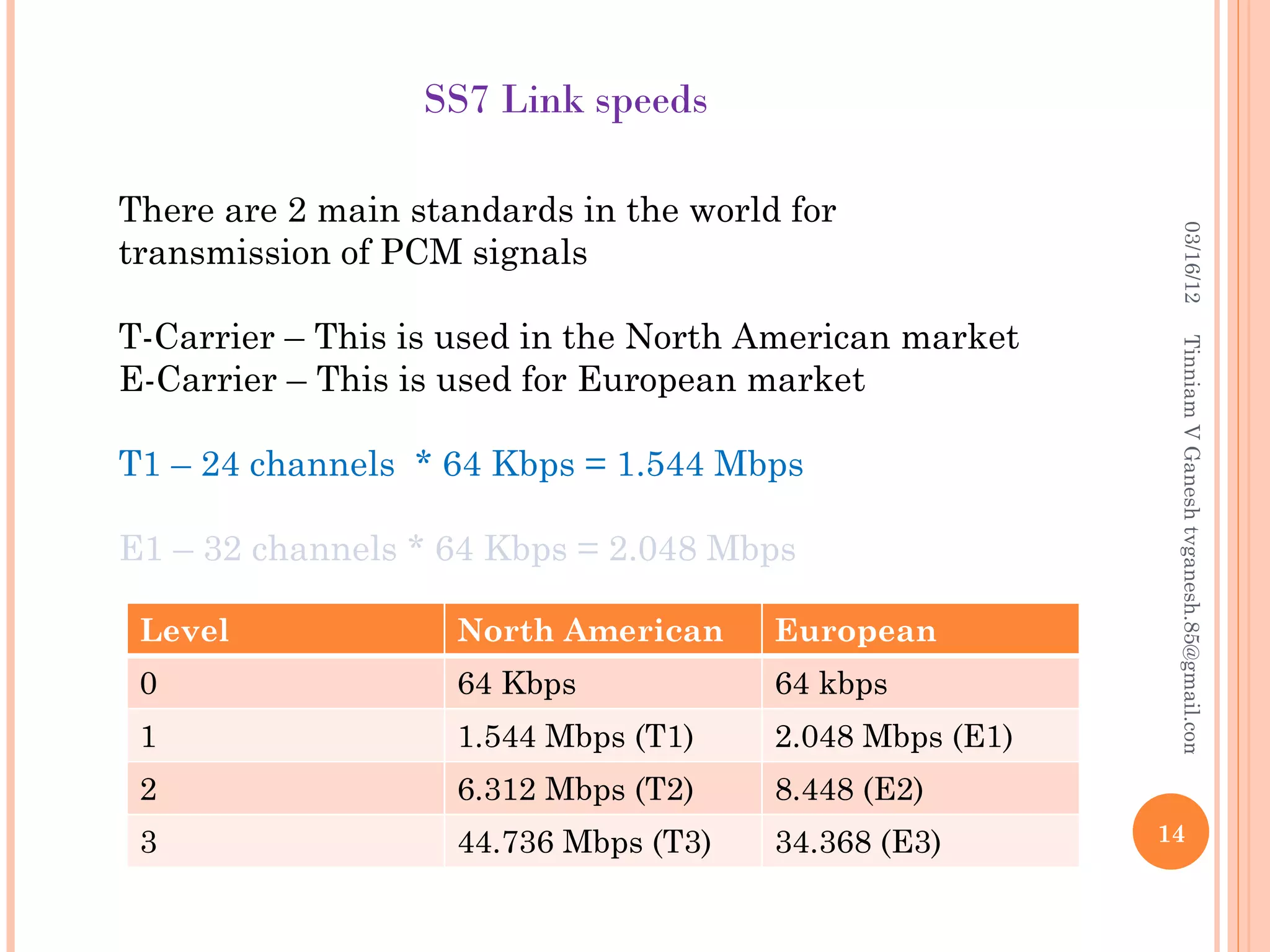
There are 2 main standards in the world for


                                                           03/16/12
transmission of PCM signals

T-Carrier – This is used in the North American market


                                                          Tinniam V Ganesh tvganesh.85@gmail.com
E-Carrier – This is used for European market

T1 – 24 channels * 64 Kbps = 1.544 Mbps

E1 – 32 channels * 64 Kbps = 2.048 Mbps

 Level              North American     European
 0                  64 Kbps            64 kbps
 1                  1.544 Mbps (T1)    2.048 Mbps (E1)
 2                  6.312 Mbps (T2)    8.448 (E2)
 3                  44.736 Mbps (T3)   34.368 (E3)       14
MTP LAYER 1 – PHYSICAL LAYER


                                                       03/16/12
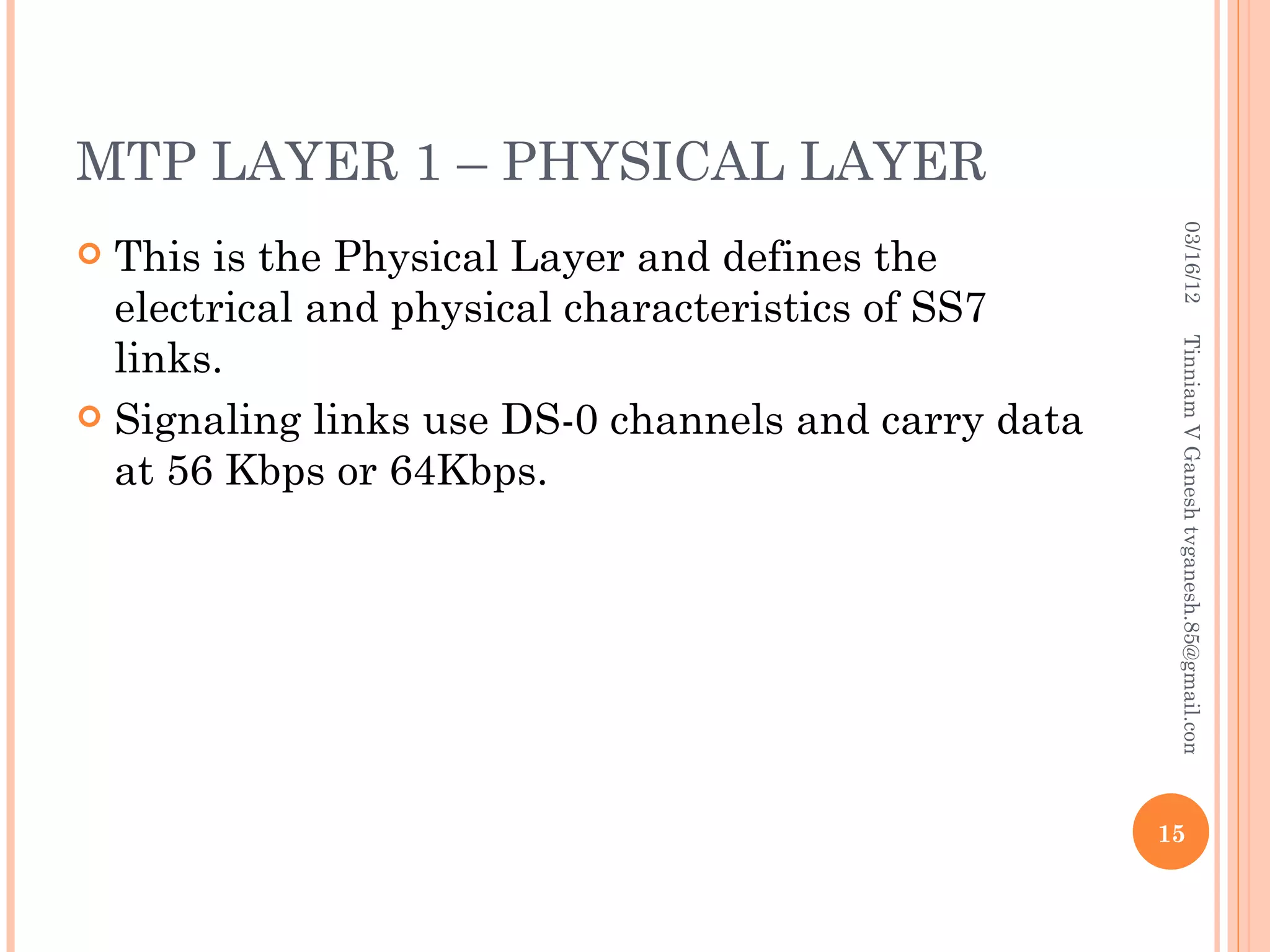
 This is the Physical Layer and defines the
  electrical and physical characteristics of SS7
  links.


                                                      Tinniam V Ganesh tvganesh.85@gmail.com
 Signaling links use DS-0 channels and carry data
  at 56 Kbps or 64Kbps.


                                                     15
MTP LAYER 2 – DATA LINK LAYER


                                                    03/16/12
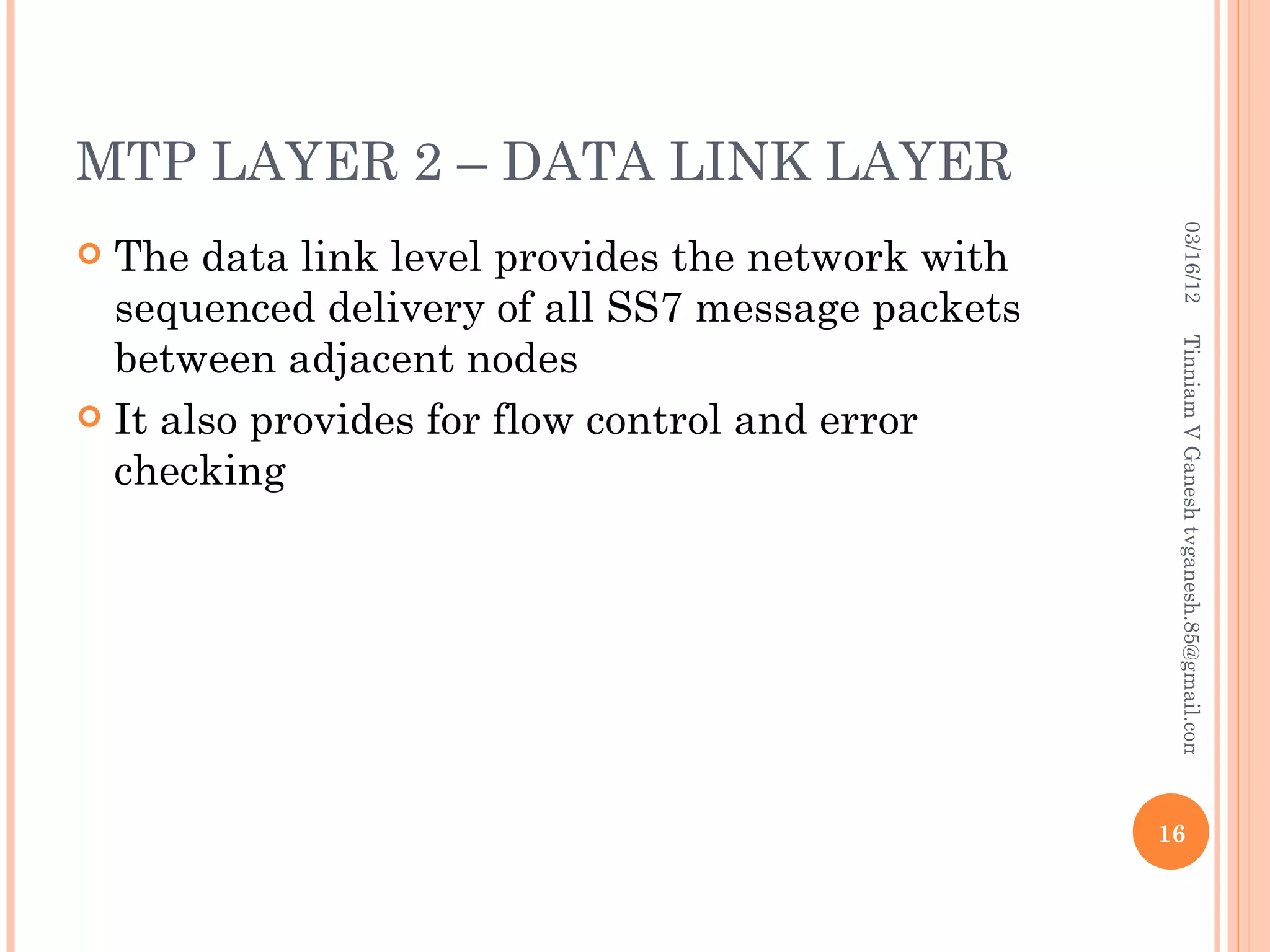
 The data link level provides the network with
  sequenced delivery of all SS7 message packets
  between adjacent nodes


                                                   Tinniam V Ganesh tvganesh.85@gmail.com
 It also provides for flow control and error
  checking


                                                  16
MTP LAYER 3 – NETWORK LAYER


                                                          03/16/12
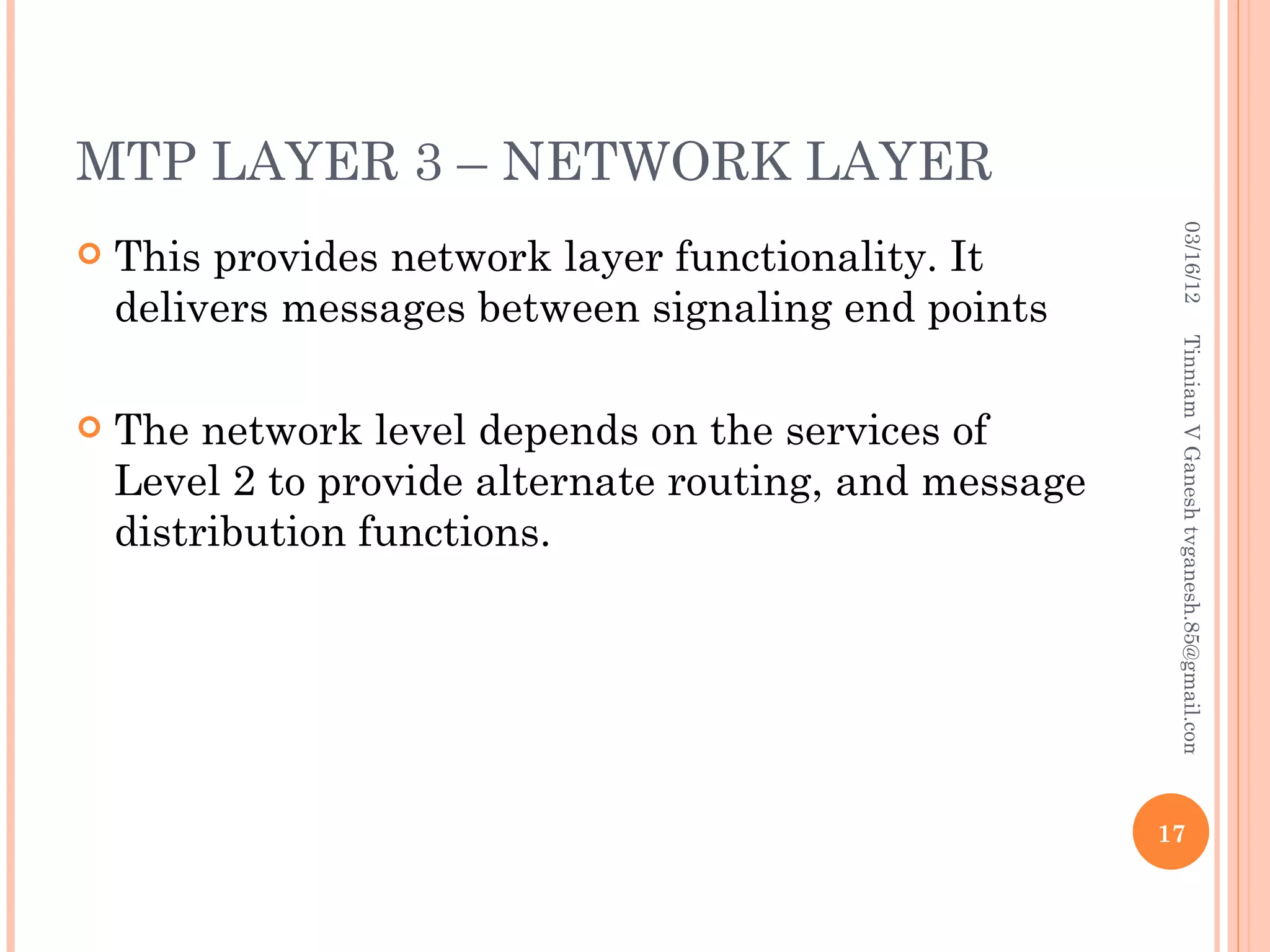
   This provides network layer functionality. It
    delivers messages between signaling end points


                                                         Tinniam V Ganesh tvganesh.85@gmail.com
   The network level depends on the services of
    Level 2 to provide alternate routing, and message
    distribution functions.


                                                        17
SCCP (SIGNALING CONNECTION CONTROL
PART)


                                                    03/16/12
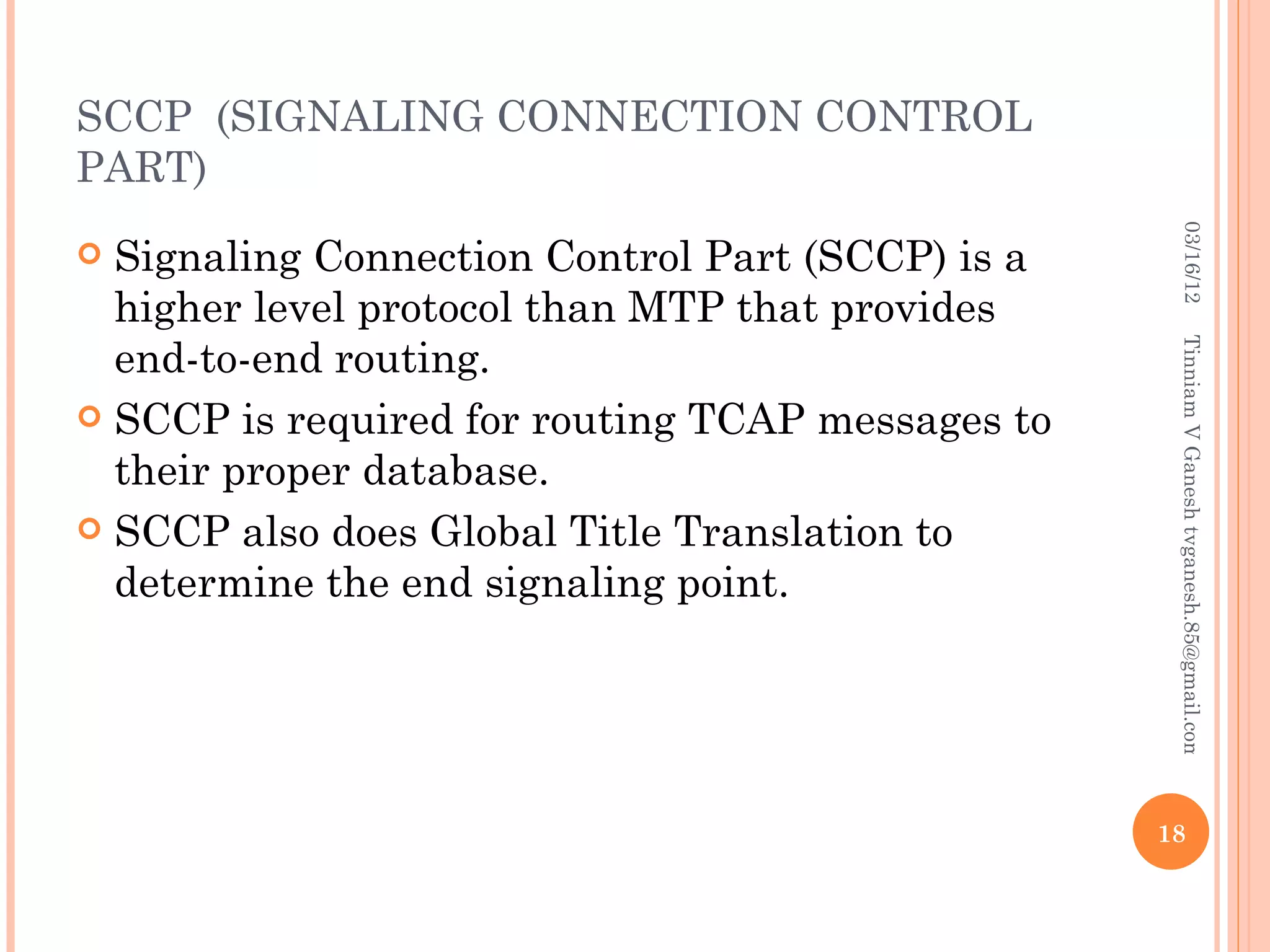
 Signaling Connection Control Part (SCCP) is a
  higher level protocol than MTP that provides
  end-to-end routing.


                                                   Tinniam V Ganesh tvganesh.85@gmail.com
 SCCP is required for routing TCAP messages to
  their proper database.
 SCCP also does Global Title Translation to
  determine the end signaling point.


                                                  18
TCAP (TRANSACTION CAPABILITIES APPLICATION
PART)


                                                      03/16/12
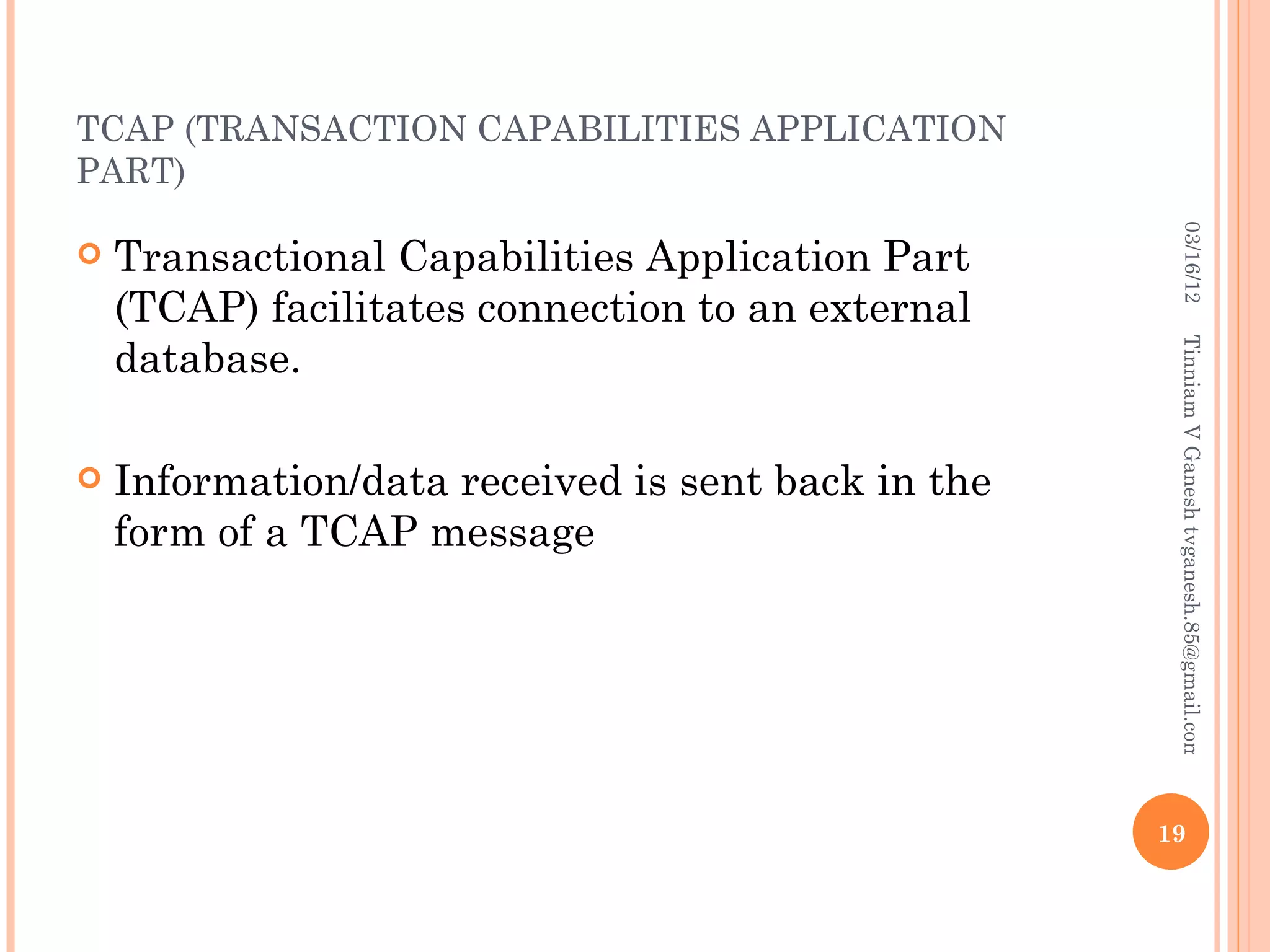
   Transactional Capabilities Application Part
    (TCAP) facilitates connection to an external
    database.


                                                     Tinniam V Ganesh tvganesh.85@gmail.com
   Information/data received is sent back in the
    form of a TCAP message


                                                    19
APPLICATION LAYER


                                                                 03/16/12
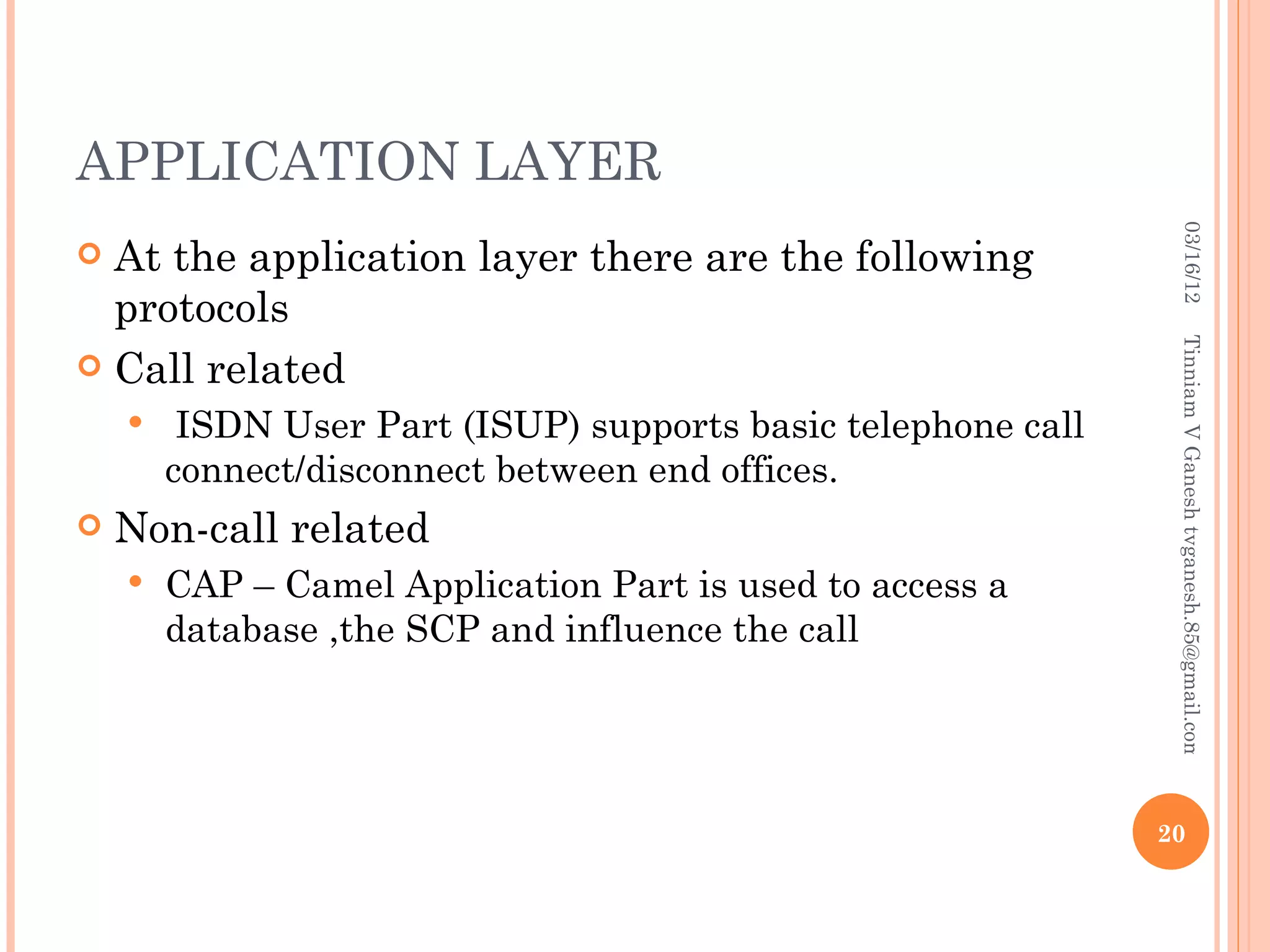
 At the application layer there are the following
  protocols


                                                                Tinniam V Ganesh tvganesh.85@gmail.com
 Call related
        ISDN User Part (ISUP) supports basic telephone call
        connect/disconnect between end offices.
   Non-call related
       CAP – Camel Application Part is used to access a
        database ,the SCP and influence the call


                                                               20
SS7 SIGNALING ARCHITECTURE


                                                      03/16/12
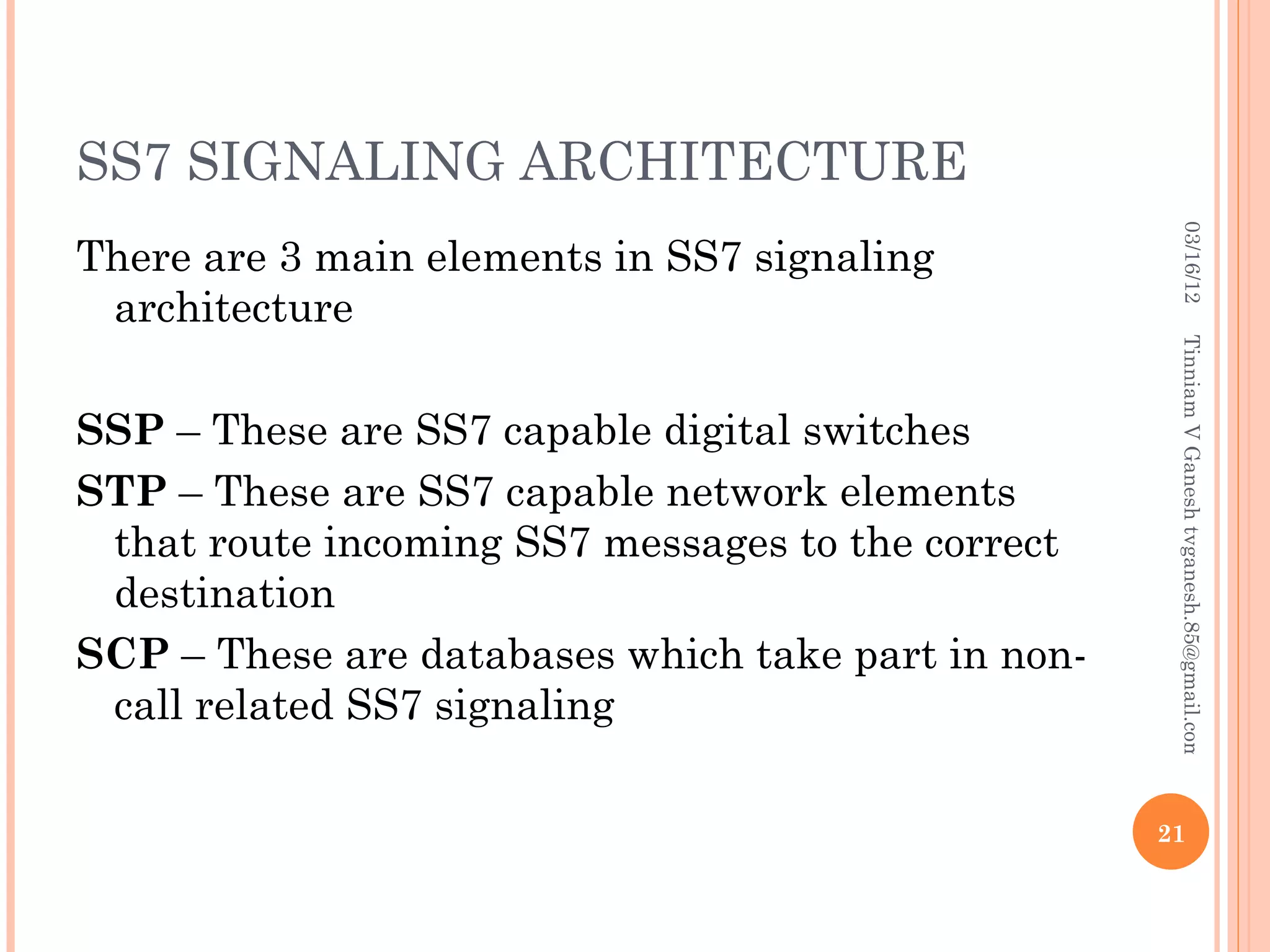
There are 3 main elements in SS7 signaling
 architecture


                                                     Tinniam V Ganesh tvganesh.85@gmail.com
SSP – These are SS7 capable digital switches
STP – These are SS7 capable network elements
 that route incoming SS7 messages to the correct
 destination
SCP – These are databases which take part in non-
 call related SS7 signaling

                                                    21
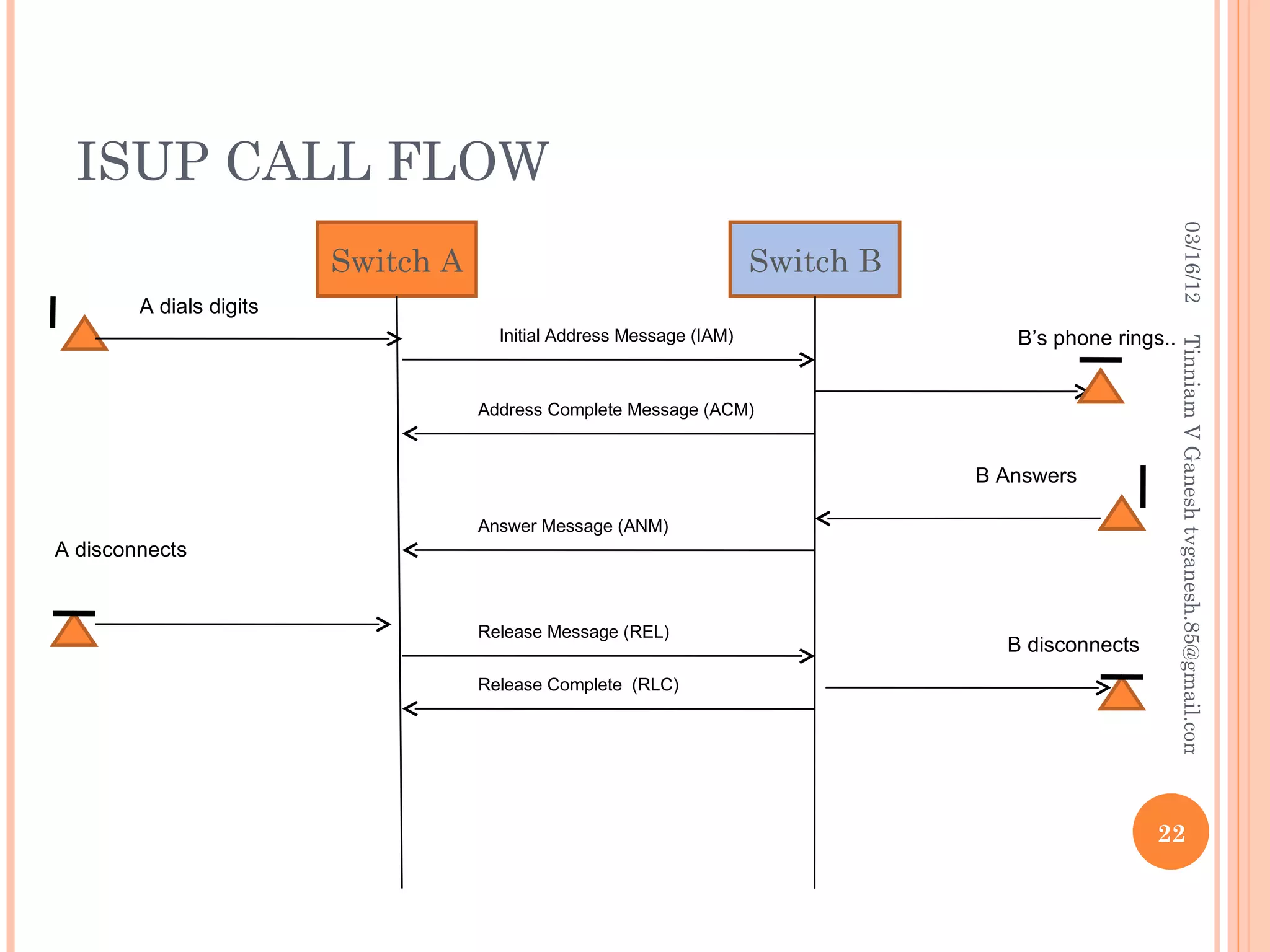
ISUP CALL FLOW


                                                                                                         03/16/12
                         Switch A                                     Switch B
        A dials digits
                                      Initial Address Message (IAM)                 B’s phone rings..


                                                                                                        Tinniam V Ganesh tvganesh.85@gmail.com
                                    Address Complete Message (ACM)


                                                                                 B Answers

                                    Answer Message (ANM)
A disconnects


                                    Release Message (REL)
                                                                                   B disconnects
                                    Release Complete (RLC)


                                                                                                   22
03/16/12   Tinniam V Ganesh tvganesh.85@gmail.com
                                                    23
               Thank You !!!

Signaling system 7 (ss7)

  • 1.
    03/16/12 Tinniam V Ganesh tvganesh.85@gmail.com SIGNALING SYSTEM 7 (SS7) 1 Tinniam.V. Ganesh tvganesh.85@gmail.com http://gigadom.wordpress.com/
  • 2.
    WHAT IS COMMUNICATION? 03/16/12  Communication is used between 2 network elements to exchange information. Tinniam V Ganesh tvganesh.85@gmail.com  There are 2 types of domains in the communication world  Data communication  Telecommunication 2
  • 3.
    DIFFERENCES BETWEEN TELECOM& DATACOM 03/16/12 Telecommunication Data Communication Tinniam V Ganesh tvganesh.85@gmail.com Network used for making voice Network used for transferring calls between telephones data from one computer to another Telephones were the end points Computers were the end point Uses protocols like ISUP, ISDN Predominantly uses TCP/IP Network elements are MSC, Network elements are Routers, HLR, SCP etc hubs, ATMs, bridges etc Uses circuit switching Uses packet switching 3
  • 4.
    NETWORKS OF TODAY… 03/16/12  In the networks of today telecommunication networks are used to download data e.g.GPRS Tinniam V Ganesh tvganesh.85@gmail.com  Data networks are used for making Voice Calls e.g. VOIP 4
  • 5.
    WHAT IS SIGNALING? 03/16/12  Signaling refers to the exchange of information between network elements Tinniam V Ganesh tvganesh.85@gmail.com  Signaling between network elements follows a specific protocol  A Protocol refers to the set of rules for communicating between the elements 5
  • 6.
    WHAT IS SS7SIGNALING ? 03/16/12  Signaling System 7 was devised by ITU-T (formerly known as CCITT) Tinniam V Ganesh tvganesh.85@gmail.com  Initially the signaling in trunks used to happen on the same channel in which the voice call used to occur. Hence call setup, digits etc would use the same line as the actual voice circuit  In SS7 a separate channel is allocated just for signaling. This is known as Out-Of- Band signaling 6
  • 7.
    SS7 SIGNALING 03/16/12  Signaling happens in a separate channel outside of the voice channels Tinniam V Ganesh tvganesh.85@gmail.com  A separate timeslot is used to transfer signaling messages like call setup, teardown etc  This is also known as Common Channel Signaling (CCS) 7
  • 8.
    ADVANTAGES OF OUTOF BAND SIGNALING 03/16/12  Allows signaling at any phase of the call  Allows upto 56 Kbps of signaling information Tinniam V Ganesh tvganesh.85@gmail.com Switch A Switch B Voice Trunk 8 Signaling Link
  • 9.
    SS7 STACK 03/16/12 CAP,MAP Tinniam V Ganesh tvganesh.85@gmail.com … Application ISUP,TUP.. layer TCAP SCCP Network layer MTP 3 Network layer MTP 2 Data link layer MTP 1 Physical layer 9
  • 10.
    SS7 LAYERS 03/16/12  MTP – Message Transfer Part  SCCP – Signaling and Connection Control Part Tinniam V Ganesh tvganesh.85@gmail.com  TCAP – Transaction Capabilities Application Part  CAP – CAMEL Application Part  ISUP – ISDN User Part  MAP – Mobile Application Part 10
  • 11.
    03/16/12 Tinniam V Ganesh tvganesh.85@gmail.com 11 SS7 VS OSI STACK
  • 12.
    SS7 PROTOCOLS 03/16/12 SS7 protocols can be classified as call related and non-call related Tinniam V Ganesh tvganesh.85@gmail.com  Call related protocols – ISUP (ISDN User Part), B-ISUP (Broadband – ISUP)  Non-call related protocols –  INAP (Intelligent Network Application Part)  CAP (CAMEL Application Part)  MAP (Mobile Application Part)  … 12
  • 13.
    SS7 STANDARD BODIES 03/16/12  The SS7 standard body for North American market is ANSI (American National Standards Institute). The ANSI versions are ANSI ISUP, Tinniam V Ganesh tvganesh.85@gmail.com ANSI TCAP etc.  The SS7 standard body for European market is ETSI (formerly CCITT). The ETSI versions of the protocols are ETSI ISUP, ETSI TCAP etc.  There are minor variations in the protocols by the two standard bodies. 13
  • 14.
    SS7 Link speeds Thereare 2 main standards in the world for 03/16/12 transmission of PCM signals T-Carrier – This is used in the North American market Tinniam V Ganesh tvganesh.85@gmail.com E-Carrier – This is used for European market T1 – 24 channels * 64 Kbps = 1.544 Mbps E1 – 32 channels * 64 Kbps = 2.048 Mbps Level North American European 0 64 Kbps 64 kbps 1 1.544 Mbps (T1) 2.048 Mbps (E1) 2 6.312 Mbps (T2) 8.448 (E2) 3 44.736 Mbps (T3) 34.368 (E3) 14
  • 15.
    MTP LAYER 1– PHYSICAL LAYER 03/16/12  This is the Physical Layer and defines the electrical and physical characteristics of SS7 links. Tinniam V Ganesh tvganesh.85@gmail.com  Signaling links use DS-0 channels and carry data at 56 Kbps or 64Kbps. 15
  • 16.
    MTP LAYER 2– DATA LINK LAYER 03/16/12  The data link level provides the network with sequenced delivery of all SS7 message packets between adjacent nodes Tinniam V Ganesh tvganesh.85@gmail.com  It also provides for flow control and error checking 16
  • 17.
    MTP LAYER 3– NETWORK LAYER 03/16/12  This provides network layer functionality. It delivers messages between signaling end points Tinniam V Ganesh tvganesh.85@gmail.com  The network level depends on the services of Level 2 to provide alternate routing, and message distribution functions. 17
  • 18.
    SCCP (SIGNALING CONNECTIONCONTROL PART) 03/16/12  Signaling Connection Control Part (SCCP) is a higher level protocol than MTP that provides end-to-end routing. Tinniam V Ganesh tvganesh.85@gmail.com  SCCP is required for routing TCAP messages to their proper database.  SCCP also does Global Title Translation to determine the end signaling point. 18
  • 19.
    TCAP (TRANSACTION CAPABILITIESAPPLICATION PART) 03/16/12  Transactional Capabilities Application Part (TCAP) facilitates connection to an external database. Tinniam V Ganesh tvganesh.85@gmail.com  Information/data received is sent back in the form of a TCAP message 19
  • 20.
    APPLICATION LAYER 03/16/12  At the application layer there are the following protocols Tinniam V Ganesh tvganesh.85@gmail.com  Call related  ISDN User Part (ISUP) supports basic telephone call connect/disconnect between end offices.  Non-call related  CAP – Camel Application Part is used to access a database ,the SCP and influence the call 20
  • 21.
    SS7 SIGNALING ARCHITECTURE 03/16/12 There are 3 main elements in SS7 signaling architecture Tinniam V Ganesh tvganesh.85@gmail.com SSP – These are SS7 capable digital switches STP – These are SS7 capable network elements that route incoming SS7 messages to the correct destination SCP – These are databases which take part in non- call related SS7 signaling 21
  • 22.
    ISUP CALL FLOW 03/16/12 Switch A Switch B A dials digits Initial Address Message (IAM) B’s phone rings.. Tinniam V Ganesh tvganesh.85@gmail.com Address Complete Message (ACM) B Answers Answer Message (ANM) A disconnects Release Message (REL) B disconnects Release Complete (RLC) 22
  • 23.
    03/16/12 Tinniam V Ganesh tvganesh.85@gmail.com 23 Thank You !!!