Higher Maths  1  4  Sequences UNIT OUTCOME SLIDE
Higher Maths  1  4  Sequences Number Sequences UNIT OUTCOME NOTE The  consecutive  numbers or terms in any sequence can be written as SLIDE u 0   ,   u 1   ,   u 2   ,   u 3   ,   u 4   ,   u 5   ...   u n consecutive  means ‘ next to  each other’ u n +1 u n the  n th  number in a sequence  the number  after  the  n th  number  (the ‘next’ number) u n   –1 the number  before  the  n th  number  (the ‘previous’ number)
Higher Maths  1  4  Sequences Basic Recurrence Relations UNIT OUTCOME NOTE It is often possible to write the next number in a sequence as a function of the previous numbers. SLIDE u n   =  2   u n –1   –  3   with   u 0  =  4 4   ,   5   ,   7   ,   11   ,   19   ,   35   ,   67   … u n   =  a   u n –1   +   b or alternatively u n –1 ×   2 –   3 u n The number sequence is as follows: is called a  linear recurrence relation . u n +1   =  a   u n   +   b In number sequences, Example
Higher Maths  1  4  Sequences Sequences on a Calculator UNIT OUTCOME NOTE It is possible to use a scientific calculator to quickly generate consecutive numbers in a sequence. SLIDE Set up   u 0 Example u n +1   =  u n   +   1 4 3 (   ) 2 – = Input the recurrence relation, using the  answer  button as u n with Step 1: Step 2: u 0   =  -2 Repeatedly press  equals  to generate the number sequence. Step 3: 4 ÷ 3 × ANS + 1
Higher Maths  1  4  Sequences Convergence and Divergence. UNIT OUTCOME NOTE Some sequences never stop increasing, while others eventually settle at a particular number.  SLIDE If the numbers in a sequence continue to get further and further apart, the sequence  diverges .  u n n u n n If a sequence  tends towards a limit , it is described as  convergent .  u n n L L
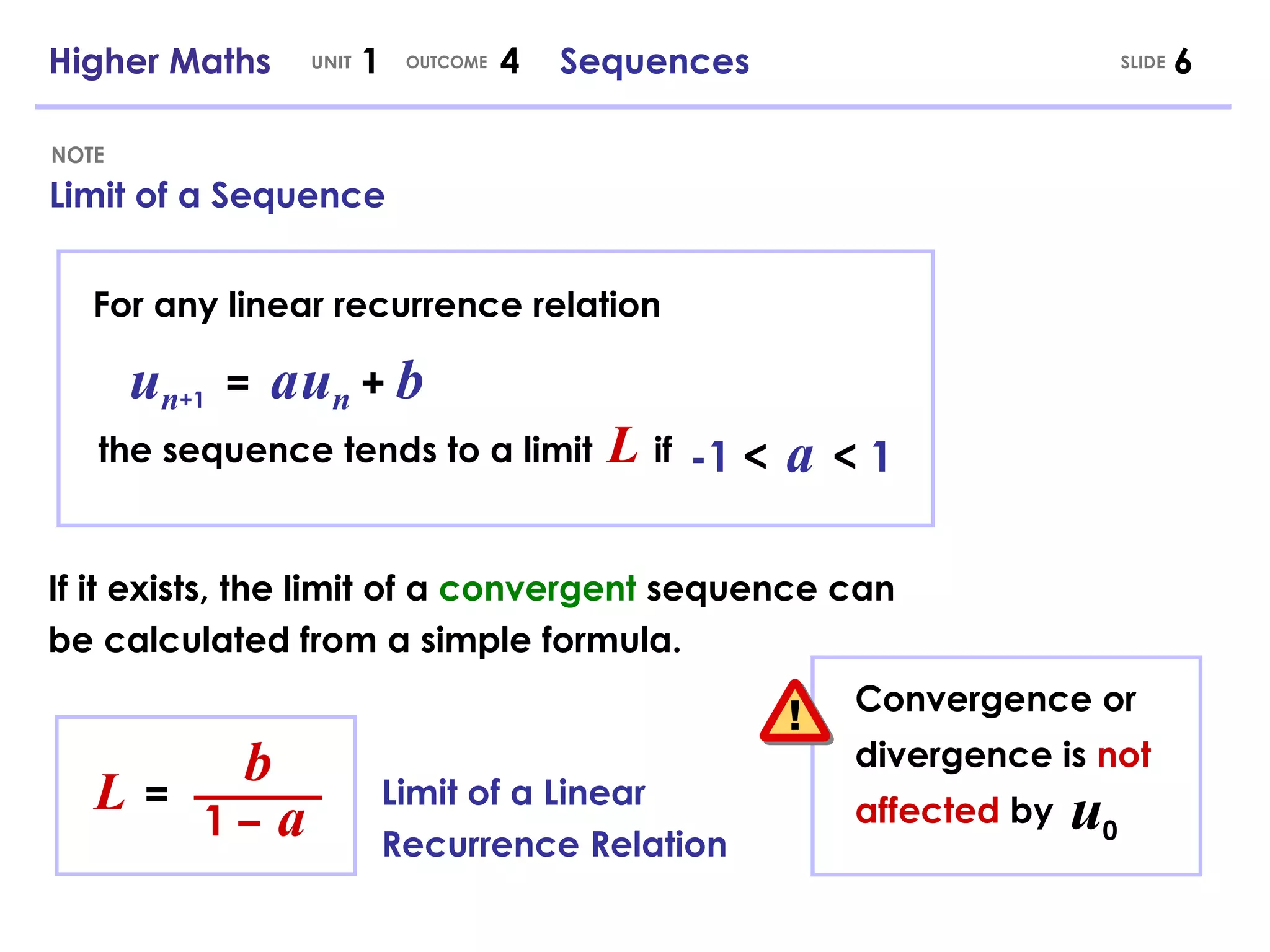
Higher Maths  1  4  Sequences Limit of a Sequence UNIT OUTCOME NOTE For any linear recurrence relation SLIDE u n +1   =   a   u n   +   b -1   <   a   <   1 If it exists, the limit of a  convergent  sequence can be calculated from a simple formula. L   = b 1 –  a the sequence tends to a limit  L   if Limit of a Linear Recurrence Relation Convergence or divergence is  not affected  by u 0
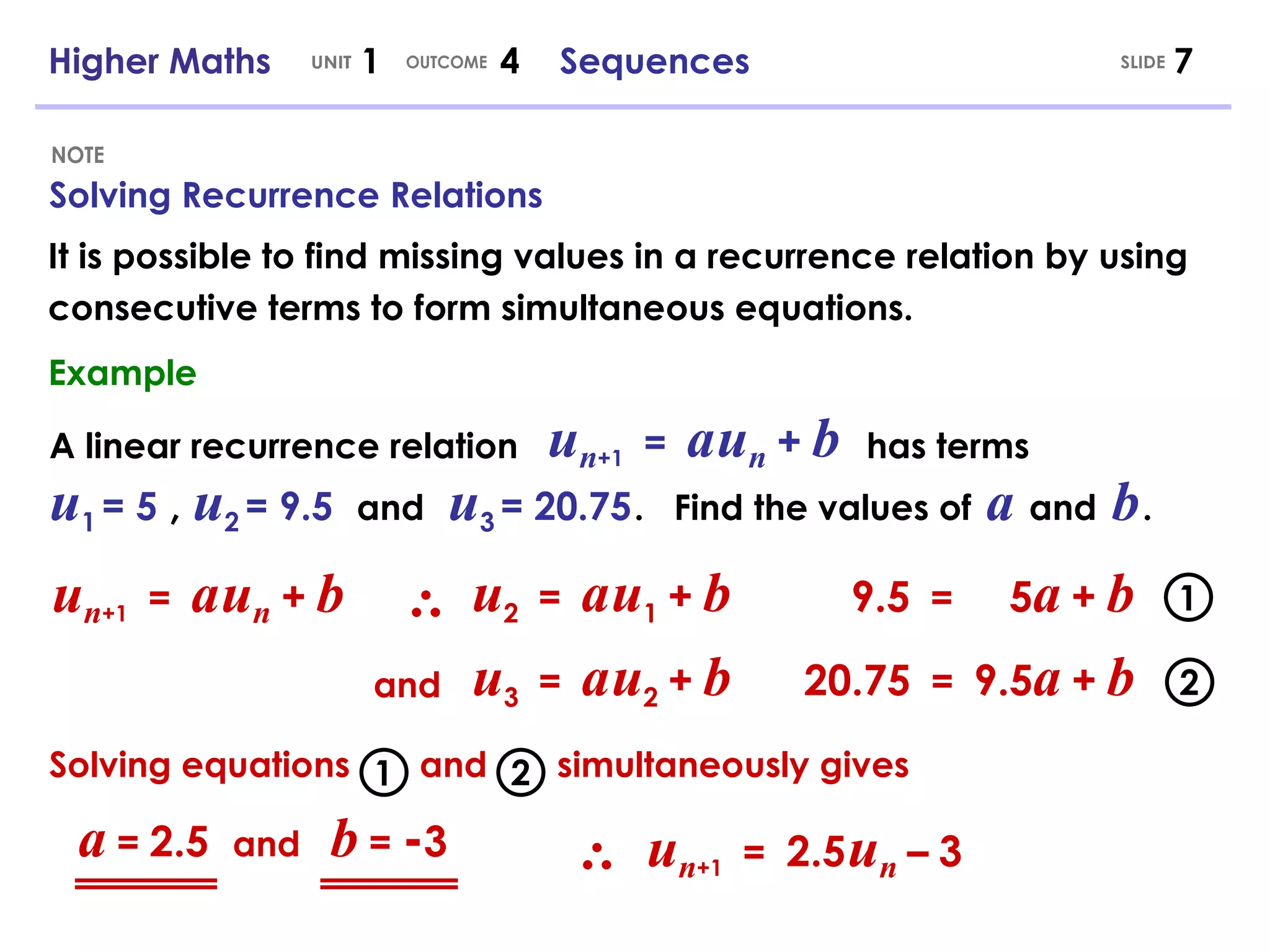
Higher Maths  1  4  Sequences Solving Recurrence Relations UNIT OUTCOME NOTE It is possible to find missing values in a recurrence relation by using consecutive terms to form simultaneous equations. SLIDE Example A linear recurrence relation  has terms u n +1   =   a   u n   +   b u 1   = 5  ,  u 2   = 9.5   and   u 3   = 20.75   .  Find the values of   a   and  b   . 9.5   =   5 a   +   b u 2   =   a   u 1   +   b 20.75   =   9.5 a   +   b u 3   =   a   u 2   +   b Solving equations  and  simultaneously gives u n +1   =   a   u n   +   b and u n +1   =  2.5   u n   –   3 a   =   2.5  and  b   =   - 3 2 1 1 2
Higher Maths  1  4  Sequences Linked Recurrence Relations UNIT OUTCOME NOTE SLIDE Example Two libraries, A and B, have 100 books in total. a n  +  b n  =   100 a n +1   =   0.85   a n   +   0.45   b n   b n  =   100 –  a n =   0.85   a n   +   0.45 ( 100 –  a n ) =   0.4   a n   +   45 Every week,  85 %  of the books borrowed from library A are returned there, while the other  15 %  are returned to library B instead. Only  55 %  of the books borrowed from library B are returned there, with the other  45 %  returned to library A. Investigate what happens. L a   = b 1 –  a = 45 1 –  0.4 = 75 L b   = 25
Higher Maths  1  4  Sequences Special Sequences UNIT OUTCOME NOTE There are some important sequences which it is useful to know. SLIDE u n +1   =   a   u n u n +1   =   u n   +   b u n +2   =   u n   +   u n +1 Sequence Recurrence Relation Example Arithmetic Geometric Fibonacci 2, 8, 14, 20, 26, 32   ... 3, 12, 48, 192, 768   ... with u 0   =   0   and  u 1   =   1 1, 1, 2, 3, 5, 8, 13, 21, 34, 55, 89   ... discovered 1202

Higher Maths 1.4 - Sequences

  • 1.
    Higher Maths 1 4 Sequences UNIT OUTCOME SLIDE
  • 2.
    Higher Maths 1 4 Sequences Number Sequences UNIT OUTCOME NOTE The consecutive numbers or terms in any sequence can be written as SLIDE u 0 , u 1 , u 2 , u 3 , u 4 , u 5 ... u n consecutive means ‘ next to each other’ u n +1 u n the n th number in a sequence the number after the n th number (the ‘next’ number) u n –1 the number before the n th number (the ‘previous’ number)
  • 3.
    Higher Maths 1 4 Sequences Basic Recurrence Relations UNIT OUTCOME NOTE It is often possible to write the next number in a sequence as a function of the previous numbers. SLIDE u n = 2 u n –1 – 3 with u 0 = 4 4 , 5 , 7 , 11 , 19 , 35 , 67 … u n = a u n –1 + b or alternatively u n –1 × 2 – 3 u n The number sequence is as follows: is called a linear recurrence relation . u n +1 = a u n + b In number sequences, Example
  • 4.
    Higher Maths 1 4 Sequences Sequences on a Calculator UNIT OUTCOME NOTE It is possible to use a scientific calculator to quickly generate consecutive numbers in a sequence. SLIDE Set up u 0 Example u n +1 = u n + 1 4 3 ( ) 2 – = Input the recurrence relation, using the answer button as u n with Step 1: Step 2: u 0 = -2 Repeatedly press equals to generate the number sequence. Step 3: 4 ÷ 3 × ANS + 1
  • 5.
    Higher Maths 1 4 Sequences Convergence and Divergence. UNIT OUTCOME NOTE Some sequences never stop increasing, while others eventually settle at a particular number. SLIDE If the numbers in a sequence continue to get further and further apart, the sequence diverges . u n n u n n If a sequence tends towards a limit , it is described as convergent . u n n L L
  • 6.
    Higher Maths 1 4 Sequences Limit of a Sequence UNIT OUTCOME NOTE For any linear recurrence relation SLIDE u n +1 = a u n + b -1 < a < 1 If it exists, the limit of a convergent sequence can be calculated from a simple formula. L = b 1 – a the sequence tends to a limit L if Limit of a Linear Recurrence Relation Convergence or divergence is not affected by u 0
  • 7.
    Higher Maths 1 4 Sequences Solving Recurrence Relations UNIT OUTCOME NOTE It is possible to find missing values in a recurrence relation by using consecutive terms to form simultaneous equations. SLIDE Example A linear recurrence relation has terms u n +1 = a u n + b u 1 = 5 , u 2 = 9.5 and u 3 = 20.75 . Find the values of a and b . 9.5 = 5 a + b u 2 = a u 1 + b 20.75 = 9.5 a + b u 3 = a u 2 + b Solving equations and simultaneously gives u n +1 = a u n + b and u n +1 = 2.5 u n – 3 a = 2.5 and b = - 3 2 1 1 2
  • 8.
    Higher Maths 1 4 Sequences Linked Recurrence Relations UNIT OUTCOME NOTE SLIDE Example Two libraries, A and B, have 100 books in total. a n + b n = 100 a n +1 = 0.85 a n + 0.45 b n b n = 100 – a n = 0.85 a n + 0.45 ( 100 – a n ) = 0.4 a n + 45 Every week, 85 % of the books borrowed from library A are returned there, while the other 15 % are returned to library B instead. Only 55 % of the books borrowed from library B are returned there, with the other 45 % returned to library A. Investigate what happens. L a = b 1 – a = 45 1 – 0.4 = 75 L b = 25
  • 9.
    Higher Maths 1 4 Sequences Special Sequences UNIT OUTCOME NOTE There are some important sequences which it is useful to know. SLIDE u n +1 = a u n u n +1 = u n + b u n +2 = u n + u n +1 Sequence Recurrence Relation Example Arithmetic Geometric Fibonacci 2, 8, 14, 20, 26, 32 ... 3, 12, 48, 192, 768 ... with u 0 = 0 and u 1 = 1 1, 1, 2, 3, 5, 8, 13, 21, 34, 55, 89 ... discovered 1202