Recurrence relation
Arecurrence relation is an infinite sequence a1, a2, a3,
…, an,… in which the formula for the nth term an
depends on one or more preceding terms, with a finite
set of start-up values or initial conditions
3.
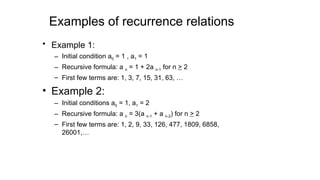
Examples of recurrencerelations
• Example 1:
– Initial condition a0 = 1 , a1 = 1
– Recursive formula: a n = 1 + 2a n-1 for n > 2
– First few terms are: 1, 3, 7, 15, 31, 63, …
• Example 2:
– Initial conditions a0 = 1, a1 = 2
– Recursive formula: a n = 3(a n-1 + a n-2) for n > 2
– First few terms are: 1, 2, 9, 33, 126, 477, 1809, 6858,
26001,…
4.
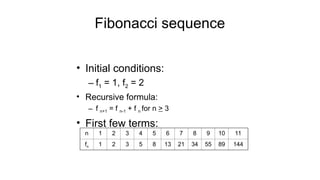
Fibonacci sequence
• Initialconditions:
– f1 = 1, f2 = 2
• Recursive formula:
– f n+1 = f n-1 + f n for n > 3
• First few terms:
n 1 2 3 4 5 6 7 8 9 10 11
fn 1 2 3 5 8 13 21 34 55 89 144
5.
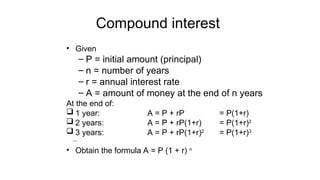
Compound interest
• Given
–P = initial amount (principal)
– n = number of years
– r = annual interest rate
– A = amount of money at the end of n years
At the end of:
1 year: A = P + rP = P(1+r)
2 years: A = P + rP(1+r) = P(1+r)2
3 years: A = P + rP(1+r)2
= P(1+r)3
…
• Obtain the formula A = P (1 + r) n
6.
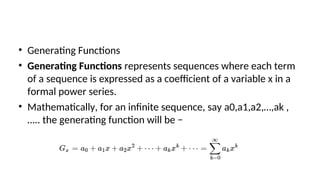
• Generating Functions
•Generating Functions represents sequences where each term
of a sequence is expressed as a coefficient of a variable x in a
formal power series.
• Mathematically, for an infinite sequence, say a0,a1,a2,…,ak ,
….. the generating function will be −


![Arithmetic sequences and series[1]](https://cdn.slidesharecdn.com/ss_thumbnails/arithmeticsequencesandseries1-110831022502-phpapp01-thumbnail.jpg?width=640&height=640&fit=bounds)


