Warning from a journal
Literature cited: citations in text must be checked for
consistency with those listed at the end under References.
Authors must pay serious attention to the formatting of
references. “Manuscripts will be returned even without
reviewing if reference style is not adhered to.”
Citations and references
Citations, 1
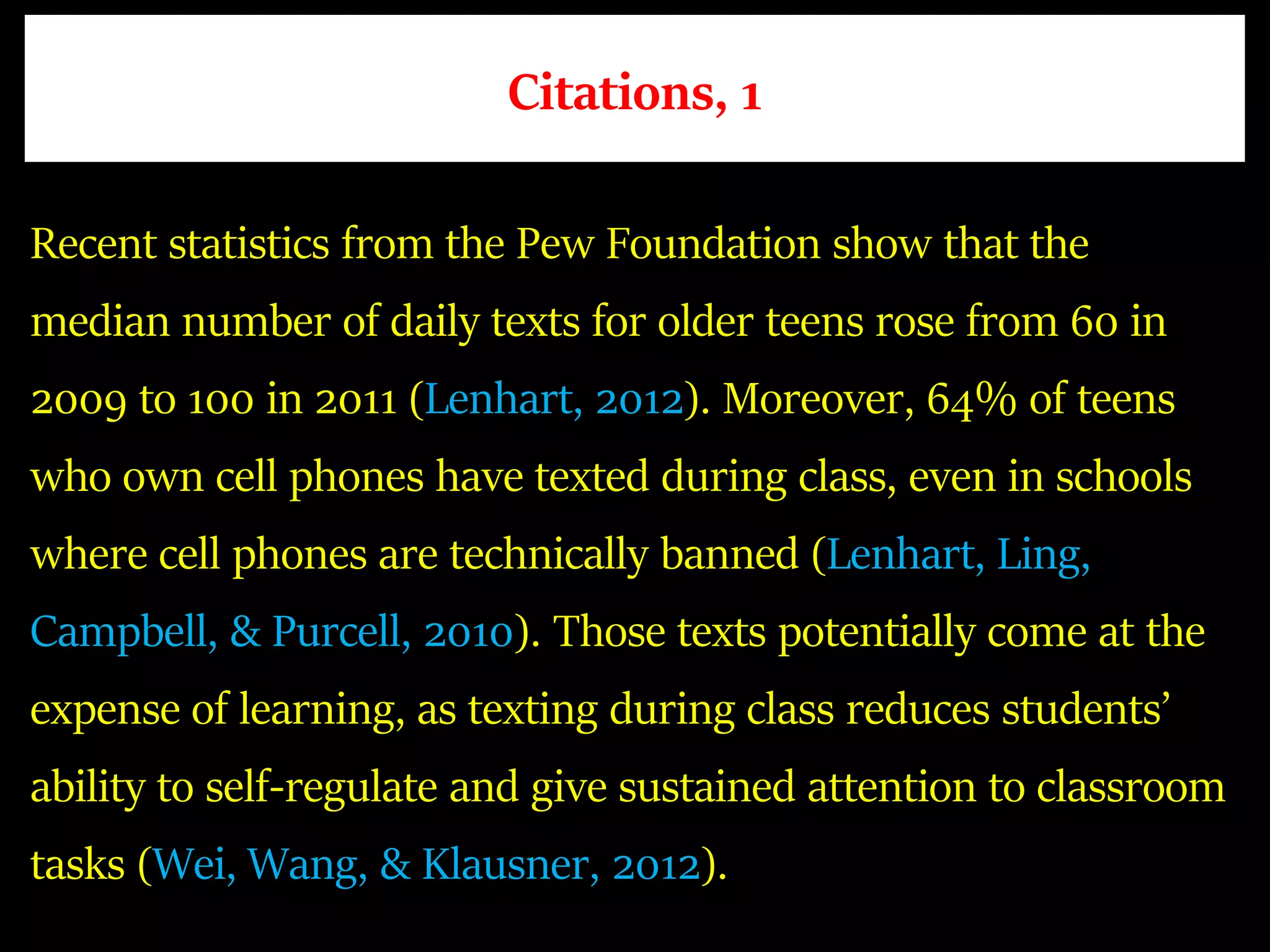
Recent statistics from the Pew Foundation show that the
median number of daily texts for older teens rose from 60 in
2009 to 100 in 2011 (Lenhart, 2012). Moreover, 64% of teens
who own cell phones have texted during class, even in schools
where cell phones are technically banned (Lenhart, Ling,
Campbell, & Purcell, 2010). Those texts potentially come at the
expense of learning, as texting during class reduces students’
ability to self-regulate and give sustained attention to classroom
tasks (Wei, Wang, & Klausner, 2012).
Citations, 2
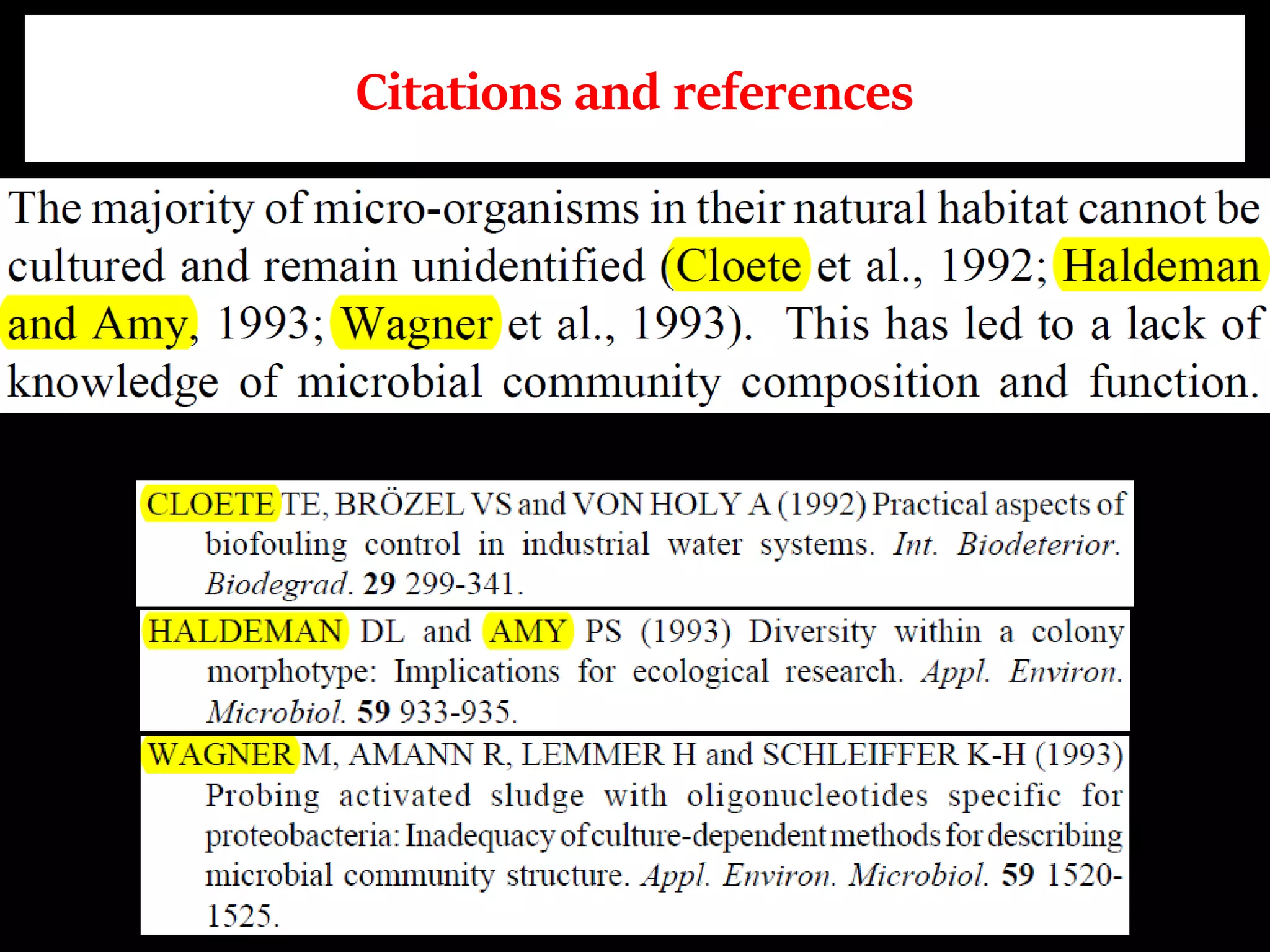
The majority of micro-organisms in their natural habitat
cannot be cultured and remain unidentified (Cloete et al., 1992;
Haldeman and Amy, 1993; Wagner et al., 1993). This has led to
a lack of knowledge of microbial community composition and
function. Recently, molecular techniques have been used in
microbial ecology studies in an attempt to overcome the
limitations of culture techniques (Pace et al., 1986; Wagner et
al., 1993; Amann et al., 1995; Muyima et al., 1997). These
techniques require a high level of expertise and sophistication
and are often tedious (Schwieger and Tebbe, 1998).
Citations, 3
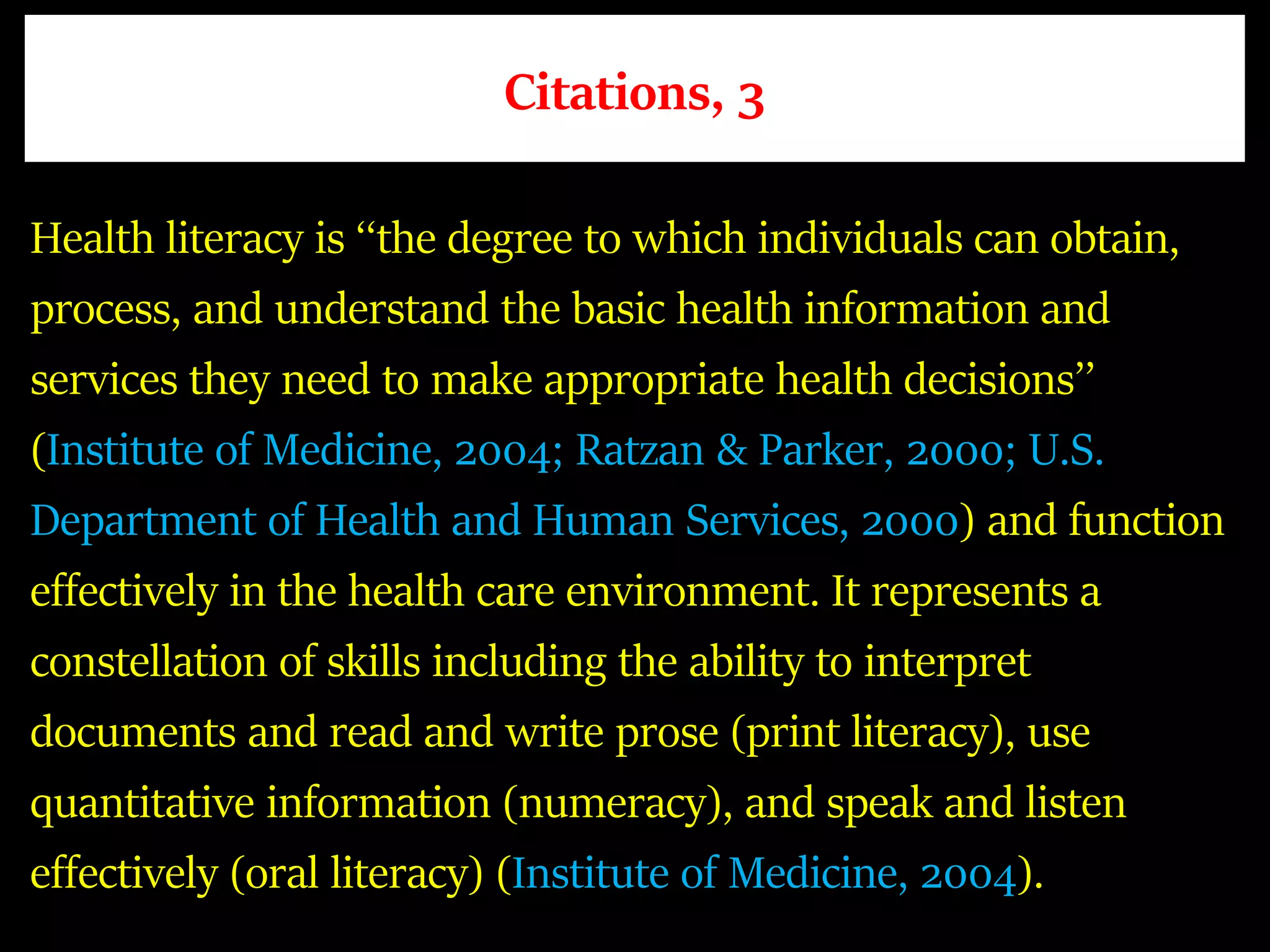
Health literacy is ‘‘the degree to which individuals can obtain,
process, and understand the basic health information and
services they need to make appropriate health decisions’’
(Institute of Medicine, 2004; Ratzan & Parker, 2000; U.S.
Department of Health and Human Services, 2000) and function
effectively in the health care environment. It represents a
constellation of skills including the ability to interpret
documents and read and write prose (print literacy), use
quantitative information (numeracy), and speak and listen
effectively (oral literacy) (Institute of Medicine, 2004).
Why use citations, 1
To give the sources of data, facts, opinions, etc.
To support what you say
To point readers to additional information
To show that ‘you have done your homework’.
To enable readers to verify your assertions.
Why use citations, 2
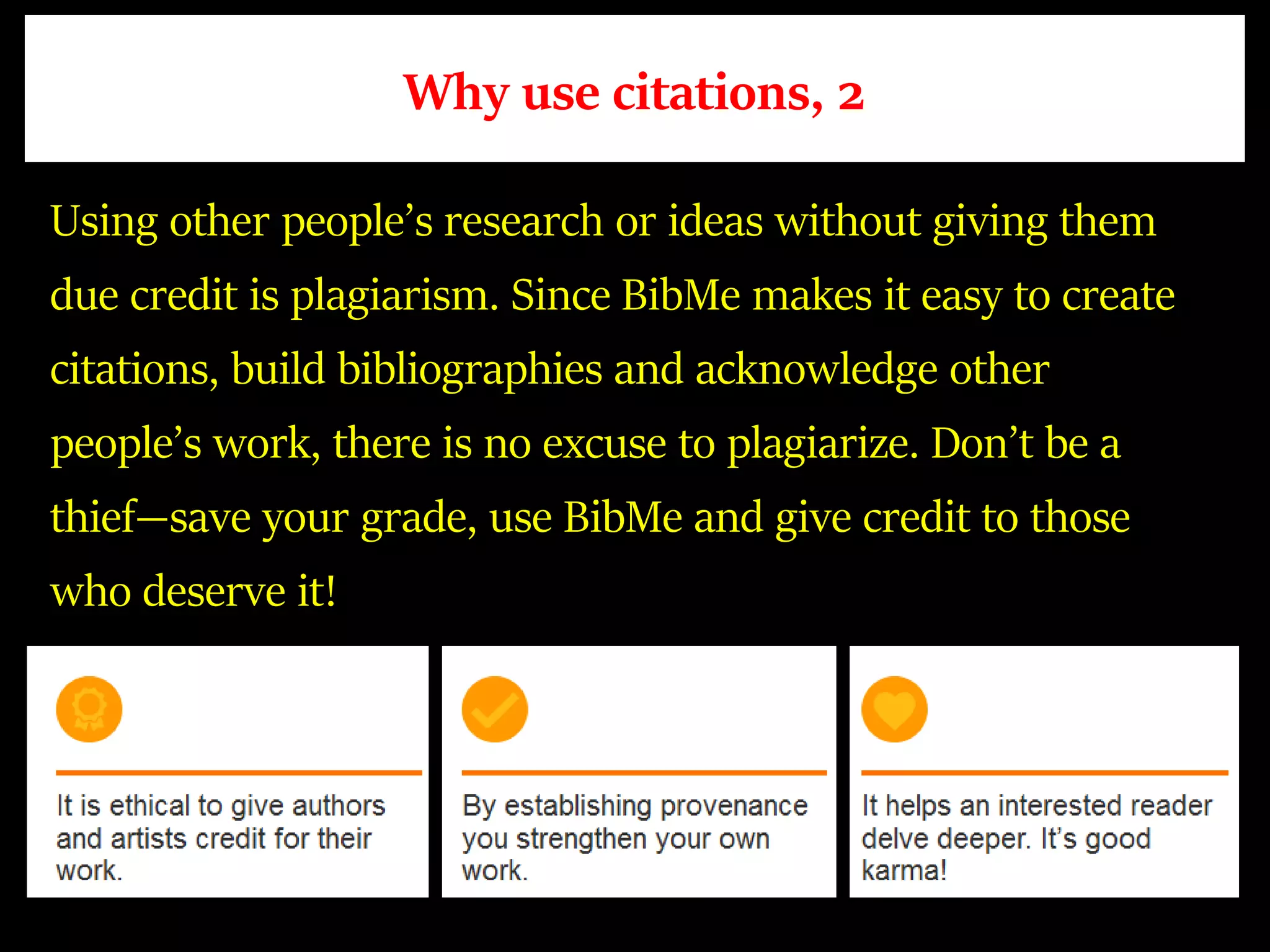
Using other people’s research or ideas without giving them
due credit is plagiarism. Since BibMe makes it easy to create
citations, build bibliographies and acknowledge other
people’s work, there is no excuse to plagiarize. Don’t be a
thief—save your grade, use BibMe and give credit to those
who deserve it!
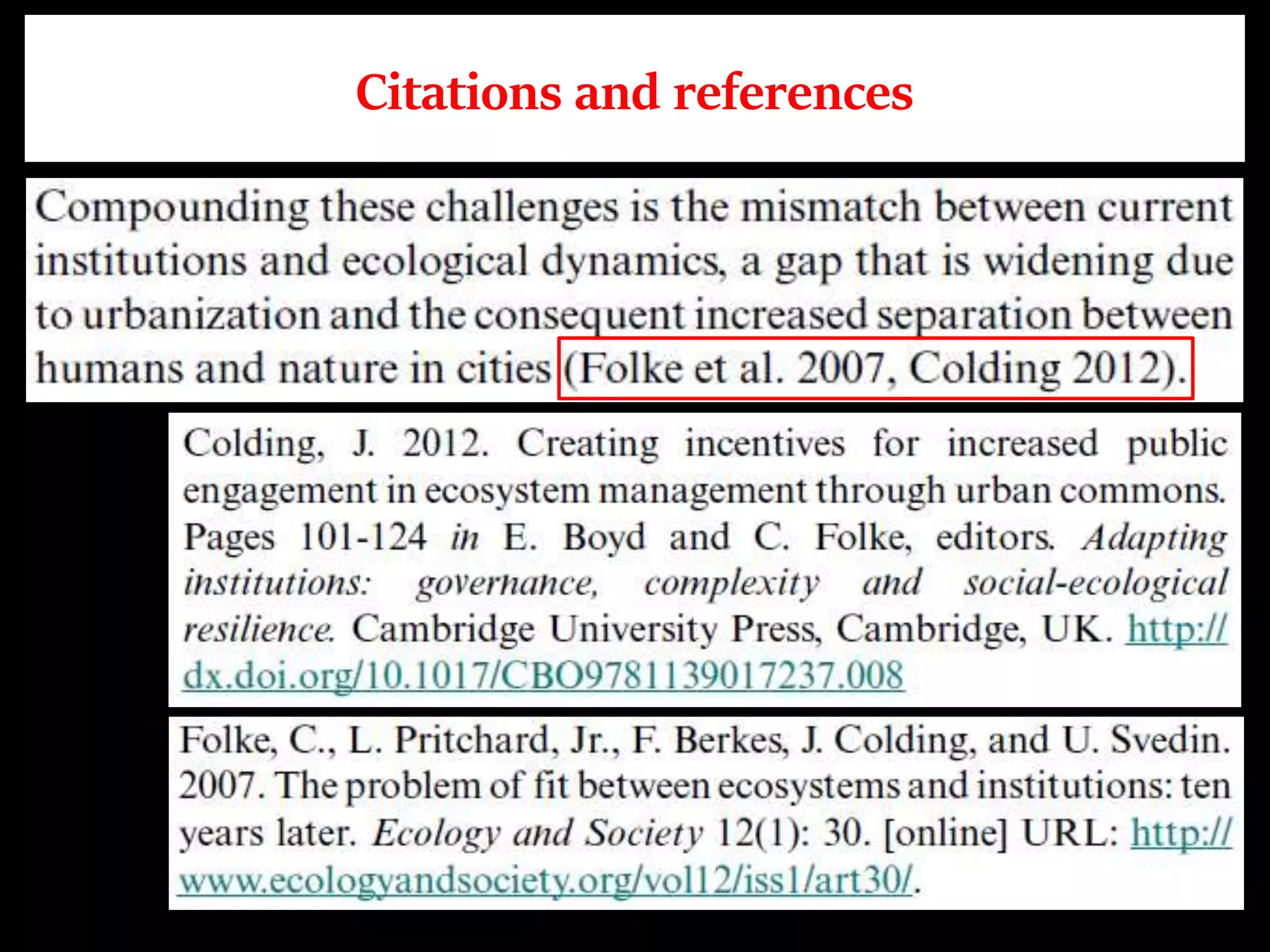
Citations and references
Citations are embedded in the text of the document.
References are appended to the document.
Citations are pointers to references.
References provide enough details to
— pinpoint the source
— let readers judge the quality of the source
— obtain the document if required
Cite responsibly and accurately
Do not cite unless you have read the original.
If you reproduce exact words (copy–paste),
enclose the matter between quotation marks
If you paraphrase, retain the original sense.
Do not include assertions that you cannot trace.
Give full reference.
Citation not required
What you cite is common knowledge, found in many sources
Easily observed phenomena
Common sayings, proverbs, etc.
Cite but do not include in references
Personal communications: letters, email messages, text
messages, conversations, and so on
Unpublished data (includes matter from papers
submitted but not published)
In-house documents not accessible to the public
Note Cite papers accepted but not yet published as
‘forthcoming’; supply available details in references.
Citations: by numbers or by names?
Citations by numbers, the Vancouver system
Citations by names of authors, the Harvard system
Citations by numbers: the Vancouver system
Superscript numbers or ‘in line’ numbers?
Parentheses (round brackets) or square brackets?
Placement of numbers in relation to punctuation:
before or after?
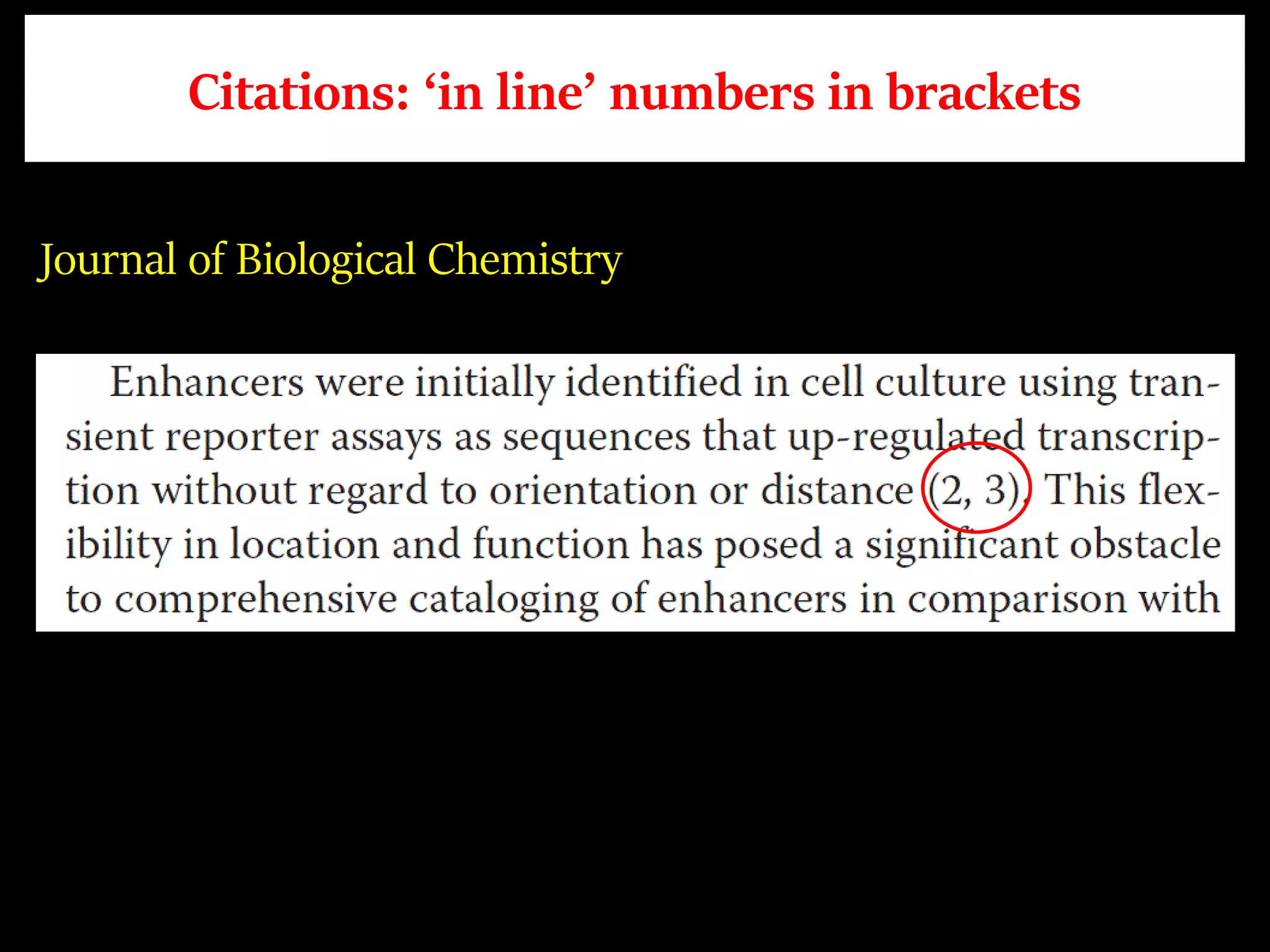
Citations: ‘in line’ numbers in brackets
Journal of Biological Chemistry
Citations: numbers in italics
Science
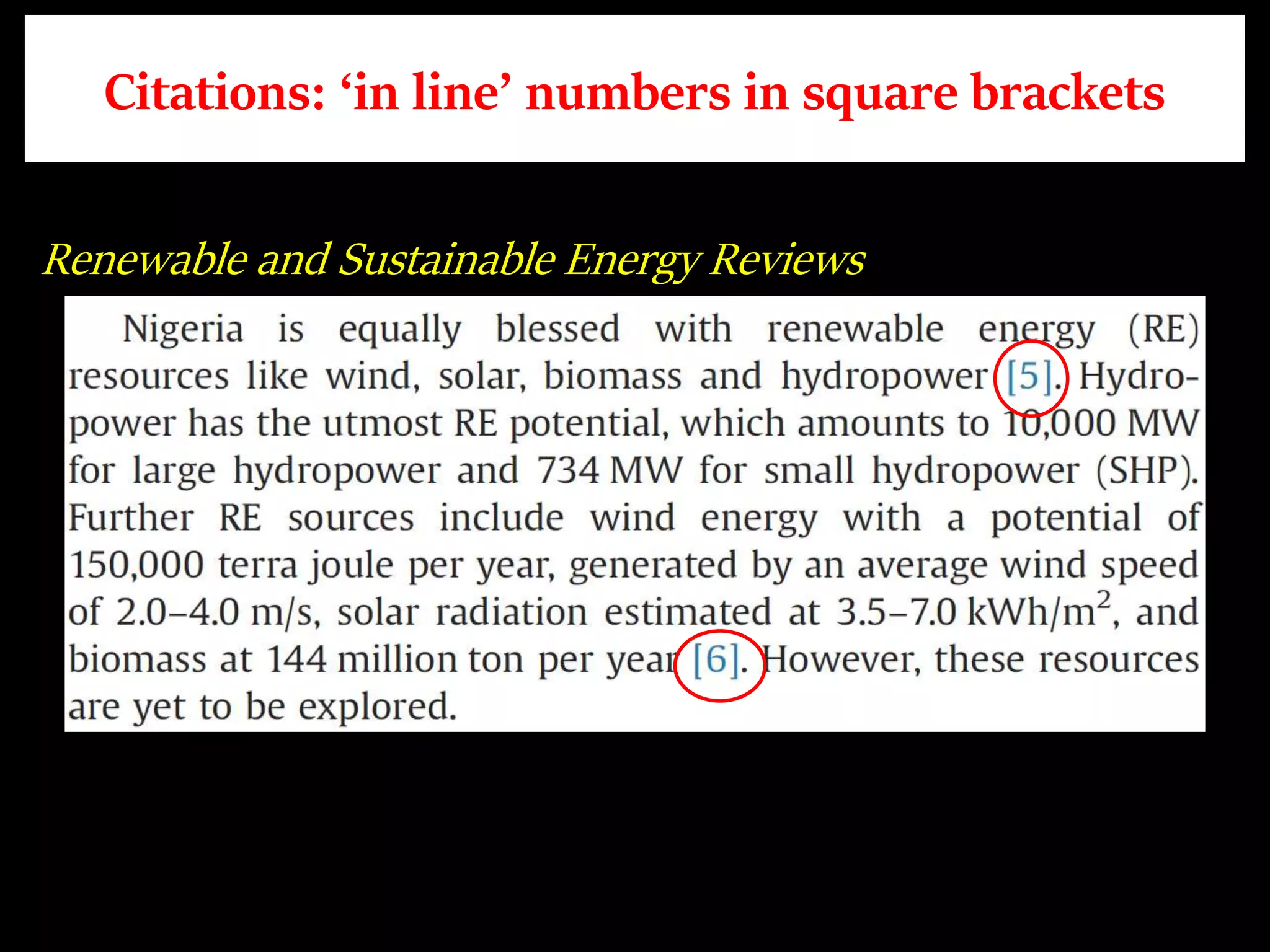
Citations: ‘in line’ numbers in square brackets
Renewable and Sustainable Energy Reviews
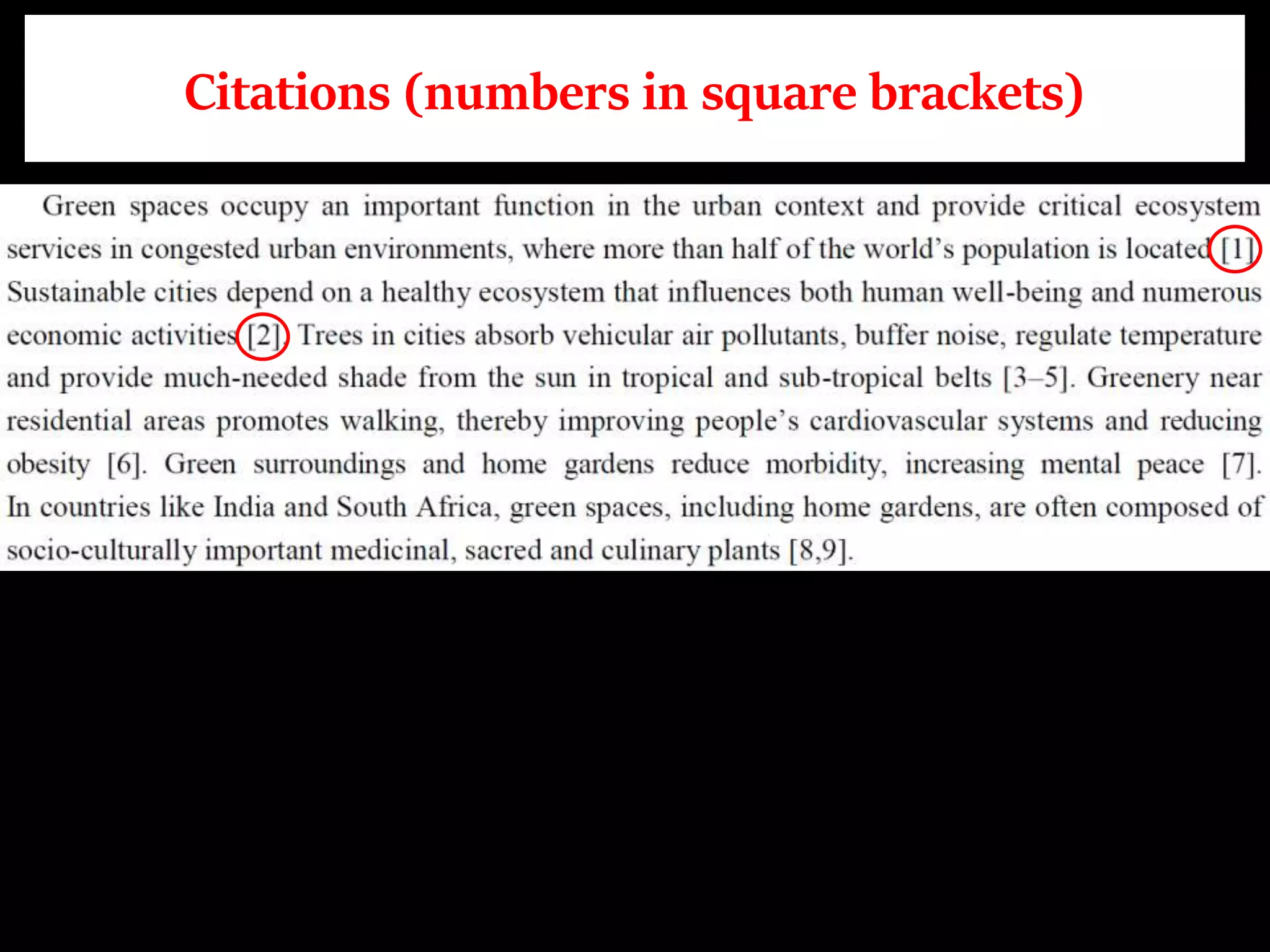
Citations (numbers in square brackets)
Citations: superscript numbers
Citations: superscript numbers in square brackets
Advanced Energy Materials
References in square brackets as superscripts after punctuation.
Placement of numbered citations
Numbers after full stops and commas: The young are more
tolerant of cellphones in the classroom than the old.1
Numbers immediately after authors: Kraushaar and Novak1
explored connections between classroom laptop usage and
course achievements.
Numbers before colons and semicolons: Solar cells generate
energy during the day1; turbines can do so 24 hours.2
Superscript numbers before full stop
Current Science [superscript numbers before full stop]
Superscript numbers after full stop
BMJ [superscript numbers after full stop]
Numbered reference list
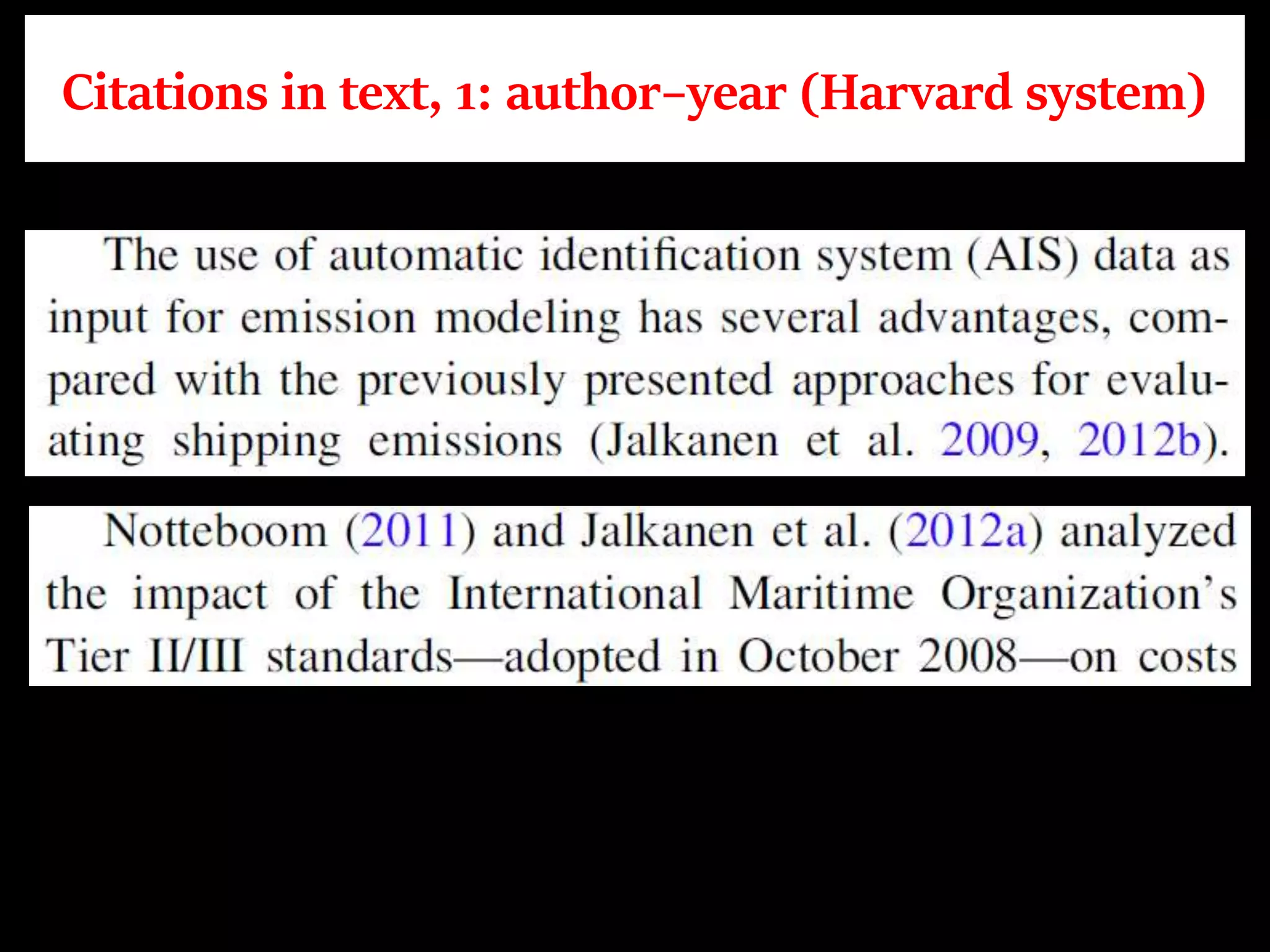
Citations in text, 1: author–year (Harvard system)
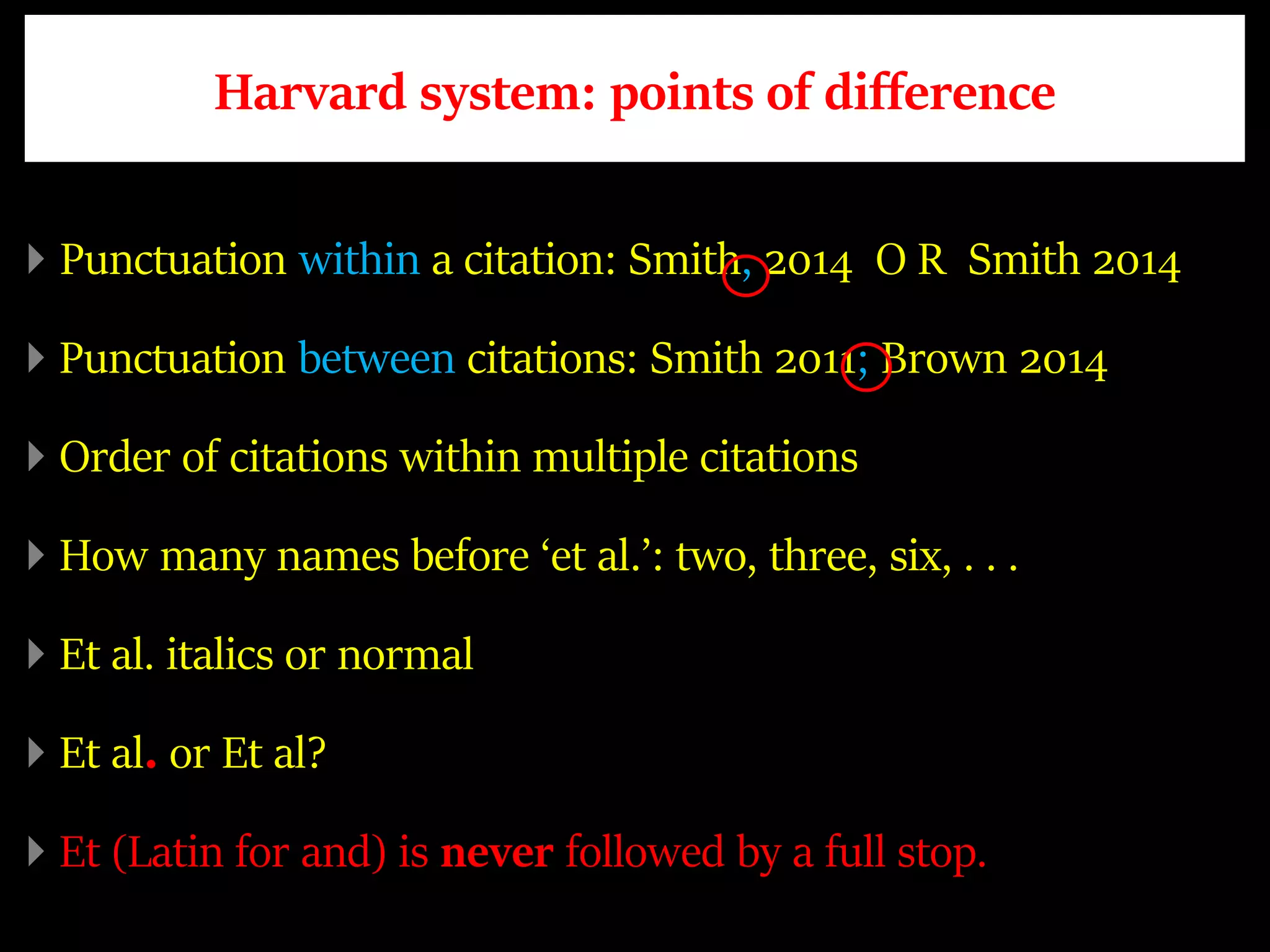
Harvard system: points of difference
Punctuation within a citation: Smith, 2014 O R Smith 2014
Punctuation between citations: Smith 2011; Brown 2014
Order of citations within multiple citations
How many names before ‘et al.’: two, three, six, . . .
Et al. italics or normal
Et al. or Et al?
Et (Latin for and) is never followed by a full stop.
Names or et al.? et al. or et al. or et al?
Journal of Applied Biology, The Holocene: names up to three
authors; et al. thereafter
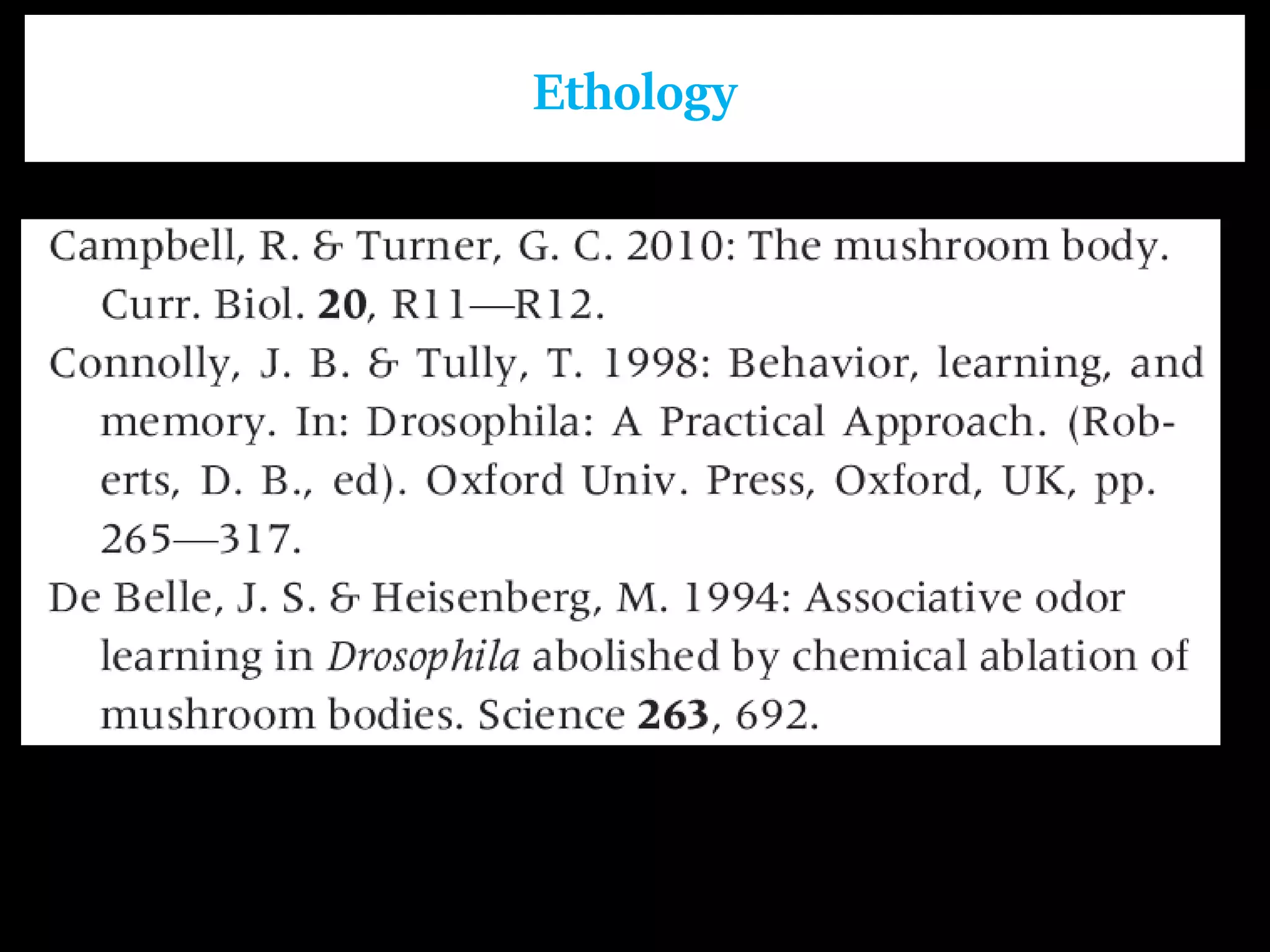
Conservation Biology, Ethology, Animal Behaviour: names up
to two authors
Journal of Applied Ecology, Marine Mammal Science: et al.
Conservation Biology: ‘Do not italicize et al.’
Animal Behaviour: “Note that ‘et al.’ is not in italics.”
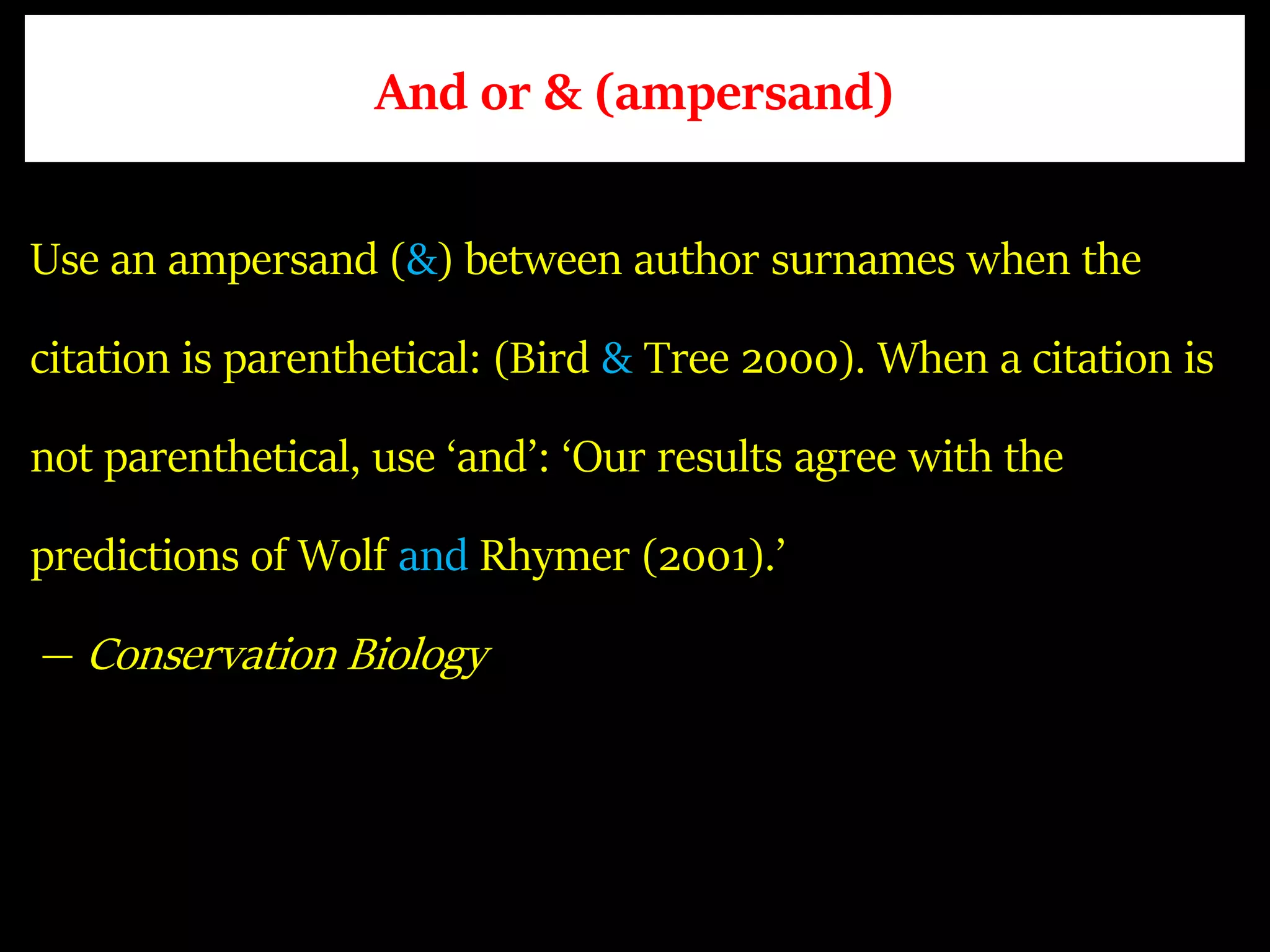
And or & (ampersand)
Use an ampersand (&) between author surnames when the
citation is parenthetical: (Bird & Tree 2000). When a citation is
not parenthetical, use ‘and’: ‘Our results agree with the
predictions of Wolf and Rhymer (2001).’
— Conservation Biology
Placing in-text citations, 1
Give the citation where it fits comfortably with the flow of
your writing.
Where the author’s name does not occur naturally,
put the in-text citation into brackets.
If you paraphrase something it may be neater to
give the in-text citation at the end of the sentence.
Queen’s University, Belfast
Placing in-text citations, 2
Insert names
Start: Kraushaar and Novak (2010) explored connections
between classroom laptop usage and course achievement.
Middle: Available information on pre-harvest processes and
their effects on shelf life (Scuderi et al. 2010) is limited.
End: Students can score higher when they take notes
(Titsworth & Kiewra, 2004).
Multiple citations in chronological order
International Journal of Urban and Regional Research
Multiple citations in reverse chronological order
Queen’s University, Belfast; Open University, UK
Multiple citations in alphabetical order
Economic Botany, Ecological Modelling,
Journal of Tropical Ecology, Animal Behaviour
Multiple citations in alphabetical order but in square
brackets
American Journal of Primatology
References at the end, 1
References at the end, 2
Citations, references, and bibliography
Citations in text; references at the end
Citations: numbers or author/s–year
References: details of sources cited, or referred to, in text
Bibliography: sources used but not specifically cited
Cryptic notation
Nature 171: 737
Paper with 1014 authors
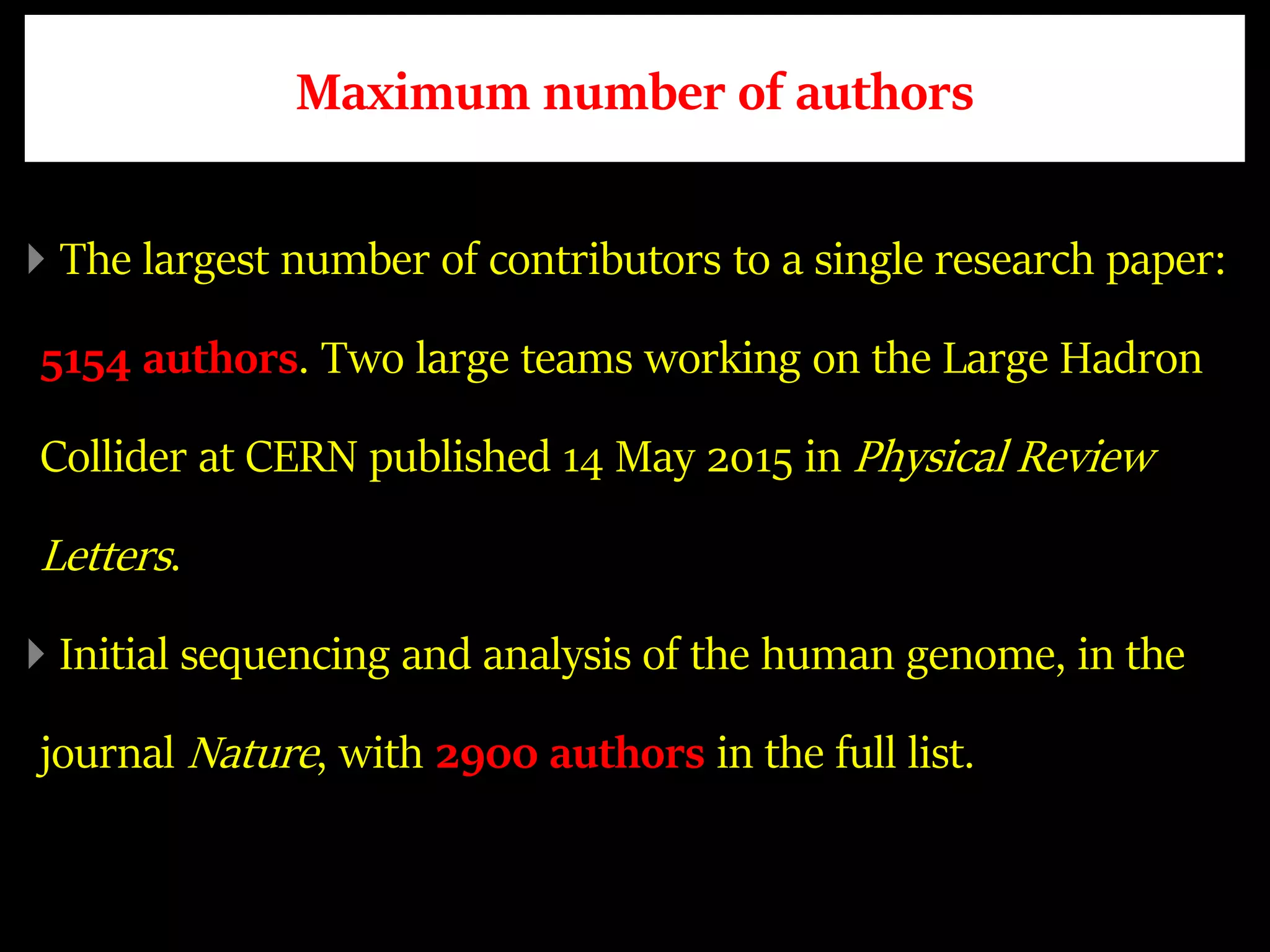
Maximum number of authors
The largest number of contributors to a single research paper:
5154 authors. Two large teams working on the Large Hadron
Collider at CERN published 14 May 2015 in Physical Review
Letters.
Initial sequencing and analysis of the human genome, in the
journal Nature, with 2900 authors in the full list.
Very many authors
List the first six authors.
Skip all the rest except the last; represent the omission
with ellipsis (three dots)
End the list of names with the last author.
Singh P K, Daniel R, Gupta P K, Kaul S T, Smith G,
Chowdhury G M . . . Menon R. 2014. Improved designs
of blades for offshore turbines. Energy 34: 5–12
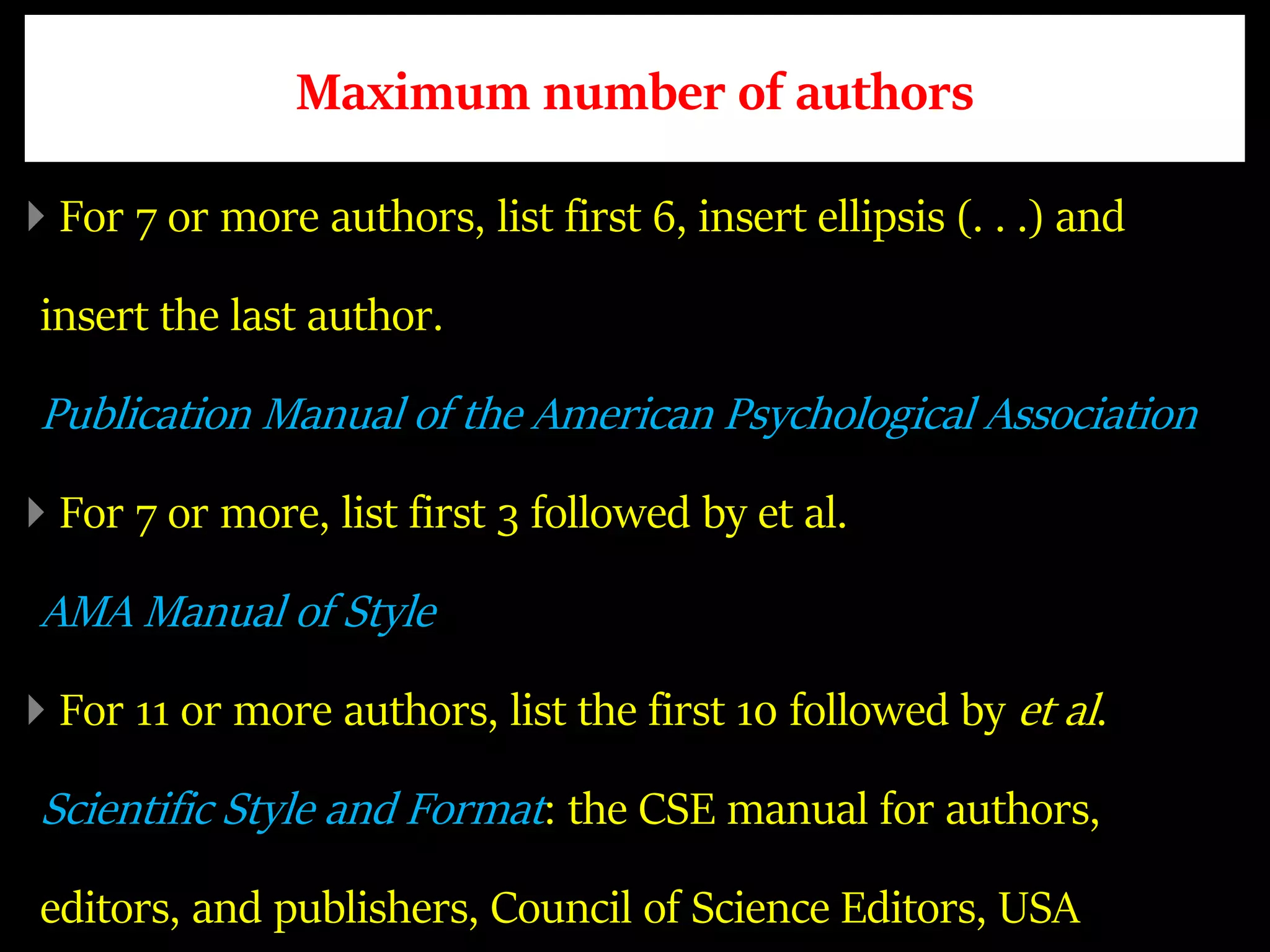
Maximum number of authors
For 7 or more authors, list first 6, insert ellipsis (. . .) and
insert the last author.
Publication Manual of the American Psychological Association
For 7 or more, list first 3 followed by et al.
AMA Manual of Style
For 11 or more authors, list the first 10 followed by et al.
Scientific Style and Format: the CSE manual for authors,
editors, and publishers, Council of Science Editors, USA
Differences in reference formats
Elements or parts of a reference
Sequence and details of elements
Punctuation between elements
Typography
Elements, or parts, of a reference
Paper in a journal? Chapter in a book? A whole book?
Presentation at a conference? Webpage? News item?
Author/s and year of publication
Title of the paper, book, presentation, etc.
Source details
(title of the journal, book, conference, etc. | volume-, issue-,
and page numbers | publisher and place of publication | dates
and place of the conference | conference organizer | URL); full
stop or no full stop
Sequence and details of elements, 1
Place: publisher or Publisher, place
London: Academic Press or
Academic Press, London
Inverted names: all or only the first
Patil A B, Gupta C D, and Roy E F or
Patil A B, C D Gupta, and E F Roy
Sequence or details of elements, 2
Journal names: full or abbreviated
Journal of Architectural Review or J. Archi. Rev.
Capitalization in journal names
The Architectural Review or
The architectural review
Page numbers: full or elided
[vol.] 25: 121–128 or [vol.] 25: 121–8
Punctuation between elements
Comma or space between surname and initials
Patil, A B or Patil A B
Dots after initials; space or no space
Patil A.B. or Patil A B or Patil AB
Comma or colon after volume number
Building and Environment 56, 123–128 or
Building and Environment 56: 123–128
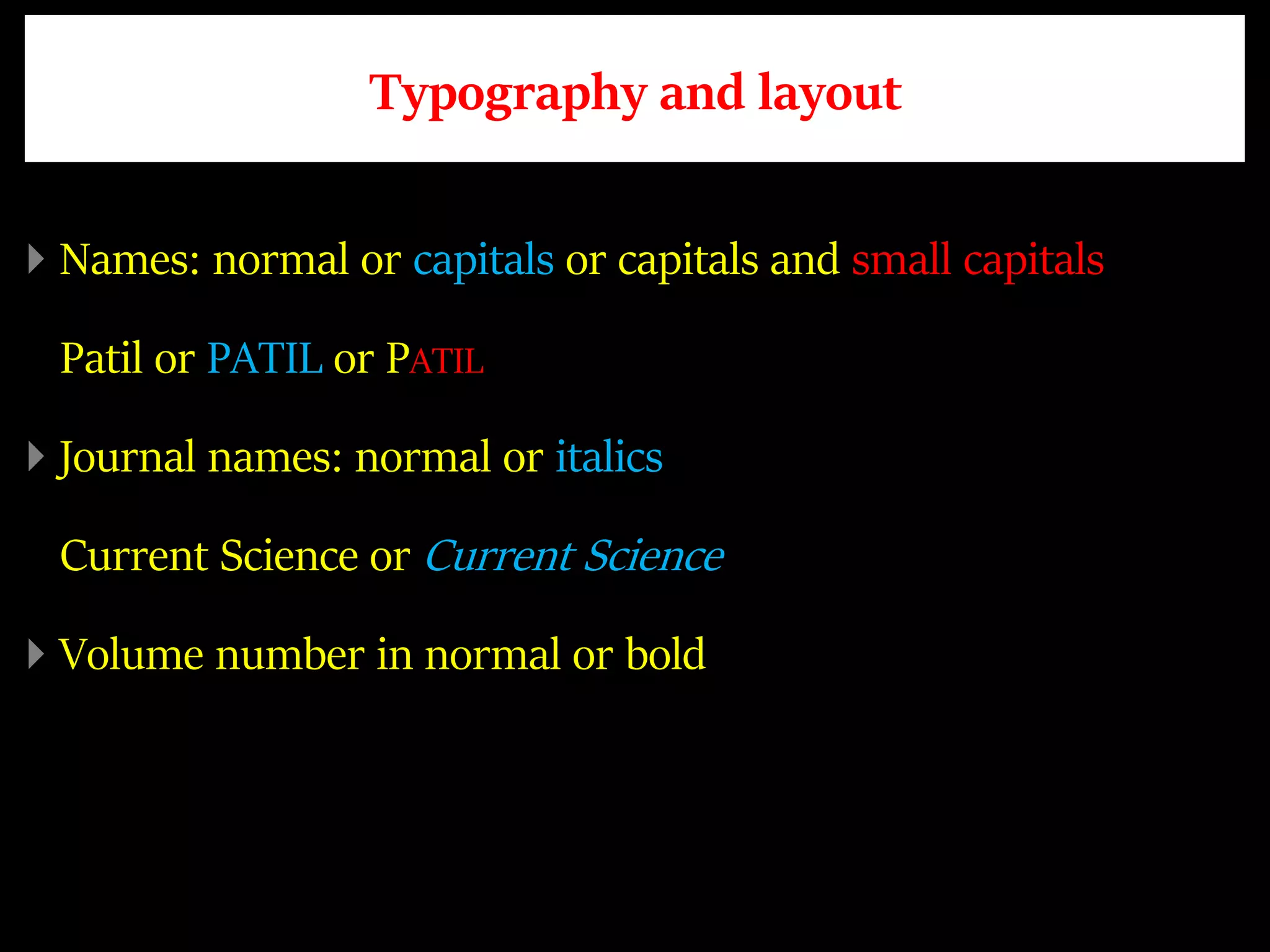
Typography and layout
Names: normal or capitals or capitals and small capitals
Patil or PATIL or PATIL
Journal names: normal or italics
Current Science or Current Science
Volume number in normal or bold
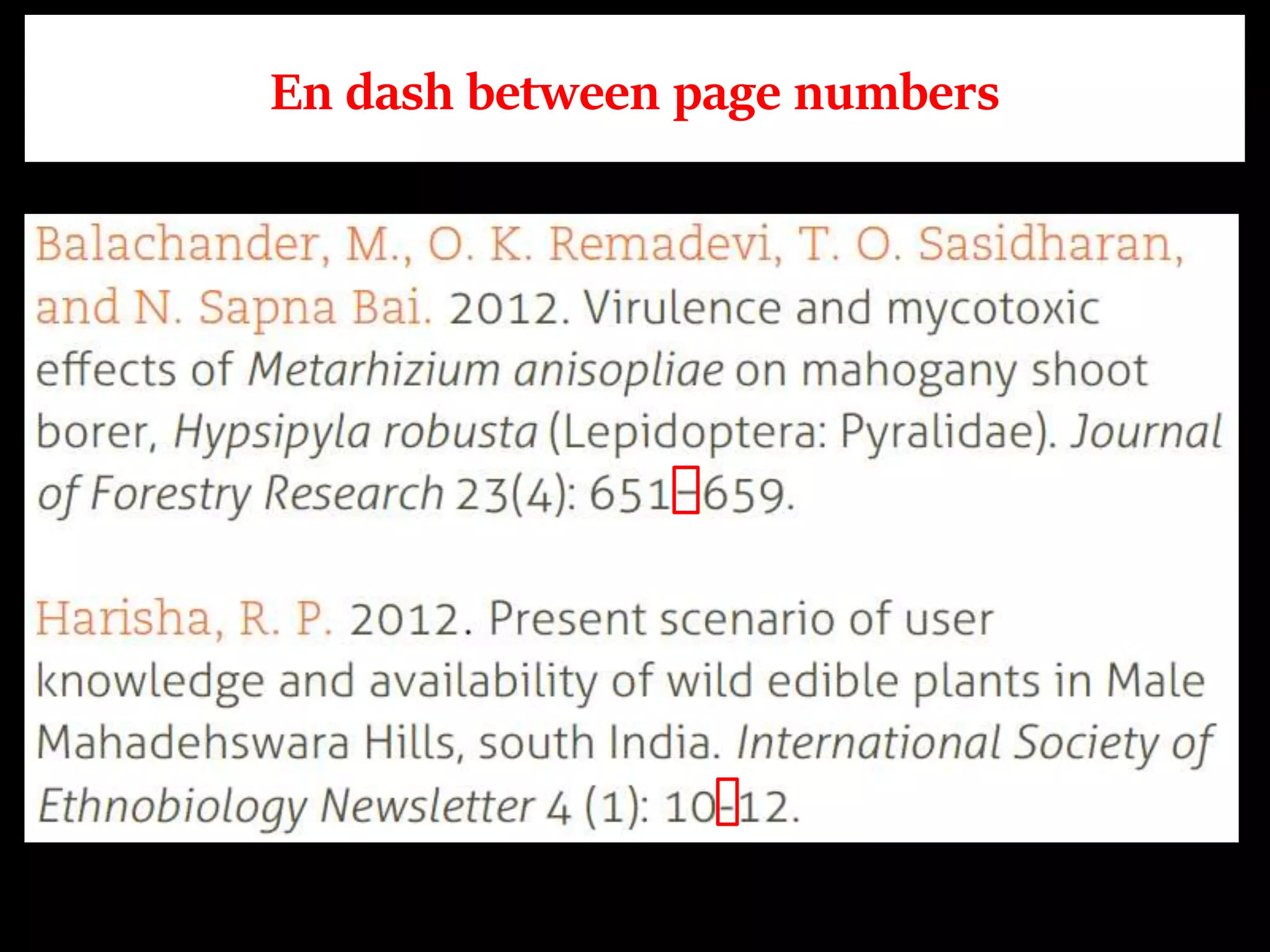
En dash between page numbers
Omit issue numbers if pagination is across issues
Ethology
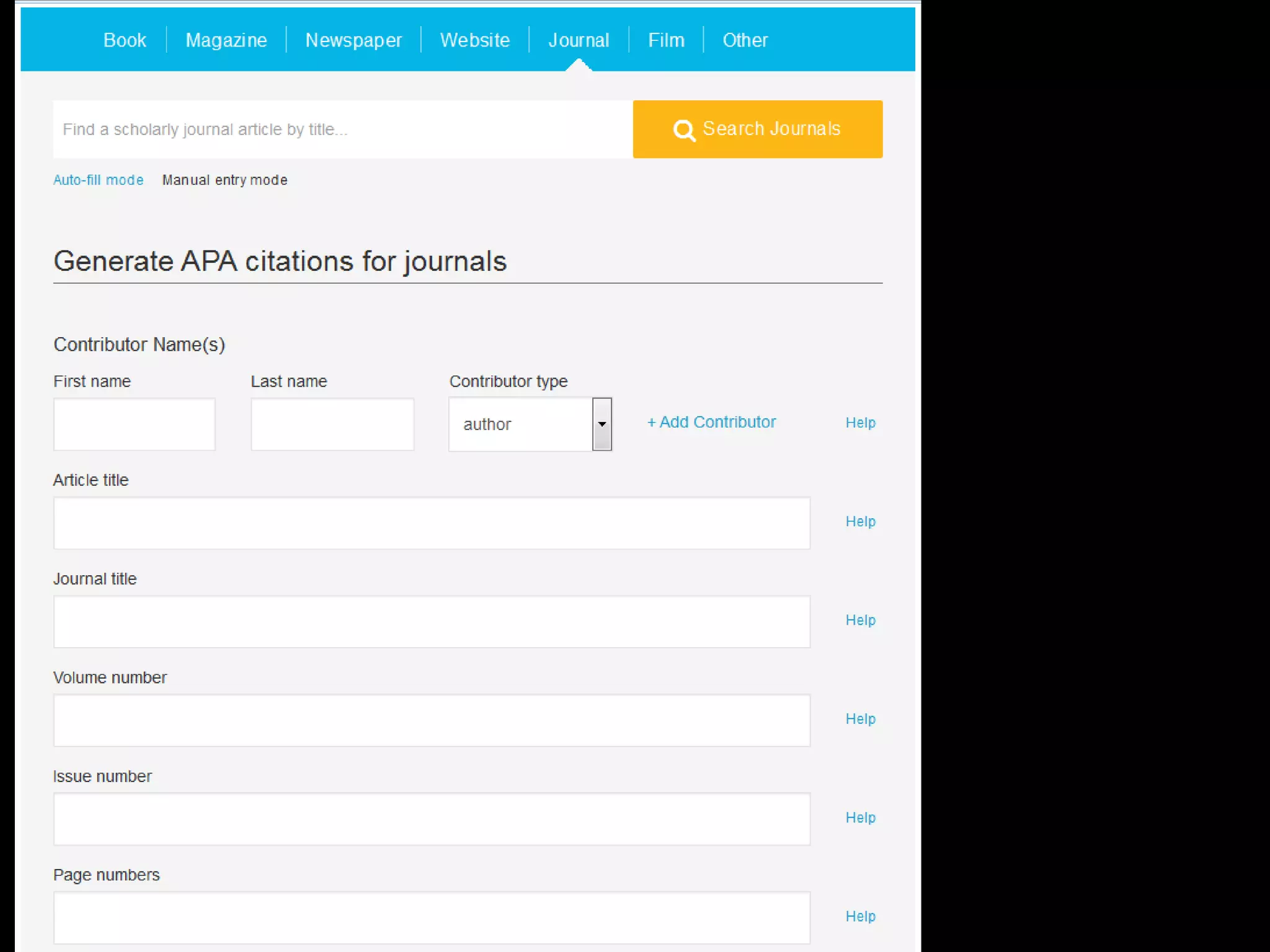
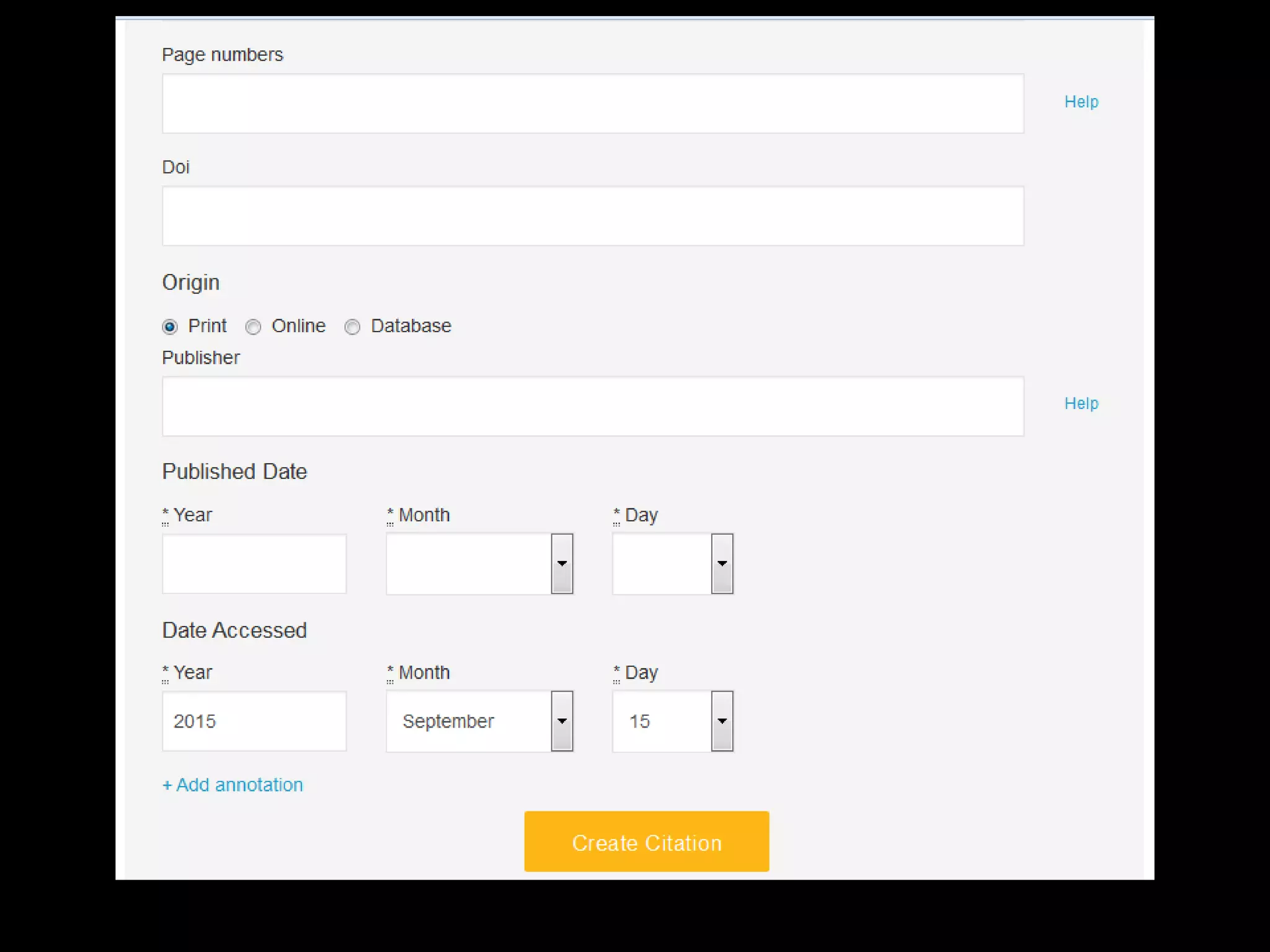
http://www.bibme.org/
http://www.stylewizard.com/apa6wiz.html
http://www.zotero.org
https://www.mendeley.com/
59
Mendeley is a free reference manager and academic social
network. Make your own fully-searchable library in seconds,
cite as you write, and read and annotate your PDFs on any
device.
https://www.mendeley.com/
60
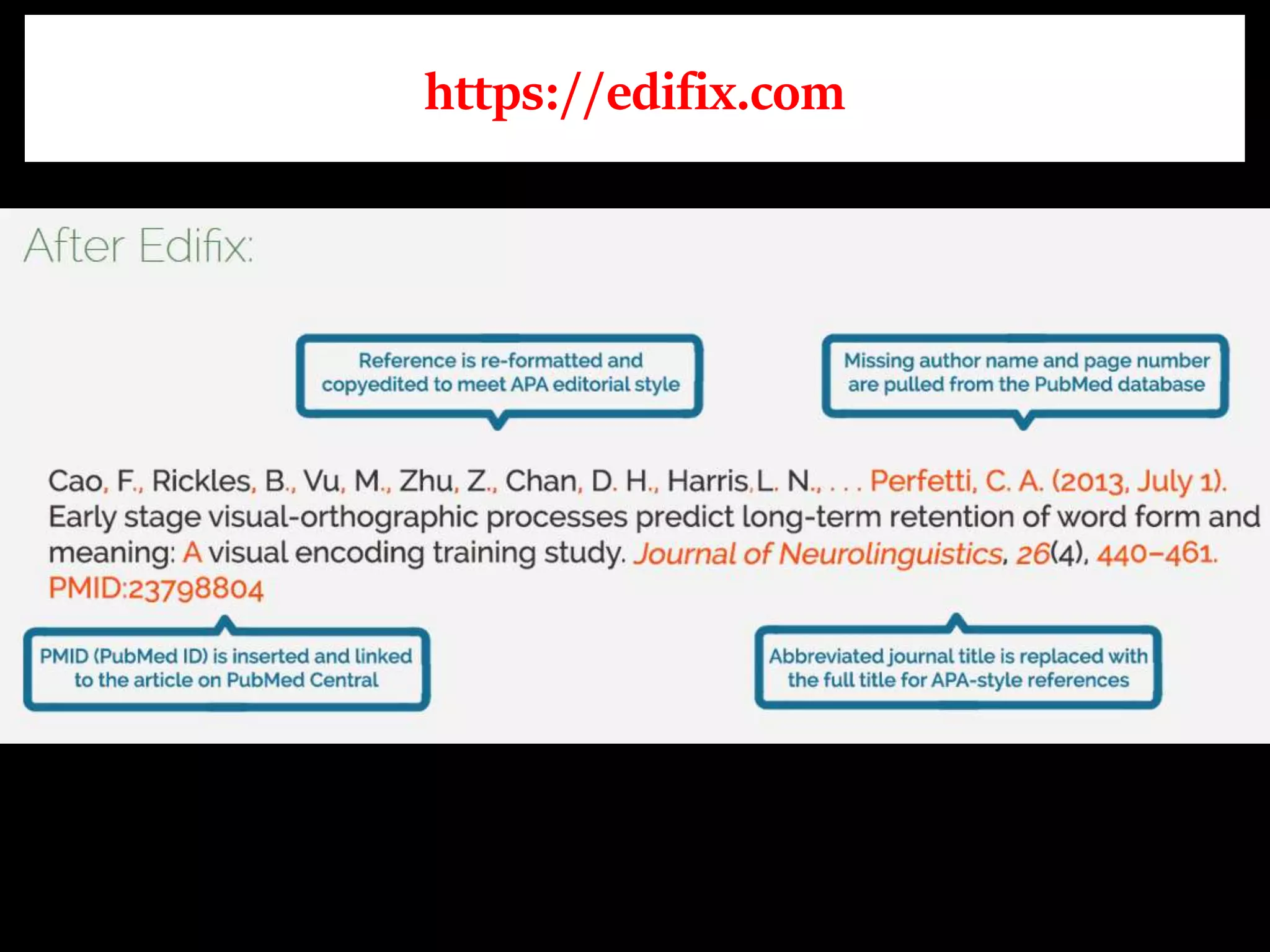
https://edifix.com/
The days of transposing author given-name initials and
surnames; removing (or adding) parentheses from (or to)
dates; and verifying the accuracy of article/book titles,
author names, and other facts of publication are over.
Edifix performs all of these tasks and more, not only
restructuring the references to conform to the selected
style but also verifying the facts of publication against
PubMed and CrossRef databases.
https://edifix.com
Renewable and Sustainable Energy Reviews
Journal of Applied Ecology
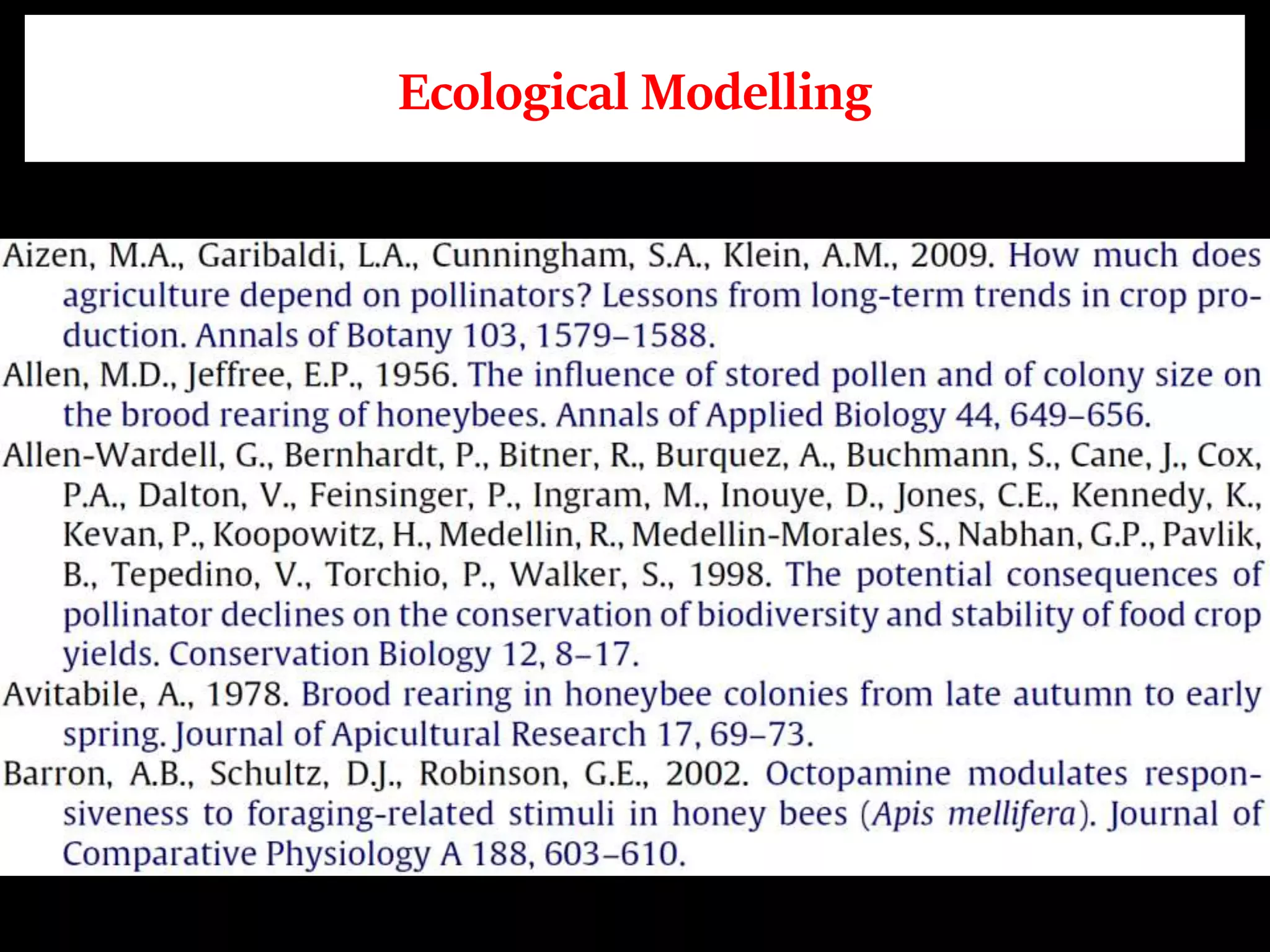
Ecological Modelling
Journal of Threatened Taxa
Animal Behaviour
Indian Journal of Geosciences
http://library.caltech.edu/reference/abbreviations/
View the LTWA <www.issn.org/services/online-
services/access-to-the-ltwa/>
Click on the letter corresponding to your search or enter a
word in the field provided for this purpose.
LTWA: List of Title Word Abbreviations
70
Harvard system, no authoritative source
No single authoritative source for Harvard style
Exact formatting and punctuation vary with the journal and
organization. Consult your target journal.
Council of Science Editors (US), American Chemical Society,
and American Psychological Society have their versions of the
Harvard style.
Vancouver system, authoritative source
www.citethemrightonline.com/About
The distortion of meaning over the years
In 1942, Katherine Frost Bruner, an editorial assistant at the
Journal of Abnormal and Social Psychology, wrote:
“Incidentally, a sin one more degree heinous than an
incomplete references is an inaccurate reference; the former
will be caught by the editor or the printer, whereas the latter
will stand in print as an annoyance to future investigators and a
monumnet ot the writer's carelessness.”
Bruner’s original article, 1942
Bruner, as quoted in 1974
Quote from Bruner as cited in 1984
www.qub.ac.uk/cite2write/home.html
Recommended reading
Lipson C. 2011. Cite Right, 2nd edn. University of Chicago
Press. 224 pp.
Neville C. 2010. The Complete Guide to Referencing and
Avoiding Plagiarism, 2nd edn. Maidenhead, Berkshire,
England: Open University Press. 207 pp.
Guzman M and Verstappen B. 2005. How to Record Names of
Persons. Versoix [Switzerland]: Huridocs. 24 pp.
Pears R and Shields G. 2013. Cite Them Right: the essential
referencing guide, 9th edn. London: Palgrave Macmillan.
136 pp.
Recommended reading
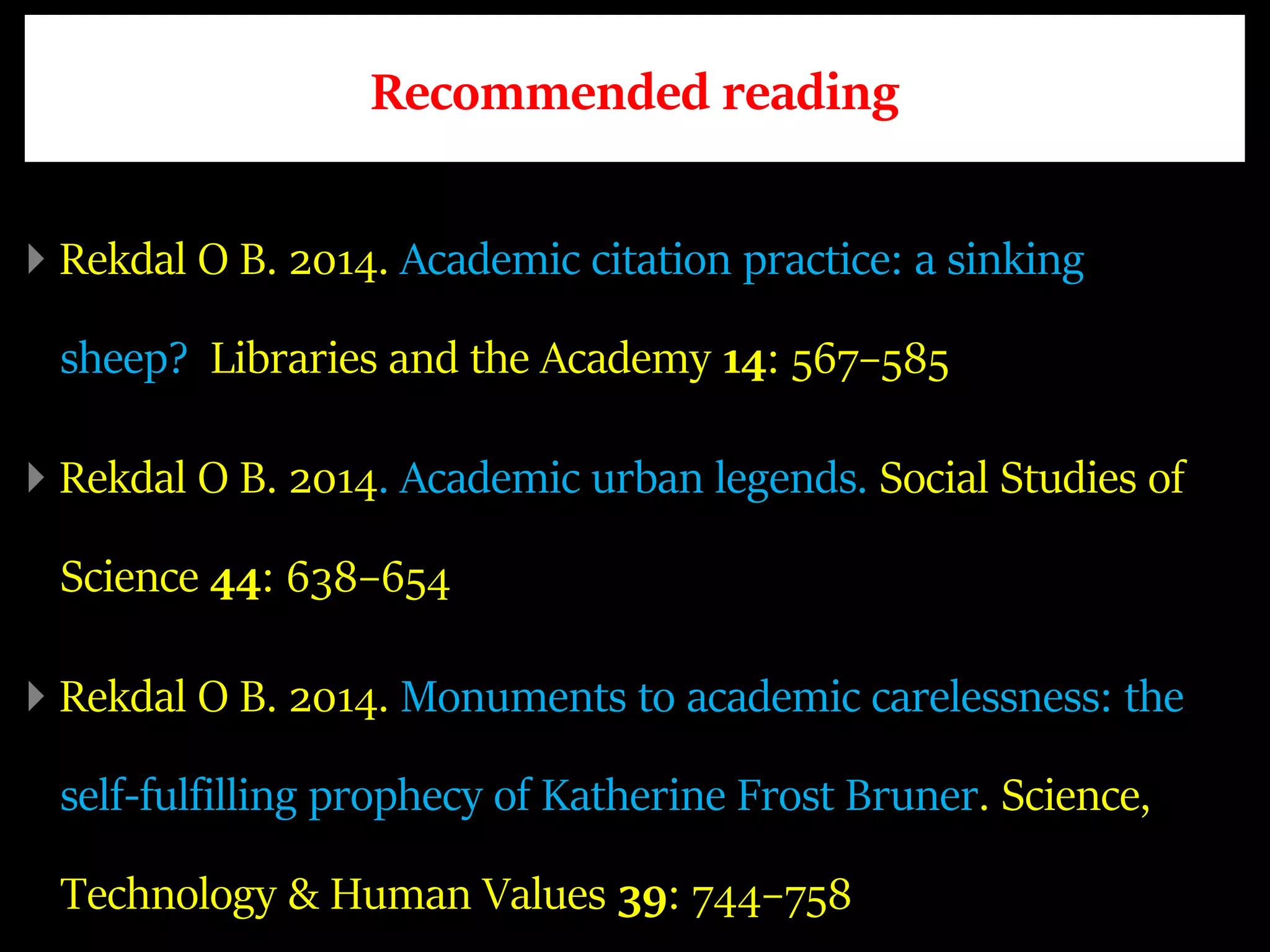
Rekdal O B. 2014. Academic citation practice: a sinking
sheep? Libraries and the Academy 14: 567–585
Rekdal O B. 2014. Academic urban legends. Social Studies of
Science 44: 638–654
Rekdal O B. 2014. Monuments to academic carelessness: the
self-fulfilling prophecy of Katherine Frost Bruner. Science,
Technology & Human Values 39: 744–758
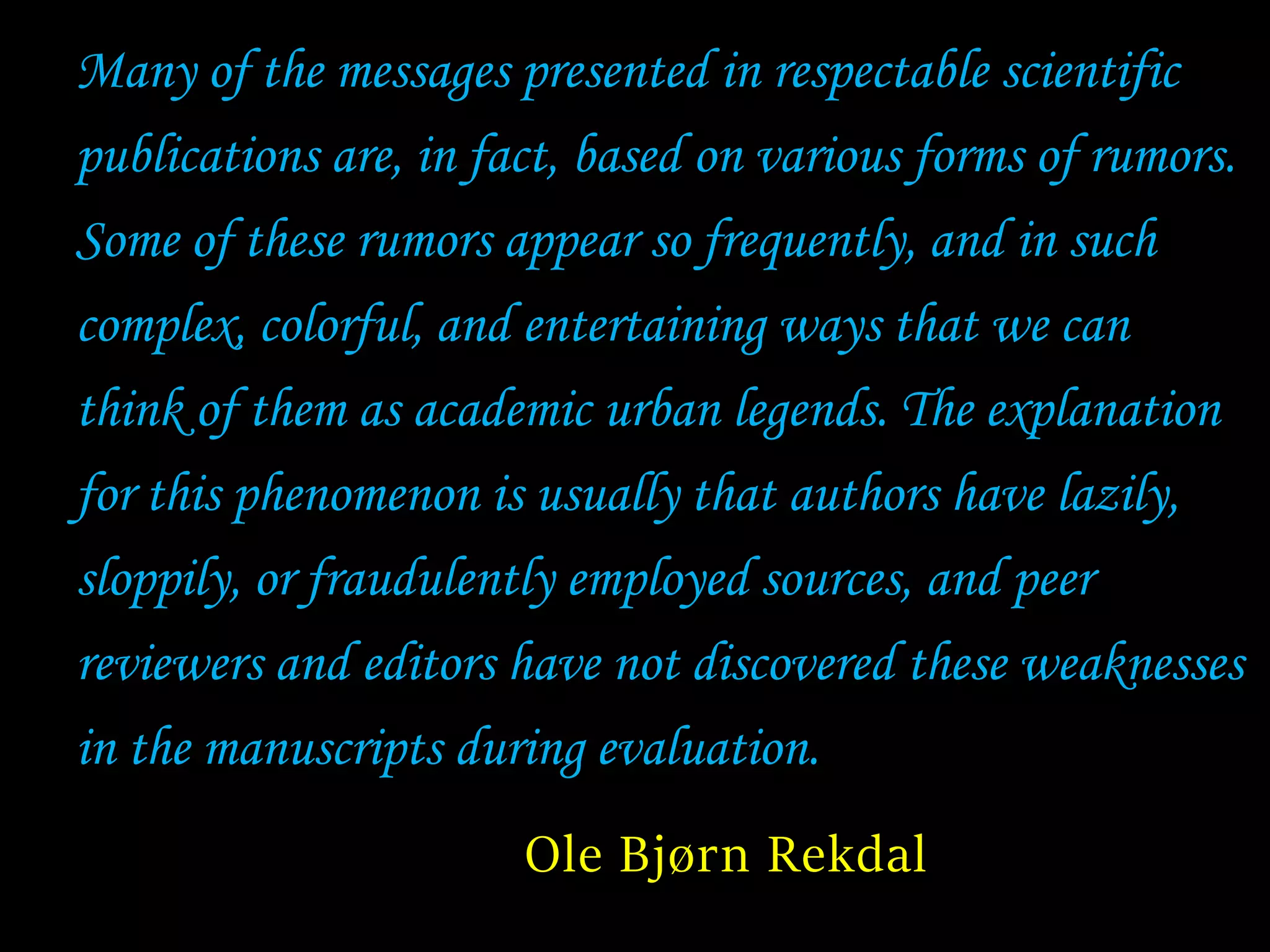
Many of the messages presented in respectable scientific
publications are, in fact, based on various forms of rumors.
Some of these rumors appear so frequently, and in such
complex, colorful, and entertaining ways that we can
think of them as academic urban legends. The explanation
for this phenomenon is usually that authors have lazily,
sloppily, or fraudulently employed sources, and peer
reviewers and editors have not discovered these weaknesses
in the manuscripts during evaluation.
Ole Bjørn Rekdal

7 Citations and References

  • 1.
    Warning from ajournal Literature cited: citations in text must be checked for consistency with those listed at the end under References. Authors must pay serious attention to the formatting of references. “Manuscripts will be returned even without reviewing if reference style is not adhered to.”
  • 2.
  • 3.
    Citations, 1 Recent statisticsfrom the Pew Foundation show that the median number of daily texts for older teens rose from 60 in 2009 to 100 in 2011 (Lenhart, 2012). Moreover, 64% of teens who own cell phones have texted during class, even in schools where cell phones are technically banned (Lenhart, Ling, Campbell, & Purcell, 2010). Those texts potentially come at the expense of learning, as texting during class reduces students’ ability to self-regulate and give sustained attention to classroom tasks (Wei, Wang, & Klausner, 2012).
  • 4.
    Citations, 2 The majorityof micro-organisms in their natural habitat cannot be cultured and remain unidentified (Cloete et al., 1992; Haldeman and Amy, 1993; Wagner et al., 1993). This has led to a lack of knowledge of microbial community composition and function. Recently, molecular techniques have been used in microbial ecology studies in an attempt to overcome the limitations of culture techniques (Pace et al., 1986; Wagner et al., 1993; Amann et al., 1995; Muyima et al., 1997). These techniques require a high level of expertise and sophistication and are often tedious (Schwieger and Tebbe, 1998).
  • 5.
    Citations, 3 Health literacyis ‘‘the degree to which individuals can obtain, process, and understand the basic health information and services they need to make appropriate health decisions’’ (Institute of Medicine, 2004; Ratzan & Parker, 2000; U.S. Department of Health and Human Services, 2000) and function effectively in the health care environment. It represents a constellation of skills including the ability to interpret documents and read and write prose (print literacy), use quantitative information (numeracy), and speak and listen effectively (oral literacy) (Institute of Medicine, 2004).
  • 6.
    Why use citations,1 To give the sources of data, facts, opinions, etc. To support what you say To point readers to additional information To show that ‘you have done your homework’. To enable readers to verify your assertions.
  • 7.
    Why use citations,2 Using other people’s research or ideas without giving them due credit is plagiarism. Since BibMe makes it easy to create citations, build bibliographies and acknowledge other people’s work, there is no excuse to plagiarize. Don’t be a thief—save your grade, use BibMe and give credit to those who deserve it!
  • 8.
  • 9.
  • 10.
    Citations and references Citationsare embedded in the text of the document. References are appended to the document. Citations are pointers to references. References provide enough details to — pinpoint the source — let readers judge the quality of the source — obtain the document if required
  • 11.
    Cite responsibly andaccurately Do not cite unless you have read the original. If you reproduce exact words (copy–paste), enclose the matter between quotation marks If you paraphrase, retain the original sense. Do not include assertions that you cannot trace. Give full reference.
  • 12.
    Citation not required Whatyou cite is common knowledge, found in many sources Easily observed phenomena Common sayings, proverbs, etc.
  • 13.
    Cite but donot include in references Personal communications: letters, email messages, text messages, conversations, and so on Unpublished data (includes matter from papers submitted but not published) In-house documents not accessible to the public Note Cite papers accepted but not yet published as ‘forthcoming’; supply available details in references.
  • 14.
    Citations: by numbersor by names? Citations by numbers, the Vancouver system Citations by names of authors, the Harvard system
  • 15.
    Citations by numbers:the Vancouver system Superscript numbers or ‘in line’ numbers? Parentheses (round brackets) or square brackets? Placement of numbers in relation to punctuation: before or after?
  • 16.
    Citations: ‘in line’numbers in brackets Journal of Biological Chemistry
  • 17.
    Citations: numbers initalics Science
  • 18.
    Citations: ‘in line’numbers in square brackets Renewable and Sustainable Energy Reviews
  • 19.
    Citations (numbers insquare brackets)
  • 20.
  • 21.
    Citations: superscript numbersin square brackets Advanced Energy Materials References in square brackets as superscripts after punctuation.
  • 22.
    Placement of numberedcitations Numbers after full stops and commas: The young are more tolerant of cellphones in the classroom than the old.1 Numbers immediately after authors: Kraushaar and Novak1 explored connections between classroom laptop usage and course achievements. Numbers before colons and semicolons: Solar cells generate energy during the day1; turbines can do so 24 hours.2
  • 23.
    Superscript numbers beforefull stop Current Science [superscript numbers before full stop]
  • 24.
    Superscript numbers afterfull stop BMJ [superscript numbers after full stop]
  • 25.
  • 26.
    Citations in text,1: author–year (Harvard system)
  • 27.
    Harvard system: pointsof difference Punctuation within a citation: Smith, 2014 O R Smith 2014 Punctuation between citations: Smith 2011; Brown 2014 Order of citations within multiple citations How many names before ‘et al.’: two, three, six, . . . Et al. italics or normal Et al. or Et al? Et (Latin for and) is never followed by a full stop.
  • 28.
    Names or etal.? et al. or et al. or et al? Journal of Applied Biology, The Holocene: names up to three authors; et al. thereafter Conservation Biology, Ethology, Animal Behaviour: names up to two authors Journal of Applied Ecology, Marine Mammal Science: et al. Conservation Biology: ‘Do not italicize et al.’ Animal Behaviour: “Note that ‘et al.’ is not in italics.”
  • 29.
    And or &(ampersand) Use an ampersand (&) between author surnames when the citation is parenthetical: (Bird & Tree 2000). When a citation is not parenthetical, use ‘and’: ‘Our results agree with the predictions of Wolf and Rhymer (2001).’ — Conservation Biology
  • 30.
    Placing in-text citations,1 Give the citation where it fits comfortably with the flow of your writing. Where the author’s name does not occur naturally, put the in-text citation into brackets. If you paraphrase something it may be neater to give the in-text citation at the end of the sentence. Queen’s University, Belfast
  • 31.
    Placing in-text citations,2 Insert names Start: Kraushaar and Novak (2010) explored connections between classroom laptop usage and course achievement. Middle: Available information on pre-harvest processes and their effects on shelf life (Scuderi et al. 2010) is limited. End: Students can score higher when they take notes (Titsworth & Kiewra, 2004).
  • 32.
    Multiple citations inchronological order International Journal of Urban and Regional Research
  • 33.
    Multiple citations inreverse chronological order Queen’s University, Belfast; Open University, UK
  • 34.
    Multiple citations inalphabetical order Economic Botany, Ecological Modelling, Journal of Tropical Ecology, Animal Behaviour
  • 35.
    Multiple citations inalphabetical order but in square brackets American Journal of Primatology
  • 36.
  • 37.
  • 38.
  • 39.
    Citations, references, andbibliography Citations in text; references at the end Citations: numbers or author/s–year References: details of sources cited, or referred to, in text Bibliography: sources used but not specifically cited
  • 40.
  • 41.
  • 42.
    Maximum number ofauthors The largest number of contributors to a single research paper: 5154 authors. Two large teams working on the Large Hadron Collider at CERN published 14 May 2015 in Physical Review Letters. Initial sequencing and analysis of the human genome, in the journal Nature, with 2900 authors in the full list.
  • 43.
    Very many authors Listthe first six authors. Skip all the rest except the last; represent the omission with ellipsis (three dots) End the list of names with the last author. Singh P K, Daniel R, Gupta P K, Kaul S T, Smith G, Chowdhury G M . . . Menon R. 2014. Improved designs of blades for offshore turbines. Energy 34: 5–12
  • 44.
    Maximum number ofauthors For 7 or more authors, list first 6, insert ellipsis (. . .) and insert the last author. Publication Manual of the American Psychological Association For 7 or more, list first 3 followed by et al. AMA Manual of Style For 11 or more authors, list the first 10 followed by et al. Scientific Style and Format: the CSE manual for authors, editors, and publishers, Council of Science Editors, USA
  • 45.
    Differences in referenceformats Elements or parts of a reference Sequence and details of elements Punctuation between elements Typography
  • 46.
    Elements, or parts,of a reference Paper in a journal? Chapter in a book? A whole book? Presentation at a conference? Webpage? News item? Author/s and year of publication Title of the paper, book, presentation, etc. Source details (title of the journal, book, conference, etc. | volume-, issue-, and page numbers | publisher and place of publication | dates and place of the conference | conference organizer | URL); full stop or no full stop
  • 47.
    Sequence and detailsof elements, 1 Place: publisher or Publisher, place London: Academic Press or Academic Press, London Inverted names: all or only the first Patil A B, Gupta C D, and Roy E F or Patil A B, C D Gupta, and E F Roy
  • 48.
    Sequence or detailsof elements, 2 Journal names: full or abbreviated Journal of Architectural Review or J. Archi. Rev. Capitalization in journal names The Architectural Review or The architectural review Page numbers: full or elided [vol.] 25: 121–128 or [vol.] 25: 121–8
  • 49.
    Punctuation between elements Commaor space between surname and initials Patil, A B or Patil A B Dots after initials; space or no space Patil A.B. or Patil A B or Patil AB Comma or colon after volume number Building and Environment 56, 123–128 or Building and Environment 56: 123–128
  • 50.
    Typography and layout Names:normal or capitals or capitals and small capitals Patil or PATIL or PATIL Journal names: normal or italics Current Science or Current Science Volume number in normal or bold
  • 51.
    En dash betweenpage numbers
  • 52.
    Omit issue numbersif pagination is across issues
  • 53.
  • 54.
  • 57.
  • 58.
  • 59.
  • 60.
    Mendeley is afree reference manager and academic social network. Make your own fully-searchable library in seconds, cite as you write, and read and annotate your PDFs on any device. https://www.mendeley.com/ 60
  • 61.
    https://edifix.com/ The days oftransposing author given-name initials and surnames; removing (or adding) parentheses from (or to) dates; and verifying the accuracy of article/book titles, author names, and other facts of publication are over. Edifix performs all of these tasks and more, not only restructuring the references to conform to the selected style but also verifying the facts of publication against PubMed and CrossRef databases.
  • 62.
  • 63.
  • 64.
  • 65.
  • 66.
  • 67.
  • 68.
    Indian Journal ofGeosciences
  • 69.
  • 70.
    View the LTWA<www.issn.org/services/online- services/access-to-the-ltwa/> Click on the letter corresponding to your search or enter a word in the field provided for this purpose. LTWA: List of Title Word Abbreviations 70
  • 71.
    Harvard system, noauthoritative source No single authoritative source for Harvard style Exact formatting and punctuation vary with the journal and organization. Consult your target journal. Council of Science Editors (US), American Chemical Society, and American Psychological Society have their versions of the Harvard style.
  • 72.
  • 74.
  • 76.
    The distortion ofmeaning over the years In 1942, Katherine Frost Bruner, an editorial assistant at the Journal of Abnormal and Social Psychology, wrote: “Incidentally, a sin one more degree heinous than an incomplete references is an inaccurate reference; the former will be caught by the editor or the printer, whereas the latter will stand in print as an annoyance to future investigators and a monumnet ot the writer's carelessness.”
  • 77.
  • 78.
  • 79.
    Quote from Bruneras cited in 1984
  • 80.
  • 81.
    Recommended reading Lipson C.2011. Cite Right, 2nd edn. University of Chicago Press. 224 pp. Neville C. 2010. The Complete Guide to Referencing and Avoiding Plagiarism, 2nd edn. Maidenhead, Berkshire, England: Open University Press. 207 pp. Guzman M and Verstappen B. 2005. How to Record Names of Persons. Versoix [Switzerland]: Huridocs. 24 pp. Pears R and Shields G. 2013. Cite Them Right: the essential referencing guide, 9th edn. London: Palgrave Macmillan. 136 pp.
  • 82.
    Recommended reading Rekdal OB. 2014. Academic citation practice: a sinking sheep? Libraries and the Academy 14: 567–585 Rekdal O B. 2014. Academic urban legends. Social Studies of Science 44: 638–654 Rekdal O B. 2014. Monuments to academic carelessness: the self-fulfilling prophecy of Katherine Frost Bruner. Science, Technology & Human Values 39: 744–758
  • 83.
    Many of themessages presented in respectable scientific publications are, in fact, based on various forms of rumors. Some of these rumors appear so frequently, and in such complex, colorful, and entertaining ways that we can think of them as academic urban legends. The explanation for this phenomenon is usually that authors have lazily, sloppily, or fraudulently employed sources, and peer reviewers and editors have not discovered these weaknesses in the manuscripts during evaluation. Ole Bjørn Rekdal