How Do I Reference?
This handout describes the Name-Year (N-Y) sys-
tem, but there are two other systems also commonly
used within CSE style: Citation-Sequence (C-S) and
Citation-Name (C-N). Whatever system you choose,
be consistent:
• The Name-Year system includes the author and year
in parentheses within the text, e.g., (Jones 2008),
and lists the references in alphabetical order within
the Reference List.
• The Citation-Sequence system uses a superscript
number, e.g., 1, for each citation within the text,
and entries in the Reference List are listed nu-
merically according to the order of their inclusion
within the text.
• The Citation-Name system requires you to list all of
your references in the Reference List in alphabeti-
cal order by author and then by title. Number the
references in this order. Where that reference is to
be cited in the text, insert the reference number in
superscript form, e.g., 1.
The disadvantage of the C-S and C-N systems is that
a reference added later in the writing process will
require renumbering of all references in the list and
within the text. However, an advantage is that the
inclusion of superscript numbers as in these systems
does not interrupt the flow of text as much as does a
series of name-year citations within a sentence. (Note:
Footnotes or endnotes in CSE style can be used for
content that supplements or amplifies important in-
formation in the text, or for copyright permission.)
This handout provides examples of the CSE format
for citations within the text (see “In-Text Citations”)
as well as for your references (see “Reference List”)
according to the N-Y system. For information on
the C-S and C-N systems, see the Writing Services
website www.writingservices.uoguelph.ca and click
on the Citations and Referencing link on the right-
hand sidebar.
ACKNOWLEDGING PRINT AND ELECTRONIC SOURCES IN
THE SCIENCES
CSE STYLE
Why Should I Reference?
References are used to record or document the source
of each piece of information in your paper obtained
from other researchers and writers. If you fail to
document information that is not your own, you have
committed plagiarism, a form of stealing.
What Should I Reference?
You must reference all direct quotations; paraphrases
of material; and summaries of opinions, ideas and in-
terpretations obtained from other sources. If you fail
to reference your information, you will be criticized
for making statements that appear to be unsupported
by evidence. It is not necessary to document informa-
tion that is common knowledge, but remember that
it is always better to overdocument than to under-
document.
You may be concerned that, if you reference too
much, your instructors will think the paper is not
your own work. That is not so. The method of or-
ganization is yours, as well as the purpose which ties
the material together, the topic sentences, concluding
sentences, analytical and evaluative comments which
allow the reader to make sense out of the reference
material, and probably most of the introductory and
concluding paragraphs.
What Style Should I Use?
Always ask the professor which documentation style
is required for the assignment. Styles can vary greatly
between journals even within one scientific field. If no
specifics are given, this Fastfacts can serve as a guide
to one of the standard formats, described in Scientific
Style and Format: The CSE Manual for Authors, Edi-
tors, and Publishers (known as the CSE style), used in
all scientific disciplines related to experimental and
observational science (including but not limited to
physical sciences, mathematics, and life sciences).
Learning Commons Fastfacts Series ©2008
www.learningcommons.uoguelph.ca 2.
A. In-Text Citations
In-text citations (also called parenthetical refer-
ences) include the author’s last name and the year of
publication. These citations can be included within a
sentence in various ways, but you should always keep
them as close as possible to the relevant title, word,
or phrase. Avoid placing citations at the end of long
clauses or sentences, because the concept being refer-
enced may be unclear.
• At the end of the sentence in parentheses:
This hypothesis was tested (Smith 1970).
• As part of the sentence, using the parentheses to
include whatever reference information is not in the
sentence:
Smith (1970) tested this hypothesis; OR
Smith’s (1970) study tested this hypothesis; OR
In 1970, Smith tested this hypothesis.
If you include the titles of works within the text of
your paper, use “double quotation marks” for the title
of an article or chapter, and italics for the title of a
periodical or book.
The following list explains what information needs to
be included for various situations in a N-Y citation.
These formats apply to both electronic and print
sources.
ONE OR TWO AUTHORS
… was tested (Smith 1970).
… for measurement (ISO 1979).
… (Elias and Williams 1981).
THREE OR MORE AUTHORS
… (Lui et al. 1995).
ANONYMOUS AUTHOR / NO AUTHOR
Do not use “Anonymous.” Instead, include the first
word(s) of the title (only as many as are needed to
identify the source apart from others) followed by an
ellipsis (...).
… (Patient... 2003).
NO DATE
… (Smith [date unknown]).
MULTIPLE SOURCES, SAME AUTHOR
Order them chronologically, earliest to latest.
… (Jones 1965, 1973, 1988).
If there are several in the same year, add a desig-
nator (a, b, c, etc.) to the year in the citation and
the reference list.
… (Jones 1998a, 1998b).
Include the “a” and “b” when listing these
sources in your reference list, too.
MULTIPLE SOURCES, DIFFERENT AUTHORS
List them chronologically, and alphabetically if
they were published in the same year. Separate
authors with a semi-colon.
… (Sergeant 1973, 1975; Klevezal and Thompson
1980; Jones 1998a, 1998b; Alberts et al. 2001;
Stanford 2001).
DIFFERENT AUTHORS, SAME LAST NAME
If the citations would otherwise be identical,
provide initials or enough other names to distin-
guish between them.
… (Smith NB 1993; Smith TR 1993).
… (Elias BL and Elias SR 2004).
… (Smith, Jones, et al. 1990; Smith, Williams, et al.
1990).
A SPECIFIC PART OF A SOURCE
… (Zelickson and Robbins 1986, p 24).
A SECONDARY SOURCE
When the source you’re citing is within another
source, obtaining the original paper (e.g. King) is the
best option whenever possible.
. . . (King 1911, cited in Brown 2003)
UNPUBLISHED INFORMATION
Unpublished information that is not available to
other scholars is indicated parenthetically in the
text only, with a note indicating it is not in the
reference list. Instead, add a “Notes” section at
the end of your paper to provide further details
about the communication, meeting, or materials,
such as purpose, time, date, location, etc.
www.learningcommons.uoguelph.ca 3.
… (a 1998 Mar 26 e-mail from JR Ewing to me;
unreferenced, see “Notes”).
… (my 2004 Feb 17 notes from BIOL1030 lecture
by T Dukator; unreferenced, see “Notes”).
COURSE AND LECTURE MATERIALS
Course readers: Use the article authors as
authors and the date on the reader as the year of
publication.
… (Winston and Blais 2003).
Course manual: Treat these as books, using the
instructor as author (unless another author is
indicated).
Lecture notes: Treat these as books if they are
published, but as unpublished information if
they are your own notes, or are unpublished.
Course or lecture notes may be considered
“published” only if they have been been copied
and distributed in print or on the Web with the
instructor’s permission.
B. Reference List
The reference list comes at the end of your paper and
provides the full bibliographic information for your
materials. Works you have cited within your paper
should be listed in alphabetical order under “Refer-
ences” or “Cited References.” If you used other mate-
rial but didn’t specifically cite it, include it in a section
called “Additional References.”
These examples show you how to format various kinds
of reference list entries.
ONE TO TEN AUTHORS
Author AA, Author BB, Author CC. Year. Title
of work. Edition. Place of publication (State or
Prov): Publisher name. Number of pages p.
Agrios GN. 1978. Plant pathology. 2nd ed. New
York (NY): Academic Press. 703 p.
Davidson RH, Lyon WF. 1979. Insect pests of farm,
garden, and orchard. 7th ed. New York (NY): John
Wiley & Sons. 596 p.
MORE THAN TEN AUTHORS
List the 1st to 10th authors, followed by “et al.”
ORGANIZATION/GROUP AS AUTHOR
Provide the abbreviation of the group name in
square brackets so you can use it in your in-text
citation, but make sure you also spell out the
organization’s name.
[HSF] Heart & Stroke Foundation. 2008. Blood
pressure action plan [Internet]. Ottawa (ON);
[cited 2008 Aug 12]. 1 pg. Available from: http://
www.heartandstroke.com/site/c.ikIQLcMWJtE/
b.3484475/
ANONYMOUS AUTHOR / NO AUTHOR
Omit authorship from reference, and begin with title.
Protocol for sterile procedures. 2004. Toronto
(ON): Association for Microbiological Standards.
35 p.
DATE UNKNOWN
Smith RA. [Date unknown]. Health problems in the
elderly. New York (NY): John Wiley & Sons. 315 p.
AN EDITED BOOK OR COLLECTION
Author AA, Author BB, editors. Year. Title of
work. Edition. Place of publication: Publisher
name. Number of pages p.
Gilman AG, Rall TW, Nies AS, Taylor P, editors.
1990. The pharmacological basis of therapeutics.
8th ed. New York (NY): Pergamon. 1389 p.
PART OF AN EDITED BOOK OR COLLECTION
Author(s) of the part. Year. Title of the part. In:
author(s) or editor(s). Title of the book. Place
of publication: Publisher name. p Pages of the
part.
Kuret JA, Murad F. 1990. Adenohypophyseal
hormones and related substances. In: Gilman
AG, Rall TW, Nies AS, Taylor P, editors. The
pharmacological basis of therapeutics. 8th ed. New
York (NY): Pergamon. p 1334-60.
If the author of the part also happens to be the
book author or editor, use this format:
www.learningcommons.uoguelph.ca 4.
Author(s) or editor(s). Year. Title of book. Place
of publication: publisher name. Kind of part
and its numeration, title; p Pages of the part.
Hebel R, Stromberg MW. 1976. Anatomy of the
laboratory rat. Baltimore (MD): Williams & Wilkins.
Part C, Digestive system; p 43-54.
UNPUBLISHED INFORMATION
Only include information available to scholars in the
reference list. (See “Unpublished Information” under
“In-text Citations” above.) If no title is available,
construct one using the first few words of the docu-
ment, and enclose with square brackets. After the
location information, include the library call number
or other finding information.
Darwin C. 1863. [Letters to Sir William Jackson
Hooker]. Located at: Archives, Royal Botanic
Gardens, Kew, London (England); MS L.4562.
A SECONDARY SOURCE
When the source you’re citing is within another
source, obtaining the original paper is the best op-
tion. However, if you cannot locate the original,
include full references for both documents in your
reference list (you’ll find the information for the
secondary source in the source you’re using). As
shown below, the reference for the original document
should include a closing note (in parentheses) in the
reference list indicating the source reference.
Brown AD. 2003. Feed or feedback : agriculture,
population dynamics and the state of the planet.
Utrecht (Netherlands): International Books. 431p.
King FH. 1911. Farmers of forty centuries. Emmaus
(PA): Penguin. p. 350-79. (cited in Brown 2003)
COURSE AND LECTURE MATERIALS
Course readers: Treat articles in a course reader as
a part of an edited book or collection edited by the
instructor of the course.
Course manuals: Treat these as books or non-
periodicals, with the instructor as author (unless
another author is indicated).
Stengos T. 2003. ECON*4640 Applied
Econometrics course manual. Guelph (ON):
University of Guelph.
Lecture notes: Treat these as books or non-peri-
odicals if they are published, but as unpublished
information if they are your own notes, or are
unpublished. Lecture notes are considered pub-
lished if they have been copied and distributed
in print or on the Web with the instructor’s
permission.
Stengos T. 2003. ECON*4640 Applied
Econometrics course notes. Guelph (ON):
University of Guelph.
Stengos T. 2003. ECON*4640 Applied
Econometrics course notes. Guelph (ON):
University of Guelph; [cited 23 November
2003]. Available from: http://www.uoguelph.ca/
econometrics.htm
NEWSPAPER ARTICLE
Author AA, Author BB. Date of publication.
Article title. Newspaper title (edition); Section:
Beginning page number(column number).
Rensberger B, Specter B. 1989 Aug 7. CFCs may
be destroyed by natural process. Washington
Post;Sect A:2 (col5).
JOURNAL ARTICLE
Author AA, Author BB. Year. Article title.
Journal title. Volume number(issue number):
inclusive pages.
Burns L, Thorpe G. 1979. Fears and phobias.
Journal of Internal Medical Research. 17(2):235-
46.
ONLINE JOURNAL ARTICLE
Author AA, Author BB. Date of Publication.
Article Title. Journal Title [Medium
Designator]. Edition. [Date of Update/Revision;
Date of Citation];Volume(Issue):inclusive
pages. Available from: URL (Language).
Tong V, Abbott FS, Mbofana S, Walker MJ. 2001.
In vitro investigation of hepatic extraction. Journal
of Pharmacy & Pharmaceutical Sciences [Internet].
[cited 2001 May 3];4(1):15-23. Available from:
http://www.ualberta.ca/~csps/JPPS4(1)/F.Abbott/
RSD1070.pdf
www.learningcommons.uoguelph.ca 5.
If there is no pagination in your online material,
estimate how many pages it has:
Ganz PA. 1997 Apr. Menopause and breast
cancer. Innovations in Breast Cancer Care
[Internet]. [cited 1997 Nov 4];2(3):[about 10 p.].
Available from: http://www.meniscus.com/bcc/
Art2_23.html
NOTE: If a reference ends with html address, do not
follow with a period.
ONLINE DOCUMENT
Author AA, Author BB. Date of Publication.
Title [Content Designator Medium Designator].
Edition. Secondary Authors. Place of
Publication: Publisher; [Date of Update/
Revision; Date of Citation]. Extent. (Series).
Available from: URL (Language). Notes.
George SR. 2006 Oct. Risks associated with
somnambulism [Internet]. London (England):
National Sleep Network; [cited 2007 Apr 15]. 28 p.
Available from: http://www.nsn.org/somnamb.pdf
If the document has no author, or if the organi-
zation is acting as both the author and publisher,
begin with the document title and use the or-
ganization name as the publisher:
Metcalfe meta directory of Internet health
resources. 1999 Apr. 25. [Internet]. Iowa City (IA):
University of Iowa, Metcalfe Library for the Health
Sciences; updated 2000 Apr 25 [cited 2003 Jun
30]. Available from: http://www.lib.uiowa.edu/
metcalfe/md/index.html
WEB SITE
Web site name. Date of Publication or
Copyright. [Medium Designator]. Place of
Publication: Publisher; [Date of Update/
Revision; Date of Citation]. Available from:
URL (Language). Notes.
Medtext. c1995-2001. [Internet]. Hinsdale (IL):
Medtext, Inc.; [cited 2001 Mar 8]. Available from:
http://www.medtext.com/hdcn.htm
ELECTRONIC COMMUNICATIONS
Email and postings to discussion lists are usually
cited in the body of the paper and acknowledged
in a “Notes” section, rather than in the references
list.
For emails:
Author of Message. Date of Message. Title
of Message [Content Designator Medium
Designator]. Message to: Message Recipient.
[Date of Citation]. [Extent e.g., number of
pages/screens].
Stevens J. 2003 Feb 27. Methods of electronic
referencing [electronic mail on the Internet].
Message to: John Smith. [cited 2003 Mar 28].
[about 5 screens].
For discussion lists:
Author of Message (Author Affiliation). Date
of Publication. Title of Message. In: Title of
List [Content Designator Medium Designator].
Place of Publication: Publisher; [Date of
Citation]. Numeration of Message. [Extent].
Available from: URL (Language). Notes.
Smith J. 1998 Feb 23, 10:27 am. WebMD. In:
MEDLIB-L [discussion list on the Internet].
[Chicago (IL): Medical Library Association];
[cited 1998 Feb 24]. [about 2 p.]. Available from:
[email protected]
Archives available from: http://www.medlib-l.com
SOME GUIDELINES FOR REFERENCING
ELECTRONIC SOURCES
Remember to acknowledge electronic sources and to
evaluate them critically since much of the material on
the Internet is inappropriate for use in an academic
paper.
• Is this reference current?
• Has the work been critically evaluated and if so, by
whom?
• Who is the publisher or sponsoring organization?
Does the work cite sources?
Writing Services
The Learning Commons, 1st Floor, Library
www.learningcommons.uoguelph.ca
[email protected]
For information about how to evaluate a Web site,
go to the library’s home page and click on Online
Tutorials.
Additional Relevant Fastfacts
• Using Quotations in Your Essay
• Plagiarism and Academic Integrity
Additional Resources
This Fastfacts is based on Scientific Style and Format:
The CSE Manual for Authors, Editors, and Publishers.
If you can’t find what you’re looking for here, these
sources have more complete information:
Council of Science Editors, Style Manual Commit-
tee. 2006. Scientific style and format: the CSE manu-
al for authors, editors, and publishers. 7th ed. Reston
(VA): The Council.
Council of Science Editors [Internet]. [cited 2008
Aug 12]. Available from: http://
www.councilscienceeditors.org/publications/style.cfm
Patrias K. 2001 July. National Library of Medicine
recommended formats for bibliographic citation, sup-
plement: Internet formats [Internet]. Bethesda (MD):
National Library of Medicine; [cited 2004 Apr 16].
Available from: http://www.nlm.nih.gov/pubs/
formats/internet.pdf
Need Advice or More Information?
Writing Services, located in the Learning Commons
on the 1st floor of the Library, is the best source on
campus and online for advice and information on
writing issues.
• All University of Guelph students — undergraduate
and graduate — are entitled to three free individual
writing consultations per semester with our profes-
sional staff. Appointments are recommended.
• Peer Helpers from a variety of disciplines offer indi-
vidual writing assistance to first-year students and
ESL students.
• Writing Central is a walk-in service where trained
graduate student writing advisors look at under-
graduate and graduate student papers. Students can
access this service as many times as they wish.
• Our Web site www.writingservices.uoguelph.ca
provides resources and information about our writ-
ing programs and services. For specific questions,
e-mail [email protected]
• Fastfacts handouts (like this one) provide informa-
tion on a range of learning, writing, and academic
computing issues and are free to registered students.
The complete range of Fastfacts is available on the
Learning Commons Web site.
• Workshops, seminars, and short courses on learn-
ing, studying and writing topics are offered each
semester. Visit www.writingservices.uoguelph.ca
for details.
Please note that this material is protected by copy-
right. For permission to reproduce this document in
any form, contact Writing Services. The Learning
Commons, University of Guelph. This document has
links which are active when the handout is viewed on
our Web site: www.writingservices.uoguelph.ca
USC Aiken Library – Reference Department
CSE/CBE Style Quick Reference Guide
Disclaimer: This guide is only intended to be used as a Quick
Reference (most commonly used citations). For further
guidance, consult Scientific Style and Format: The CSE Manual
for Authors, Editors, and Publishers. For additional help
or questions on writing, refer to the Writing Room located in
H&SS 112 or ext. 3262.
General guidelines: When giving an author’s name, type out the
last name but give only the initials for the first
and middle names. Do not put spaces or periods between
initials. Do not underline or italicize book or journal
titles. In a title, capitalize the first word in the title, the first
word after a colon, and any proper nouns. If you can,
use an abbreviation for scientific journal titles. Common
abbreviations can be found at:
http://library.caltech.edu/reference/abbreviations/ ,
http://www.library.ubc.ca/scieng/coden.html, and
http://www.library.uiuc.edu/biotech/j-abbrev.html.
In-text citation guidelines: The examples in this Quick
Reference Guide use the “Name-Year” format for in-text
citations. For example, (Nowak 2006). With this format, the
bibliography is organized alphabetically by the last name of
the author. It is also common and correct to use the “Citation-
Sequence” format in which the in-text citation is a number,
for example (12). You can put this number in brackets [12],
parentheses (12), or as a superscript 12. When you cite, give
this number in the text, not the author’s name and year. The
bibliography at the end of the paper is organized by the order
in which you cite the authors. Thus, if the first person cited in
your paper is Zhang and the twelfth person is Andrews,
Zhang would be listed first and Andrews would be listed twelfth
in the bibliography, because this is the order in which
they appeared in the paper. If you cite Zhang’s paper again, you
would still refer to it as (1). That paper will always be (1).
Or, you can use the “Citation-Name” format and start by
organizing the bibliography in alphabetical order by author last
name. Then, assign each author a number, with the first one
being 1 and so on. So, in the example above, Andrews would
be (1) and Zhang might be (23). When you cite Andrews’ paper
you put (1) as the in-text citation. When you cite Zhang’s
paper you put (23).
Finally, keep in mind that changes to CSE/CBE style are
common. They are generally determined by the journal to which
you are submitting your paper. Please double-check your
citations against citations in the journal in question. Or, double-
check with the professor for whom you are writing the paper.
CSE/CBE Reference List Text Note
Books
Book by a Single Author
Nowak MA. 2006. Evolutionary dynamics: exploring the
equations of life. Cambridge (Nowak 2006)
(MA): Belknap Press.
Book by Two or More Authors
Bone Q, Marshall NB, Baxter JHS. 1999. Biology of fishes.
London: Stanley Thorne. (Bone et al. 1999)
Note: If there are only two authors, put both names in the in-
text citation.
Example: (Bone and Marshall 1999)
Article or Essay in a Collection or Anthology
Alpert P, Oliver MJ. 2002. Drying without dying. In: Black M,
Pritchard HW, (Alpert and Oliver 2002)
editors. Desiccation and survival in plants: drying without
dying. New York (NY):
CABI Publishing. p. 3-43.
http://library.caltech.edu/reference/abbreviations/
http://www.library.ubc.ca/scieng/coden.html
http://www.library.uiuc.edu/biotech/j-abbrev.html
USC Aiken Library – Reference Department
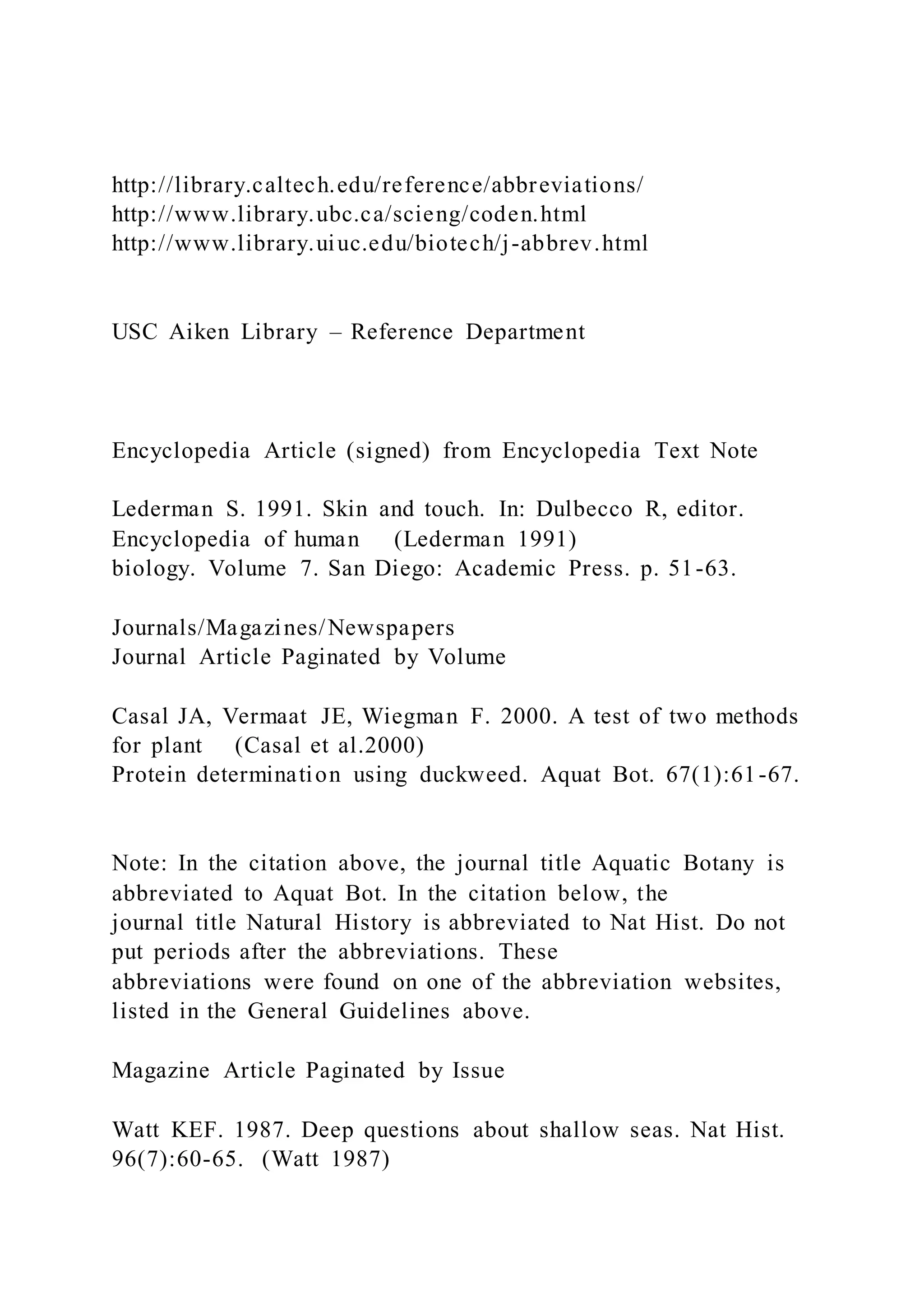
Encyclopedia Article (signed) from Encyclopedia Text Note
Lederman S. 1991. Skin and touch. In: Dulbecco R, editor.
Encyclopedia of human (Lederman 1991)
biology. Volume 7. San Diego: Academic Press. p. 51-63.
Journals/Magazines/Newspapers
Journal Article Paginated by Volume
Casal JA, Vermaat JE, Wiegman F. 2000. A test of two methods
for plant (Casal et al.2000)
Protein determination using duckweed. Aquat Bot. 67(1):61-67.
Note: In the citation above, the journal title Aquatic Botany is
abbreviated to Aquat Bot. In the citation below, the
journal title Natural History is abbreviated to Nat Hist. Do not
put periods after the abbreviations. These
abbreviations were found on one of the abbreviation websites,
listed in the General Guidelines above.
Magazine Article Paginated by Issue
Watt KEF. 1987. Deep questions about shallow seas. Nat Hist.
96(7):60-65. (Watt 1987)
Newspaper Article
O’Neil J. 2003 Nov 4. Right light for smoother skin. New York
Times. Sect. F:6(col. 3). (O’Neil 2003)
Electronic Resources
Work from a subscription service (database)
Jackson SF, Gaston KJ. 2008. Land use change and the
dependence (Jackson and Gaston
2008)
of national priority species on protected areas. Global Change
Biol [Internet].
[cited 2008 Sep 8];14(9):2132-2138. Available from:
http://search.ebscohost.com/login.aspx?direct=true&db=aph&A
N=33533307&site=ehost-live
World Wide Web sites:
[FDA] U.S. Food and Drug Administration Center for Food
Safety and Applied Nutrition (FDA 2006)
[Internet]. What consumers need to know about avian influenza;
2004 Mar 29
[updated 2006 Oct 19; cited 2006 Nov 22]. Available from:
http://www.cfsan.fda.gov/~dms/avfluqa.html
Note: If the organization, such as the U.S. Food and Drug
Administration Center for Food Safety and Applied
Nutrition (see above), has a long title, you may abbreviate the
title, placing the abbreviation at the beginning of the
citation. You may then use this abbreviation in the text note.
Mayo Foundation for Medical Education and Research
[Internet]. Dry skin; 2006 (Mayo 2006)
[cited 2007 May 22]. Available from:
http://www.mayoclinic.com/health/dry-skin/DS00560
The CSE Style Guide is also available on the Library
website at:
http://library.usca.edu/Instruction/StyleGuides

How do i reference this handout describes the name year (n-y

  • 1.
    How Do IReference? This handout describes the Name-Year (N-Y) sys- tem, but there are two other systems also commonly used within CSE style: Citation-Sequence (C-S) and Citation-Name (C-N). Whatever system you choose, be consistent: • The Name-Year system includes the author and year in parentheses within the text, e.g., (Jones 2008), and lists the references in alphabetical order within the Reference List. • The Citation-Sequence system uses a superscript number, e.g., 1, for each citation within the text, and entries in the Reference List are listed nu- merically according to the order of their inclusion within the text. • The Citation-Name system requires you to list all of your references in the Reference List in alphabeti- cal order by author and then by title. Number the references in this order. Where that reference is to be cited in the text, insert the reference number in superscript form, e.g., 1. The disadvantage of the C-S and C-N systems is that a reference added later in the writing process will require renumbering of all references in the list and within the text. However, an advantage is that the inclusion of superscript numbers as in these systems does not interrupt the flow of text as much as does a series of name-year citations within a sentence. (Note:
  • 2.
    Footnotes or endnotesin CSE style can be used for content that supplements or amplifies important in- formation in the text, or for copyright permission.) This handout provides examples of the CSE format for citations within the text (see “In-Text Citations”) as well as for your references (see “Reference List”) according to the N-Y system. For information on the C-S and C-N systems, see the Writing Services website www.writingservices.uoguelph.ca and click on the Citations and Referencing link on the right- hand sidebar. ACKNOWLEDGING PRINT AND ELECTRONIC SOURCES IN THE SCIENCES CSE STYLE Why Should I Reference? References are used to record or document the source of each piece of information in your paper obtained from other researchers and writers. If you fail to document information that is not your own, you have committed plagiarism, a form of stealing. What Should I Reference? You must reference all direct quotations; paraphrases of material; and summaries of opinions, ideas and in- terpretations obtained from other sources. If you fail to reference your information, you will be criticized for making statements that appear to be unsupported by evidence. It is not necessary to document informa- tion that is common knowledge, but remember that it is always better to overdocument than to under- document. You may be concerned that, if you reference too
  • 3.
    much, your instructorswill think the paper is not your own work. That is not so. The method of or- ganization is yours, as well as the purpose which ties the material together, the topic sentences, concluding sentences, analytical and evaluative comments which allow the reader to make sense out of the reference material, and probably most of the introductory and concluding paragraphs. What Style Should I Use? Always ask the professor which documentation style is required for the assignment. Styles can vary greatly between journals even within one scientific field. If no specifics are given, this Fastfacts can serve as a guide to one of the standard formats, described in Scientific Style and Format: The CSE Manual for Authors, Edi- tors, and Publishers (known as the CSE style), used in all scientific disciplines related to experimental and observational science (including but not limited to physical sciences, mathematics, and life sciences). Learning Commons Fastfacts Series ©2008 www.learningcommons.uoguelph.ca 2. A. In-Text Citations In-text citations (also called parenthetical refer- ences) include the author’s last name and the year of publication. These citations can be included within a sentence in various ways, but you should always keep them as close as possible to the relevant title, word, or phrase. Avoid placing citations at the end of long clauses or sentences, because the concept being refer- enced may be unclear.
  • 4.
    • At theend of the sentence in parentheses: This hypothesis was tested (Smith 1970). • As part of the sentence, using the parentheses to include whatever reference information is not in the sentence: Smith (1970) tested this hypothesis; OR Smith’s (1970) study tested this hypothesis; OR In 1970, Smith tested this hypothesis. If you include the titles of works within the text of your paper, use “double quotation marks” for the title of an article or chapter, and italics for the title of a periodical or book. The following list explains what information needs to be included for various situations in a N-Y citation. These formats apply to both electronic and print sources. ONE OR TWO AUTHORS … was tested (Smith 1970). … for measurement (ISO 1979). … (Elias and Williams 1981). THREE OR MORE AUTHORS … (Lui et al. 1995). ANONYMOUS AUTHOR / NO AUTHOR Do not use “Anonymous.” Instead, include the first word(s) of the title (only as many as are needed to identify the source apart from others) followed by an ellipsis (...).
  • 5.
    … (Patient... 2003). NODATE … (Smith [date unknown]). MULTIPLE SOURCES, SAME AUTHOR Order them chronologically, earliest to latest. … (Jones 1965, 1973, 1988). If there are several in the same year, add a desig- nator (a, b, c, etc.) to the year in the citation and the reference list. … (Jones 1998a, 1998b). Include the “a” and “b” when listing these sources in your reference list, too. MULTIPLE SOURCES, DIFFERENT AUTHORS List them chronologically, and alphabetically if they were published in the same year. Separate authors with a semi-colon. … (Sergeant 1973, 1975; Klevezal and Thompson 1980; Jones 1998a, 1998b; Alberts et al. 2001; Stanford 2001). DIFFERENT AUTHORS, SAME LAST NAME If the citations would otherwise be identical, provide initials or enough other names to distin- guish between them. … (Smith NB 1993; Smith TR 1993). … (Elias BL and Elias SR 2004).
  • 6.
    … (Smith, Jones,et al. 1990; Smith, Williams, et al. 1990). A SPECIFIC PART OF A SOURCE … (Zelickson and Robbins 1986, p 24). A SECONDARY SOURCE When the source you’re citing is within another source, obtaining the original paper (e.g. King) is the best option whenever possible. . . . (King 1911, cited in Brown 2003) UNPUBLISHED INFORMATION Unpublished information that is not available to other scholars is indicated parenthetically in the text only, with a note indicating it is not in the reference list. Instead, add a “Notes” section at the end of your paper to provide further details about the communication, meeting, or materials, such as purpose, time, date, location, etc. www.learningcommons.uoguelph.ca 3. … (a 1998 Mar 26 e-mail from JR Ewing to me; unreferenced, see “Notes”). … (my 2004 Feb 17 notes from BIOL1030 lecture by T Dukator; unreferenced, see “Notes”). COURSE AND LECTURE MATERIALS Course readers: Use the article authors as authors and the date on the reader as the year of
  • 7.
    publication. … (Winston andBlais 2003). Course manual: Treat these as books, using the instructor as author (unless another author is indicated). Lecture notes: Treat these as books if they are published, but as unpublished information if they are your own notes, or are unpublished. Course or lecture notes may be considered “published” only if they have been been copied and distributed in print or on the Web with the instructor’s permission. B. Reference List The reference list comes at the end of your paper and provides the full bibliographic information for your materials. Works you have cited within your paper should be listed in alphabetical order under “Refer- ences” or “Cited References.” If you used other mate- rial but didn’t specifically cite it, include it in a section called “Additional References.” These examples show you how to format various kinds of reference list entries. ONE TO TEN AUTHORS Author AA, Author BB, Author CC. Year. Title of work. Edition. Place of publication (State or Prov): Publisher name. Number of pages p. Agrios GN. 1978. Plant pathology. 2nd ed. New York (NY): Academic Press. 703 p.
  • 8.
    Davidson RH, LyonWF. 1979. Insect pests of farm, garden, and orchard. 7th ed. New York (NY): John Wiley & Sons. 596 p. MORE THAN TEN AUTHORS List the 1st to 10th authors, followed by “et al.” ORGANIZATION/GROUP AS AUTHOR Provide the abbreviation of the group name in square brackets so you can use it in your in-text citation, but make sure you also spell out the organization’s name. [HSF] Heart & Stroke Foundation. 2008. Blood pressure action plan [Internet]. Ottawa (ON); [cited 2008 Aug 12]. 1 pg. Available from: http:// www.heartandstroke.com/site/c.ikIQLcMWJtE/ b.3484475/ ANONYMOUS AUTHOR / NO AUTHOR Omit authorship from reference, and begin with title. Protocol for sterile procedures. 2004. Toronto (ON): Association for Microbiological Standards. 35 p. DATE UNKNOWN Smith RA. [Date unknown]. Health problems in the elderly. New York (NY): John Wiley & Sons. 315 p. AN EDITED BOOK OR COLLECTION Author AA, Author BB, editors. Year. Title of work. Edition. Place of publication: Publisher name. Number of pages p. Gilman AG, Rall TW, Nies AS, Taylor P, editors.
  • 9.
    1990. The pharmacologicalbasis of therapeutics. 8th ed. New York (NY): Pergamon. 1389 p. PART OF AN EDITED BOOK OR COLLECTION Author(s) of the part. Year. Title of the part. In: author(s) or editor(s). Title of the book. Place of publication: Publisher name. p Pages of the part. Kuret JA, Murad F. 1990. Adenohypophyseal hormones and related substances. In: Gilman AG, Rall TW, Nies AS, Taylor P, editors. The pharmacological basis of therapeutics. 8th ed. New York (NY): Pergamon. p 1334-60. If the author of the part also happens to be the book author or editor, use this format: www.learningcommons.uoguelph.ca 4. Author(s) or editor(s). Year. Title of book. Place of publication: publisher name. Kind of part and its numeration, title; p Pages of the part. Hebel R, Stromberg MW. 1976. Anatomy of the laboratory rat. Baltimore (MD): Williams & Wilkins. Part C, Digestive system; p 43-54. UNPUBLISHED INFORMATION Only include information available to scholars in the reference list. (See “Unpublished Information” under “In-text Citations” above.) If no title is available, construct one using the first few words of the docu- ment, and enclose with square brackets. After the
  • 10.
    location information, includethe library call number or other finding information. Darwin C. 1863. [Letters to Sir William Jackson Hooker]. Located at: Archives, Royal Botanic Gardens, Kew, London (England); MS L.4562. A SECONDARY SOURCE When the source you’re citing is within another source, obtaining the original paper is the best op- tion. However, if you cannot locate the original, include full references for both documents in your reference list (you’ll find the information for the secondary source in the source you’re using). As shown below, the reference for the original document should include a closing note (in parentheses) in the reference list indicating the source reference. Brown AD. 2003. Feed or feedback : agriculture, population dynamics and the state of the planet. Utrecht (Netherlands): International Books. 431p. King FH. 1911. Farmers of forty centuries. Emmaus (PA): Penguin. p. 350-79. (cited in Brown 2003) COURSE AND LECTURE MATERIALS Course readers: Treat articles in a course reader as a part of an edited book or collection edited by the instructor of the course. Course manuals: Treat these as books or non- periodicals, with the instructor as author (unless another author is indicated). Stengos T. 2003. ECON*4640 Applied
  • 11.
    Econometrics course manual.Guelph (ON): University of Guelph. Lecture notes: Treat these as books or non-peri- odicals if they are published, but as unpublished information if they are your own notes, or are unpublished. Lecture notes are considered pub- lished if they have been copied and distributed in print or on the Web with the instructor’s permission. Stengos T. 2003. ECON*4640 Applied Econometrics course notes. Guelph (ON): University of Guelph. Stengos T. 2003. ECON*4640 Applied Econometrics course notes. Guelph (ON): University of Guelph; [cited 23 November 2003]. Available from: http://www.uoguelph.ca/ econometrics.htm NEWSPAPER ARTICLE Author AA, Author BB. Date of publication. Article title. Newspaper title (edition); Section: Beginning page number(column number). Rensberger B, Specter B. 1989 Aug 7. CFCs may be destroyed by natural process. Washington Post;Sect A:2 (col5). JOURNAL ARTICLE Author AA, Author BB. Year. Article title. Journal title. Volume number(issue number): inclusive pages. Burns L, Thorpe G. 1979. Fears and phobias.
  • 12.
    Journal of InternalMedical Research. 17(2):235- 46. ONLINE JOURNAL ARTICLE Author AA, Author BB. Date of Publication. Article Title. Journal Title [Medium Designator]. Edition. [Date of Update/Revision; Date of Citation];Volume(Issue):inclusive pages. Available from: URL (Language). Tong V, Abbott FS, Mbofana S, Walker MJ. 2001. In vitro investigation of hepatic extraction. Journal of Pharmacy & Pharmaceutical Sciences [Internet]. [cited 2001 May 3];4(1):15-23. Available from: http://www.ualberta.ca/~csps/JPPS4(1)/F.Abbott/ RSD1070.pdf www.learningcommons.uoguelph.ca 5. If there is no pagination in your online material, estimate how many pages it has: Ganz PA. 1997 Apr. Menopause and breast cancer. Innovations in Breast Cancer Care [Internet]. [cited 1997 Nov 4];2(3):[about 10 p.]. Available from: http://www.meniscus.com/bcc/ Art2_23.html NOTE: If a reference ends with html address, do not follow with a period. ONLINE DOCUMENT Author AA, Author BB. Date of Publication.
  • 13.
    Title [Content DesignatorMedium Designator]. Edition. Secondary Authors. Place of Publication: Publisher; [Date of Update/ Revision; Date of Citation]. Extent. (Series). Available from: URL (Language). Notes. George SR. 2006 Oct. Risks associated with somnambulism [Internet]. London (England): National Sleep Network; [cited 2007 Apr 15]. 28 p. Available from: http://www.nsn.org/somnamb.pdf If the document has no author, or if the organi- zation is acting as both the author and publisher, begin with the document title and use the or- ganization name as the publisher: Metcalfe meta directory of Internet health resources. 1999 Apr. 25. [Internet]. Iowa City (IA): University of Iowa, Metcalfe Library for the Health Sciences; updated 2000 Apr 25 [cited 2003 Jun 30]. Available from: http://www.lib.uiowa.edu/ metcalfe/md/index.html WEB SITE Web site name. Date of Publication or Copyright. [Medium Designator]. Place of Publication: Publisher; [Date of Update/ Revision; Date of Citation]. Available from: URL (Language). Notes. Medtext. c1995-2001. [Internet]. Hinsdale (IL): Medtext, Inc.; [cited 2001 Mar 8]. Available from: http://www.medtext.com/hdcn.htm ELECTRONIC COMMUNICATIONS
  • 14.
    Email and postingsto discussion lists are usually cited in the body of the paper and acknowledged in a “Notes” section, rather than in the references list. For emails: Author of Message. Date of Message. Title of Message [Content Designator Medium Designator]. Message to: Message Recipient. [Date of Citation]. [Extent e.g., number of pages/screens]. Stevens J. 2003 Feb 27. Methods of electronic referencing [electronic mail on the Internet]. Message to: John Smith. [cited 2003 Mar 28]. [about 5 screens]. For discussion lists: Author of Message (Author Affiliation). Date of Publication. Title of Message. In: Title of List [Content Designator Medium Designator]. Place of Publication: Publisher; [Date of Citation]. Numeration of Message. [Extent]. Available from: URL (Language). Notes. Smith J. 1998 Feb 23, 10:27 am. WebMD. In: MEDLIB-L [discussion list on the Internet]. [Chicago (IL): Medical Library Association]; [cited 1998 Feb 24]. [about 2 p.]. Available from: [email protected] Archives available from: http://www.medlib-l.com SOME GUIDELINES FOR REFERENCING ELECTRONIC SOURCES Remember to acknowledge electronic sources and to
  • 15.
    evaluate them criticallysince much of the material on the Internet is inappropriate for use in an academic paper. • Is this reference current? • Has the work been critically evaluated and if so, by whom? • Who is the publisher or sponsoring organization? Does the work cite sources? Writing Services The Learning Commons, 1st Floor, Library www.learningcommons.uoguelph.ca [email protected] For information about how to evaluate a Web site, go to the library’s home page and click on Online Tutorials. Additional Relevant Fastfacts • Using Quotations in Your Essay • Plagiarism and Academic Integrity Additional Resources This Fastfacts is based on Scientific Style and Format: The CSE Manual for Authors, Editors, and Publishers. If you can’t find what you’re looking for here, these sources have more complete information: Council of Science Editors, Style Manual Commit- tee. 2006. Scientific style and format: the CSE manu- al for authors, editors, and publishers. 7th ed. Reston
  • 16.
    (VA): The Council. Councilof Science Editors [Internet]. [cited 2008 Aug 12]. Available from: http:// www.councilscienceeditors.org/publications/style.cfm Patrias K. 2001 July. National Library of Medicine recommended formats for bibliographic citation, sup- plement: Internet formats [Internet]. Bethesda (MD): National Library of Medicine; [cited 2004 Apr 16]. Available from: http://www.nlm.nih.gov/pubs/ formats/internet.pdf Need Advice or More Information? Writing Services, located in the Learning Commons on the 1st floor of the Library, is the best source on campus and online for advice and information on writing issues. • All University of Guelph students — undergraduate and graduate — are entitled to three free individual writing consultations per semester with our profes- sional staff. Appointments are recommended. • Peer Helpers from a variety of disciplines offer indi- vidual writing assistance to first-year students and ESL students. • Writing Central is a walk-in service where trained graduate student writing advisors look at under- graduate and graduate student papers. Students can access this service as many times as they wish. • Our Web site www.writingservices.uoguelph.ca provides resources and information about our writ- ing programs and services. For specific questions,
  • 17.
    e-mail [email protected] •Fastfacts handouts (like this one) provide informa- tion on a range of learning, writing, and academic computing issues and are free to registered students. The complete range of Fastfacts is available on the Learning Commons Web site. • Workshops, seminars, and short courses on learn- ing, studying and writing topics are offered each semester. Visit www.writingservices.uoguelph.ca for details. Please note that this material is protected by copy- right. For permission to reproduce this document in any form, contact Writing Services. The Learning Commons, University of Guelph. This document has links which are active when the handout is viewed on our Web site: www.writingservices.uoguelph.ca USC Aiken Library – Reference Department CSE/CBE Style Quick Reference Guide Disclaimer: This guide is only intended to be used as a Quick Reference (most commonly used citations). For further guidance, consult Scientific Style and Format: The CSE Manual for Authors, Editors, and Publishers. For additional help or questions on writing, refer to the Writing Room located in H&SS 112 or ext. 3262.
  • 18.
    General guidelines: Whengiving an author’s name, type out the last name but give only the initials for the first and middle names. Do not put spaces or periods between initials. Do not underline or italicize book or journal titles. In a title, capitalize the first word in the title, the first word after a colon, and any proper nouns. If you can, use an abbreviation for scientific journal titles. Common abbreviations can be found at: http://library.caltech.edu/reference/abbreviations/ , http://www.library.ubc.ca/scieng/coden.html, and http://www.library.uiuc.edu/biotech/j-abbrev.html. In-text citation guidelines: The examples in this Quick Reference Guide use the “Name-Year” format for in-text citations. For example, (Nowak 2006). With this format, the bibliography is organized alphabetically by the last name of the author. It is also common and correct to use the “Citation- Sequence” format in which the in-text citation is a number, for example (12). You can put this number in brackets [12], parentheses (12), or as a superscript 12. When you cite, give this number in the text, not the author’s name and year. The bibliography at the end of the paper is organized by the order in which you cite the authors. Thus, if the first person cited in your paper is Zhang and the twelfth person is Andrews, Zhang would be listed first and Andrews would be listed twelfth in the bibliography, because this is the order in which they appeared in the paper. If you cite Zhang’s paper again, you would still refer to it as (1). That paper will always be (1). Or, you can use the “Citation-Name” format and start by organizing the bibliography in alphabetical order by author last name. Then, assign each author a number, with the first one being 1 and so on. So, in the example above, Andrews would be (1) and Zhang might be (23). When you cite Andrews’ paper you put (1) as the in-text citation. When you cite Zhang’s
  • 19.
    paper you put(23). Finally, keep in mind that changes to CSE/CBE style are common. They are generally determined by the journal to which you are submitting your paper. Please double-check your citations against citations in the journal in question. Or, double- check with the professor for whom you are writing the paper. CSE/CBE Reference List Text Note Books Book by a Single Author Nowak MA. 2006. Evolutionary dynamics: exploring the equations of life. Cambridge (Nowak 2006) (MA): Belknap Press. Book by Two or More Authors Bone Q, Marshall NB, Baxter JHS. 1999. Biology of fishes. London: Stanley Thorne. (Bone et al. 1999) Note: If there are only two authors, put both names in the in- text citation. Example: (Bone and Marshall 1999) Article or Essay in a Collection or Anthology Alpert P, Oliver MJ. 2002. Drying without dying. In: Black M, Pritchard HW, (Alpert and Oliver 2002) editors. Desiccation and survival in plants: drying without dying. New York (NY): CABI Publishing. p. 3-43.
  • 20.
    http://library.caltech.edu/reference/abbreviations/ http://www.library.ubc.ca/scieng/coden.html http://www.library.uiuc.edu/biotech/j-abbrev.html USC Aiken Library– Reference Department Encyclopedia Article (signed) from Encyclopedia Text Note Lederman S. 1991. Skin and touch. In: Dulbecco R, editor. Encyclopedia of human (Lederman 1991) biology. Volume 7. San Diego: Academic Press. p. 51-63. Journals/Magazines/Newspapers Journal Article Paginated by Volume Casal JA, Vermaat JE, Wiegman F. 2000. A test of two methods for plant (Casal et al.2000) Protein determination using duckweed. Aquat Bot. 67(1):61-67. Note: In the citation above, the journal title Aquatic Botany is abbreviated to Aquat Bot. In the citation below, the journal title Natural History is abbreviated to Nat Hist. Do not put periods after the abbreviations. These abbreviations were found on one of the abbreviation websites, listed in the General Guidelines above. Magazine Article Paginated by Issue Watt KEF. 1987. Deep questions about shallow seas. Nat Hist. 96(7):60-65. (Watt 1987)
  • 21.
    Newspaper Article O’Neil J.2003 Nov 4. Right light for smoother skin. New York Times. Sect. F:6(col. 3). (O’Neil 2003) Electronic Resources Work from a subscription service (database) Jackson SF, Gaston KJ. 2008. Land use change and the dependence (Jackson and Gaston 2008) of national priority species on protected areas. Global Change Biol [Internet]. [cited 2008 Sep 8];14(9):2132-2138. Available from: http://search.ebscohost.com/login.aspx?direct=true&db=aph&A N=33533307&site=ehost-live World Wide Web sites: [FDA] U.S. Food and Drug Administration Center for Food Safety and Applied Nutrition (FDA 2006) [Internet]. What consumers need to know about avian influenza; 2004 Mar 29 [updated 2006 Oct 19; cited 2006 Nov 22]. Available from: http://www.cfsan.fda.gov/~dms/avfluqa.html Note: If the organization, such as the U.S. Food and Drug Administration Center for Food Safety and Applied Nutrition (see above), has a long title, you may abbreviate the title, placing the abbreviation at the beginning of the citation. You may then use this abbreviation in the text note. Mayo Foundation for Medical Education and Research
  • 22.
    [Internet]. Dry skin;2006 (Mayo 2006) [cited 2007 May 22]. Available from: http://www.mayoclinic.com/health/dry-skin/DS00560 The CSE Style Guide is also available on the Library website at: http://library.usca.edu/Instruction/StyleGuides http://library.usca.edu/Instruction/StyleGuides