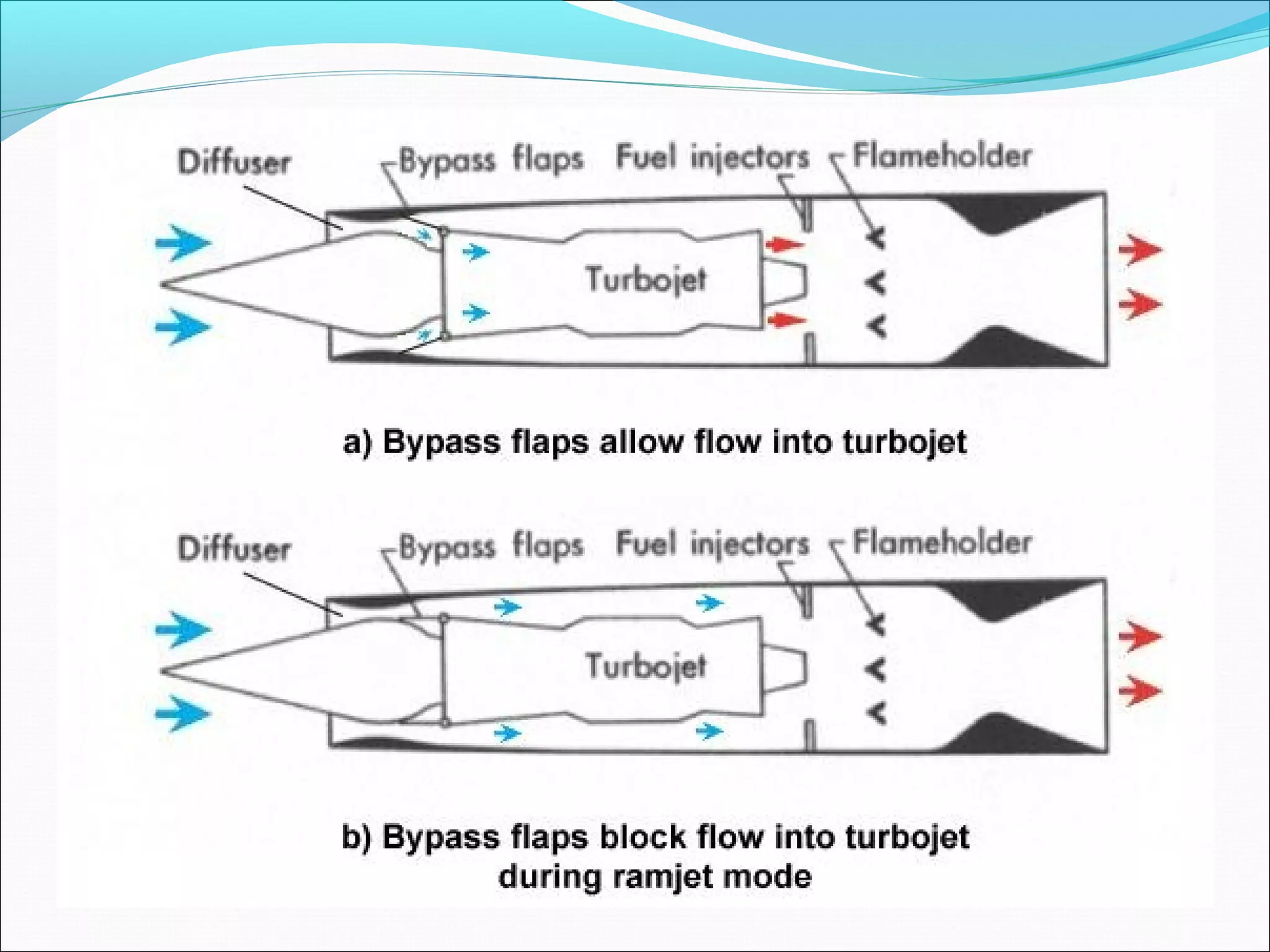
The document discusses the principles and operation of ramjet engines. A ramjet relies on forward air compression through the engine intake to generate thrust, requiring high-speed flight. It has no moving parts for compression. Air entering the intake is slowed in a supersonic diffuser, then combustion and expansion in the engine accelerates the exhaust faster than inlet air to produce thrust. The HyFly program demonstrated a dual-combustion ramjet concept for hypersonic cruise flight at Mach 6 with a liquid hydrocarbon fuel. While ramjets have low drag and can operate at high pressures and temperatures, they also have limitations such as altitude restrictions and lower efficiency compared to engines with mechanical compression like turbojets.
The presentation is introduced by KVK, outlining the focus on ramjet engine principles.
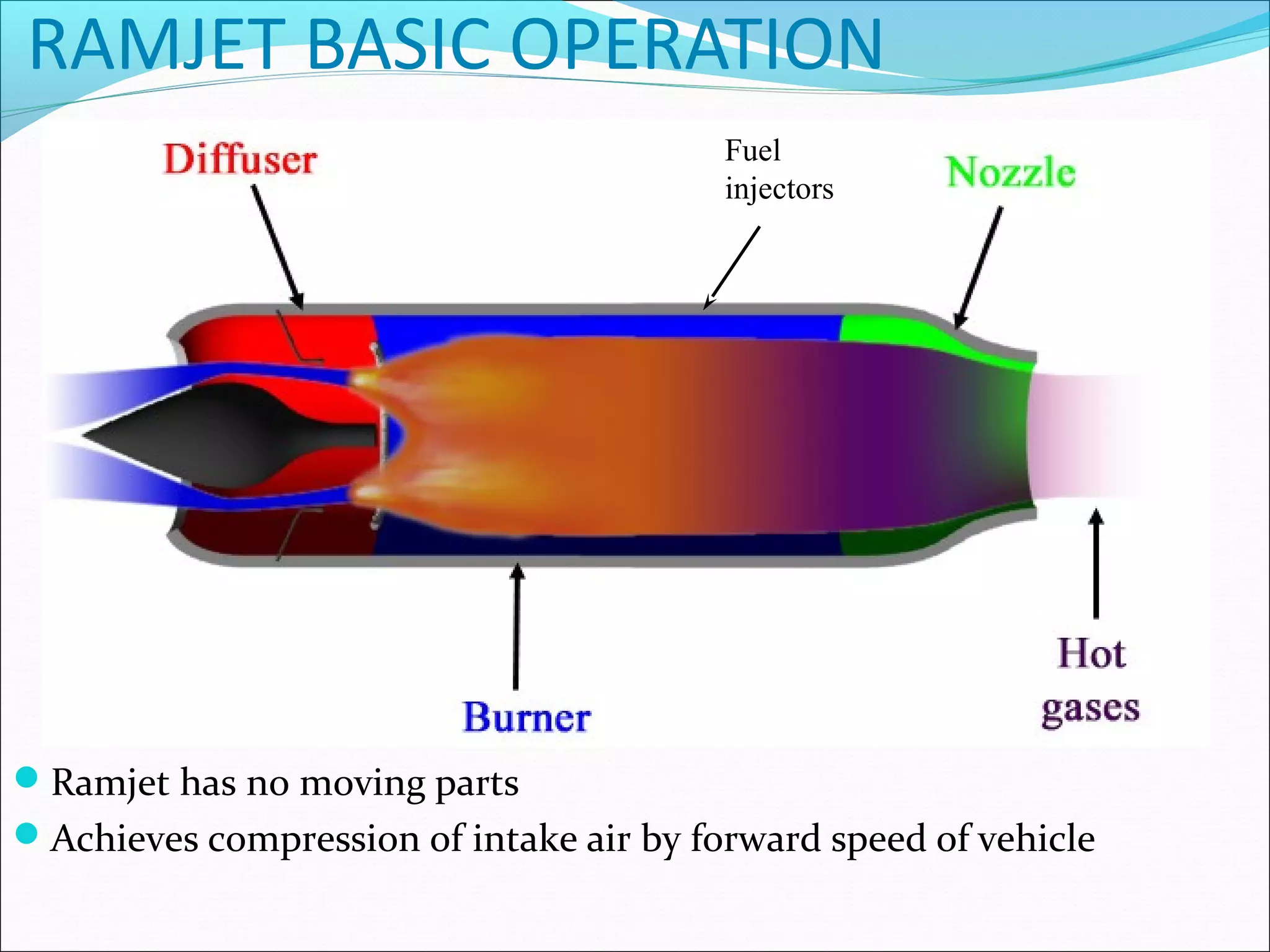
Explains how the ramjet engine converts kinetic energy of air into pressure rise (ram pressure) through super and subsonic diffusers.
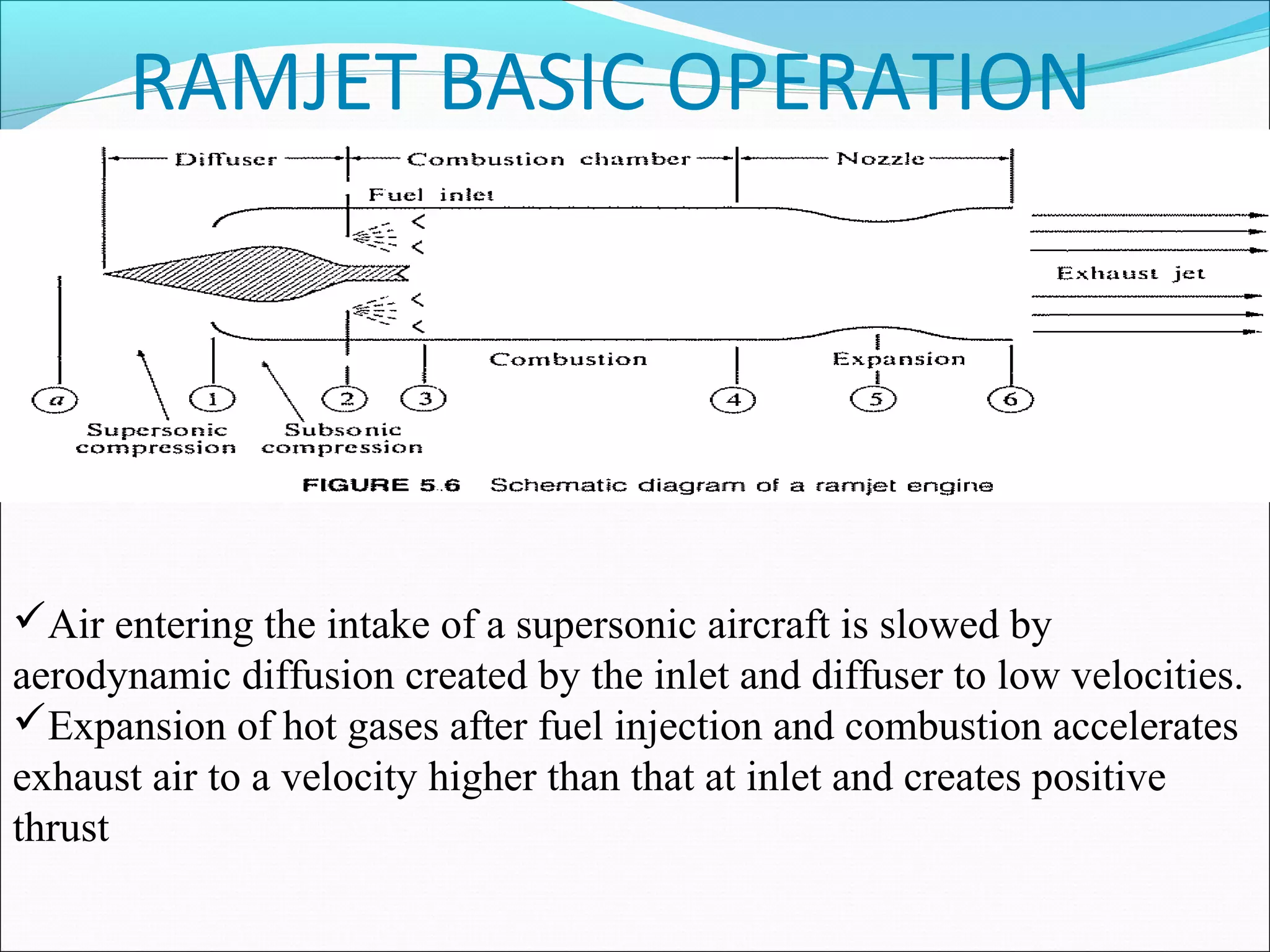
Describes ramjet operation without moving parts, achieving air compression by vehicle speed, and how expansion of hot gases creates thrust.
Introduces HyFly program, aiming for hypersonic flight at Mach 6, launched by DARPA and the U.S. Navy, with Boeing as the prime contractor.
Details on HyFly engine using JP-10 fuel, featuring dual-combustion ramjet design for different speeds and novel operability with conventional fuel.
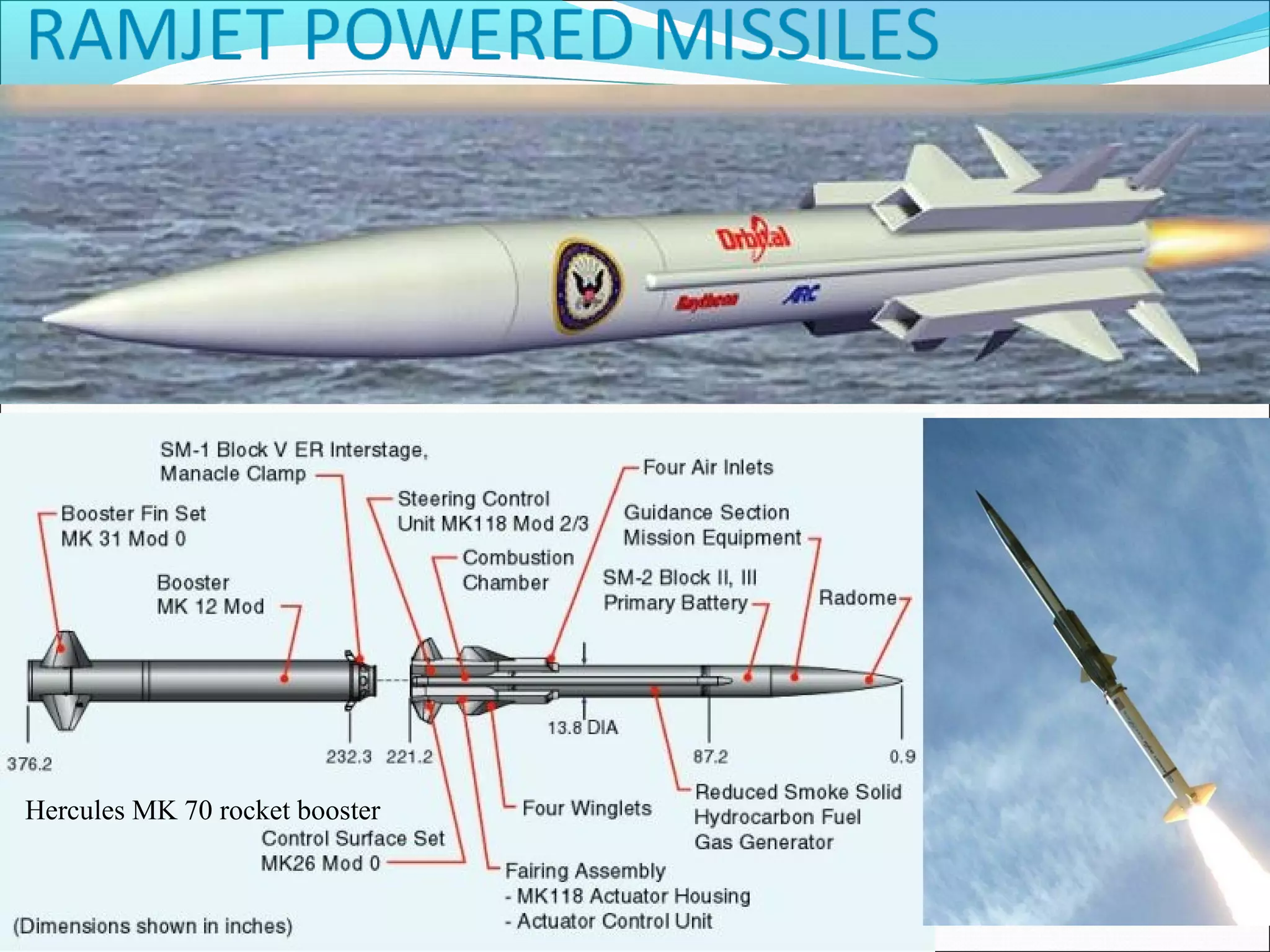
Mentions the Hercules MK 70 rocket booster as part of the HyFly project.
Summarizes ramjet's reliance on ram compression, static thrust absence, and efficiency increases with Mach number, along with transition to turbojet engines.
Lists benefits of ramjet engines including low frontal area, low drag coefficient, high load capacity, and high pressure capabilities.
Highlights limitations such as altitude restrictions, low thermal efficiency, high thrust-specific fuel consumption (TSFC), and erosion issues.
PRINCIPLE OF RAMJETENGINE
THE FUNCTION OF A SUPERSONIC AND
SUBSONIC DIFFUSER IS TO CONVERT THE
KINETIC ENERGY OF THE ENTERING AIR INTO A
PRESSURE RISE CALLED RAM PRESSURE.
3.
RAMJET BASIC OPERATION
Ramjethas no moving parts
Achieves compression of intake air by forward speed of vehicle
Fuel
injectors
4.
RAMJET BASIC OPERATION
Airentering the intake of a supersonic aircraft is slowed by
aerodynamic diffusion created by the inlet and diffuser to low velocities.
Expansion of hot gases after fuel injection and combustion accelerates
exhaust air to a velocity higher than that at inlet and creates positive
thrust
HyFly RAMJET CONCEPT
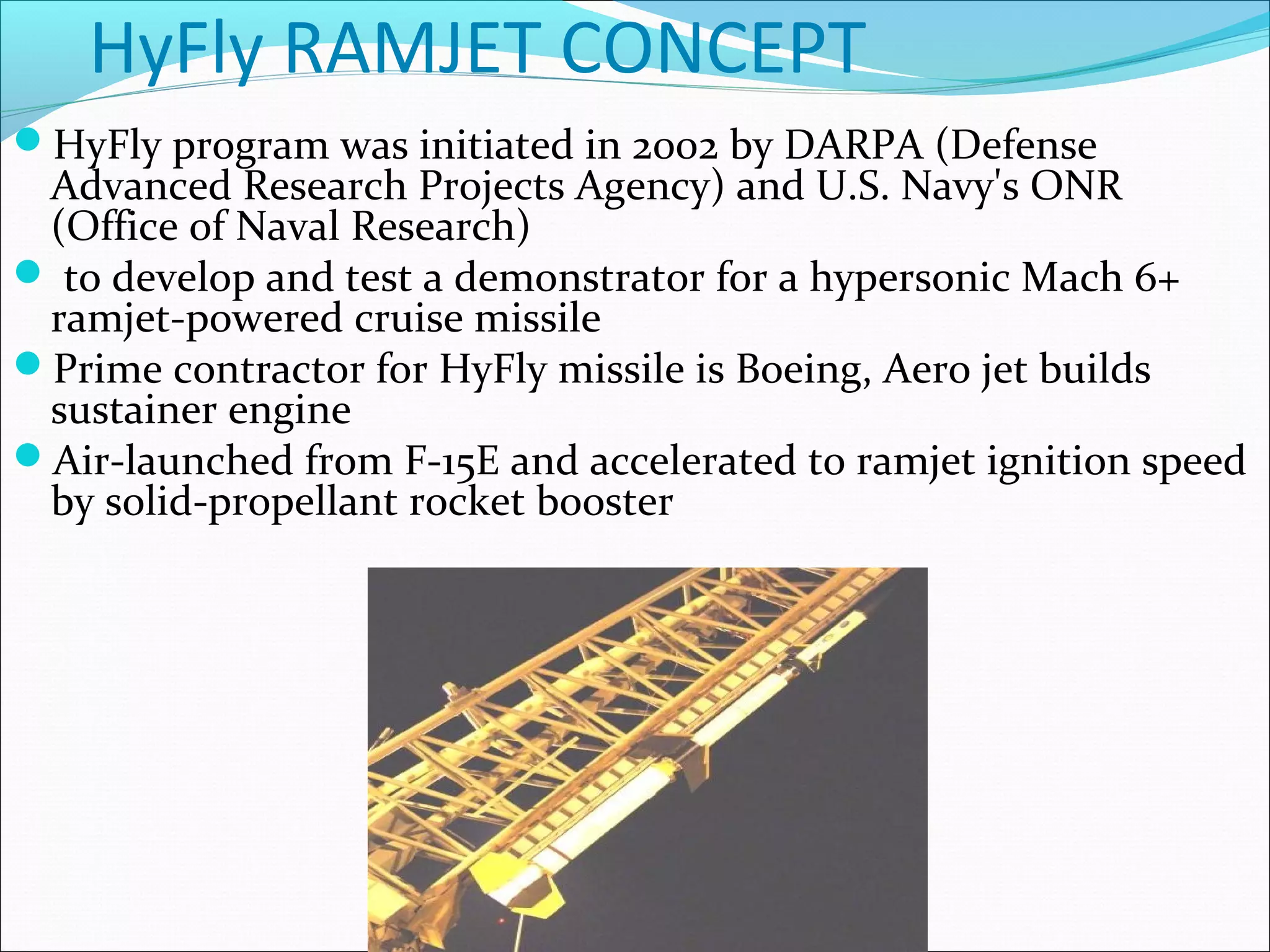
HyFlyprogram was initiated in 2002 by DARPA (Defense
Advanced Research Projects Agency) and U.S. Navy's ONR
(Office of Naval Research)
to develop and test a demonstrator for a hypersonic Mach 6+
ramjet-powered cruise missile
Prime contractor for HyFly missile is Boeing, Aero jet builds
sustainer engine
Air-launched from F-15E and accelerated to ramjet ignition speed
by solid-propellant rocket booster
7.
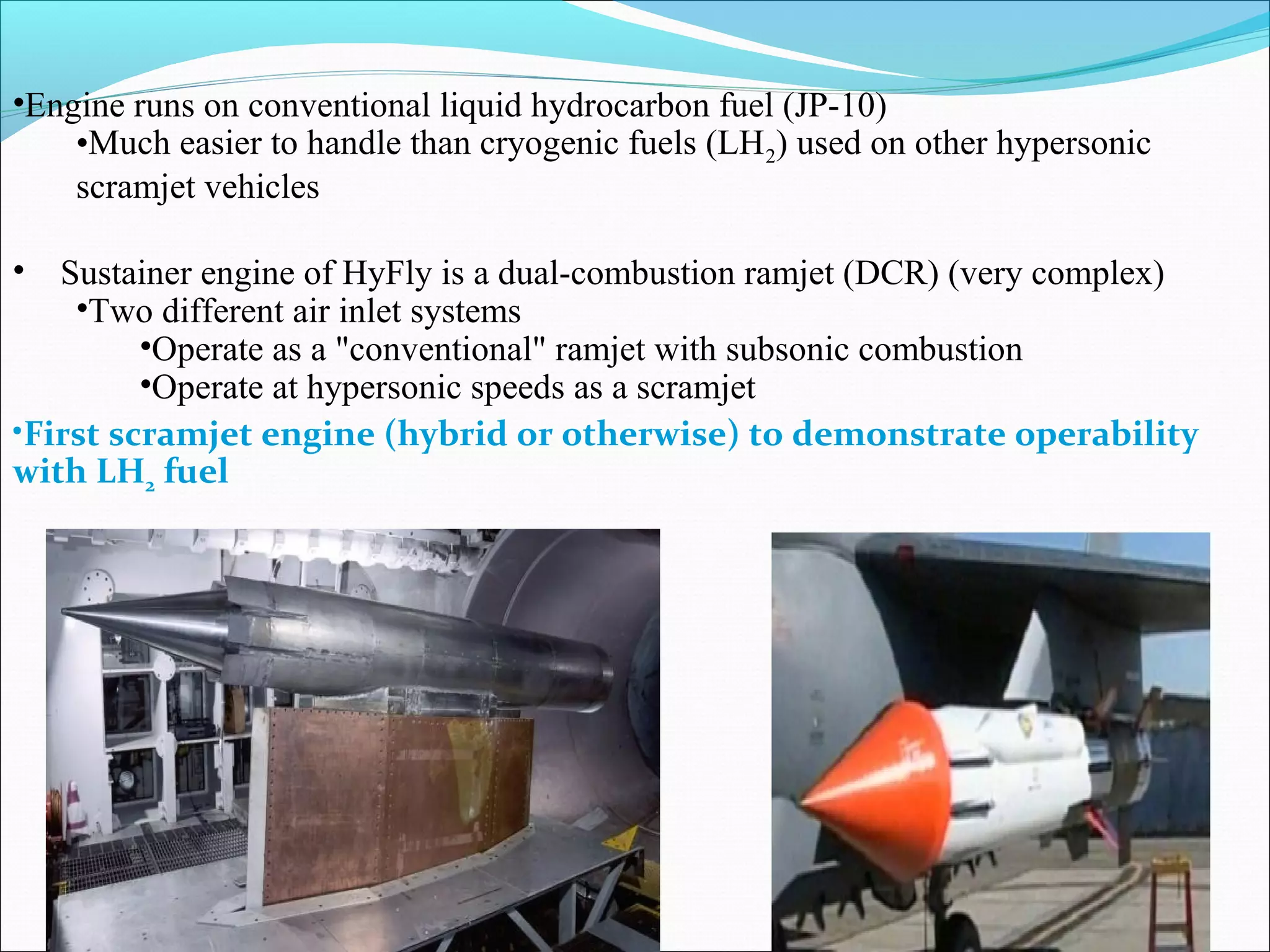
•Engine runs onconventional liquid hydrocarbon fuel (JP-10)
•Much easier to handle than cryogenic fuels (LH2) used on other hypersonic
scramjet vehicles
• Sustainer engine of HyFly is a dual-combustion ramjet (DCR) (very complex)
•Two different air inlet systems
•Operate as a "conventional" ramjet with subsonic combustion
•Operate at hypersonic speeds as a scramjet
•First scramjet engine (hybrid or otherwise) to demonstrate operability
with LH2 fuel
SUMMARY
Ramjet developsno static thrust
Relies on ‘ram’ compression of air
Requires high speed flight
Performance depends on increase in stagnation temperature across burner
(combustor)
Efficiencies (thermal, propulsive, and overall) increase with increasing flight
Mach number
Next step: We desire an engine that develops static thrust
Put in a device to mechanically compress air (compressor)
Put in a device to power compressor (turbine)
Solution: Turbojet engine
DISADVANTAGES
THERE WE HAVINGALTITUDE LIMITATION.
LOW THERMAL EFFICIENCY.
HIGH TSFC.
EROSION OCCURS AT THE NOZZLE DUE HIGH
TEMPERATURE OF GAS COMING OUT FROM THE
NOZZLE.









![Scramjet engine[1]by Shashwat Mishra](https://cdn.slidesharecdn.com/ss_thumbnails/scramjetengine1-170314055119-thumbnail.jpg?width=640&height=640&fit=bounds)


