By
Dr.Ahmed MohammedAbd El Wahab
Lecturer of Internal Medicine
(Nephrology)
Kidney and Endocrine
Outline
A. Effect of CKD on Endocrine system
1) HPG Axis abnormalities in Uremics
2) CKD and GH
3) Thyroid function in CKD
4) CHO and Insulin metabolism in CKD
5) CKD and PTH (BMD)_____>FGF 23 and Klotho
6) CKD and adrenal gland
B. Effect of Endocrine system on kidney
C. Kidney as an endocrine organ
Effect of CKD on Endocrine system
HPG Axis abnormalities in Uremics
At least 50% (some studies say up to 80%) of men :
 ED
 ↓ libido
 ↓ frequency of intercourse
Improve with dialysis BUT don’t normalize
Even with transplant, libido and ED remain↓
↓ Gonadal function
 ↓ testosterone production
↓ Hypothalamic-pituitary function
 Blunted increase in serum LH levels (but total LH increased)
 ↓ LH secretory burst
 Var. increase in FSH levels
 Increased PRL levels
Impaired spermatogenesis and testicular damage →
infertility
Semen analysis:
 Decreased volume of ejaculate
 Low or complete azoospermia
 Low percentage of motility
Histologic analysis
 Decreased spermatogenesis
Pathologic analysis
 interstitial fibrosis, calcifications in seminiferous tubules,
epididymis, corpora cavernosa, atrophy of sertoli cells
Guvel S, Pourbager M, Torun D, et al. J Androl 2004;25:752-756
No hypertrophy in sertoli or leydig cells
 Suggesting hormonal regulation defect of cells as in
gonadotropin deficiency or resistance (? functional
hypogonadism)
Etiology of testicular damage in uremia is unclear
 ??? Plasticizers in dialysis tubing (e.g. phthalate) potentiating
the cytotoxic effects ???
 ….but then why does dialyzing more frequently improve sexual
dysfunction…
Total and free testosterone reduced
Binding capacity and concentration of sex hormone
binding globulin (SHBG) normal
Stimulation by HCG (LH like action) gives only
blunted response in uremic men.
 Possible factor blocking LH receptor in CKD
 Reversed by transplantation
Total plasma estrogen concentration increased
Dunkel L. et al. Kidney Int 1997;51:777-784
Increased LH in CKD 2/2 :
 decreased Testosterone release from leydig cells no feedback→
inhibition of LH release
 Decreased metabolic clearance rate of LH with CKD
NL LH sx in pulsatile fashion
FSH increased in men with CKD and LH/FSH ratio
increased (LH proportionally higher)
Inhibin made by sertoli cells inhibits FSH
 Highest FSH in pts with most severe damage to seminiferous tubules
High FSH poor prognostic sign for spermatogenesis
recovery after transplant
In CKD
 PRL levels increased but significance unclear as LH also
INCREASED
Possible cause of increased PRL levels
 Hyperparathyroidism
 Zinc deficiency in CKD
Caticha O et al. J Endocrinol Invest 1996;19:441-448
 Gynecomastia is seen in 30% of HD men
Pathogenesis unclear
 ? Elevated PRL levels
 ? Increased Estrogen : Androgen ratio
Treatment options for men
 Treatment options
 6X/week hemo pts show increased testosterone
 EPO administration shown to improve sexual function
 Controlling PTH levels to lower PRL
 Viagra (60-80% response rate)
 Vacuum device (pump)
 Testosterone
 Zinc replacement to raise testosterone levels
 Transplant
Palmer et al. Adv Ren Replace Ther 2003; 10:48-60
HPG Axis in CKD Women
Major abnormalities:
 Disturbances in menstruation, anovulation/infertility,
decreased libido and reduced ability to reach orgasm
 Pregnancy occurs rarely BUT fetal wastage markedly increased
No progesterone effect on endometrium per biopsy
No preovulatory peak LH and estradiol
concentrations
Increase in circulating endorphin levels in CKD due
to reduction in opiod clearance
 Endorphins inhibit ovulation (possibly by reducing GnRH)
In CKD, women (like men) have increased PRL
levels
 Hypersecretion autonomous like men
 Increased PRL levels impair hypothalamus and pituitary
function → contribute to sexual dysfunction and galactorrhea
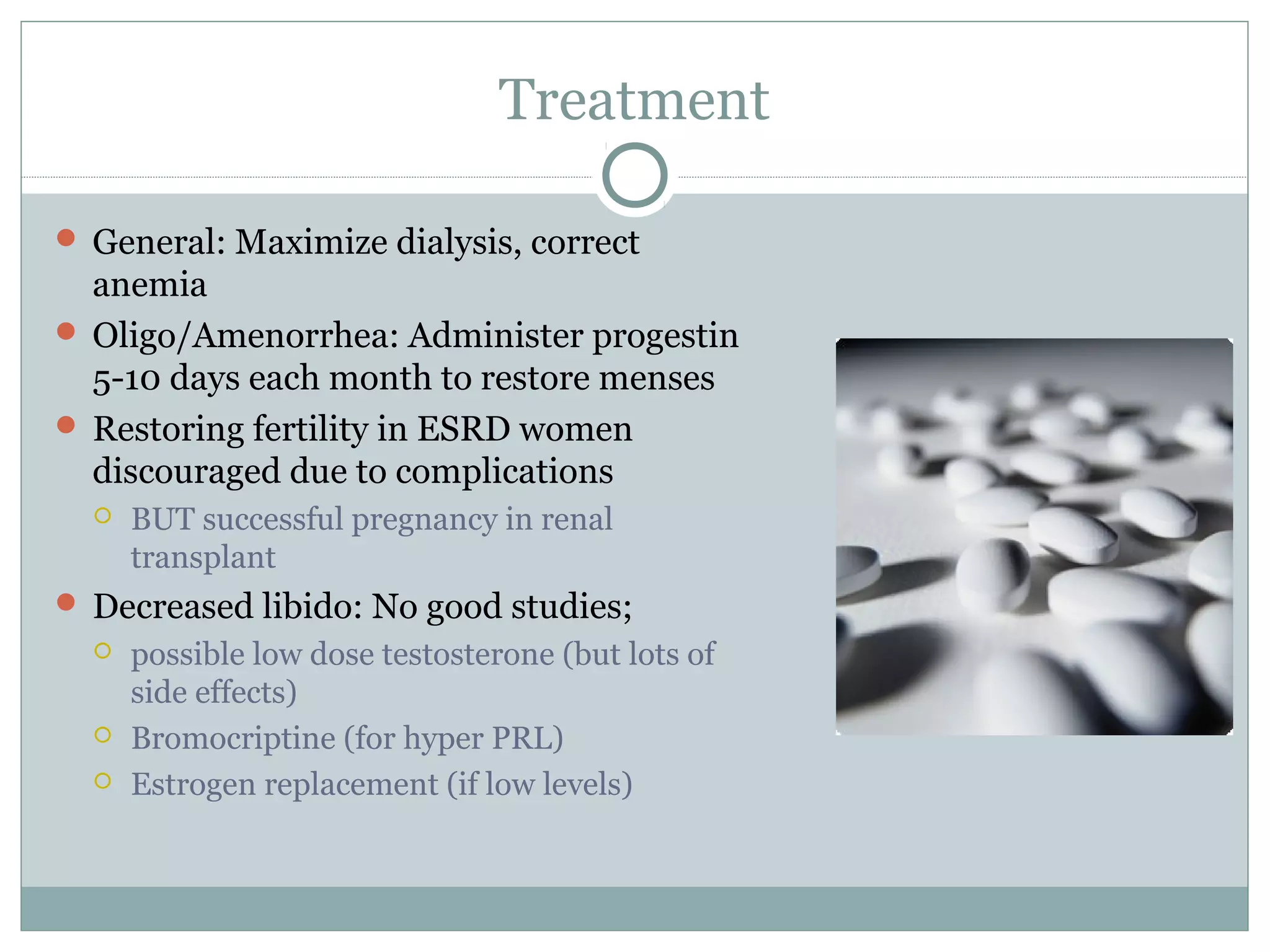
Treatment
 General: Maximize dialysis, correct
anemia
 Oligo/Amenorrhea: Administer progestin
5-10 days each month to restore menses
 Restoring fertility in ESRD women
discouraged due to complications
 BUT successful pregnancy in renal
transplant
 Decreased libido: No good studies;
 possible low dose testosterone (but lots of
side effects)
 Bromocriptine (for hyper PRL)
 Estrogen replacement (if low levels)
Treatment (cont.)
Estrogen replacement may improve sexual function
in women with low circulating estradiol levels
Gold standard: renal transplantation
GH in CKD
Increases in plasma concentration and decreases
end-organ responsiveness.
Levels fall to low-normal values after the institution
of dialysis and the administration of EPO
Growth hormone resistance may be associated with
growth retardation in children with CKD.
Supraphysiologic doses of rGH can lead to increased
growth
Resistance is due to decreased somatomedin activity,
decreased caloric intake, metabolic acidosis.
(Uptodate)
Thyroid Function in CKD
Thyroid Function Abnormalities
↓ total T3 due to
 decreased conversion from T4
 reduced protein binding to thyroid hormone binding globulin
and albumin
 Metabolic Acidosis
Thyroid Function Abnormalities (cont.)
Normal rT3 (to differentiate from chronic illness where
rT3 is enhanced)
T4 either low or normal
 Heparin interferes w/ T4 binding to TBG (so transient ↑ after
dialysis)
Normal TSH
 but blunted and delayed response to TRH
Clinical Manifestations
Significant overlap in findings between CKD and
hypothyroidism:
 Both have
 low T3
 cold intolerance
 puffy appearance
 dry skin
 lethargy
 fatigability
 Constipation
 Slight increase in hypothyroidism in CKD.
Thyroid Structure Abnormalities
Gland size
 Increased in CKD
 Mechanism unclear
Nodules/Carcinoma
 Slightly higher frequency of both
 Mechanism unclear
Carbohydrate Metabolism:
Yin and Yang
 Yin
 Marked fall in insulin clearance leads to improvement in glucose
tolerance
 BUT…
 Yang
 Glucose control deteriorates with worsening renal function
Insulin Resistance
Uremia associated with impaired glucose metabolism:
 Due to impaired tissue sensitivity (especially skeletal muscles)
 Possible mechanism:
 Increased hepatic gluconeogenesis
 Reduced hepatic/skeletal muscle uptake
 Impaired intracellular metabolism due to decreased glycogen
synthesis, or decreased oxidation to CO2
 accumulation of nitrogenous wastes, reduced excretion of
adiponectin, inflammatory cytokines and hyperparathyroidism
NOTE: Interestingly, actions of insulin such as K+ uptake,
proteolysis inhibition, maintained in renal failure
Insulin Resistance Treatment
Both HD and PD improve insulin resistance consistent with
role of uremic toxins
PD restores higher insulin sensitivity than HD
Correction of anemia with EPO markedly increases (~50%
in one study) insulin-induced glucose utilization
ACEI improve insulin resistance, hyperinsulinemia, glucose
intolerance in CKD
METFORMIN and TZDs are CI
Insulin Resistance Treatment
Calcitriol therapy:
 Enhances insulin release and improves glucose tolerance.
 Its effects independent of PTH
PTH
 Excess PTH may interfere with pancreatic B-Cells ability to secrete
insulin
 Possible mechanism: PTH causes increased intracellular calcium which
decreases cell ATP concentration and Na-K ATPase activity
Insulin Clearance
Decline in insulin clearance seen when GFR < 15-
20cc/min
NOTE: at this GFR also see concomitant decline in
hepatic insulin metabolism
This defect reversed with adequate dialysis
Adrenal Gland
 A study of patients on
maintenance hemodialysis found
that an elevated predialysis serum
cortisol concentration was
predictive of increased morbidity,
as defined by the need for
hospitalization [uptodate]
Cont.,
There is reduced PPB and increased clearance of
dexamethasone .
There is reduced PPB but decreased clearance of
prednisolone . The fall in clearance may explain the
apparently higher incidence of steroid-induced side
effects when prednisolone is used in renal failure.
The pharmacokinetics of methylprednisolone are
unaltered.
Effect of Endocrine system on kidney
1ry HPT
Acromegaly
Cont.,
In conclusion
1. Acromegaly is responsible for structural
abnormalities and renal function impairment
because it induces an increase in renal size together
with an increase in CrC, decrease in Na& K FEs,
hypercalciuria, hyperphosphaturia, increase in mA
levels.
2.These alterations seem to revert only partially
after the correction of GH and IGF1 excess by
treatment.
Renal endocrinology: The new
frontier
Hormones: RAS, EPO, vit D3.
 Enzymes: kallikreins, which produce hormones in
other, distant sites.
Local hormones: PGs, Ets and adrenomedullin.
Target organ for: aldosterone, angiotensin, and
the natriuretic peptides.
 Indian J Endocrinol Metab. 2012 Mar-Apr; 16(2): 154–155.
THANK YOU

Kidney and endocrine

  • 1.
    By Dr.Ahmed MohammedAbd ElWahab Lecturer of Internal Medicine (Nephrology) Kidney and Endocrine
  • 2.
    Outline A. Effect ofCKD on Endocrine system 1) HPG Axis abnormalities in Uremics 2) CKD and GH 3) Thyroid function in CKD 4) CHO and Insulin metabolism in CKD 5) CKD and PTH (BMD)_____>FGF 23 and Klotho 6) CKD and adrenal gland B. Effect of Endocrine system on kidney C. Kidney as an endocrine organ
  • 3.
    Effect of CKDon Endocrine system HPG Axis abnormalities in Uremics At least 50% (some studies say up to 80%) of men :  ED  ↓ libido  ↓ frequency of intercourse Improve with dialysis BUT don’t normalize Even with transplant, libido and ED remain↓
  • 4.
    ↓ Gonadal function ↓ testosterone production ↓ Hypothalamic-pituitary function  Blunted increase in serum LH levels (but total LH increased)  ↓ LH secretory burst  Var. increase in FSH levels  Increased PRL levels
  • 5.
    Impaired spermatogenesis andtesticular damage → infertility Semen analysis:  Decreased volume of ejaculate  Low or complete azoospermia  Low percentage of motility Histologic analysis  Decreased spermatogenesis Pathologic analysis  interstitial fibrosis, calcifications in seminiferous tubules, epididymis, corpora cavernosa, atrophy of sertoli cells Guvel S, Pourbager M, Torun D, et al. J Androl 2004;25:752-756
  • 6.
    No hypertrophy insertoli or leydig cells  Suggesting hormonal regulation defect of cells as in gonadotropin deficiency or resistance (? functional hypogonadism) Etiology of testicular damage in uremia is unclear  ??? Plasticizers in dialysis tubing (e.g. phthalate) potentiating the cytotoxic effects ???  ….but then why does dialyzing more frequently improve sexual dysfunction…
  • 7.
    Total and freetestosterone reduced Binding capacity and concentration of sex hormone binding globulin (SHBG) normal Stimulation by HCG (LH like action) gives only blunted response in uremic men.  Possible factor blocking LH receptor in CKD  Reversed by transplantation Total plasma estrogen concentration increased Dunkel L. et al. Kidney Int 1997;51:777-784
  • 8.
    Increased LH inCKD 2/2 :  decreased Testosterone release from leydig cells no feedback→ inhibition of LH release  Decreased metabolic clearance rate of LH with CKD NL LH sx in pulsatile fashion FSH increased in men with CKD and LH/FSH ratio increased (LH proportionally higher) Inhibin made by sertoli cells inhibits FSH  Highest FSH in pts with most severe damage to seminiferous tubules High FSH poor prognostic sign for spermatogenesis recovery after transplant
  • 9.
    In CKD  PRLlevels increased but significance unclear as LH also INCREASED Possible cause of increased PRL levels  Hyperparathyroidism  Zinc deficiency in CKD Caticha O et al. J Endocrinol Invest 1996;19:441-448
  • 10.
     Gynecomastia isseen in 30% of HD men Pathogenesis unclear  ? Elevated PRL levels  ? Increased Estrogen : Androgen ratio
  • 11.
    Treatment options formen  Treatment options  6X/week hemo pts show increased testosterone  EPO administration shown to improve sexual function  Controlling PTH levels to lower PRL  Viagra (60-80% response rate)  Vacuum device (pump)  Testosterone  Zinc replacement to raise testosterone levels  Transplant Palmer et al. Adv Ren Replace Ther 2003; 10:48-60
  • 12.
    HPG Axis inCKD Women Major abnormalities:  Disturbances in menstruation, anovulation/infertility, decreased libido and reduced ability to reach orgasm  Pregnancy occurs rarely BUT fetal wastage markedly increased
  • 13.
    No progesterone effecton endometrium per biopsy No preovulatory peak LH and estradiol concentrations Increase in circulating endorphin levels in CKD due to reduction in opiod clearance  Endorphins inhibit ovulation (possibly by reducing GnRH)
  • 14.
    In CKD, women(like men) have increased PRL levels  Hypersecretion autonomous like men  Increased PRL levels impair hypothalamus and pituitary function → contribute to sexual dysfunction and galactorrhea
  • 15.
    Treatment  General: Maximizedialysis, correct anemia  Oligo/Amenorrhea: Administer progestin 5-10 days each month to restore menses  Restoring fertility in ESRD women discouraged due to complications  BUT successful pregnancy in renal transplant  Decreased libido: No good studies;  possible low dose testosterone (but lots of side effects)  Bromocriptine (for hyper PRL)  Estrogen replacement (if low levels)
  • 16.
    Treatment (cont.) Estrogen replacementmay improve sexual function in women with low circulating estradiol levels Gold standard: renal transplantation
  • 17.
    GH in CKD Increasesin plasma concentration and decreases end-organ responsiveness. Levels fall to low-normal values after the institution of dialysis and the administration of EPO Growth hormone resistance may be associated with growth retardation in children with CKD. Supraphysiologic doses of rGH can lead to increased growth Resistance is due to decreased somatomedin activity, decreased caloric intake, metabolic acidosis. (Uptodate)
  • 18.
  • 19.
    Thyroid Function Abnormalities ↓total T3 due to  decreased conversion from T4  reduced protein binding to thyroid hormone binding globulin and albumin  Metabolic Acidosis
  • 20.
    Thyroid Function Abnormalities(cont.) Normal rT3 (to differentiate from chronic illness where rT3 is enhanced) T4 either low or normal  Heparin interferes w/ T4 binding to TBG (so transient ↑ after dialysis) Normal TSH  but blunted and delayed response to TRH
  • 21.
    Clinical Manifestations Significant overlapin findings between CKD and hypothyroidism:  Both have  low T3  cold intolerance  puffy appearance  dry skin  lethargy  fatigability  Constipation  Slight increase in hypothyroidism in CKD.
  • 22.
    Thyroid Structure Abnormalities Glandsize  Increased in CKD  Mechanism unclear Nodules/Carcinoma  Slightly higher frequency of both  Mechanism unclear
  • 23.
    Carbohydrate Metabolism: Yin andYang  Yin  Marked fall in insulin clearance leads to improvement in glucose tolerance  BUT…  Yang  Glucose control deteriorates with worsening renal function
  • 24.
    Insulin Resistance Uremia associatedwith impaired glucose metabolism:  Due to impaired tissue sensitivity (especially skeletal muscles)  Possible mechanism:  Increased hepatic gluconeogenesis  Reduced hepatic/skeletal muscle uptake  Impaired intracellular metabolism due to decreased glycogen synthesis, or decreased oxidation to CO2  accumulation of nitrogenous wastes, reduced excretion of adiponectin, inflammatory cytokines and hyperparathyroidism NOTE: Interestingly, actions of insulin such as K+ uptake, proteolysis inhibition, maintained in renal failure
  • 25.
    Insulin Resistance Treatment BothHD and PD improve insulin resistance consistent with role of uremic toxins PD restores higher insulin sensitivity than HD Correction of anemia with EPO markedly increases (~50% in one study) insulin-induced glucose utilization ACEI improve insulin resistance, hyperinsulinemia, glucose intolerance in CKD METFORMIN and TZDs are CI
  • 26.
    Insulin Resistance Treatment Calcitrioltherapy:  Enhances insulin release and improves glucose tolerance.  Its effects independent of PTH PTH  Excess PTH may interfere with pancreatic B-Cells ability to secrete insulin  Possible mechanism: PTH causes increased intracellular calcium which decreases cell ATP concentration and Na-K ATPase activity
  • 27.
    Insulin Clearance Decline ininsulin clearance seen when GFR < 15- 20cc/min NOTE: at this GFR also see concomitant decline in hepatic insulin metabolism This defect reversed with adequate dialysis
  • 28.
    Adrenal Gland  Astudy of patients on maintenance hemodialysis found that an elevated predialysis serum cortisol concentration was predictive of increased morbidity, as defined by the need for hospitalization [uptodate]
  • 29.
    Cont., There is reducedPPB and increased clearance of dexamethasone . There is reduced PPB but decreased clearance of prednisolone . The fall in clearance may explain the apparently higher incidence of steroid-induced side effects when prednisolone is used in renal failure. The pharmacokinetics of methylprednisolone are unaltered.
  • 30.
    Effect of Endocrinesystem on kidney
  • 32.
  • 33.
  • 34.
    Cont., In conclusion 1. Acromegalyis responsible for structural abnormalities and renal function impairment because it induces an increase in renal size together with an increase in CrC, decrease in Na& K FEs, hypercalciuria, hyperphosphaturia, increase in mA levels. 2.These alterations seem to revert only partially after the correction of GH and IGF1 excess by treatment.
  • 35.
    Renal endocrinology: Thenew frontier Hormones: RAS, EPO, vit D3.  Enzymes: kallikreins, which produce hormones in other, distant sites. Local hormones: PGs, Ets and adrenomedullin. Target organ for: aldosterone, angiotensin, and the natriuretic peptides.  Indian J Endocrinol Metab. 2012 Mar-Apr; 16(2): 154–155.
  • 37.