QUICの話 Technical Overview of QUIC 
大津繁樹 
Shigeki Ohtsu 
InternetInitiative Japan 
2014 Nov. 3 
HTTP/2 Conference Japan 2014
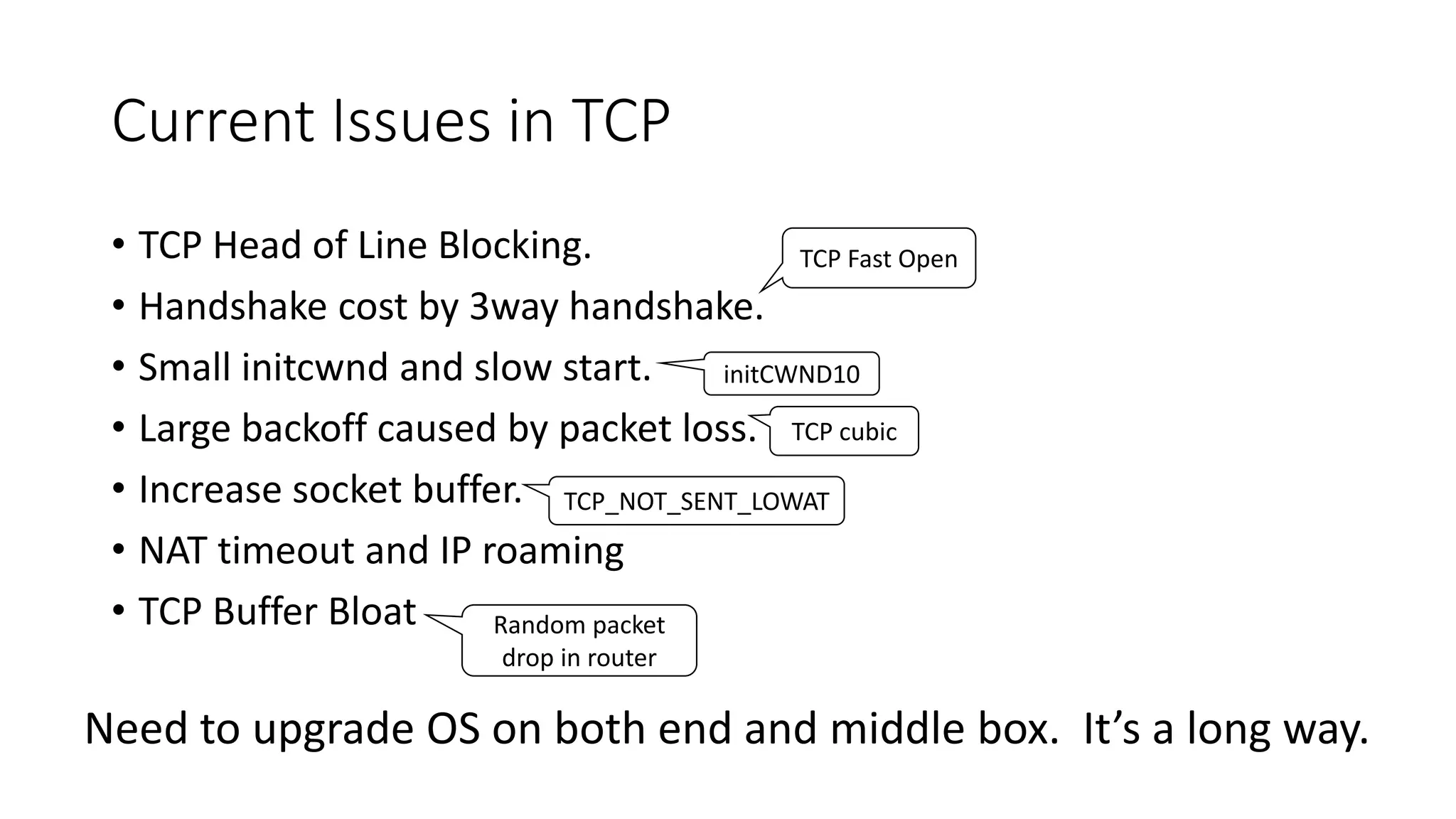
CurrentIssues in TCP 
•TCP Head of Line Blocking. 
•Handshake cost by 3way handshake. 
•Small initcwndand slow start. 
•Large backoffcaused by packet loss. 
•Increase socket buffer. 
•NAT timeout and IP roaming 
•TCP Buffer Bloat 
TCP Fast Open 
initCWND10 
TCP cubic 
Random packet drop in router 
TCP_NOT_SENT_LOWAT 
Need to upgrade OS on both end and middle box. It’s a long way.
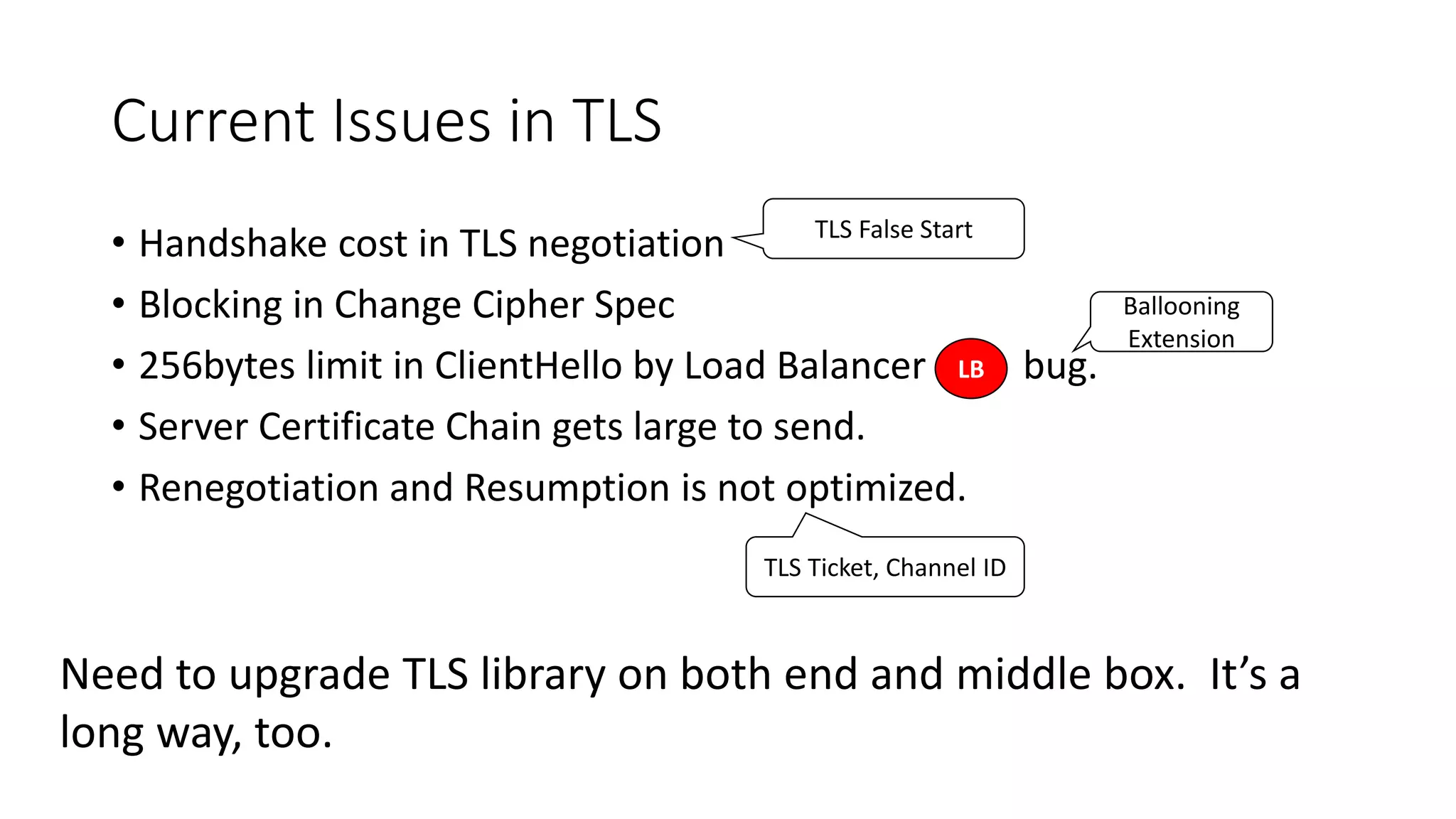
Current Issues in TLS 
•Handshake cost in TLS negotiation 
•Blocking in Change Cipher Spec 
•256bytes limit in ClientHelloby Load Balancer bug. 
•Server Certificate Chain gets large to send. 
•Renegotiation and Resumption is not optimized. 
LB 
Ballooning Extension 
TLS Ticket, Channel ID 
TLS False Start 
Need to upgrade TLS library on both end and middle box. It’s a long way, too.
SPDY 
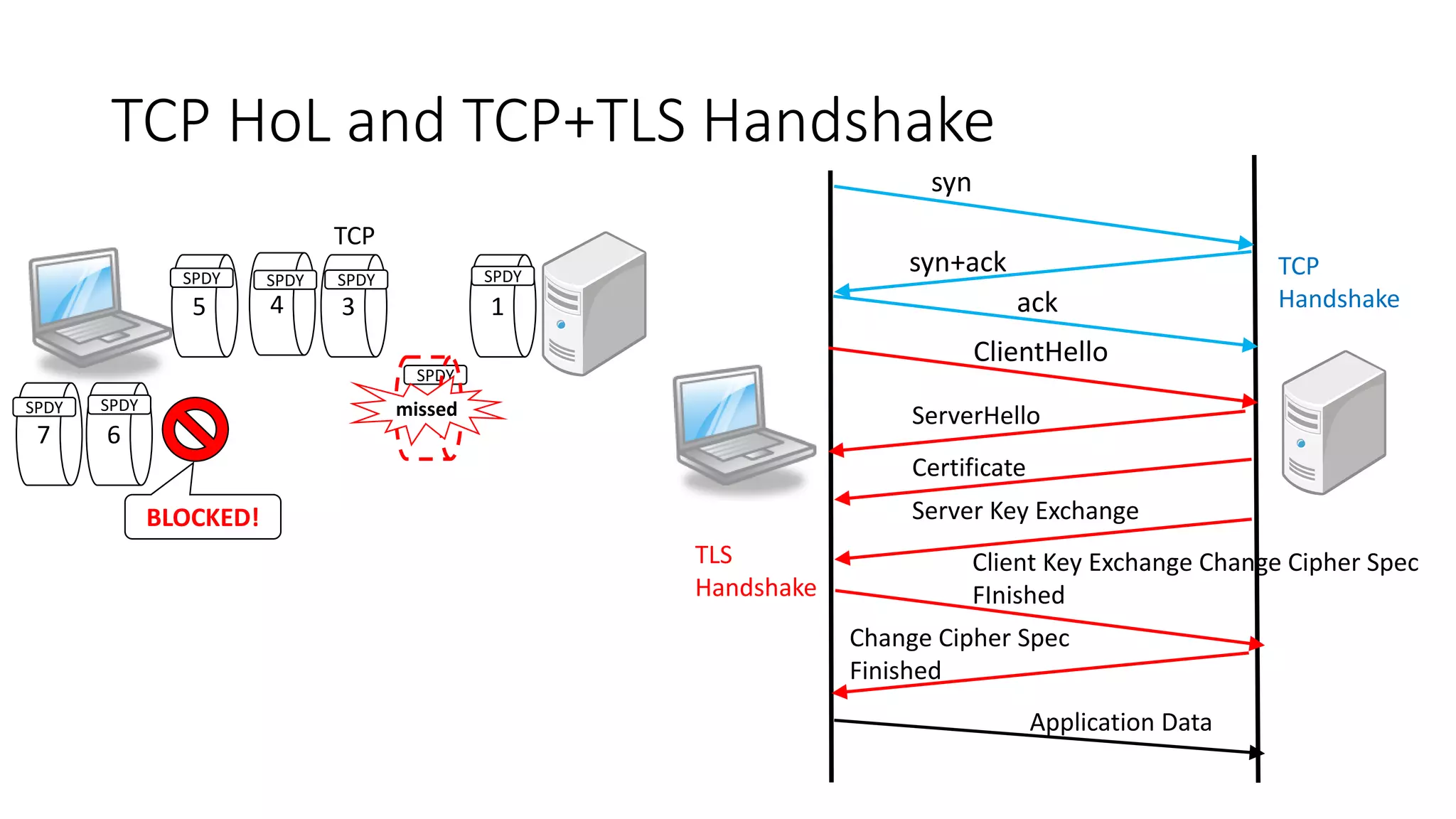
TCP HoL and TCP+TLS Handshake 
5 4 3 1 
missed 
7 6 
BLOCKED! 
TCP 
syn 
syn+ack 
ack 
ClientHello 
ServerHello 
Certificate 
Server Key Exchange 
Client Key Exchange Change Cipher Spec 
FInished 
Application Data 
TCP 
Handshake 
Change Cipher Spec 
Finished 
TLS 
Handshake 
SPDY SPDY SPDY SPDY 
SPDY SPDY
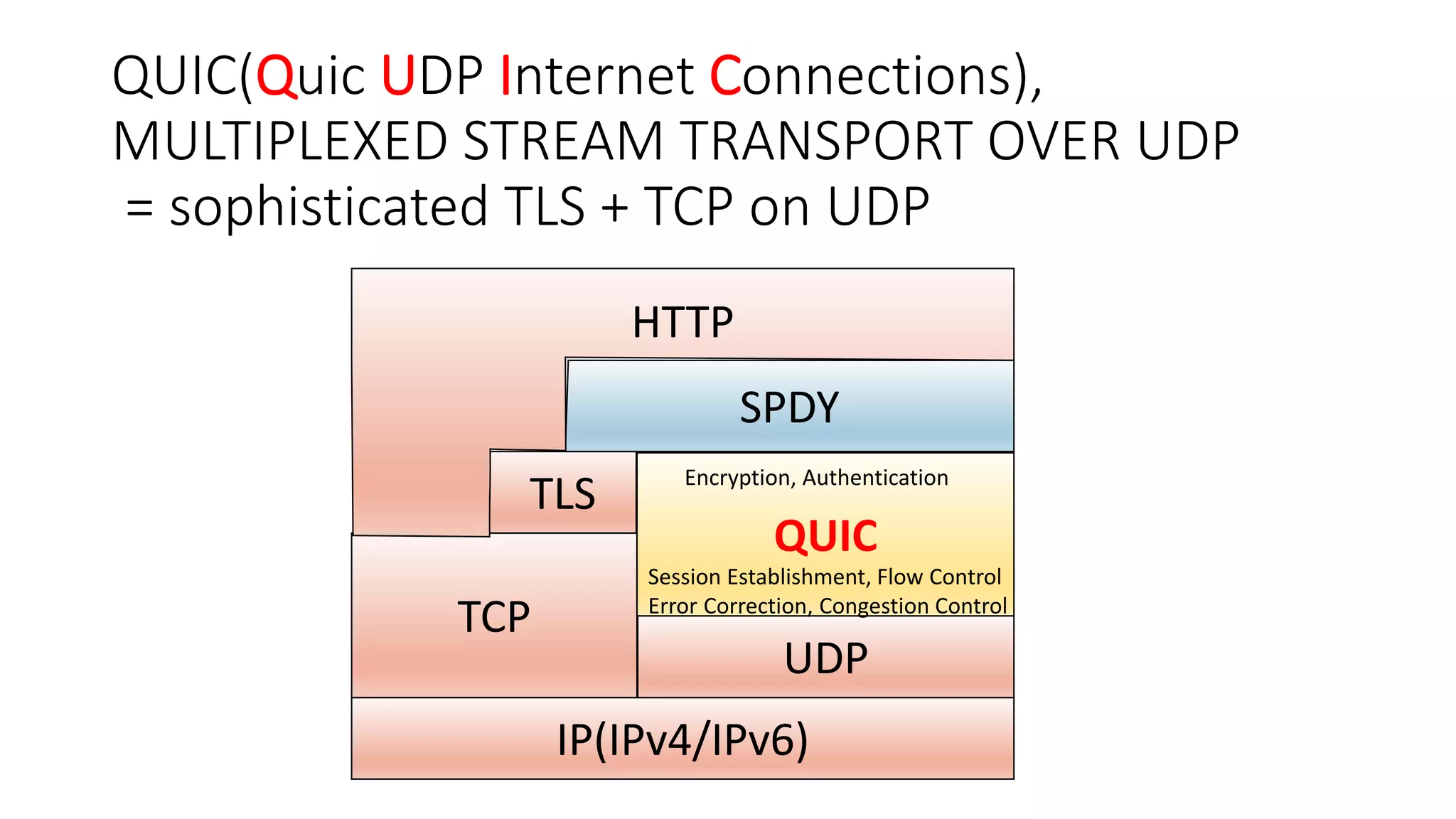
QUIC(QuicUDP Internet Connections), MULTIPLEXED STREAM TRANSPORT OVER UDP= sophisticated TLS + TCP on UDP 
IP(IPv4/IPv6) 
UDP 
TCP 
TLS 
QUIC 
SPDY 
HTTP 
Encryption, Authentication 
Session Establishment, Flow Control 
Error Correction, Congestion Control
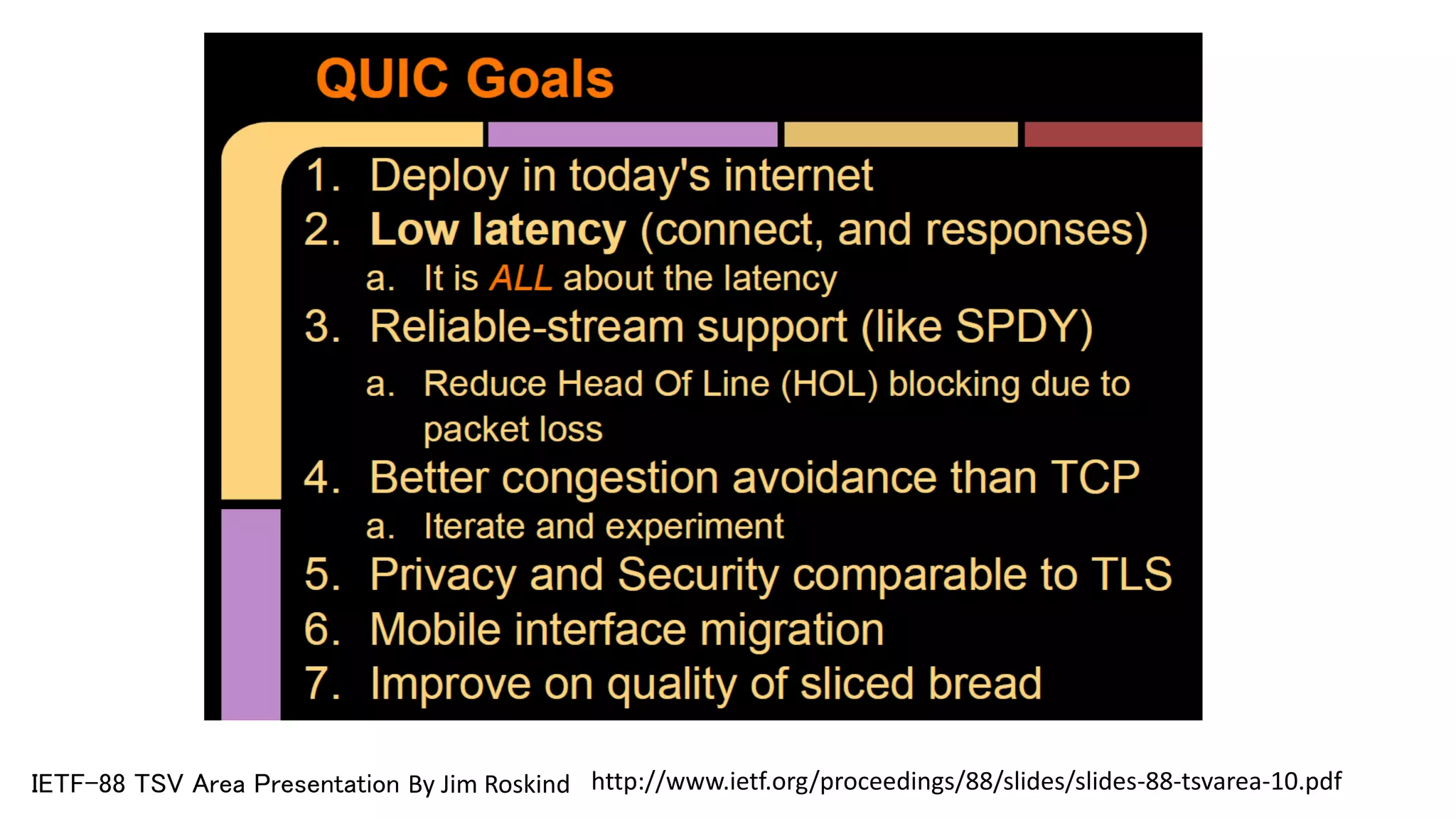
http://www.ietf.org/proceedings/88/slides/slides-88-tsvarea-10.pdf 
IETF-88 TSV Area Presentation By Jim Roskind
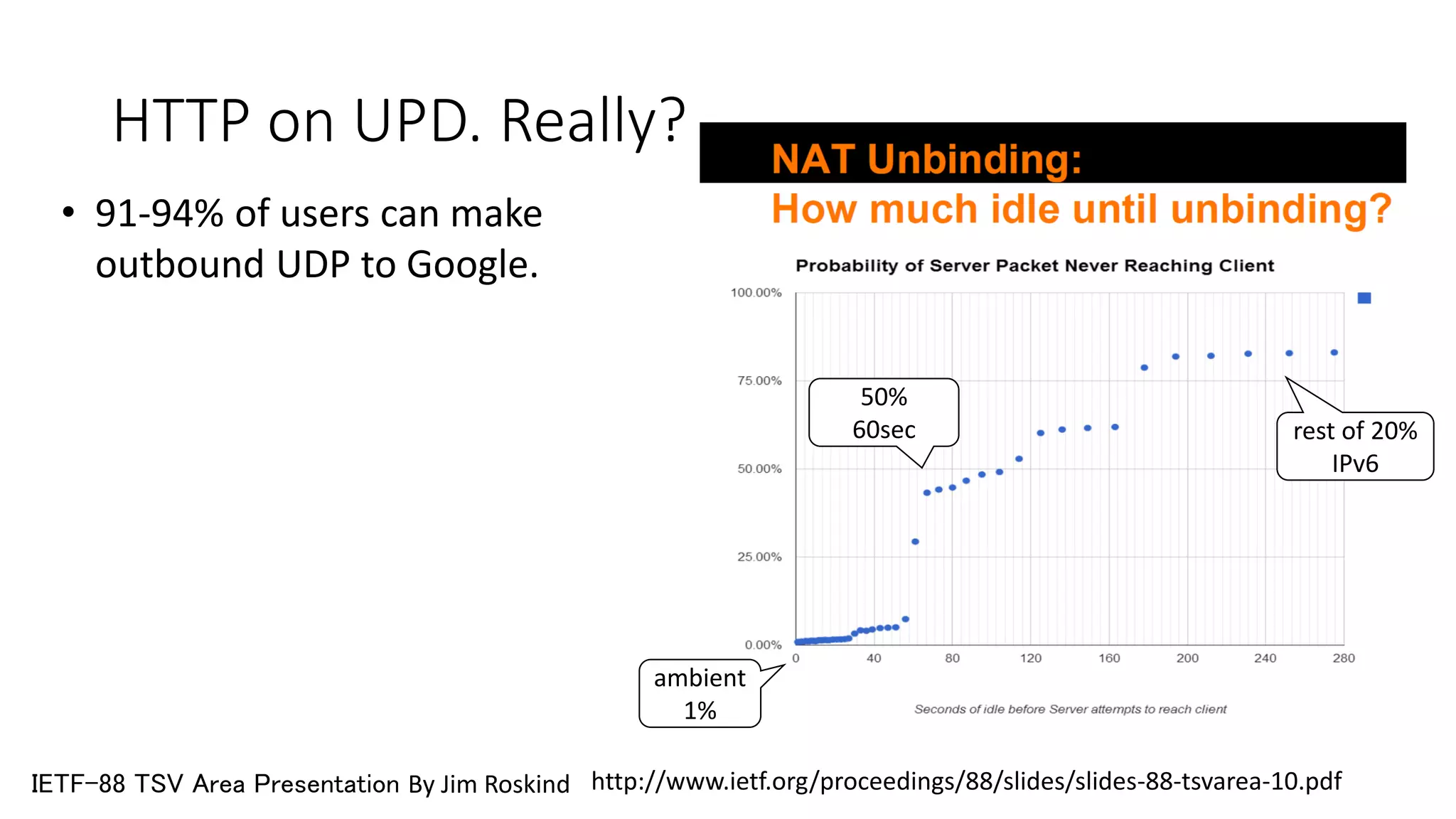
HTTP on UPD. Really? 
http://www.ietf.org/proceedings/88/slides/slides-88-tsvarea-10.pdf 
IETF-88 TSV Area Presentation By Jim Roskind 
•91-94% of users can make outbound UDPto Google. 
ambient 
1% 
rest of 20% 
IPv6 
50% 
60sec
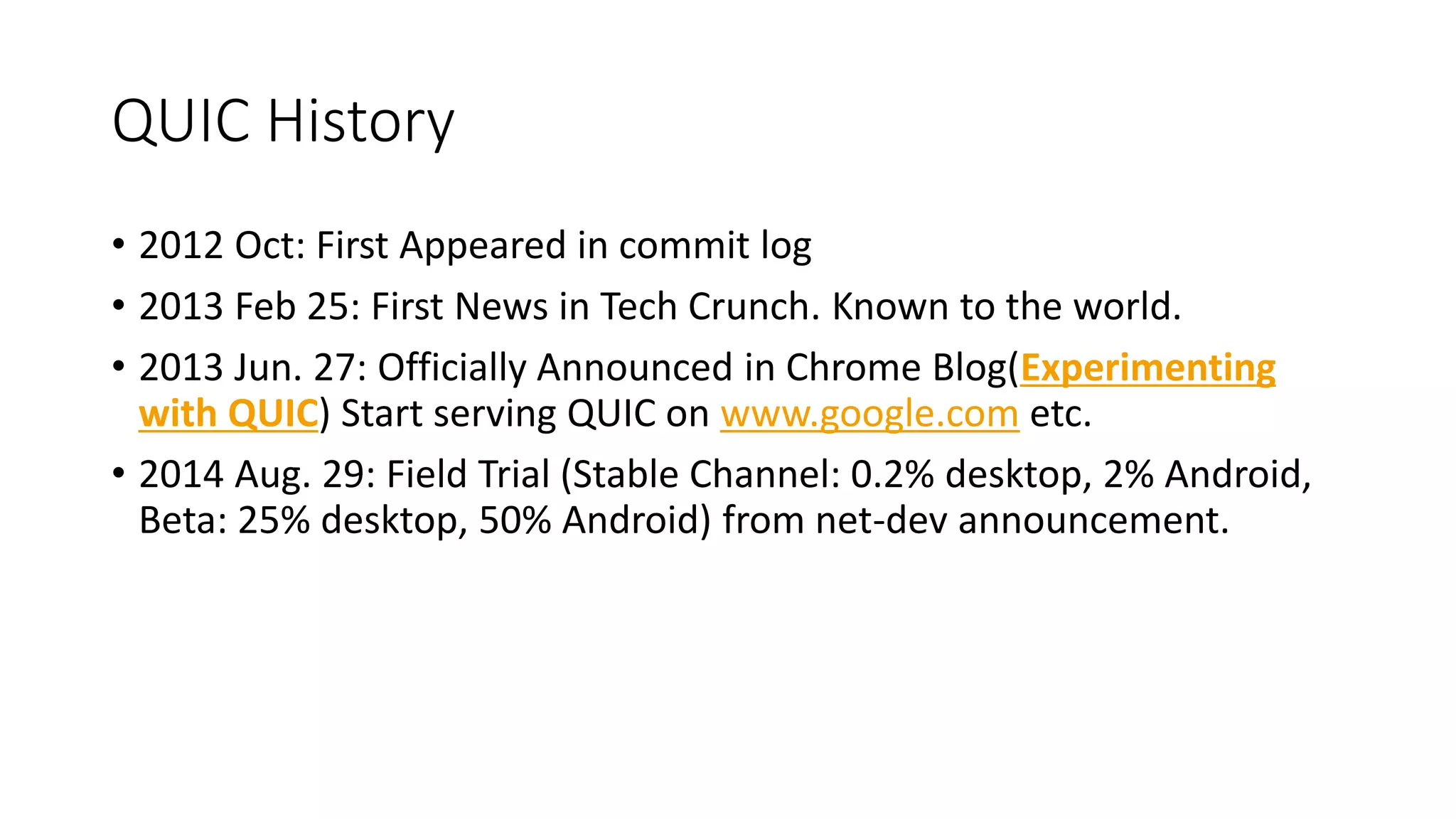
QUIC History 
•2012 Oct: First Appeared in commit log 
•2013 Feb 25: First News in Tech Crunch. Known to the world. 
•2013 Jun. 27: Officially Announced in Chrome Blog(Experimenting with QUIC) Start serving QUIC on www.google.cometc. 
•2014 Aug. 29: Field Trial (Stable Channel: 0.2% desktop, 2% Android, Beta: 25% desktop, 50% Android) from net-devannouncement.
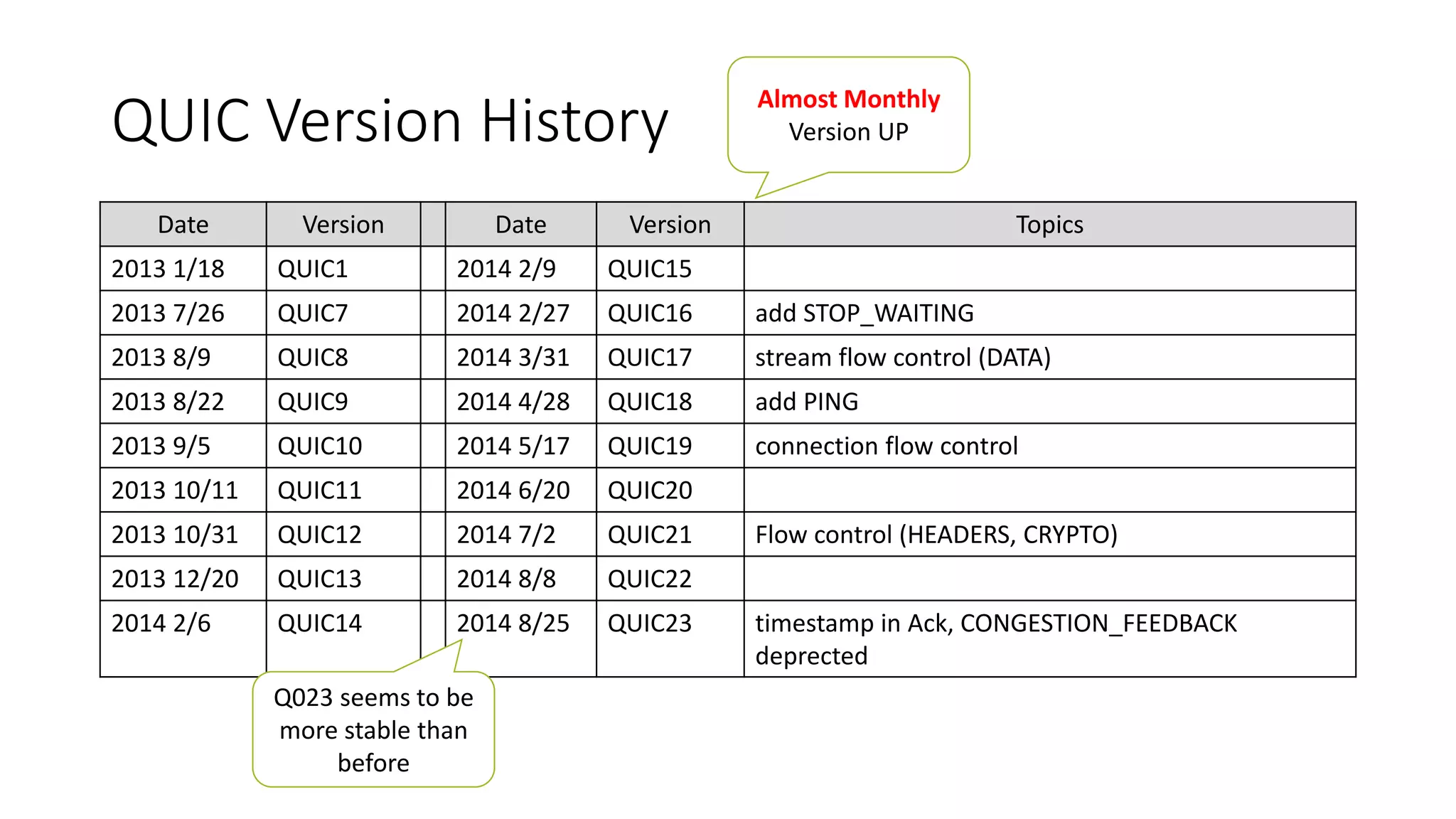
QUIC Version History 
Date 
Version 
Date 
Version 
Topics 
20131/18 
QUIC1 
20142/9 
QUIC15 
20137/26 
QUIC7 
20142/27 
QUIC16 
add STOP_WAITING 
2013 8/9 
QUIC8 
2014 3/31 
QUIC17 
stream flow control (DATA) 
2013 8/22 
QUIC9 
2014 4/28 
QUIC18 
add PING 
2013 9/5 
QUIC10 
2014 5/17 
QUIC19 
connection flow control 
2013 10/11 
QUIC11 
2014 6/20 
QUIC20 
2013 10/31 
QUIC12 
2014 7/2 
QUIC21 
Flow control(HEADERS, CRYPTO) 
2013 12/20 
QUIC13 
2014 8/8 
QUIC22 
2014 2/6 
QUIC14 
2014 8/25 
QUIC23 
timestampin Ack, CONGESTION_FEEDBACK deprected 
AlmostMonthly 
VersionUP 
Q023 seems to be more stable than before
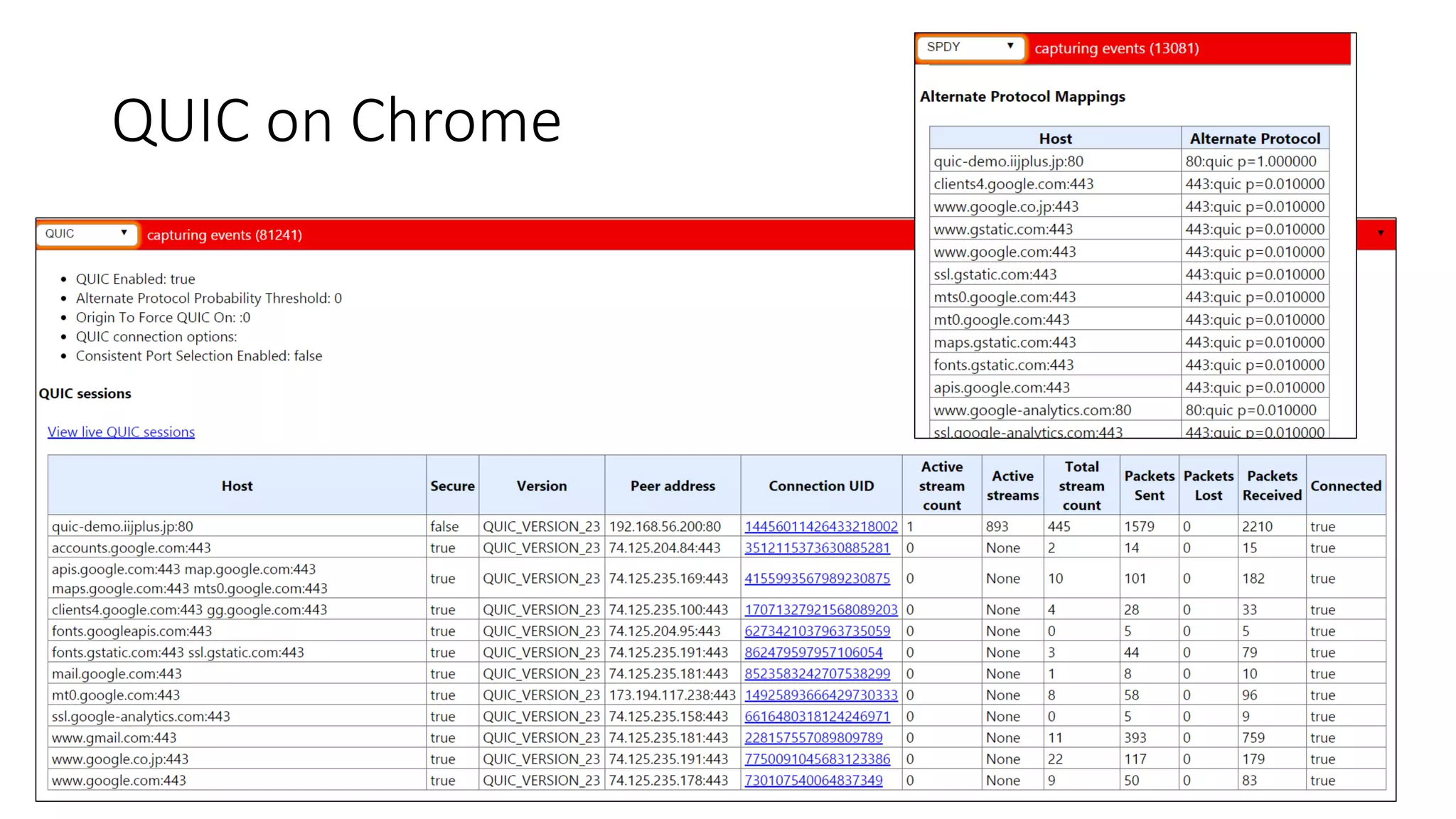
QUIC on Chrome
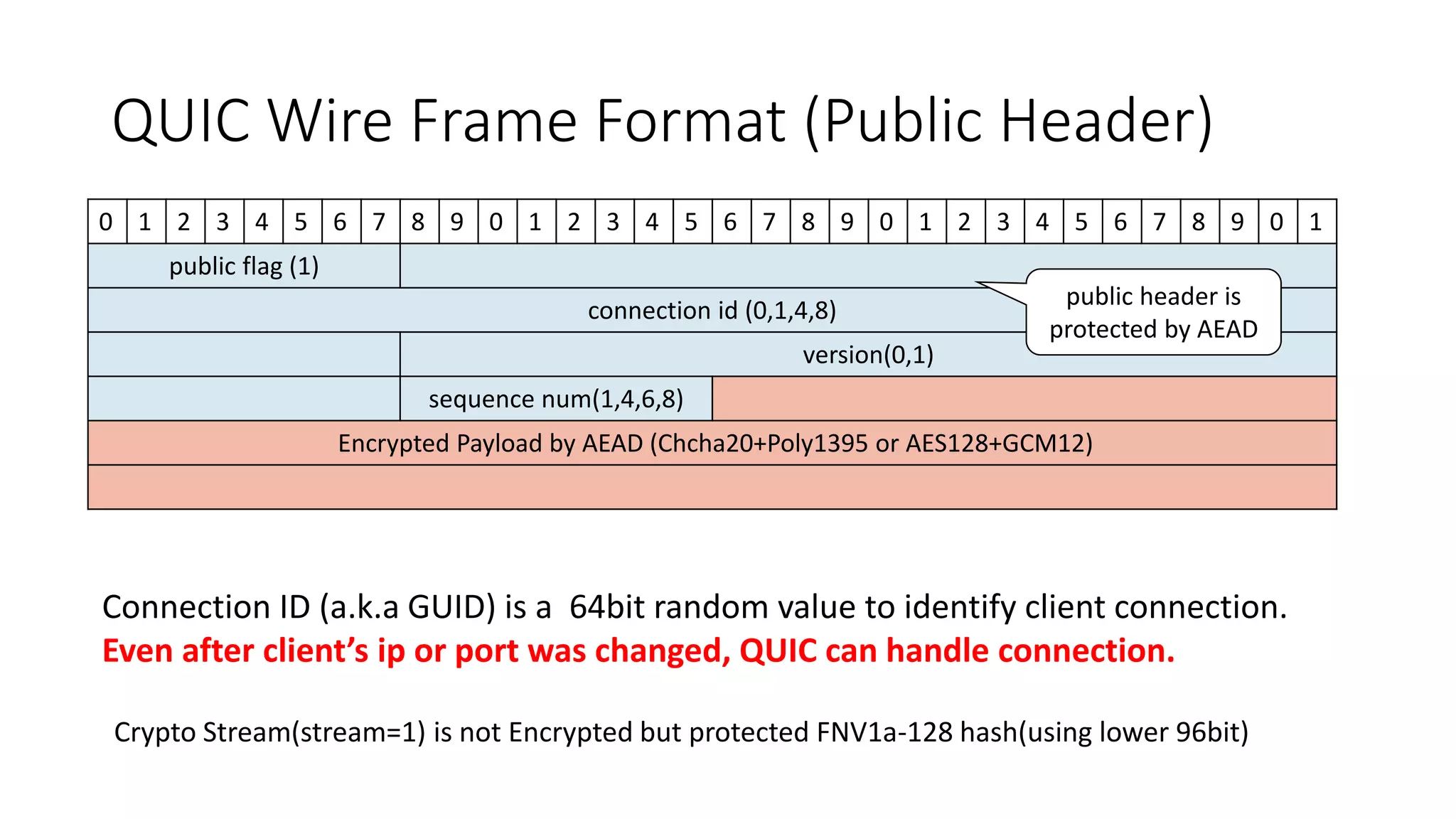
QUIC Wire Frame Format (Public Header) 
0 
1 
2 
3 
4 
5 
6 
7 
8 
9 
0 
1 
2 
3 
4 
5 
6 
7 
8 
9 
0 
1 
2 
3 
4 
5 
6 
7 
8 
9 
0 
1 
public flag (1) 
connection id (0,1,4,8) 
version(0,1) 
sequencenum(1,4,6,8) 
Encrypted Payload byAEAD (Chcha20+Poly1395 or AES128+GCM12) 
ConnectionID (a.k.aGUID) is a 64bit random value to identify client connection. 
Even after client’s ipor port was changed, QUIC can handle connection. 
public header is protected by AEAD 
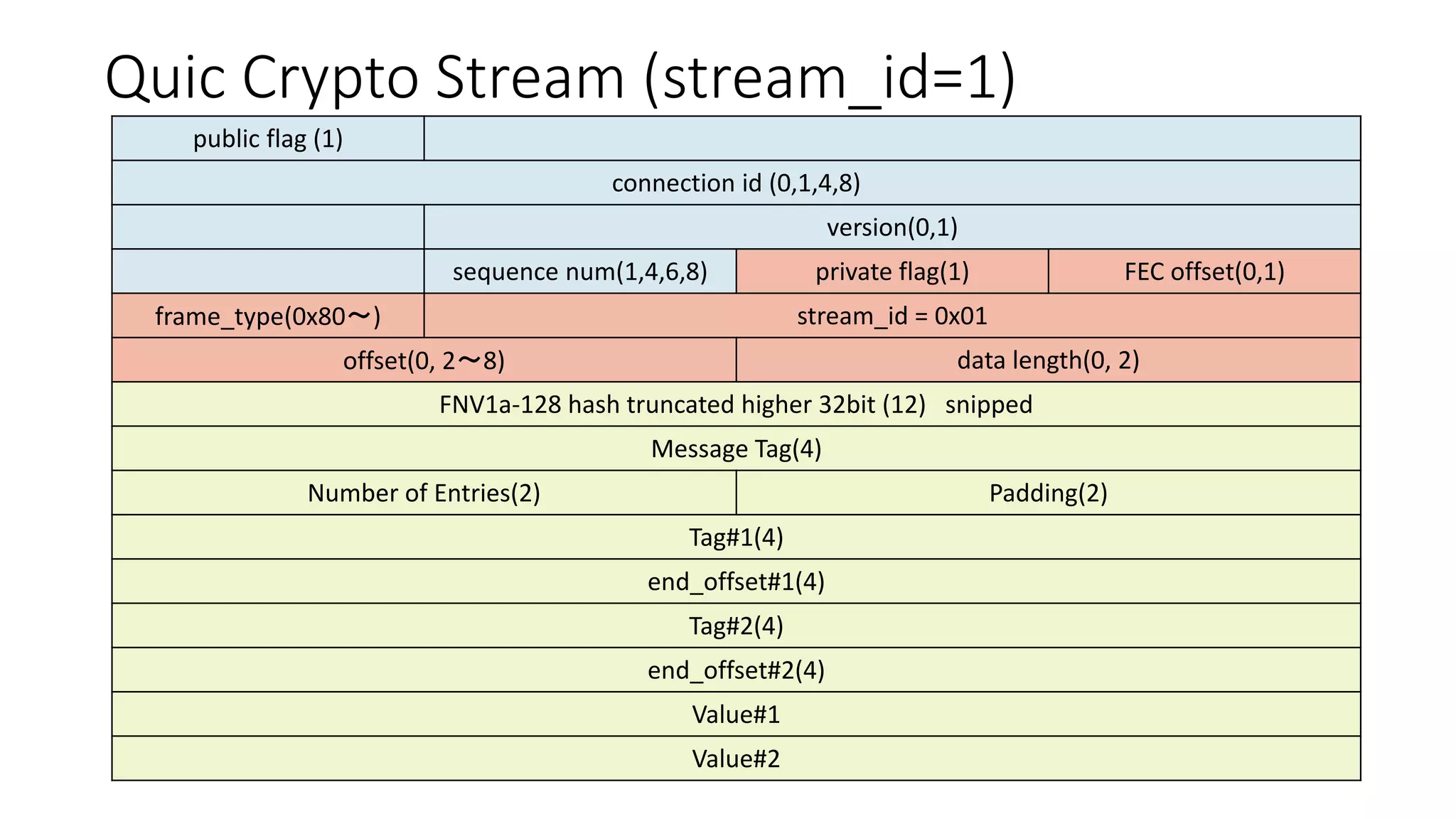
Crypto Stream(stream=1) is not Encrypted but protected FNV1a-128 hash(using lower 96bit)
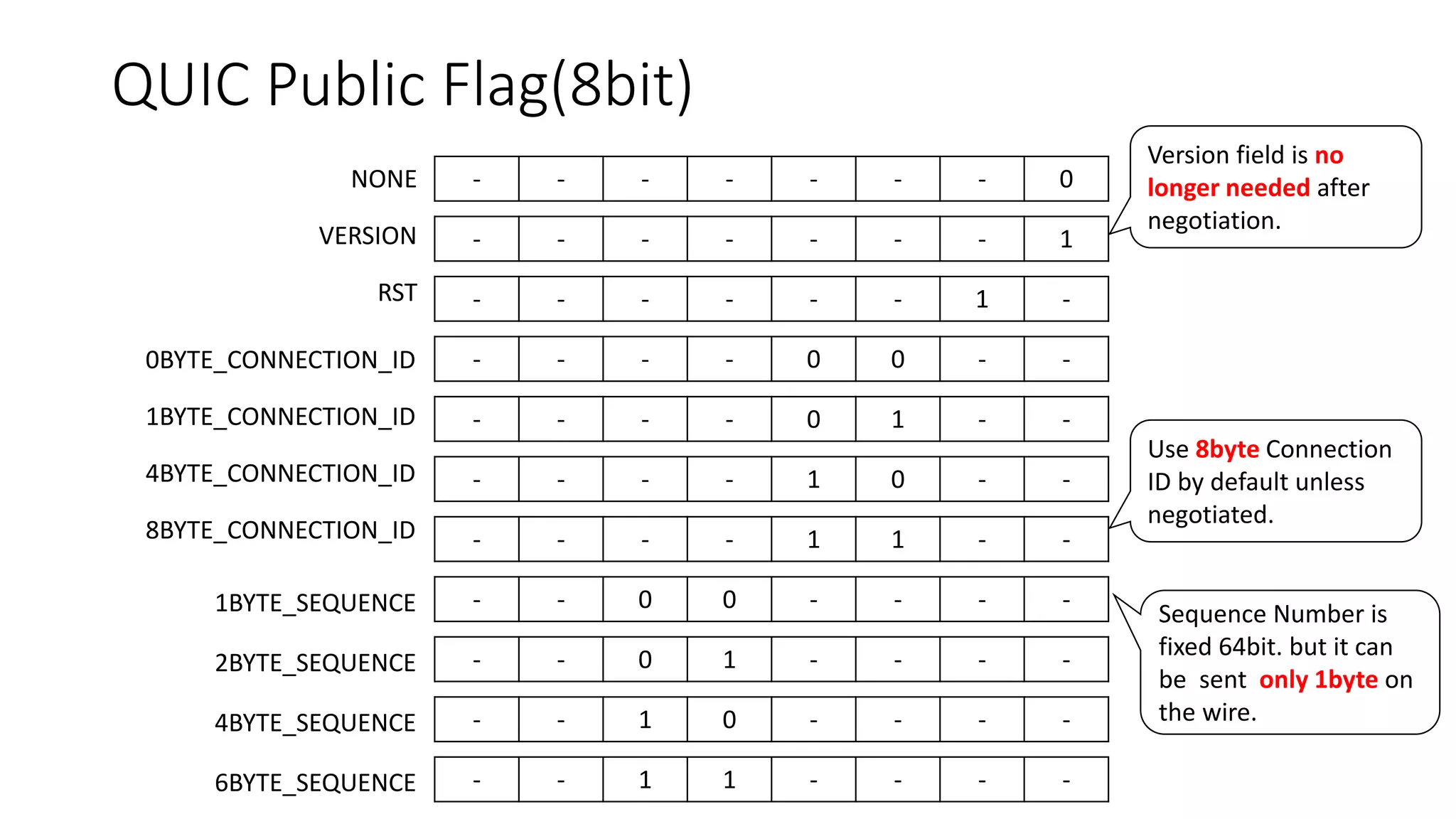
QUIC Public Flag(8bit) 
- 
- 
- 
- 
- 
- 
- 
0 
NONE 
VERSION 
- 
- 
- 
- 
- 
- 
- 
1 
RST 
- 
- 
- 
- 
- 
- 
1 
- 
- 
- 
- 
- 
0 
0 
- 
- 
- 
- 
- 
- 
0 
1 
- 
- 
- 
- 
- 
- 
1 
0 
- 
- 
- 
- 
- 
- 
1 
1 
- 
- 
- 
- 
0 
0 
- 
- 
- 
- 
- 
- 
0 
1 
- 
- 
- 
- 
- 
- 
1 
0 
- 
- 
- 
- 
- 
- 
1 
1 
- 
- 
- 
- 
0BYTE_CONNECTION_ID 
1BYTE_CONNECTION_ID 
4BYTE_CONNECTION_ID 
8BYTE_CONNECTION_ID 
1BYTE_SEQUENCE 
2BYTE_SEQUENCE 
4BYTE_SEQUENCE 
6BYTE_SEQUENCE 
Use 8byteConnection ID by default unless negotiated. 
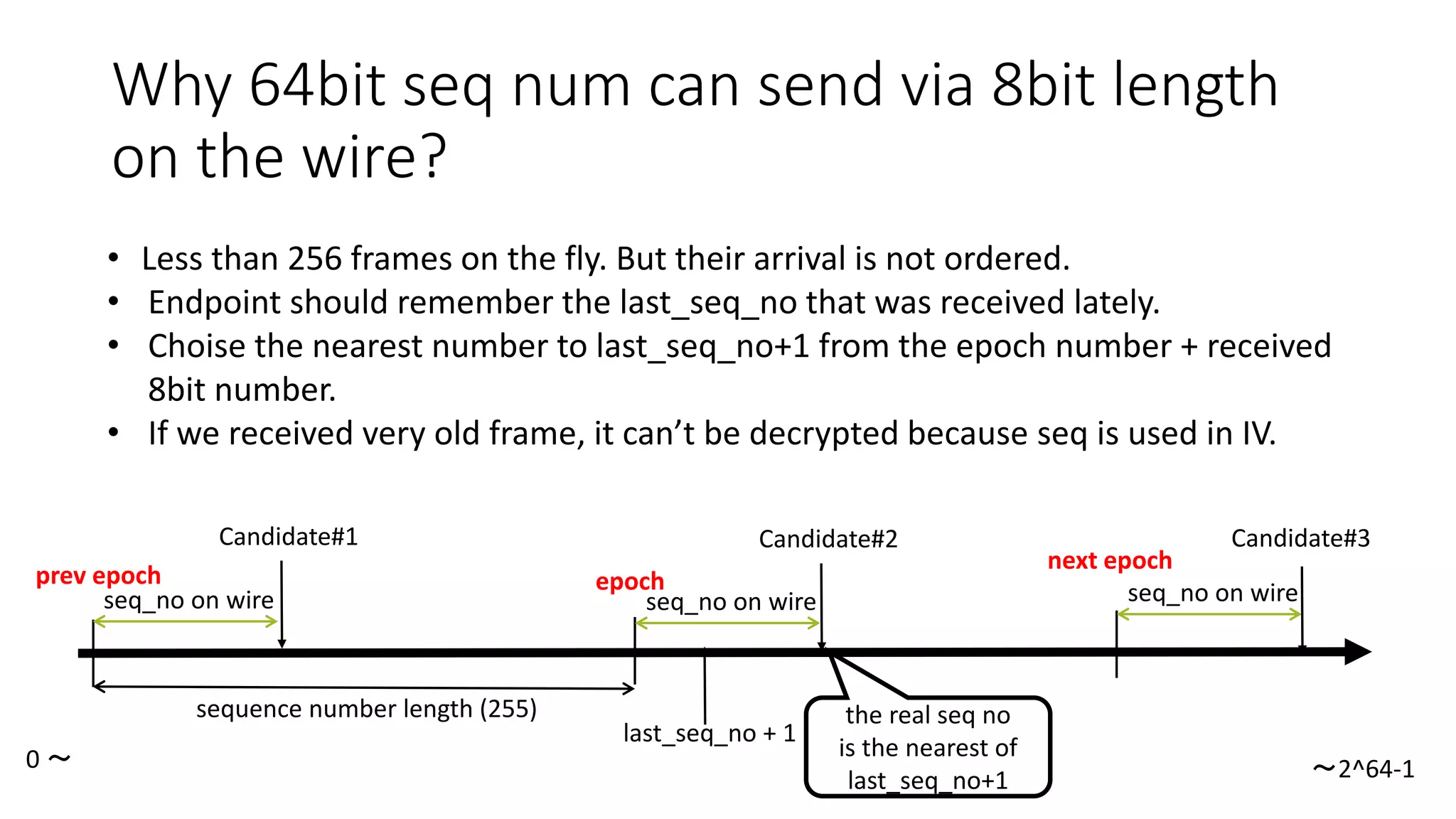
Sequence Number is fixed 64bit. but it can be sent only 1byte on the wire. 
Version field is no longer needed after negotiation.
Why 64bit seqnumcan send via 8bit length on the wire? 
next epoch 
epoch 
prevepoch 
last_seq_no+ 1 
seq_noon wire 
seq_noon wire 
seq_noon wire 
Candidate#1 
Candidate#2 
Candidate#3 
the real seqno 
is the nearest of last_seq_no+1 
sequence number length (255) 
0 ~ 
~2^64-1 
•Less than 256 frames on the fly. But their arrival is not ordered. 
•Endpoint should remember the last_seq_nothat was received lately. 
•Choisethe nearest number to last_seq_no+1 from the epoch number + received 8bit number. 
•If we received very old frame, it can’t be decrypted because seqis used in IV.
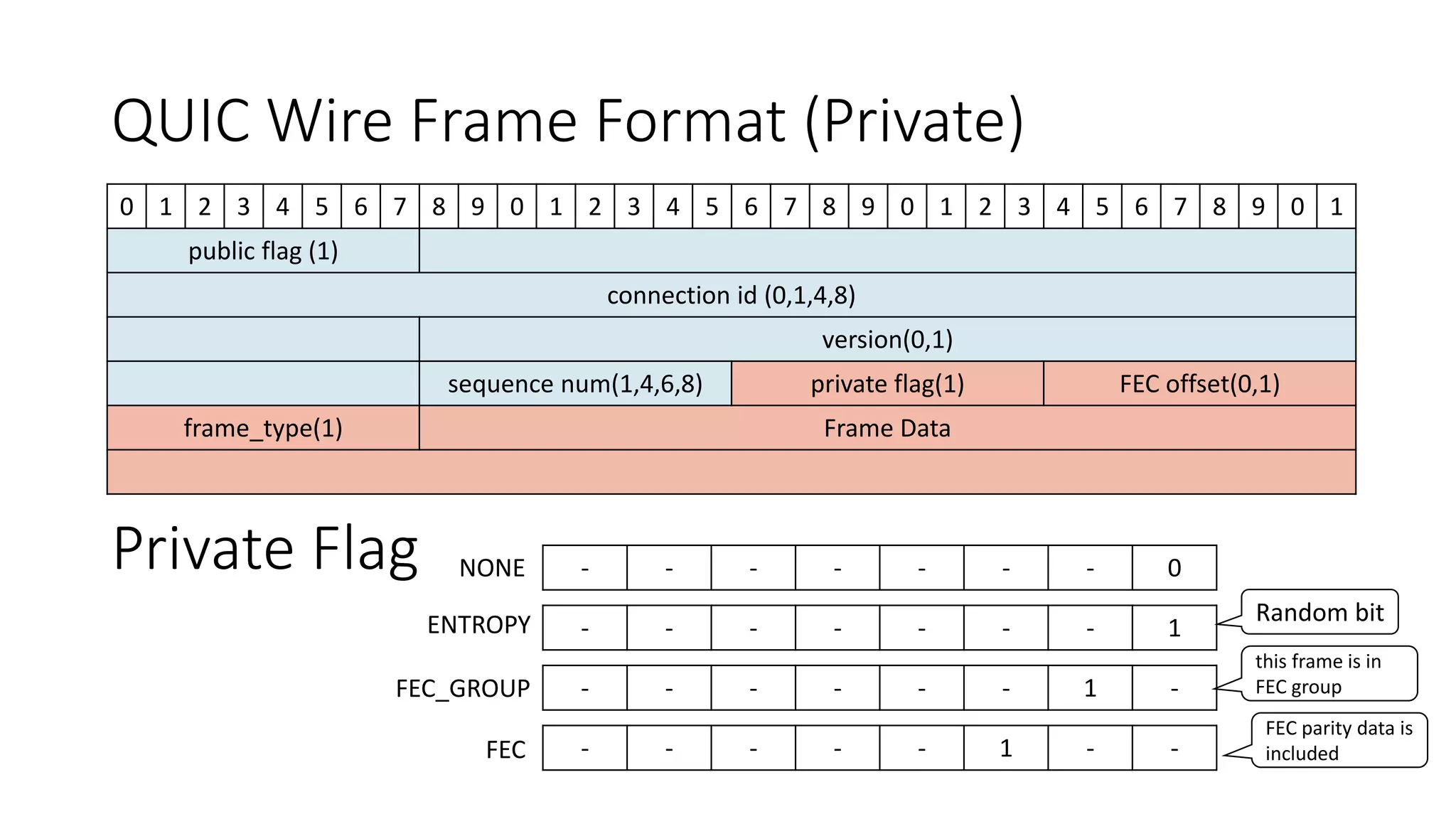
QUIC Wire Frame Format (Private) 
0 
1 
2 
3 
4 
5 
6 
7 
8 
9 
0 
1 
2 
3 
4 
5 
6 
7 
8 
9 
0 
1 
2 
3 
4 
5 
6 
7 
8 
9 
0 
1 
public flag (1) 
connection id (0,1,4,8) 
version(0,1) 
sequencenum(1,4,6,8) 
private flag(1) 
FECoffset(0,1) 
frame_type(1) 
Frame Data 
Private Flag 
- 
- 
- 
- 
- 
- 
- 
0 
NONE 
ENTROPY 
- 
- 
- 
- 
- 
- 
- 
1 
FEC_GROUP 
- 
- 
- 
- 
- 
- 
1 
- 
- 
- 
- 
- 
- 
1 
- 
- 
FEC 
Random bit 
this frame is in FEC group 
FEC parity data is included
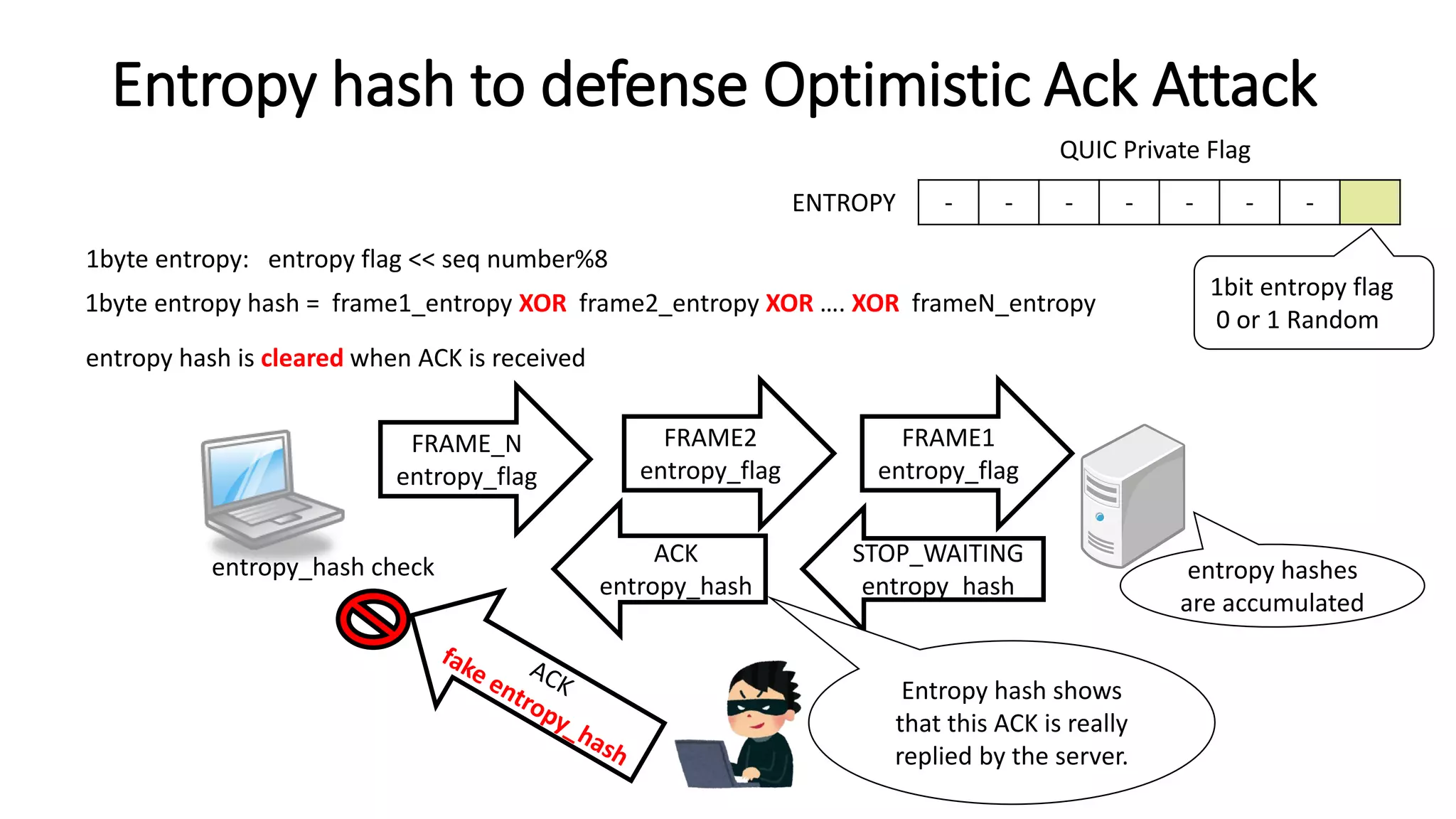
Entropy hash to defense Optimistic Ack Attack 
1byte entropy: entropy flag << seq number%8 
1byte entropy hash = frame1_entropy XOR frame2_entropy XOR …. XOR frameN_entropy 
entropy hash is cleared when ACK is received 
ACK 
entropy_hash 
STOP_WAITING 
entropy_hash 
FRAME1 
entropy_flag 
FRAME2 
entropy_flag 
FRAME_N 
entropy_flag 
entropy_hash check 
ENTROPY - - - - - - - 
QUIC Private Flag 
1bit entropy flag 
0 or 1 Random 
entropy hashes 
are accumulated 
Entropy hash shows 
that this ACK is really 
replied by the server.
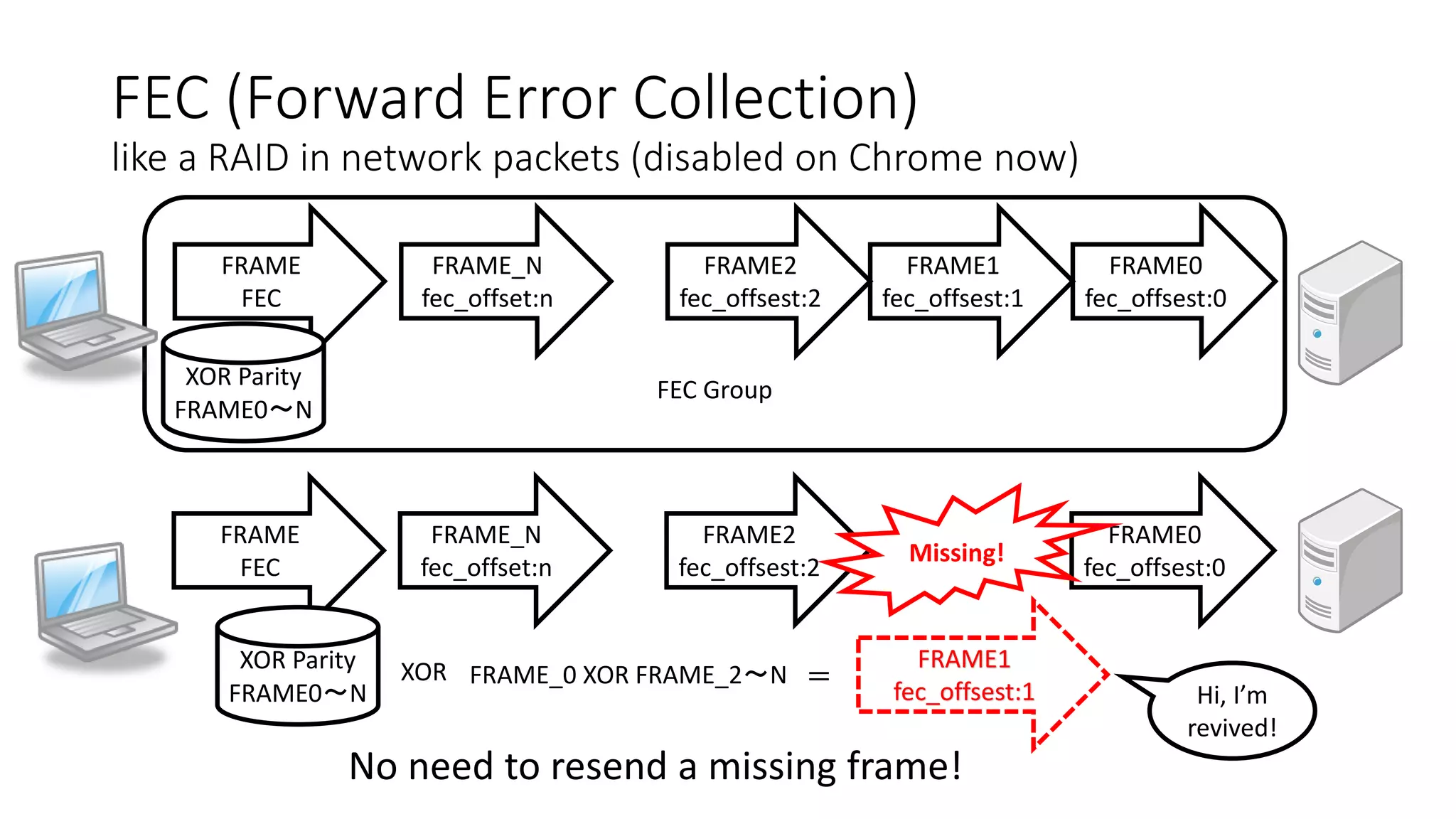
FEC (Forward Error Collection) 
like a RAID in network packets (disabled on Chrome now) 
FEC Group 
FRAME_N 
fec_offset:n 
FRAME0 
fec_offsest:0 
FRAME 
FEC 
XOR Parity 
FRAME0~N 
FRAME1 
fec_offsest:1 
FRAME2 
fec_offsest:2 
FRAME_N 
fec_offset:n 
FRAME0 
fec_offsest:0 
FRAME 
FEC 
FRAME2 
fec_offsest:2 
FRAME1 
fec_offsest:1 
Missing! 
XOR FRAME_0 XOR FRAME_2~N 
XOR Parity 
FRAME0~N 
= 
Hi, I’m 
revived! 
No need to resend a missing frame!
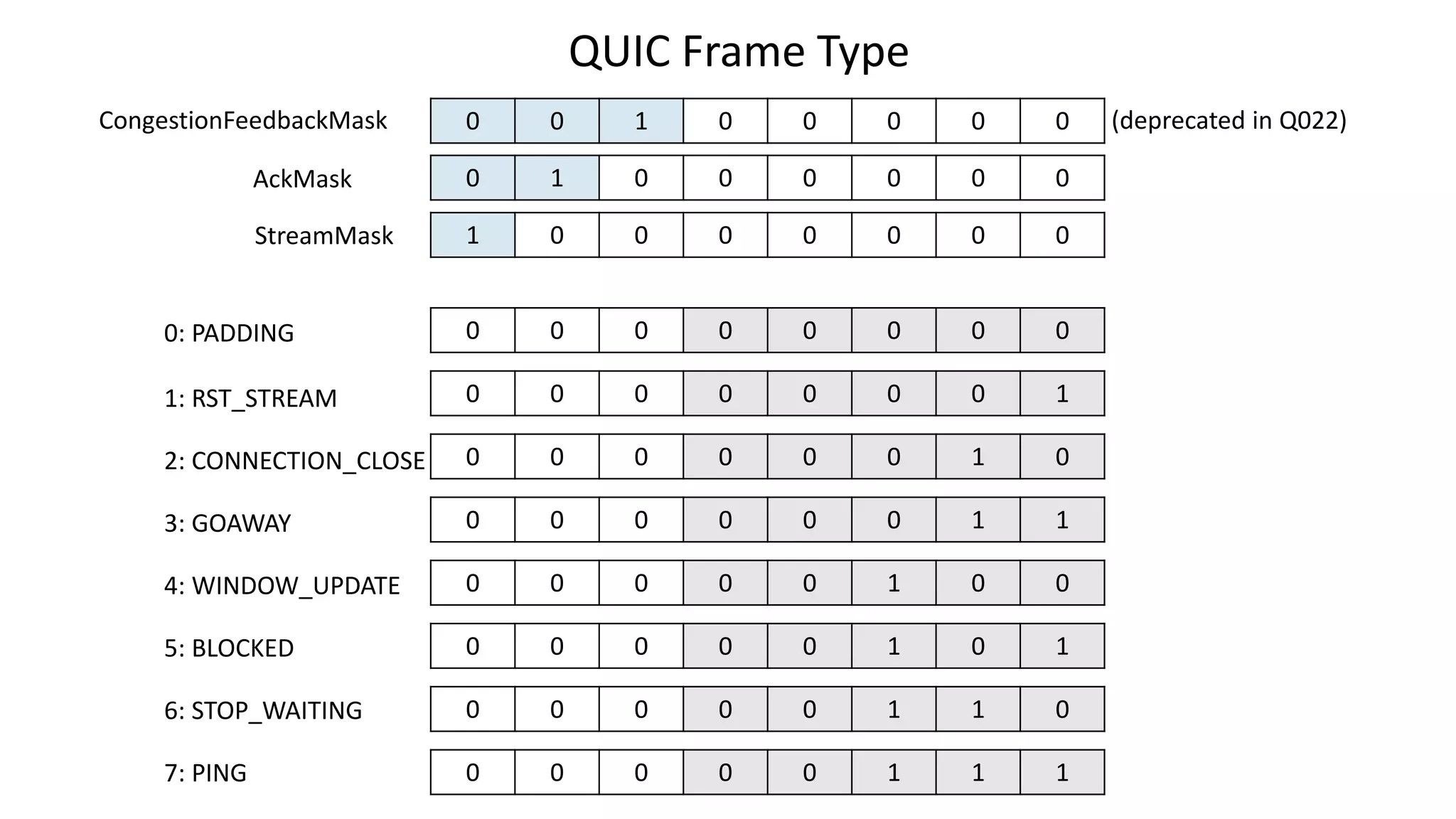
QUIC FrameType 
1 
0 
0 
0 
0 
0 
0 
0 
StreamMask 
AckMask 
CongestionFeedbackMask 
0 
1 
0 
0 
0 
0 
0 
0 
0 
0 
1 
0 
0 
0 
0 
0 
0 
0 
0 
0 
0 
0 
0 
0 
0: PADDING 
0 
0 
0 
0 
0 
0 
0 
1 
1: RST_STREAM 
0 
0 
0 
0 
0 
0 
1 
0 
2: CONNECTION_CLOSE 
0 
0 
0 
0 
0 
0 
1 
1 
3: GOAWAY 
0 
0 
0 
0 
0 
1 
0 
0 
4: WINDOW_UPDATE 
0 
0 
0 
0 
0 
1 
0 
1 
5: BLOCKED 
0 
0 
0 
0 
0 
1 
1 
0 
6: STOP_WAITING 
0 
0 
0 
0 
0 
1 
1 
1 
7: PING 
(deprecated in Q022)
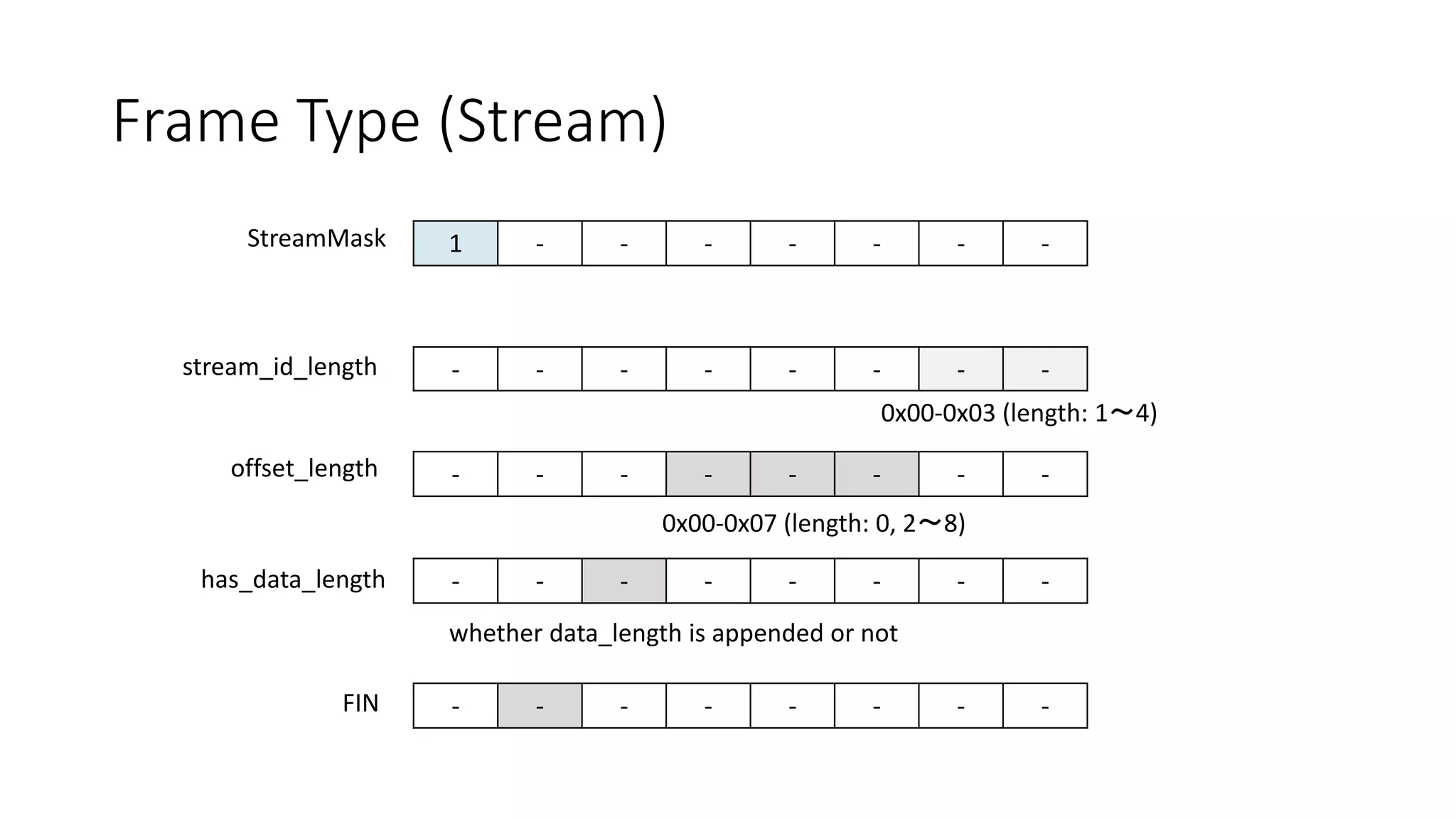
Frame Type (Stream) 
1 
- 
- 
- 
- 
- 
- 
- 
StreamMask 
- 
- 
- 
- 
- 
- 
- 
- 
stream_id_length 
- 
- 
- 
- 
- 
- 
- 
- 
offset_length 
- 
- 
- 
- 
- 
- 
- 
- 
has_data_length 
- 
- 
- 
- 
- 
- 
- 
- 
FIN 
0x00-0x03 (length: 1~4) 
0x00-0x07 (length: 0, 2~8) 
whether data_lengthis appended or not
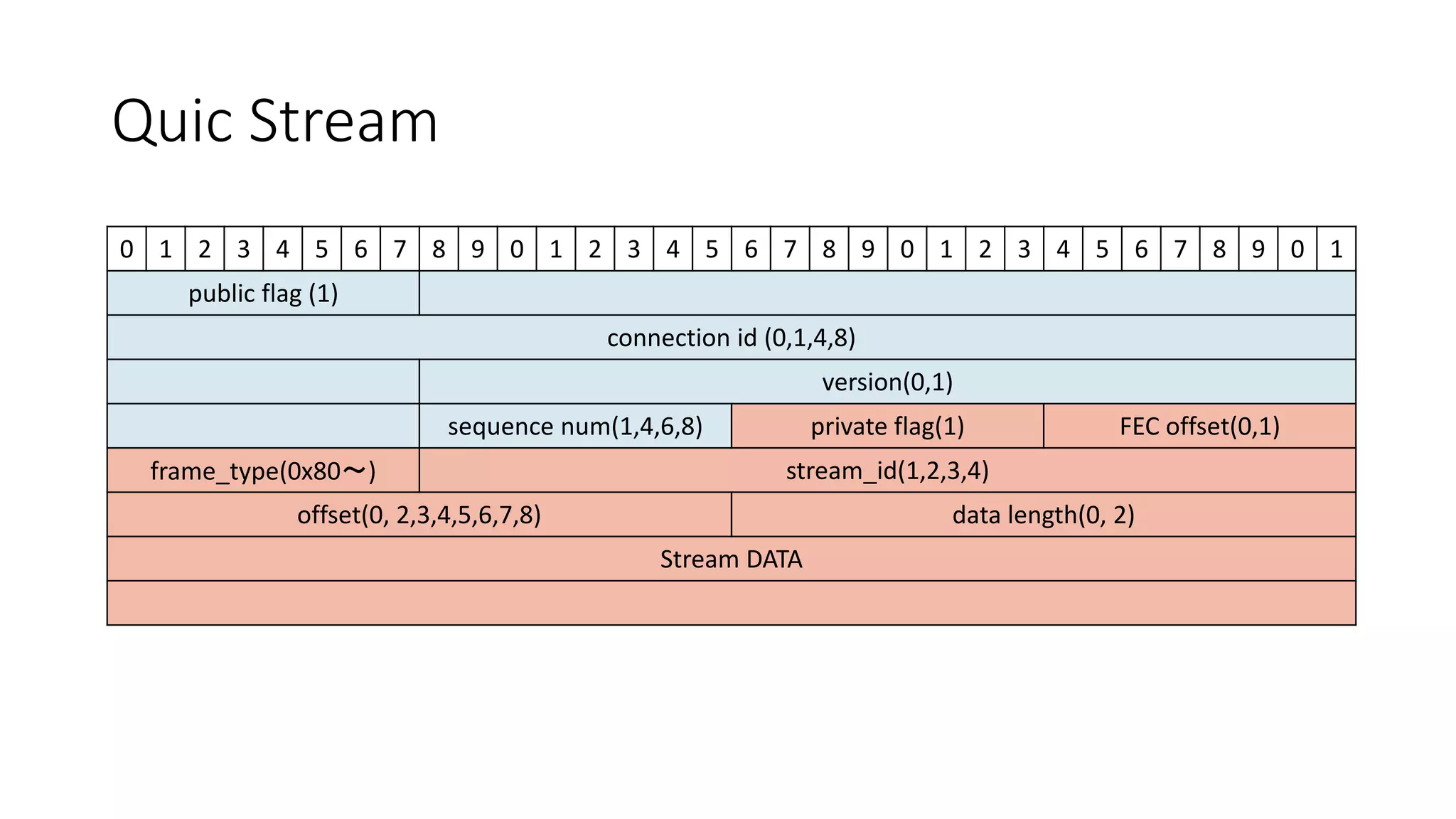
QuicStream 
0 
1 
2 
3 
4 
5 
6 
7 
8 
9 
0 
1 
2 
3 
4 
5 
6 
7 
8 
9 
0 
1 
2 
3 
4 
5 
6 
7 
8 
9 
0 
1 
public flag (1) 
connection id (0,1,4,8) 
version(0,1) 
sequencenum(1,4,6,8) 
private flag(1) 
FECoffset(0,1) 
frame_type(0x80~) 
stream_id(1,2,3,4) 
offset(0, 2,3,4,5,6,7,8) 
data length(0, 2) 
StreamDATA
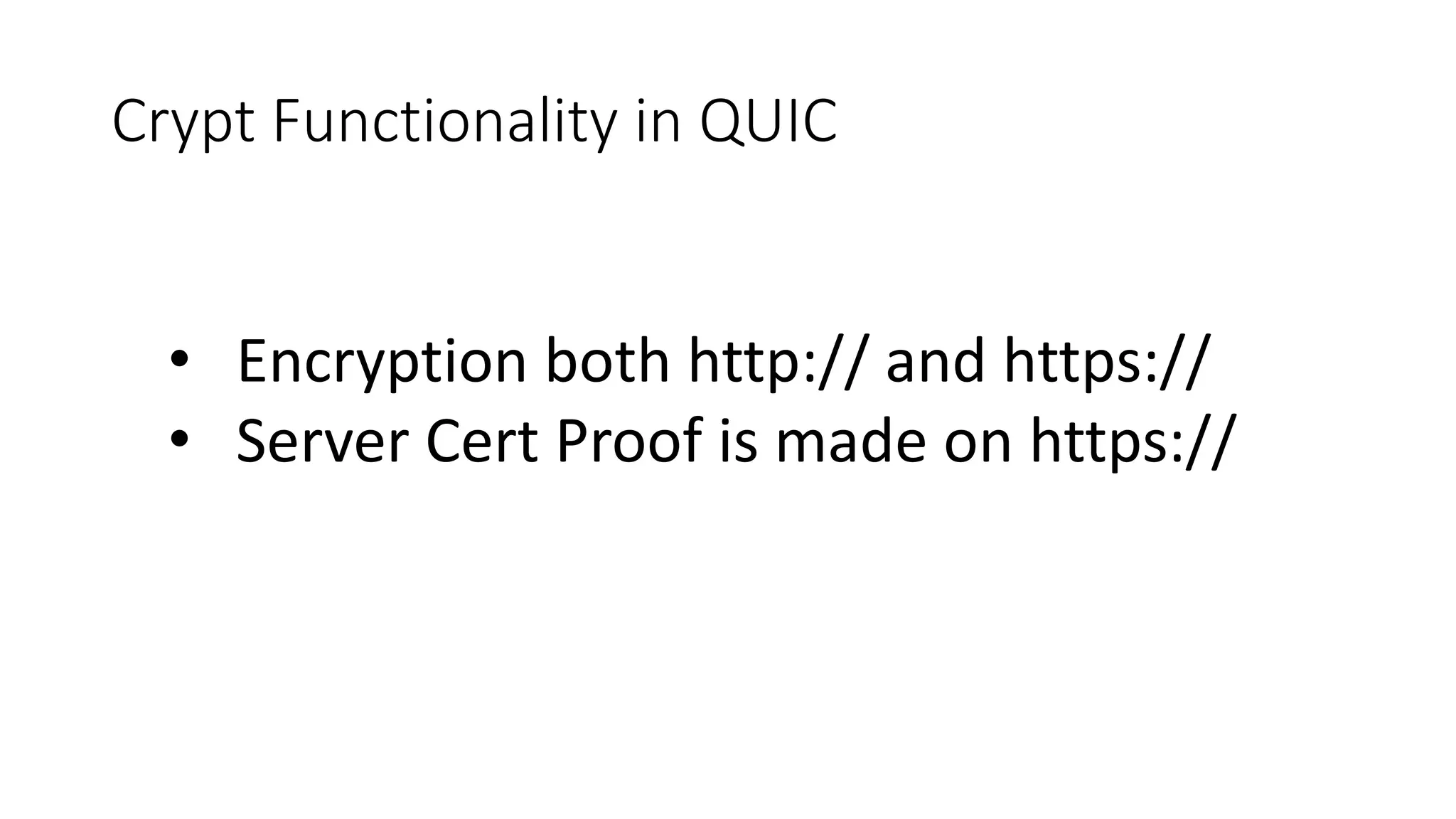
Crypt Functionality in QUIC 
•Encryption both http:// and https:// 
•Server Cert Proof is made on https://
QuicCrypto Stream (stream_id=1) 
public flag (1) 
connection id (0,1,4,8) 
version(0,1) 
sequencenum(1,4,6,8) 
private flag(1) 
FECoffset(0,1) 
frame_type(0x80~) 
stream_id= 0x01 
offset(0, 2~8) 
data length(0, 2) 
FNV1a-128 hash truncated higher 32bit (12) snipped 
Message Tag(4) 
Number of Entries(2) 
Padding(2) 
Tag#1(4) 
end_offset#1(4) 
Tag#2(4) 
end_offset#2(4) 
Value#1 
Value#2
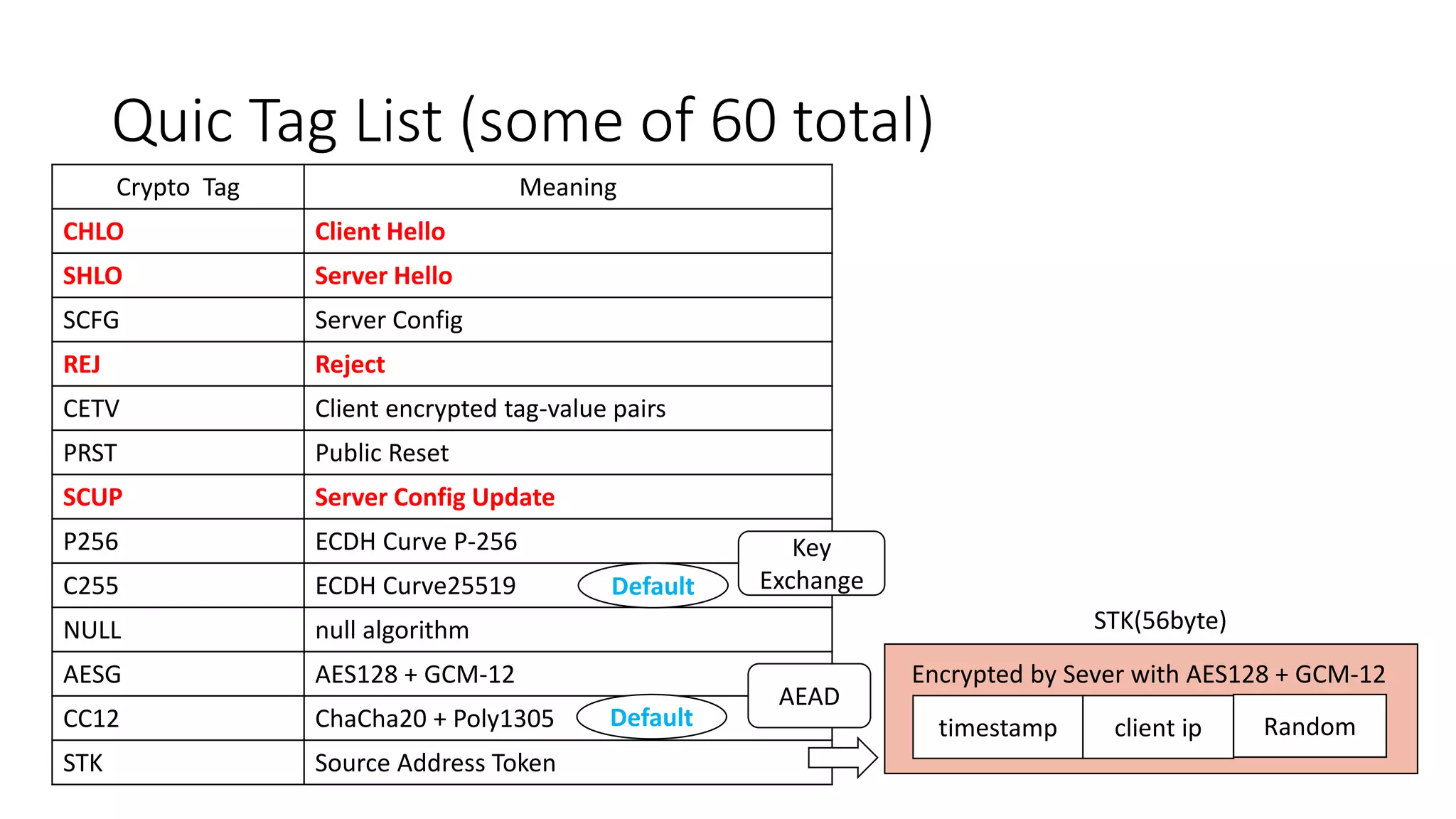
QuicTag List (some of 60 total) 
Crypto Tag 
Meaning 
CHLO 
Client Hello 
SHLO 
Server Hello 
SCFG 
Server Config 
REJ 
Reject 
CETV 
Client encrypted tag-value pairs 
PRST 
Public Reset 
SCUP 
Server ConfigUpdate 
P256 
ECDHCurve P-256 
C255 
ECDH Curve25519 
NULL 
null algorithm 
AESG 
AES128 + GCM-12 
CC12 
ChaCha20+ Poly1305 
STK 
SourceAddress Token 
timestamp 
client ip 
Random 
Encrypted by Sever with AES128 + GCM-12 
STK(56byte) 
Default 
Default 
Key Exchange 
AEAD
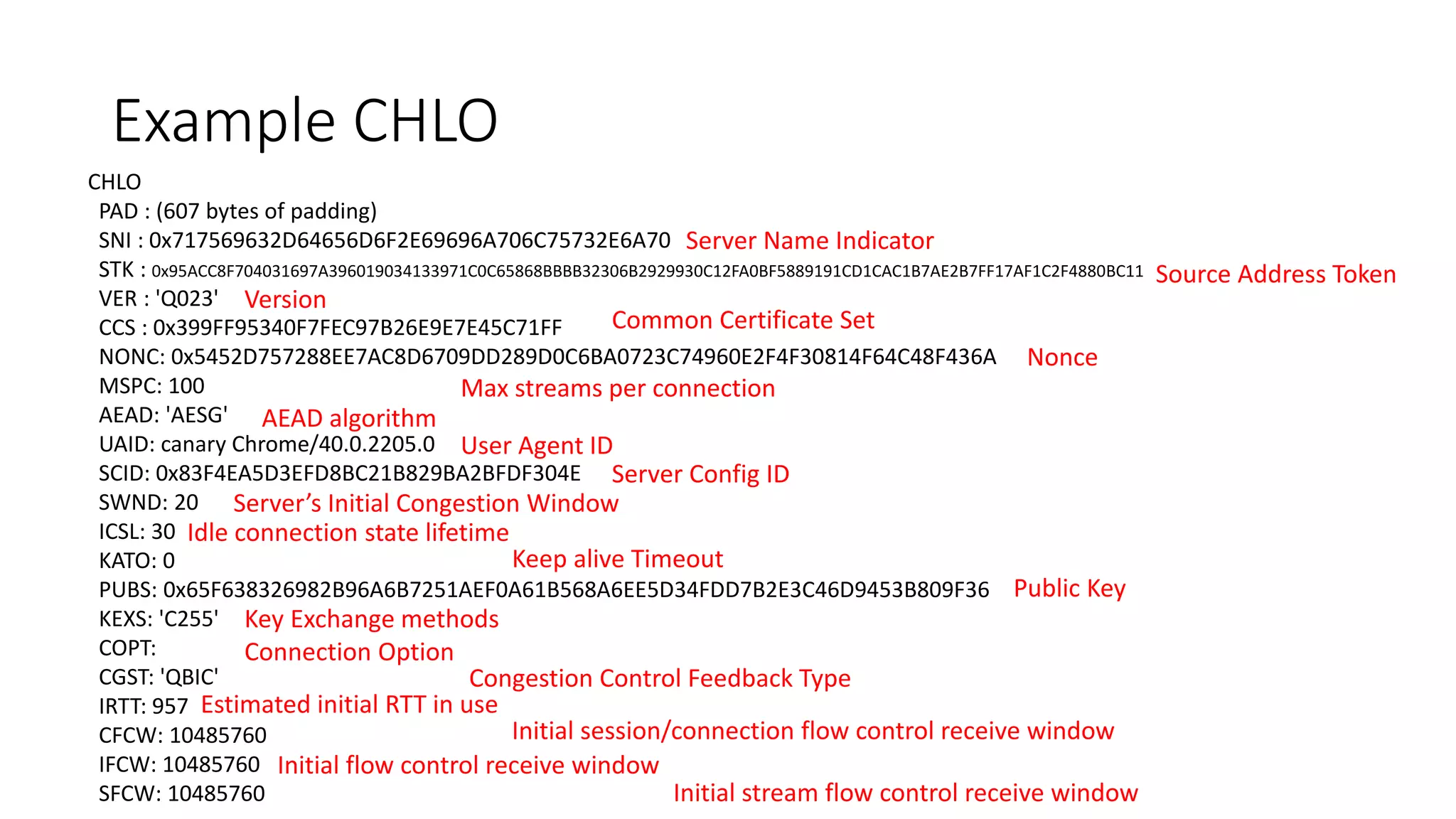
Example CHLO 
CHLO 
PAD : (607 bytes of padding) 
SNI : 0x717569632D64656D6F2E69696A706C75732E6A70 
STK : 0x95ACC8F704031697A396019034133971C0C65868BBBB32306B2929930C12FA0BF5889191CD1CAC1B7AE2B7FF17AF1C2F4880BC11 
VER : 'Q023' 
CCS : 0x399FF95340F7FEC97B26E9E7E45C71FF 
NONC: 0x5452D757288EE7AC8D6709DD289D0C6BA0723C74960E2F4F30814F64C48F436A 
MSPC: 100 
AEAD: 'AESG' 
UAID: canary Chrome/40.0.2205.0 
SCID: 0x83F4EA5D3EFD8BC21B829BA2BFDF304E 
SWND: 20 
ICSL: 30 
KATO: 0 
PUBS: 0x65F638326982B96A6B7251AEF0A61B568A6EE5D34FDD7B2E3C46D9453B809F36 
KEXS: 'C255' 
COPT: 
CGST: 'QBIC' 
IRTT: 957 
CFCW: 10485760 
IFCW: 10485760 
SFCW: 10485760 
Server Name Indicator 
Source Address Token 
Version 
Nonce 
Common Certificate Set 
Max streams per connection 
AEAD algorithm 
User Agent ID 
Server ConfigID 
Server’s Initial Congestion Window 
Idle connection state lifetime 
Keep alive Timeout 
Public Key 
Key Exchange methods 
Connection Option 
Congestion Control Feedback Type 
Estimated initial RTT in use 
Initial session/connection flow control receive window 
Initial stream flow control receive window 
Initial flow control receive window
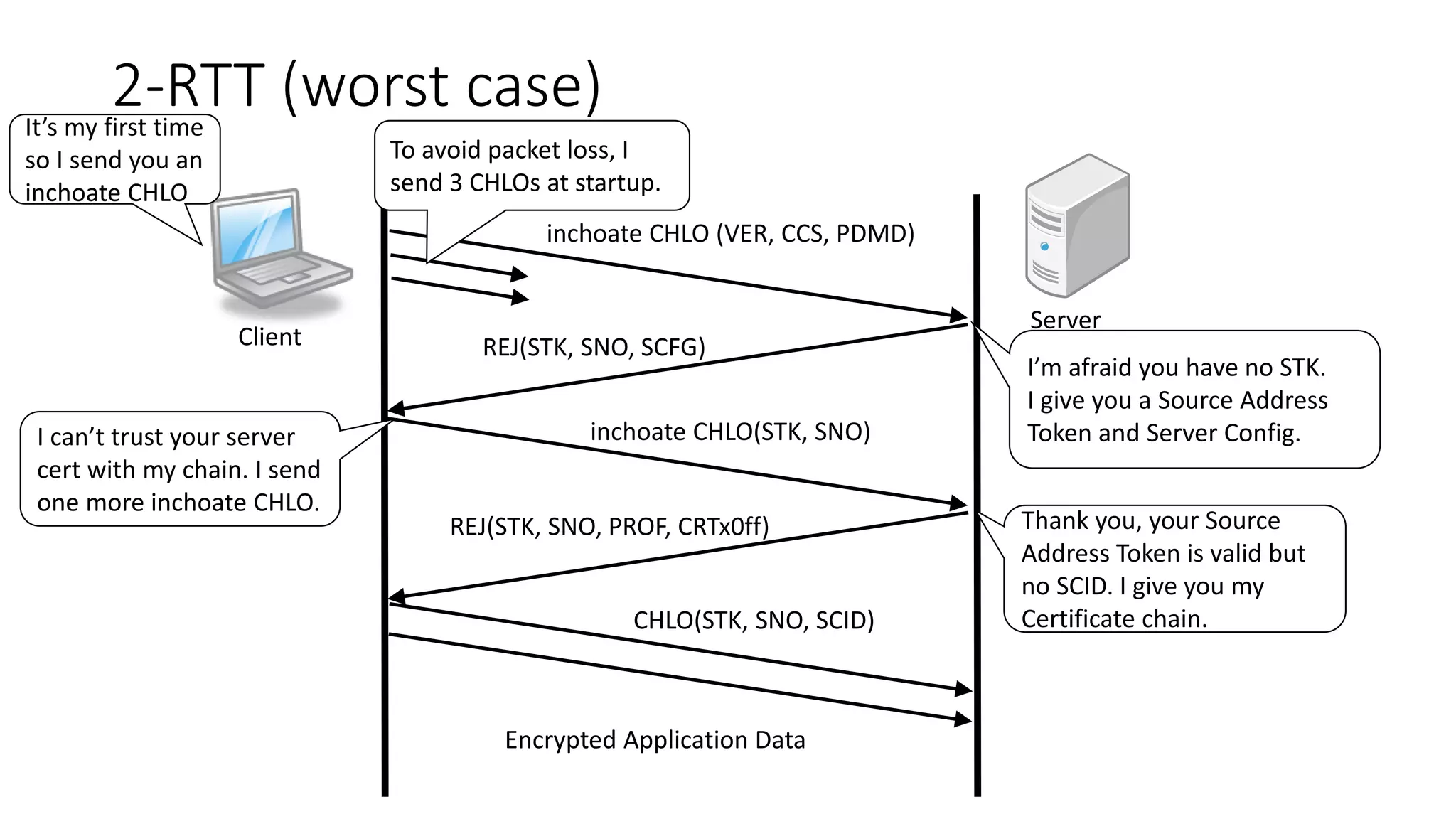
2-RTT (worst case) 
Client 
Server 
inchoate CHLO (VER, CCS, PDMD) 
REJ(STK, SNO, SCFG) 
inchoate CHLO(STK, SNO) 
REJ(STK, SNO, PROF, CRTx0ff) 
CHLO(STK, SNO, SCID) 
Encrypted Application Data 
Thank you, your Source 
Address Token is valid but 
no SCID. I give you my 
Certificate chain. 
I can’t trust your server 
cert with my chain. I send 
one more inchoate CHLO. 
I’m afraid you have no STK. 
I give you a Source Address 
Token and Server Config. 
It’s my first time 
so I send you an 
inchoate CHLO 
To avoid packet loss, I 
send 3 CHLOs at startup.
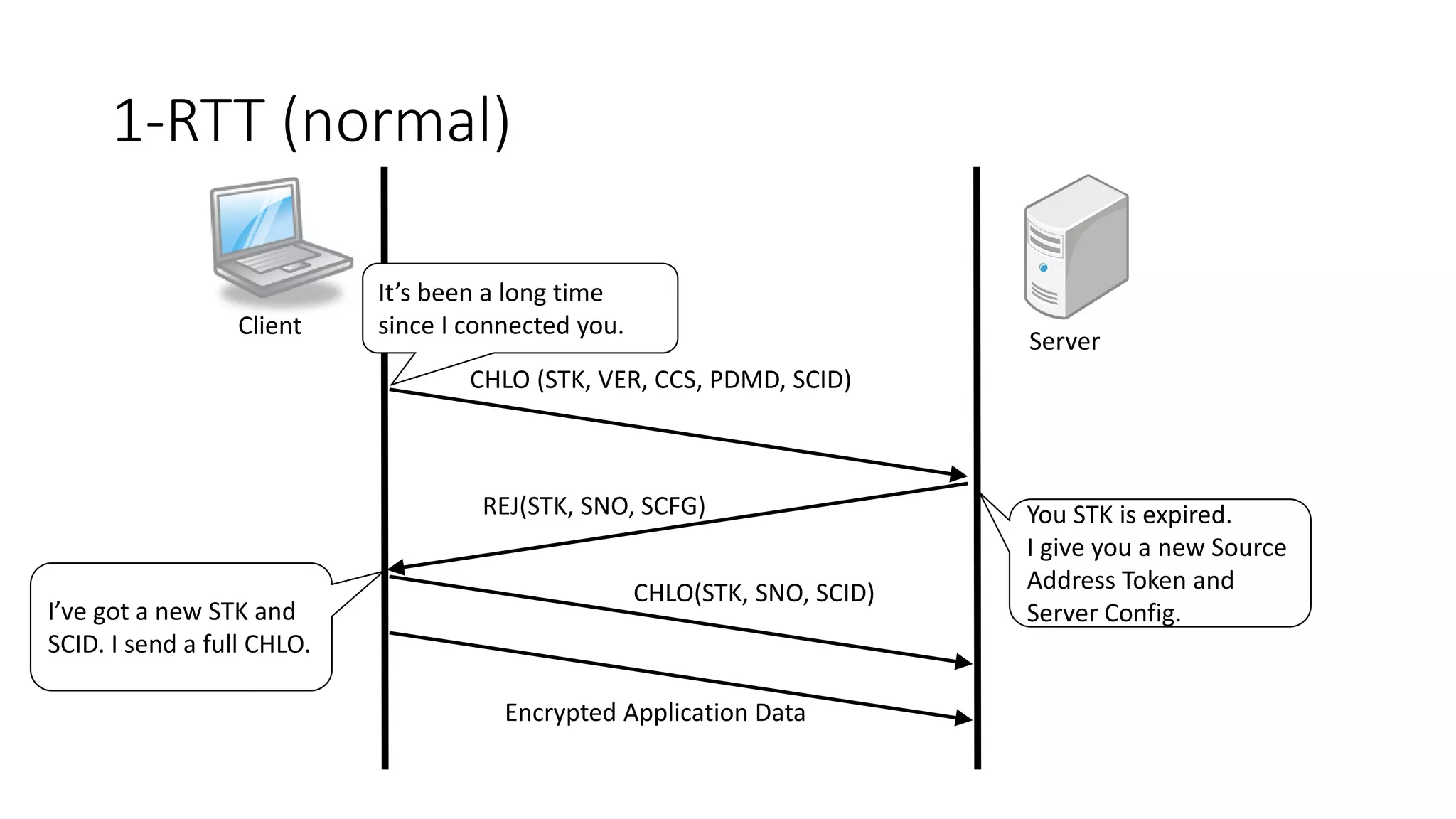
1-RTT (normal) 
Client 
Server 
CHLO (STK, VER, CCS, PDMD, SCID) 
REJ(STK, SNO, SCFG) 
CHLO(STK, SNO, SCID) 
Encrypted Application Data 
I’ve got a new STK and 
SCID. I send a full CHLO. 
You STK is expired. 
I give you a new Source 
Address Token and 
Server Config. 
It’s been a long time 
since I connected you.
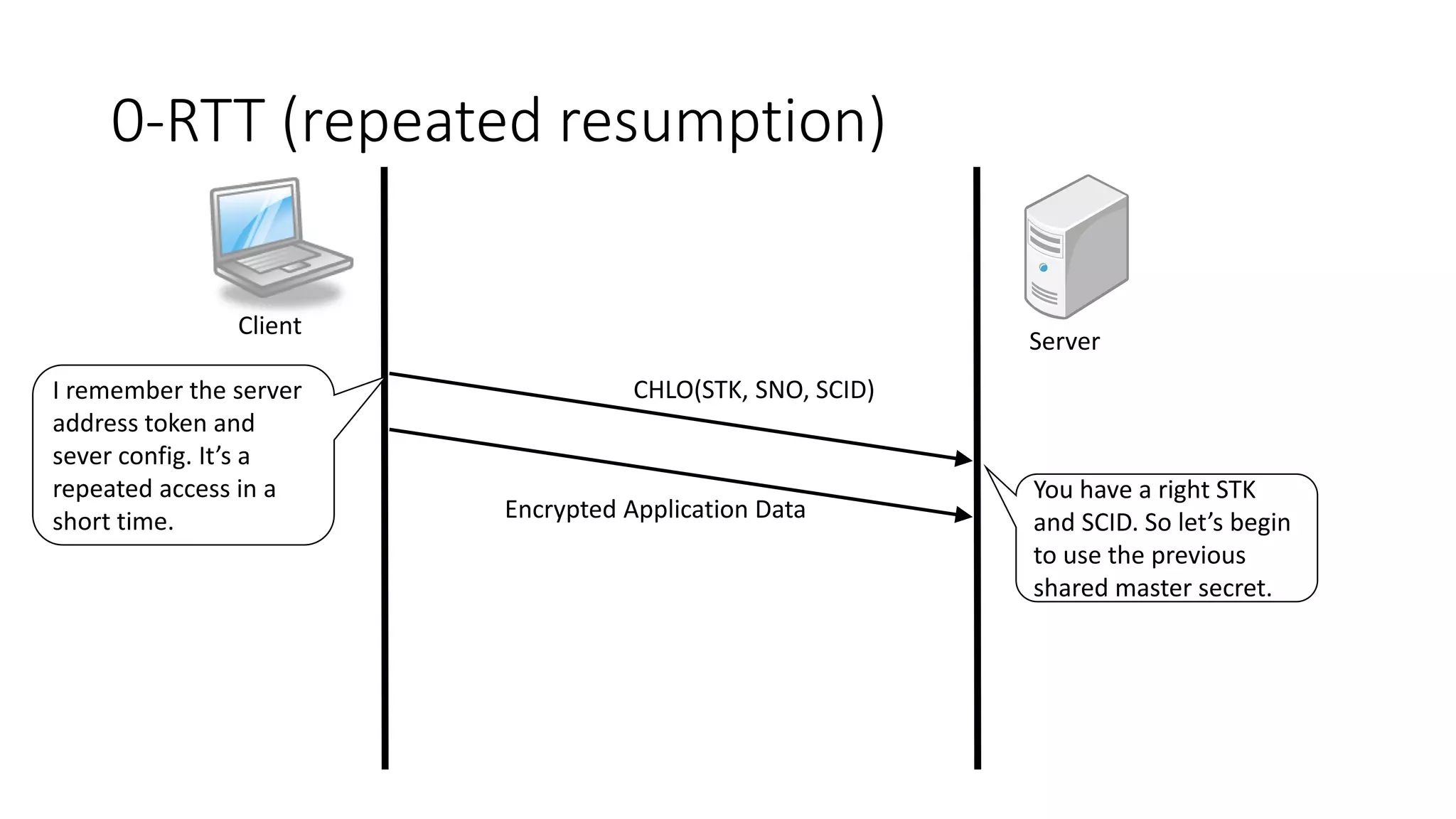
0-RTT (repeated resumption) 
Client 
Server 
CHLO(STK, SNO, SCID) 
Encrypted Application Data 
I remember the server 
address token and 
sever config. It’s a 
repeated access in a 
short time. 
You have a right STK 
and SCID. So let’s begin 
to use the previous 
shared master secret.
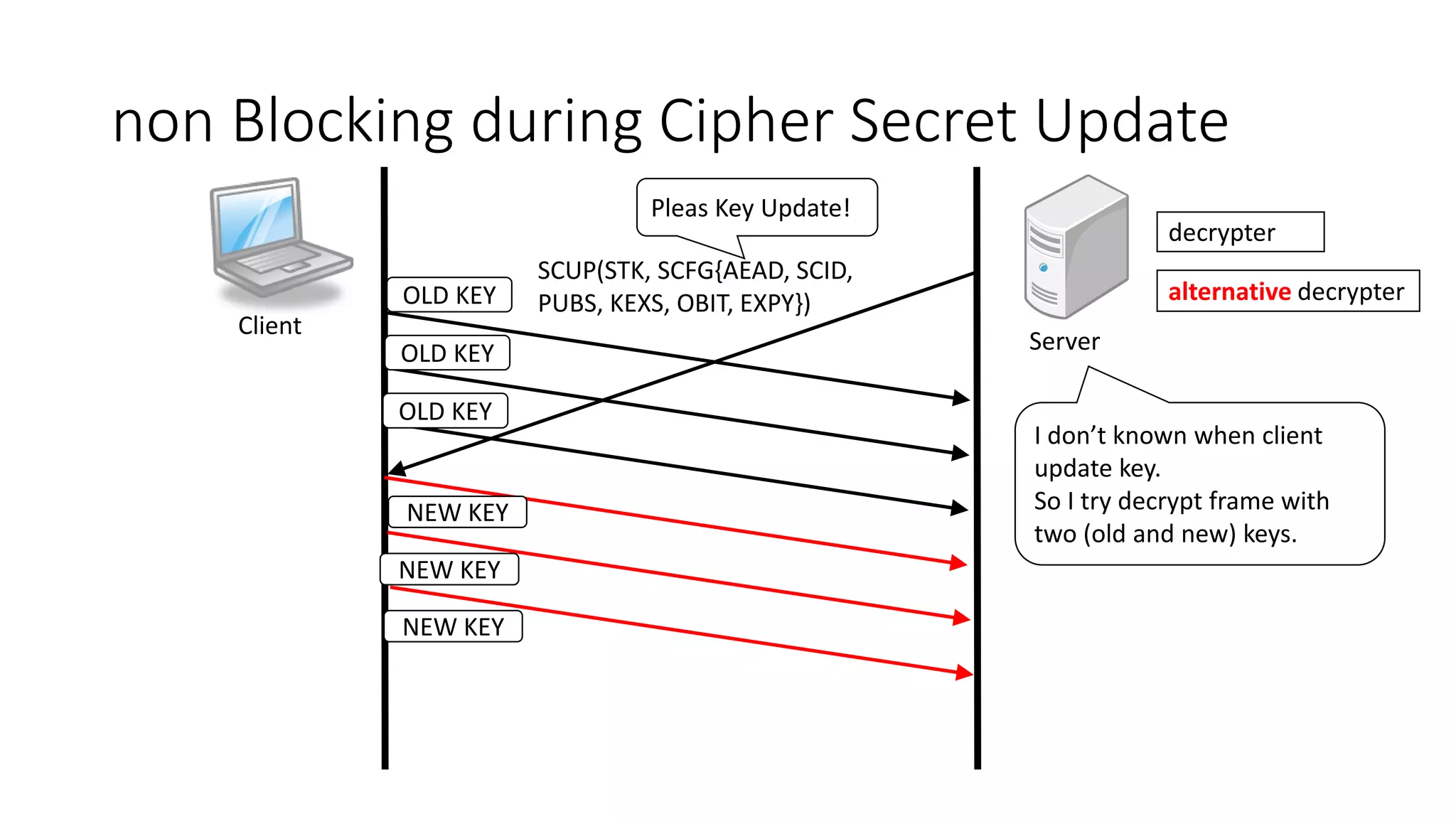
non Blocking during Cipher Secret Update 
Client 
Server 
Pleas Key Update! 
I don’t known when client 
update key. 
So I try decrypt frame with 
two (old and new) keys. 
SCUP(STK, SCFG{AEAD, SCID, 
OLD KEY PUBS, KEXS, OBIT, EXPY}) 
OLD KEY 
OLD KEY 
NEW KEY 
NEW KEY 
NEW KEY 
decrypter 
alternative decrypter
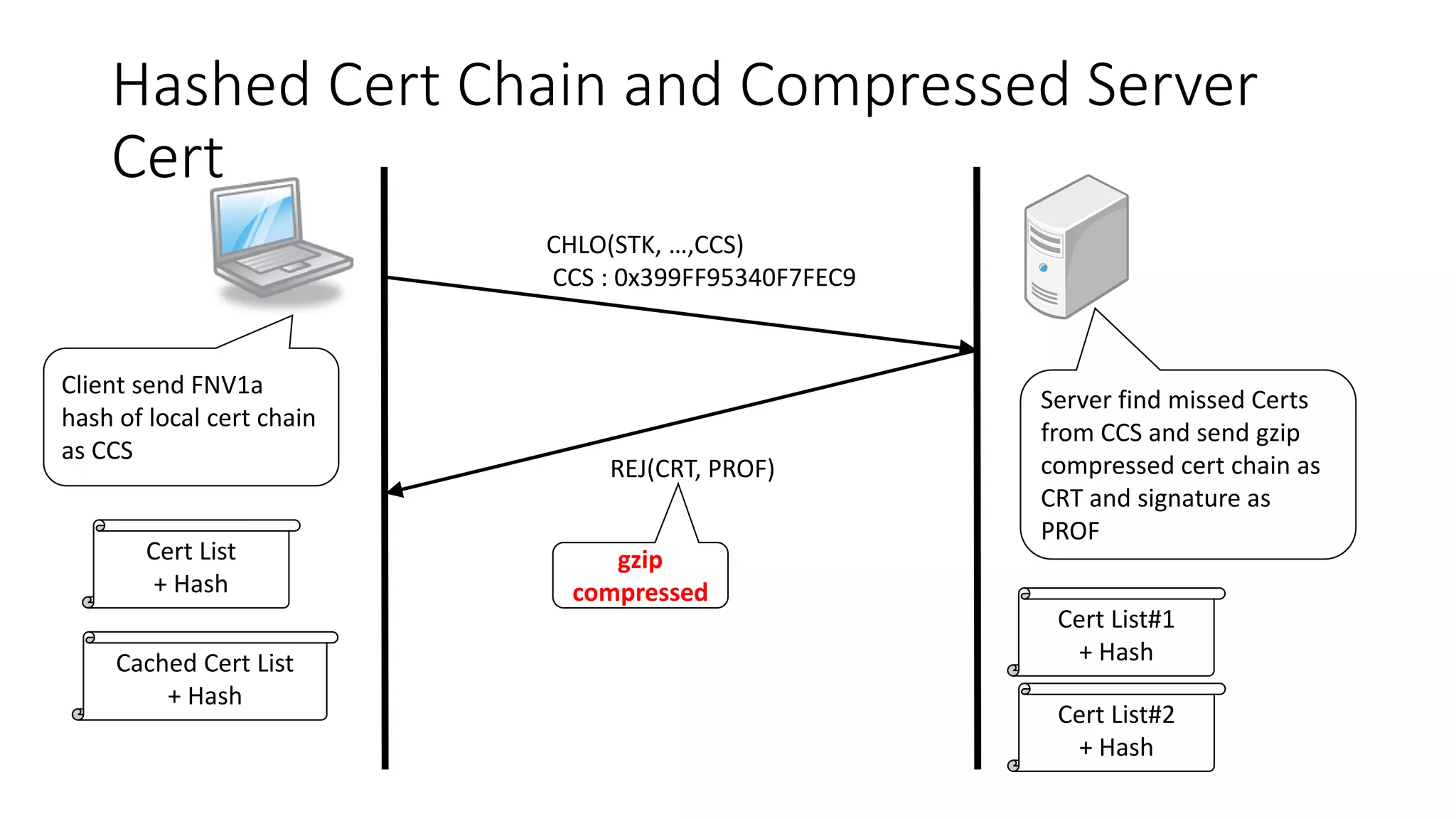
Hashed Cert Chain and Compressed Server 
Cert 
CHLO(STK, …,CCS) 
CCS : 0x399FF95340F7FEC9 
REJ(CRT, PROF) 
Client send FNV1a 
hash of local cert chain 
as CCS 
Server find missed Certs 
from CCS and send gzip 
compressed cert chain as 
CRT and signature as 
PROF 
Cert List 
+ Hash 
Cached Cert List 
+ Hash 
Cert List#1 
+ Hash 
Cert List#2 
+ Hash 
gzip 
compressed
Transport Functionality
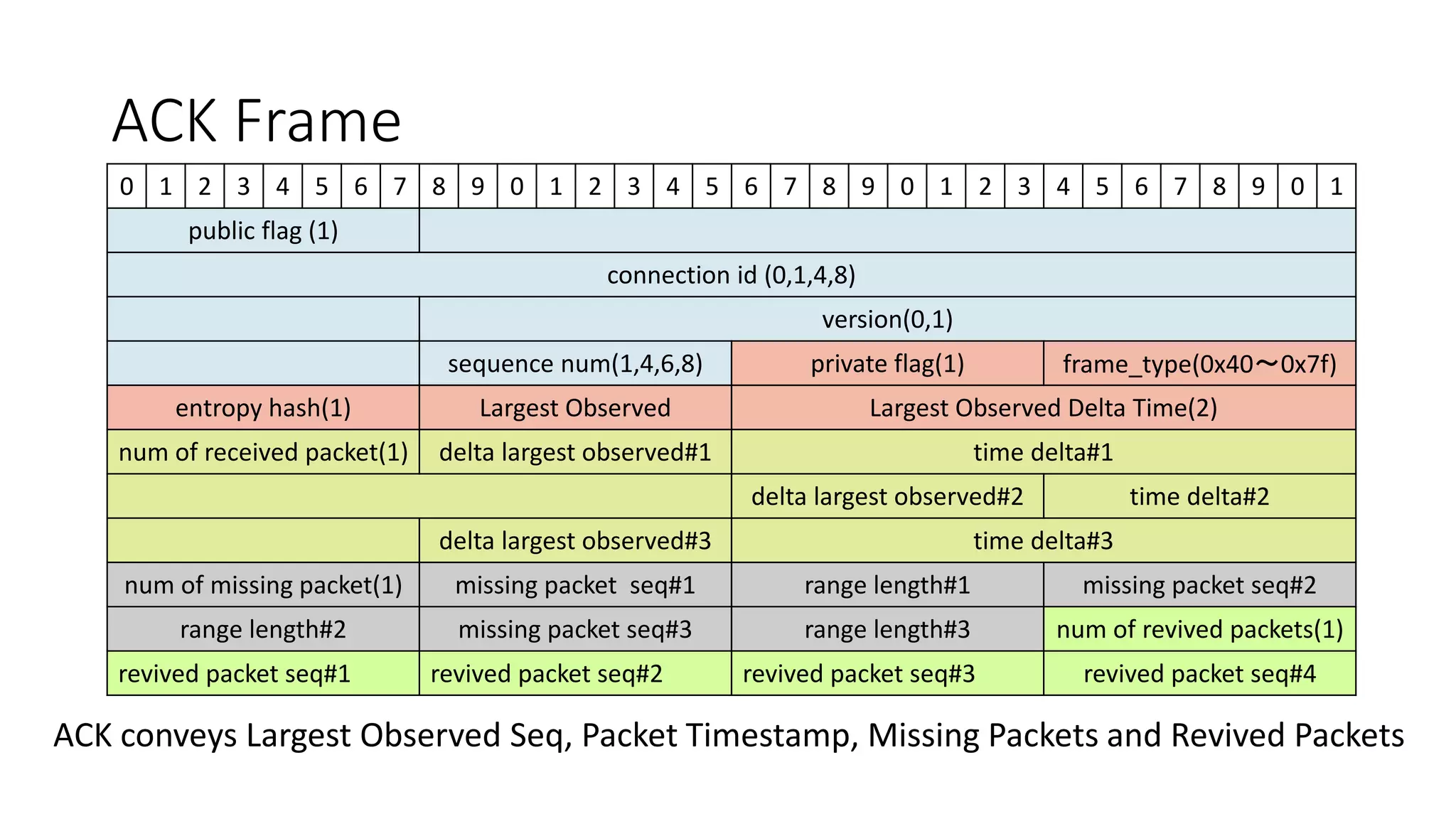
ACK Frame 
0 
1 
2 
3 
4 
5 
6 
7 
8 
9 
0 
1 
2 
3 
4 
5 
6 
7 
8 
9 
0 
1 
2 
3 
4 
5 
6 
7 
8 
9 
0 
1 
public flag (1) 
connection id (0,1,4,8) 
version(0,1) 
sequencenum(1,4,6,8) 
private flag(1) 
frame_type(0x40~0x7f) 
entropy hash(1) 
Largest Observed 
LargestObserved Delta Time(2) 
numof received packet(1) 
delta largest observed#1 
time delta#1 
delta largest observed#2 
time delta#2 
delta largest observed#3 
time delta#3 
numof missing packet(1) 
missing packet seq#1 
range length#1 
missing packet seq#2 
range length#2 
missing packet seq#3 
rangelength#3 
numof revivedpackets(1) 
revivedpacket seq#1 
revivedpacket seq#2 
revivedpacket seq#3 
revivedpacket seq#4 
ACK conveys Largest Observed Seq, Packet Timestamp, Missing Packets and Revived Packets
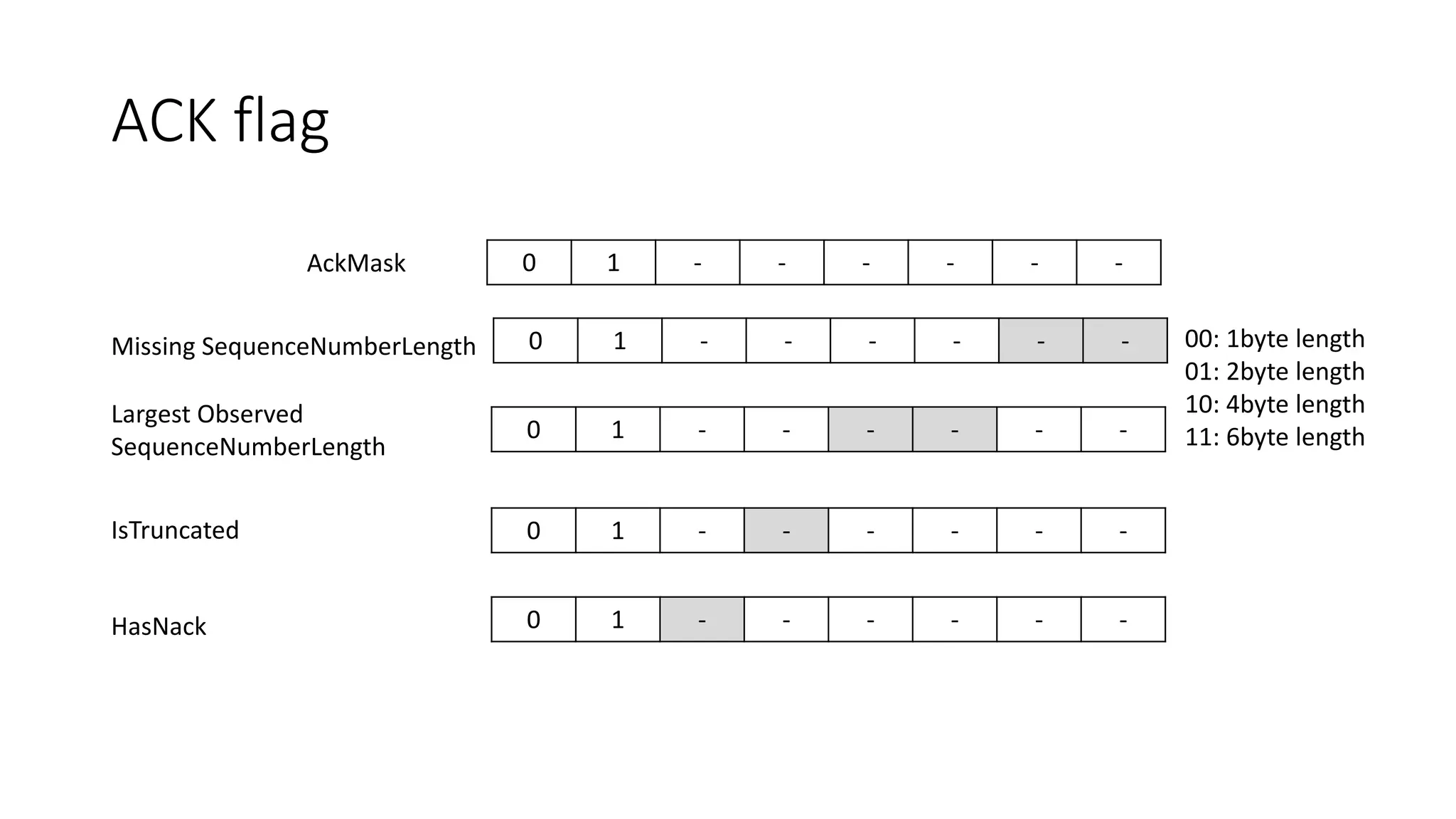
ACK flag 
0 
1 
- 
- 
- 
- 
- 
- 
AckMask 
0 
1 
- 
- 
- 
- 
- 
- 
Missing SequenceNumberLength 
00: 1byte length 
01: 2byte length 
10: 4byte length 
11: 6byte length 
0 
1 
- 
- 
- 
- 
- 
- 
Largest Observed 
SequenceNumberLength 
0 
1 
- 
- 
- 
- 
- 
- 
IsTruncated 
0 
1 
- 
- 
- 
- 
- 
- 
HasNack
Retransmit a lost frame as a new stream 
STREAM_FRAME 
ACK(largest_observed: 11, missing: [10]) 
Lost 
id=9 
id=10 
id=11 
id=13 retransmit as id=10 
id=12 
id=10 was lost. 
retransmit it as a new 
stream(id=13) 
Non-Blocked! 
Retransmitted as a 
new stream
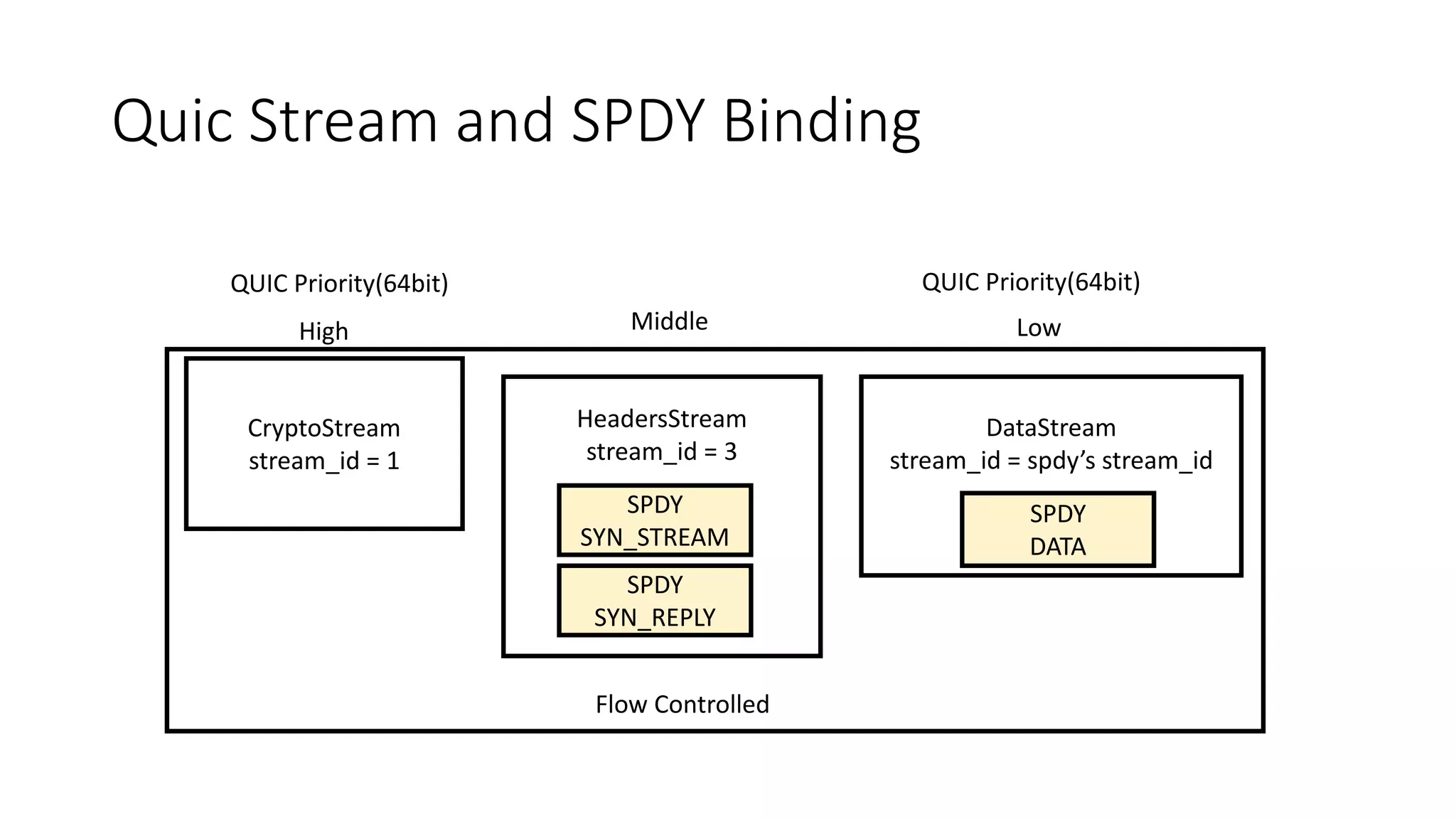
QuicStream and SPDY Binding 
CryptoStream 
stream_id= 1 
HeadersStream 
stream_id= 3 
SPDY 
SYN_REPLY 
SPDY 
SYN_STREAM 
DataStream 
stream_id= spdy’sstream_id 
SPDY 
DATA 
QUIC Priority(64bit) 
High 
Low 
Flow Controlled 
QUIC Priority(64bit) 
Middle
Congestion Control 
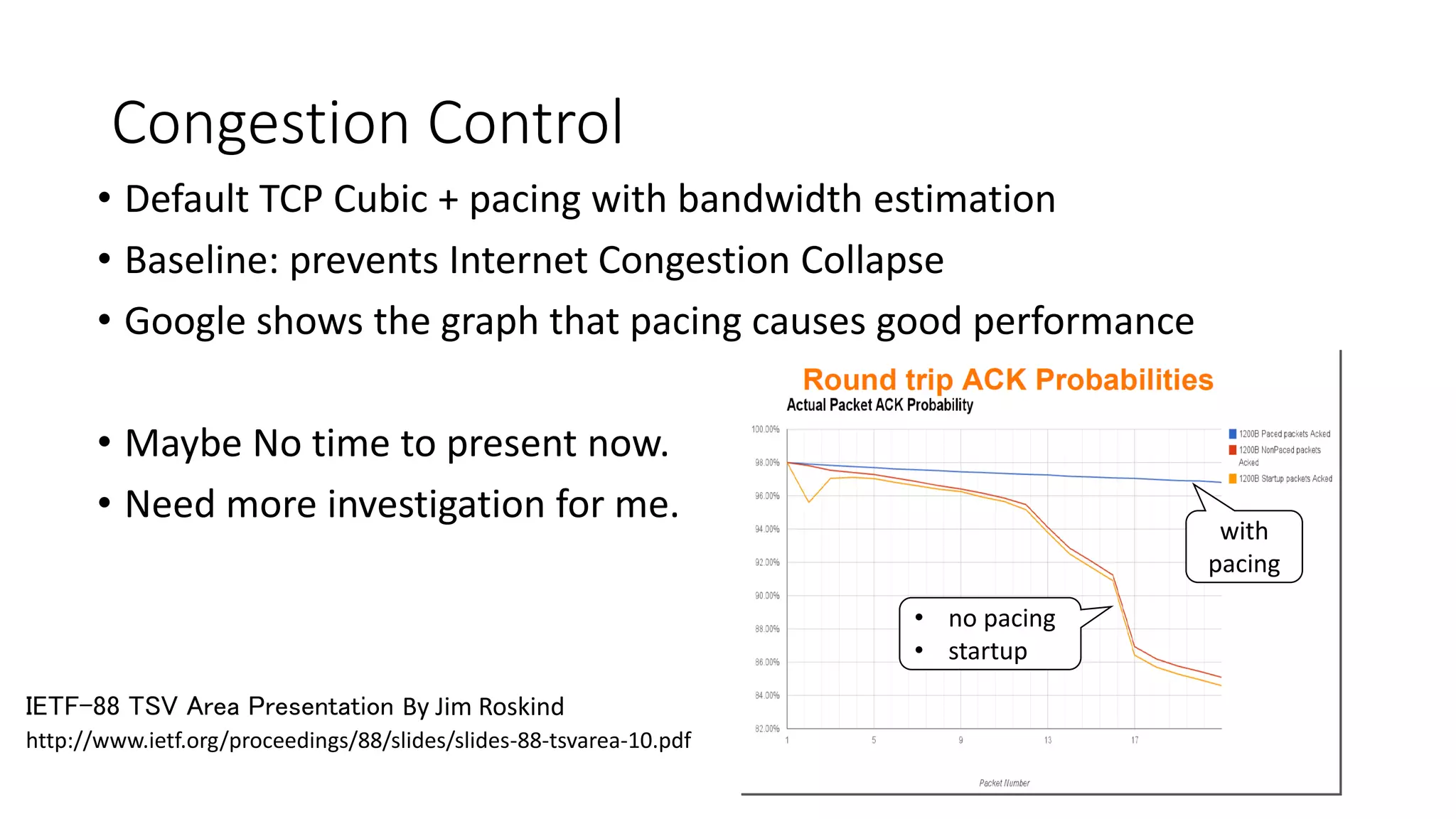
•Default TCP Cubic + pacing with bandwidth estimation 
•Baseline: prevents Internet Congestion Collapse 
•Google shows the graph that pacing causes good performance 
•Maybe No time to present now. 
•Need more investigationfor me. 
http://www.ietf.org/proceedings/88/slides/slides-88-tsvarea-10.pdf 
IETF-88 TSV Area Presentation By Jim Roskind 
with pacing 
•no pacing 
•startup
QUIC vs SPDY demo 
•https://www.youtube.com/watch?v=bP-8vfDX2ts
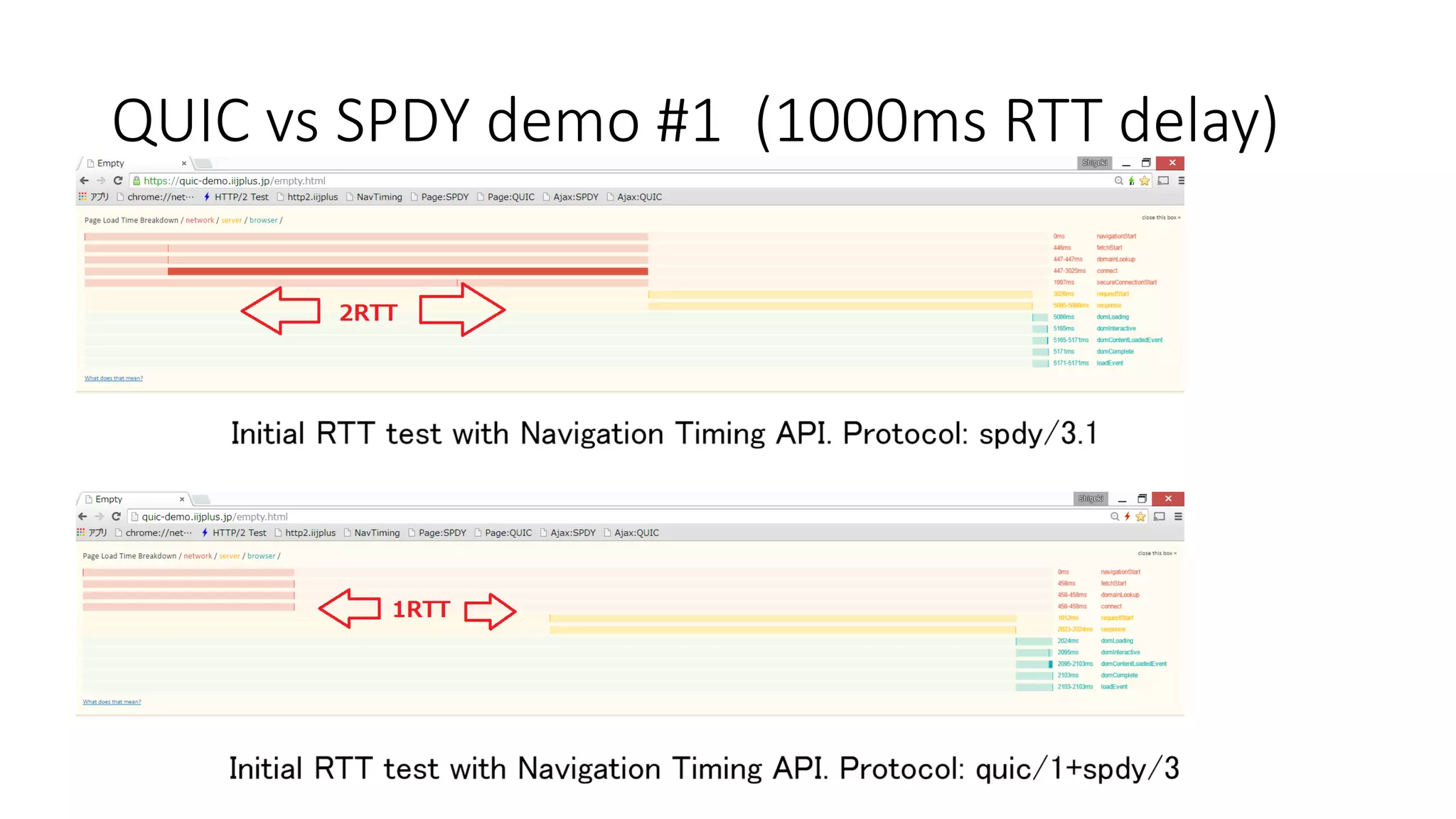
QUIC vs SPDY demo #1 (1000ms RTT delay)
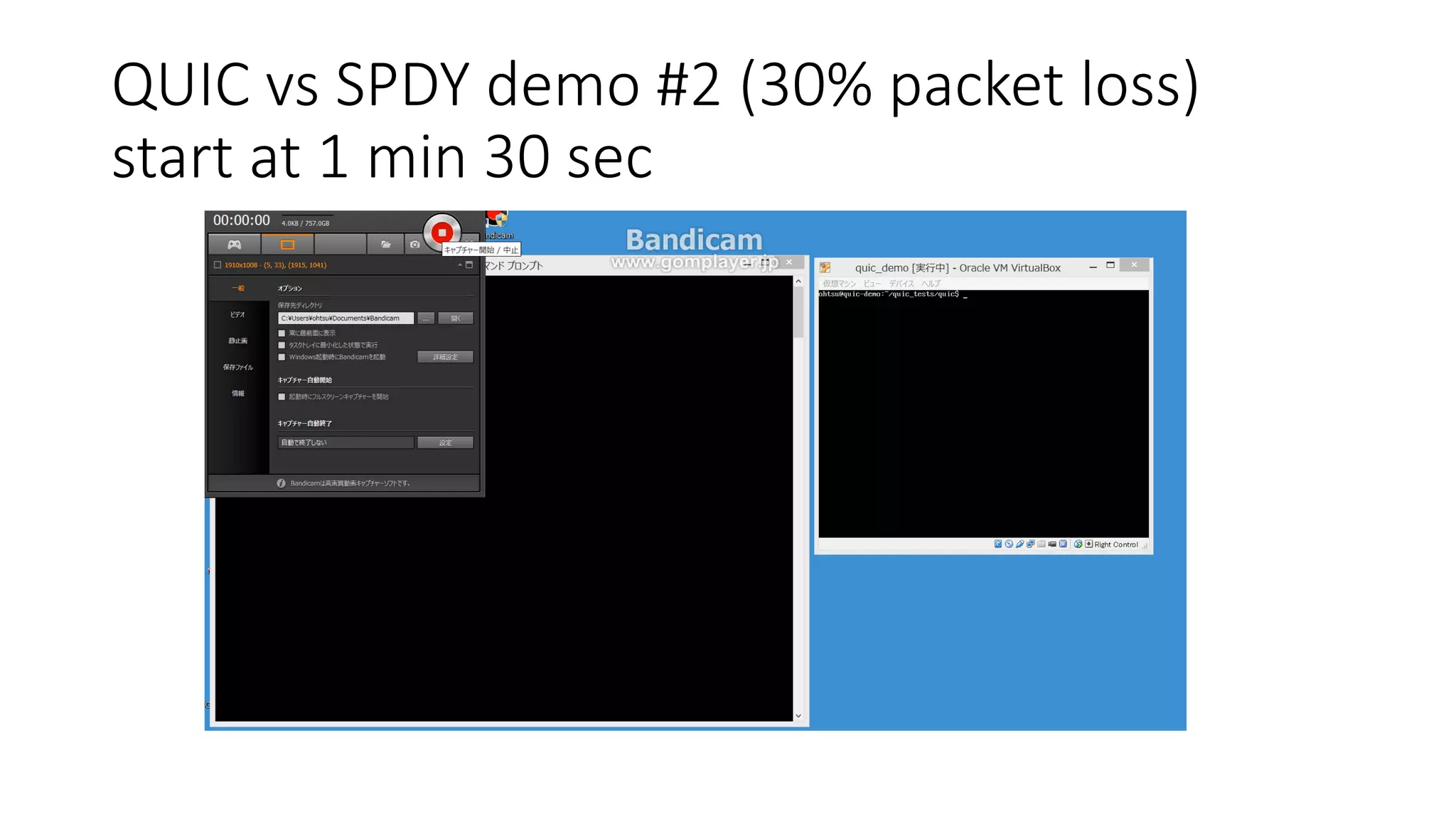
QUIC vs SPDY demo #2 (30% packet loss) start at 1 min 30 sec
Thanks

Technical Overview of QUIC

  • 1.
    QUICの話 Technical Overviewof QUIC 大津繁樹 Shigeki Ohtsu InternetInitiative Japan 2014 Nov. 3 HTTP/2 Conference Japan 2014
  • 2.
    CurrentIssues in TCP •TCP Head of Line Blocking. •Handshake cost by 3way handshake. •Small initcwndand slow start. •Large backoffcaused by packet loss. •Increase socket buffer. •NAT timeout and IP roaming •TCP Buffer Bloat TCP Fast Open initCWND10 TCP cubic Random packet drop in router TCP_NOT_SENT_LOWAT Need to upgrade OS on both end and middle box. It’s a long way.
  • 3.
    Current Issues inTLS •Handshake cost in TLS negotiation •Blocking in Change Cipher Spec •256bytes limit in ClientHelloby Load Balancer bug. •Server Certificate Chain gets large to send. •Renegotiation and Resumption is not optimized. LB Ballooning Extension TLS Ticket, Channel ID TLS False Start Need to upgrade TLS library on both end and middle box. It’s a long way, too.
  • 4.
    SPDY TCP HoLand TCP+TLS Handshake 5 4 3 1 missed 7 6 BLOCKED! TCP syn syn+ack ack ClientHello ServerHello Certificate Server Key Exchange Client Key Exchange Change Cipher Spec FInished Application Data TCP Handshake Change Cipher Spec Finished TLS Handshake SPDY SPDY SPDY SPDY SPDY SPDY
  • 5.
    QUIC(QuicUDP Internet Connections),MULTIPLEXED STREAM TRANSPORT OVER UDP= sophisticated TLS + TCP on UDP IP(IPv4/IPv6) UDP TCP TLS QUIC SPDY HTTP Encryption, Authentication Session Establishment, Flow Control Error Correction, Congestion Control
  • 6.
  • 7.
    HTTP on UPD.Really? http://www.ietf.org/proceedings/88/slides/slides-88-tsvarea-10.pdf IETF-88 TSV Area Presentation By Jim Roskind •91-94% of users can make outbound UDPto Google. ambient 1% rest of 20% IPv6 50% 60sec
  • 8.
    QUIC History •2012Oct: First Appeared in commit log •2013 Feb 25: First News in Tech Crunch. Known to the world. •2013 Jun. 27: Officially Announced in Chrome Blog(Experimenting with QUIC) Start serving QUIC on www.google.cometc. •2014 Aug. 29: Field Trial (Stable Channel: 0.2% desktop, 2% Android, Beta: 25% desktop, 50% Android) from net-devannouncement.
  • 9.
    QUIC Version History Date Version Date Version Topics 20131/18 QUIC1 20142/9 QUIC15 20137/26 QUIC7 20142/27 QUIC16 add STOP_WAITING 2013 8/9 QUIC8 2014 3/31 QUIC17 stream flow control (DATA) 2013 8/22 QUIC9 2014 4/28 QUIC18 add PING 2013 9/5 QUIC10 2014 5/17 QUIC19 connection flow control 2013 10/11 QUIC11 2014 6/20 QUIC20 2013 10/31 QUIC12 2014 7/2 QUIC21 Flow control(HEADERS, CRYPTO) 2013 12/20 QUIC13 2014 8/8 QUIC22 2014 2/6 QUIC14 2014 8/25 QUIC23 timestampin Ack, CONGESTION_FEEDBACK deprected AlmostMonthly VersionUP Q023 seems to be more stable than before
  • 10.
  • 11.
    QUIC Wire FrameFormat (Public Header) 0 1 2 3 4 5 6 7 8 9 0 1 2 3 4 5 6 7 8 9 0 1 2 3 4 5 6 7 8 9 0 1 public flag (1) connection id (0,1,4,8) version(0,1) sequencenum(1,4,6,8) Encrypted Payload byAEAD (Chcha20+Poly1395 or AES128+GCM12) ConnectionID (a.k.aGUID) is a 64bit random value to identify client connection. Even after client’s ipor port was changed, QUIC can handle connection. public header is protected by AEAD Crypto Stream(stream=1) is not Encrypted but protected FNV1a-128 hash(using lower 96bit)
  • 12.
    QUIC Public Flag(8bit) - - - - - - - 0 NONE VERSION - - - - - - - 1 RST - - - - - - 1 - - - - - 0 0 - - - - - - 0 1 - - - - - - 1 0 - - - - - - 1 1 - - - - 0 0 - - - - - - 0 1 - - - - - - 1 0 - - - - - - 1 1 - - - - 0BYTE_CONNECTION_ID 1BYTE_CONNECTION_ID 4BYTE_CONNECTION_ID 8BYTE_CONNECTION_ID 1BYTE_SEQUENCE 2BYTE_SEQUENCE 4BYTE_SEQUENCE 6BYTE_SEQUENCE Use 8byteConnection ID by default unless negotiated. Sequence Number is fixed 64bit. but it can be sent only 1byte on the wire. Version field is no longer needed after negotiation.
  • 13.
    Why 64bit seqnumcansend via 8bit length on the wire? next epoch epoch prevepoch last_seq_no+ 1 seq_noon wire seq_noon wire seq_noon wire Candidate#1 Candidate#2 Candidate#3 the real seqno is the nearest of last_seq_no+1 sequence number length (255) 0 ~ ~2^64-1 •Less than 256 frames on the fly. But their arrival is not ordered. •Endpoint should remember the last_seq_nothat was received lately. •Choisethe nearest number to last_seq_no+1 from the epoch number + received 8bit number. •If we received very old frame, it can’t be decrypted because seqis used in IV.
  • 14.
    QUIC Wire FrameFormat (Private) 0 1 2 3 4 5 6 7 8 9 0 1 2 3 4 5 6 7 8 9 0 1 2 3 4 5 6 7 8 9 0 1 public flag (1) connection id (0,1,4,8) version(0,1) sequencenum(1,4,6,8) private flag(1) FECoffset(0,1) frame_type(1) Frame Data Private Flag - - - - - - - 0 NONE ENTROPY - - - - - - - 1 FEC_GROUP - - - - - - 1 - - - - - - 1 - - FEC Random bit this frame is in FEC group FEC parity data is included
  • 15.
    Entropy hash todefense Optimistic Ack Attack 1byte entropy: entropy flag << seq number%8 1byte entropy hash = frame1_entropy XOR frame2_entropy XOR …. XOR frameN_entropy entropy hash is cleared when ACK is received ACK entropy_hash STOP_WAITING entropy_hash FRAME1 entropy_flag FRAME2 entropy_flag FRAME_N entropy_flag entropy_hash check ENTROPY - - - - - - - QUIC Private Flag 1bit entropy flag 0 or 1 Random entropy hashes are accumulated Entropy hash shows that this ACK is really replied by the server.
  • 16.
    FEC (Forward ErrorCollection) like a RAID in network packets (disabled on Chrome now) FEC Group FRAME_N fec_offset:n FRAME0 fec_offsest:0 FRAME FEC XOR Parity FRAME0~N FRAME1 fec_offsest:1 FRAME2 fec_offsest:2 FRAME_N fec_offset:n FRAME0 fec_offsest:0 FRAME FEC FRAME2 fec_offsest:2 FRAME1 fec_offsest:1 Missing! XOR FRAME_0 XOR FRAME_2~N XOR Parity FRAME0~N = Hi, I’m revived! No need to resend a missing frame!
  • 17.
    QUIC FrameType 1 0 0 0 0 0 0 0 StreamMask AckMask CongestionFeedbackMask 0 1 0 0 0 0 0 0 0 0 1 0 0 0 0 0 0 0 0 0 0 0 0 0 0: PADDING 0 0 0 0 0 0 0 1 1: RST_STREAM 0 0 0 0 0 0 1 0 2: CONNECTION_CLOSE 0 0 0 0 0 0 1 1 3: GOAWAY 0 0 0 0 0 1 0 0 4: WINDOW_UPDATE 0 0 0 0 0 1 0 1 5: BLOCKED 0 0 0 0 0 1 1 0 6: STOP_WAITING 0 0 0 0 0 1 1 1 7: PING (deprecated in Q022)
  • 18.
    Frame Type (Stream) 1 - - - - - - - StreamMask - - - - - - - - stream_id_length - - - - - - - - offset_length - - - - - - - - has_data_length - - - - - - - - FIN 0x00-0x03 (length: 1~4) 0x00-0x07 (length: 0, 2~8) whether data_lengthis appended or not
  • 19.
    QuicStream 0 1 2 3 4 5 6 7 8 9 0 1 2 3 4 5 6 7 8 9 0 1 2 3 4 5 6 7 8 9 0 1 public flag (1) connection id (0,1,4,8) version(0,1) sequencenum(1,4,6,8) private flag(1) FECoffset(0,1) frame_type(0x80~) stream_id(1,2,3,4) offset(0, 2,3,4,5,6,7,8) data length(0, 2) StreamDATA
  • 20.
    Crypt Functionality inQUIC •Encryption both http:// and https:// •Server Cert Proof is made on https://
  • 21.
    QuicCrypto Stream (stream_id=1) public flag (1) connection id (0,1,4,8) version(0,1) sequencenum(1,4,6,8) private flag(1) FECoffset(0,1) frame_type(0x80~) stream_id= 0x01 offset(0, 2~8) data length(0, 2) FNV1a-128 hash truncated higher 32bit (12) snipped Message Tag(4) Number of Entries(2) Padding(2) Tag#1(4) end_offset#1(4) Tag#2(4) end_offset#2(4) Value#1 Value#2
  • 22.
    QuicTag List (someof 60 total) Crypto Tag Meaning CHLO Client Hello SHLO Server Hello SCFG Server Config REJ Reject CETV Client encrypted tag-value pairs PRST Public Reset SCUP Server ConfigUpdate P256 ECDHCurve P-256 C255 ECDH Curve25519 NULL null algorithm AESG AES128 + GCM-12 CC12 ChaCha20+ Poly1305 STK SourceAddress Token timestamp client ip Random Encrypted by Sever with AES128 + GCM-12 STK(56byte) Default Default Key Exchange AEAD
  • 23.
    Example CHLO CHLO PAD : (607 bytes of padding) SNI : 0x717569632D64656D6F2E69696A706C75732E6A70 STK : 0x95ACC8F704031697A396019034133971C0C65868BBBB32306B2929930C12FA0BF5889191CD1CAC1B7AE2B7FF17AF1C2F4880BC11 VER : 'Q023' CCS : 0x399FF95340F7FEC97B26E9E7E45C71FF NONC: 0x5452D757288EE7AC8D6709DD289D0C6BA0723C74960E2F4F30814F64C48F436A MSPC: 100 AEAD: 'AESG' UAID: canary Chrome/40.0.2205.0 SCID: 0x83F4EA5D3EFD8BC21B829BA2BFDF304E SWND: 20 ICSL: 30 KATO: 0 PUBS: 0x65F638326982B96A6B7251AEF0A61B568A6EE5D34FDD7B2E3C46D9453B809F36 KEXS: 'C255' COPT: CGST: 'QBIC' IRTT: 957 CFCW: 10485760 IFCW: 10485760 SFCW: 10485760 Server Name Indicator Source Address Token Version Nonce Common Certificate Set Max streams per connection AEAD algorithm User Agent ID Server ConfigID Server’s Initial Congestion Window Idle connection state lifetime Keep alive Timeout Public Key Key Exchange methods Connection Option Congestion Control Feedback Type Estimated initial RTT in use Initial session/connection flow control receive window Initial stream flow control receive window Initial flow control receive window
  • 24.
    2-RTT (worst case) Client Server inchoate CHLO (VER, CCS, PDMD) REJ(STK, SNO, SCFG) inchoate CHLO(STK, SNO) REJ(STK, SNO, PROF, CRTx0ff) CHLO(STK, SNO, SCID) Encrypted Application Data Thank you, your Source Address Token is valid but no SCID. I give you my Certificate chain. I can’t trust your server cert with my chain. I send one more inchoate CHLO. I’m afraid you have no STK. I give you a Source Address Token and Server Config. It’s my first time so I send you an inchoate CHLO To avoid packet loss, I send 3 CHLOs at startup.
  • 25.
    1-RTT (normal) Client Server CHLO (STK, VER, CCS, PDMD, SCID) REJ(STK, SNO, SCFG) CHLO(STK, SNO, SCID) Encrypted Application Data I’ve got a new STK and SCID. I send a full CHLO. You STK is expired. I give you a new Source Address Token and Server Config. It’s been a long time since I connected you.
  • 26.
    0-RTT (repeated resumption) Client Server CHLO(STK, SNO, SCID) Encrypted Application Data I remember the server address token and sever config. It’s a repeated access in a short time. You have a right STK and SCID. So let’s begin to use the previous shared master secret.
  • 27.
    non Blocking duringCipher Secret Update Client Server Pleas Key Update! I don’t known when client update key. So I try decrypt frame with two (old and new) keys. SCUP(STK, SCFG{AEAD, SCID, OLD KEY PUBS, KEXS, OBIT, EXPY}) OLD KEY OLD KEY NEW KEY NEW KEY NEW KEY decrypter alternative decrypter
  • 28.
    Hashed Cert Chainand Compressed Server Cert CHLO(STK, …,CCS) CCS : 0x399FF95340F7FEC9 REJ(CRT, PROF) Client send FNV1a hash of local cert chain as CCS Server find missed Certs from CCS and send gzip compressed cert chain as CRT and signature as PROF Cert List + Hash Cached Cert List + Hash Cert List#1 + Hash Cert List#2 + Hash gzip compressed
  • 29.
  • 30.
    ACK Frame 0 1 2 3 4 5 6 7 8 9 0 1 2 3 4 5 6 7 8 9 0 1 2 3 4 5 6 7 8 9 0 1 public flag (1) connection id (0,1,4,8) version(0,1) sequencenum(1,4,6,8) private flag(1) frame_type(0x40~0x7f) entropy hash(1) Largest Observed LargestObserved Delta Time(2) numof received packet(1) delta largest observed#1 time delta#1 delta largest observed#2 time delta#2 delta largest observed#3 time delta#3 numof missing packet(1) missing packet seq#1 range length#1 missing packet seq#2 range length#2 missing packet seq#3 rangelength#3 numof revivedpackets(1) revivedpacket seq#1 revivedpacket seq#2 revivedpacket seq#3 revivedpacket seq#4 ACK conveys Largest Observed Seq, Packet Timestamp, Missing Packets and Revived Packets
  • 31.
    ACK flag 0 1 - - - - - - AckMask 0 1 - - - - - - Missing SequenceNumberLength 00: 1byte length 01: 2byte length 10: 4byte length 11: 6byte length 0 1 - - - - - - Largest Observed SequenceNumberLength 0 1 - - - - - - IsTruncated 0 1 - - - - - - HasNack
  • 32.
    Retransmit a lostframe as a new stream STREAM_FRAME ACK(largest_observed: 11, missing: [10]) Lost id=9 id=10 id=11 id=13 retransmit as id=10 id=12 id=10 was lost. retransmit it as a new stream(id=13) Non-Blocked! Retransmitted as a new stream
  • 33.
    QuicStream and SPDYBinding CryptoStream stream_id= 1 HeadersStream stream_id= 3 SPDY SYN_REPLY SPDY SYN_STREAM DataStream stream_id= spdy’sstream_id SPDY DATA QUIC Priority(64bit) High Low Flow Controlled QUIC Priority(64bit) Middle
  • 34.
    Congestion Control •DefaultTCP Cubic + pacing with bandwidth estimation •Baseline: prevents Internet Congestion Collapse •Google shows the graph that pacing causes good performance •Maybe No time to present now. •Need more investigationfor me. http://www.ietf.org/proceedings/88/slides/slides-88-tsvarea-10.pdf IETF-88 TSV Area Presentation By Jim Roskind with pacing •no pacing •startup
  • 35.
    QUIC vs SPDYdemo •https://www.youtube.com/watch?v=bP-8vfDX2ts
  • 36.
    QUIC vs SPDYdemo #1 (1000ms RTT delay)
  • 37.
    QUIC vs SPDYdemo #2 (30% packet loss) start at 1 min 30 sec
  • 38.